
Sicily, with its dark history, rough mountains, ravishing scenery, and Etna, that brooding snow-capped volcano that is never far from people’s thoughts, is one of the Mediterranean islands to which I am constantly drawn back. I go there for the known attractions and for the food, heavily influenced by the cuisine of the many nations that conquered the island, and for the Baroque towns that sprang up after the earthquake of 1693 that devastated the south-east of the island. All are beautiful, but the finest of them all is Noto, a town built of golden stone from a local quarry and a UNESCO World Heritage Site. After the earthquake, Giuseppe Lanza, Duke of Camastra, employed the best architects of the day to rebuild the city just south of the original town: the result is a triumph of urban planning and harmony.  Noto is in the province of Siracusa, itself a gem of a city and one that should not be rushed through as it has some of the most beautiful buildings in the area, plus the world famous Duomo in the Piazza of the same name, a sea-front with a wall just made for sitting on while you feast on a gelato. Noto lies about 35 kilometers southwest of Siracusa and is easily reached by local trains which run regularly.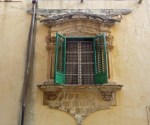
It was built almost entirely in the prevailing style at the time, Baroque, and these near-perfect buildings are what makes Noto so special and which earned it the title of UNESCO World Heritage site. 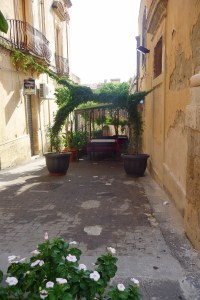
It is a very accessible town. You can wander the length of the graceful Corso, stopping here and there for a coffee and one of Noto’s famous cakes, or a gelato or freshly squeezed orange or lemon juice. Take a detour down the side streets and climb the steep steps to the top where the aristocrats lived, then come down to the next level which housed the clergy and other nobility, before arriving back at street level where the ordinary people lived. One of the best streets in which to wander is the Via Nicolaci, famous for its buttressed balconies held up with playful horses, griffons, cherubs and old men, incongruous on an otherwise severely classical façade.

Just at the top of Via Nicolaci is the beautiful elliptical façade of the Chiesa di Montevirgine. I didn’t have time to count them, let alone visit them, but I was assured that Noto has thirty-two churches. Think on that – thirty two churches.

So, what to visit when you are only there for a day visit. If time is short my advice is just to wander. Like Florence, the history of the town is in its buildings, their façades and the sense of life in the streets. The Cathedral rises impressively above Corso Vittorio Emmanuelle and is approached by a wide and graceful flight of steps and its simple interior 
may well come as a surprise in contrast to its exterior.
I had initially mistaken the flamboyant Chiesa di san Dominica for the Cathedral, flanked as it is by huge palm trees and looking more Middle East than Mediterranean. The Municipio (town hall) has an exuberant trompe l’oeil ceiling and a “magic mirror” which is just a mirror of illusion. My own favourite interior was the Vittorio Emmanuelle Theatre, still offering productions to its patrons, a fantasy theatre with red velvet and gilded boxes lining the walls echoed by heavy drapes curving round the proscenium arch. 
If you want to imagine what Italian towns looked like in the 17th century, then Noto should be on your list of towns to visit – it’s very special. 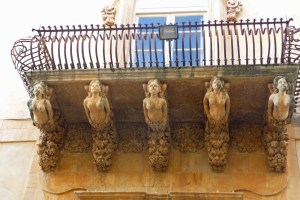



 MARI'S TRAVELS WITH HER CAMERA