Blog

  • VERONA:  A NIGHT AT THE OPERA

    VERONA: A NIGHT AT THE OPERA

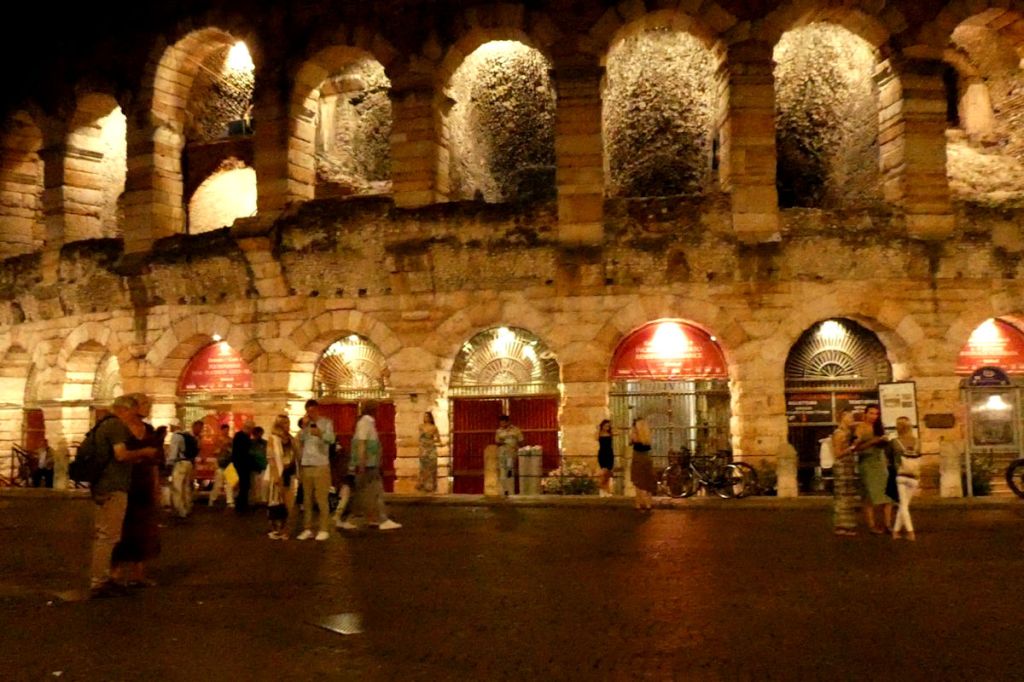
    Exterior of Arena

    We came, we saw and we were conquered. Not just by the city but by the by-product of that city, opera, for we were in Verona for the 100th Anniversary of the performance held in the ancient arena, an arena older than the Colosseum in Rome. In ancient times it held 30,000 people for its circuses and gladiatorial events but as the stage for opera performances decreases the available seating, it now has places for only 22,000.
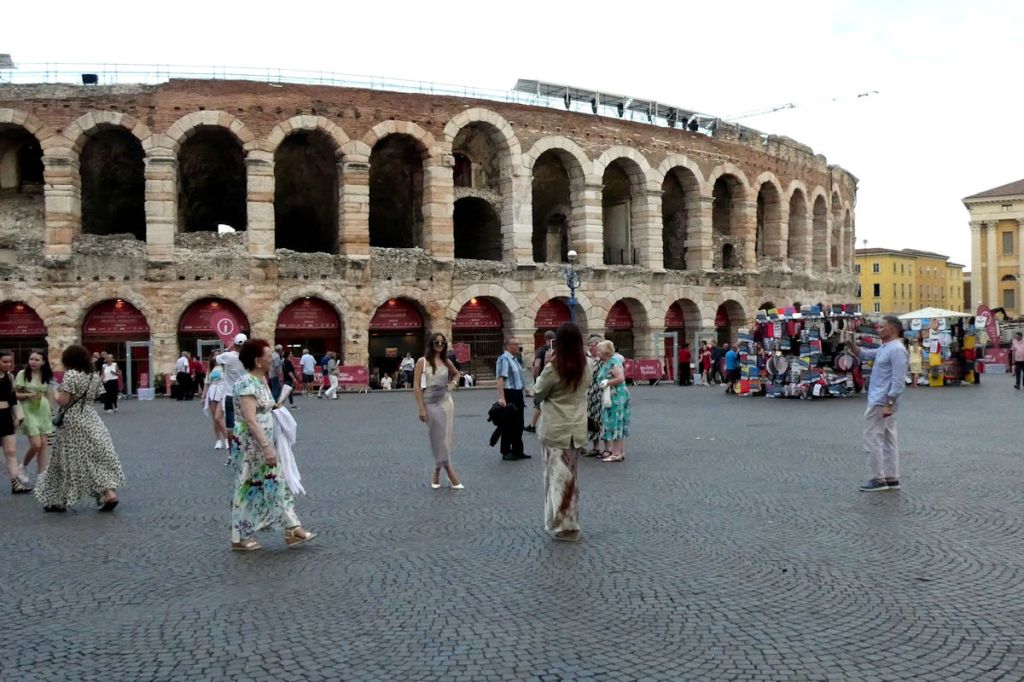
    Exterior of Arena early evening

    We came to Verona, my friend Jane and I, for Giuseppe Verdi’s Aida, the signature opera of the city. Although there had been some productions during the 1850s, it wasn’t until 1913 that opera began in earnest in the Arena, due to the zeal of the famous Italian tenor Giovanni Zenatello and the impresario Ottono Royato. The first opera to be produced in the arena on 10th August 1913 to mark the centenary of Verdi’s birth in 1813, was Aida, and since then, Aida opens the yearly festival of opera.

    The moon has appeared as the audience awaits the evening’s performance

    As dusk settled over the amphitheatre and a pale moon floated in the velvety blue sky above, anticipation was high. We’d watched the stage-hands sweep the tiered stage, watched the lighting engineers fiddle with the lamps, and wondered at the meaning of the objects that decorated the set, crystal pyramids, giant hands, and lighting designs which, although technologically modern, blended easily into the ancient Roman amphitheatre. Later I read that the giant white hands that dominated the stage represented power.

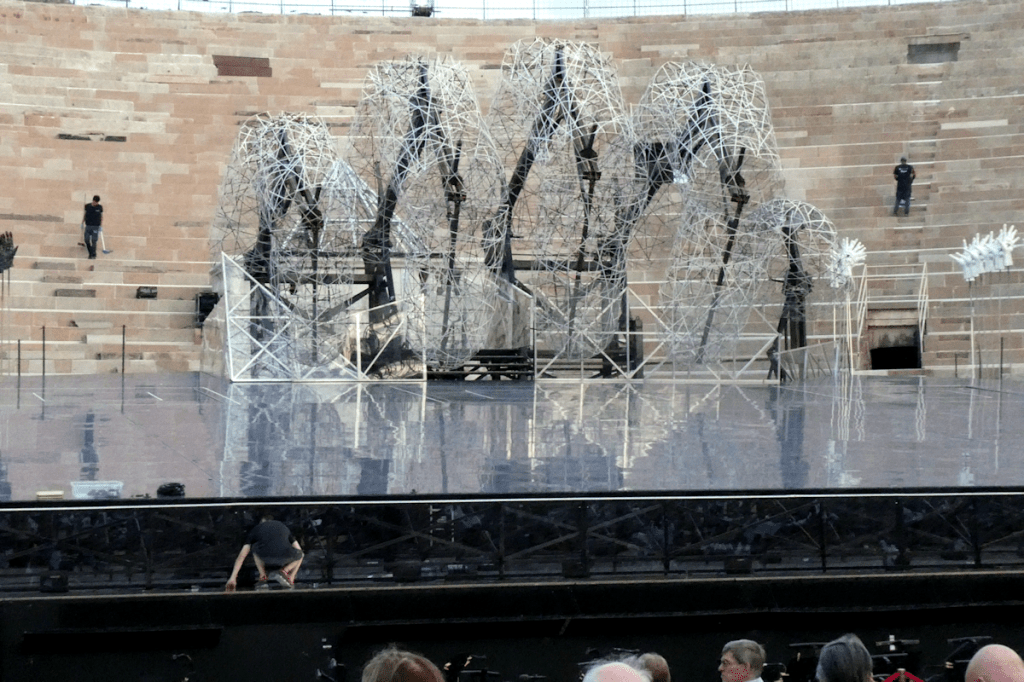
    The arena was full, from the front padded seats to the tier upon tier of stone seats (no back rests but with hired cushions for comfort), and the audience milled around taking photographs, chatting in groups and in Italian fashion, jumping over seats to shake hands with old friends before the performance began at 9.30 pm. It was an audience as enthusiastic as any I’d ever seen – and noisier than most.

    Then suddenly the orchestra was filing on to rapturous applause and the opera was about to begin.

    There was a hush as Alexander Vinogradov as Ramfis began singing, a hush that continued throughout the First Act and every subsequent Act. I have never, ever, known an audience be so quiet, enraptured even, so receptive of the story being told in voice and music from the stage, so totally engrossed in what was happening in front of them.

    I can’t even begin to guess how wide the stage was: one’s eye just couldn’t take it all in at once, yet somehow, the war-stricken world of Aida materialised in an intimate setting on the vast arena stage, as over 300 performers – soloists, chorus members, dancers and mimes – cast their spell. Their costumes were inspired by Paco Rabanne and Capucci, silver robes and helmets radiating brilliance across the expanse of the tiered stage.

    The gigantic wire hands which towered over the stage and had puzzled us when we first saw them now moved menacingly or soothingly as the music and the story demanded. Stefano Podo’s avant-garde production included LED-laser lights that formed shapes and changed colours from red to blue to green, to great effect, plus impressive lighting effects at the back of the arena as actors brandished what looked like light rods used to great effect during the judgment scene.

    And as for the Arena itself! Built in AD30 out of white and pink Valpolicella limestone (a few repairs since then), the arena has perfect acoustics (amplification was only brought in in 2011). In its heyday it hosted gladiatorial fights and blood sports, horse races and medieval jousts but nowadays the crowds come not for blood and gore in the sand but to be transported to another realm by the beauty of the human voice.

    I’m failing as a writer here because I can’t describe what the experience of seeing and hearing the opera was like; it was a spectacle that needed to be seen in order to understand the power it had. I had been to the Arena years ago when the stage effects for Aida included ancient Egyptian scenes to rival those of Cairo. We were younger then, my husband and I, and we sat on the stone seats way, way up on the terraces. The excitement of opera under the stars past midnight (it starts about 9.30 pm and finishes, usually, around 2.00 or 2.30 am) – meant that I wasn’t aware of any discomfort.

    But the 2023 100th Anniversary Performance was even better, it was uncomplicatedly magical. Possibly helped by the fact that age now demands a padded seat and some space so we had expensive seats front centre (still nearly half what a similar seat would cost at Covent Garden). I would recommend paying that bit extra for the comfort if you are aged from 30 upwards!

    Just across from the Arena after the performance

    And then jostling for seating at the café opposite the Arena with others who’d shared the experience, sipping a glass of wine at 2.30 am when the heat from the ochre-coloured stones was still intense, not wanting to go back to the hotel, and feeling part of something great and grand was somehow life-affirming.

    Was it the settings? The music? The atmosphere? Maybe some of the silver dust drifted from the costumes and covered us with its magic? I don’t want to be a third-rate critic so I’ve found a clip on You Tube with a selection of scenes from the performance in Verona and if there are any opera fans among you, you might like to take a look and enjoy what we enjoyed.

    Factfile:
    Purchase tickets directly online, at www.arena.it/buy. You can check the availability of seats by consulting the seating plan, which can be found on each performance date. You will be asked to give a password so have one ready. If you want to book by phone, call +39 0458005151 Monday to Saturday 9 am to 6 pm.

    British Airways flies direct to Verona.
  • My Year in Books (2022)

    My Year in Books (2022)

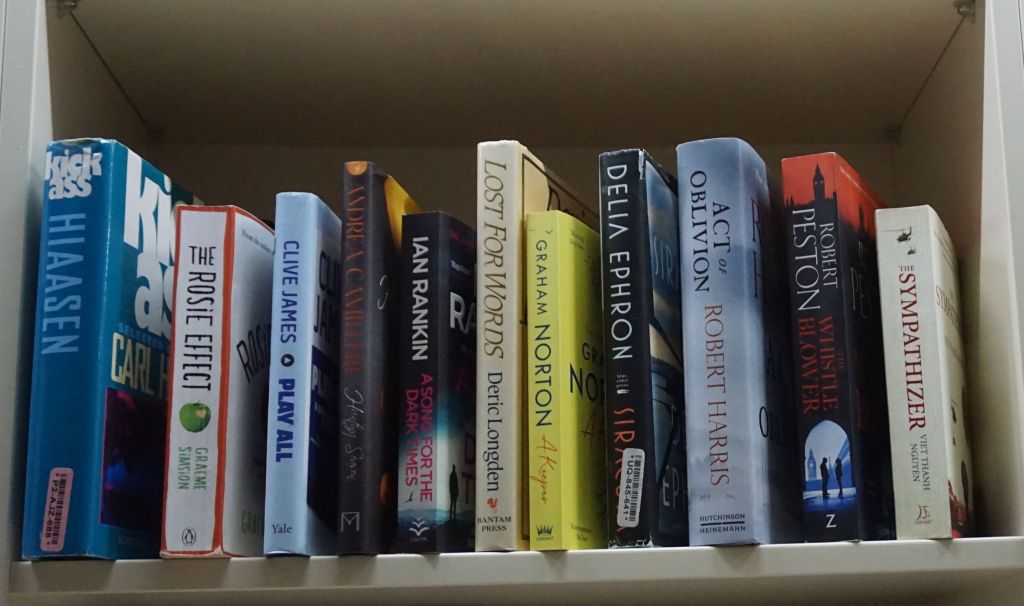
    I thought I’d better try and post something before the year ends and then up popped Cathy at 746 books with her meme My Year in Books. I can never resist a quiz or a challenge, so I looked through some of the books I’d read this year and answered her prompts. Here is the result.

    In high school I was Lost for Words (Deric Longden).

    People might be surprised by Siracusa (Delia Ephron).

    I will never be The Whistleblower (Robert Preston).

    My life post-lockdown was Act of Oblivion (Robert Harris)

    My fantasy job is The Assassination of Margaret Thatcher (Hilary Mantel)

    At the end of a long day, I need The Rosie Effect (Graeme Simsion)

    I hate being A Keeper (Graham Norton)

    I wish I had A Song for Dark Times (Ian Rankin)

    My family reunions are Play All (Clive James)

    At a party you’d find me with The Sympathizer (Viet Thanh Nguen)

     I’ve never been to The Salt Path (Raynor Winn)

     A happy day includes House of Fun (Simon Hoggart)

    Motto I live by:  Kick Ass (Carl Hiassen)

    On my bucket list is Hunting Season (Andrea Camilleri)

    In my next life, I want to have Nada (Carmen Laforet)

    If you feel like joining in, just do your own list from the prompts and let Cathy know.

  • Sculpture Saturday

    Sleeping Child by By Håkon Anton Fagerås.

    This sculpture of a sleeping child is said to symbolize Norwegian optimism, survivability, and future life.

    The design incorporates a separate pedestal, a rock from Hiroshima’s ground zero given earlier to Narvik by the mayor of Hiroshima. One of three peace sculptures in Narvik it was dedicated in 1956, 1995 and 2006 to remember the atomic bomb that was dropped on Hiroshima.

  • BABY ELEPHANTS ARE GORGEOUS

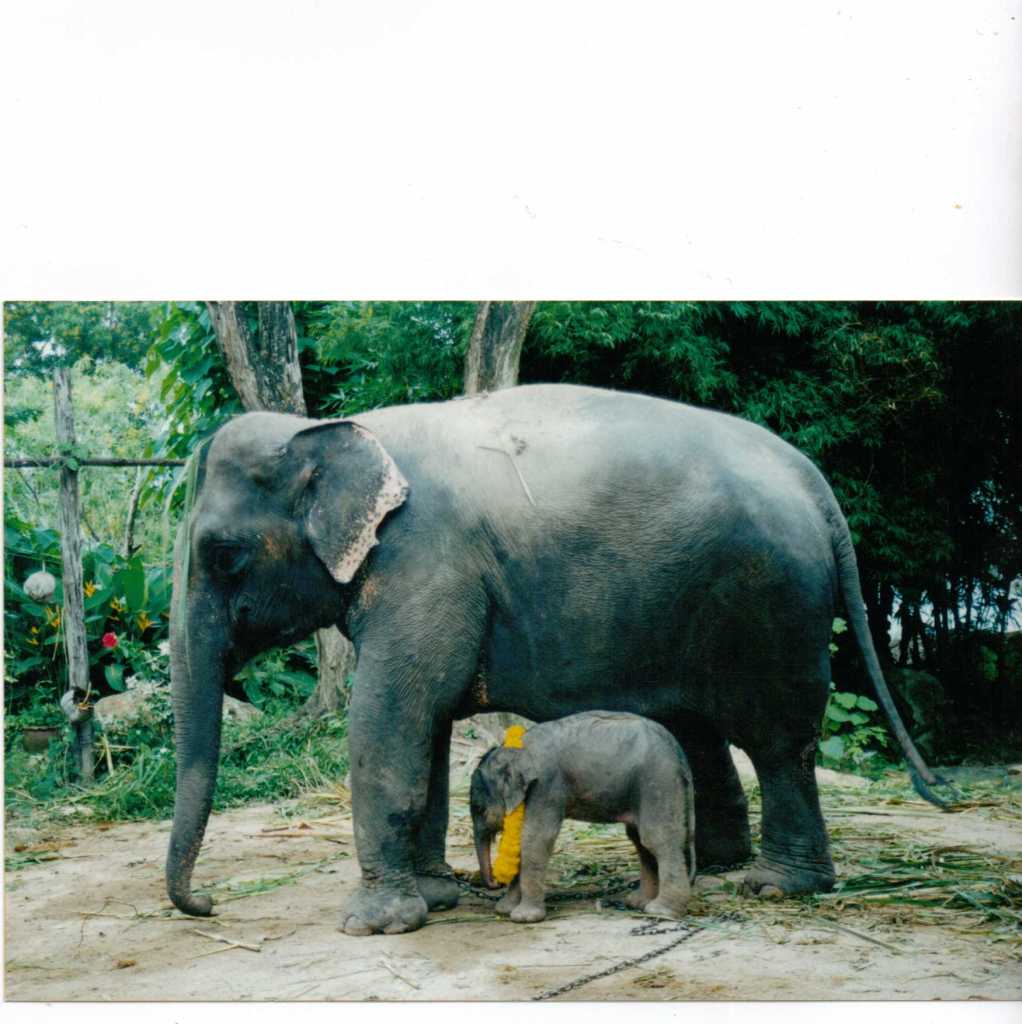
    Just a day or two old

    I was going to keep this one for mother’s day but I realised I’d forget all about it by next year so I thought it best to post it now.

    It’s one I took when I was doing some work with the Elephant Help Clinic in Phuket many years ago. The baby elephant is wearing a lei because she’d just been blessed by the monks from the nearby temple.

  • Another fine mess I’ve got me Into

    Intrigued by the recent email from WP I thought I’d have a look at the new themes they are offering. I shouldn’t have!

    I seem to remember that in earlier days I could activate a theme to see how it would look on my current site but this didn’t happen. Instead clicking ‘Activate’ meant that I accepted the site – and of course, I didn’t like it – but I couldn’t remember the name of my old site, nor could I find it again.

    Many changes of site and I’m still befuddled, left with a site that has caused me to swear and shout at the screen. It actually transported a page from the site I’d tried earlier (but with that page’s wording etc. not fitting with my content) and I had to delete the pictures and text block by block and then save the blank page!

    For tonight I’ll leave it and I maybe able to get back to it tomorrow but if not, you’ll know why my site looks odder than usual.

    It’s probably all my fault. I should leave well alone, but it’s like touching the surface when it says Wet Paint – Do Not Touch, I just can’t resist clicking to see what is hiding behind the italics!

  • Another Trio

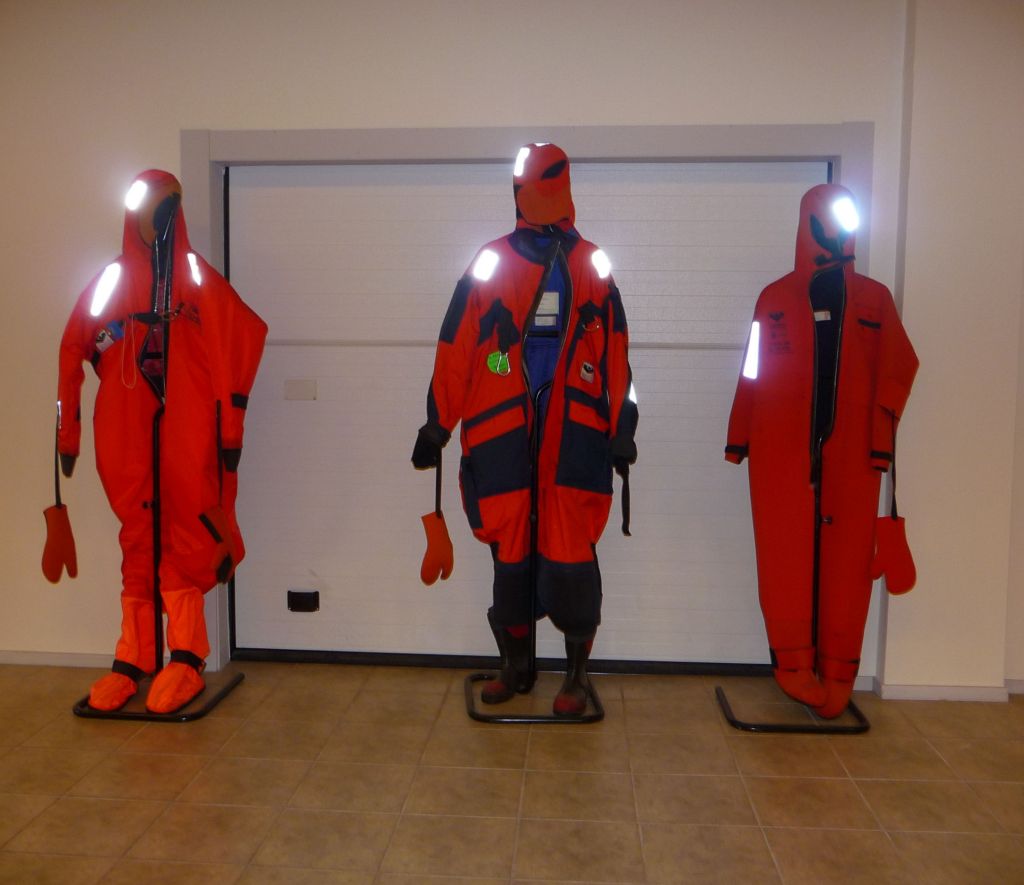
    Something a bit unusual I think, for Mama Cormier’s Thursday Trios.

    These are total immersion suits that will keep you alive for at least 6 hours in freezing water. I photographed these some years ago when I visited the workshop of Survitec in Sweden. Survitec is the worldwide group that manufactures and maintains rescue craft for ships, planes, oil rigs and container ships, as well as the above survival suits. Chances are that whatever cruise line or airline you are travelling on, its life rafts will be serviced and supplied by Survitec.

    It’s something we take for granted, but I saw at first hand how important it is for this safety equipment to be in perfect order and how thorough the inspection is – right down to the medicines for pain, the batteries for the torches, and the bottled water, carried on board. So, a big clap for SURVITEC for keeping us safe, in the air and on the sea, and for the engineers and mechanics who test everything in freezing waters.

    Join Mama Cormier’s Thursday Trios HERE

  • The Godfather in Savoca

    The Godfather in Savoca

    Al Pacino

    Excitement is high among fans of The Godfather trilogy, with the release of the newly re-mastered films, three movies that are Shakespearean in drama, operatic, and complex. As one of those fans I delved into my archives to search for photographs I took in Savoca, location of a few major scenes of The Godfather, and a reminder of one of those serendipitous moments that occur from time to time in one’s travels.

    A shady spot at the Bar Vitelli

    It was in Sicily, about 30 years ago, when we came across Savoca, a medieval village perched on a hill overlooking the Ionian coast. We had driven through the mountains from Taormina, stopping here and there to admire villages clinging to the sides of the mountains and blue seas far below on which floated toy boats. We pulled into Piazza Fossia, saw a parking place opposite a pleasant looking bar with terrace which meant we could sit outside rather than in the inky black interiors preferred by the Sicilians, and entered Bar Vitelli.

    The Bar Vitelli

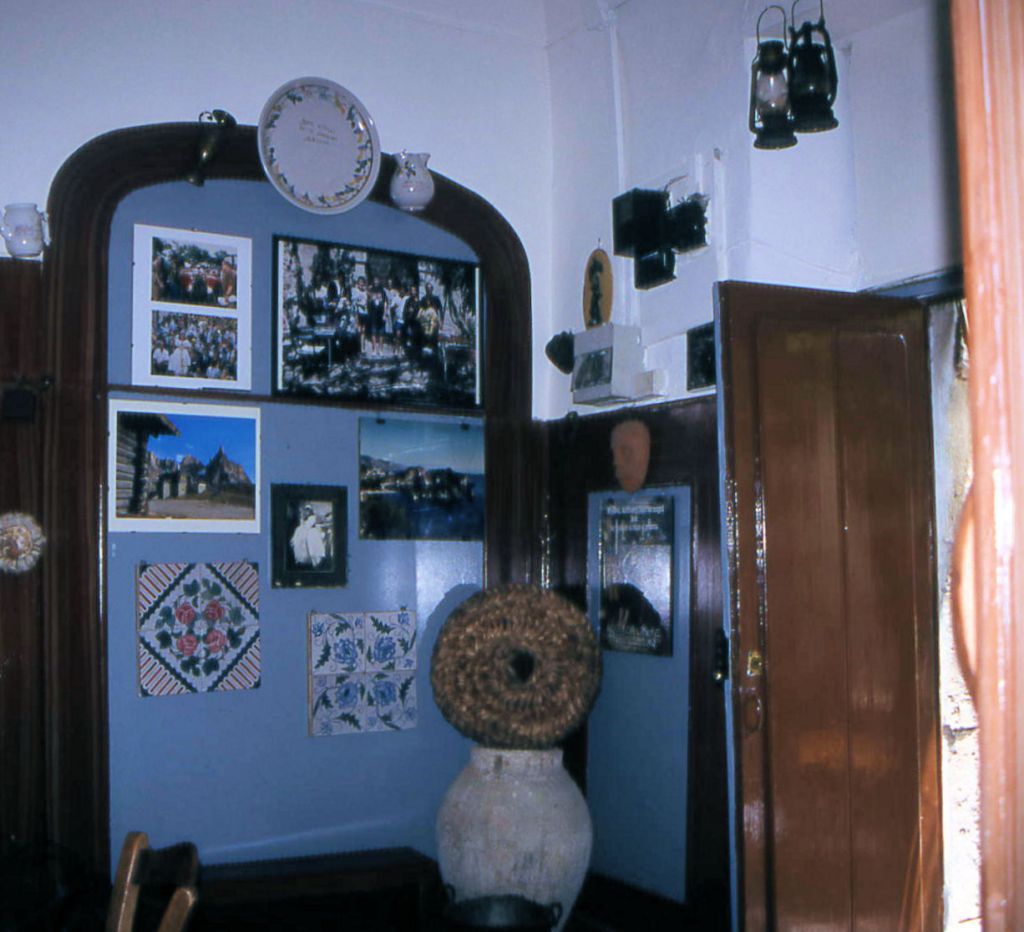
    We ordered drinks, and the owner graciously waved me inside to see what else was available.  What she really wanted me to see was her wall of photographs of the stars of The Godfather and various artifacts to do with the film.  Most were of Marlon Brando – although he was never in Savoca for filming – Al Pacino, Simonetta Stefanelli, who played Apollonia in the film, and James Caan. 

    Then I made the connection.  This was the small, cliff-side café where Michael Corleone (Al Pacino) sat with his two bodyguards (one of whom would later betray him) and drank wine. In fact, this small patio with the dappled sunlight playing on the tables, was the location of several scenes filmed over a six-week period during the shooting of the first Godfather movie. 

    Michael Corleone (Al Pacino) had fled New York City to escape both police and the Mafia and came to Sicily to take refuge. Out hunting one day, he saw a beautiful Sicilian girl and immediately fell in love with her.

    Back room of Bar Vitelli with photographs and connections to The Godfather

    The Bar Vitelli, as it is now, was actually the home of the beautiful young girl he’d seen, and it is here he asks the café owner for permission to court his daughter, the lovely Apollonia (Simonetta Stefanelli). A later scene, depicting a traditional Italian family Sunday dinner and a still later scene of the eventual outdoor wedding reception, was also staged on the terrace of the Bar Vitelli and in the tiny piazza in front.

    La Signora watched me carefully and when she could see that I was suitably impressed with the display she sat me down and told me tales of what it was like when she had Pacino and Brando in her café.  Of course, I knew that Brando had never been there but everyone’s allowed a little bit of licence and in that small village of less than 100 inhabitants, The Godfather had sprinkled a little bit of its magic on both the village and the Bar Vitelli. 

    La Signora sits outside Bar Vitelli.

    Savoca owes it’s connection to Hollywood to the fact that Francis Ford Coppola thought that Corleone, a town near Palermo and the book’s setting for The Godfather, looked too modern for his vision of the Sicilian village from which the family came. After much searching throughout the island, he found two small villages untouched by modernisation for his locations, – Savoca and Forza d’Agro.

    At the time we were there, few tourists visited this remote village so La Signora was happy to spend time talking to us and showing us some more pictures of the stars of The Godfather, plus some newspaper cuttings she’d collected.

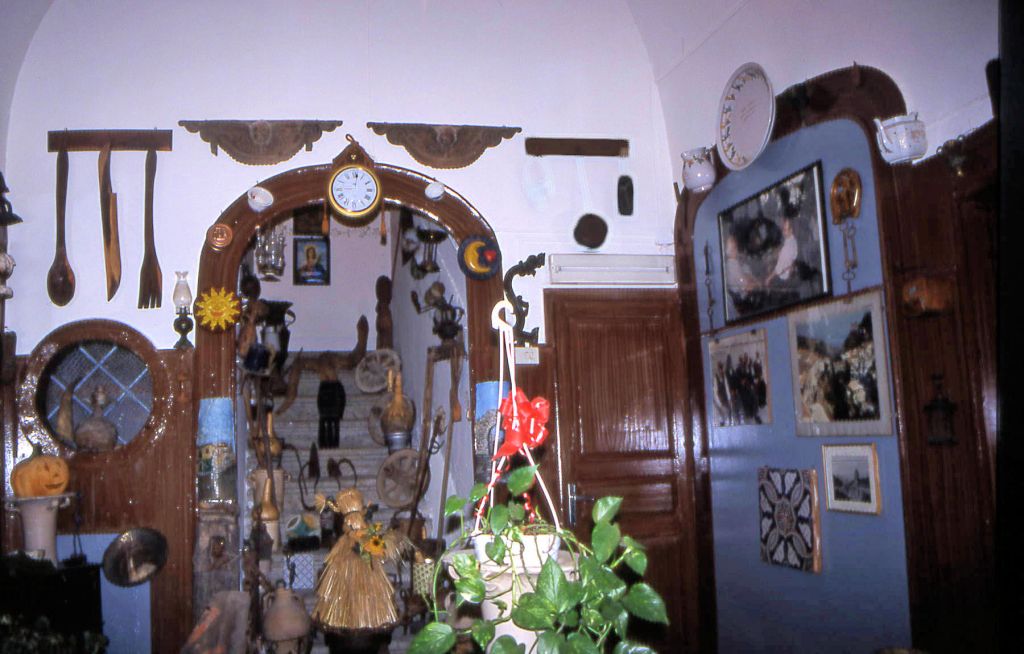
    Back room of Bar Vitelli

    I never got back to Bar Vitelli but I saw a short film a while back that showed it looking exactly as it had been when I visited, and as it was in the film – right down to the bead curtain in the doorway.  La Signora is no longer alive and the bar/restaurant is now successfully run by her descendants: Godfather tours (along with Montelbano tours) are now big business in Sicily, and Savoca is a port of call on the trail. 

    It was nice to know that it hadn’t been commercialised at all and that the stone-flagged walls covered in greenery and the terrace with vine covered pergolas, still offer shade to travellers, along with coffee granita, supposedly the favourite drink of both Pacino and Coppola when they were there.

    When I watch the 3-hour long film again on March 26th, I will be carried back 30 years to when I sat on Al Pacino’s chair in Bar Vitelli and heard first-hand from la Signora that, although Pacino may have come from New York, he was molto Siciliano.

    This was the prettiest house we saw in Savoca, and we were told it belonged to someone very important. I wonder who it belongs to today?

    1.  In Savoca, apart from Bar Vitelli, the nearby Church of San Nicola was used as a location for the wedding of Michael Corleone and Apollonia. The church is only a short walk from Bar Vitelli.
    2. Bar Vitelli is housed in the 18th century Palazzo Trimarchi, located in the Piazza Fossia, the town’s main square, near the Town Hall.

    The Godfather:

    The Godfather revolutionized film-making, saved Paramount Pictures from Bankruptcy, minted a new generation of movie stars, and made the author of the book, Mario Puzo, rich and famous.  It is compelling, dramatic, and complex and it started a war between Hollywood and the high echelons of the Mob as the makers had to contend with the real-life members of the Mafia.  Location permits were withdrawn without notice at inconvenient times, Al Ruddy’s car was found riddled with bullets, and ‘connected’ men insisted on being in the cast (some were given film roles, whether due to threats or talent nobody knows)!

  • Action- One Word Sunday

    Action- One Word Sunday

    This week’s theme from Debbie is ACTION. Linked to Debbie’s here

    Ready to hurtle down the slope on the famous basket ride in Funchal, Madeira

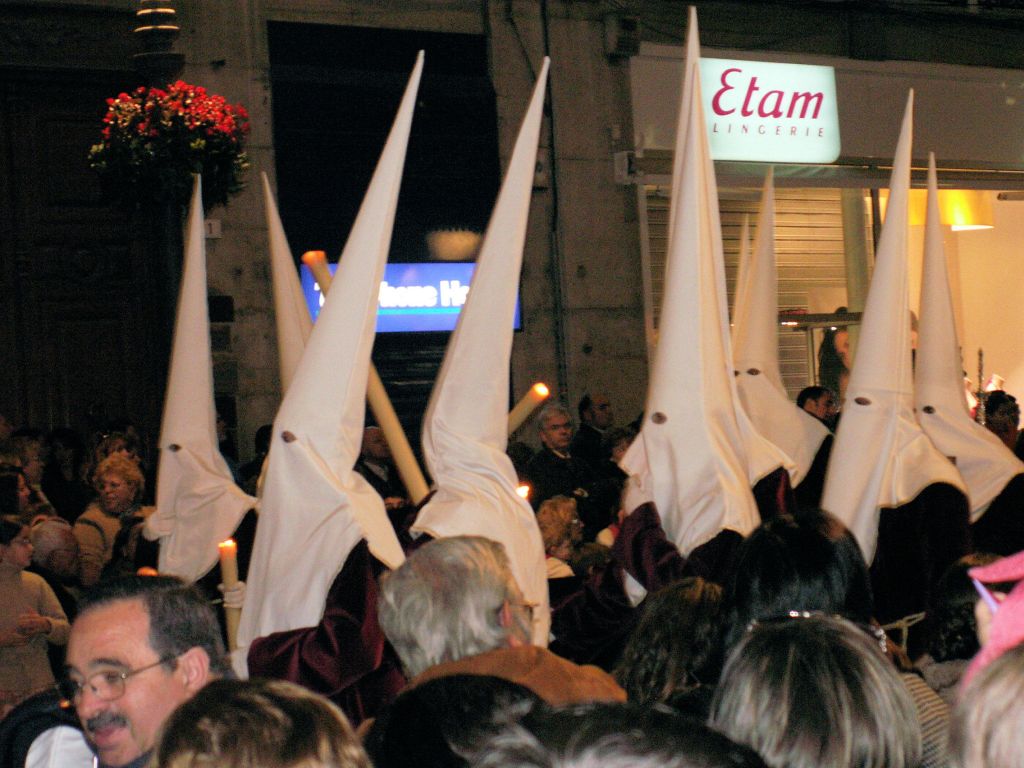
    Is praying action? Not the Klu Klux Klan but Penitents during Holy Week in Malaga.

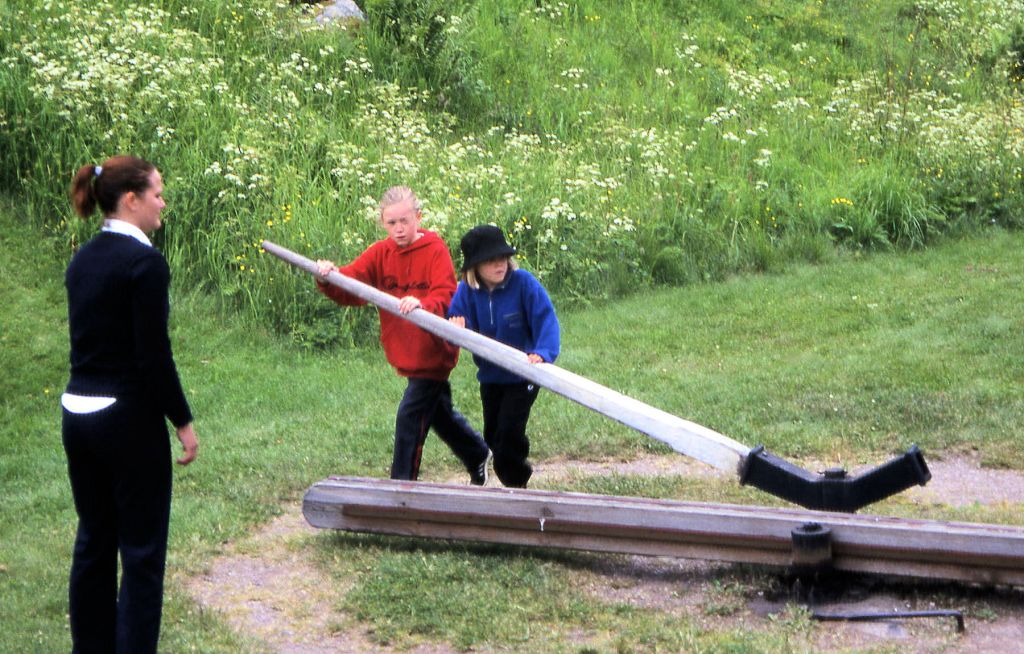
    The lock-keeper’s daughters open a lock on the Gota Canal, Sweden

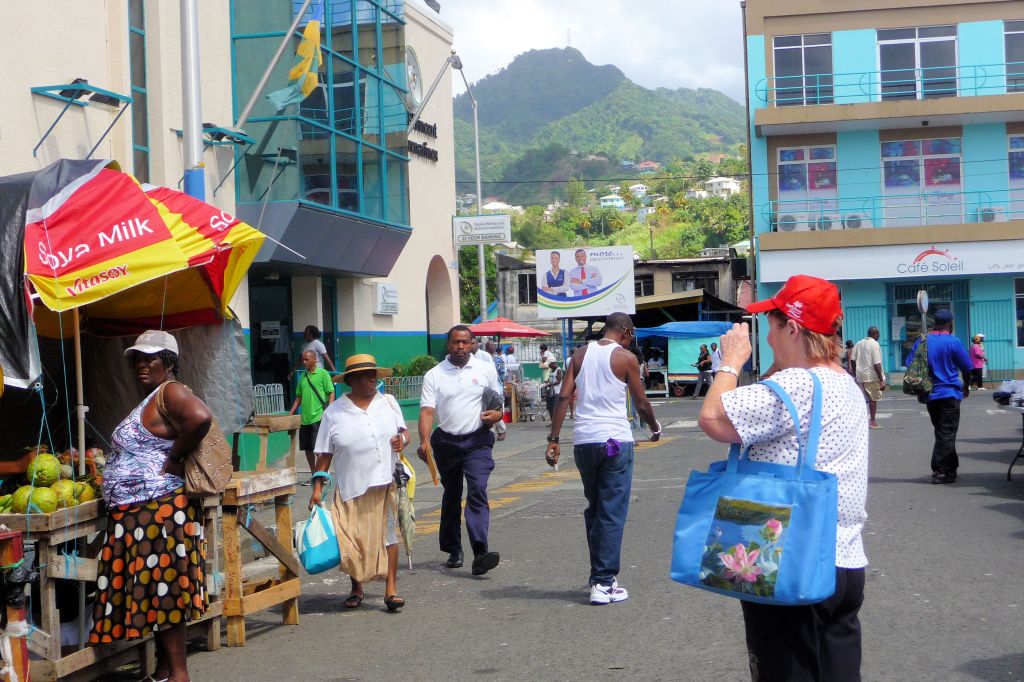
    Camera, Action. A tourist takes a photograph in Grenada, Caribbean.

  • Silent Sunday

    Somewhere, it’s going to be a beautiful day, so hush, it’s Sunday.

  • Saturday Sulpture:

    Outside the Caen-Normandie Museum of WWll in Caen, France.

    That joyful moment in 1945.

    Based on a photograph by Alfred Eisenstaedt which appeared in an issue of Life magazine in 1945, this sculpture has been much criticised by women’s rights groups since it was erected at the city-owned Mémorial de Caen. The French group, Osez le Féminisme, said at the time “we cannot accept that the Mémorial de Caen holds up a sexual assault as a symbol of peace,” but the city-owned Memorial de Caen refused to take it down. They based their objection on the fact that the sailor had been observed kissing ‘all he met, young and old’.

    There are many copies of this sculpture (by Seward Johnson) in other parts of the world.

  • Silent  Sunday

    Silent Sunday

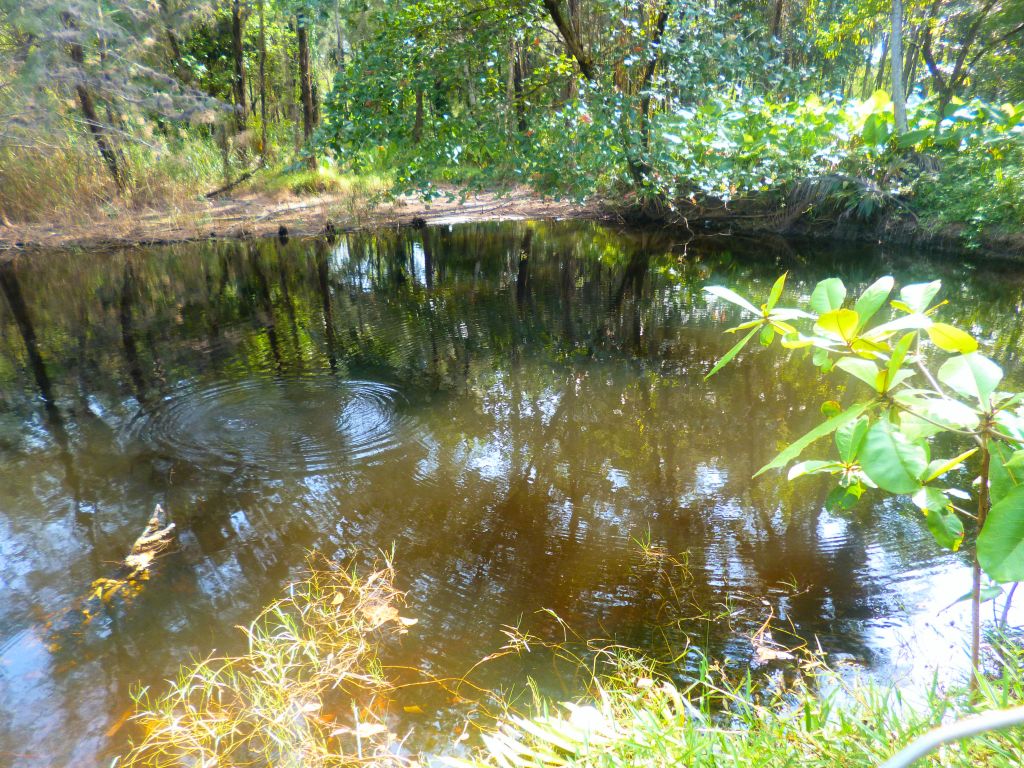
    It was a silent Sunday until something stirred in the water: a fish, an insect, a thing from the deep? Whatever it was, it caused a ring of ripples in the water.

  • Life im Colour: White/Silver

    Life im Colour: White/Silver

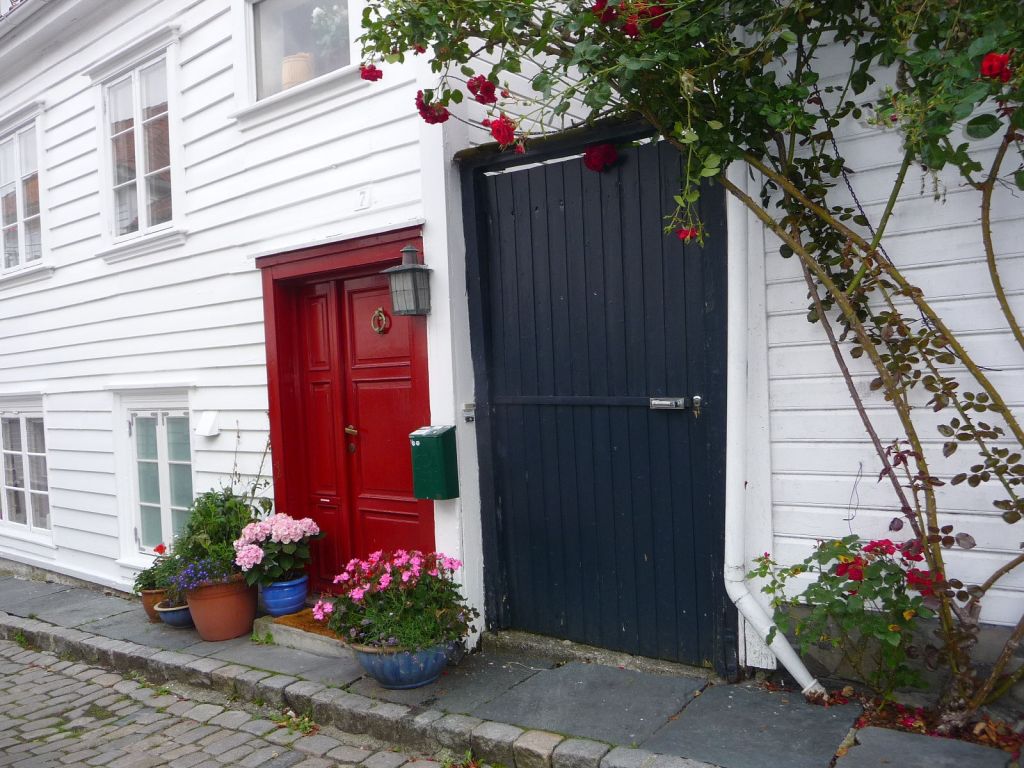
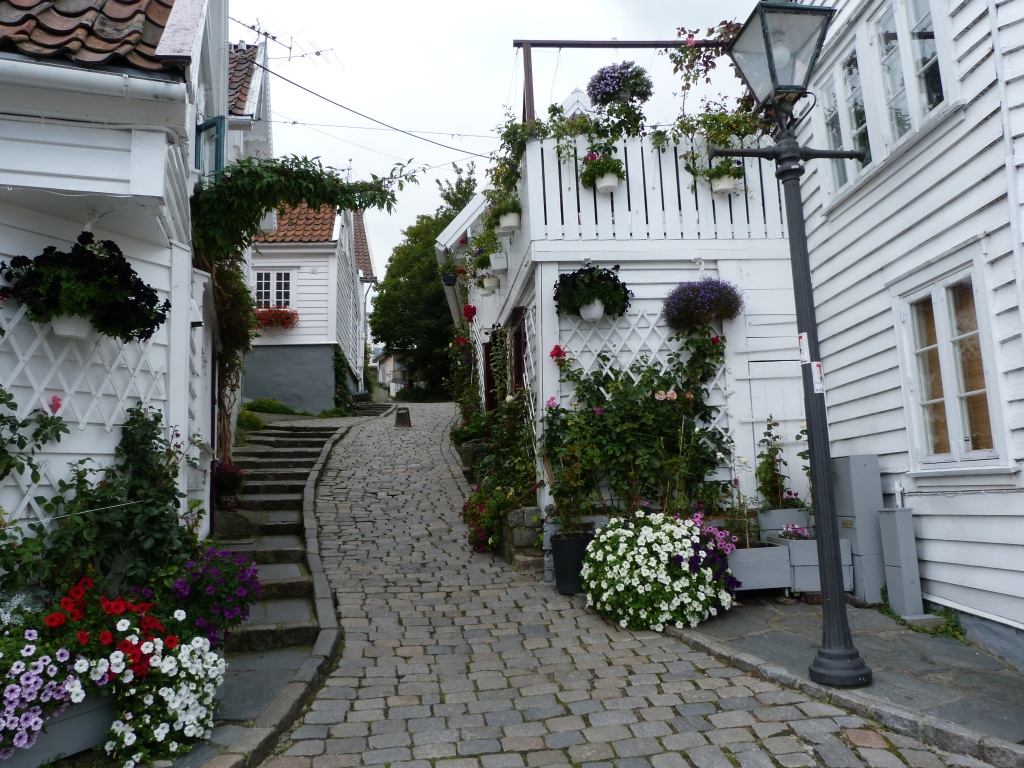
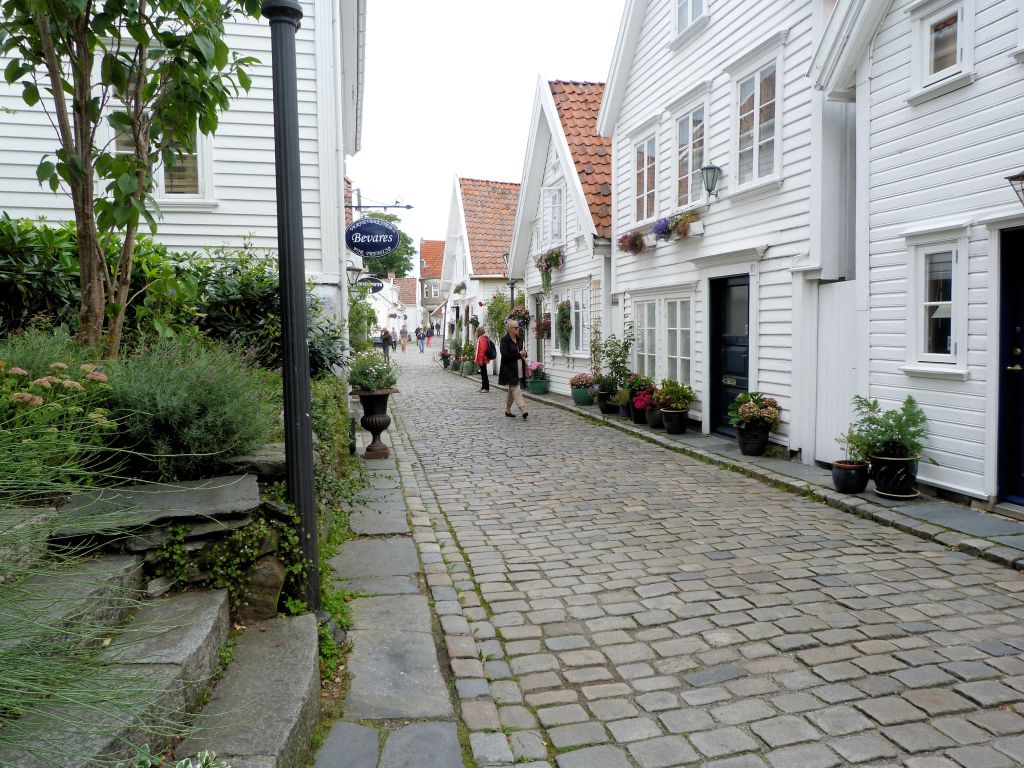
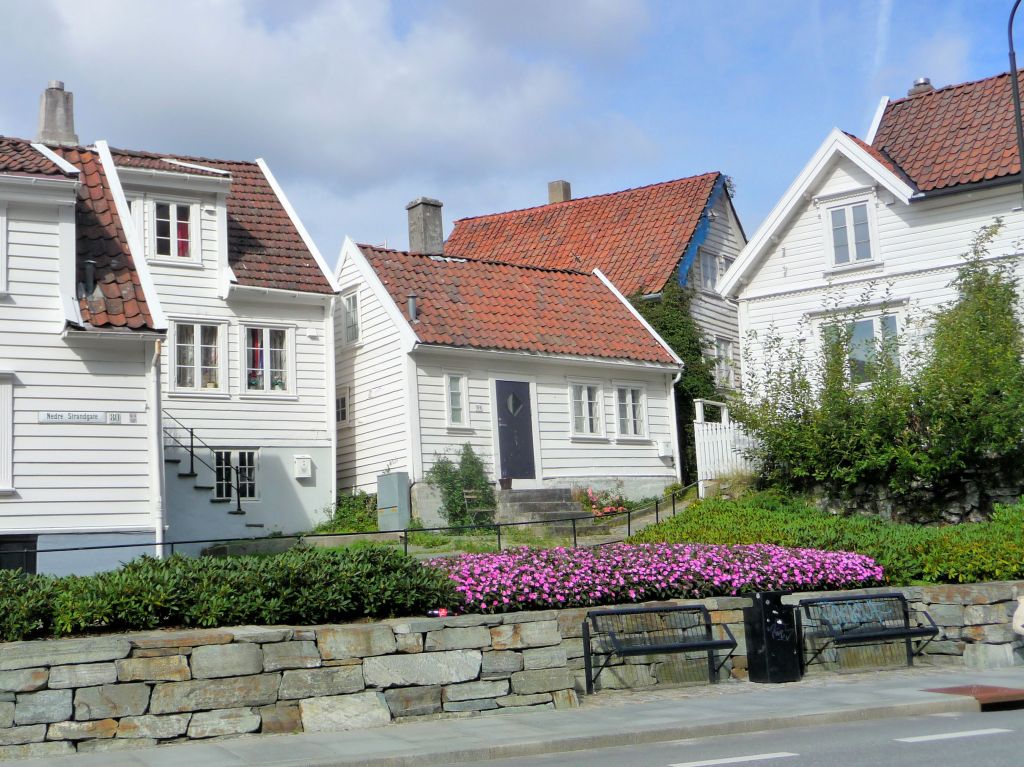
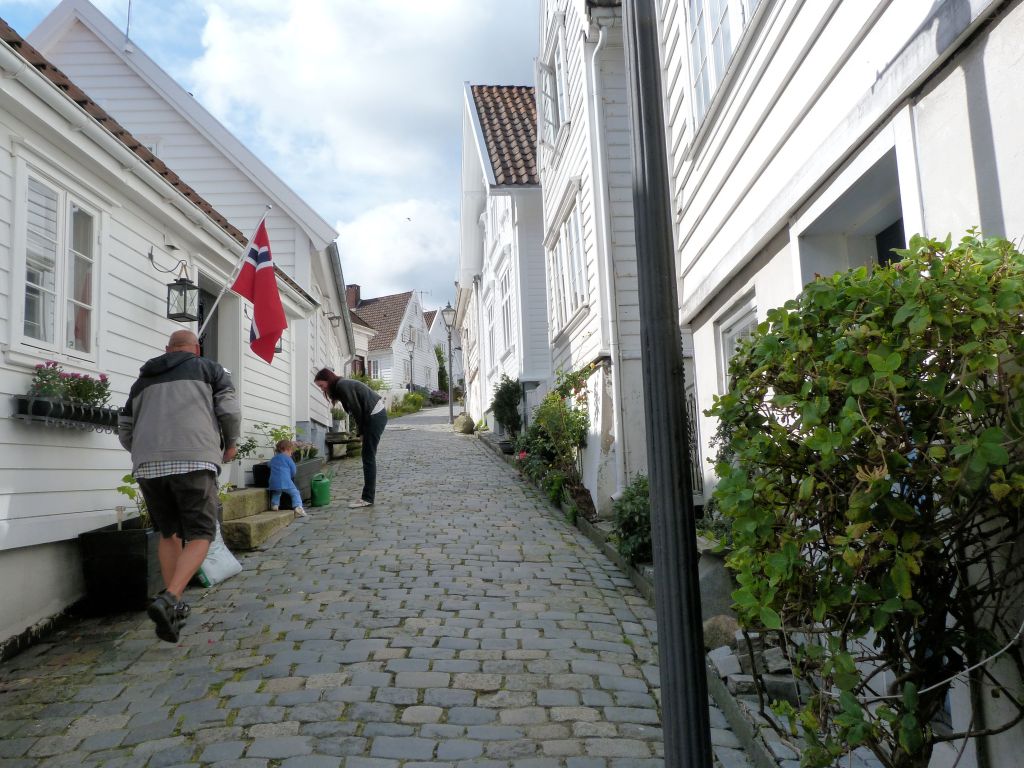
    I didn’t think I’d have another picture to add to Jude’s White/Silver challenge but I suddenly remembered the whiteness of lovely Stavanger in Norway, and I offer a selection to link to Jude here.

    A hilly, colourful street in Stavanger

    Link to Jude here.

  • Life in Colour – 21

    Life in Colour – 21

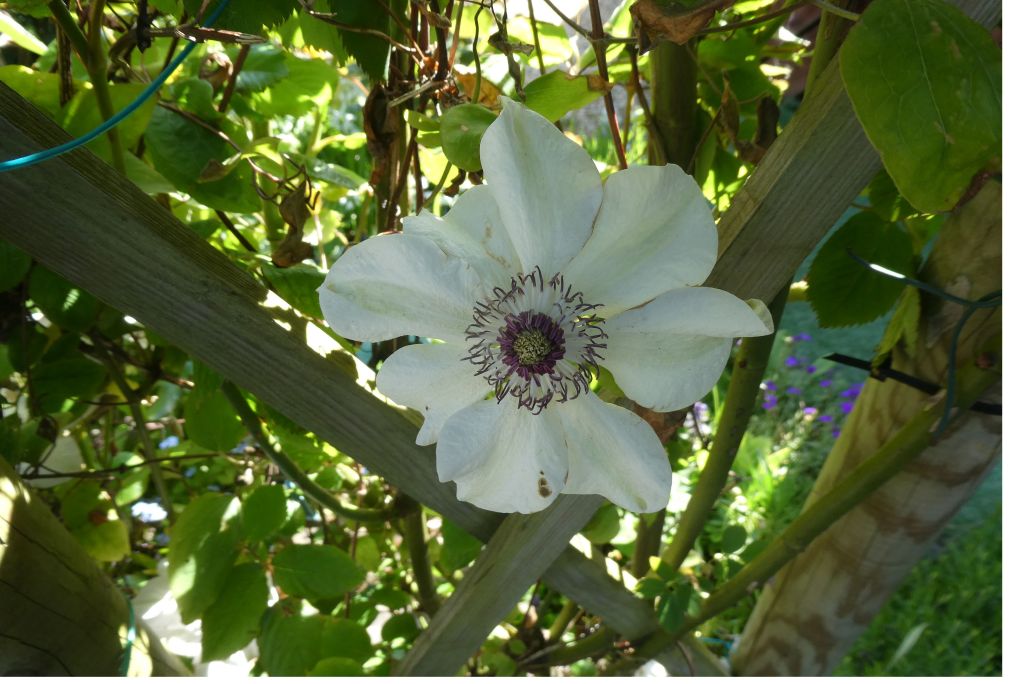
    This month, Jude has asked us to find examples of White, so here are a few images taken today in my garden. Perhaps some, less botanical, during the week.

    White Clematis

    Link to Jude here.

  • Pull Up a Seat: Photo Challenge

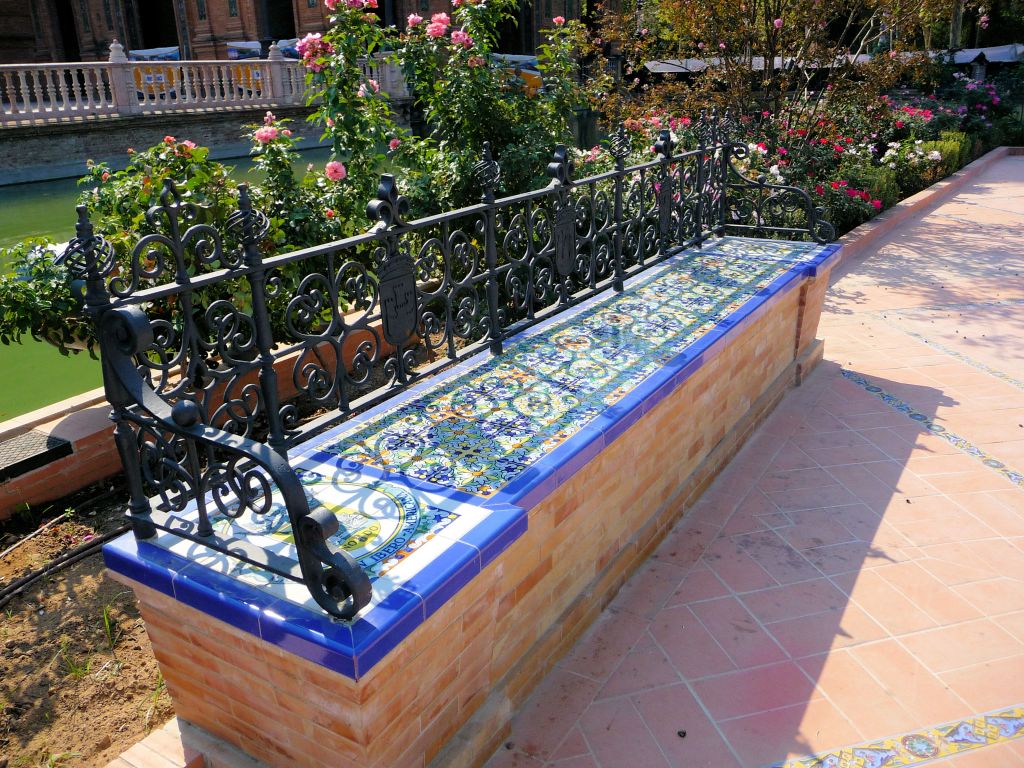
    We are in Seville for both of my seats, the first one a lovely tiled seat in the Plaza de España which I’ve mentioned in another post here, a gorgeous extravagance of tiles, walkways, streams, bridges, more tiles, all within the Parque de Doña Maria Luisa.

    A very elegant tiled bench in Plaza de España, Seville.

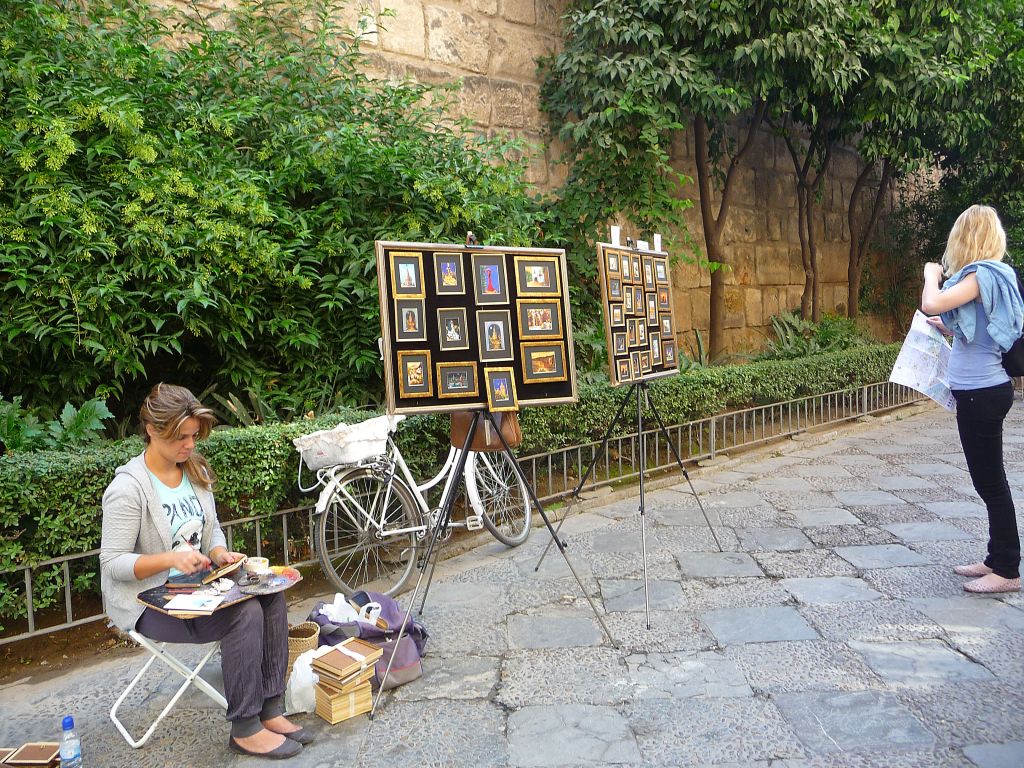
    And still in Seville we are on our way to the Alcazar when we came across this painter, oblivious to the passersby who photographed her and walked around her as she sat on a flimsy white stool. She worked quickly and the paintings looked good, good enough for her to sell quite a few while we stood admiring the finished pictures. By her feet she had different types of frames and she offered to change the frames of any on display if needed. I liked her bicycle behind the finished pictures, it made the whole thing seem so casual and a long way from high-art.

    Near the Alcazar, Seville, Spain

  • Sculpture Saturday: Seville

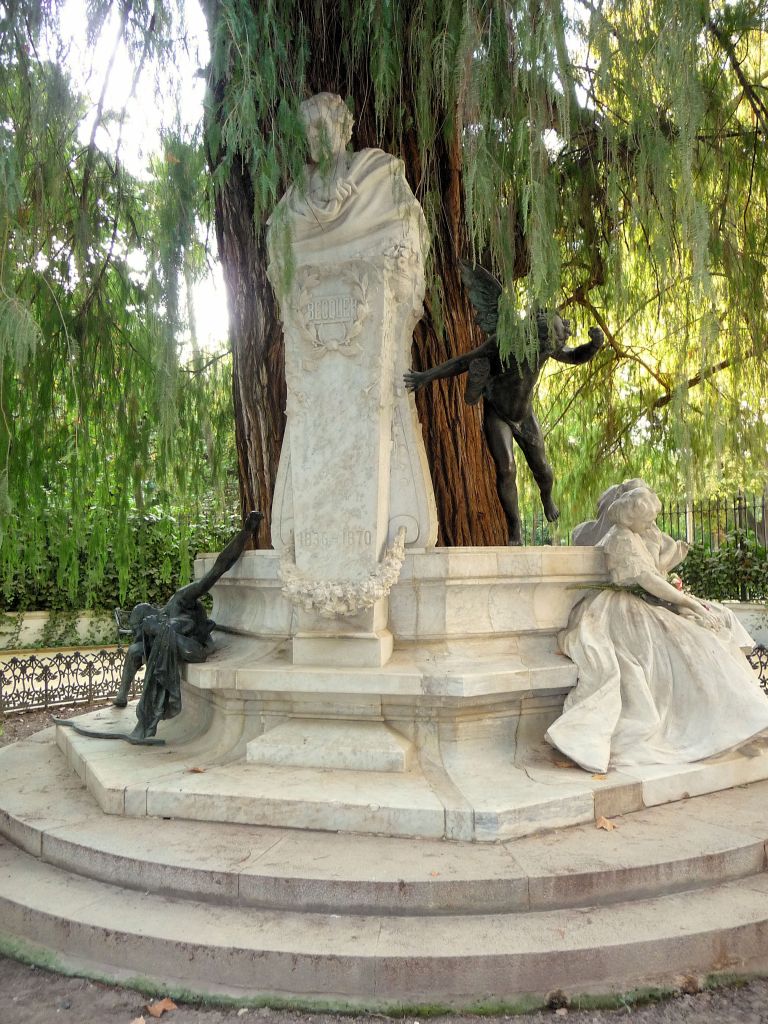
    In the lovely Maria Luisa Park in Seville is a monument to the Spanish poet Gustavo Adolfo Becquer and his poem Amor Eterno (Eternal Love). The statue depicts three women symbolizing the three states of love, excited love, possessed love and love lost. Behind them are two bronze pieces, ‘wounded love’ and ‘love hurts’ and a lifesize statue of the poet Becquer. The group of female figures is sculpted from a single piece of marble.

    Glorieta de Becquer –  Monument was constructed in 1911 by Lorenzo Coullaut-Valera, in collaboration with the architect Juan Talavera Heredia and Catalan sculptor Federico Bechini.

    The Cypress tree around which the monument is located was planted in 1850, according to some, and in 1870 according to others, and it is one of the individual trees of the Parque de Maria Luisa. The monument can be found along the Avenue de Becquer at the roundabout of the same name.

    View from the other side with statue of the poet Becquer and the two bronze figures with the seated females.

    Hundreds of trees line the avenues with exotic touches provided by colourful tiled benches and Moorish fountains and pools and there are numerous seats around the park and the famous monument from which to enjoy this beautiful green space close to the River Guadalquivir..

    The park was the site of the Expo 29, which had the Plaza de Espana as its centrepiece. My favourite way to see the park is to take a carriage ride through it – and yes, I know it’s a bit touristy and kitschy but nevertheless, it is a magical way to view this park. Large enough never to feel crowded, it is also a delightful place for a quiet stroll, a kids’ runabout, or a boat ride.  A more energetic option is a bike for four with sunshade – the front seats have belts to strap wriggly young children in safely. They are for hire in the road opposite Plaza de España.

  • An Artist in Ice

    An Artist in Ice

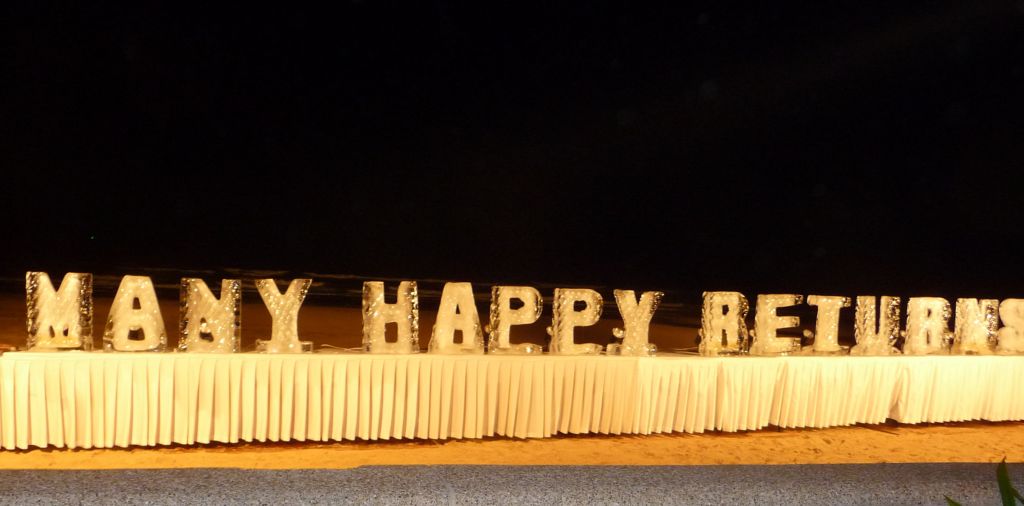
    Birthday Party on the Beach

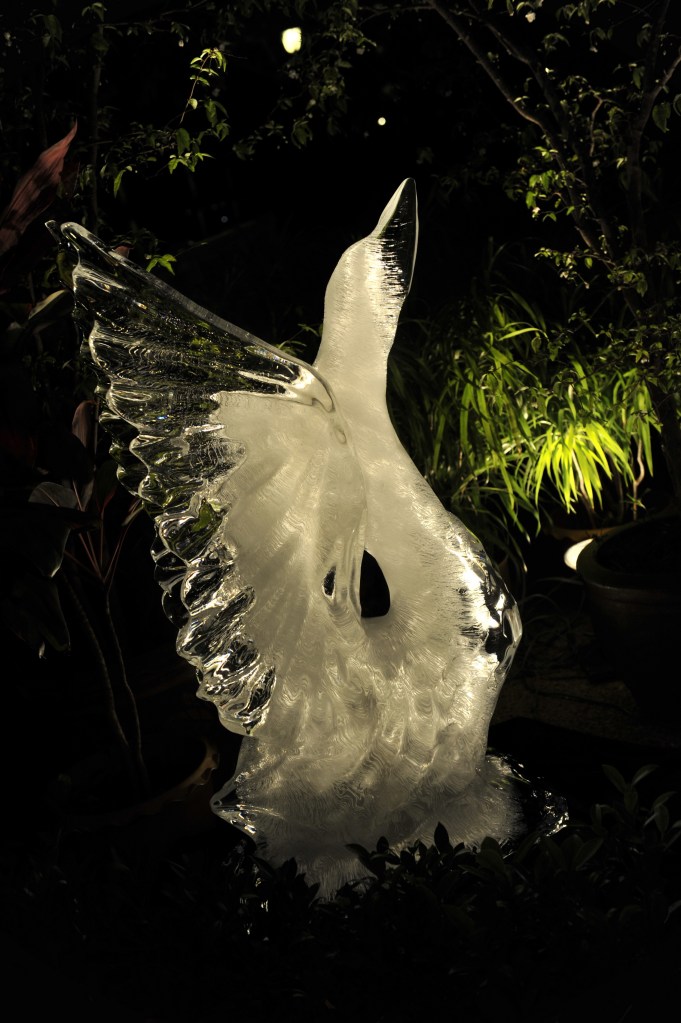
    The Buffet table at your holiday resort looks stunning, the food arranged with aesthetic attention to detail, and dominating the centre is a beautiful carving in ice, a pagoda, a ‘plane, a fantasie in ice with coloured lights making it dance and dazzle, or a bird, its neck an opaque white and the translucent wings poised as though to take flight.  In a few hours it will have dissolved into a puddle.

    The people who create these centrepieces are artists in ice, men and women who have the ability to create these beautiful animals, birds, and flowers in frozen water to add a shimmering brilliance to the tables.  And they do this knowing it will all disappear in a few hours. Performance art? Or art installation?

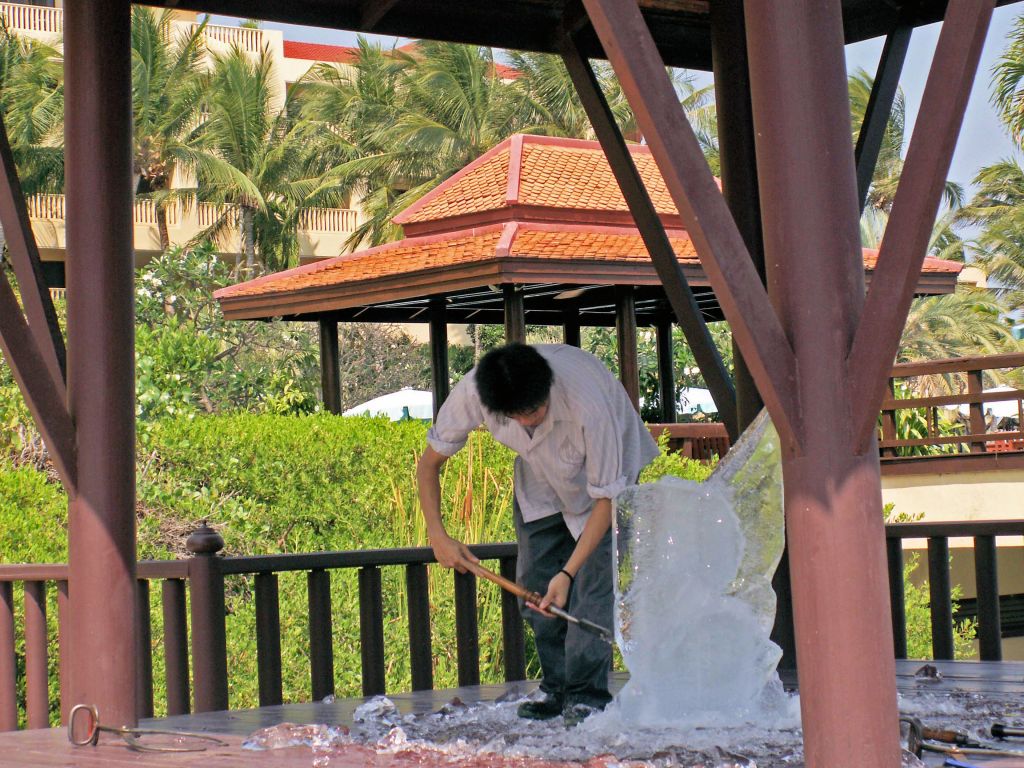
    Khun Panas Suchantra at the Dusit Thani Resort in Hua Hin, Thailand, was the resident artist in this ephemeral medium when I was last there.  He is involved in every aspect of the work, from the early discussions with the F & B Manager, the chef, and the General Manager if the event is of importance.  

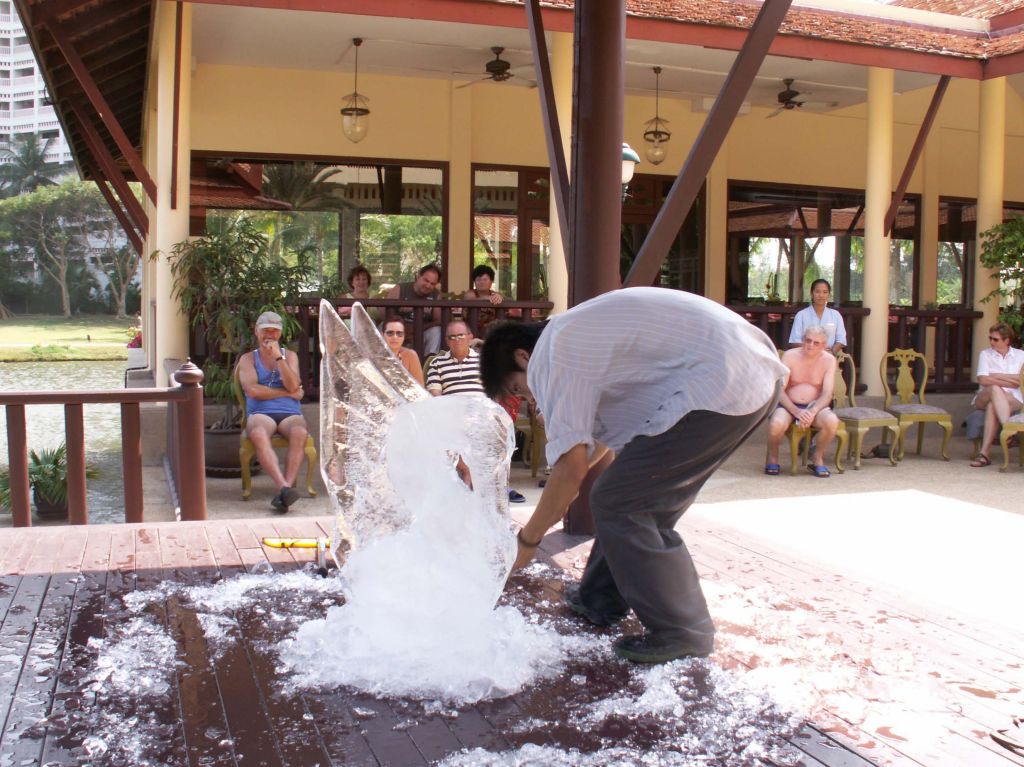
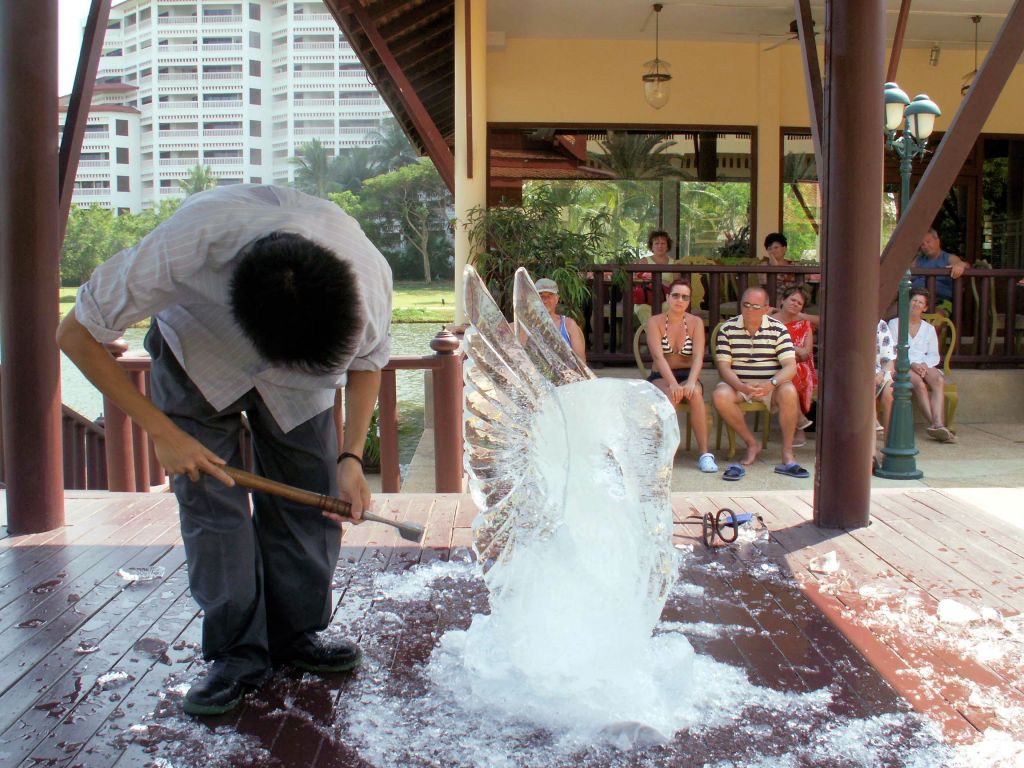
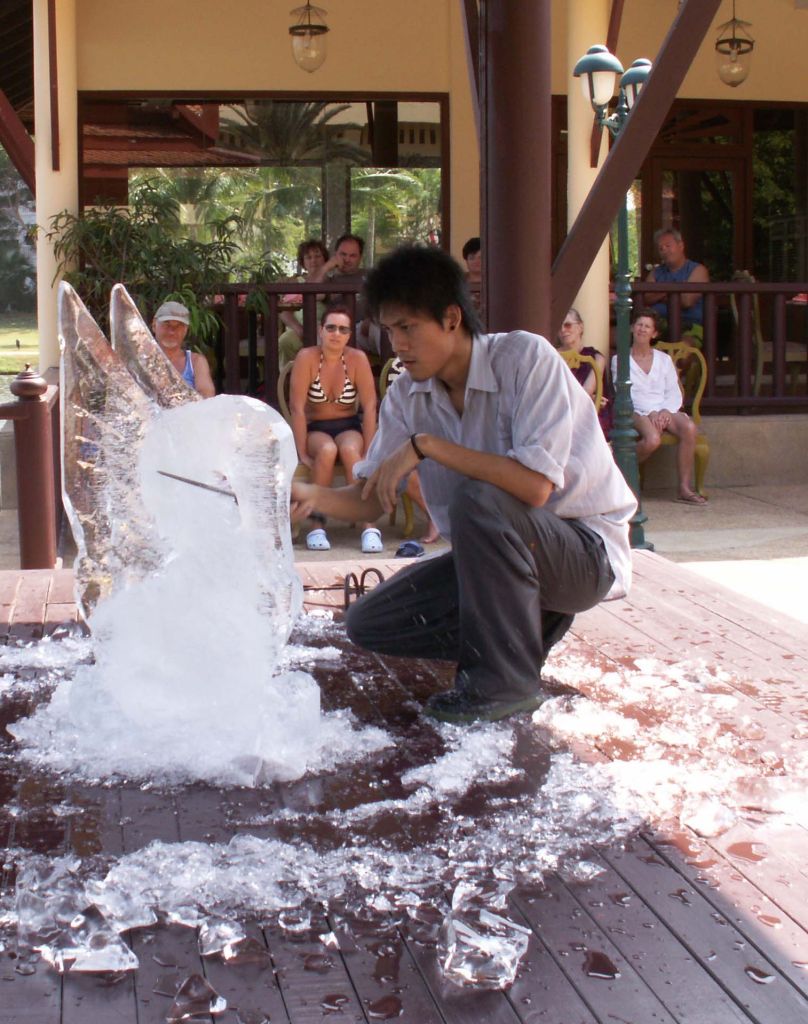
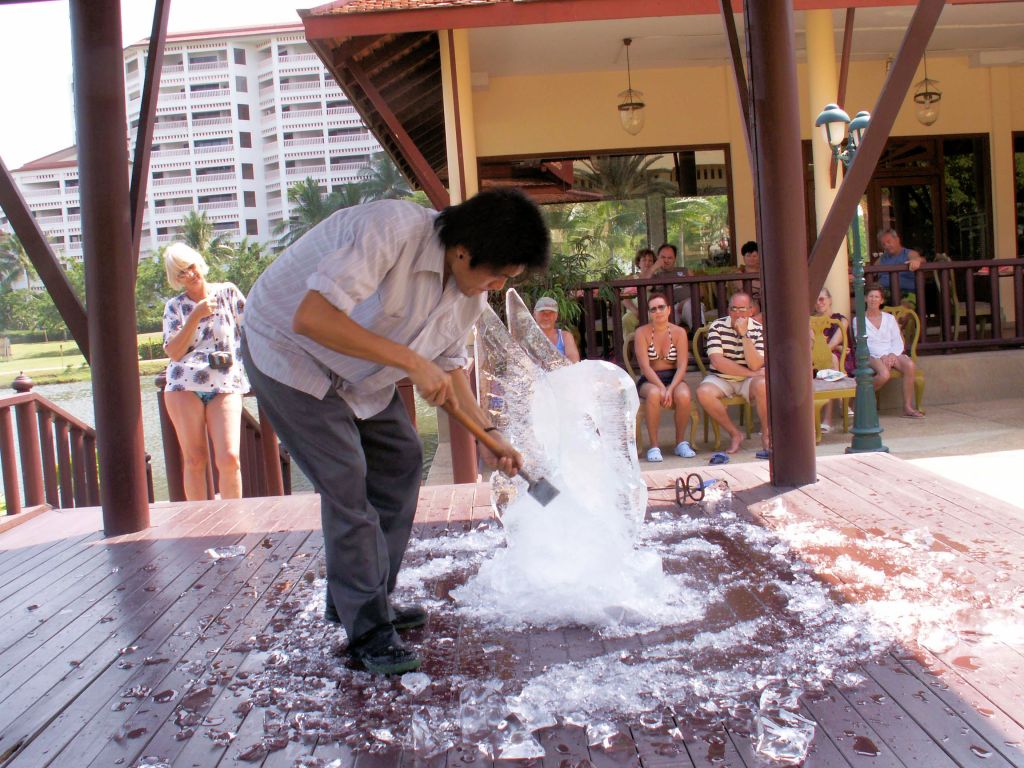
    I watched him work on various carvings over a three week period and never tired of the theatricality of the scene as he chipped and chopped, moved around with speed (the ice continues to melt as he works on it) and created delicate ice flowers and feathered wings with the precision of a mathematician.

    Most ice-carving artists use many different types of chisels, plus a saw, to get their effects.   Initally, a V-angle chisel is used to score the outline and to draw on the uncut ice, gouge chisels with their round tipped blades are used for making patterns, and flat chisels are for shaving.  The saw is used for cutting and carving (see photograph below).

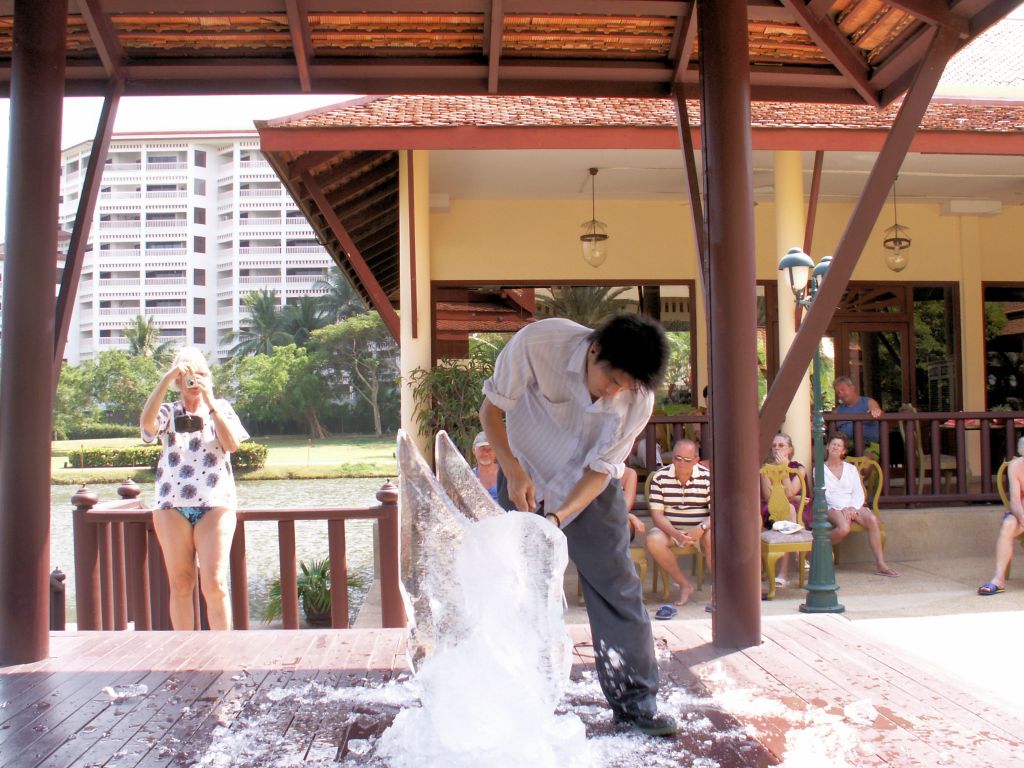
    Khun Panas  often works outdoors in a covered Pagoda overlooking the sea, a piece of performance art that is much appreciated by the visitors to the hotel who gather round to watch in silence, as a solid block of ice is transformed into a three-dimensional sculpture. 

    As he works, the mateial starts to melt and there is a sense of urgency about his actions but with a few quick movements he saws off a piece of the block on which he outlines a shape before beginning to chisel away the excess.

    With the outer shape of the subject delineated he starts on the base cutting into the ice to enhance the main figure.  After that it seems but a very short time before the ice-carving is complete, to be taken into the kitchens and stored in the freezer until it is ready to be placed centre table at the buffet.

    Japan is the country that has elevated ice sculpting to high art: you only have to look at the Winter Festival in Sapporo to see what visions they create.  It goes without saying therefore, that the best and most expensive tools come from that country, seasoned by years of experience in making Samurai swords.

    Tools of the ice-carver’s trade

  • Sculpture Saturday – Cardiff

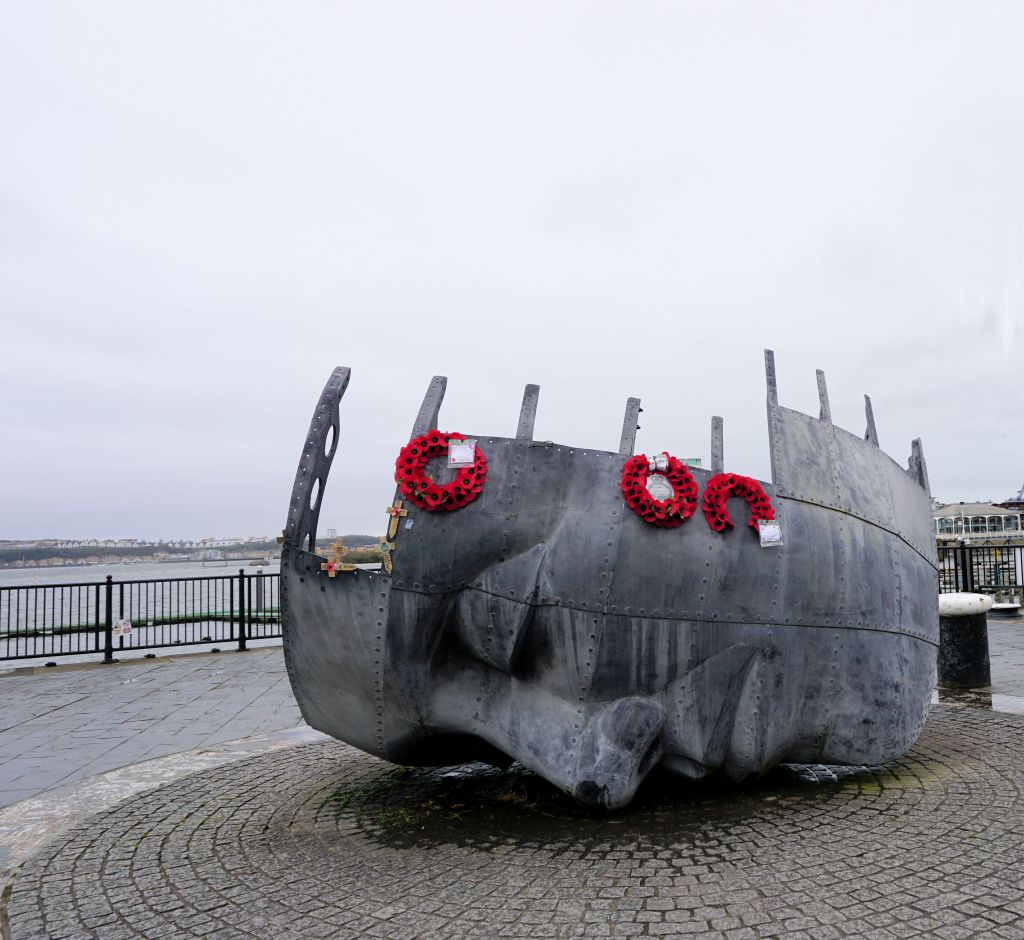
    IN MEMORY OF THE MERCHANT SEAFARERS FROM THE PORTS OF BARRY PENARTH CARDIFF WHO DIED IN TIMES OF WAR

    Challenge hosted by Sally Kelly over at Ruined for Life: Phoenix Edition.

    This striking Merchant Seaman’s Memorial in Cardiff Bay is in the form of a sleeping face fused with a ship’s hull. This was made by riveting plates of metal together, a traditional technique used in early iron and steel ship building. The sculptor Brian Fell, whose own father had been a merchant seaman, was commissioned to create the work in 1994 by Cardiff Bay Arts Trust, Cardiff Bay Development Corporation, Merchant Navy Memorial Committee and Cardiff County Council and it sits in Tiger Bay, Cardiff.

    The ports of South Wales played a vital role in supplying coal from Welsh mines to fuel the world’s ships, especially warships and the allies were dependent on merchant vessels to transport troops, food, ammunition, raw materials and equipment. Shipping lanes ran around Pembrokeshire and around the island of Anglesey to get to and from the port of Liverpool and to access the Atlantic; within these lanes German U-boats targeted ships, sinking them with torpedoes and sea mines.

    Over 150 vessels were sunk off the coast of Wales during the first World War alone.

    Challenge hosted by Sally Kelly over at Ruined for Life: Phoenix Edition.

  • When Democracy Ruled

    Image by Carol M. Highsmith – https://commons.wikimedia.org

    Depressed by the current news, the arguments, the depths to which politicians and supposedly clever men and women are sinking, I think back to how years ago Franklin D. Roosevelt was a beacon of light to a world deep in a fiscal depression. As he saw America through a war and put in action methods to help Europe build itself up after the second world war, he laid the groundwork for 20th century democracy in the western world. Less than a century later, we stand to lose it.

    FDR had many faults, he was a human being after all, but he was a giant compared to what we see today.

  • Sculpture Saturday:  Budapest

    Sculpture Saturday: Budapest

    Challenge hosted by Sally Kelly over at Ruined for Life: Phoenix Edition.

    Heroes’ Square, Budapest

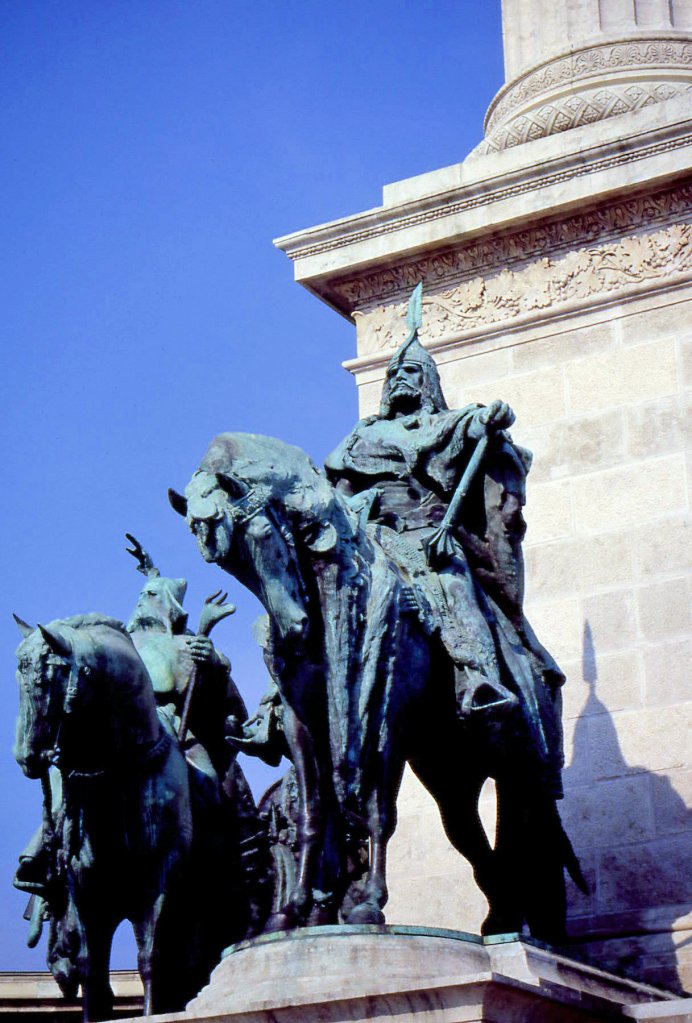
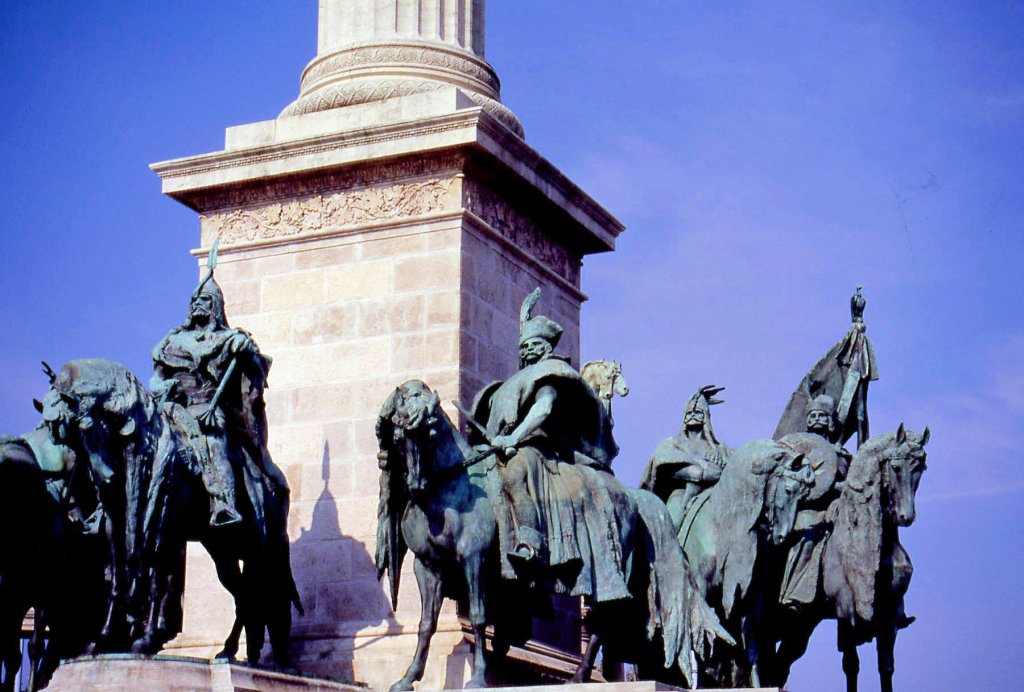
    Designed in 1896 to mark the 1000th Anniversary of the Magyar conquest of the Carpathian Basin, Heroes’ Square (a name given to it in 1932) was designed in 1896 for the celebration of the Millennium of Hungary. The 36-m high column, topped by the Archangel Gabriel holding the Hungarian crown and cross, dominates the square. Around the base of the column are sculptures of Magyar chieftains from the 9th century mounted on horses. The colonnades that run behind the column hold 14 statues of earlier rulers and statesmen from King Stephen to Lajos Kossuth.

    Base of Millennium Column in Heroes’ Square, Budapest
    Magyar Chiefs at base of Millennium column, Budapest

  • Wanted: Hot Chestnuts

    Hot Chestnuts for sale in Lucerne, Switzerland

    It’s a cold and wintry day here, the skies are grey, not blue like they were yesterday, and my mind flies back to this time last year in Lucerne where, along the lake dotted with boats and swans, the hot chestnut sellers were doing a roaring trade. I can smell them now and I long for some. Some Swiss chocolate wouldn’t come amiss either.

  • Walking Towards Autumn

    Walking Towards Autumn

    Today I changed my walking route, left the sea behind me and turned inland. I had no plans, no set route to follow and no idea of what I wanted to photograph.

    First, I meandered through Los Altos Park which was deserted: it was eerie having this space all to myself. Normally a place full of dog-walkers, chattering children, and elderly folk sitting on the benches reading, today it was empty despite a temperature of 16 degrees, blue skies, warm sun and no wind. Covid space? Too late in the day? Who knows, but the place was all mine.

    Los Altos Park, Sandown

    Not far from here was what used to be one of the area’s oldest hotels but unfortunately, it closed this year due to a series of misfortunes. The grounds are now deserted, the building, once a grand manor, now stands forlorn its windows no longer shining a light to welcome visitors. There was no one to disturb me or chase me away and I felt a terrible sadness at the loss of this great mansion, its tennis courts now a coach park, and its grounds being overtaken by nature.

    The lane in front of the hotel. I didn’t go further into that darkness!

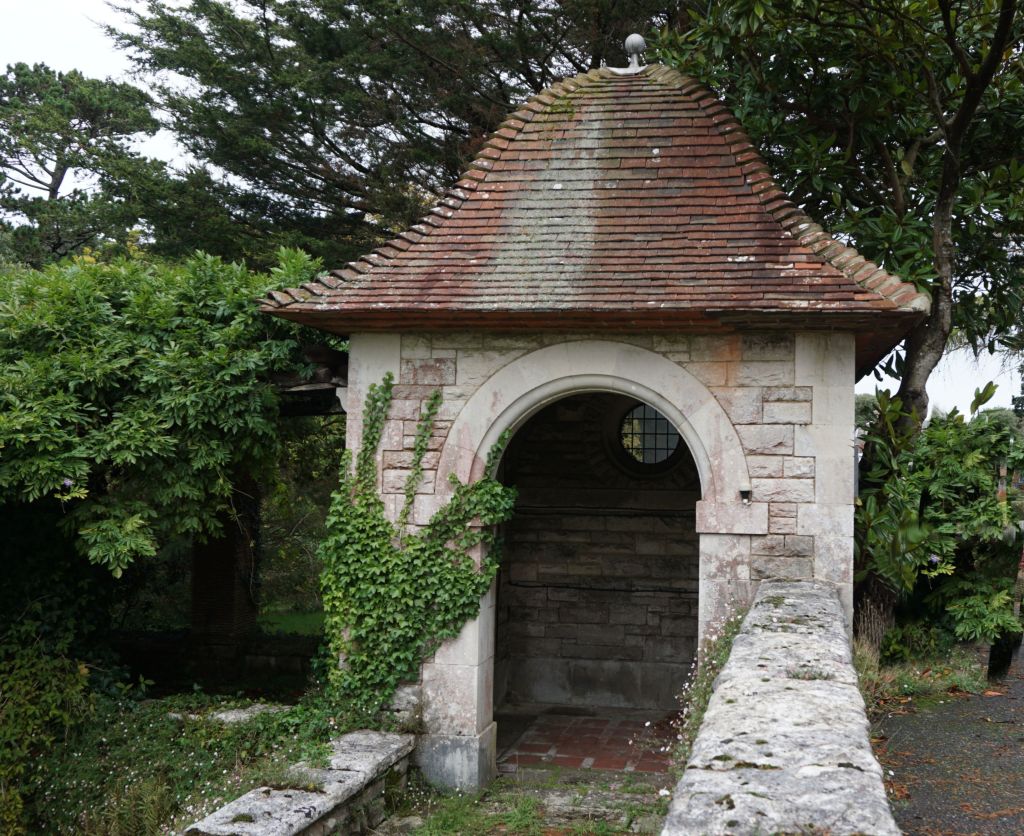
    Further into the gardens I came across these seats looking so forlorn as they sat amid the falling leaves. Nearby a couple of palm trees, stretched towards the light, valiantly fighting to survive. They were definitely in need of some TLC.

    Although I felt sad that the bracken (or was it fern) was now running rampant over the garden wall I cheered myself up with the thought that this would provide a cosy home for the winter for the wildlife I’d seen on my walk (a couple of hedgehogs, lots of spiders and odd creepy-crawlies and I’m sure there were lots more keeping out of my way).

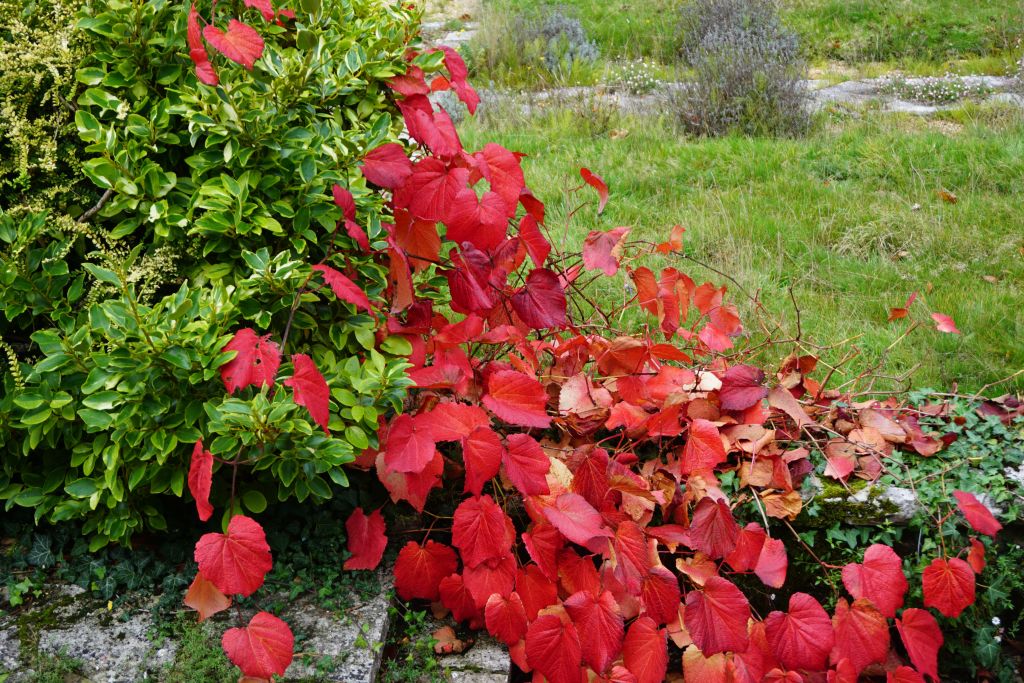
    And then I came upon the sunken garden and this splash of colour, a glorious cascade of scarlet leaves, Virginia Creeper I think, that must have migrated from the wall of the old house and settled here to decorate these steps. And just a bit further on, the brilliant red of the Holly berries – a dazzling display of colour amid the dying of the year. It seemed the autumnal red of the Virginia creeper led me to the winter of the Holly.

  • Thursday’s Special Words

    Linked to Thursday’s Special at Paula’s here

    First up is Impregnable and I give you The White Cliffs of Dover. We don’t know if they are but it’s a good song and a nice idea.

    The White Cliffs of Dover

    and not far from here is Dover Castle which commands the Strait of Dover, the shortest sea crossing between England and continental Europe, a position of strategic importance throughout history and whose underground tunnels housed troops. war rooms and hospitals from the early 19th century right up until the Second World War 1939-45.

    The castle visible today was established by Henry II (r.1154–89), in the decade 1179–89, creating at Dover the most advanced castle design in Europe, a sophisticated building that combined defence with a palatial residence.

    Dover Castle, Kent

    Next word is Volte Face and there are so many in the political field today that it’s hard to choose. However, anyone who reads politics these days must agree that the winner in any volte face competition has to be

    Boris Johnson

    Linked to Thursday’s Special at Paula’s here

  • SCULPTURE SATURDAY:  Scottish Memorial in France

    SCULPTURE SATURDAY: Scottish Memorial in France

    I debated with myself whether or not to post these images as some might wish to argue that they are not sculpture. Yet they were brought into being by a sculptor whose name unfortunately, I have not been able to find (I am still searching).

    So here is the Monument to the Scottish fallen in World War 1, an unusual sculpture of granite slabs slotted together like dry-stone walling which stands in a field adjacent to the British Military Cemetery on the road between St. Laurent-Blangy and Gavrelle and which was unveiled on 9 April 1922, the fifth anniversary of the battle. Located north of the village of Athies it is not far from the battlefields of Loos and Arras.

    Pont du Jour Memorial to the Scottish fallen

    Around the field are individual stones with the names of Scottish battalions who fought here.

    And a close-up of the plaque on the monument.

    Ypres to the Scheldt 1915-1918

  • Narnia in Belfast

    Narnia in Belfast

    NARNIA – The Lion, The Witch and The Wardrobe

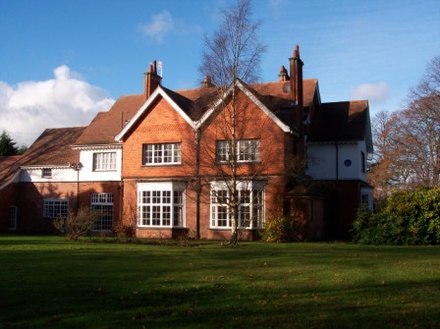
    Clive Staples Lewis (known as Jack), the author of The Chronicles of Narnia, was born in Belfast on November 29th, 1898 to the comfortably off Albert James and Flora Augusta Hamilton.  He grew up happily in a house called Little Lea, a house that is generally credited as the one from which he derived the inspiration for the stories which have given pleasure to so many people.  It was a large, gabled house overlooking the River Lagan, with dark, narrow passages and a library that was crammed with books including two of his favourites, Treasure Island by Robert Louis Stevenson and The Secret Garden by Frances Hodgson Burnett. 

    Little Lea (photo Wikkiwand)

    During the second world war many London evacuee children were sent to live in Belfast’s supposedly fresh country air to avoid the bombing and the air-raids (despite the fact that the Northern Ireland capital was also subject to severe bombing).  Like the Pevensie children in The Lion, the Witch and the Wardrobe, several groups of children stayed with Lewis at his country home and they played with Jack and his brother in the large overgrown garden in a Northern Ireland not then plagued by bitter civil strife, although there were always tensions.

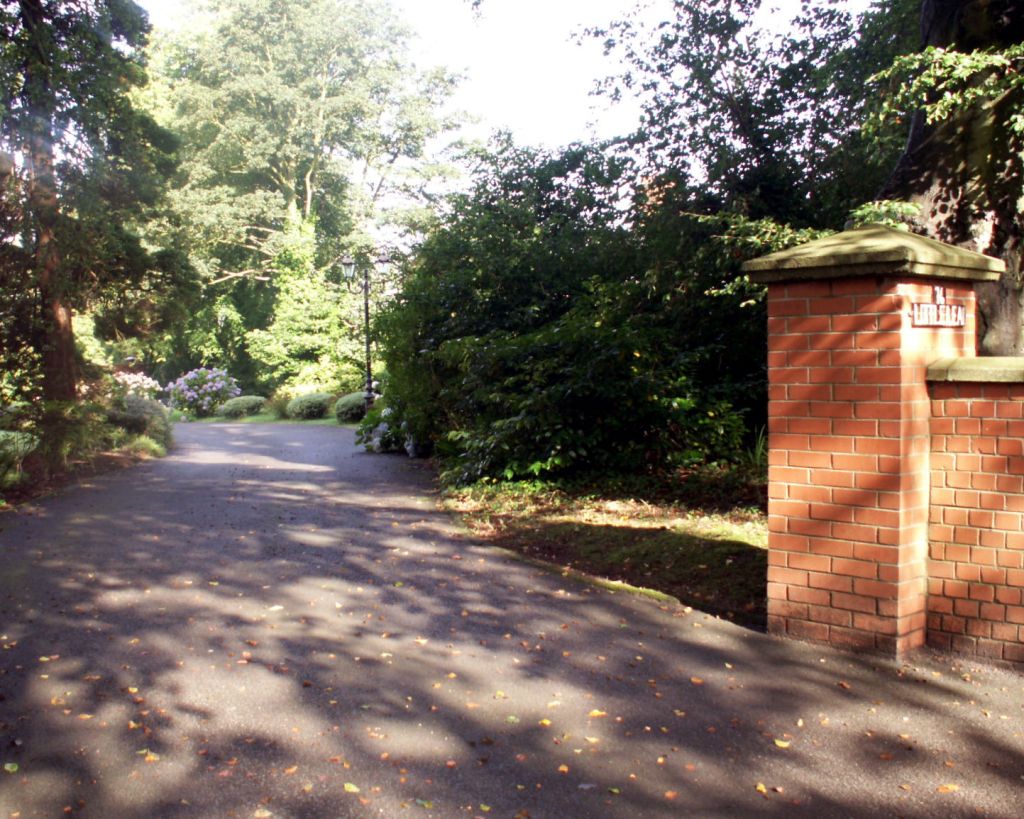
    Entrance to Little Lea – photo Mari Nicholson

    The first Narnia book was published in 1950, since when they have sold more than 100 million copies and been translated into over 30 languages, opening up a world of magic to children who have lapped up the stories of the mythical world found behind the wardrobe.

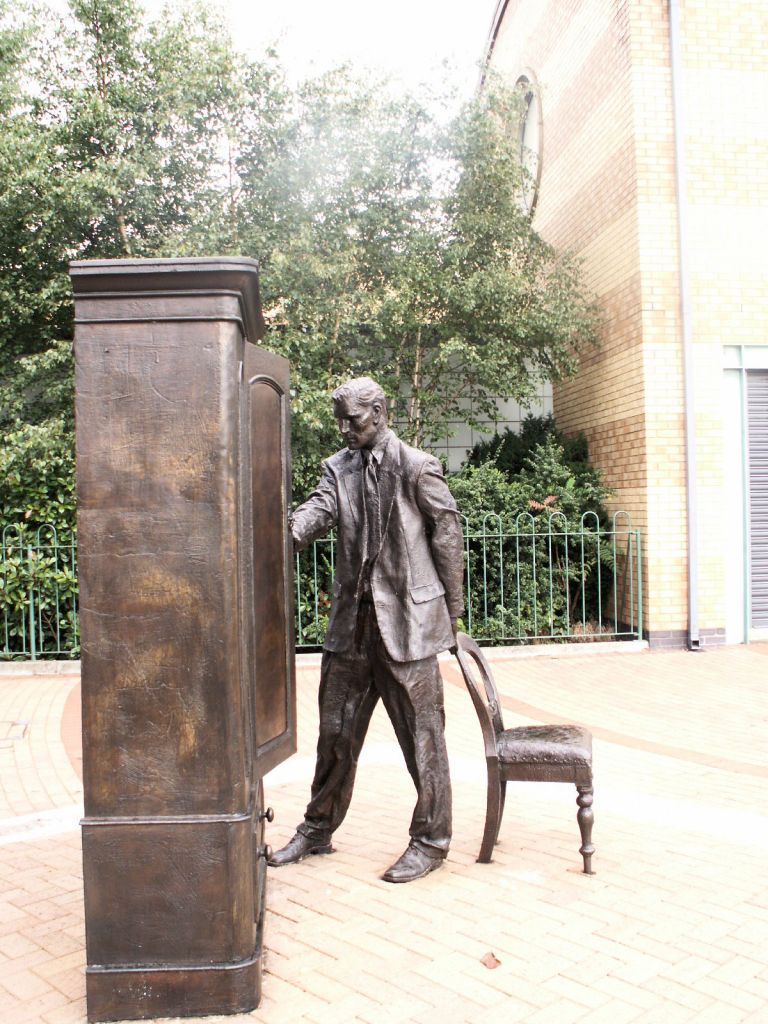
    Bronze Statue by Ross Wilson in Belfast – photo Mari Nicholson

    As a child, C. S. Lewis constanrtly made up stories about a place he called “Animal-Land“, a land inhabited by animals, mice and rabbits who rode out to kill cats.  These stories he related to his brother as they sat among the coats in their grandfather’s old wardrobe. He even created detailed maps of the fantasy world.

    The Narnia story

    By chance, four young children from wartime England discover a magic land called Narnia, lying beyond and through an ordinary wardrobe.  Once through the wardrobe and into the mythical land, Edmund, one of the children, betrays his siblings to a wicked witch who has been holding the world of Narnia in thrall to winter.  Spring can only come to Narnia and the betrayal be forgiven when the lion, Aslan, agrees to die at the witch’s hand.

    Little Lea, C.S. Lewis’s home in Belfast

    Looking around the area in which he grew up, it is not hard to believe that his surroundings inspired the mythical land of Narnia.  The craggy, heather-draped Mourne Mountains just a few miles away, Belfast’s own Black Mountain, and the lakes, rivers, forests and ruined castles with which the area abounds played their part as sure as the tales of hobgoblins and giants from Irish folklore and the Norse sagas which were, apparently, Lewis’s favourite reading.

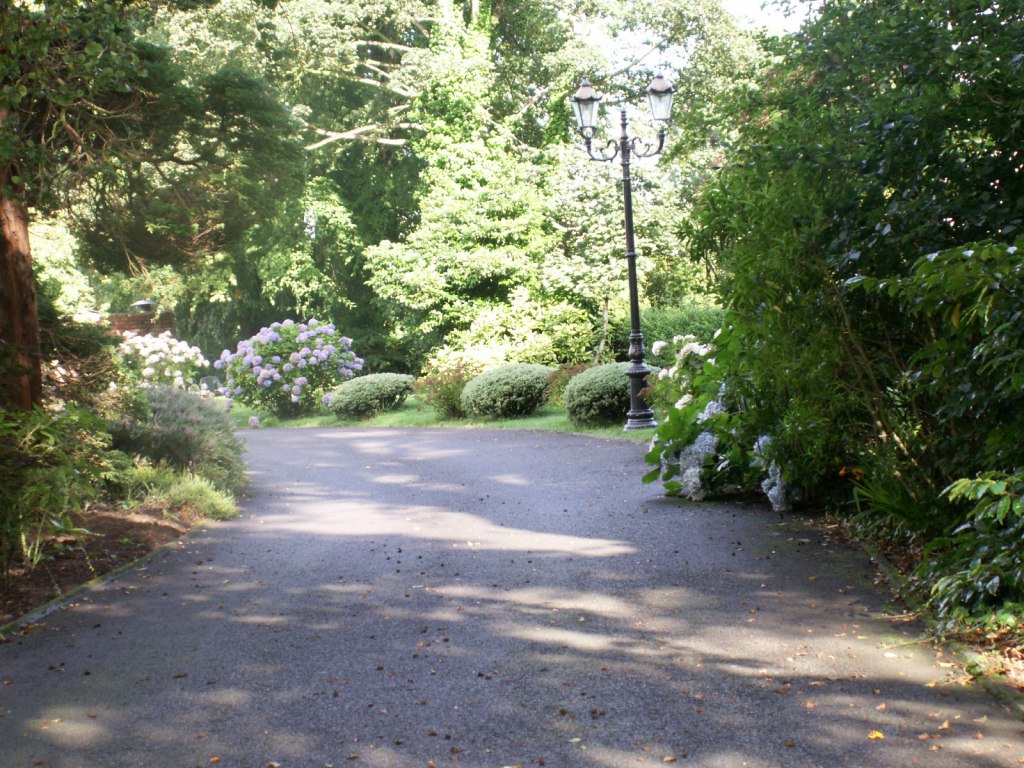
    The Drive at Little Lea – photo Mari Nicholson

    CS Lewis spent his childhood holidays in Rostrevor, a small seaside town about 50 miles from Belfast which faces across the Lough to Carlingford in the Republic of Ireland.  In one of his letters to his brother Lewis wrote that the mountains that loom above it (the Mournes) made him feel “that at any moment a giant might raise its head over the next ridge”.

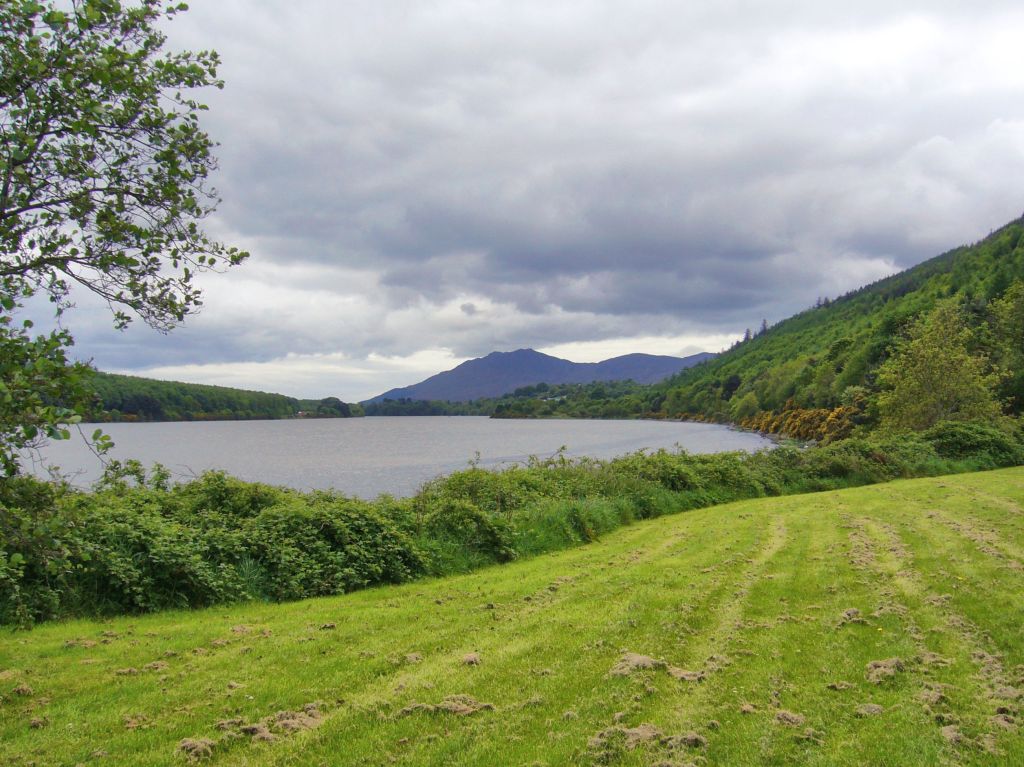
    Looking towards the Mournes from Warrenpoint

    At Kilbroney Park in Rostrevor, a Narnia trail will bring you into the world of Lewis’s chronicles., meeting Tree People and beavers along the way.  The walk starts and finishes within Kilbroney Park and the trail is entered, like the magical world of Narnia itself, through a ‘Wardrobe Door’ and along the way you’ll find features like Tree People, The Lamp Post, The Beaver’s House and Aslan’s Table.

     Enter at your peril though, as the curse of the White Witch lies upon the land.  It is always winter and Christmas never comes and you run the risk of being turned into stone especially if you eat the forbidden sweets.   

    If there is time and if you are fit, climb the mountain to Cloughmore (trans. big stone) the granite boulder that stands 1,000 metres above Rostrevor – a perfect model for Aslan’s altar – where the final chapters of The Lion, the Witch and the Wardrobe come to life. With a little suspension of disbelief you can imagine the creatures that worship there – the Well Women, centaurs and unicorns – and, of course, the great Aslan.

    Before you go. The jury is still out on some of the places that inspired Narnia but the 17th century Dunluce Castle on the Antrim Coast is believed to be the basis for Cair Paravel, the royal fortress in Narnia. 

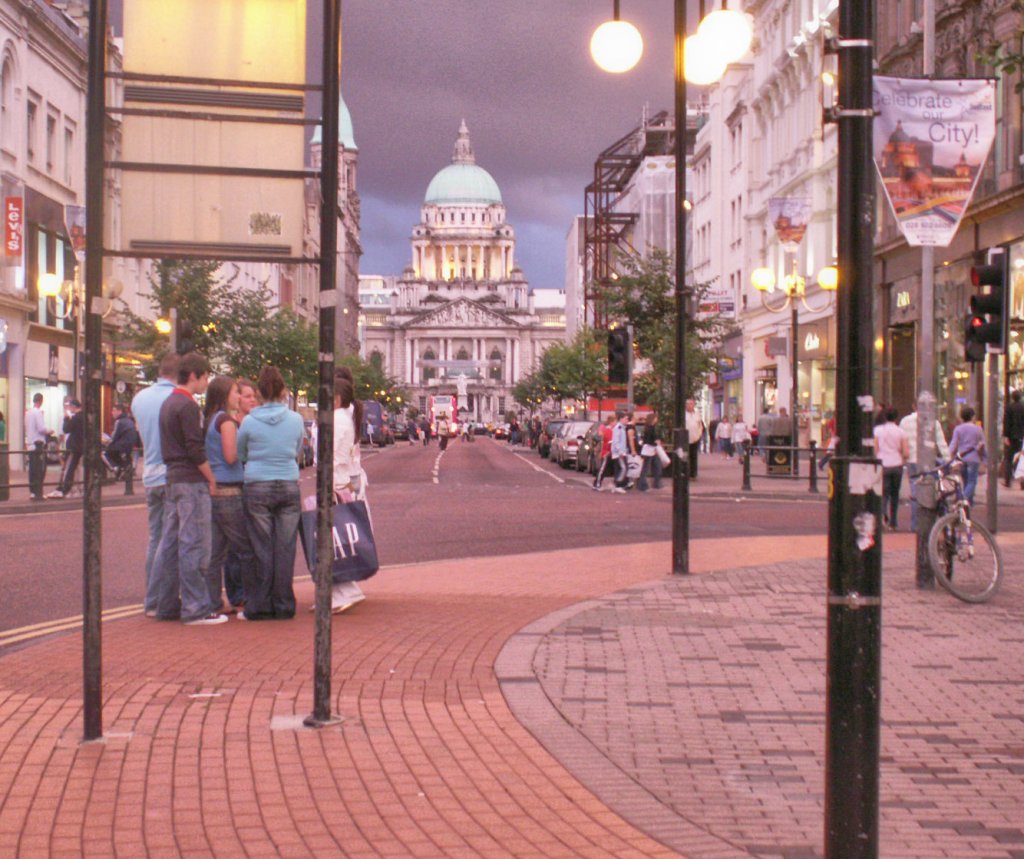
    Belfast at dusk – photo Mari Nichiolson

    NOTES; Unfortunately, it is not permitted to enter Little Lea, Lewis’s former home, as the house is privately owned but fans of the book seem satisfied to stand outside and gaze at the one-time family home.

    Any tour of Lewis’s Belfast must encompass the magnificent bronze of The Wardrobe (called “The Searcher”) by Ross Wilson which has been erected in central Belfast and the many murals on Belfast’s walls which refer to the man and his work.  However, Belfast today is one of the most vibrant cities in Europe and murals are changing rapidly.  CS Lewis wouldn’t recognise today’s Belfast were he to return, from the magnificent Waterfront Concert Halls and Visitor Attractions to the Titanic Museum, but he would recognise that the soul of the city is still intact.

    A private taxi tour is an excellent way of seeing the area and the Belfast Tourist Board will be happy to advise on this.

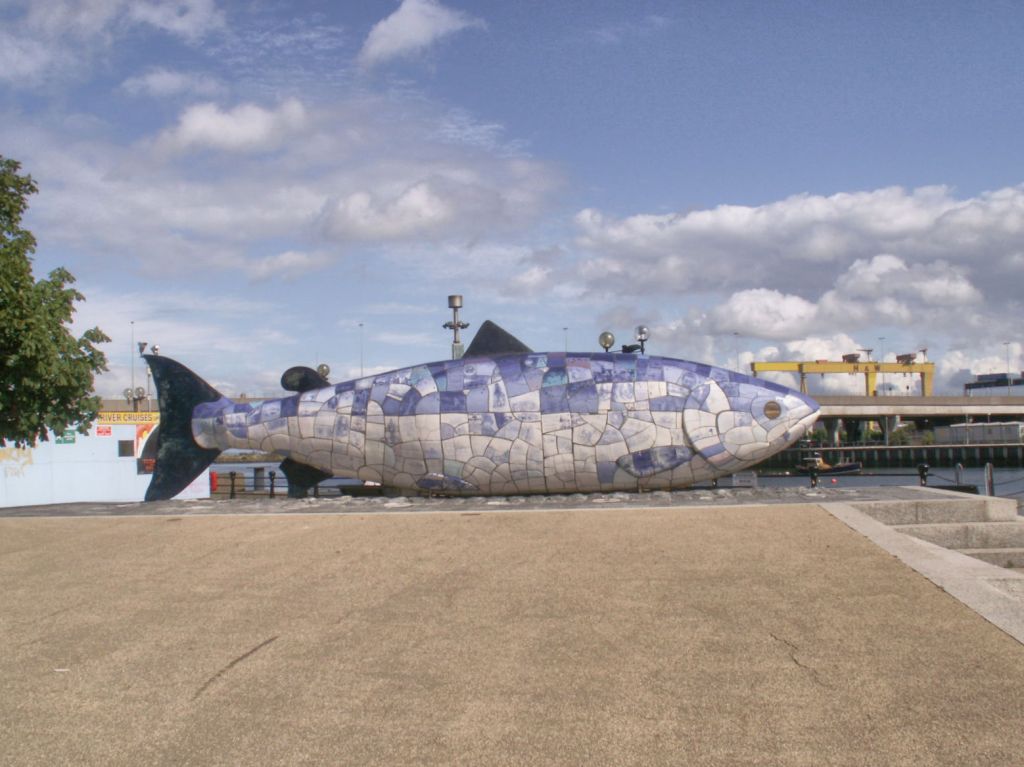
    The Giant Fish on Belfast’s Waterfront
  • The Amalfi Drive

    The Amalfi Drive

    White Houses Clinging to the Rocky Hillside

    Known as The Amalfi Drive (formally Strada Statale 163) the coast road along the shoreline from Sorrento to Amalfi (and on to Salerno) is one of the most poular drives in Italy.  Originally built by the Romans, it is one of the most photographed coastal routes in the world, seen in countless films like Under the Tuscan Sun and the Humphrey Bogart classic Beat the Devil (1957) featuring a young Gina Lollobrigida. Gamers may recognize it as a setting for fictional tracks in Forza Motorsport and Gran Turismo 4 games.  UNESCO actually named the Amalfi Coast an outstanding example of Mediterranean landscape and gave it a place on the World Heritage List.

    So far down the boats are hardly recognisable

    Carved out of the side of the coastal cliffs for the greater part of its route, the road gives vertiginous views down to the Tyrrhenian Sea and to the towering cliffs above. It passes through Positano, the village of the rich and famous where fabulous villas accessible only on foot from above, by helicopter from the air, or by yacht from the sea, are built into the sides of the mountain, making it a major tourist attraction.

    We originally took the guided tour by coach as this seemed the easiest way to experience the drive, and we were right, but we enjoyed the trip so much that we took the local bus a few days later and enjoyed it even more.  

    Positano

     We decided against stopping off at Positano however, having been warned against this by a fellow hotel guest who had been left standing for hours as the buses returning from Amalfi were all full when it reached Positano so no chance of getting on one.  Amalfi filled the day however, and we managed to fit in a trip to Ravello as well.

    I have no argument with those who say that the 50 Kilometre Amalfi Coast drive is probably the world’s most beautiful and thrilling, piece of tarmac-ed sightseeing in Europe.  If you can ignore the hairpin bends, the crazy Italian driving, the narrowness of the road that means your vehicle could possibly plunge into the churning sea below, the views are spectacular.  The road is built at a very steep angle, zigzagging backwards and forwards and from the window of your vehicle you can see craggy rocks thrusting through the foamy waters below.

    One of many Medieval Watchtowers on the Amalfi Drive

    Despite the heavy traffic, all fighting for space on hairpin bends, the Amalfi Drive is a fascinating trip with every corner revealing an even more stunning view protected by Unesco.  Pastel-coloured villages are terraced into the mountainside, medieval watchtowers guard the coast, and here and there huge colourful ceramic urns In yellow, blue, green and red, announce a “ceramic factory”.  Among the green slopes of the cliffs are scented lemon groves and a profusion of pink and white oleanders, and enticing restaurants locate on precipitous corners daring you to stop for a coffee. This white-knuckle ride is one of Italy’s greatest wonders but it is not for the faint of heart. It is 80 kl of narrow, S-curve roadway strung halfway up a cliff with the waves crashing below.

    At the end of the Drive you have Amalfi, tiny, expensive but one of the easier towns of those strung along the coast to walk around.  It rises gently up the hillside from the waterfront rather than clinging vertically to it like some of the other coastal towns, like Positano for instance.  Hard to believe that this very touristy town had a glorious history as a maritime republic on a par with the better known Pisa, Venice and Genoa. 

    Nevertheless, Amalfi was a trade bridge between the Byzantine and western worlds for centuries with a population exceeding 70,000 (today, less than 5,000).   Unfortunately, there are very few historical buildings of note as most of the old city, and its inhabitants, slid into the sea during the 1343 earthquake.

  • ONE DAY (the One Day Prompt)

    The phrase ‘One Day’ set me thinking of a poem by Alun Lewis whose work I’d recently been re-reading, and try as I might I can’t get it out of my mind. One Day is not the same as All Day, yet the two phrases seemed to fuse. The Lewis poem, All Day It Has Rained, is about one day in the life of a group of soldiers stationed in Hampshire, during the Great War.

    All Day It Has Rained

    This is one of Lewis’s greatest poems, one of the great World War 1 poems even if guns and five-nines aren’t even mentioned. The wealth of observation and the matter-of-fact vocabulary lifts the poem from the everyday: nothing about the poem is predictable, from the down to earth vocabulary to rhythm and metre.

    And now I shall have to read something else to get it out of my mind!

    Here is the first part of the poem. If you don’t know it and would like to read the rest of it, it can be found online.

    All Day It Has Rained

    All day it has rained, and we on the edge of the moors
    Have sprawled in our bell-tents, moody and dull as boors,
    Groundsheets and blankets spread on the muddy ground
    And from the first grey wakening we have found
    No refuge from the skirmishing fine rain
    And the wind that made the canvas heave and flap
    And the taut wet guy-ropes ravel out and snap.
    All day the rain has glided, wave and mist and dream,
    Drenching the gorse and heather, a gossamer stream
    Too light to stir the acorns that suddenly
    Snatched from their cups by the wild south-westerly
    Pattered against the tent and our upturned dreaming faces.
    And we stretched out, unbuttoning our braces,
    Smoking a Woodbine, darning dirty socks,
    Reading the Sunday papers – I saw a fox
    And mentioned it in the note I scribbled home; –
    And we talked of girls and dropping bombs on Rome,
    And thought of the quiet dead and the loud celebrities
    Exhorting us to slaughter, and the herded refugees:

    …….

    Tomorrow maybe love; but now it is the rain
    Possesses us entirely, the twilight and the rain.

    Linked to One Day Prompt

  • Bench Challenge

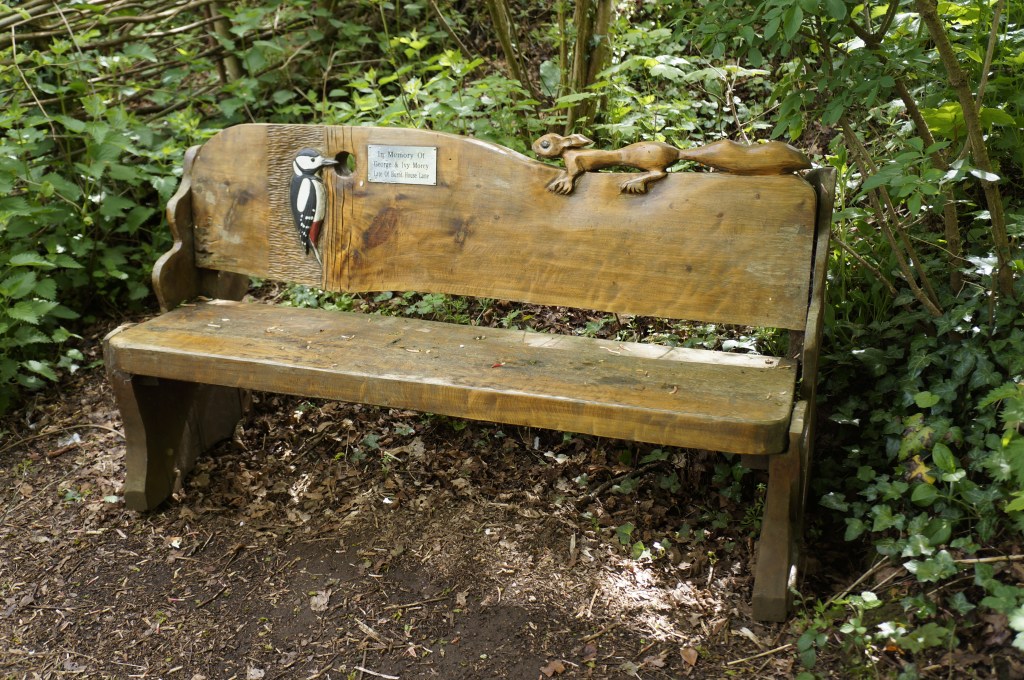
    Not sure if this challenge is still running but I’ve found two more images of benches that I’d like to post.

    On a walk along the sea cliffs in my home town I spied this one.

    More than one bench here along the river Adige , the second longest river in Italy and a central feature of the city of Verona through which it runs before heading towards the Adriatic Sea.   Verona’s historic centre is partly enclosed by the river and several of her historic bridges cross the river including the Scaligeri family’s Ponte di Castelvecchio.

    Link to Juhttps://traveltalk.me.uk/bench-series/de’s challenge.

  • Bench Photo

    Does this count? Can it make it into the Bench challenge? It’s a bench seat in a Gondola in Venice (where else)?

    Bench photo linked with Jude here.

  • Bench challenge

    Having just seen Jo’s Bench challenge and realising i have a lot of benches amongst my images, I thought I’d make an easy comeback to WP and dip my foot into the water again as it were, by posting “a bench” and re-joining the community. So, a stone bench with shadow!

    I’m not even sure I know how to do this properly any more!

    A resting place in the Botanical Gardens at Blanes, Spain

    Image posted as part of the Bench photo challenge but I’m not sure if I link to Jo, Jude or Cee.

  • Thursday Doors

    Strolling through old Hastings a few days ago, I saw this lovely old door. There were many rare looking doors and doorways but it’s high season and all seemed to have resting visitors. I could quite understand as it was one of England’s hottest days.

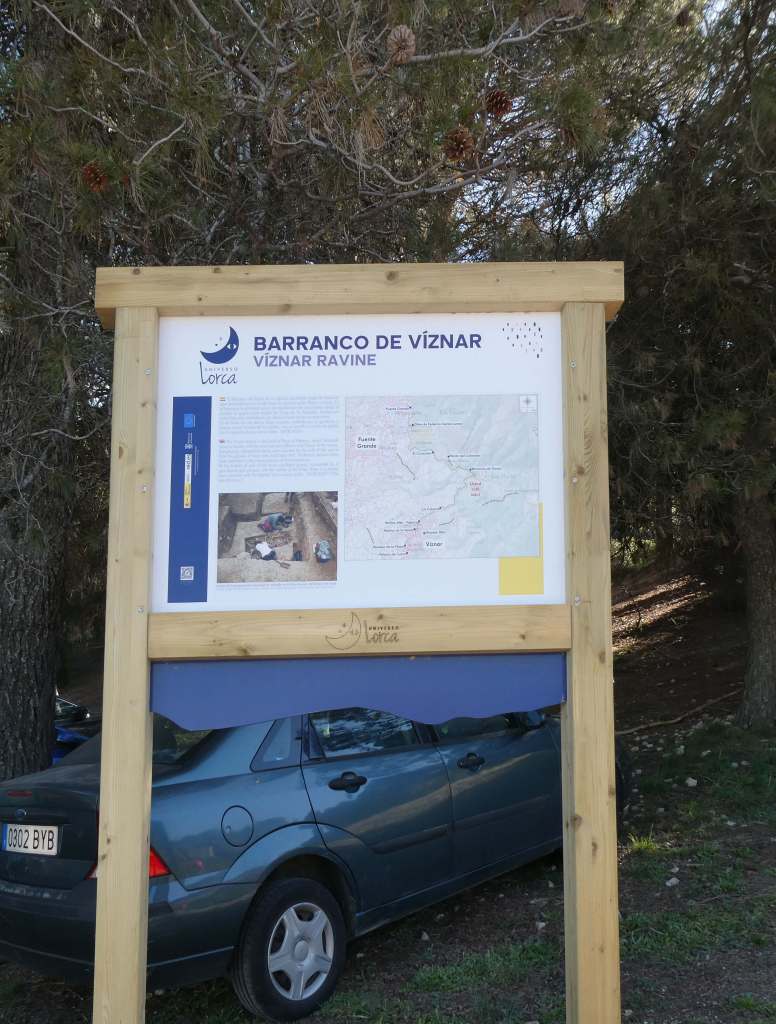
  • Barranco de Viznar: Unearthing Lorca’s Legacy and the Spanish Civil War Tragedy

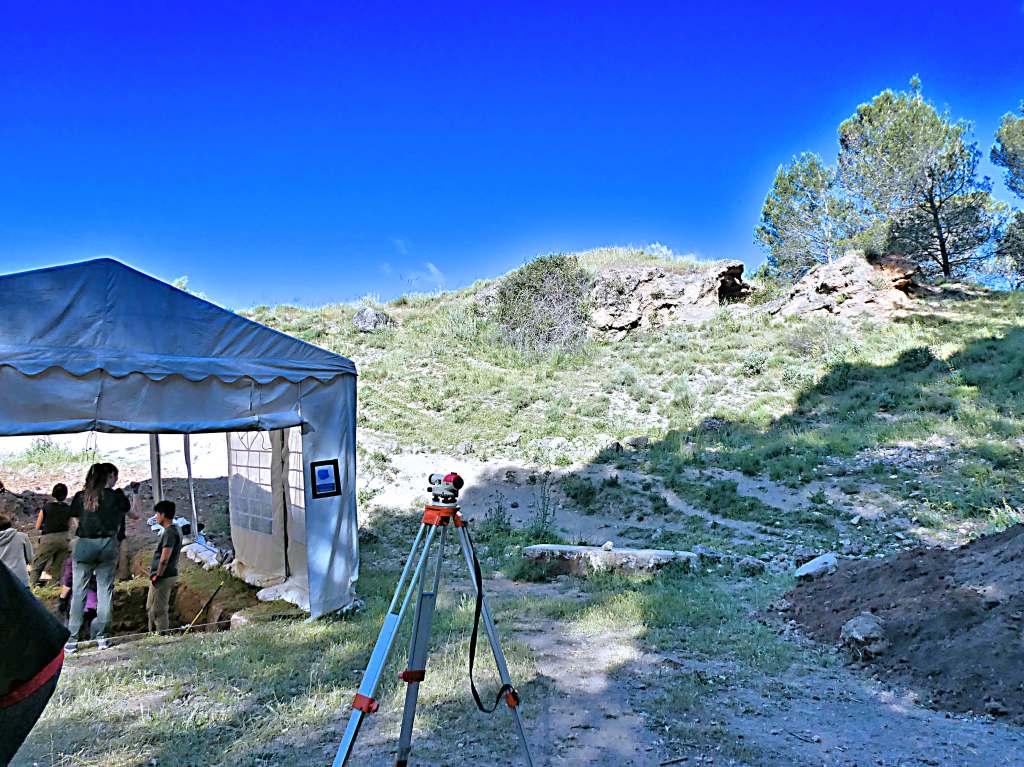
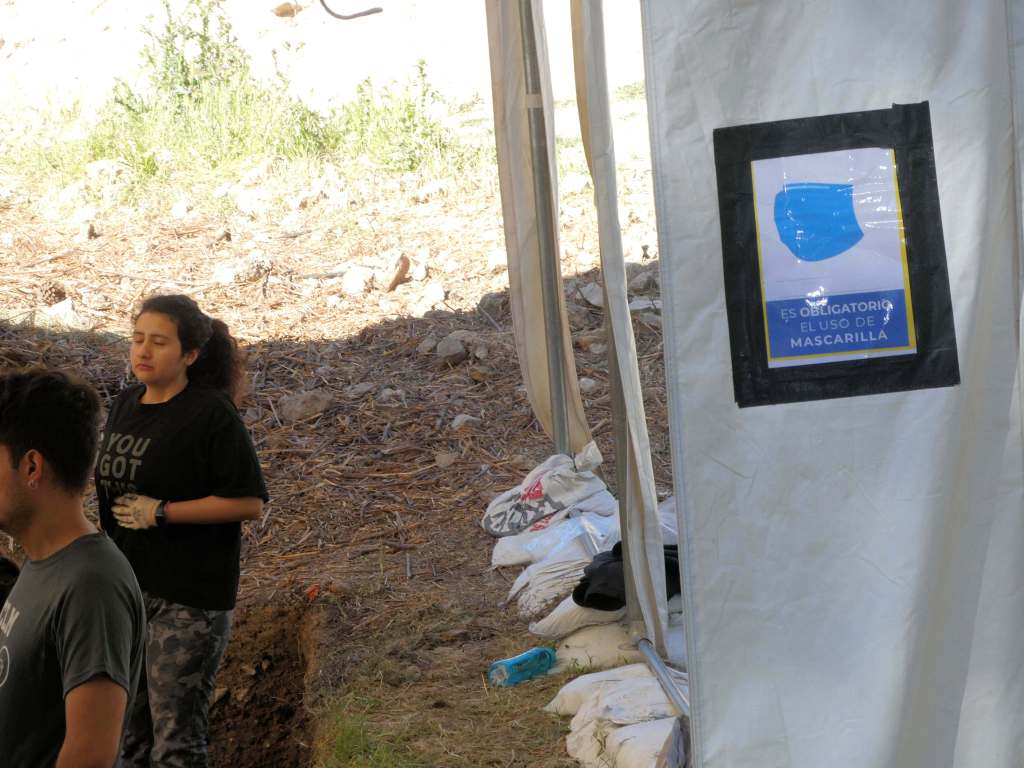
    They work in silence over a hole in the ground, on their knees, lying flat on their stomachs to access the dig. On a table nearby are some bones, skulls too. The harsh sun has bleached the surrounding terrain but there is a little shade in the nearby wooded area and under the gazebo tented area in which they work.

    The Barranco de Viznar has been declared a Place of Historical Memory in Granada, Spain, and as a life-long student of the Spanish Civil War, standing in this sloping, wooded area of about 10,000 square meters on a sharp curve of the road between Alfacar and Viznar, just has to be one of the best moment of 2024 for me.

    We know where the bodies are

    Imagine being given the opportunity to visit the site where the exhumation of thousands of young men assassinated by Franco’s troops during the Spanish civil war is taking place. Between September and November 1936, at the start of the Spanish Civil War (1936-1939), it is reckoned that at least 173 people were killed here and thrown into mass graves. Even earlier, in July and August, just after the coup d’état that triggered the war, there had been other assassinations, including that of the poet Federico García Lorca, but no record was left of them.

    Imagine how overwhelming it was , as a lover of Lorca’s poetry and plays, to be given the privilege of visiting the place where his assassination is presumed to have taken place in the opening days of that terrible conflict, and to talk with those involved in the ‘dig’.

    In Lorca’s Footsteps in Granada

    That is what happened when my friend Kathleen and I visited Granada recently to renew our acquaintance with a city that had charmed us both decades ago. We found it virtually unchanged, still intensely Spanish, catering mainly to Spanish visitors and still with the best tapas bars in Spain, but giving nods to a more modern vibe with the addition of Gin bars!

    Our idea was to walk In the Footsteps of Federico Garcia Lorca, guided by the Ian Gibson book of the same name, and it was while we were doing this that we had a serendipitous encounter with a Granada local who shared our enthusiasm and who invited us to visit the dig in Viznar.

    The Barranco de Viznar and its secrets

    The Barranco de Víznar is a ravine in the province of Granada, Spain, where a team of researchers made up of archaeologists, geophysicists, anthropologists, forensic experts and historians led by Francisco Carrión Méndez, a Senior Lecturer in Prehistory and Archaeology at the University of Granada has been searching for the bodies of the those assassinated during the Spanish Civil War, and searching for one in particular, the poet and playwright, Federico Garcia Lorca, one of the first to be killed.

    How Many Assassinations

    No one knows exactly how many were assassinated in the Spanish Civil War but it is estimated that it was more than 500,000, thousands of whom were massacred in the Province of Granada, some, including Lorca, even before Franco’s military coup.

    In the area of Viznar, to date, they have located 16 mass graves and recovered 124 bodies. In one mass grave they found the bodies of 10 people with gunshot wounds to the head and their hands tied behind their backs.

    The area of Barranco de Víznar was replanted with a thick forest of pine trees which has covered up the graves left after the mass executions committed by platoons of assault guards, part of the ferocious repression that followed the uprising.

    How is the Dig Funded

    The project is funded by the state and the regional government and is being conducted under the 1922  Democratic Memory Law which was enacted following the coming to power of the government of Pedro Sánchez. However, there are fears that this could be in jeopardy and the excavation stopped under a new government.

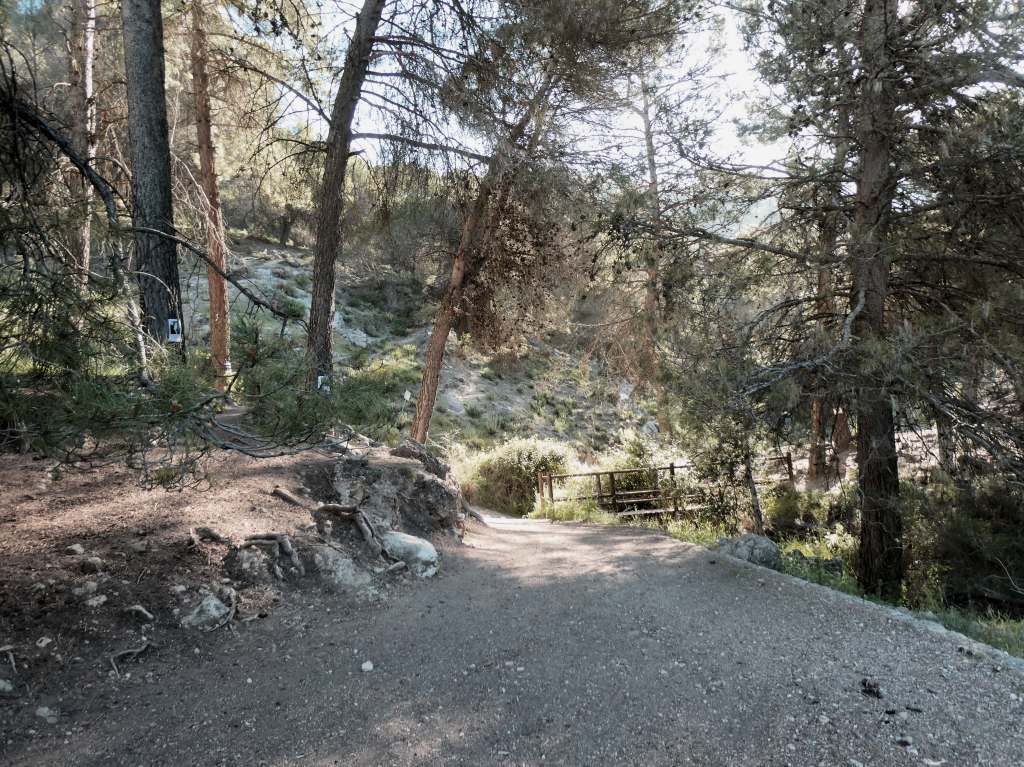
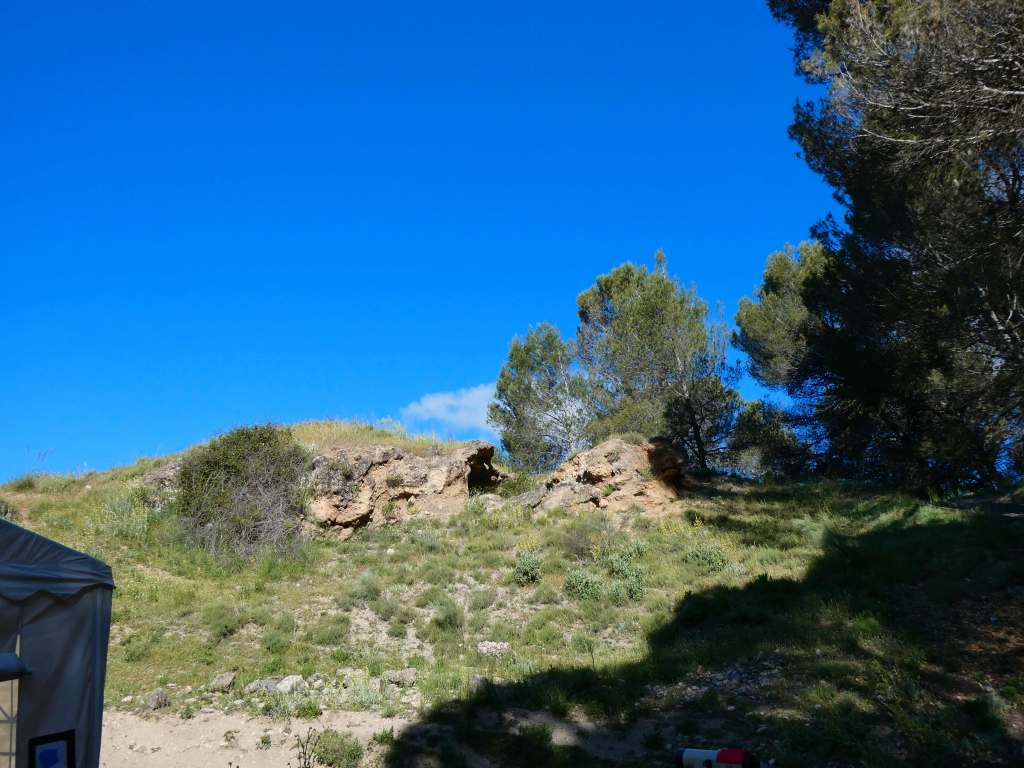
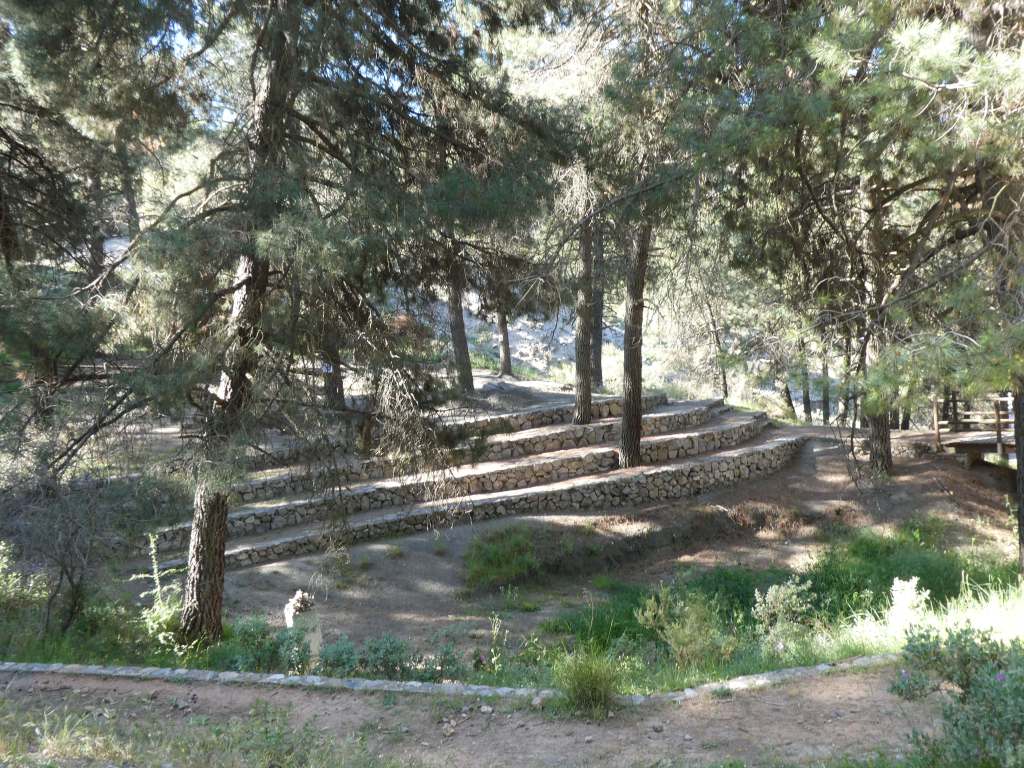
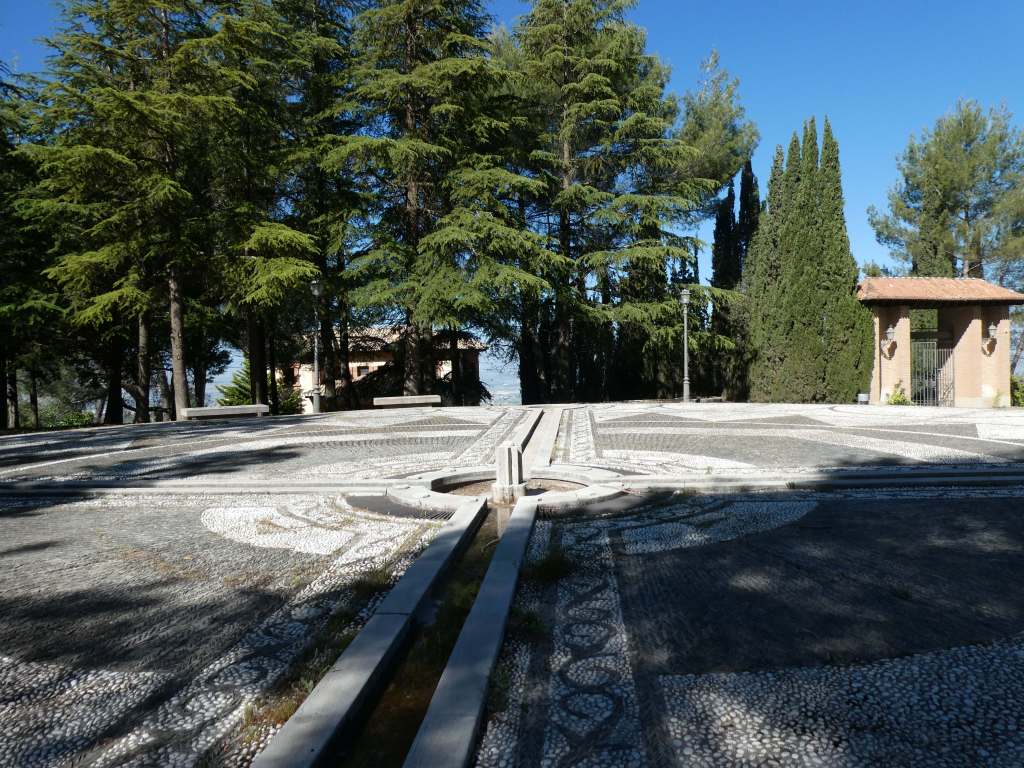
    Some scenes of the Barranco, above. Throughout the woods are dotted tents where the archaeologists and forensic scientists are working, in difficult terrain and extreme heat.

    One of the volunteers told me it usually takes four to six weeks to complete an exhumation, to excavate the personal effects and log, photograph and do the paperwork. Fortunately, the soil in the ravine of Víznar has managed to preserve the bones remarkably well, helpful in identifying the age and sex of the victims, as well as the injuries and the type of violence to which they were subjected. The DNA results can take a long time to come in but when the families are re-united with a family member, it is a great moment.

    Each tree could be a Memorial

    When a family is linked with a body from one of the mass graves via the DNA their permission is requested for a photograph of the victim to be displayed on a tree. Most families agree and it was an emotional moment to wander amongst the trees, see the photographs and read the names and occupations – some academics, a bullfighter but mostly ordinary citizens, killed because of their sympathies with the legally elected Republican government.

    Among the bones of those discovered is a former Rector of the University of Granada, Salvador Vila (above) who was brought from Salamanca to Granada and shot on October 22nd 1936. His wife, Gerda Leimdörfer, daughter of the editor-in-chief of Berlin’s leading Jewish newspaper, the Berliner Zeitung am Mittag, was spared thanks to the mediation of Manuel de Falla, the Spanish composer, who obtained a pardon in exchange for her conversion from Judaism to Catholicism.

    The burial area is accessed over uneven terrain and a paved dirt path has been laid by the City Council of Víznar that after a detour, leads to the main grave which is surrounded by a stone gallery filled with small metal plaques bearing the names and circumstances of those killed, placed there by Historical Memory Associations and the heirs of those shot.

    The Death of Lorca

    Lorca was spending time in the home of family friends, the Rosales, on Angulo Street, on 17th August 1936, when he was arrested and taken just 300 metres away to the Civil Government building, at that time a centre of terror: from there he was quickly transferred to Alfacar and Víznar, two small towns located only ten kilometres away where Franco’s rebel army had created a centre for the extermination of left-wing sympathizers. He was assassinated not only because of his beliefs and his ideology, but because he was homosexual.

    Memorial to Lorca

    All Were Lorca memorial stone

    Within the area there is a simple stone with the legend “All were Lorca. 18-08-2002″ and each year, on August 19, a poetry event takes place here beginning at midnight and lasting until the early hours of the morning. This celebration of Lorca’s poetry originally started as a clandestine event during the last years of the dictatorship and was the first open-air commemoration of Lorca’s assassination.

    The road to Al

    To date, Lorca’s body has not been discovered but hope remains high that one day it will be among those exhumed.

    Postscript:

    The project in the ravine, which is in its fourth and final phase, is now funded by the state and the regional government and is being conducted under the new Democratic Memory Law passed in 2022. It is not certain that this will continue if a more right-wing government should be installed in Madrid.

    Essential Reading

    For the politics of Spain during the Civil War and since, anything by Peter Preston is to be recommended.

    Ian Gibson: Federico García Lorca:  A Life (Faber & Faber)

    Ian Gibson:  The Assassination of Federico García Lorca (Penguin)

    Ian Gibson:  Lorca’s  Granada (Faber & Faber):  This is a great guide book to Granada as it takes you on ten routes, step by step from his birthplace to the site of his execution outside the city via the poets best-loved places in Granada.

    Granada Tourist Board – Patronato Provincial de Turismo de Granada
    Cárcel Baja, 3. 18001 Granada
    Tel: +34 958 24 71 27
    www.turgranada.es<http://www.turgranada.es/>

  • Pull up a seat

    Linked to xingfumama 

    Pull up a seat in the Parque Federico Garcia Lorca in Alfacar, Granada, Spain, and meditate on the poet’s death and those of his 3 close companions, plus the thousands of others assassinated by Franco’s rebel army in the area, just a few days after the outbreak of Spain’s Civil War.

    The Park was inaugurated by the Provincial Council of Granada in 1986 to pay tribute to the thousands shot between Alfacar and Viznar and has been declared a Place of Historical Memory.

    Sombre yes, but good to have such a place to commemorate a great poet and playwright, and the thousands of other victims of the Spanish Civil War..

    Linked to xingfumama 

  • A Battle with BATTLE

    KODAK Digital Still Camera

    Our battle was with the weather, and we were in Battle, Sussex, scene of the Battle of Hastings. If the wind and rain had been as bad in 1066 as it was during part of our stay, I think the Normans might have turned tail and gone back home.

    As it was, we did what we Brits always do, grumbled a bit and then got on with it, struggling against the elements and elbowing our way into cafes to drink mugs of hot chocolate, in between sampling the Award winning local beer, Abbey Pale Ipa brewed by Battle Brewery. A shout out here to the very welcoming Abbey Pub just opposite the Abbey where the fire in the cosy nook added to the welcome.

    English Heritage Accommodation

    We had five days in the area so we managed to see and do a lot. We had a car, lots of reading matter and fabulous accommodation at The Lodge at Battle Abbey, an English Heritage rental which provided us with some of the best self-catering I’ve ever had. It was warm, the heating was superb, the bedrooms were luxurious and comfortable, the kitchen had everything one could wish for, from Jasper Conran china to Joseph utensils and state-of-the-art means of cooking. Oh, and a lovely hamper of local produce to start us off.

    Photographs of The Lodge at Battle provided by English Heritage

    We looked out on green fields where the sheep safely grazed and a flowering crab apple lit up the garden, our rental included VIP tickets to English Heritage sites in the area, discount in the shops and cafes, and access to the Abbey through the grounds in which our Lodge was situated. What more could travellers, history buffs and walkers want?

    One of the houses in Battle High Street

    Location of Battle?

    Lying just 50 miles from London and 27 miles from Brighton, Battle is well placed for visitors to the UK to include a day trip to see the attractive town and its Abbey. It gets its name from the Battle of Hastings, fought between Harold the Saxon king and William the Conqueror in 1066, a battle that changed the course of English history.

    Battle Abbey & St. Mary’s Church

    After he won the battle, William built the Abbey of St. Martin, something he’d vowed to do if he won. Built between 1070 and 1094, the high altar is believed to have been placed on the spot where Harold fell, although this fact is disputed today.

    Looking up Battle’s High Street with cottages and houses dated form the 1700’s on the left.

    The Abbey ruins and the battlefield are a magnificent sight as you look down the length of Battle’s High Street, past the Georgian buildings that line the street. At the northern end can be found the Almonry, built in 1090, which now houses the Town Council and the Battle Museum of Local History.

    At the other end of the street, the cottages and houses near the Abbey date from around 1700. The nearby parish church of St. Mary is for the most part 12th century in construction. This lovely old church is worth a visit for its rare 14th century wall paintings and its Norman font, but it also houses a modern tapestry in the style of the Bayeux tapestry, a community project conceived and designed by local inhabitant, Tina Greene. The contemporary tapestry is a three-metre long depiction of how the town of Battle might have grown between the years following the Battle of Hastings in 1066 to the founding of St Mary’s Parish Church in 1115. Started in 2016 and with contributions from 741 registered stitchers, not only from Battle but from the rest of the UK and abroad, the tapestry was finally completed in January 2017.

    Dissolution of the Monastery in 1538

    Battle’s influence grew over the years until the Dissolution of the Monasteries under Henry Vlll and the closure of the Abbey in 1538. In later centuries however, the town achieved fame through its charcoal-making technique and Battle became famous in the 17th and 18th centuries for its gunpowder, rated by Daniel Defoe as the finest in Europe.

    Battle Today

    Now today, this quiet market town concentrates on the finer things in life and, apart from its great historical appeal, it offers the visitor great food experiences from the comfort of tiny cafés and tea rooms that spill out onto the pavements (and a special mention here to Bluebells Tea Rooms) to fine dining at chef Paul Webbe’s The Wild Mushroom, in nearby Westfield, right up to tastings at Oastbrook Estate Vineyard.

    Shopping is a delight too, as Battle’s historic high street features many of the type of shops you don’t often see elsewhere, independent clothes shops, craft shops, wool shops and book shops, and my favourite, the delightful British Design British Made, showing the best of British design. For beer lovers, Battle Brewery and Bottle Shop is a don’t-miss, offering beer from their own microbrewery as well as other locally produced ciders, wines and snacks.

    There are mapped walks ranging from 4.5 miles to 37 miles and the helpful tourist office can offer guidance on these.

    In fact, the weather doesn’t really matter in Battle as there is just so much to do. I know this for a fact, five days in Battle flew by and we even made time to visit Hastings (more about that another day).

    Facts:

    For a selection of English Heritage accommodation: https://www.english-heritage.org.uk/visit/holiday-cottages/ I have previously stayed at Walmar Castle in Deal and Osborne House on the Isle of Wight, both of which I highly recommend.

  • New Orleans: Tennessee Williams Festival

    New Orleans: Tennessee Williams Festival

    In With a Shout.

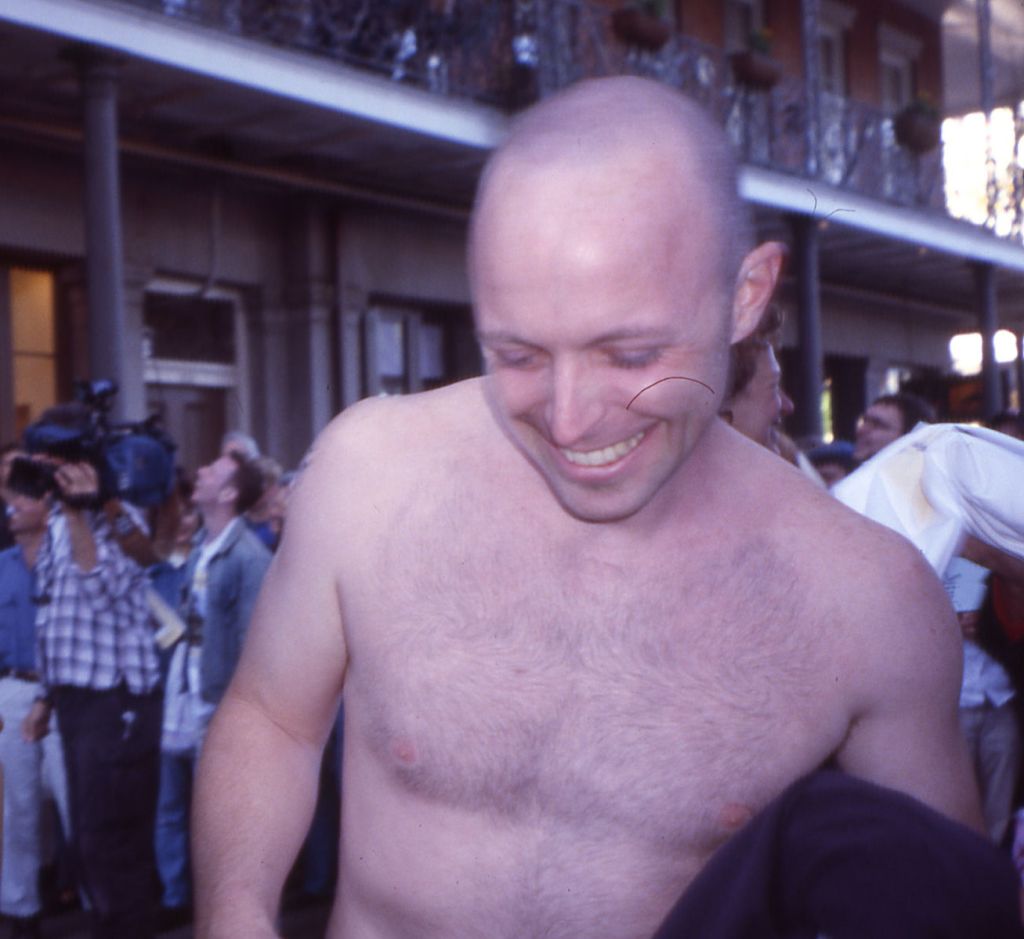
    One of the Apps on my computer offers what it calls Memories. It flags up a photo taken on the same date years before. A few weeks ago, the photograph was one taken some years back at the Tennessee Williams Literary Festival in New Orleans.

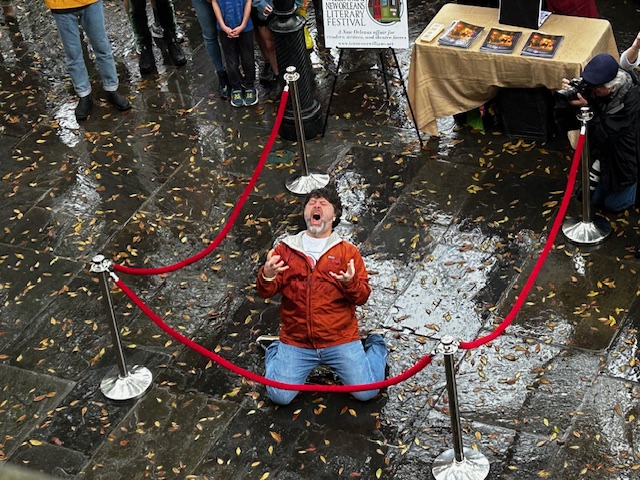
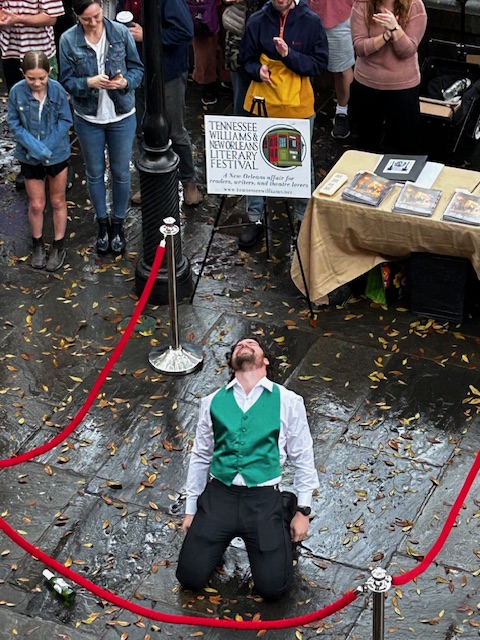
    My photo was one taken at a very quirky part of that festival – the ‘Stella Shouting Contest’ – a homage to A Streetcar Named Desire and the character of Stanley Kowalski, the hero/antihero of the play.

    Image from Wikicommons

    The Stella Shouting Contest in New Orleans

    Stellllllaaaaa! Stellllllaaaaa!”

    The cry reverberates around the French Quarter of New Orleans and the crowd jostling in the packed courtyard applauds. From the balcony above, Stella waves to the damp-haired man in the sweat-stained shirt below who blows kisses to the crowd as the next tee-shirted Stanley steps forward to chance his luck at outshouting the other participants.

    For this is the Stella Shouting Contest, part of the Literary Festival, held for nearly 40 years in honour of New Orleans’ favourite son, the playwright, Tennessee Williams. The Stella contest pays homage to his classic A Streetcar Named Desire and for the last three decades or so, the primal screams of wannabe Stanley Kowalskis have been echoing around the magnolia-laden French Quarter to mark the Festival.

    A Streetcar Named Desire

    “They told me to take a street-car named Desire, and transfer to one called Cemeteries, and ride six blocks and get off at Elysian Fields”, says Blanche when she arrives at the house in which her sister Stella lives with Stanley.

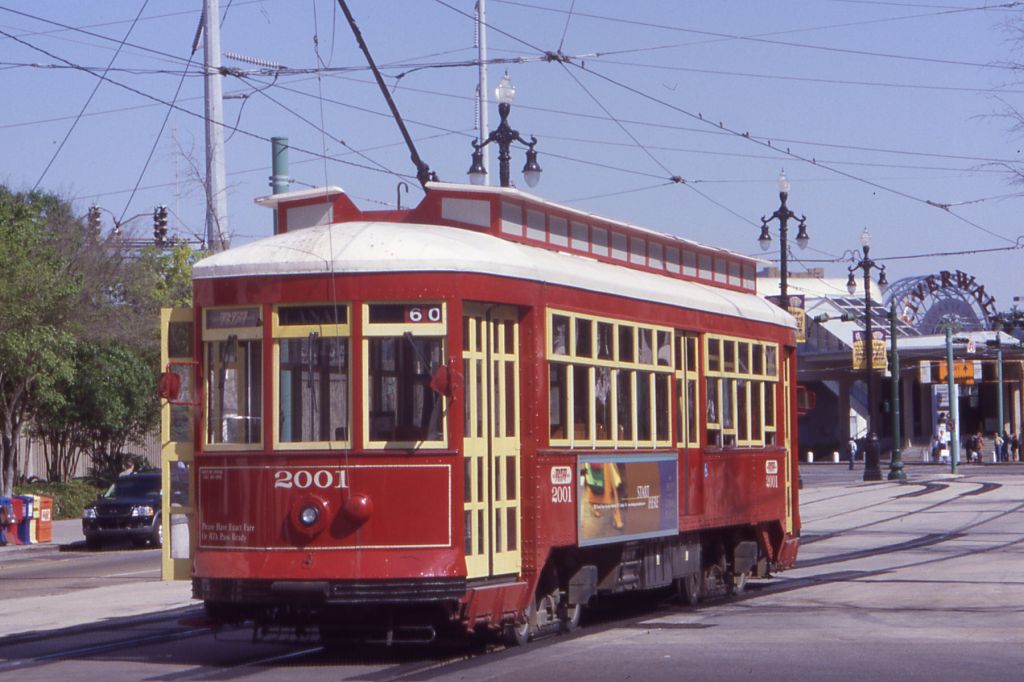
    Williams used the title metaphorically: there was no street-car named Desire trundling along the tramlines to Stella’s house, but there was, and is, Elysian Fields Avenue, a name is forever linked to the steamy tragedy of Stella, Stanley and Blanche.

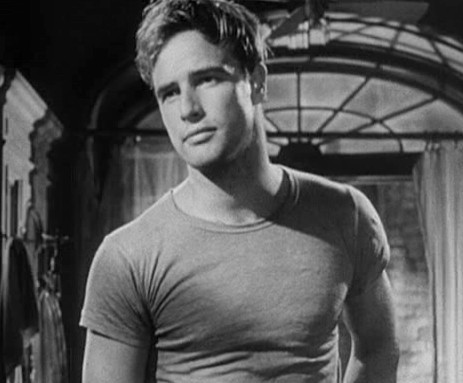
    Image from Wikicommons (Brando in Streetcar)

    Marlon Brando in Streetcar

    Marlon Brando played Stanley in the original Broadway production, and in the 1951 film adaptation of the play, he set the standard for all future Stanleys. His despairing “Stellllaaaa” echoed around cinemas and lodged in the minds of filmgoers forever when drunk, sweat-soaked and half-dressed, he stumbled onto the sidewalk and fell to his knees, bellowing for his wife, “Stellllaaaa” – probably the most famous line from any of Williams’ plays. Little did anyone guess then that this angst-ridden howl would one day become a feature of one of the USA’s Literary Festivals.

    What Happens During the Literary Festival

    Events like the Stella Shouting Contest, theatre productions, in-depth writing workshops, and lectures from best-selling authors on everything from scene-setting to stereotypes in fiction, attract attendees from all over the world. Giants from the world of literature and theatre mingle with would-be-playwrights and authors, to offer advice, give talks and join in the celebrations, all overlain with that N’awlins easy charm.

    What Happens in the Stanley Shouting Contest

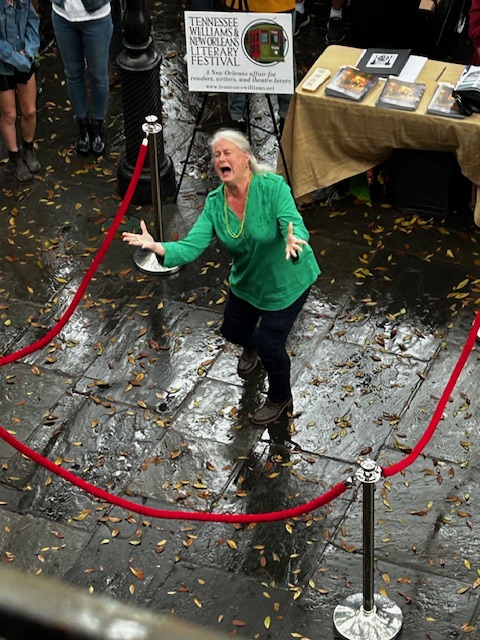
    The famous scene, and the scream, is replayed again and again by men who come to The Big Easy to test their screams against other men. Technically it’s a Stanley/Stella shouting contest as females can also take part, but as Stella didn’t yell “Stanley” it doesn’t resonate with the public in quite the same way so there are few entries on the Stella side.

    Photo credit: Tennessee Williams Literary Festival

    Standing beneath the filigreed balconies of the houses around the green oasis of Jackson Square the contestants direct their howls of desire and angst at local actors attired as Stella and Blanche on a balcony above. Celebrity judges lounge on adjoining balconies, while festival go-ers and voodoo hustlers jostle for positions from which to watch the fun.

    One by one the contestants give it their best shot in the allotted three shouts in which they must portray Stanley’s despair, rage and emotion. They fall to their knees, tear their shirts – the iconic torn white tee-shirt is a given – and douse themselves with water to conjure up the image of Stanley’s sweat-soaked torso.

    To whoops and cheers, six finalists are selected and they go on to compete a few hours later, on the main stage of Le Petit Theatre, the venue for the Festival’s workshops, play readings and lectures. We, the onlookers and audience, troop in after them, by now having a favourite to encourage in the tension-filled finals.

    Interior of Le Petit Theatre

    On the stage at Le Petit, the Stanleys now scream with more gusto and histrionics, encouraged by their fans in the crowd. Hyped up – alcohol may play a part as well – cheering for their man and booing the opposition, the audience sounds as primal as Stanley.

    All this for the grand prize of the Golden Stella Trophy, holidays in New Orleans, hampers of local goodies, and trips on Ole Miz, the muddy brown Mississippi.

    Interior Courtyard of Le Petit Theatre by David Ohmer, creative commons.org/licenses/by/2.0 via Wikimedia Commons

    Few Festivals have such a strong performance element as the Tennessee Williams Literary Festival – two full-length plays and several one-act plays of the master are usually staged alongside film screenings, tours of the French Quarter, book signings, and jazz evenings. All this plus work-shops and lectures from writers like David Simon, James Lee Burke, Richard Ford, Laura Lipman, and dozens of others. You’re bound to meet your favourite author there and for some reason, crime writers are particularly well represented.

    Tennessee Williams – Photo: Orlando Fernandez, World Telegraph staff photographer, via Wikimedia Commons

    New Orleans

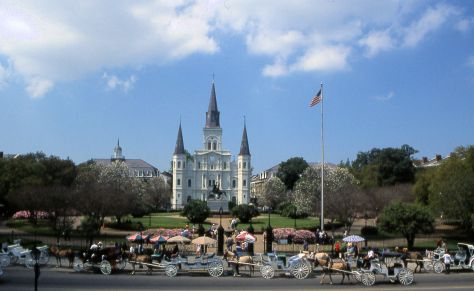
    The Big Easy still lives up to its motto of ‘Laissez les bon temps rouler’ – let the good times roll – and outside the theatre the city goes about its business, partying along Bourbon Street and entertaining the tourists in Jackson Square where the voodoo priestesses, hawkers of hats and beads, and groups of wild looking Cajun and Zydeco musicians straight from central casting come together in a gloriously chaotic, laid-back cocktail.

    There are also city tours, swamp tours, plantation tours, and that old standby, shopping, and that for which New Orleans is best known – music – from trad jazz to funk, zydeco to gospel. While there you can take in a session with one of the city’s best bands, Jon Cleary and the Monster Gentlemen Band, who will take you on a jazz voyage like you’ve never experienced before.

    St. Louis Cathedral, New Orleans, the oldest continuous use cathedral in the USA.

    So if you’re in the area next March and fancy your chances of being a ripped-shirt Stanley with a voice that could persuade Stella not to leave him, then go for it.

    Tennessee Williams loved this mixture of the pious and the profane, the sinners and the saints – isn’t that what all his plays are about?

    Get ready to party New Orleans style.

    Factfile:

    The 38th Annual Tennessee Williams/New Orleans Literary Festival took place this year between March 20th—24th. Next year’s dates not yet published. Sign-up for the Stella Shouting Contest will begin at 1.30 3 or 4 days prior to the opening.

    The Tennessee Williams Literary Festival: 938 Lafayette Street, Suite 513, New Orleans, Louisiana 70113. Tel: 504 581 1144. info@tennesseewilliams.net


    British Airways flies direct to New Orleans from £575 Return and also offers hotel bookings. Other airlines fly via Chicago – a good place for a stop-off.