Blog

  • Cliff Diving at Mostar, BosniaHerzeGovina

    Cliff Diving at Mostar, BosniaHerzeGovina

    p1150743
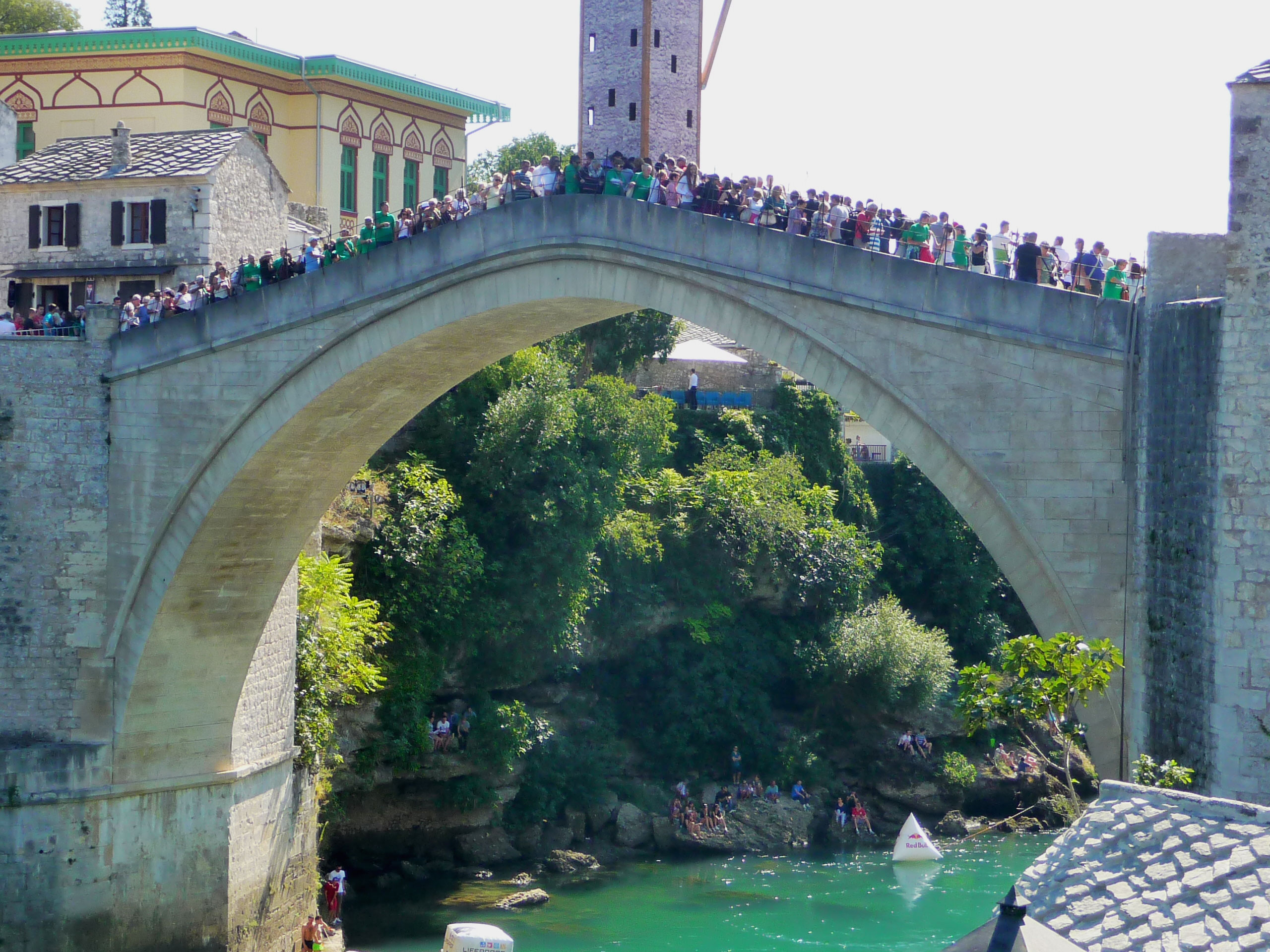
    Thronging the Bridge to see the Cliff Dives – Mari Nicholson

    I must confess that when I visited the world famous Mostar Bridge in Bosnia-Herzegovina a few weeks ago, my attention was easily diverted from the historical reasons for my visit.  Surrounded on all sides by the travelling fans, plus hundreds of local fans of the Red Bull Cliff  Divers, I jostled with everyone else fo a place from which to view the adrenalin fuelled dives of these young men and women.

    p1150752
    Preparing to do a Back Somersault off the Platform – Mari Nicholson

    I had been unaware of the event until I got there so had to do a quick check on who was in what position, something I found fairly easy as the Mostar locals are all big fans.  I was even informed that my own countryman, the young British diver Gary Hunt, was lying in fourth position at the time (he subsequently came in second in this trial).

    checking-the-distance

    Checking that all is well

    You can read about the Stari Most Bridge (colloquially known as the Mostar Bridge) in my earlier post put up this afternoon so I need not go into its historical importance here, nor mention the terrible war in which it was destroyed.

    p1150742

    Awaiting the “rescue” divers below.

    The Iconic Stari Most bridge served as launch point for 22 male and female athletes during the Red Bull Cliff Diving World Series’ 7th stop on 24 September 2016 in Bosnia and Herzegovina.  Five-time champion Gary Hunt had missed out on a win in the previous two stops – in the past six seasons the brilliant Brit has never gone more than two stops without a win.

    p1150753

    It may be a coach with the diver – Mari Nicholson.

    I haven’t seen any of these Cliff Diving Championships before live, although I have watched some of them on media outlets but the stunning setting of Bosna-Herzegovina’s most renowned landmark, where diving has been a tradition dating back to the 17th century, has made me a total fan.  The city’s diving enthusiasts have warm-heartedly welcomed the 22 World Series athletes for many years now and introduced them to their preferred take-off point high above the Neretva River.
    p1150750

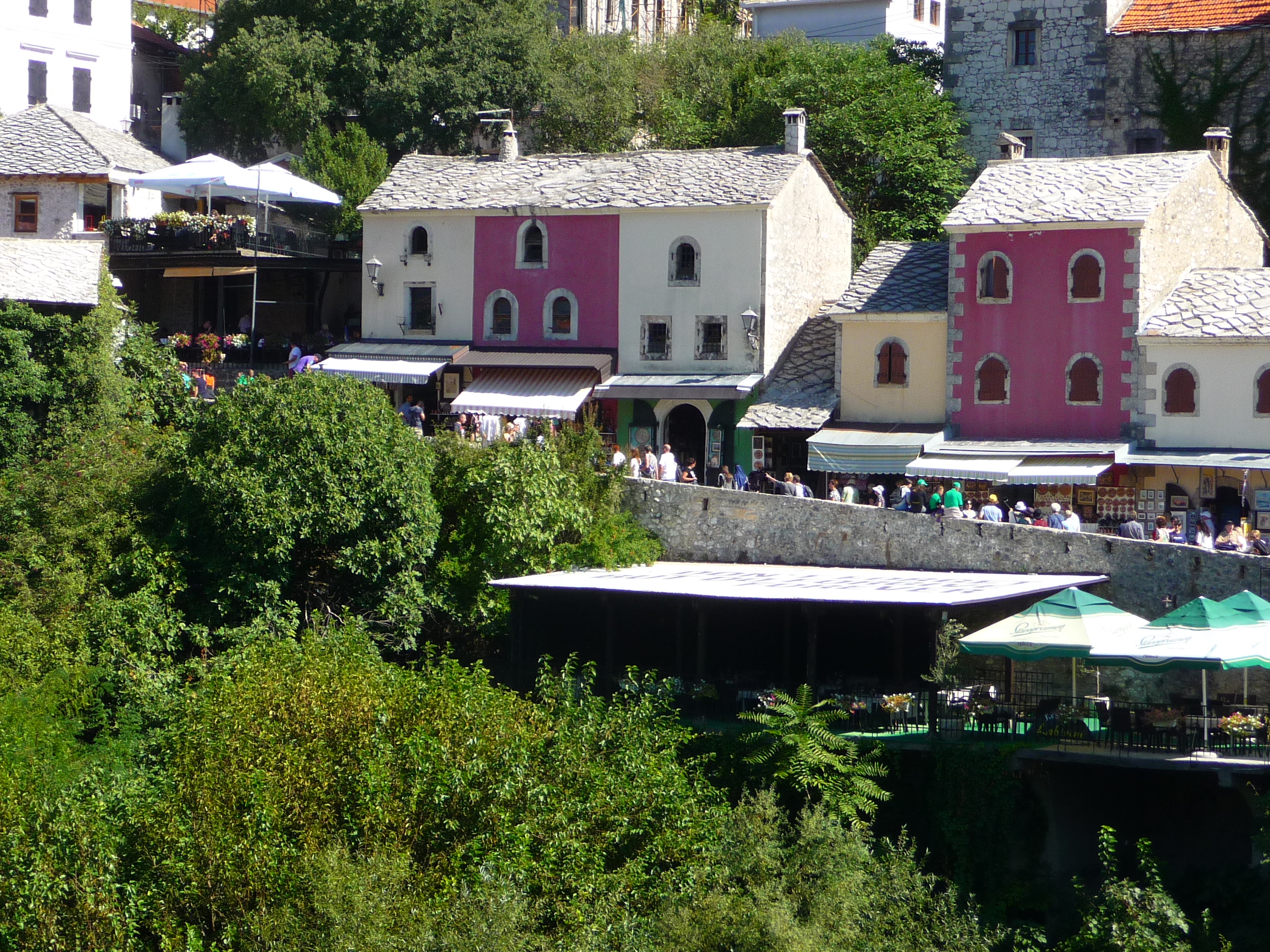
    There are Vantage Points Everywhere – Mari Nicholson

    “This town lives for diving and lives for this bridge,” my waiter told me as we gave our order in Restaurant Teatro, a balconied eatng place that offered a fantastic view of the bridge, the crowds, and the amazing turquoise river below with the colourful rescue canoes and the wet-suited divers.  He seemed to know everyone in the competition, from much respected Columbian Orlando Duque right down to the 25-year-old wildcard Australian female diver Rhiannon Iffland, here to battle it out with Canada’s Lysanne Richard.

    p1150756

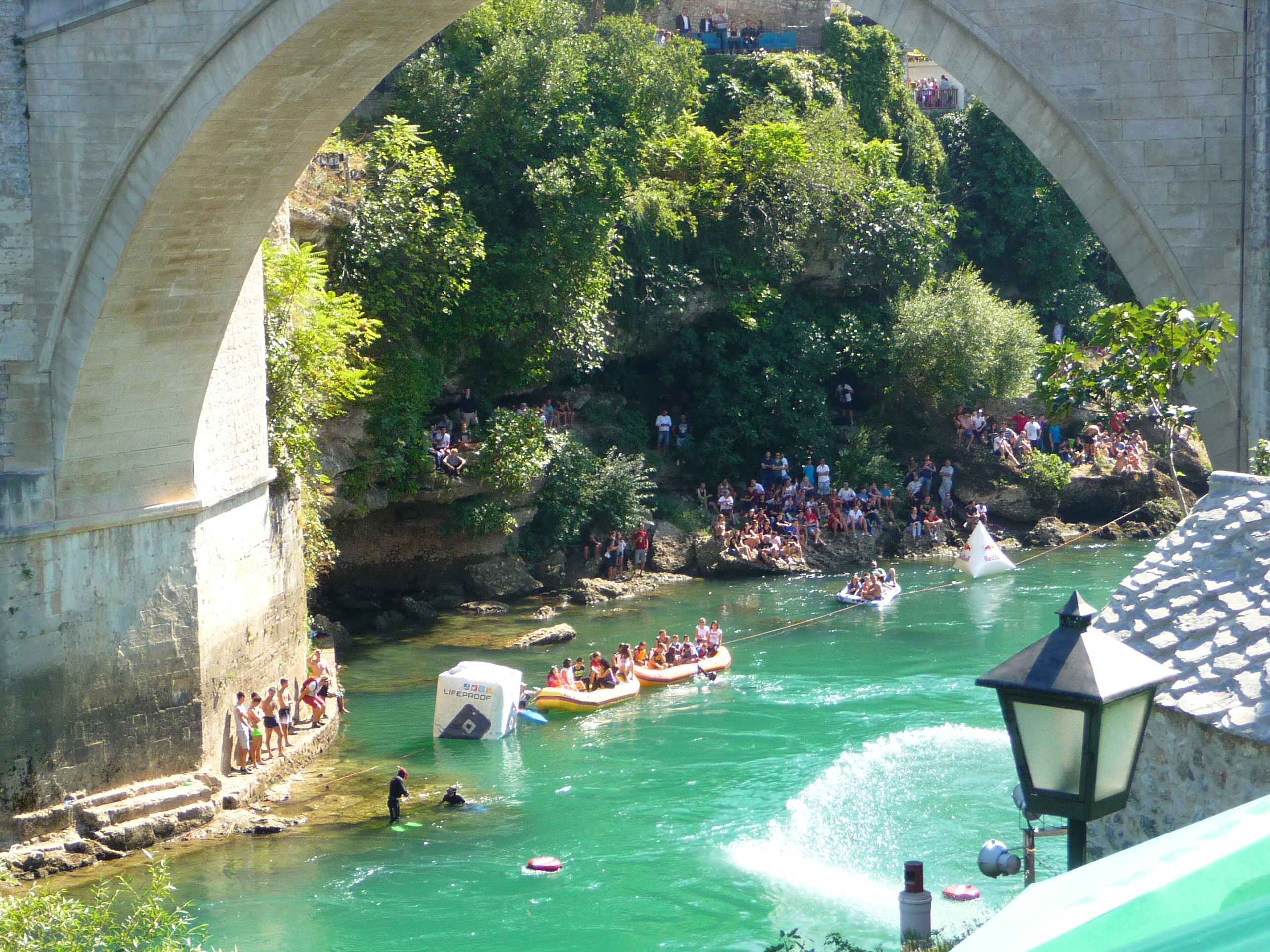
    The Diver Enters the Water and rescue is at hand should it be needed – Mari Nicholson

    The first dives off the bridge date back more than 400 years, my waiter told me, but in the current competition, the men dive from a platform 28 metres high and the women from the bridge at 21 metres high.  Eternalized in the city’s flag and coat of arms, life in Mostar has been centred on the humpback bridge ever since its construction in the 16th century as the young men plunge into the Neretva River to prove their courage in a test of maturity.
    p1150755

    The colour of the water looks inviting – but from 85 feet??  – Mari Nicholson

    Competition cliff diving dates back to 1770, when King Kahekili, the last king of Maui (Hawaiian islands), leapt from Kaunolu, a 63-foot (19-meter) cliff and entered the water below without causing a splash.  Later, he made his warriors jump from cliffs to prove their courage and loyalty.  It is probably the easiest sport for the enthusiast to enter as there is no equipment to buy and no special clothing to wear.  All you need is nerve, a fit body, and the ability to sail through the air from a dizzy height and plunge into waters below, avoiding cliffs and jutting rocks as you descend.

    mostar-765787_1280

    Old Mostar and the bridge – Photo Pixabay

    The teams tour the world as they compete in different countries each month in front of top judges from the sport.  More information and pictures can be seen here.   It really is thrilling.

    See also:  Mostar, UNESCO World Heritage Site in Bosnia Herzegovina.

  • MOSTAR, UNESCO World Heritage Site

    MOSTAR, UNESCO World Heritage Site

    Dalmatian Sights:

    p1150750

    Modern day Mostar – Mari Nicholson

    Famous for the bridge that was destroyed in the 1990 conflict in the Balkans, the historic old town of Mostar in Herzegovina that spans the deep valley of the Neretva River, is somewhere that should be visited by anyone who travels to Dalmatia.   Most of the old town, as well as the bridge, was destroyed in that dreadful war, signs of which are still in evidence around the area.

    present-day-mostar-looking-from-the-bridge

    Mostar, Astride the River – Mari Nicholson

    Dating back to the 15th century, Mostar was developed as an Ottoman frontier town and was further developed during the 19th and 20th centuries when the Ottomans were seemingly unstoppable as they pushed at the gates of the Austrian-Hungarian Empire.

    mostar-bridge
    Old Bridge – Photo Pixabay

    Long known for its old Turkish houses and the iconic bridge, Stari Most, after which the town is named (mostari meaning the bridge-keepers) many of the dwellings in the Old Town were restored or rebuilt in 2004 with the help of UNESCO.   The Old Bridge was originally designed by the architect Hajruddin, under the direction of his famous architect teacher Sinan, and its reconstruction was based on thorough and detailed analyses, use of authentic materials and techniques: the reconstructed portions have been left visible.

    colourful-souk-on-way-to-bridge-mostar

    Before the war, Muslims, Christians, and Jews, mosques, churches, and synagogues existed side-by-side indicating that the Roman Catholic Croats, the Eastern Orthodox Serbs, and the Sephardic Jews, had lived peaceably together with the Bosniak-Muslims for more than four centuries and the town is an outstanding example of a multicultural settlement with its pre-Ottoman, eastern Ottoman, Mediterranean and western European features. cafe-near-entrance-to-the-souk-mari-nicholson

    It is hoped that the reconstructed old bridge and city of Mostar will serve as a symbol of the coexistence of the diverse cultural, ethnic and religious communities in this region.

    mostar-old-town
    Old Houses, Mostar – Photo Pixbay
    mostar-bridge-2016-watching-the-cliff-divers
    Mostar Bridge today (watching the Cliff Divers)
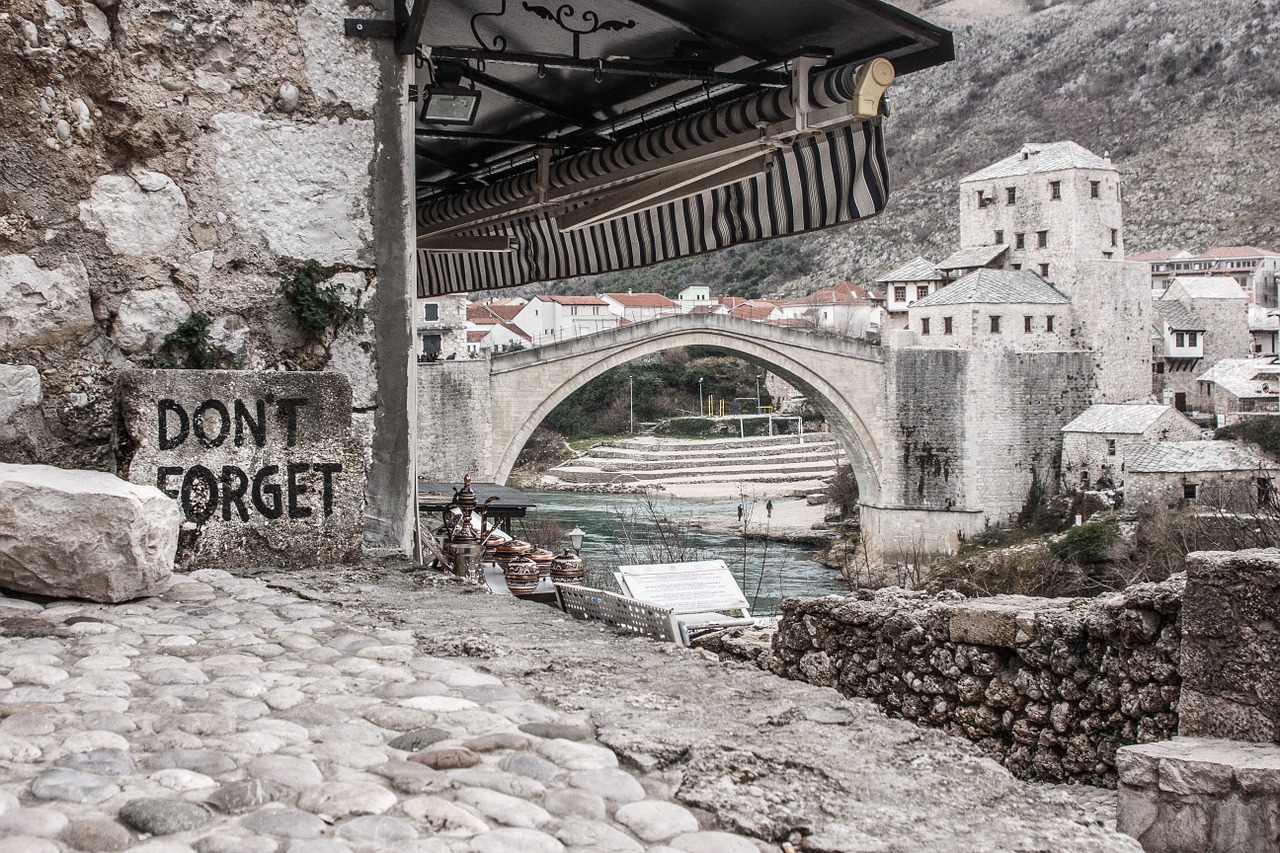
    dont-forget-mostar
    A Plea from the Heart – Don’t Forget the Past – Photo Pixabay
  • Weekly Photo Challenge: H2O

    No rain promised in my area for a while so I’ve looked through my photos to see what I could come up with and here are two.  Both of these were taken in Thailand, one in Koh Samui, the other in Hua Hin on the Gulf of Siam just a couple of hours drive from Bangkok.

    you-can-have-fun-with-a-polystyrene-box-lid-even-without-an-x-box
    Having fun at Hua Hin, Thailand

    This little boy was having the time of his life on his polystyrene box lid which served as a raft from which he was trying to catch fish.  I don’t think it mattered whether he caught any or not, the fun was in trying, and in having such a marvellous float to carry him along the seashore.  Don’t worry, Dad was trawling the near water keeping an eye out so that he didn’t drift off.  They had little money, it was obvious.  Mum was digging in the sand for tiny little sandfish and crabs for supper and his sisters were gathering leaves from the hedges around.  Tech toys were unknown to him and even though I am sure he hankered after them, I confess I hoped he could continue to enjoy the childlike life he was having at the moment I took this photograph.

    koh-samuii-in-rainstorm
    Torrential rain in Koh Samui, Thailand

    Oh dear, it wasn’t supposed to rain in Koh Samui, but it did, and heavily.  Two days of torrential rain rendered the hotel’s umbrellas unusable, the decking awash, and the grey sea a hazard if one wanted to swim.   Day and night it pounded the beach, the noise like thunder at night.  Room service was needed but by the time food got to the rooms it was cold – and sometimes very wet – so everyone waded through the water to the restaurant where the staff did their best to serve us with hot food.

    Two days later it was all over.  We woke up to sunshine, dry decking, dry beaches and a placid blue sea.  Had it really been as bad as I remember?   As the locals say, “TIT” – This is Thailand”.

  • Weekly Photo Challenge: Nostalgia

    The  last days of summer, the last two deckchairs on the beach, coats on because the weather has turned really cold on this early Autumn day.   Maybe it was just the contrast with the former sunny days that made this party don what looks like winter gear?  Who knows, but the scene struck me as somewhat forlorn.

    last-days-of-summer

  • Weekly Photo Challenge: Nostalgia

    I hate to think how many years ago this was.   Rubbing down, preparing, under-coating, top-coating an entire broken-down house.  I look back in wonder at the energy and enthusiasm we had then, but I also look back with gratitude at the fun we had in doing up an old house and then standing back and saying, this is all our work.

    firgrove-kitchen-1965


  • Montpelier:  Antigone Area

    Montpelier: Antigone Area

    Montpelier had been experiencing rapid growth since the 1970s.  The city was on line to become the new regional technology centre and there was a need for expansion and for more public housing.  In 1979, the newly elected municipal council of Montpelier, with far-seeing vision, decided to develop a whole new district to provide for this expansion and link the centre to the River Lez.  The plan for the stunning development incorporated a west-east axis consisting of a landscaped boulevard and a series of squares enclosed by residential blocks each of seven-stories, to terminate in a new waterfront “port” along the Lez.

    p1080172

    Magnificent Buildings along the 1 Kl-length of Antigone – Mari Nicholson

    Thus did Antigone, surely the most attractive of new developments in France, c0me into being.  The 1-Kilometre length of this development was built on the grounds of the former Joffre Barracks, located between the old centre of Montpelier and the River Lez which meanders along the eastern side of the city.  It is known as the Champs-Élysées of Montpelier and the master plan was designed by Spanish architect, Ricardo Bofill – who also designed the majority of the buildings – as a series of grand neo-classical structures with pediments, entablatures and pilasters on a gigantic scale.

    greek-heroes

    Neo-Greek Statues with Fountain – Mari Nicholson

    The Antigone squares are idealised, perfectly proportioned Renaissance spaces with grand names like La Place du Nombre d’Or.  Neo-classical Greek statuary that harks back to another age is dotted about the boulevards and plazas in streets that were planned to allow a paved walkway from Place des Echelles de la Ville to the River Lez.  A continuous movement of wheeled devices and small battery-powered minibuses provide transportation within the mall.

    Antigone is an enormous project in every respect.   It includes about 4,000 new dwellings and 20,000 sq. meters of commercial space, the Languedoc-Roussillon regional government headquarters, office space, various government offices, restaurants and cafes, schools with special housing for students and artists, sports facilities, and underground parking.  This new development is town planning n a grand scale.

    among the water spouts with Greek statue centre – Mari Nicholson

    The only other project of this size and scale designed by one architectural firm is the Karl Mark Hof in Vienna, but this has a mere 1500 dwellings as compared to the 4,000 at Antigone and almost no other services.

    p1080197
    On the River Lez there are various watersports for the public – Mari Nicholson

    A visit to this remarkable area of Montpelier makes it easy to see why it continues to attract worldwide attention.

    This slideshow requires JavaScript.

  • Weekly Photo Challenge – Mirror

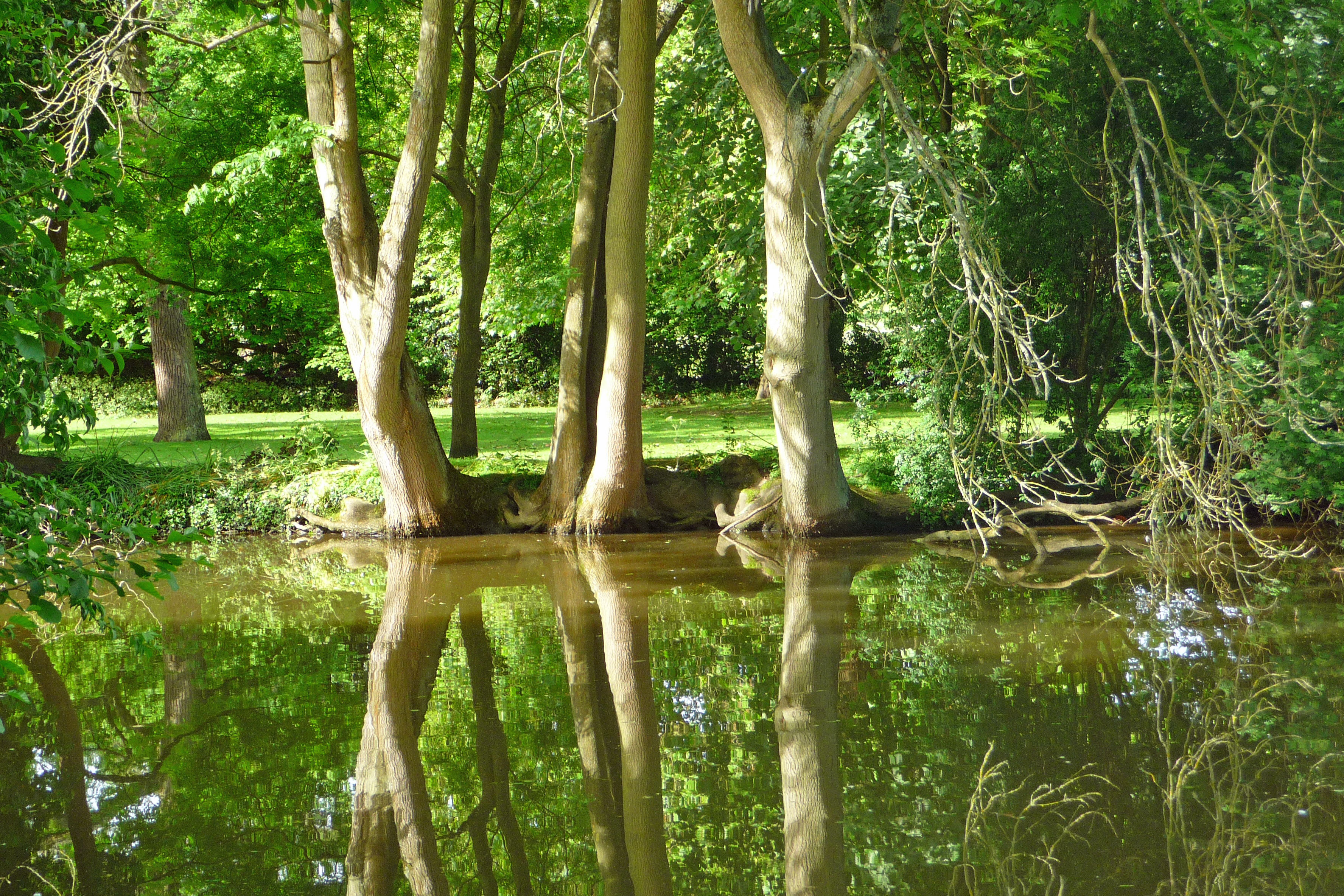
    My photograph this week pretty basically depicts the challenge word, Mirror, and shows just a reflection.  It is, however, one of my favourite photographs from a fondly remembered day spent recently in lovely St. Albans in the UK, formerly the ancient Roman city of Verulanium.

    The picture was taken in the grounds of a hotel in the town where I was attending a wedding.  I’d escaped for a few moments to wander through the 20-acres of beautfully landscaped gardens and as I came upon the quiet waters of this lovely lake the symmetry of the trees reflections had me reaching for my camera.

    Reflections-in-the-Lake,-St

  • Palavas les Flots – Montpelier’s Seaside

    Palavas les Flots – Montpelier’s Seaside

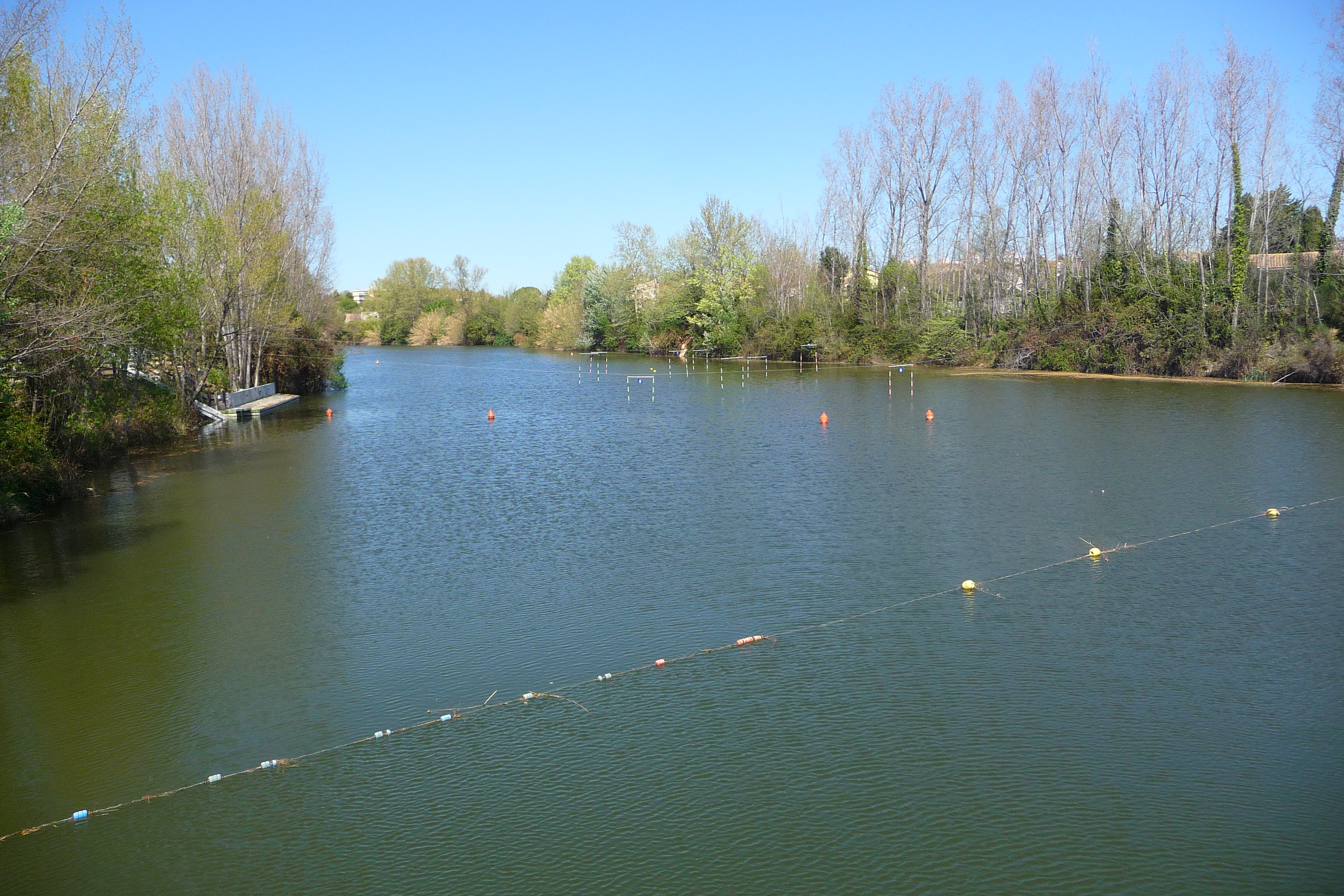
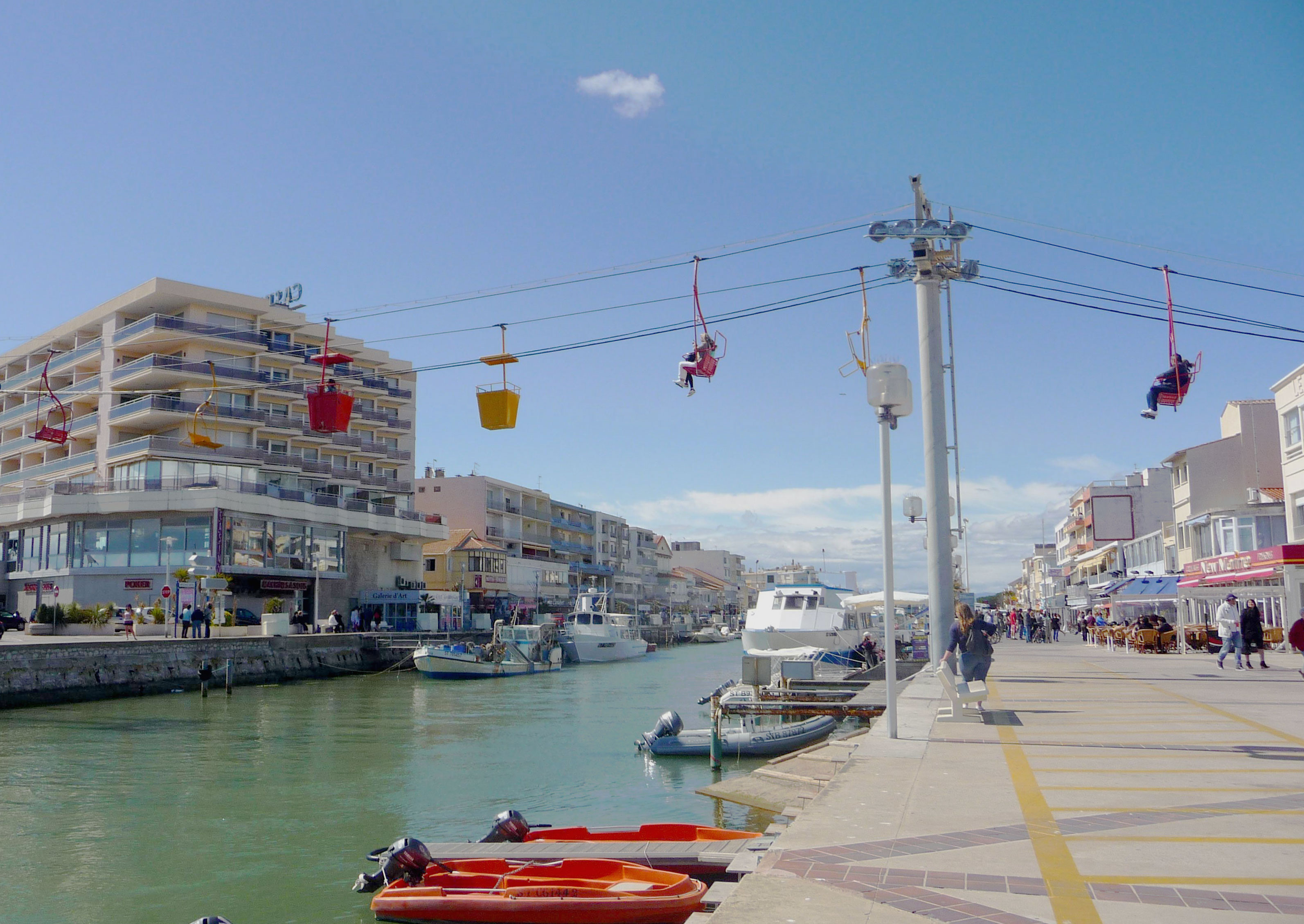
    Just six kilometres south of Montpelier lies Palavas-les-Flots, a seaside town with some very fine seafood restaurants lining the canalised section of the River Lez  that runs through the centre of the town just before it enters the sea.    This has the effect of splitting the town into two sections, a Left Bank and a Right Bank, the names by which they are known.

    Chair-Lift-Over-Palabas-Les-Flot

    See Palavas by Chair Lift- Mari Nicholson

    In the centre of the town is the distinctive ‘lighthouse of the Mediterranean’ with its popular revolving restaurant: next to this stands the church of Saint Pierre with its attractive garden.  There are few other sights to detain one in this seaside resort – it is a place for relaxation and enjoyment of the watersports and the facilities on hand.  What is a charming sight, though, is the canalised section of the town on which the fishing fleet makes a fine picture on a sunny day as they get ready to set sail.  And again, on their return, photographers line up to  photograph the fishermen who sell the fish directly from the decks of their boats to customers from the nearby flats and even from towns beyond.

    Fishing-boats-ready-to-sail---Mari-Nicholson

    The restaurants that line the canal are a magnet for visitors from Montpelier, especially at weekends, and you should be prepared to wait a while for a table and again for the meal to be served once you have chosen a restaurant.  The favourite meal is  mussels , served n every imaginable style, and always in the traditional big, blue enamel pots beloved of French restaurants.  They can be recommended.

    Those who enjoy the fun of local markets should visit on the mornings of Monday, Wednesday and Friday when there is a market in the town.

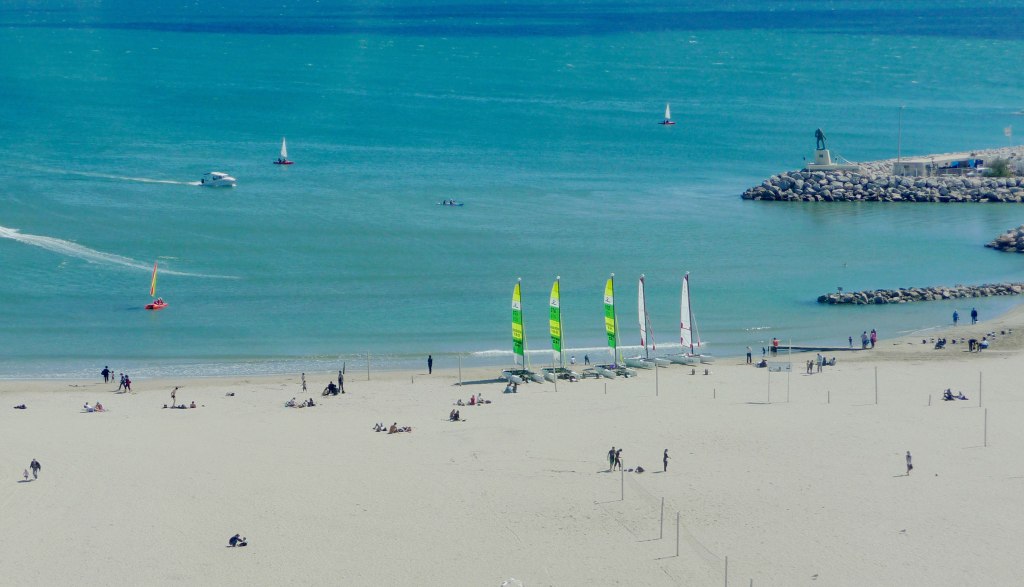
    The seafront is a short distance from the town centre and has a wide sandy beach, not what one would call a ‘golden beach’ but nevertheless, sandy and clean.  It is seven kilometres long and with this massive stretch of seaside comes all the water-related sports activities you could wish for  – kayaking, jet-skis, windsurfing, paragliding, swimming, snorkelling and diving.  Most of the equipment can be hired from concessions on and around the beach.

    The sprawl of apartment buildings that is a backdrop to the beach either side of the centre is not especially handsome but the little harbour is attractive and from the small concrete pier are some good views of the town and across the bay to La Grande Motte.   And as I said, the good stretch of sandy beach is an ideal spot for families and couples to enjoy the facilities on offer.

    Just outside Palavas, a short walk away, there are natural ponds that are home to an interesting selection of wildlife.   What attracts most people to the area, however, are the flocks of flamingoes that live here and that make a visit to the ponds something rather special.

    How to Get to Palavas-les-Flots from Montpelier

    By Tram or Bus, but the tram is so quick and fun to ride that I recommend them.  Purchase tickets before boarding, multi-lingual ticket machines at each tram stop. A day pass is recommended if you plan to use the tram much. Be sure to validate your ticket in the machines, being found without a valid ticket means an on-the-spot fine of around 30 euros. Not speaking French is not accepted as an excuse.

    One-way tickets cost €1.40 round-trip €2.50. A 24-hour bus and tram ticket is €3.80.  Line 28 runs to the beach at Palavas les Flots.

    The “Navette des Plages” bus runs non-stop to the “Face a la Plage” beach, between Palavas les Flots and La Grande Motte. Bus 131 runs to Palavas-les-Flots.


  • MONTPELIER, France

    MONTPELIER, France

    If there’s a city in France that can offer more in the way of enjoyment, relaxation, places to visit outside the area than Montpelier, then I have yet to find it.

    Known as the sunshine capital of France because of its 300 sunny days per year, Montpelier lies just 11 km from the Mediterranean coast and has its own wide sandy beach within an easy tram ride.

    Narrow-streets-of-the-Old-Town

    Montpelier combines recent history and old-fashioned elegance with a youthful feel, mostly due to its large student population and its university.  It had the first medical school in France at which Nostradamus and Rabelais studied and is a delightful mix of old buildings in the centre, and  major new-age industries in modern buildings around the edge.  Lovely beaches are nearby at Palavas-les-Flots. What more could anyone want?

    As easy town to get around, the places listed as ‘must-sees’ are more or less grouped together, the Place de la Comédie, the Peyrou garden, the Charles de Gaulle esplanade,  t the Arc de Triomphe,.and the Saint-Roch church, all on the well-trodden tourist route.   However, like European capital cities such as London, Madrid, or Paris, the city abounds with special neighbourhoods with individual identities, some specialising in artisan work, some in antiquities and others devoted to food and wine.  Their social mix gives them a fascination lacking in other towns in the region.

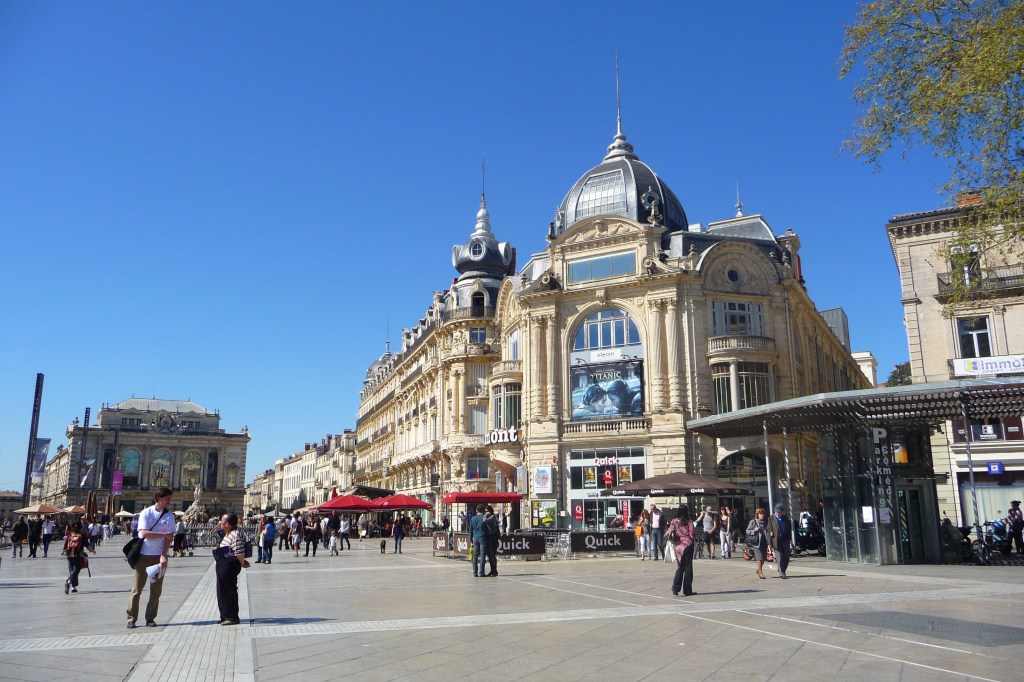
    The centre of the action and the beating heart of the pedestrianised centre is the Place de la Comédie.  During the morning there is a market at one side of the Place where the local farmers set up stalls and sell fresh fruit and vegetables: off to one side of this is the flower market, a static garden of jewel-coloured blooms and plants.  During the season an old-fashioned carousel is stationed at the other end of the square near the Opera House (a useful place to arrange to meet someone as is the statue of the Three Graces).  In the middle of the square street artists demonstrate their talents as magicians, living statues, cycle gymnasts, mime artists and break dancers.  Passengers coming from the St. Roch railway station with their wheeled luggage skirt around them as they dodge the colourful trams that glide over the yellow paving while students watch from the nearby cafes, their books open before them.

    Cae Riche, Montpelier, France

    The large student population makes it a lively spot all year round and gives the city a buzz. The cafés, bars, and bistros in the pedestrianised city square which spill out onto the street are one of the attractions of Montpelier and it can be difficult to find a table at certain times.  One of the busiest cafés, the Café Riche, is also the most popular and dominates the square with a grand awning bearing the name and date of its foundation.

    Famed for its produce, Couer de Bouef

    Couer de Bouef Tomatoes – a Speciality of the Region

    The Montpelier region is known for its local produce, its excellent wine, its fine dining and its farmers’ markets.  It has 3 Michelin-starred restaurants in addition to other excellent eating places and bistros.  Being right in the heart of the Languedoc, the opportunity to sample the luscious wines of the region as well as those of nearby Roussillon shouldn’t be missed, and tastings at nearby vineyards are easy to arrange.

    Restaurant,-Montpelier
    Restaurant in Montpelier

    The old town with its medieval narrow streets is lined with upmarket boutiques and antique shops interspersed with restaurants and typical houses of the area fronted by private courtyards, a  world that sits quite comfortably with cutting-edge design and architecture in other parts of the city.  Check out the mock-Gothic Pavilion Populaire and compare it with the modern, glass-clad town hall.  Even transport gets into the act, with designer trams from the hand of no less than Christian Lacroix!

    Montpelier, France
    Montpelier

    Wander along Rue Foch, a road carved through medieval Montpellier to the Arc-de-Triomphe, a glorious golden stone arch which could only be in France and which was built to honour Louis XIV.  Just beyond this point, you will come upon the king mounted on a horse on the magnificent Peyrou Promenade.

    Antigone is Montpelier’s new modern part of the city, is located to the east of the historic centre and is the biggest single development to be built in France.  This extraordinary development which extends the city to the banks of the River Lez, has been designed by Catalan architect Ricardo Bofill and was completed in the 1980’s.

    Antigone.-Montpelier
    Antigone

    As it’s name implies, the area is based loosely on the architecture of Ancient Greece and a further link is apparent in the boulevards with names like Rue de L’Acropole and Rue de Thebes that open out and lead you into large squares with names redolent of famous Greek events, like Place de Marathon and Place de Sparte.  The neoclassical design of the buildings, the sculptures, and the layout, are dramatically different to the architecture of the old town, and although on a larger than life scale, it is all well proportioned.

    At the end of the Antigone district is the Place de Europe, a huge semi-circular area with a crescent of buildings. On the other side is the River Liz adding to the drama of the site and on the opposite bank the ‘Hotel de Region’ also built in the neo-classical style.

    Palavas-les-Flots, Montpelier

    Palavas-les-Flots, Montpelier

    The fishing port of Palavas-les-Flots is worth a trip even if it’s only for a bowl of mussels served with chips (French fries to some) or garlic and herb breads in any one of the ways in which they are served here.  The port is making great efforts to turn itself into a seaside resort but despite the attempts of the many boat owners to entice you aboard for a sea trip, a fishing trip or a tour around the lagoons, it remains firmly a place to visit for its great food.  Bars, bistros, and ice-cream parlours line the central canal and you can walk a few miles along the spit of land to the medieval Maguelone cathedral which stands between sea and lagoon.


    donna's book


    Best Guide Book

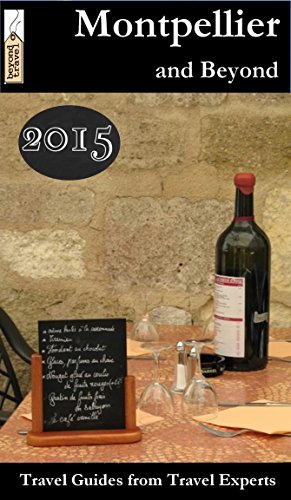
    Montpelier and Beyond Travel Guide is a pocket guide to the best of Montpellier, written by two award-winning travel experts Donna Dailey and Mike Gerard and published by the team behind the successful Beyond London Travel.   Available from Amazon as an e-book or a download for Kindle.


  • Weekly Photo Challenge: RARE

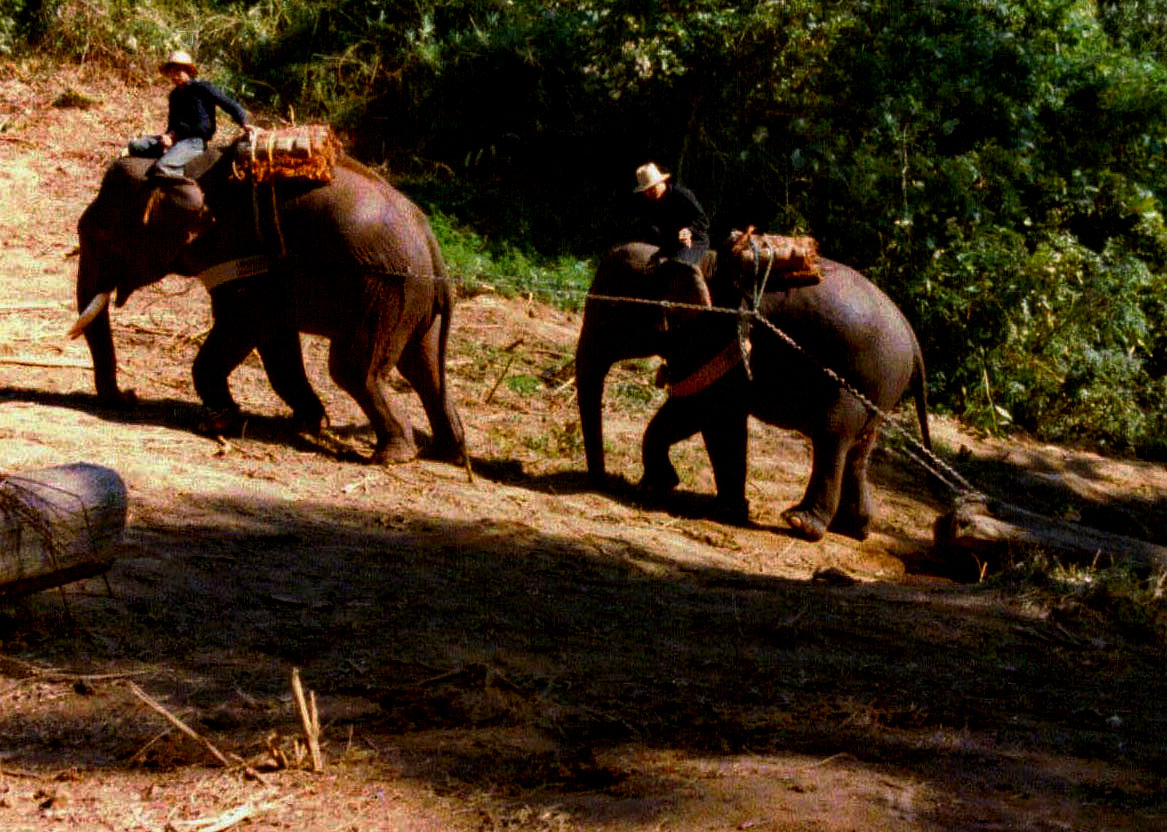
    Elephants Hauling Teak, Chiang Mai Thailand copy

    This is an old photograph from my collection, one I took way back in 1972 when the elephant was still known as “the tractor of Thailand”.  Sadly, the lovely big animals no longer haul teak and this sort of thing is a rare occurrence now as they no longer live a happy life with their mahouts in the forests in the north of the country.  Their habitat has been destroyed by logging, legal and illegal, and most of them have had to journey south with their mahouts, to the coastal areas where they are reduced to giving rides to tourists.  In many cases they fall ill from diseases to which they have no resistance; the grasses along the sides of the road are sprayed with pesticides which harm them, and their young ones are often taken away from them and chained up outside a bar for the amusement of tourists.

    If you see such a thing, tell the owner you don’t approve.