Tag: Art

  • New Orleans: Tennessee Williams Festival

    New Orleans: Tennessee Williams Festival

    In With a Shout.

    One of the Apps on my computer offers what it calls Memories. It flags up a photo taken on the same date years before. A few weeks ago, the photograph was one taken some years back at the Tennessee Williams Literary Festival in New Orleans.

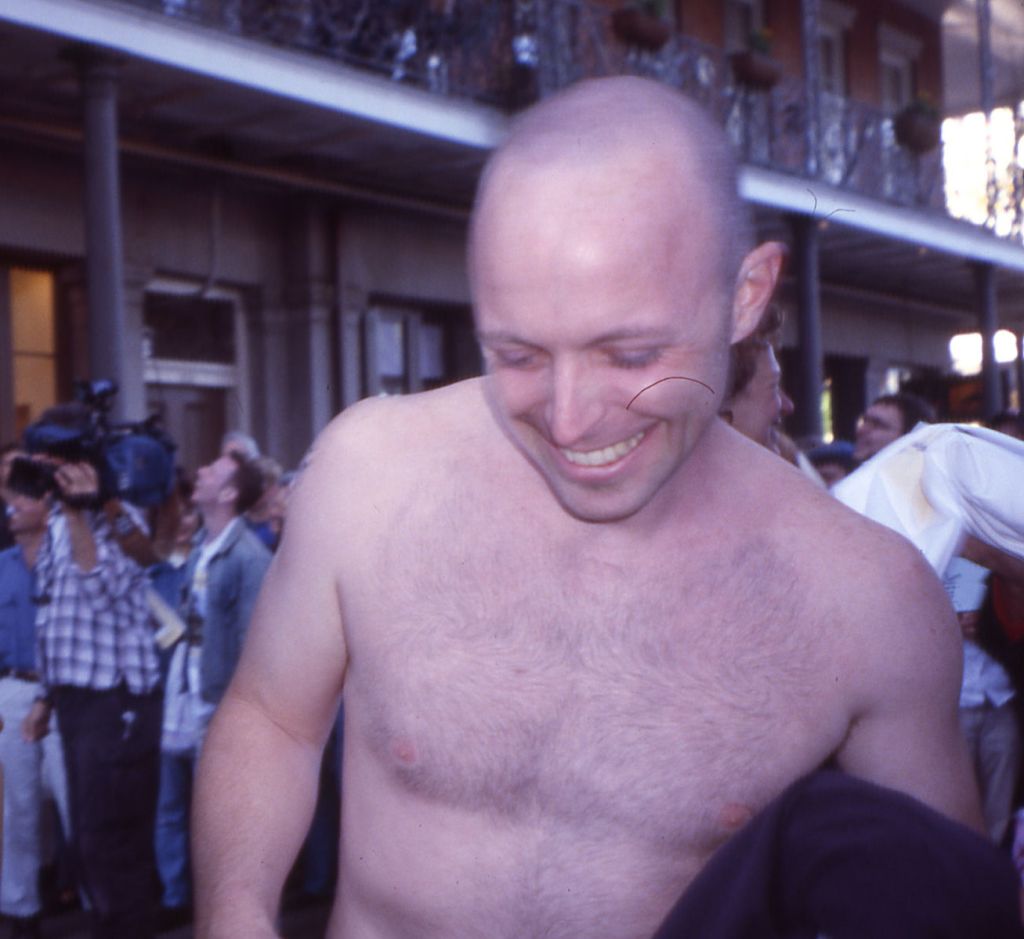
    My photo was one taken at a very quirky part of that festival – the ‘Stella Shouting Contest’ – a homage to A Streetcar Named Desire and the character of Stanley Kowalski, the hero/antihero of the play.

    Image from Wikicommons

    The Stella Shouting Contest in New Orleans

    Stellllllaaaaa! Stellllllaaaaa!”

    The cry reverberates around the French Quarter of New Orleans and the crowd jostling in the packed courtyard applauds. From the balcony above, Stella waves to the damp-haired man in the sweat-stained shirt below who blows kisses to the crowd as the next tee-shirted Stanley steps forward to chance his luck at outshouting the other participants.

    For this is the Stella Shouting Contest, part of the Literary Festival, held for nearly 40 years in honour of New Orleans’ favourite son, the playwright, Tennessee Williams. The Stella contest pays homage to his classic A Streetcar Named Desire and for the last three decades or so, the primal screams of wannabe Stanley Kowalskis have been echoing around the magnolia-laden French Quarter to mark the Festival.

    A Streetcar Named Desire

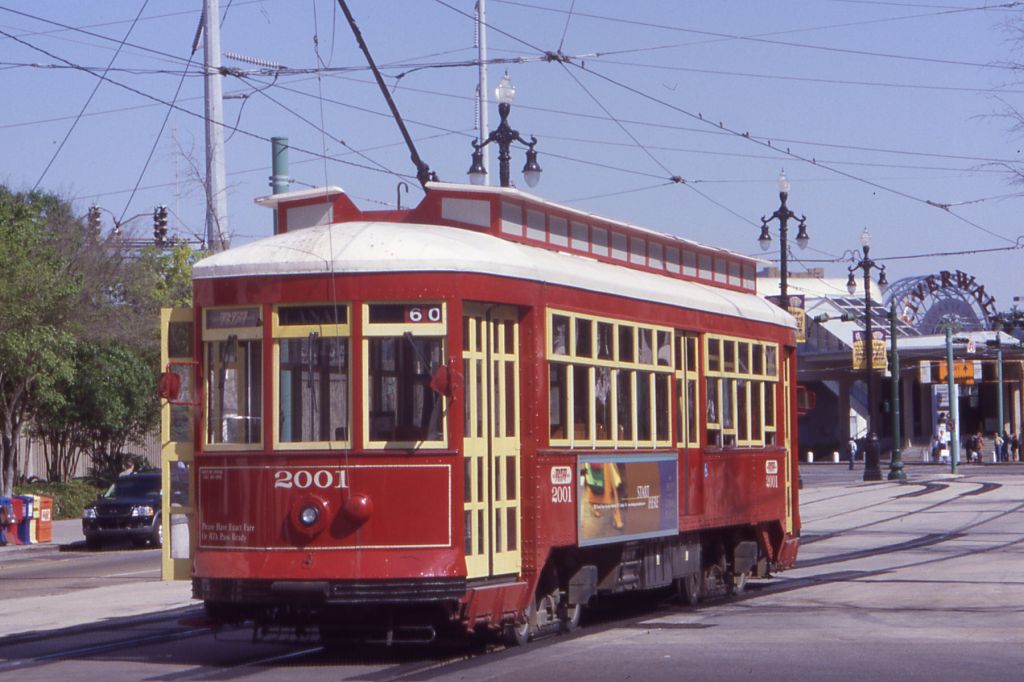
    “They told me to take a street-car named Desire, and transfer to one called Cemeteries, and ride six blocks and get off at Elysian Fields”, says Blanche when she arrives at the house in which her sister Stella lives with Stanley.

    Williams used the title metaphorically: there was no street-car named Desire trundling along the tramlines to Stella’s house, but there was, and is, Elysian Fields Avenue, a name is forever linked to the steamy tragedy of Stella, Stanley and Blanche.
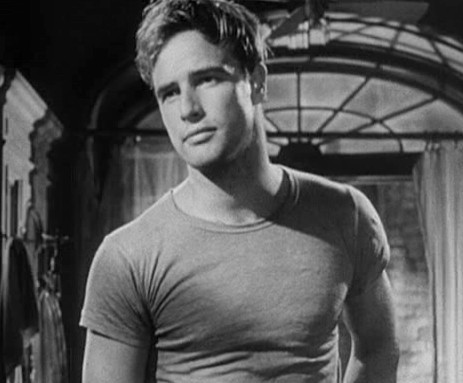
    Image from Wikicommons (Brando in Streetcar)

    Marlon Brando in Streetcar

    Marlon Brando played Stanley in the original Broadway production, and in the 1951 film adaptation of the play, he set the standard for all future Stanleys. His despairing “Stellllaaaa” echoed around cinemas and lodged in the minds of filmgoers forever when drunk, sweat-soaked and half-dressed, he stumbled onto the sidewalk and fell to his knees, bellowing for his wife, “Stellllaaaa” – probably the most famous line from any of Williams’ plays. Little did anyone guess then that this angst-ridden howl would one day become a feature of one of the USA’s Literary Festivals.
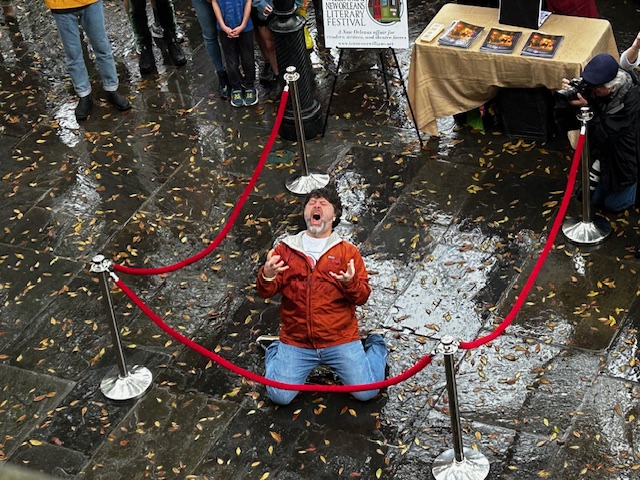
    What Happens During the Literary Festival

    Events like the Stella Shouting Contest, theatre productions, in-depth writing workshops, and lectures from best-selling authors on everything from scene-setting to stereotypes in fiction, attract attendees from all over the world. Giants from the world of literature and theatre mingle with would-be-playwrights and authors, to offer advice, give talks and join in the celebrations, all overlain with that N’awlins easy charm.

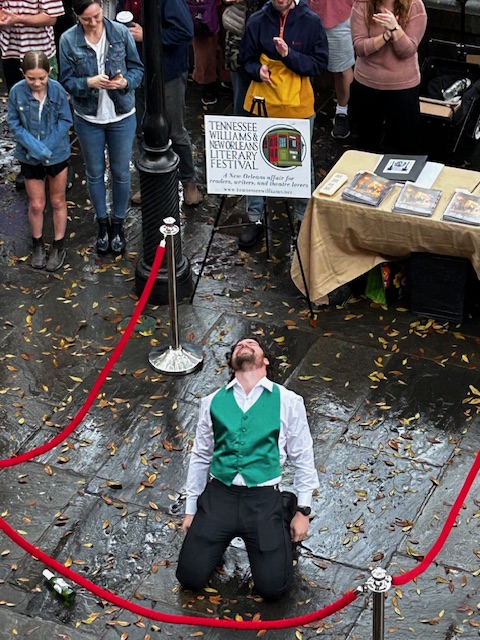
    What Happens in the Stanley Shouting Contest

    The famous scene, and the scream, is replayed again and again by men who come to The Big Easy to test their screams against other men. Technically it’s a Stanley/Stella shouting contest as females can also take part, but as Stella didn’t yell “Stanley” it doesn’t resonate with the public in quite the same way so there are few entries on the Stella side.
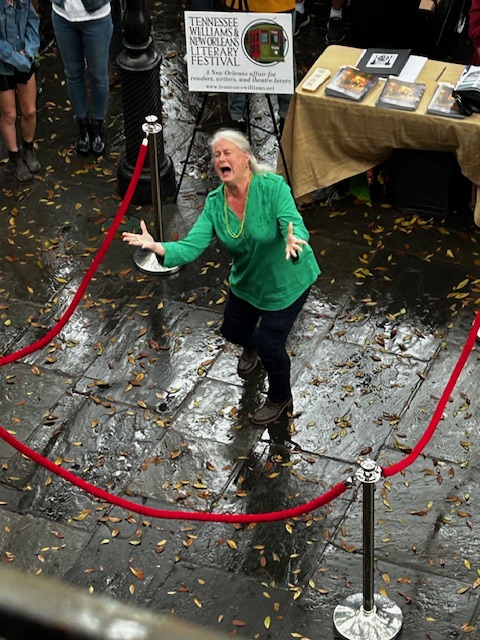
    Photo credit: Tennessee Williams Literary Festival

    Standing beneath the filigreed balconies of the houses around the green oasis of Jackson Square the contestants direct their howls of desire and angst at local actors attired as Stella and Blanche on a balcony above. Celebrity judges lounge on adjoining balconies, while festival go-ers and voodoo hustlers jostle for positions from which to watch the fun.

    One by one the contestants give it their best shot in the allotted three shouts in which they must portray Stanley’s despair, rage and emotion. They fall to their knees, tear their shirts – the iconic torn white tee-shirt is a given – and douse themselves with water to conjure up the image of Stanley’s sweat-soaked torso.

    To whoops and cheers, six finalists are selected and they go on to compete a few hours later, on the main stage of Le Petit Theatre, the venue for the Festival’s workshops, play readings and lectures. We, the onlookers and audience, troop in after them, by now having a favourite to encourage in the tension-filled finals.

    Interior of Le Petit Theatre

    On the stage at Le Petit, the Stanleys now scream with more gusto and histrionics, encouraged by their fans in the crowd. Hyped up – alcohol may play a part as well – cheering for their man and booing the opposition, the audience sounds as primal as Stanley.

    All this for the grand prize of the Golden Stella Trophy, holidays in New Orleans, hampers of local goodies, and trips on Ole Miz, the muddy brown Mississippi.

    Interior Courtyard of Le Petit Theatre by David Ohmer, creative commons.org/licenses/by/2.0 via Wikimedia Commons

    Few Festivals have such a strong performance element as the Tennessee Williams Literary Festival – two full-length plays and several one-act plays of the master are usually staged alongside film screenings, tours of the French Quarter, book signings, and jazz evenings. All this plus work-shops and lectures from writers like David Simon, James Lee Burke, Richard Ford, Laura Lipman, and dozens of others. You’re bound to meet your favourite author there and for some reason, crime writers are particularly well represented.

    Tennessee Williams – Photo: Orlando Fernandez, World Telegraph staff photographer, via Wikimedia Commons

    New Orleans

    The Big Easy still lives up to its motto of ‘Laissez les bon temps rouler’ – let the good times roll – and outside the theatre the city goes about its business, partying along Bourbon Street and entertaining the tourists in Jackson Square where the voodoo priestesses, hawkers of hats and beads, and groups of wild looking Cajun and Zydeco musicians straight from central casting come together in a gloriously chaotic, laid-back cocktail.

    There are also city tours, swamp tours, plantation tours, and that old standby, shopping, and that for which New Orleans is best known – music – from trad jazz to funk, zydeco to gospel. While there you can take in a session with one of the city’s best bands, Jon Cleary and the Monster Gentlemen Band, who will take you on a jazz voyage like you’ve never experienced before.
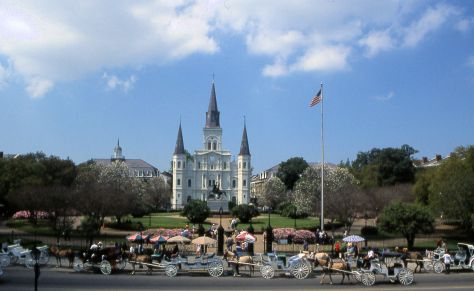
    St. Louis Cathedral, New Orleans, the oldest continuous use cathedral in the USA.

    So if you’re in the area next March and fancy your chances of being a ripped-shirt Stanley with a voice that could persuade Stella not to leave him, then go for it.

    Tennessee Williams loved this mixture of the pious and the profane, the sinners and the saints – isn’t that what all his plays are about?

    Get ready to party New Orleans style.

    Factfile:

    The 38th Annual Tennessee Williams/New Orleans Literary Festival took place this year between March 20th—24th. Next year’s dates not yet published. Sign-up for the Stella Shouting Contest will begin at 1.30 3 or 4 days prior to the opening.

    The Tennessee Williams Literary Festival: 938 Lafayette Street, Suite 513, New Orleans, Louisiana 70113. Tel: 504 581 1144. info@tennesseewilliams.net


    British Airways flies direct to New Orleans from £575 Return and also offers hotel bookings. Other airlines fly via Chicago – a good place for a stop-off.

  • Venice, La Serenissima

    Venice, La Serenissima

    I finally made it back to Venice.

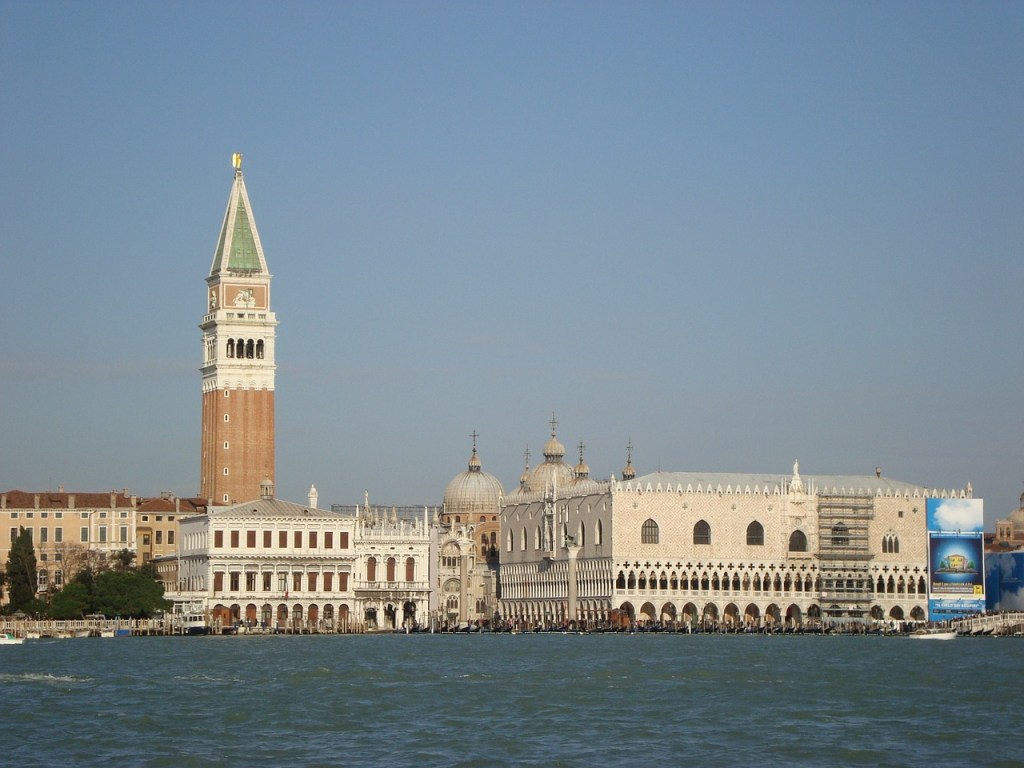
    I’d wanted to return to La Serenissima for years but the thought of elbowing my way through the crowds, queueing for a restaurant, queueing to visit the Doge’s Palace, queueing even for a Gondola ride, was just too much. I thought of a winter visit: then I read about Venice’s floods, the rain, the mist, the dark medieval streets one has to negotiate at night, and thought again.

    Desire overcame caution however, and two weeks ago I returned to Venice and I can now thoroughly recommend a winter/spring visit. I wouldn’t travel later than the second week in March though, as the number of tourists was increasing daily and the queues were already beginning to lengthen.

    Canals and Crumbling Houses

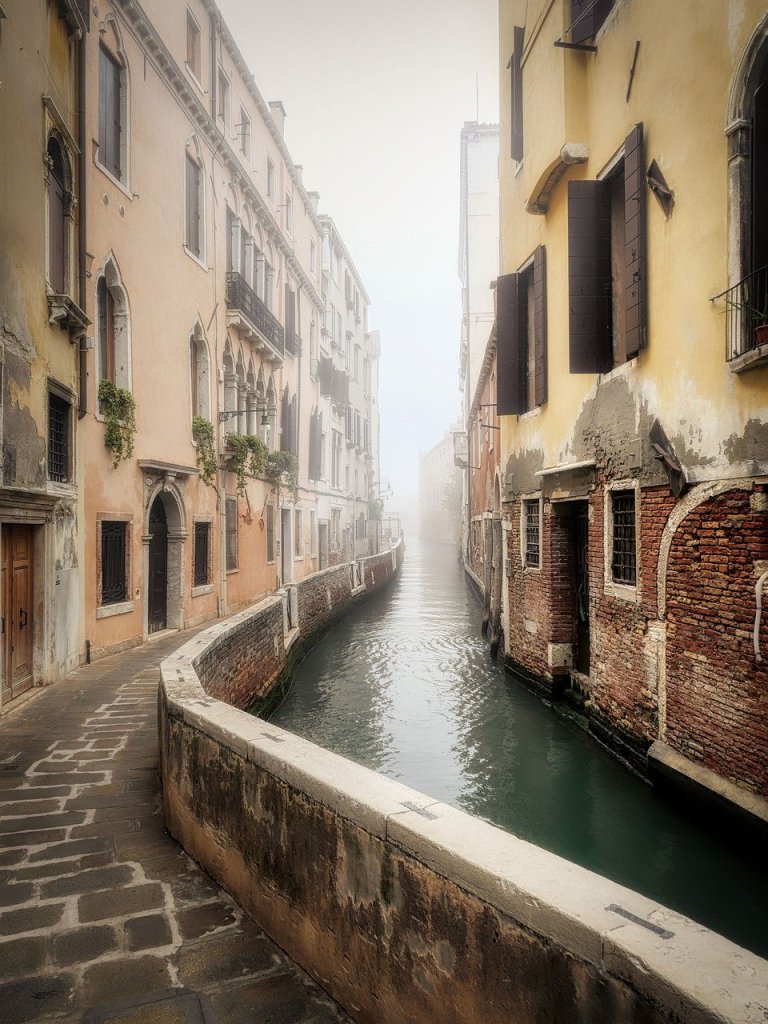
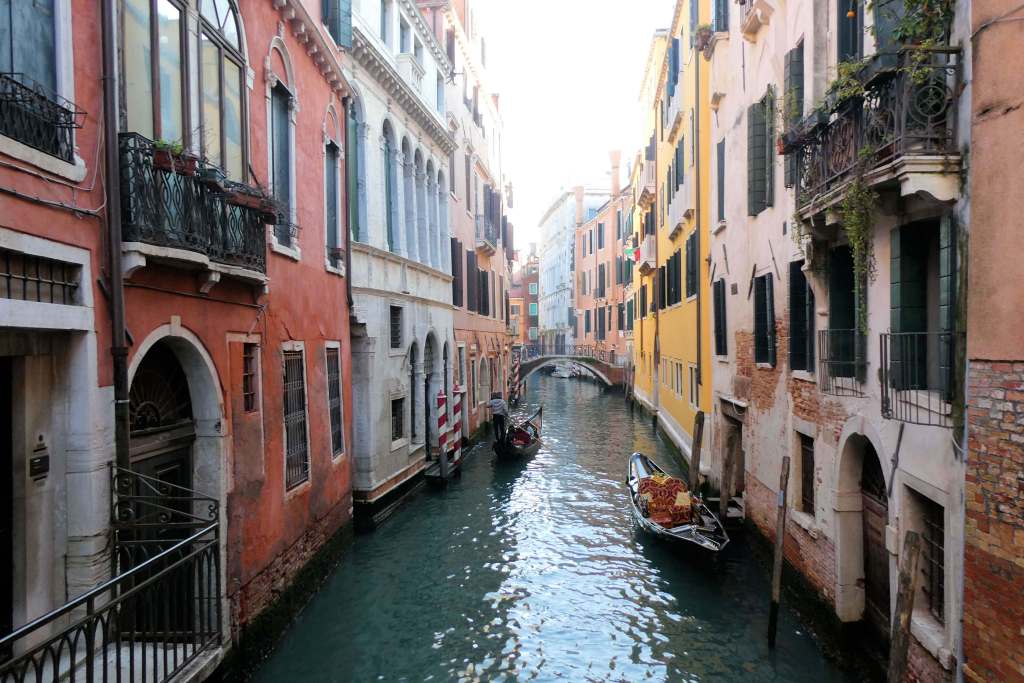
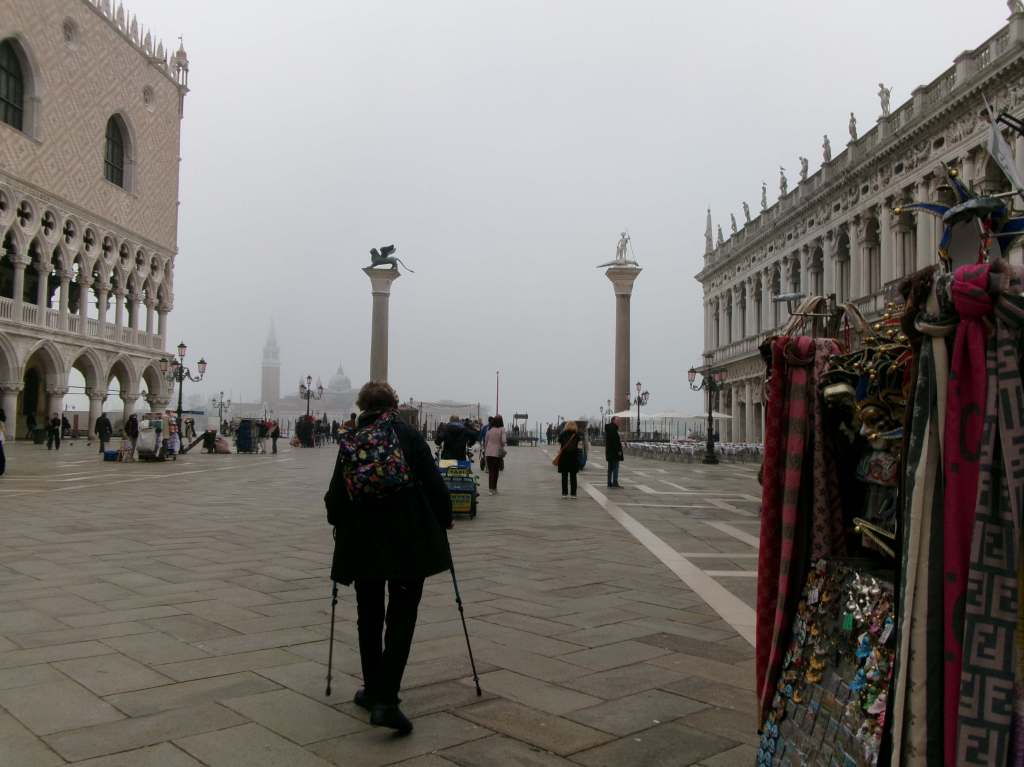
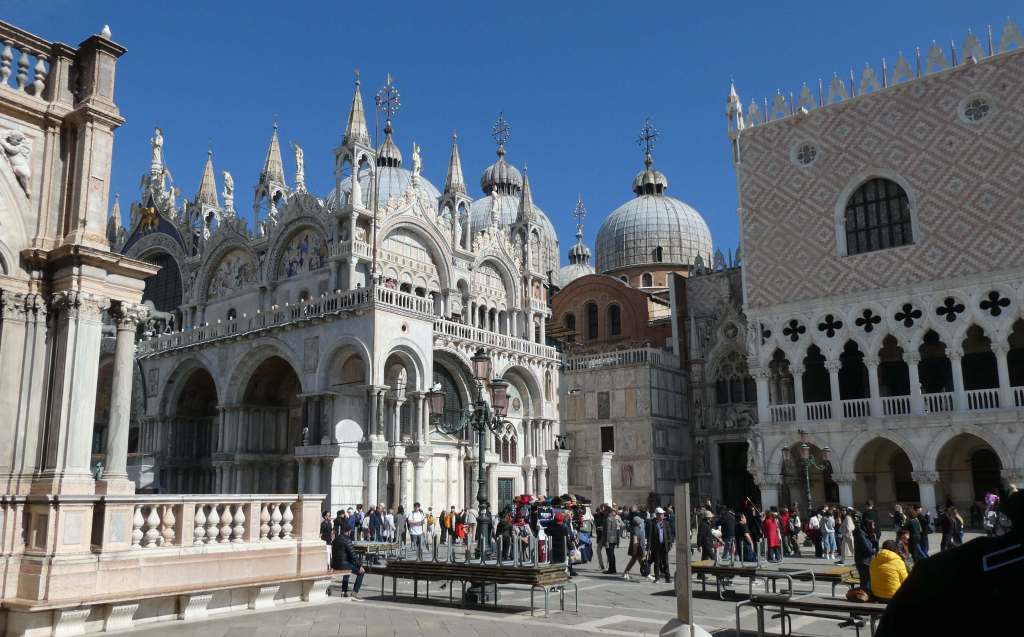
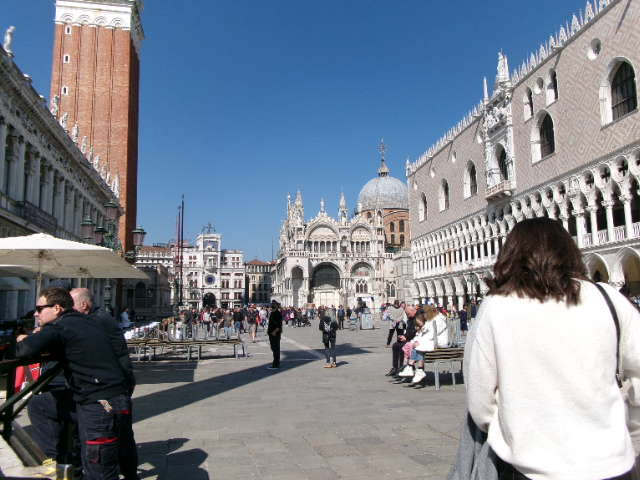
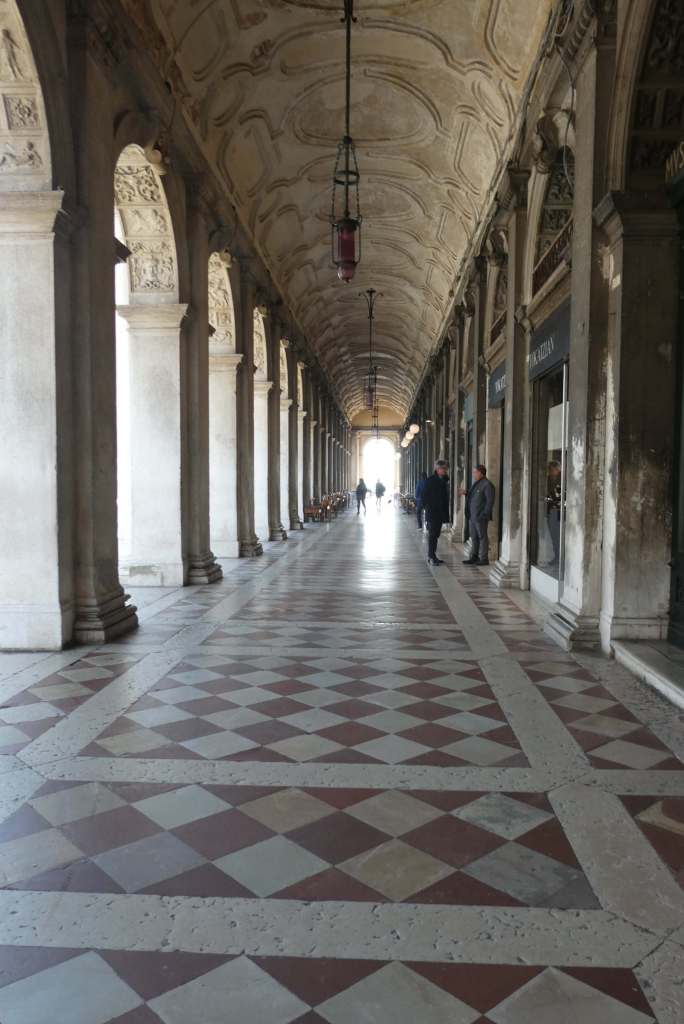
    Misty mornings gave way to sunny afternoons and Venice worked her charm as always. Wandering around the maze of streets that lead of Piazza San Marco, stopping for hot chocolate and coffee when we spied a particularly attractive place, walking across the small bridges that span the green waters of the canals and stopping to watch the gondolas gliding under them, in areas away from the crowds, was something we never tired of.

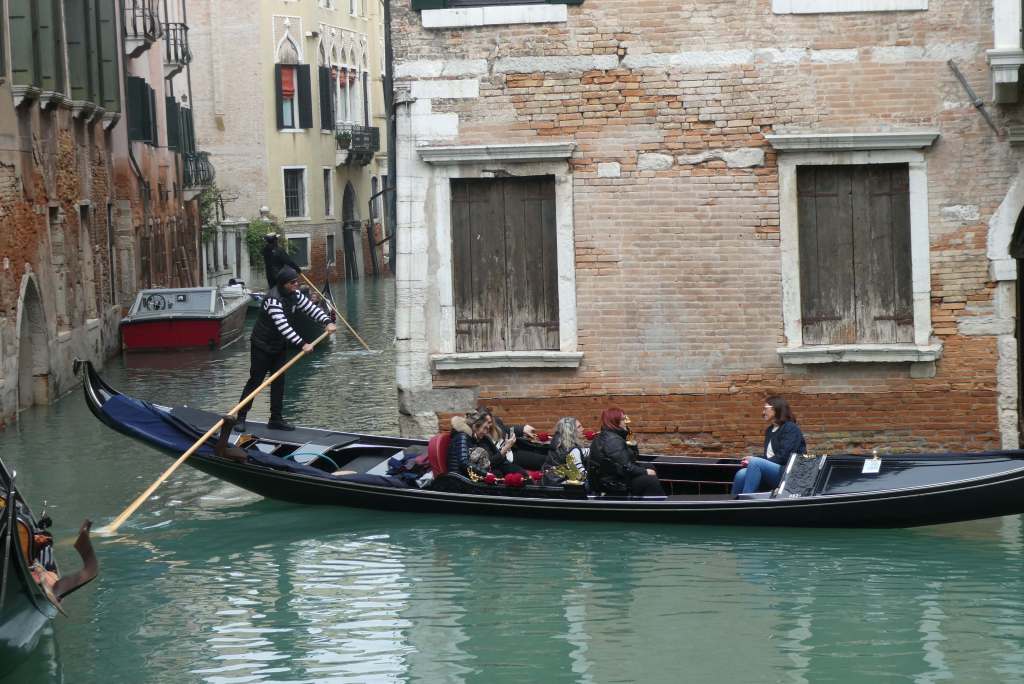
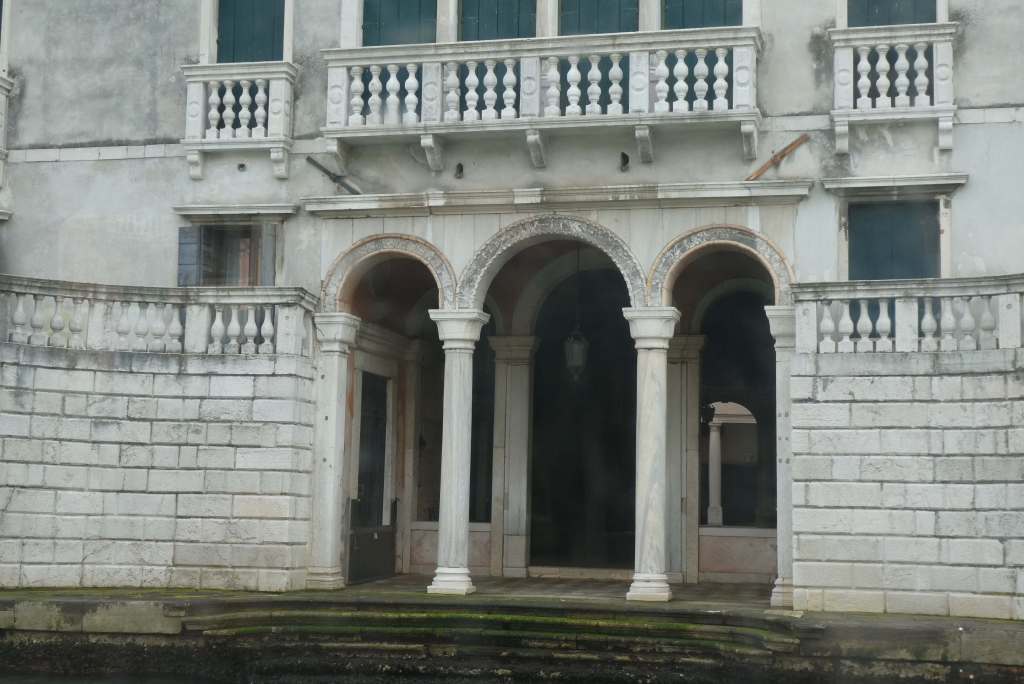
    We had a map but still got lost. How could one not in Venice, when crumbling houses and palazzos, fading murals and ancient wooden doorways lured one into areas unknown. The tall buildings hushed the noise from the surrounding streets and often the only sound was that of the gondoliers’ oars swishing through the water as they ferried locals to their doorways on the canals, or transported tourists beyond the tourist spots.

    Gondolastheir history

    In the 14th century, horses were outlawed from the streets of Venice and the Nobles embraced gondolas as a respectable form of transportation. It then became the way to get around the lagoon’s islands. In order to navigate over the sandbars, the boats had to be flat-bottomed and the gondolier had to stand up to see ahead.

    Two hundred years ago, there were 10,000 gondolas. Today there are about 400 licensed gondoliers only. When one dies, the license passes to his widow, so keeping the skill and the tradition in Venetian families.

    A law enacted in the 17th century decreed that all Gondolas be painted black to eliminate competition between nobles for what were status symbols at that time. Today they are still painted black and decorated extensively, their detailed carvings embellished with gold, and with unique upholstery, trim and detailing. .

    St. Mark’s Basilica and The Doge’s Palace

    We arrived in a Venice which had more people than I’d expected, even for late spring, but the queues for the main sites were already huge.

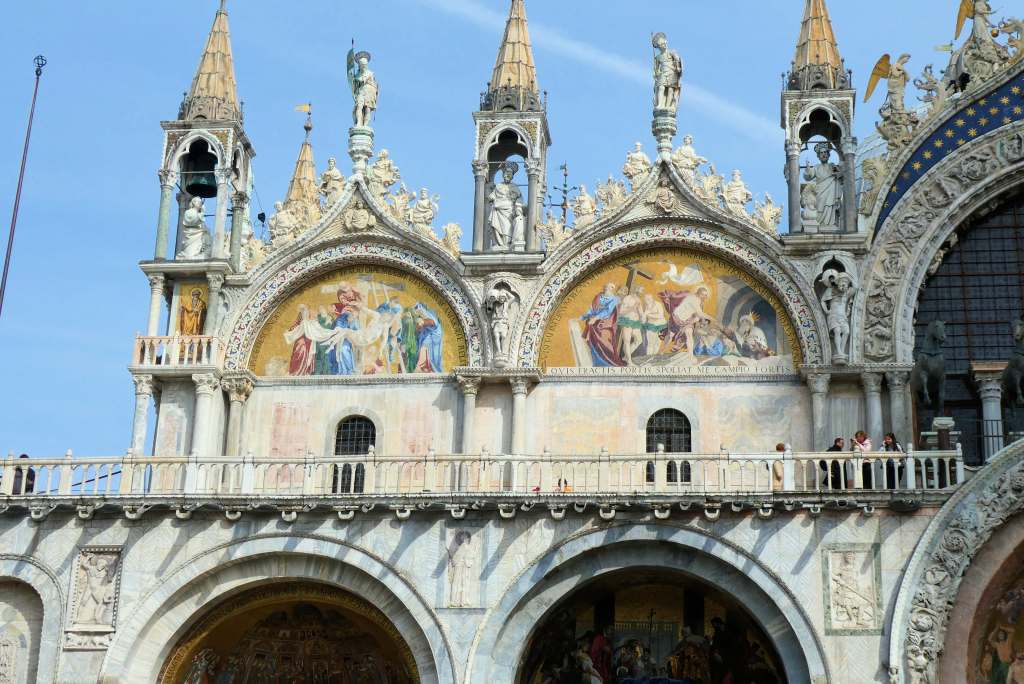
    Day 1, the time on the board for the queue to St. Mark’s Basilica said 1 hour 15 minutes. Want to jump the queue? Of course, you can, for just 90 Euros, and then you are whisked inside in 10 minutes to shuffle around with all the others. It was a mere 1 hour queue for The Doge’s Palace with the same 90 Euros to jump the queue and by the time we left, six days later, the time queue in both cases, had increased by half an hour.

    What will happen at Easter and after, when the two local airports welcome increased flights from all over Europe and the cruise ships disgorge their thousands daily, is anyone’s guess.

    Rialto Bridge

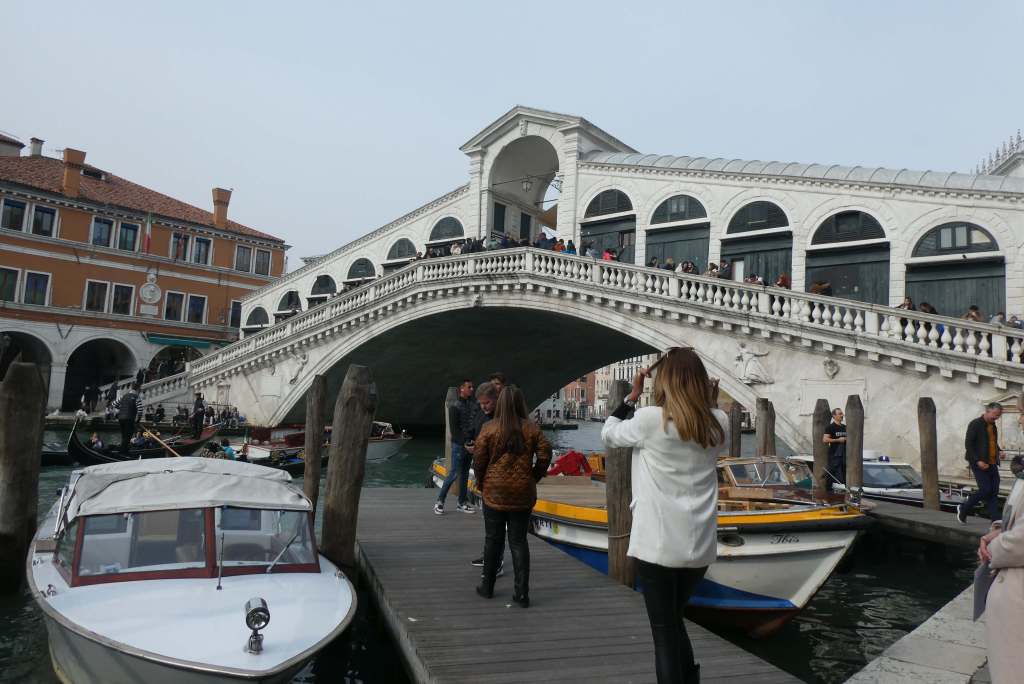
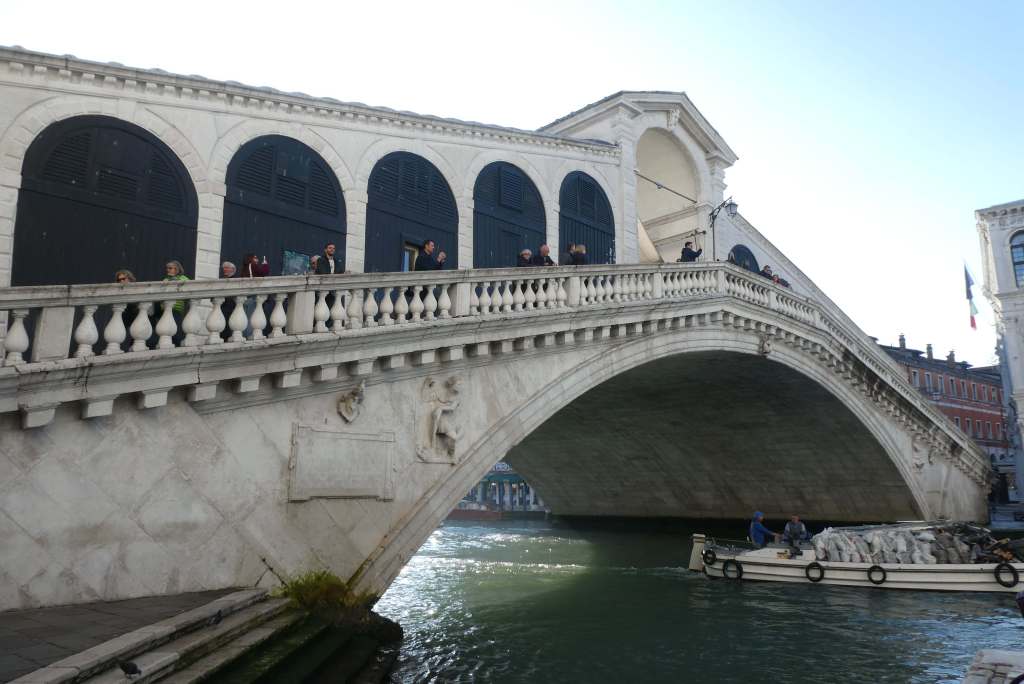
    Of course we spent time window gazing at the expensive Murano glass items in the shops by the Rialto Bridge, the jewellry, the bags, and the multi-coloured pastas, pestis and ricottas packaged for easy packing.

    In fact we spent a lot of time in the area, fascinated not just by the food, but by the selfie-taking photographers balancing precariously on the Rialto Bridge, sure that one of them would fall into the murky waters and secretly hoping one of them would.

    Grand Canal

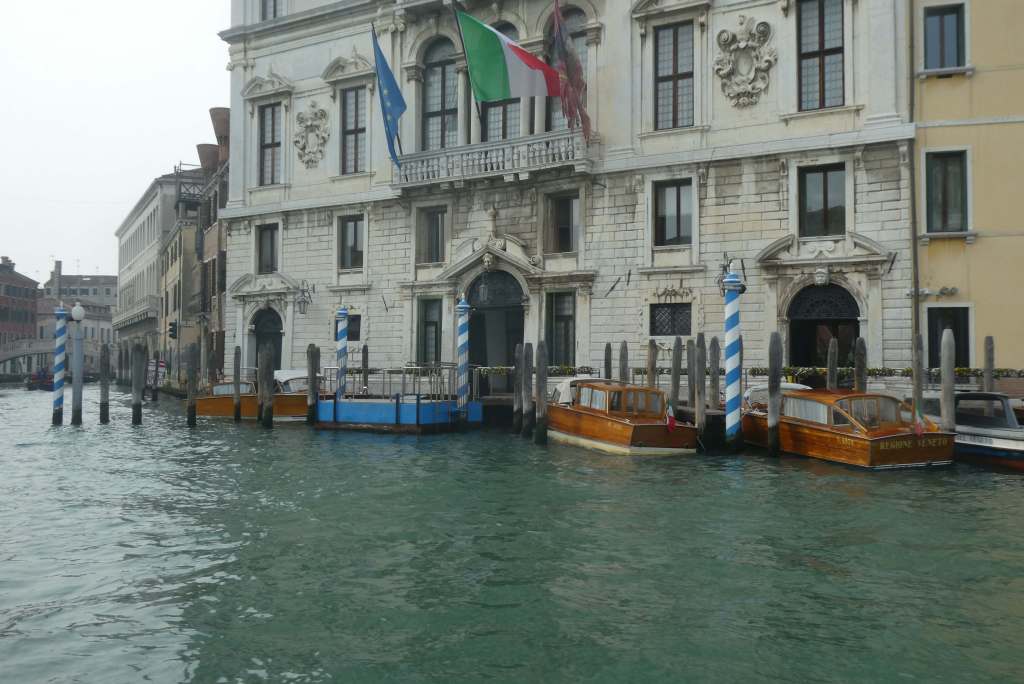
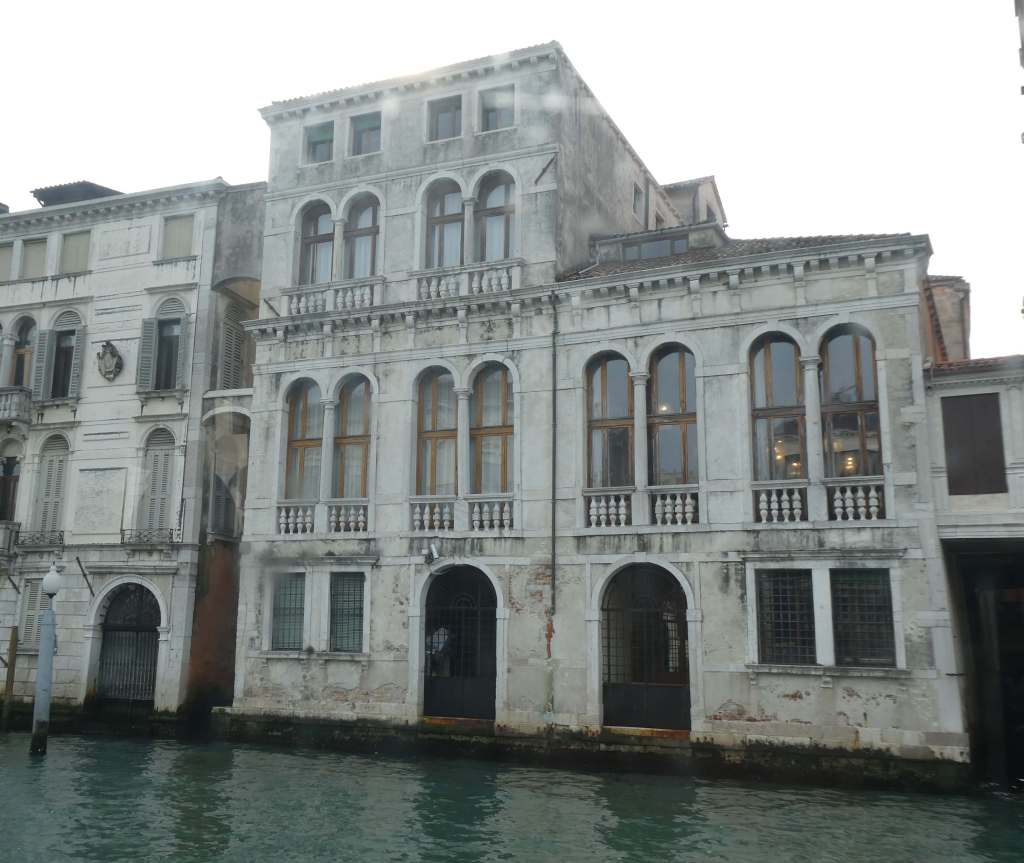
    We took boat rides on the Grand Canal with both the slow Water Bus and the Vaporetto, the commuters’ form of water transport. Below are just some of the houses along this magnificent waterway, some still occupied by old families, some now rented out, and some now AB&Bs. As you can imagine, photographing from a moving, and sometimes rocking, boat, was not easy.

    I would recommend a Grand Canal trip to everyone visiting. It’s the only way to see the magnificence that once was Venice, the mansions, palazzos, and houses of minor aristocrats that line this great watery thoroughfare.

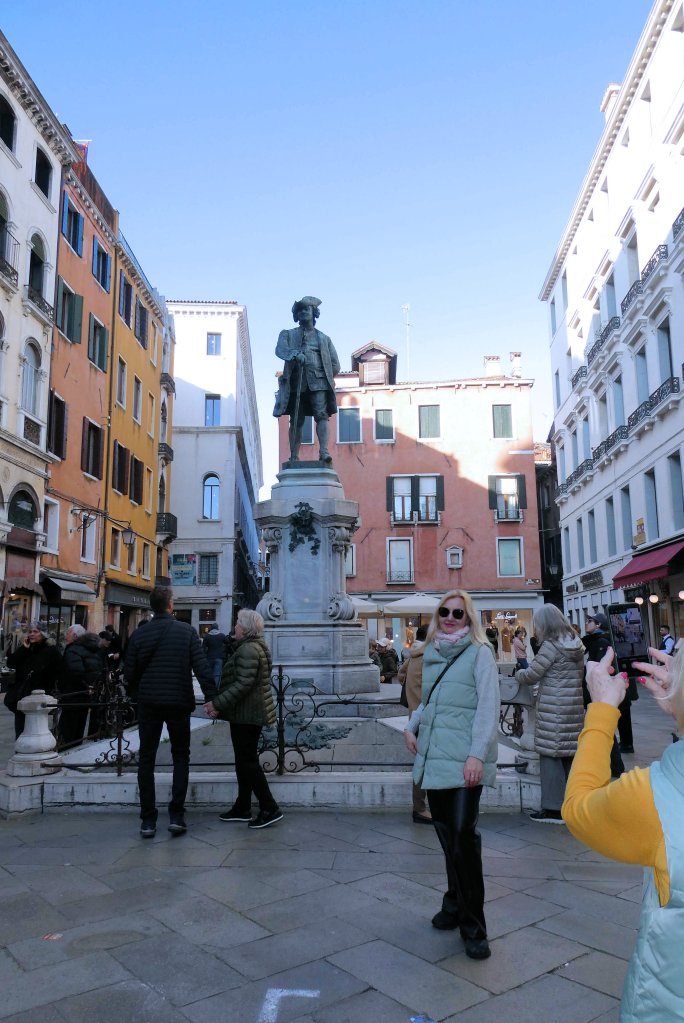
    There were churches to visit which we didn’t, islands to visit which we didn’t, and even a Lido which we neglected, as the experience of just being in Venice proved enough to satisfy us. We seemed to retrace our steps most days, always starting at Piazza San Marco for a coffee and then just wandering, lost in the magic of this wonderful city that is Italian, but totally of itself. Venice is the only place in Italy which doesn’t appear to have a statue of Garibaldi but they honour their famous playwright son, the 18th century writer, Carlo Goldoni of Commedia dell ‘art fame, with a bronze statue in Campo S. Bartolomeo, not far from the Rialto Bridge.

    I didn’t take a gondola ride as mobility problems made this an impossibility, but I would have done so if I could. After all, where else but in Venice can you experience this. I watched enviously as my friend went off in her black and gold gondola, her straw-hatted gondolier skilfully avoiding the other boats as he steered them across the lagoon and under the Bridge of Sighs. I know, I know, it’s touristy, isn’t it, but who cares when you’re in Venice and doing what Venice is famous for?

    And as we walked back to our hotel at night, over bridges under which dark waters flowed, I tried not to think about the chilling figure in the red cloak that haunts the Venice of Nicholas Roeg’s classic film Don’t Look Now – but it was hard to dispel the image, it is so part of the Venice I know.

    I have plans for a return visit in 2025. What better recommendation than that?

    Getting from the airport to Venice hotels:

    Water Taxis – 30-45 minutes, from 140 euros (1-4 people)

    Shared Water Taxis from 60 Euros per person.

    Allilaguna Line – Comfortable water bus to Piazza San Marco takes 1 hr 14 mins with stops along the way. 15 Euros

    Vaporetto – fast commuter boat takes slightly more time as it stops more often, but you may have to stand. Costs 7.5 Euros.

    Bus from airport to Train station, then taxi to ferry, then boat.

    Whichever way you travel, you eventually have to go by water to reach San Marco & surroundings but you can stay on the mainland and travel daily by waterbus.

  • VERONA  –  A SHORT STOPOVER

    VERONA – A SHORT STOPOVER

    Across the River Adige to old Verona

    It’s no secret that I love Verona, and just two of the reasons for loving it are a) the city is highly walkable, and b) it is a place where tourists take second place to locals who live and work in its historic centre.

    That’s not to say that visitors aren’t everywhere, but as you stroll through the medieval streets, charmed by faded frescoes and hidden gardens, or sit at the foot of an enigmatic marble statue in one of the huge piazzas, you never feel part of mass tourism.

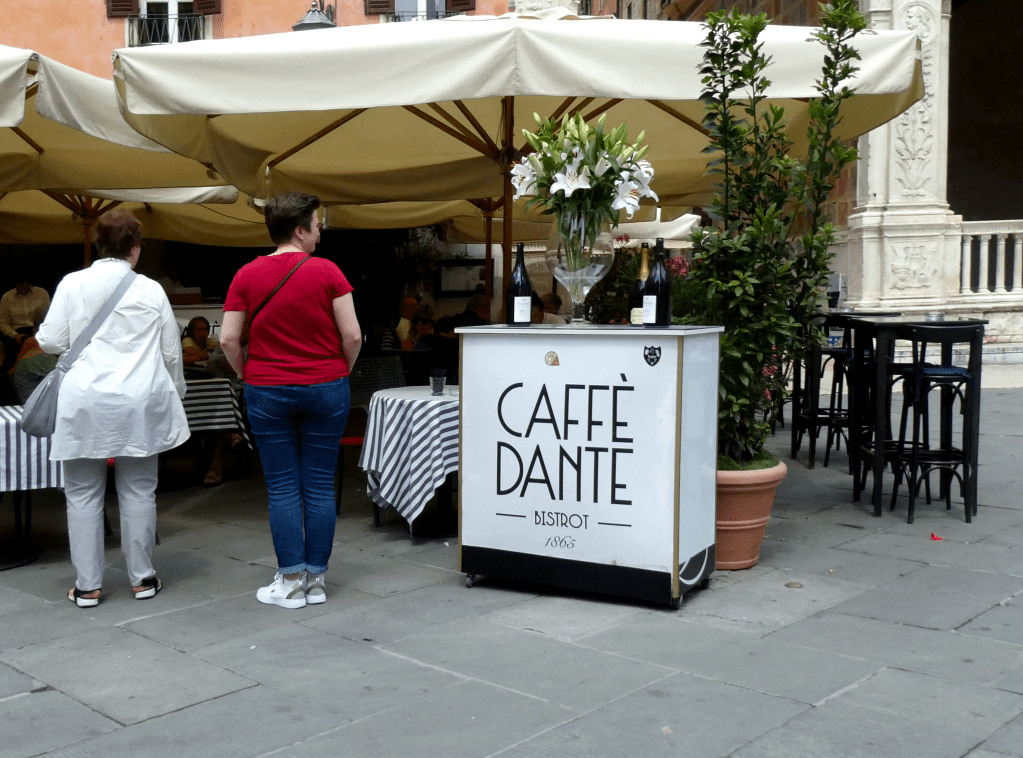
    Simply strolling through Verona leads one to magical places, like the splendid Piazza del Signori. Italy’s most famous poet, Alighieri Dante, lodged nearby with the ruling Della Scala family during his exile from Florence in the 14th century, and so the square also answers to the name of Piazza Dante. Surrounded by ancient buildings which played an important role in Verona’s early civic life, whose façades, although faded, are still beautiful, the square still resonates with a sense of medieval life.

    Scaligeri, Napoleon and Castelvecchio

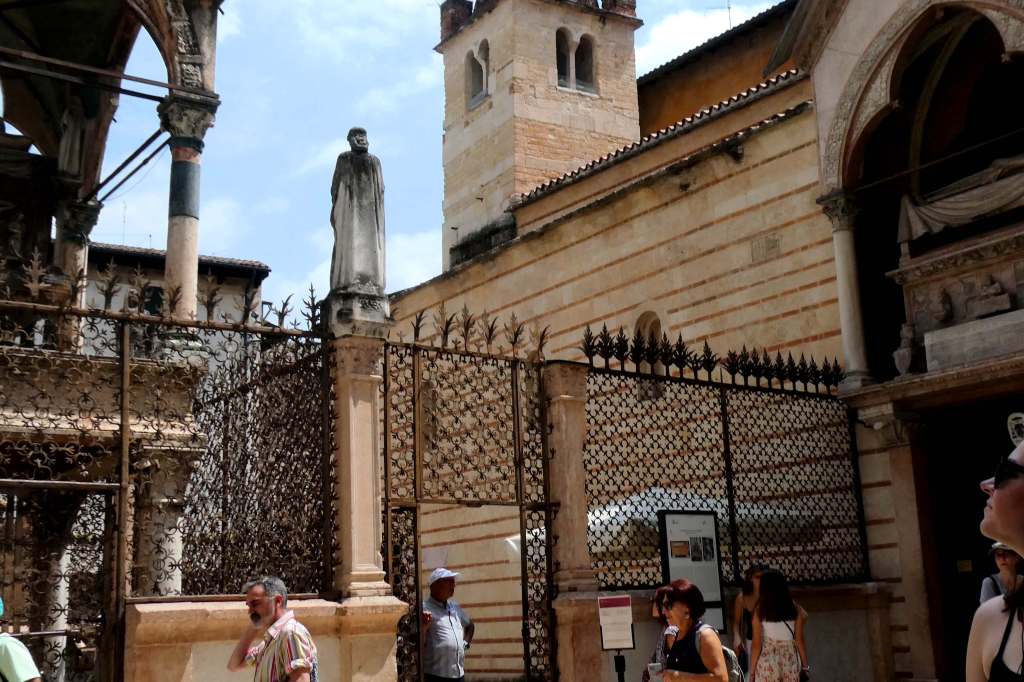
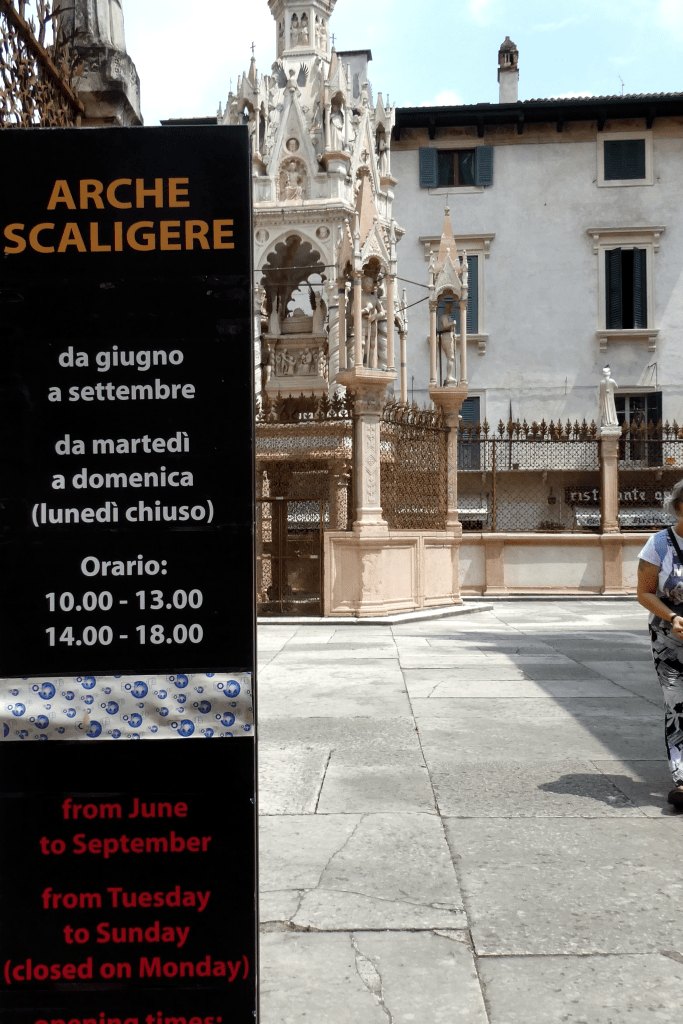
    Nearby is another tiny square in which can be found the tombs of the Scaligeri family. They dominate the area, massive Gothic-like edifices, some behind a gated courtyard, and one above the church door. Intriguing, certainly, and something not to be mi

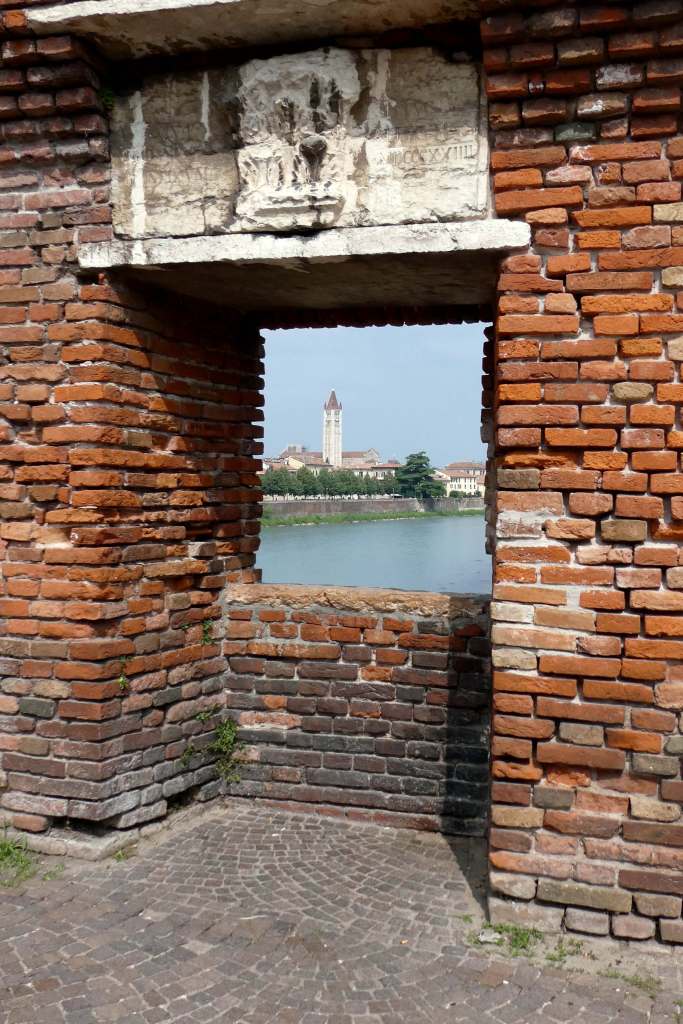
    More Scaligeri family history can be found at Castelvecchio, best approached along the Adige River and across the bridge into the city proper. Castelvecchio (in Italian ‘the old castle), a red brick building with crenelated walls and square turrets was built by the ruthless Scaligeris in the 1350’s as a home and a fortress. A later ruler also used it as his residence, during his time in Verona – one Napoleon Bonaparte who had conquered most of Northern Italy in the early 1800’s.

    During the 1920’s it was converted into a Museum and then in 1985, a renovation project to repair the damage done during the second world war was started by Italian architect Cala Scarpa. The result of that renovation is the splendid red brick castle one sees today the interior of which has been converted into one of the best Museums in Northern Italy.

    Romeo & Juliet

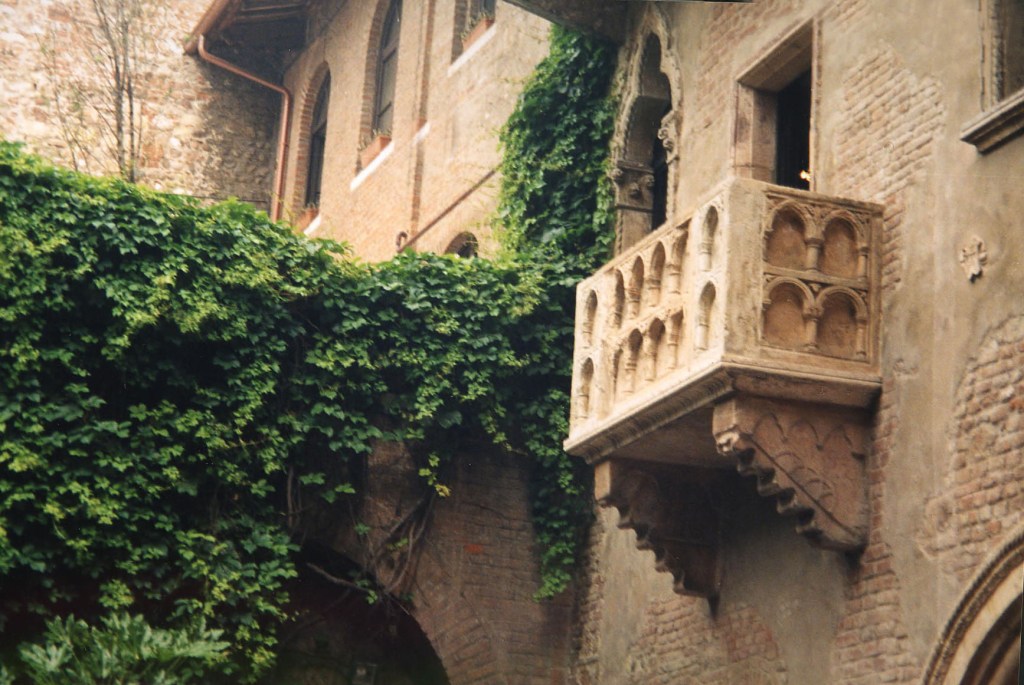
    The Balcony 2003
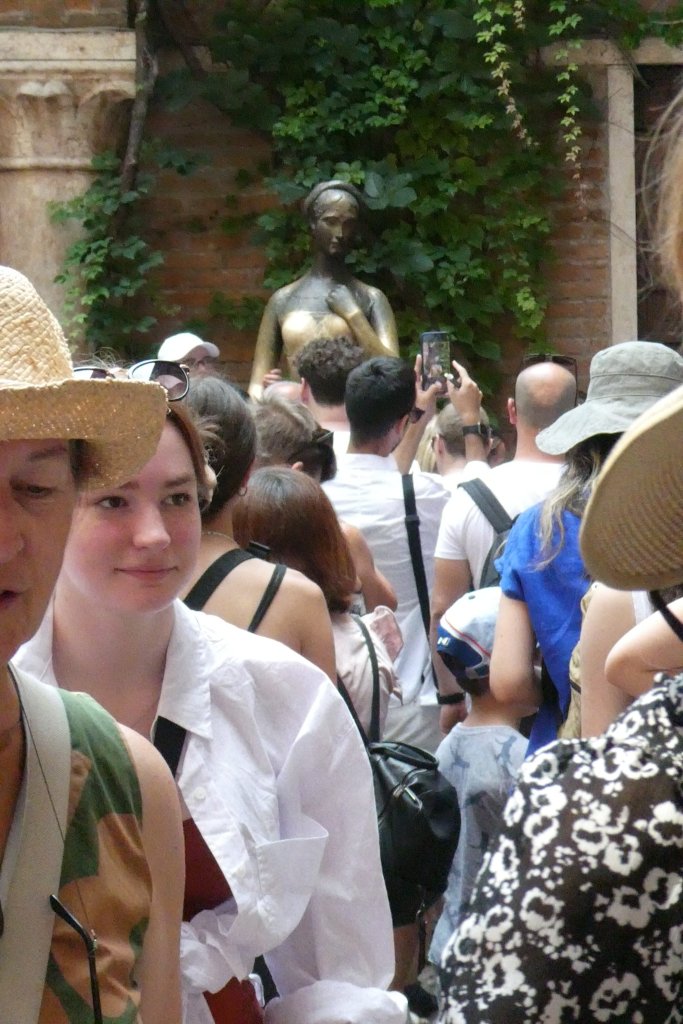
    The Crowds Below Juliet’s supposed balcony, 2023

    Everyone knows that Romeo & Juliet are fictitious characters dreamt up by William Shakespeare, but that doesn’t stop the crowds pouring into the courtyard of the supposed home of Juliet in Via Cappello, to touch the statue of the young heroine, and to pose on the balcony for a selfie. So many people have touched Nereo Costantini’s bronze statue that her right breast has now been burnished to gold. But even though the balcony you see today was erected only because tourists kept demanding to see the balcony, it is worth a visit even if you are in Verona for only one day. The house once belonged to the rich Veronese Dal Cappello family, and to visit the house and its courtyard gives an idea of how families lived in Verona in the 14th century.

    My last visit was some 14 or so years ago, the courtyard then was almost empty, we had time to explore the house and surroundings and even read some of the letters received daily asking for advice. This time, however, the search for the ultimate selfie by the crowds queueing and surging into the small space under Juliet’s balcony was a major distraction, yet I would still return to feel the magic that the place possesses. It is but a short step away from the city’s two major Piazzas linked by its famous shopping street, Via Mazzini.

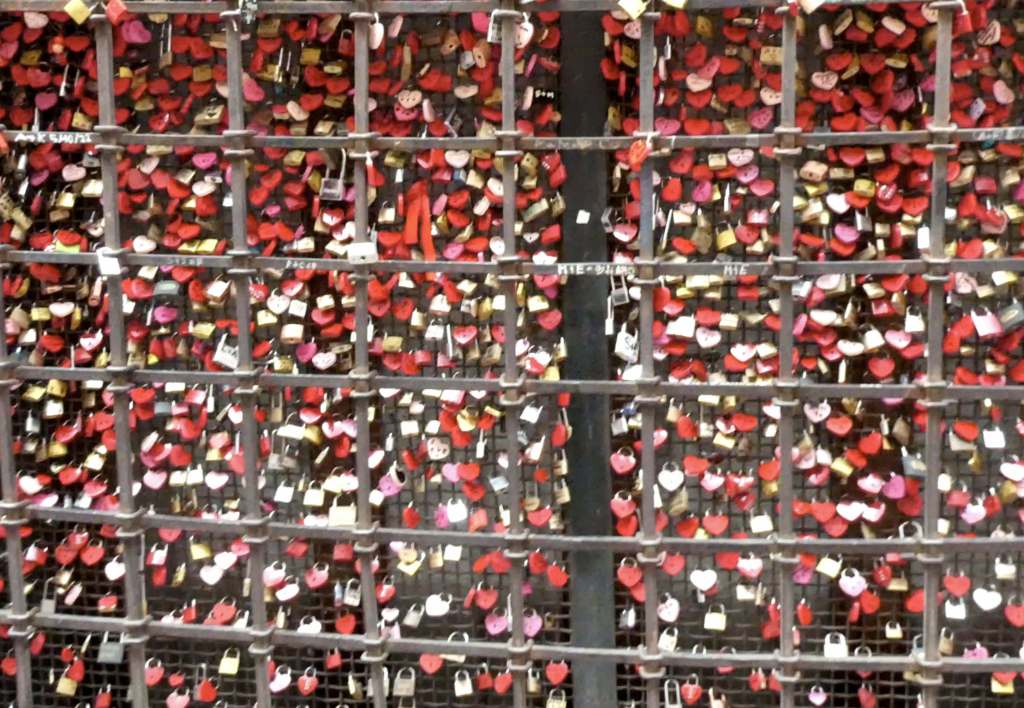
    Lovers’ Locks

    Verona was the first place to have love locks on bridges, something that is now defacing bridges all over the world.

    Piazza del Erbe and Piazza Bra

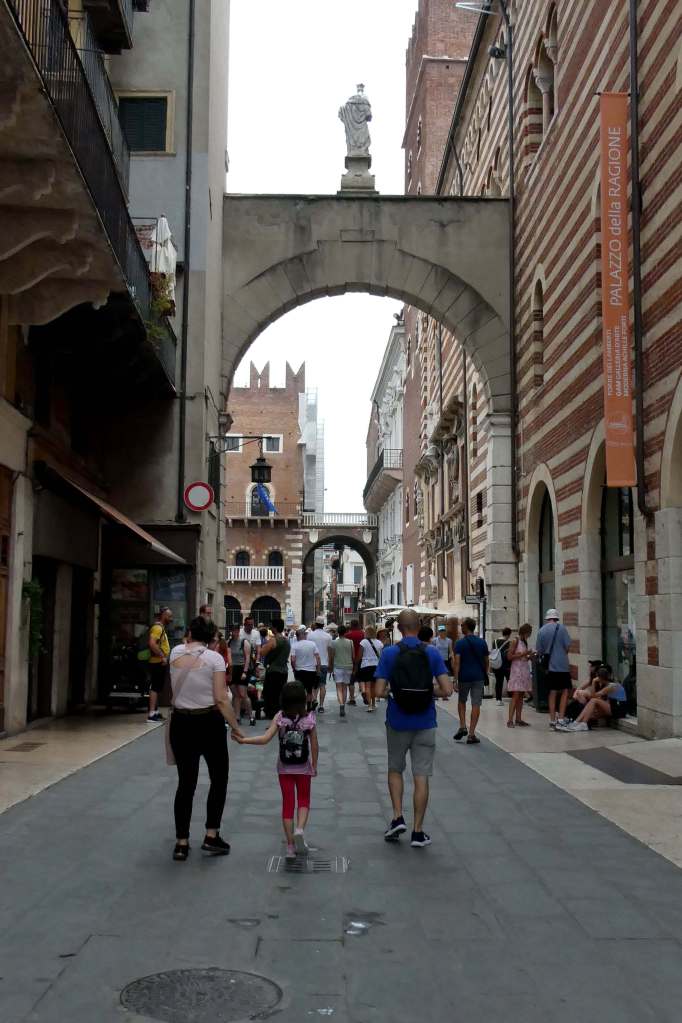
    Piazza del Erbe, named after the spices that were once sold there, (erbe=spices in Italian), Verona’s most ancient piazza, was ‘the Forum’ during Roman times. It is now Verona’s commercial centre, a hub for shopping, café life, and people watching. Beautiful old buildings surround the Piazza in front of which lively market stalls sell food, spices and household goods, while the traders entertain the public as they have done since Roman times. It is around this area that you will find the prettiest streets and alleyways.

    Piazza del Bra

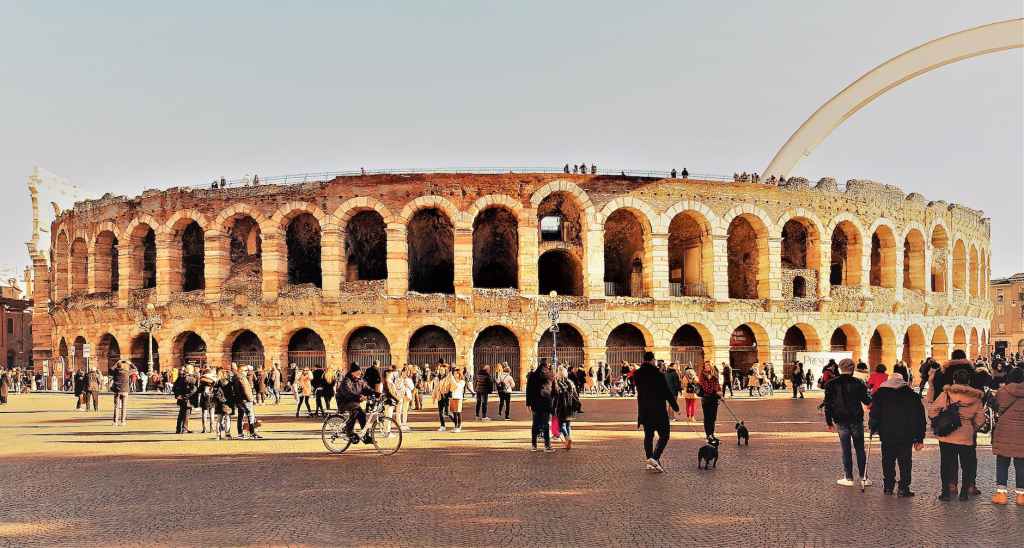
    The Via Mazzini, a high-end shopping area where the shops all bear famous fashion names, from Chanel to Dolce & Gabbana, links Piazza del Erbe with Piazza Bra, home to the famous Amphitheatre of Verona, usually called The Arena. Elegant ladies with tiny dogs parade down this street which on Sundays can become very crowded when it is time for the passeggiata, the ritual Sunday evening parade when all Italy turns out to display la bella figura.

    The Verona Arena

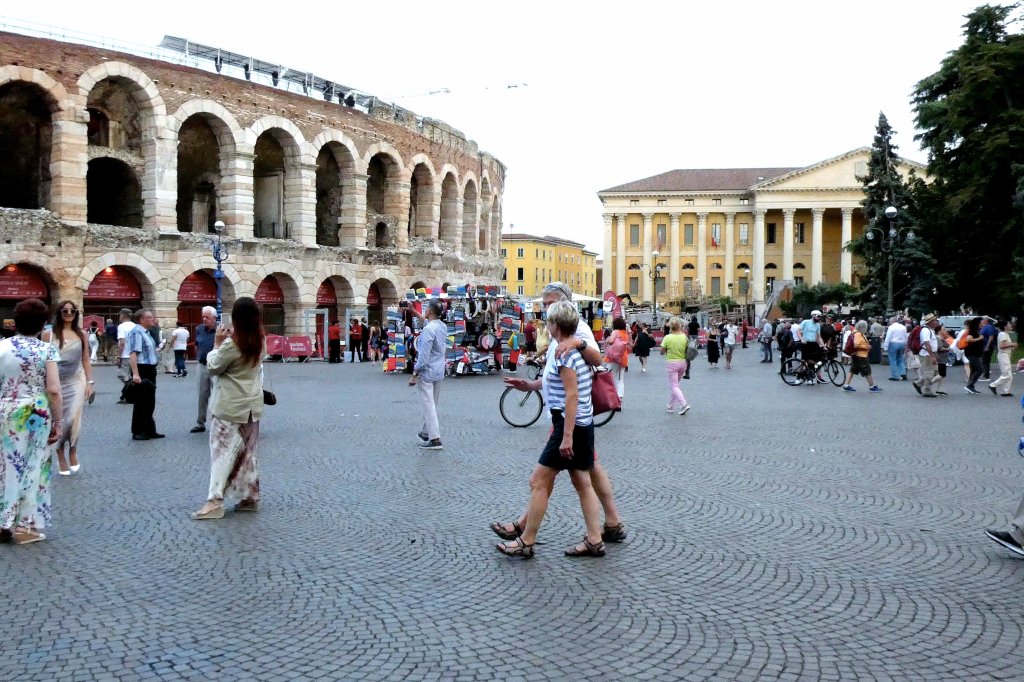
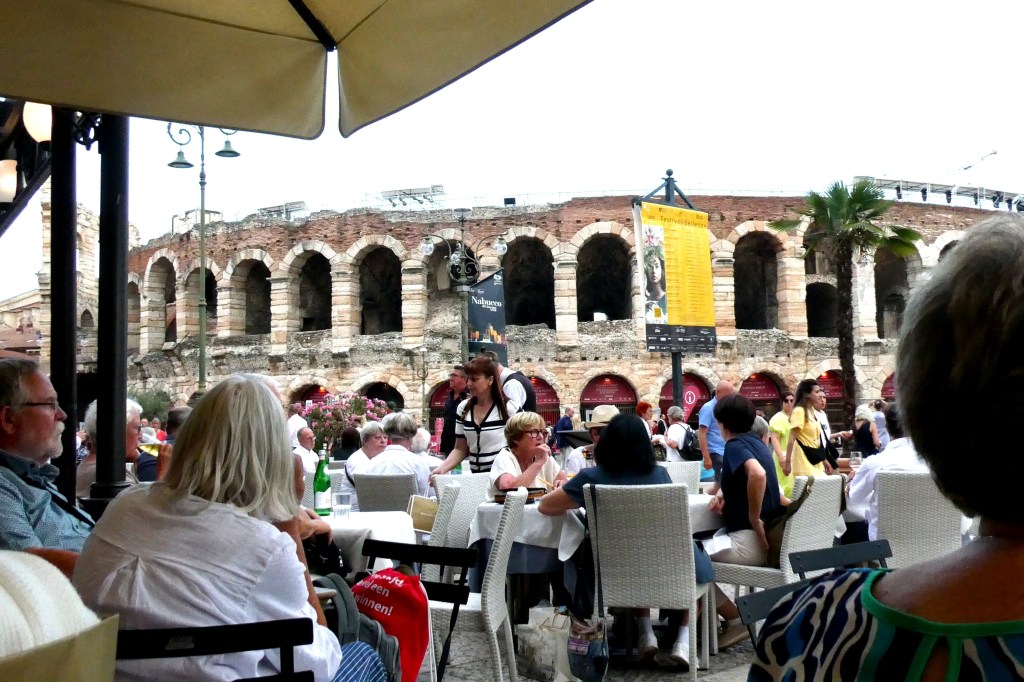
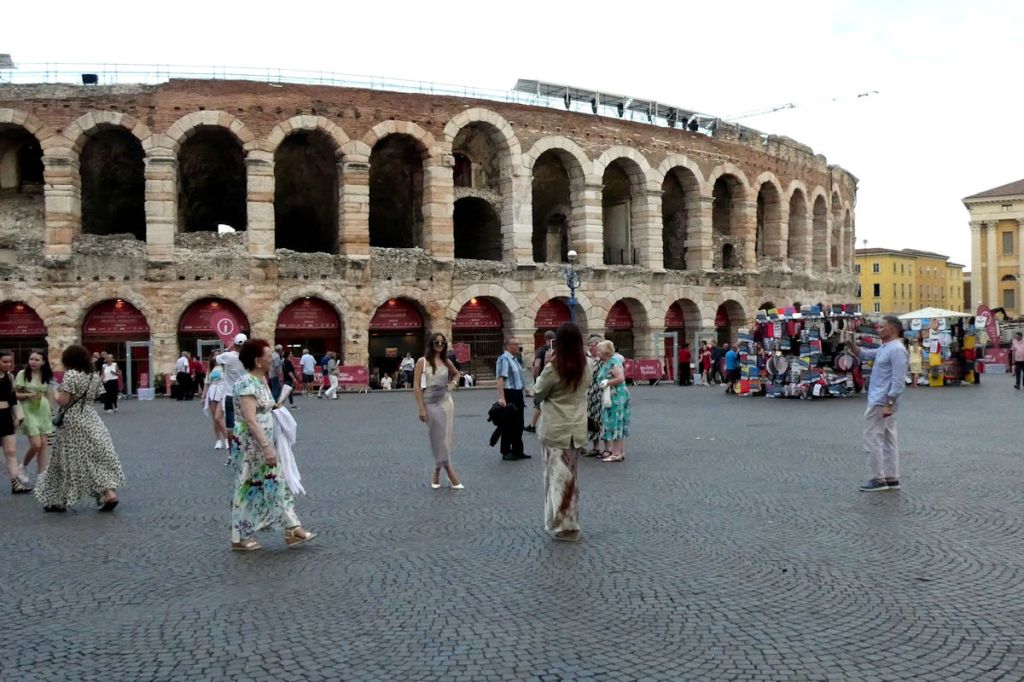
    I kept the best till last. The impeccably preserved Amphitheatre in the heart of old Verona and the city’s most famous site, is deserving of that much abused word, awesome. Rows of arches and curves dominate the skyline and form a centrepiece in Piazza Bra, the city’s largest public square.

    Piazza Bra and the Colosseum

    The square is lined with bustling restaurants and imposing buildings, notably the 19th century Palazzo Barbieri, a yellow building with a neoclassical façade that now serves as Verona’s Town Hall. Nearly two millennia old, the Colosseum used to hold up to 30,000 spectators at gladiatorial fights between men and men and men and beasts, who fought to the death on the sandy stage. And this glorious arena is not a dead relic of the past: it still entertains the masses although in a different way. No more are the crowds offered bread and circuses but performances of high art, most notably the world famous Verona Opera Festival which takes place every summer.

    Verona is a city for all, young and old, the seeker after history & ancient cultures and lovers looking to re-kindle an old love or find a new one, opera lovers who fill the Arena night after night during the summer, and fans of William Shakespeare who watch his dramas play out under the stars. There’s a jazz festival, a festival of street games, and even a horse fair. As I said, Verona is a city for everyone.

  • VERONA:  A NIGHT AT THE OPERA

    VERONA: A NIGHT AT THE OPERA

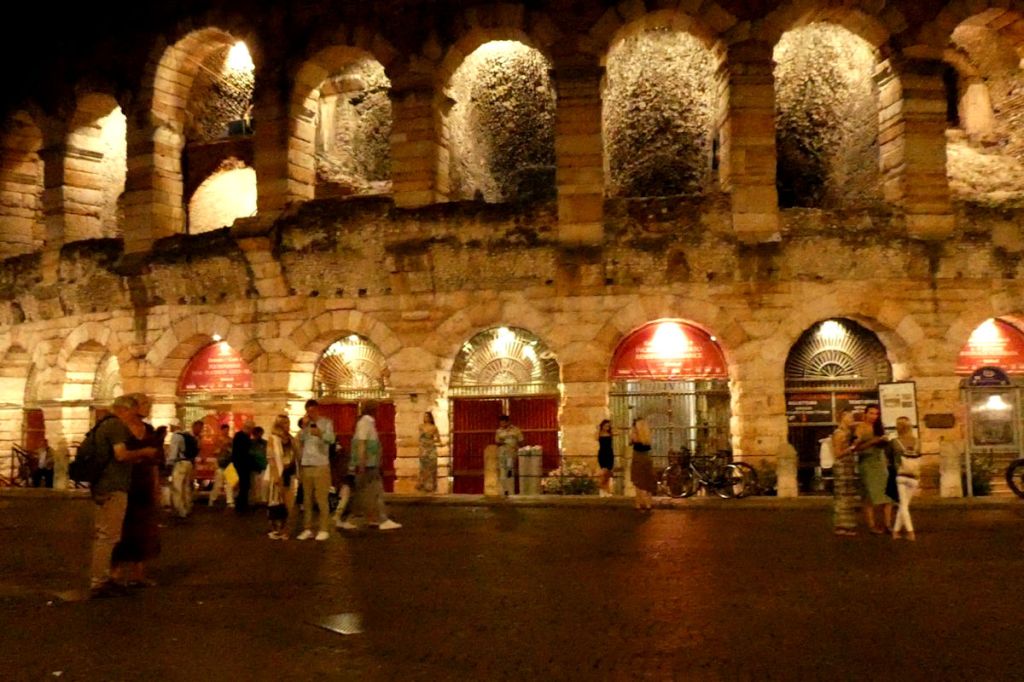
    Exterior of Arena

    We came, we saw and we were conquered. Not just by the city but by the by-product of that city, opera, for we were in Verona for the 100th Anniversary of the performance held in the ancient arena, an arena older than the Colosseum in Rome. In ancient times it held 30,000 people for its circuses and gladiatorial events but as the stage for opera performances decreases the available seating, it now has places for only 22,000.

    Exterior of Arena early evening

    We came to Verona, my friend Jane and I, for Giuseppe Verdi’s Aida, the signature opera of the city. Although there had been some productions during the 1850s, it wasn’t until 1913 that opera began in earnest in the Arena, due to the zeal of the famous Italian tenor Giovanni Zenatello and the impresario Ottono Royato. The first opera to be produced in the arena on 10th August 1913 to mark the centenary of Verdi’s birth in 1813, was Aida, and since then, Aida opens the yearly festival of opera.

    The moon has appeared as the audience awaits the evening’s performance

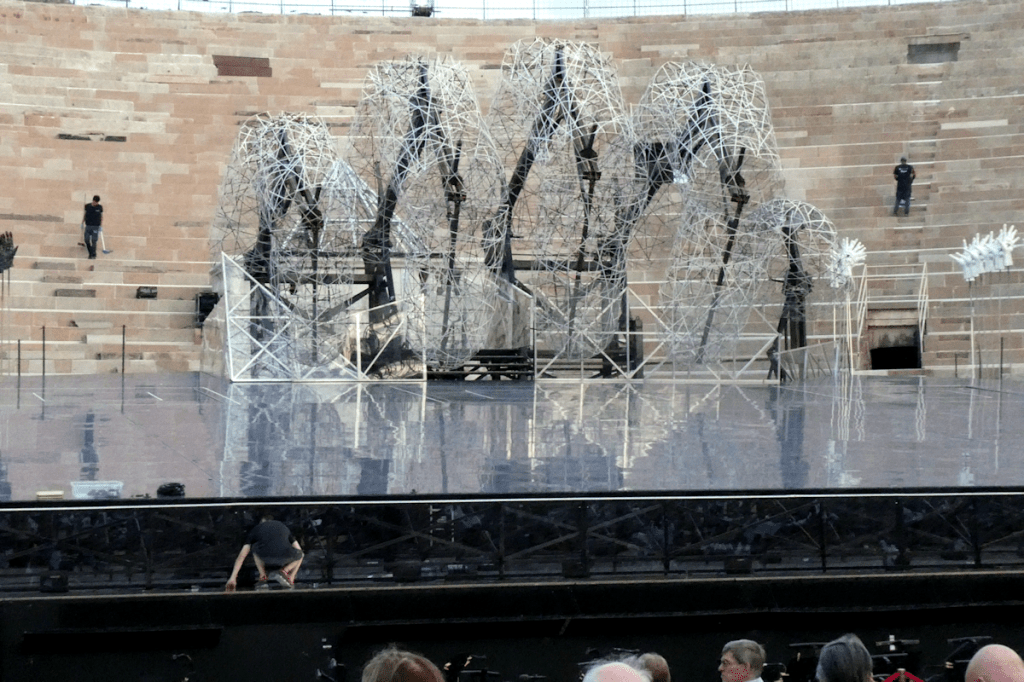
    As dusk settled over the amphitheatre and a pale moon floated in the velvety blue sky above, anticipation was high. We’d watched the stage-hands sweep the tiered stage, watched the lighting engineers fiddle with the lamps, and wondered at the meaning of the objects that decorated the set, crystal pyramids, giant hands, and lighting designs which, although technologically modern, blended easily into the ancient Roman amphitheatre. Later I read that the giant white hands that dominated the stage represented power.

    The arena was full, from the front padded seats to the tier upon tier of stone seats (no back rests but with hired cushions for comfort), and the audience milled around taking photographs, chatting in groups and in Italian fashion, jumping over seats to shake hands with old friends before the performance began at 9.30 pm. It was an audience as enthusiastic as any I’d ever seen – and noisier than most.

    Then suddenly the orchestra was filing on to rapturous applause and the opera was about to begin.

    There was a hush as Alexander Vinogradov as Ramfis began singing, a hush that continued throughout the First Act and every subsequent Act. I have never, ever, known an audience be so quiet, enraptured even, so receptive of the story being told in voice and music from the stage, so totally engrossed in what was happening in front of them.

    I can’t even begin to guess how wide the stage was: one’s eye just couldn’t take it all in at once, yet somehow, the war-stricken world of Aida materialised in an intimate setting on the vast arena stage, as over 300 performers – soloists, chorus members, dancers and mimes – cast their spell. Their costumes were inspired by Paco Rabanne and Capucci, silver robes and helmets radiating brilliance across the expanse of the tiered stage.

    The gigantic wire hands which towered over the stage and had puzzled us when we first saw them now moved menacingly or soothingly as the music and the story demanded. Stefano Podo’s avant-garde production included LED-laser lights that formed shapes and changed colours from red to blue to green, to great effect, plus impressive lighting effects at the back of the arena as actors brandished what looked like light rods used to great effect during the judgment scene.

    And as for the Arena itself! Built in AD30 out of white and pink Valpolicella limestone (a few repairs since then), the arena has perfect acoustics (amplification was only brought in in 2011). In its heyday it hosted gladiatorial fights and blood sports, horse races and medieval jousts but nowadays the crowds come not for blood and gore in the sand but to be transported to another realm by the beauty of the human voice.

    I’m failing as a writer here because I can’t describe what the experience of seeing and hearing the opera was like; it was a spectacle that needed to be seen in order to understand the power it had. I had been to the Arena years ago when the stage effects for Aida included ancient Egyptian scenes to rival those of Cairo. We were younger then, my husband and I, and we sat on the stone seats way, way up on the terraces. The excitement of opera under the stars past midnight (it starts about 9.30 pm and finishes, usually, around 2.00 or 2.30 am) – meant that I wasn’t aware of any discomfort.

    But the 2023 100th Anniversary Performance was even better, it was uncomplicatedly magical. Possibly helped by the fact that age now demands a padded seat and some space so we had expensive seats front centre (still nearly half what a similar seat would cost at Covent Garden). I would recommend paying that bit extra for the comfort if you are aged from 30 upwards!

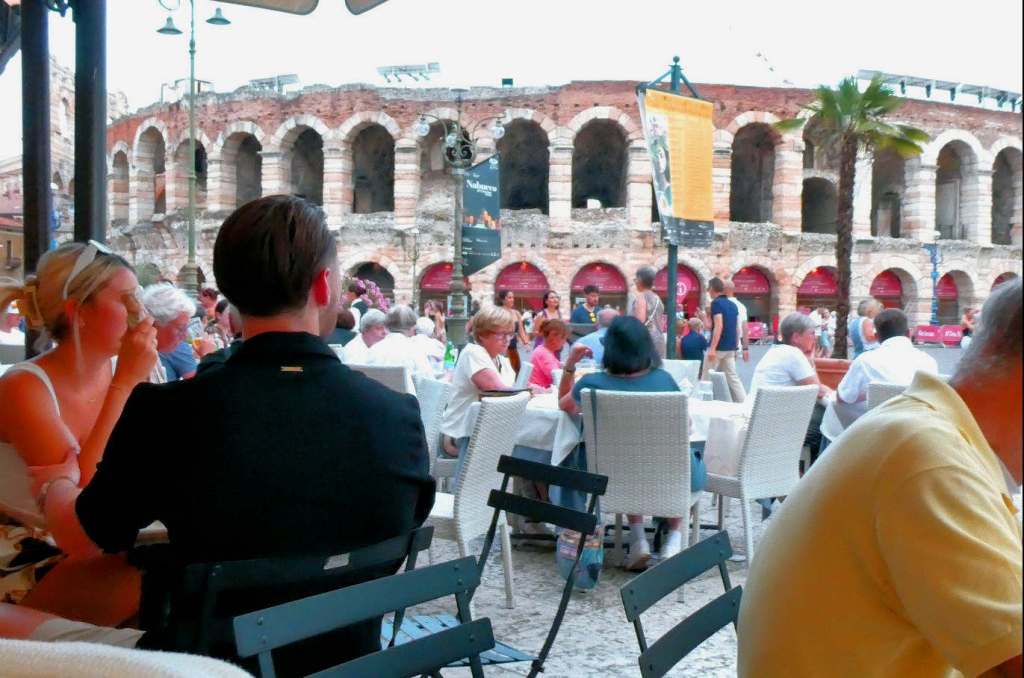
    Just across from the Arena after the performance

    And then jostling for seating at the café opposite the Arena with others who’d shared the experience, sipping a glass of wine at 2.30 am when the heat from the ochre-coloured stones was still intense, not wanting to go back to the hotel, and feeling part of something great and grand was somehow life-affirming.

    Was it the settings? The music? The atmosphere? Maybe some of the silver dust drifted from the costumes and covered us with its magic? I don’t want to be a third-rate critic so I’ve found a clip on You Tube with a selection of scenes from the performance in Verona and if there are any opera fans among you, you might like to take a look and enjoy what we enjoyed.

    Factfile:
    Purchase tickets directly online, at www.arena.it/buy. You can check the availability of seats by consulting the seating plan, which can be found on each performance date. You will be asked to give a password so have one ready. If you want to book by phone, call +39 0458005151 Monday to Saturday 9 am to 6 pm.

    British Airways flies direct to Verona.

  • Caerleon – The Sculptures

    Caerleon town, just five miles from Newport in Wales, is a pleasant, charming little town of mostly Georgian houses, narrow streets with good shops and some excellent restaurants. A historic town, famous for its Roman amphitheatre and the Roman Museum, it is easy to spend a good couple of days here just enjoying the fascinating history of the place. See my post Camelot in Wales.

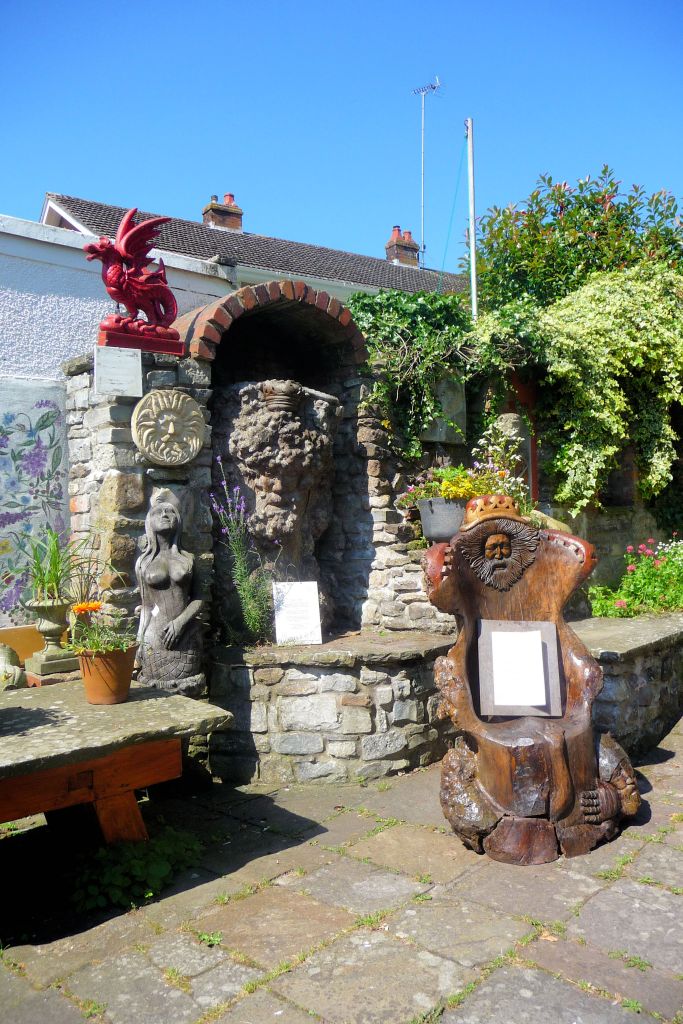
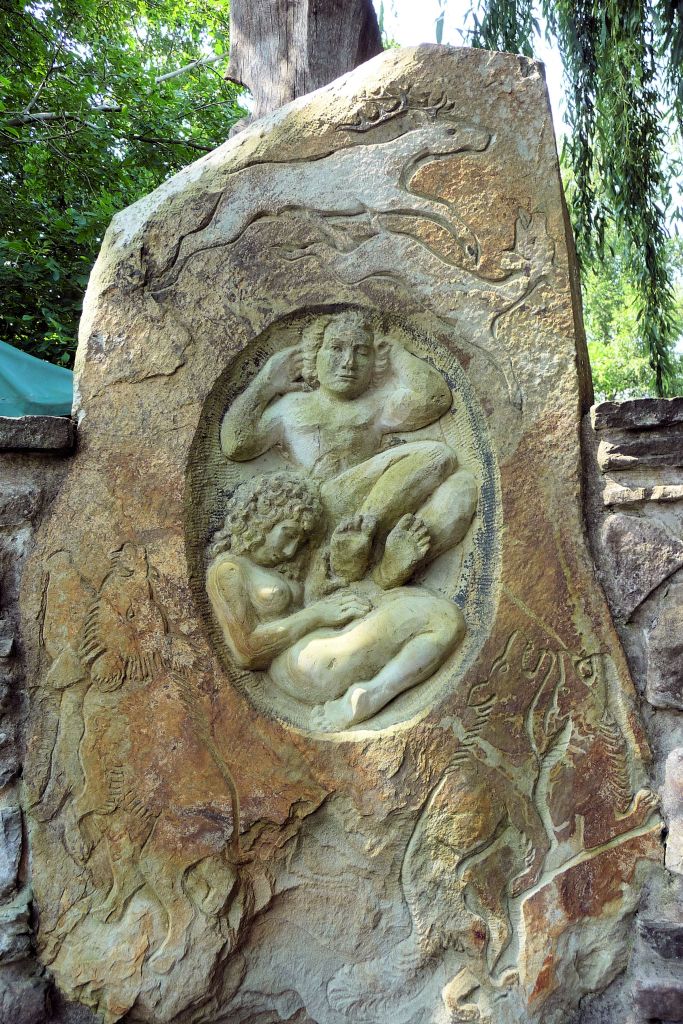
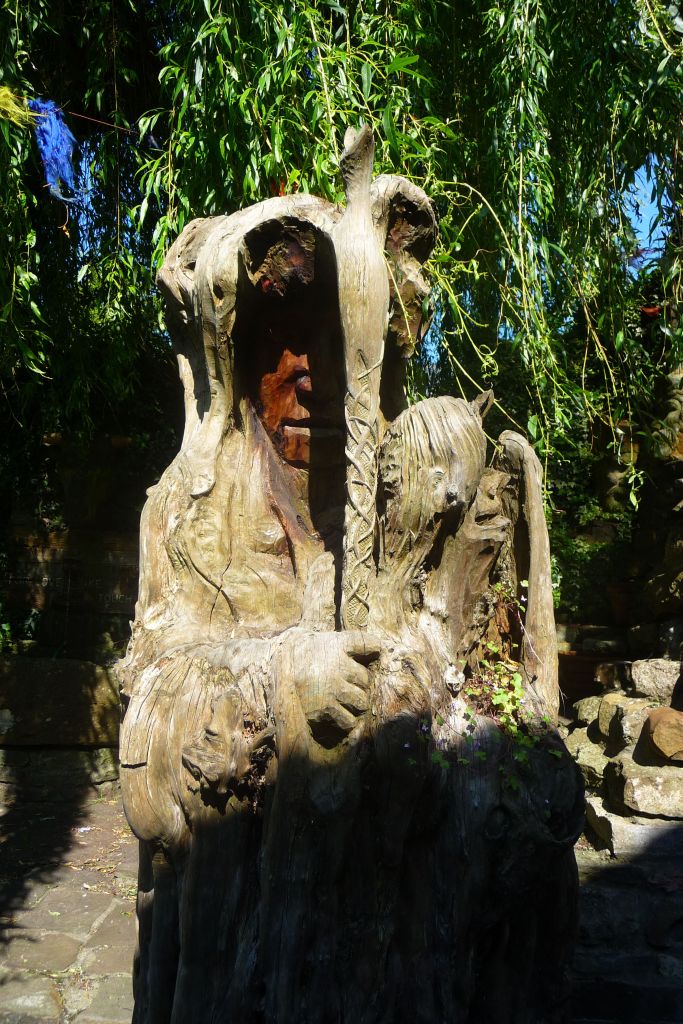
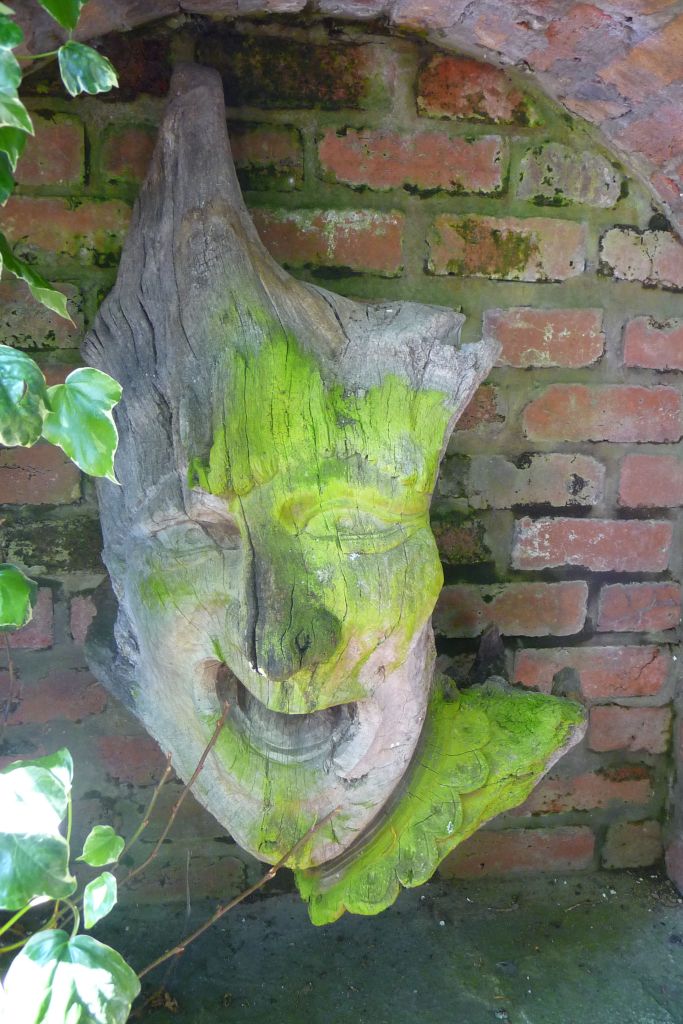
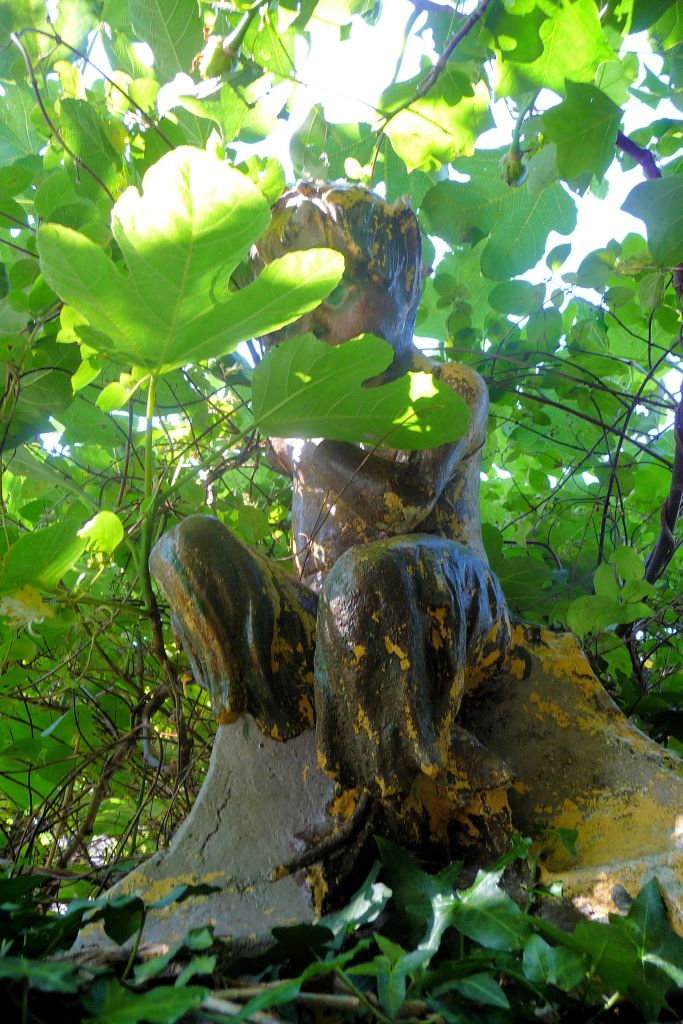
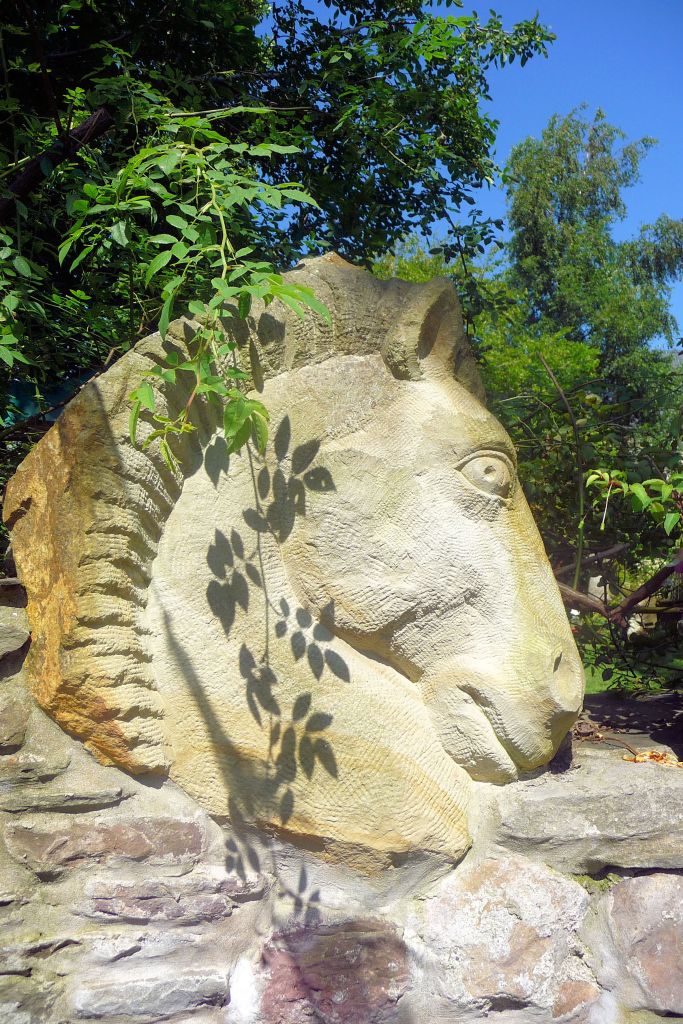
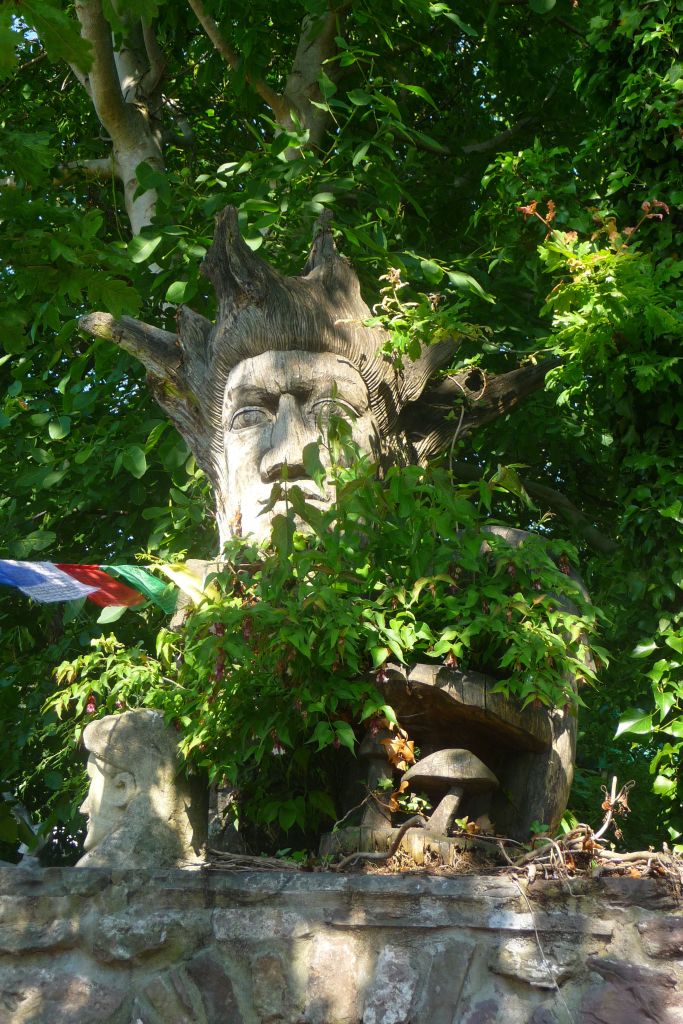
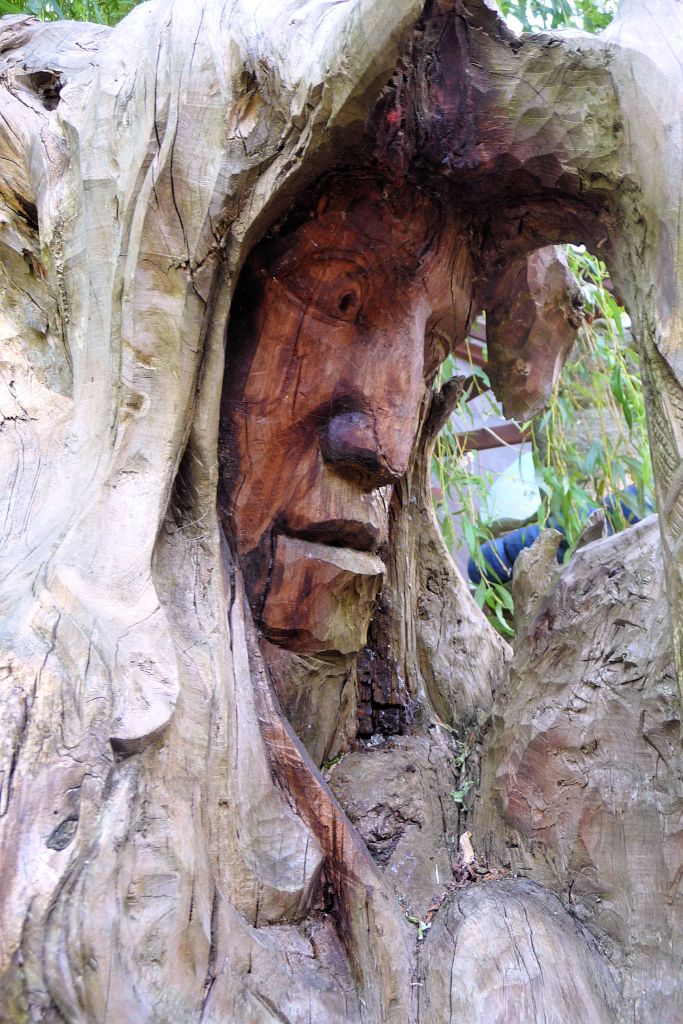
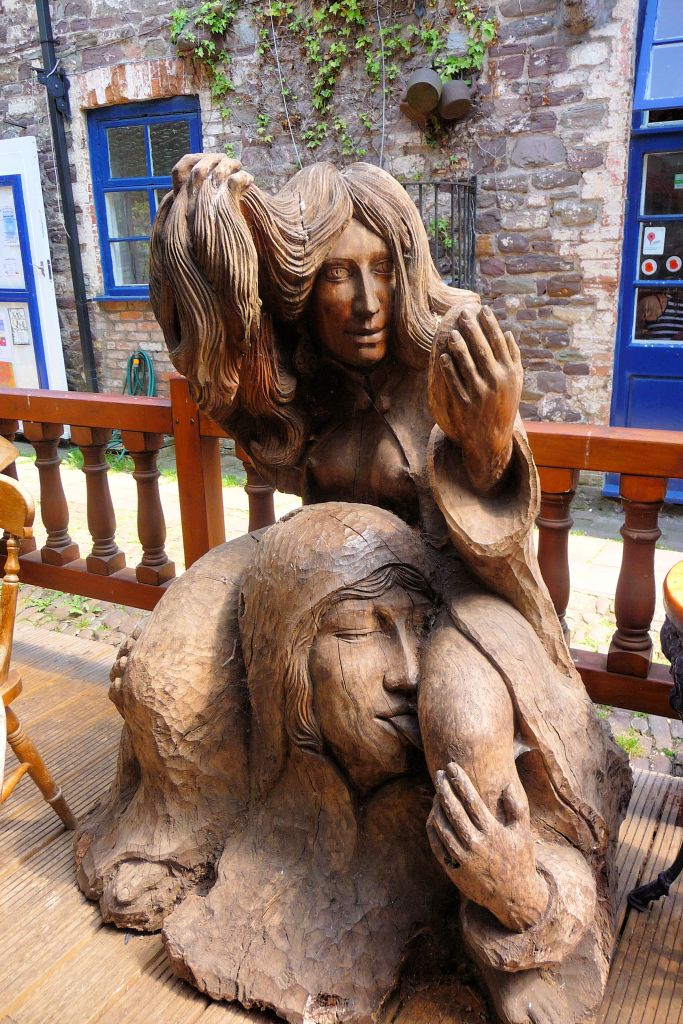
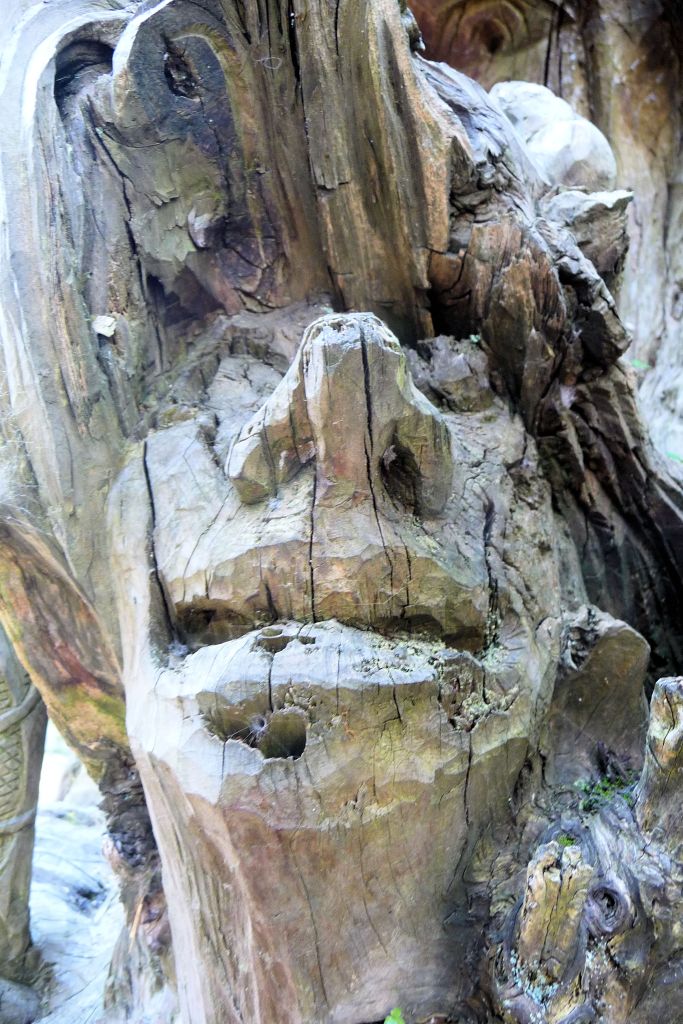
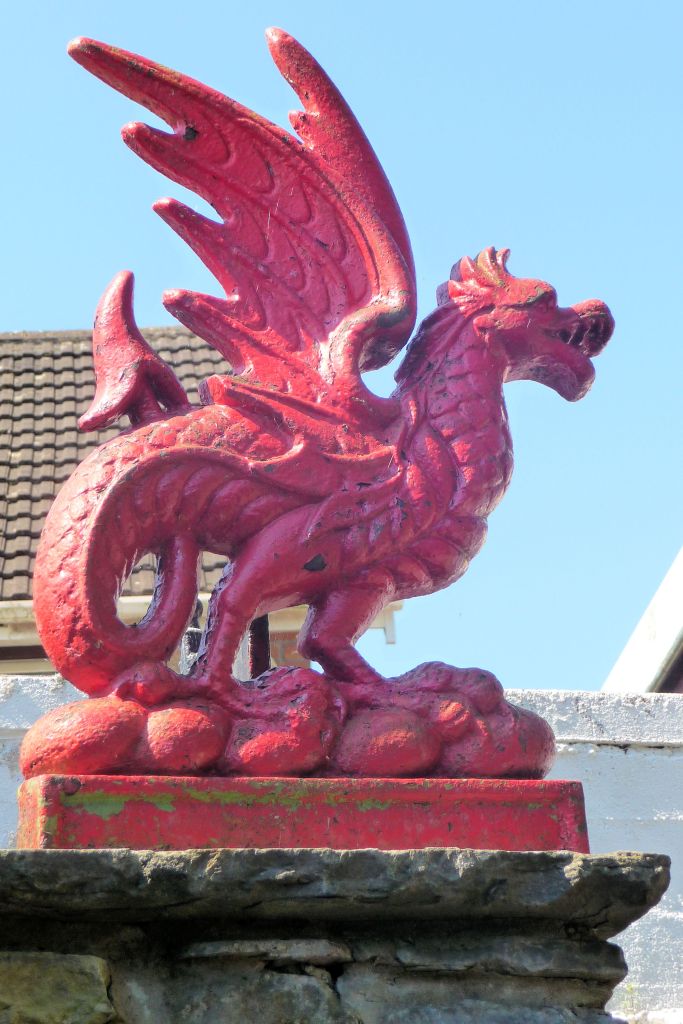
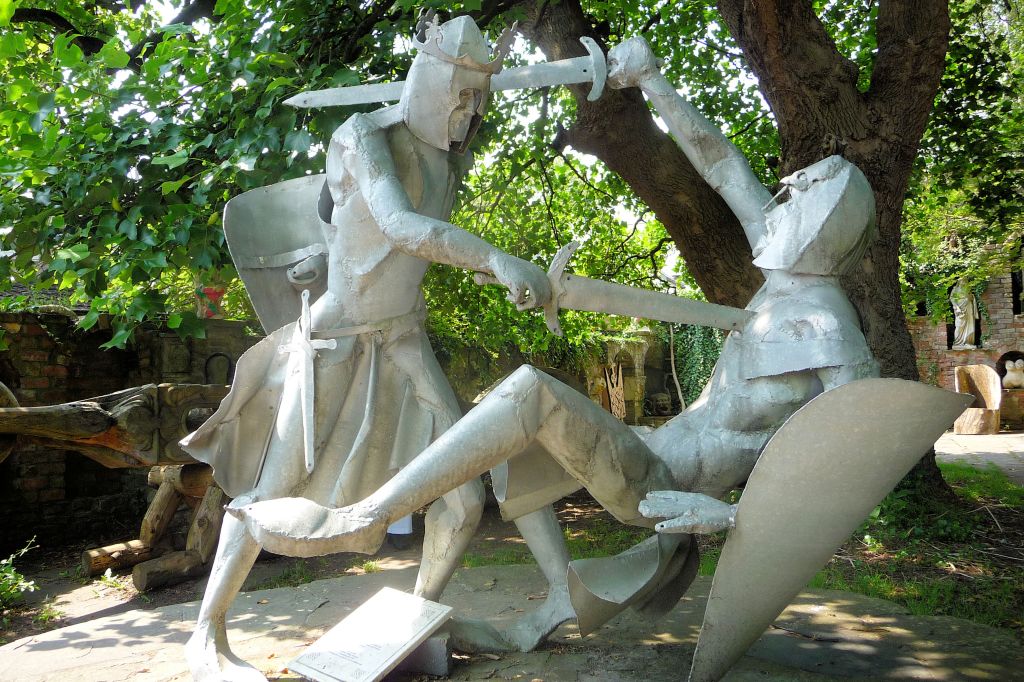
    But Caerleon has more to offer than ancient history.  Just off the High Street you can walk through a reconstructed arch of the main Roman gates, across cobblestones and into an eighteenth century walled garden peopled with sculptures of King Arthur, Merlin, Mordred and Morgana, and, at 44 feet long – the world’s largest love spoon.  Alongside these carvings of mythical figures are carvings of characters from classic Welsh folktales from The Mabinogion, a collection of sculptures that has no equal anywhere in Wales.

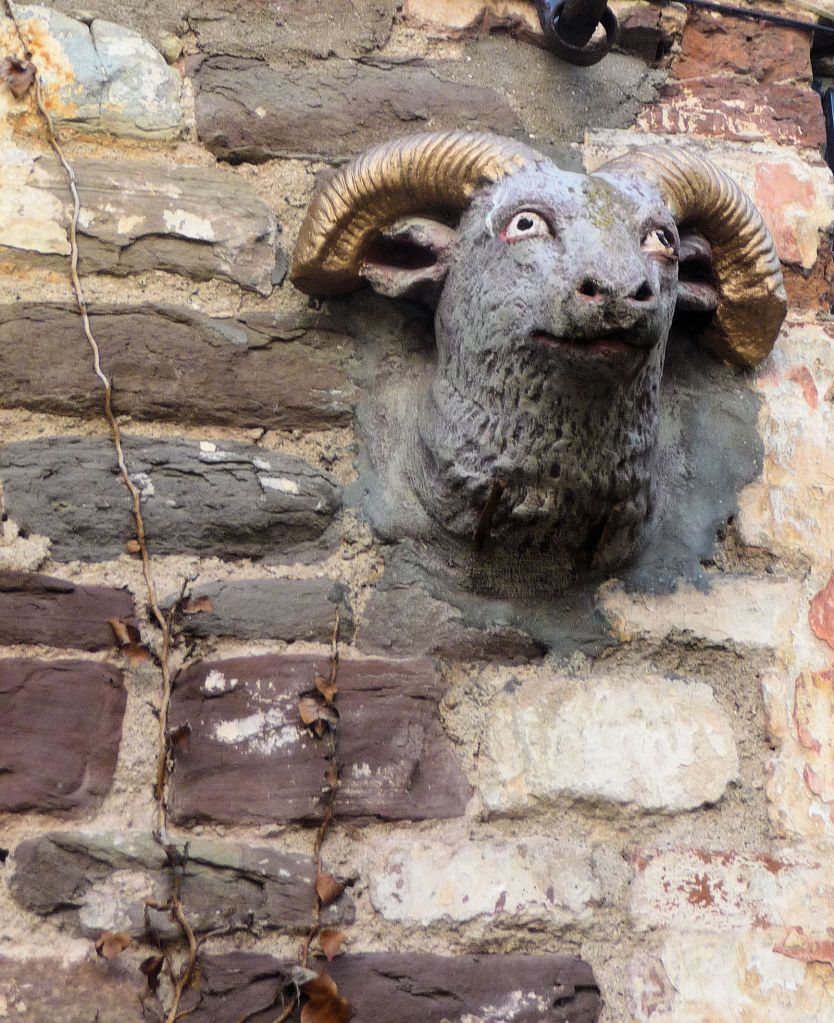
    Caerleon has FFWRWM

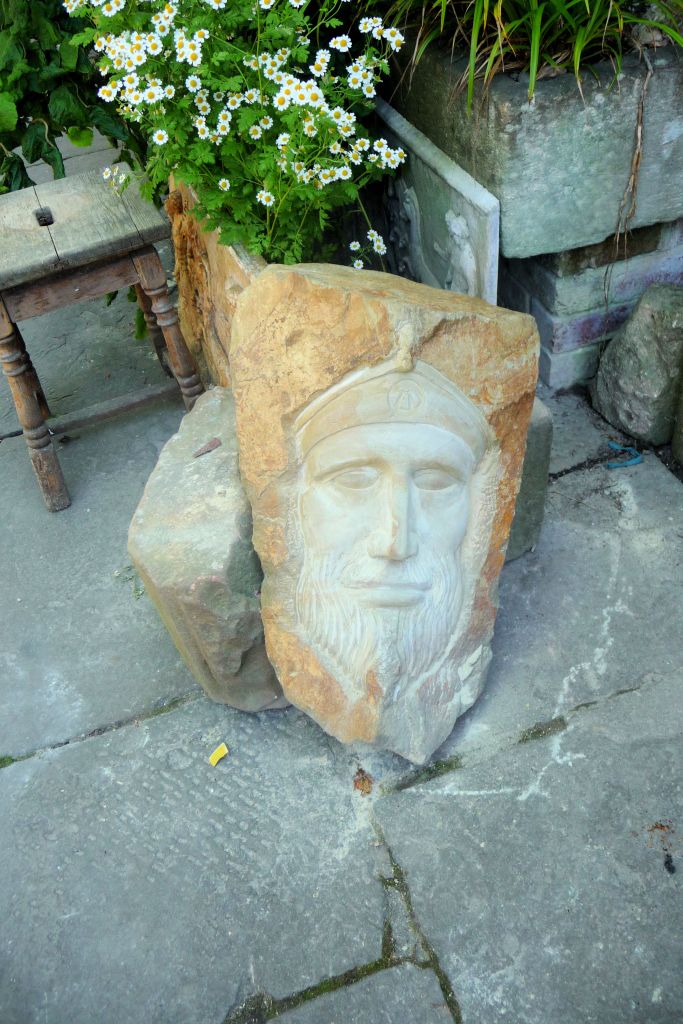
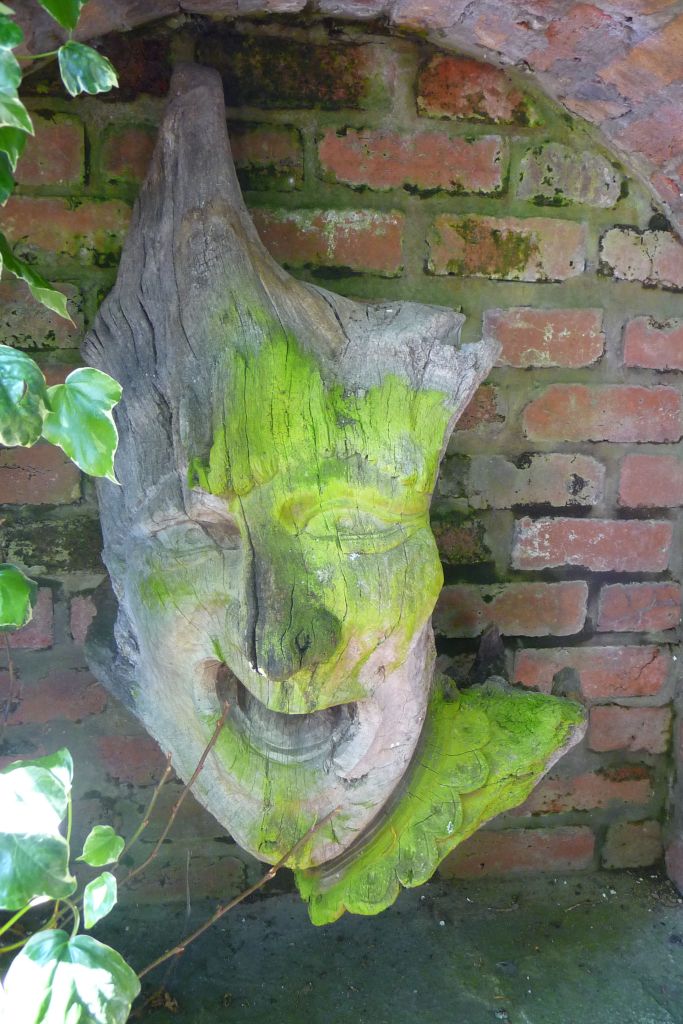
    Lifesize Head

    So here, in the heart of Caerleon town, is Ffwrwm Arts where people can meet, sit and talk, shop, view an exhibition, have holistic treatments, enjoy fine arts, eat or even join a workshop.  And all around you are wonderful carved works of the imagination. If you’ve ever wondered about the Welsh myths, this is the place to find out exactly what they mean.

    The range is eclectic, the themes bookish and mythical.

    We’ll finish with some Roman Legionairres fighting, because Caerleon was one of the most important military sites in Britain under the Roman Empire, home to the 2nd Augustan Legion of 6,000 soldiers.
  • AMALFI – Italy’s Gem

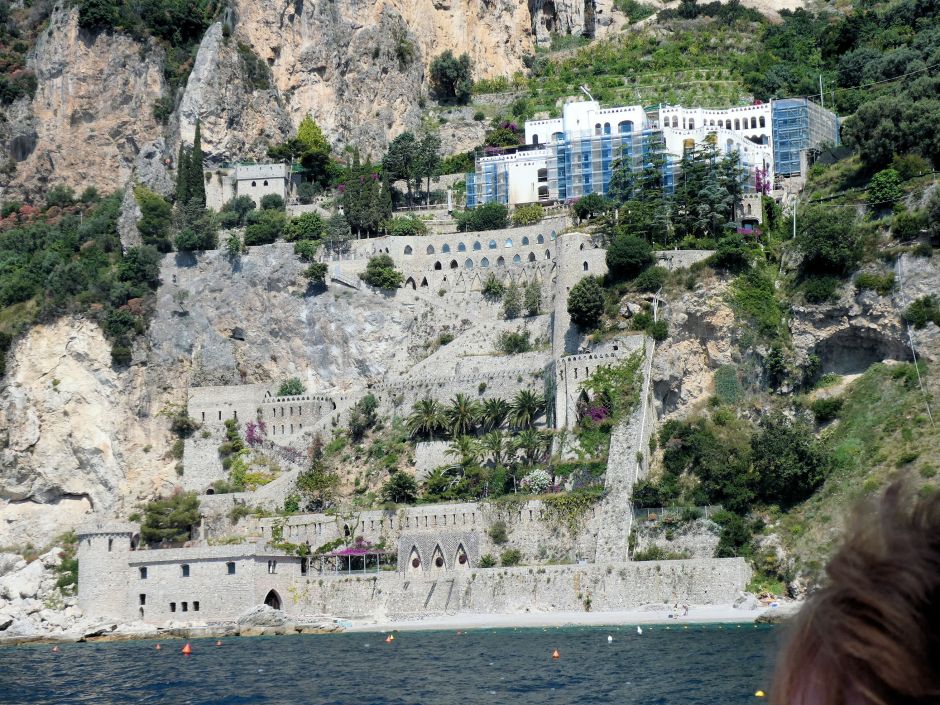
    Amalfi, tiny and expensive is one of the easier coastal towns to walk around as it rises gently up the hillside from the waterfront rather than clinging vertically to it, like Positano for instance. 

    Centreville, Amalfi

    It is hard to believe that this very small town had a glorious history as a maritime republic on a par with Venice and Genoa, but Amalfi was a trade bridge between the Byzantine and western worlds for centuries with a population exceeding 70,000 (today, less than 5,000).   Unfortunately, there are very few historical buildings of note to see as most of the old city, and its inhabitants, slid into the sea during the 1343 earthquake.

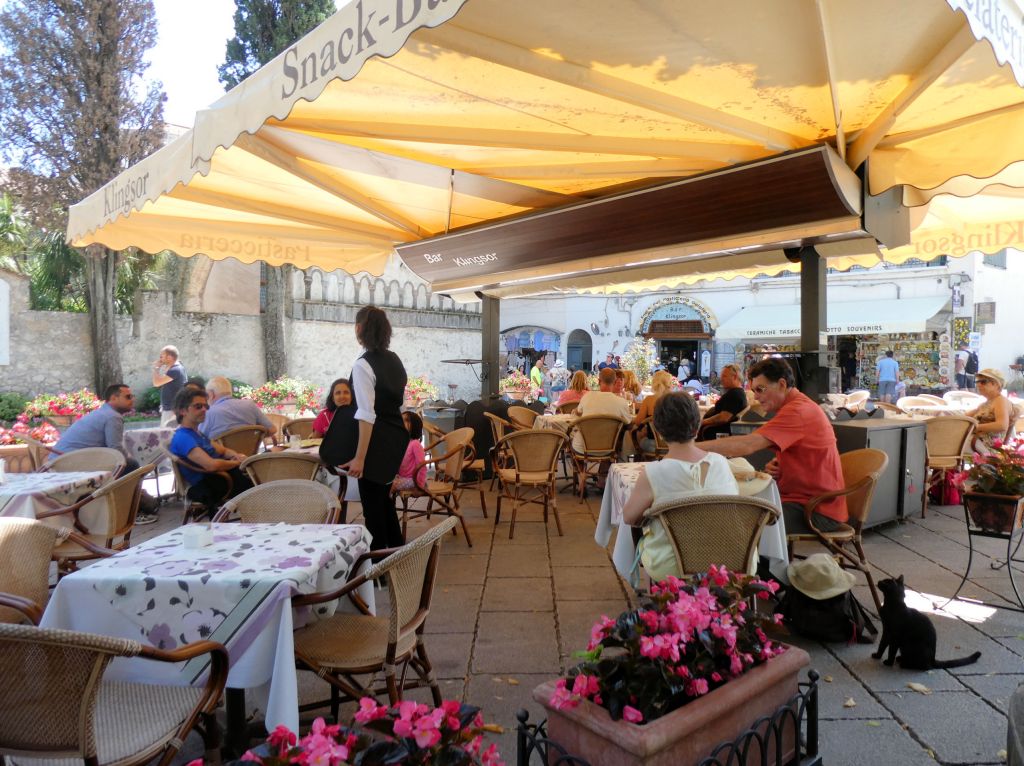
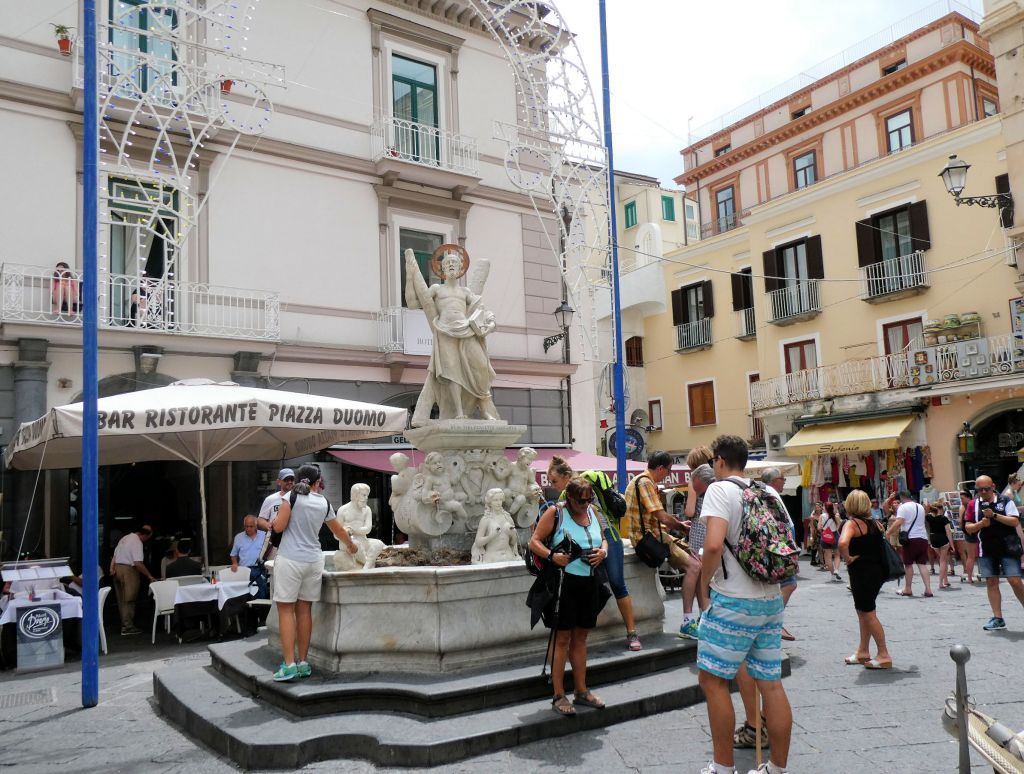
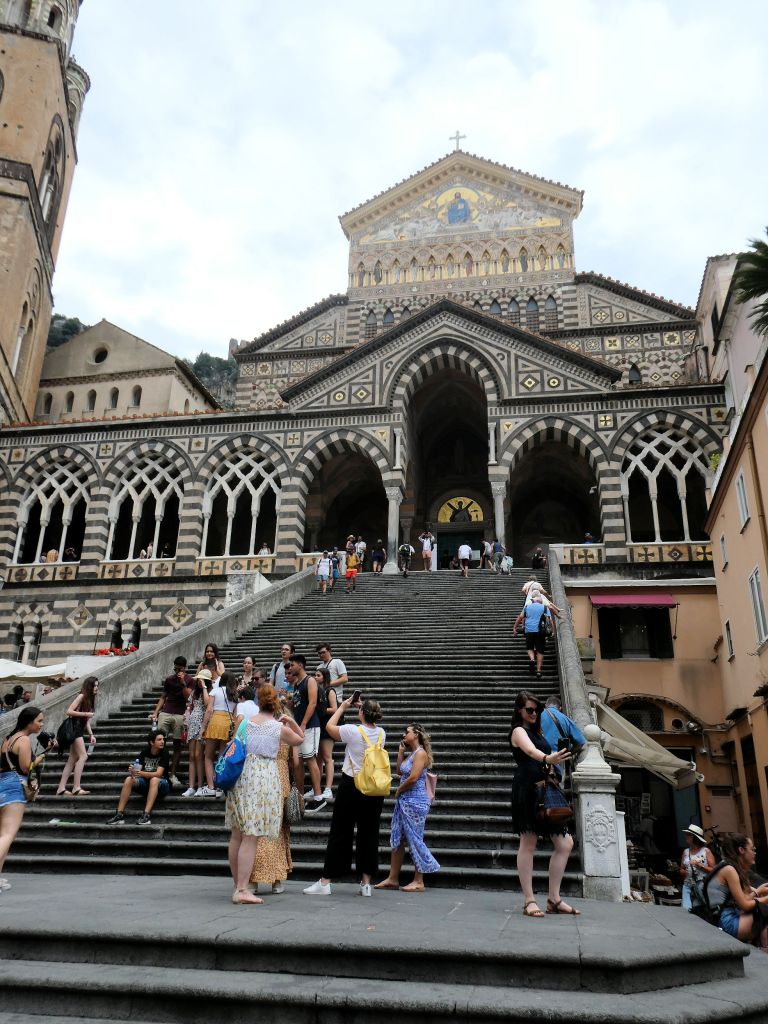
    There is a delightful promenade along the waterfront and a marina full of colorful boats but the focal point of the historic center is the Piazza del Duomo with its striking cathedral dedicated to St. Andrew. There are sixty steps leading up to the Byzantine-style church with its Moorish-influenced arches and decoration and inside the church is a forest of columns and Arabesque arches and the hidden Cloister of Paradise, dating to 1266.  The Piazza is lined with bars, cafes, gelaterias, artisan and tourist shops, and is a perfect place for people watching – if you can bag a table.  It seems to be permanently busy. Don’t forget the water if you decide to walk up the steps, those 65 can feel like 100 when the sun is out.

    The Duomo

    Famous for the manufactire pf paper, the Paper Museum (Museo della Carta) is well worth a visit to see how the products were made by hand. There are still some family-owned paper mills that carry on the tradition of hand-made paper which can be bought in some of the high-end shops – good, if expensive buys, for that special present for someone who still likes to write letters. 

    How Many G & T’s could that Lemon serve?

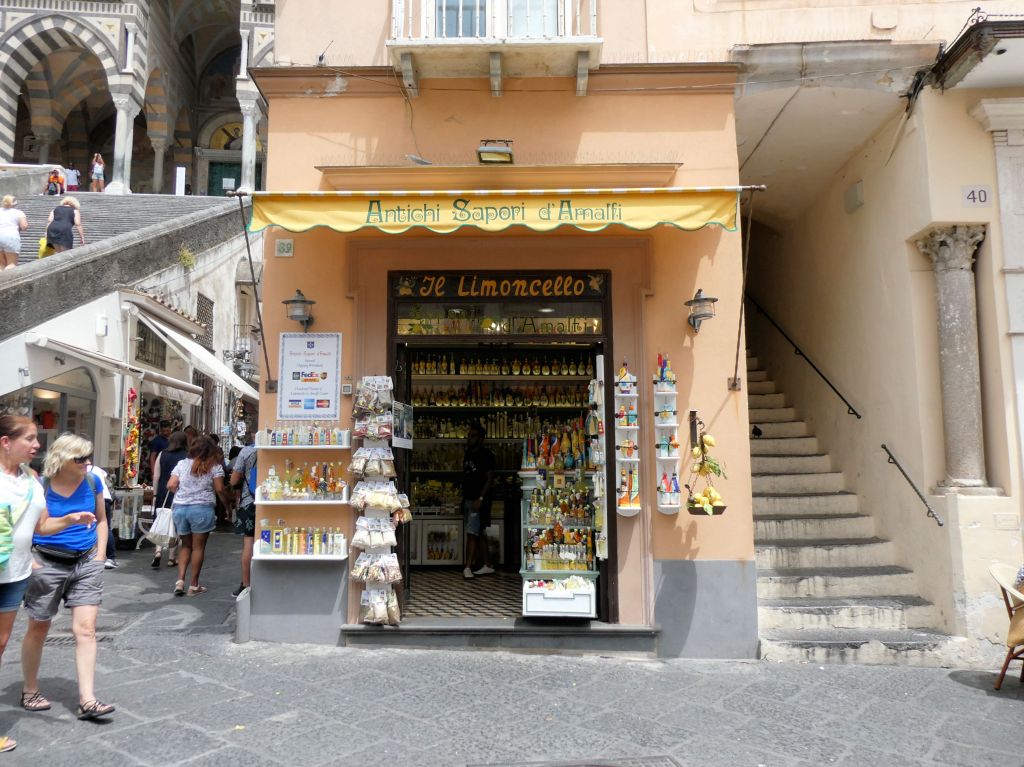
    However, the primary product of the area is lemons, enormous in size, picked fresh to make limoncello liqueur and to be used in local dishes.  Lemon ice-cream features a lot in restaurants and gelaterias, the one by the town gate serving quite the biggest lemon sorbet I have every seen (or eaten). 

    Biggest Lemon Sorbet I’ve ever eaten

    If you don’t spend too much time over lunch or coffee, there will still be time to visit hilltop Ravello, full of historic, artistic, monumental and architectural treasures – another expensive town but exquisite in its layout, and its 13th century Villa Rufolo which has breathtaking views from gardens overlooking the sea.  Famous names you’ll hear mentioned a lot in Ravello are Richard Wagner who was inspired by the Villa to compose some verses of the Parsifal, Boccaccio who stayed here while writing the Decameron, D. H. Lawrence who supposedly got inspiration for Lady Chatterley’s Lover while holidaying in the town and Gore Vidal who came for a visit and stayed for 30 years! 

    Ravello

    Shopping is rather special in Ravello too, as there are many craft and high-end fashion stops where you will find one-off garments – at a price, of course. Even the ice-cream advertises as ‘gourmet’ gelato though what that is I have no idea. 

    Ideal spot for lunch in Ravello
    Interesting items for sale in Ravello- Wine and Drugs. I hope it doesn’t mean what it says!

    Restaurants bars and bistros abound, but walk around the interesting narrow backstreets of cobble-stones, peering in at dark interiors, looking over dry-stone walls fronting overgrown gardens and vegetable plots, if you want to see what this hill-top village is really like. Ravello is a great starting point for walks in the surrounding Lattari mountains along ancient paths.

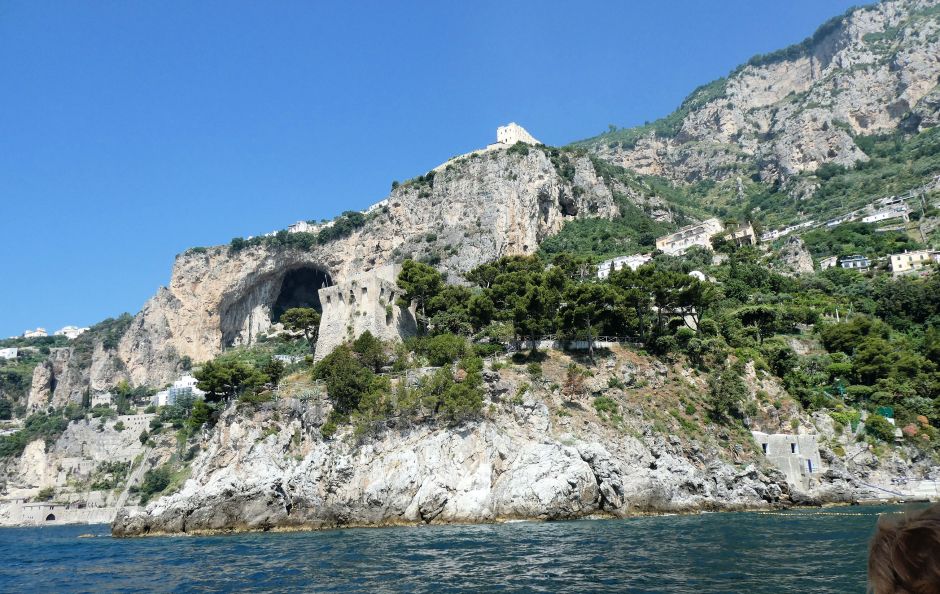
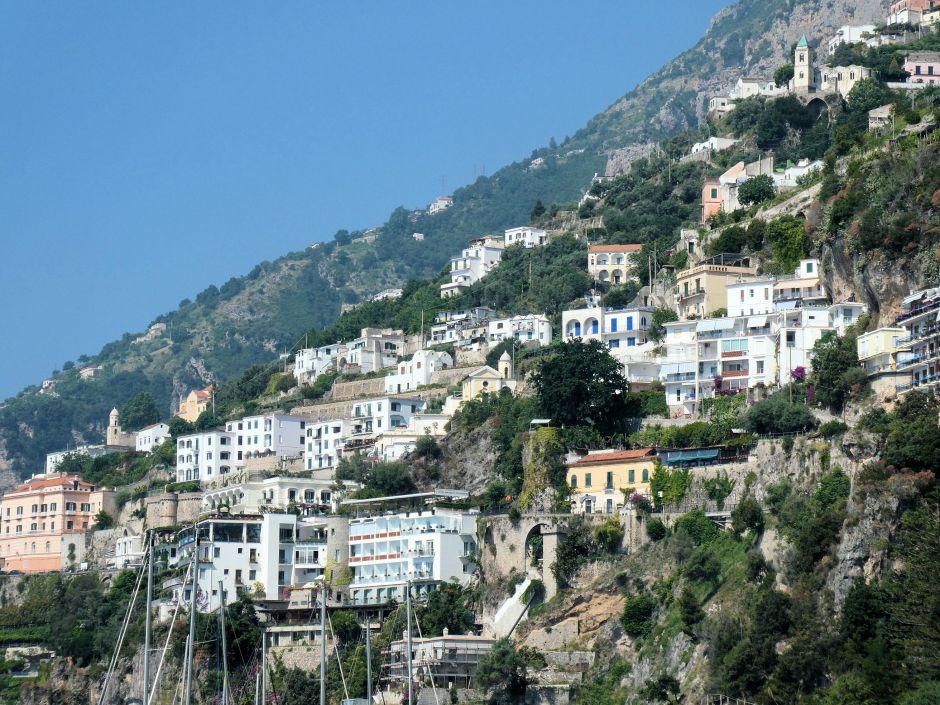
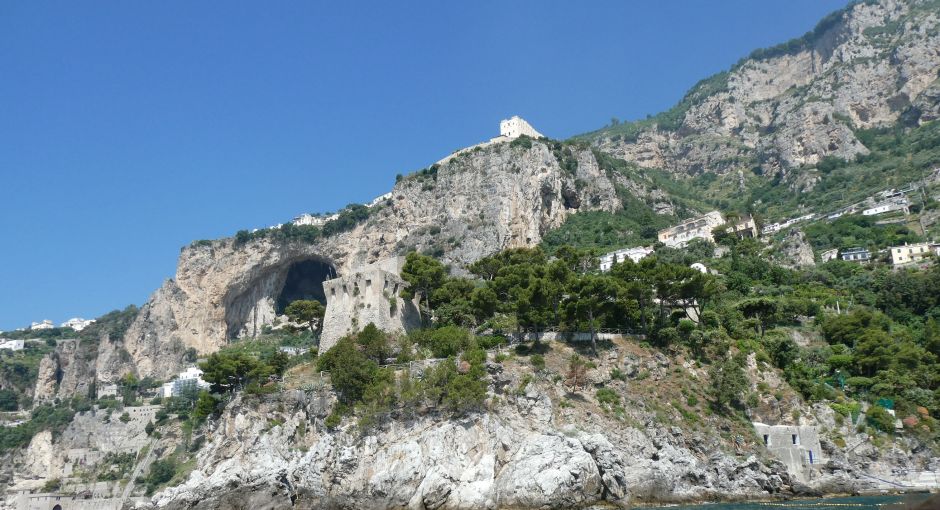
    Amalfi’s trading importance may have declined but its maritime importance continues, as you can hop ferries and hydrofoils to Capri, Salerno, and Positano.   For me, the best way to view Amalfi is from the sea and the best way to do that is to take a boat trip around the bay, either in one of the 45-minute trips or by hiring a boat to take you to hidden coves to enjoy some private sun and surf.  You will see the homes of Gina Llolabrigida, Sofia Loren, George Clooney (before he moved to Como I presume) and other famous names, smaller than you’d imagine because of their position built into the rocks.  In the above slide show of scenes from the sea, the blue and white house set ino the hillside is that of Sofia Loren.

  • Syracuse – The Other Bits

    Syracuse – The Other Bits

    After my earlier Post on the Greek and Roman theatres in Syracuse, I thought I’d like to show you a few of the more colourful parts of the city.   I hope you’ll enjoy the photographs that follow of the transparent seas around the island, Piazza Archimede and its magnificent fountain, the food market, a few more ruins – for how could one not include them as they are part of the street furniture.

    Just to recap.  In the 5th century, when Dionysus reigned, Syracuse was one of the biggest and most powerful cities in the Mediterranean, embellished by gardens, fountains, palaces and temples.   Plato called it “an ideal city”, one of enormous military power capable of withstanding the might of Athens and Carthage. 

    With your back to the sea, you can walk either straight ahead to the old town and the Duomo, or to the left through the Porto Marina and into the old town and Ortygia.  Either way, strolling around Syracuse at your leisure is sheer pleasure.

    This slideshow requires JavaScript.

    Although the image of the fishermen mending their nets is captioned, I hope you notice the massive cruise ship in the background, the old and the new side by side, the old struggling to make a living, the new a disaster, or a dividend to a city?  The jury is still out on that one in Sicily.

    As you leave the ruins of the 7th-century Temple of Apollo you will find yourself in the Corso Matteotti with its 14th-century Greek palace, and from here it is a short walk to the Piazza Archimede, opened in 1878 and dedicated to the Greek mathematics and physics genius, Archimedes (287-212 BC), and one of Syracuse’s most illustrious sons.   

    In the centre of the Piazza is the beautiful Artemis Fountain by Giulio Moschetti (1906) dedicated to Diana the goddess of the Hunt (Diana was the Roman name of the Goddess, Artemis the Greek).  Appalled by the erotic pursuit of Alpheus the river god, Arethusa had asked the Goddess Diana for help: Diana then transformed Arethusa into a fountain which emerged on the nearby island of Ortygia, the core and oldest part of the Sicilian city, where you will find the spring named after Arethusa.  In the fountain, Alpheus peers from behind the goddess while the nymph is about to slip into the water below where, as the tale goes, she will blend with the stream before re-emerging in Ortygia.  Charging horses, Tritons and nymphs splash in the waters of the fountain and a good hour can be spent just walking around the admiring the work.

    This slideshow requires JavaScript.

     If you choose to go through the Porta Marina you will find yourself surrounded by fading Baroque Villas and Palaces facing the sea and hidden in the narrow alleyways, secretive dwellings with shades of a once glorious past still clinging to them.  Along this long, narrow promenade you will pass the Church of the Holy Spirit which is worth a visit if time allows (but remember you have the Duomo and Santa Lucia alle Badia to explore as well).

    Despite the lack of beach facilities the area around here is popular with swimmers, and often you will see people diving off the rocks into the near transparent waters or sunbathing in what looks like dangerous places along this rocky foreshore.  

    There is another church right by the Duomo, often missed by visitors because of the wonderful golden-coloured Duomo with its complex history which stands beside it, and this is the Santa Lucia alla Badia church which houses The Burial of Santa Lucia by Caravaggio, above the altar.  Caravaggio had arrived in Messina from Malta in December 1608 where he was commissioned to paint the Burial of Santa Lucia for the church of the same name: he completed this in less than a month.

    It is difficult to see this picture because the church is kept fairly dark – I presume to preserve the painting – and no photography is allowed.  

    And with all the sight-seeing, don’t forget to stop occasionally for a snack at one of the many good cafes and restaurants around (very much cheaper in the modern part of the city, by the way), and make sure to have an ice-cream and that Sicilian favourite, a Granita.


  • SYRACUSE, SICILY

    SYRACUSE, SICILY

    My recent trip to Syracuse gave me lots of material for posts but as I have written before about this Sicilian city I thought that this time I would hone in on the Archaeological Park of Neapolis which holds Syracuse’s most important Greek and Roman remains.  The Park covers approximately 240 square metres and the Greek and Roman periods are divided by a green, tranquil oasis in the midst of the ruins, called Viale Paradiso.

    p1030461
    Between the two cultures, through the Viale Paradaiso.

    The Park came into being between 1952 and 1955 with the idea of bringing together all the monuments, pillars and stones which previously had been located on various private properties and were not accessible to the public.  The result has been an outstanding success.

    The Roman part dates back to the 3rd century AD and the Amphitheatre (seen below) is the largest in Sicily at 140 x 190 metres, and it is recorded that the first performance of Aeschylus’ Etnean Women was performed here in 476 BC.  To avoid this turning into a history lesson, I shall leave the images, with captions, to speak for themselves.

    Not only was the amphitheatre used for drama: political life was played out here too, especially the assemblies in which all citizens participated.

  • In the Footsteps of The Impressionists

    In the Footsteps of The Impressionists

    Looking through some images last night reminded me of a trip I took a few years ago visiting the places where the Impressionists had painted (sometimes standing exactly where they had stood as they worked), places like Rouen, Honfleur, Etretat and Le Havre in N. France.  The idea behind the trip was to look at the reality of what the artists had painted and then to make a connection with the painting by viewing it in a nearby gallery.

    Where and what they painted at the time was a complete change in the art world, helped by pre-mixed paints in tubes and new vibrant hues like chromium yellow and French ultramarine that freed them from the chore of grinding up lapus lazuli and mixing dry pigment in linseed oil to make colour.  With these aids, their style of painting could now evolve and they were able to paint ordinary subject matter outdoors, capturing the momentary, transient aspects of light and the ever-changing colours of the clouds.

    Claude Monet painted more than thirty versions of Notre-Dame Cathedral in Rouen, a church which is a mishmash of architectural styles spanning four centuries, but which is mesmerizing in its scale and grandeur.    As we stood facing the church from the opposite side of the square from where Monet had painted the church, rain was pouring down its exterior walls.  But Monet had painted many rain-washed scenes of the Cathedral so that was good.

    Notre-Dame Cathedral, Rouen
    Notre-Dame Cathederal, Rouen

    The Musée des Beaux-Art in Rouen has a particularly fine collection of Impressionist paintings and when I came face to face with Monet’s misty, murky impression of the rainswept sumptuous west face of this massive Gothic structure, I was nearer understanding why so many were painted in the rain.

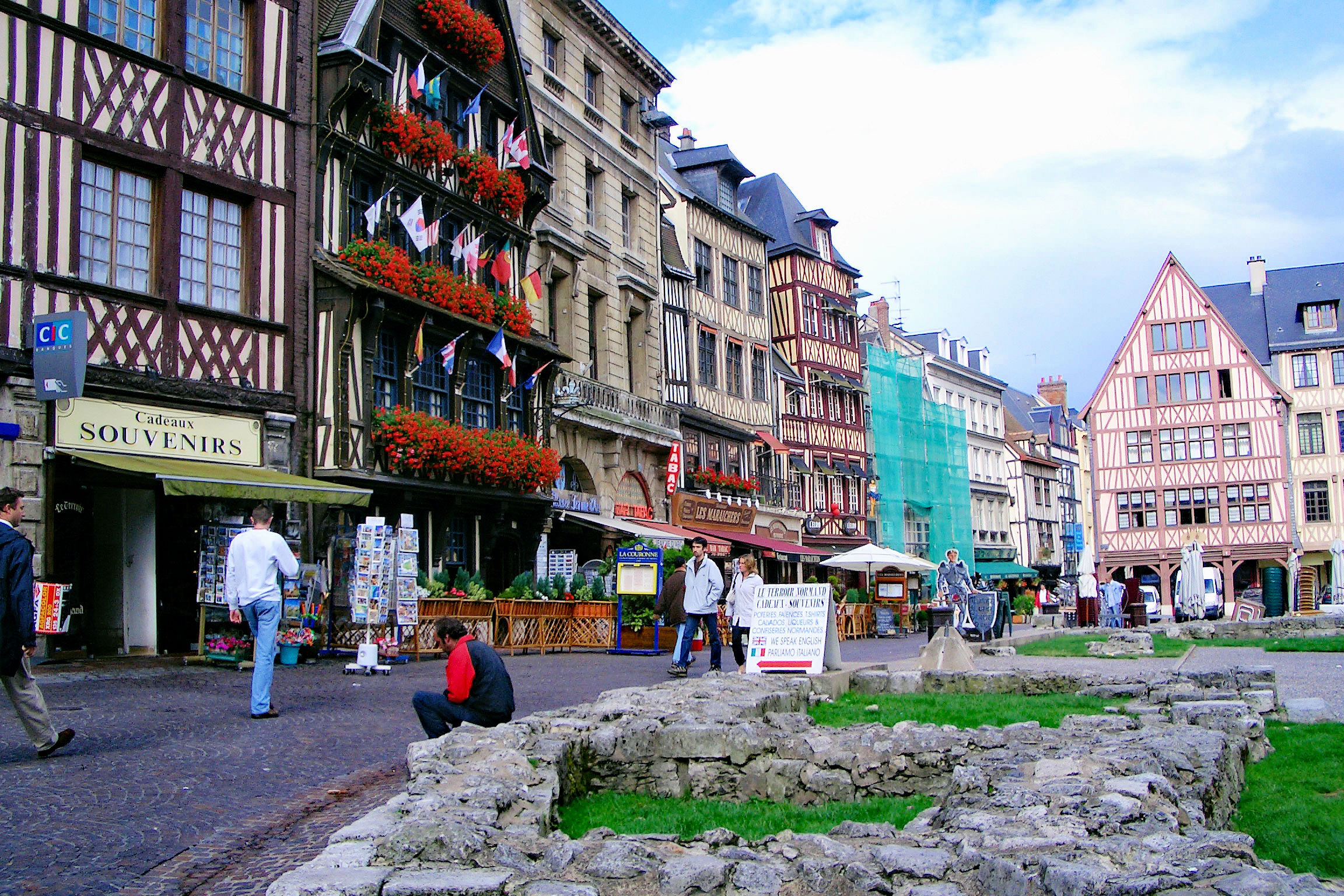
    Rouen is a maze of cobbled streets lined with beautifully preserved or restored half-timbered houses that lean crookedly together: more than 100 of these houses date back to the Middle Ages.  Many of these streets lead from the Cathedral to the famous Rue du Gros Horloge with its lavish Renaissance clock centred in an elegantly carved arch, and then to the city’s hub, the Place du Vieux Marché ringed by cafés and restaurants housed in 16th – 18th century buildings, and famous as the place where Joan of Arc was burned at the stake in 1431.  An iron cross set in a simple little memorial garden marks the spot and a daringly designed slate-covered church dedicated to the saint stands next to it.

    Joan-of-Arc-Place
    Place Joan d’Arc, Rouen

    Not far from Rouen is atmospheric little Honfleur, a town unlike any other in Normandy where the 10-storey high timber and slate-faced buildings that surround its 17th century Vieux Bassin has made it one of the most photographed towns on the Seine.   Bright trawlers jostle together in the old harbour to sell succulent seafood on the quayside, seafood which is later served up by the many waterside restaurants.

    Honfleur 4

    It is here that Eugène Boudin and a like-minded group of friends from Paris formed the Impressionist movement.  Attracted by the beauty of the town and the quality of its light they used to gather at the nearby Côte de Grace Hill above the town, and paint the scene before them, edging towards something experimental and new, using short, broken brushstrokes of untinted and unmixed colour, painting wet paint on to wet paint instead of waiting for one layer to dry, which led to intermingling of the colours.   Later, they would drink and dine in a simple 17th-century farm dwelling, Ferme St. Siméon, now a luxurious and very expensive hotel.

    Honfleur

    The delightful and intimate little art gallery, Musée Eugène Boudin, founded in 1868 by Honfleur’s best known artist, considered by many to be the father of Impressionism, has one of the best collections of Boudin’s own works – including the wonderful Port de Dieppe – as well as a vast collection of paintings by artists like Jongkind, Isabey, Monet, Dubourg, Mettling, Pissarro, Renoir and Dufy who came to be known as “the Honfleur school”.

    Honfleur was also the birthplace in 1886 of the musician Erik Satie and it is worth spending an extra hour or two in the Maisons Satie where you are led from one room to another to the accompaniment of Satie’s music backed by a series of stunning Satie-esque visual effects – like the white piano in an all-white room that clanks and jangles maniacally.

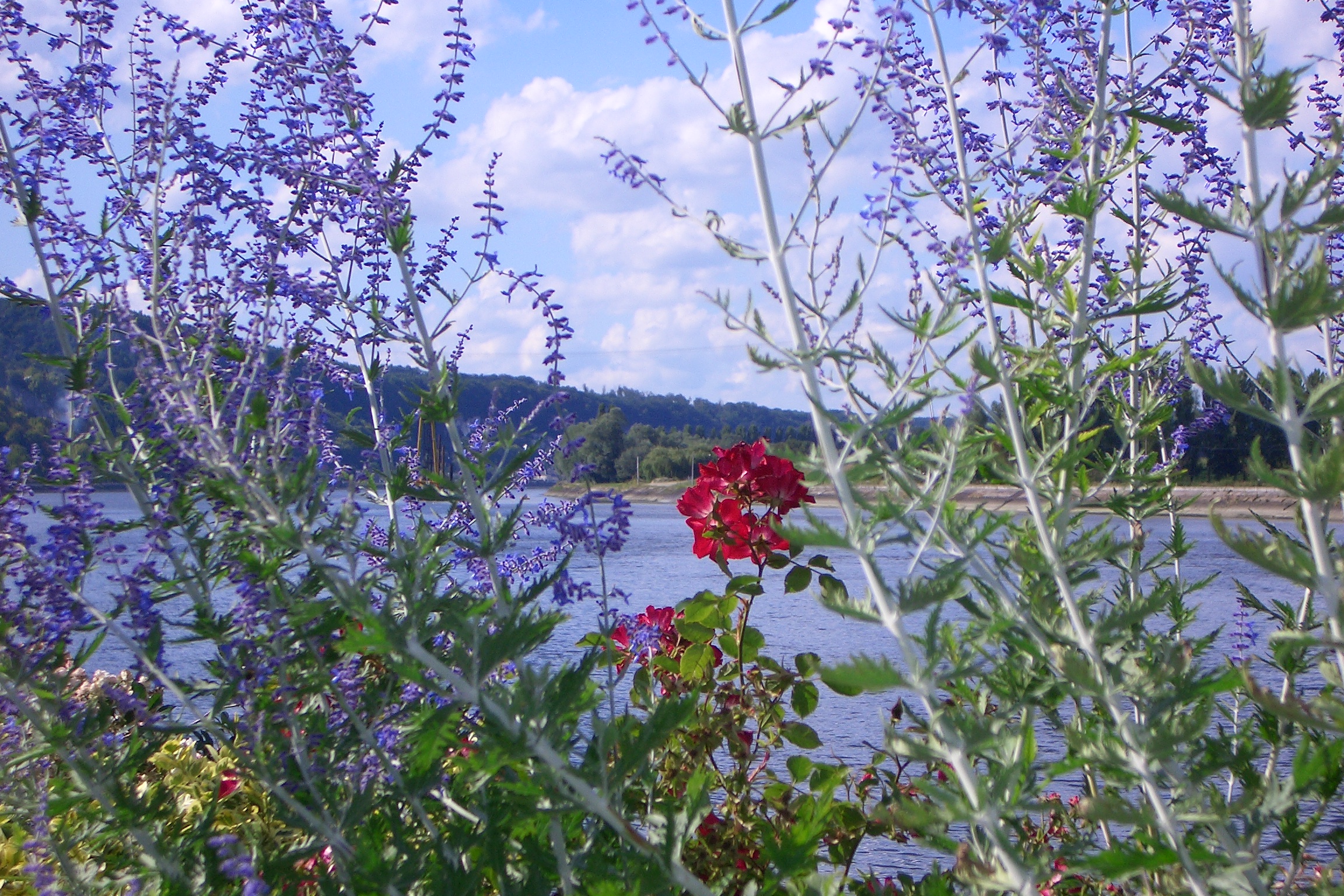
    The scene painted by Sisley at La Bouille
    This is my picture of a scene painted by Sisley at La Bouille 

    A surfeit of art and too many Museums can lead to an inability to be a discerning art critic, so a trip to La Bouille on the banks of the Seine, a favourite spot for Alfred Sisley to paint, came next.   Packed with art galleries and good restaurants, this charming village is a haven of peace.  To see it from the river, you can board a cruise from Rouen and enjoy the scenery along the way, the many little villages along the curves of the Seine and the village life of France.   Canoes and kayaks swish through the water, a little ferry chugs across the river transporting passengers and cars between Duclair and La Bouille, and Sahurs and La Bouille and if you stand by the landing stage and gaze downstream to the loop in the Seine, you are looking at a scene often painted by Sisley.

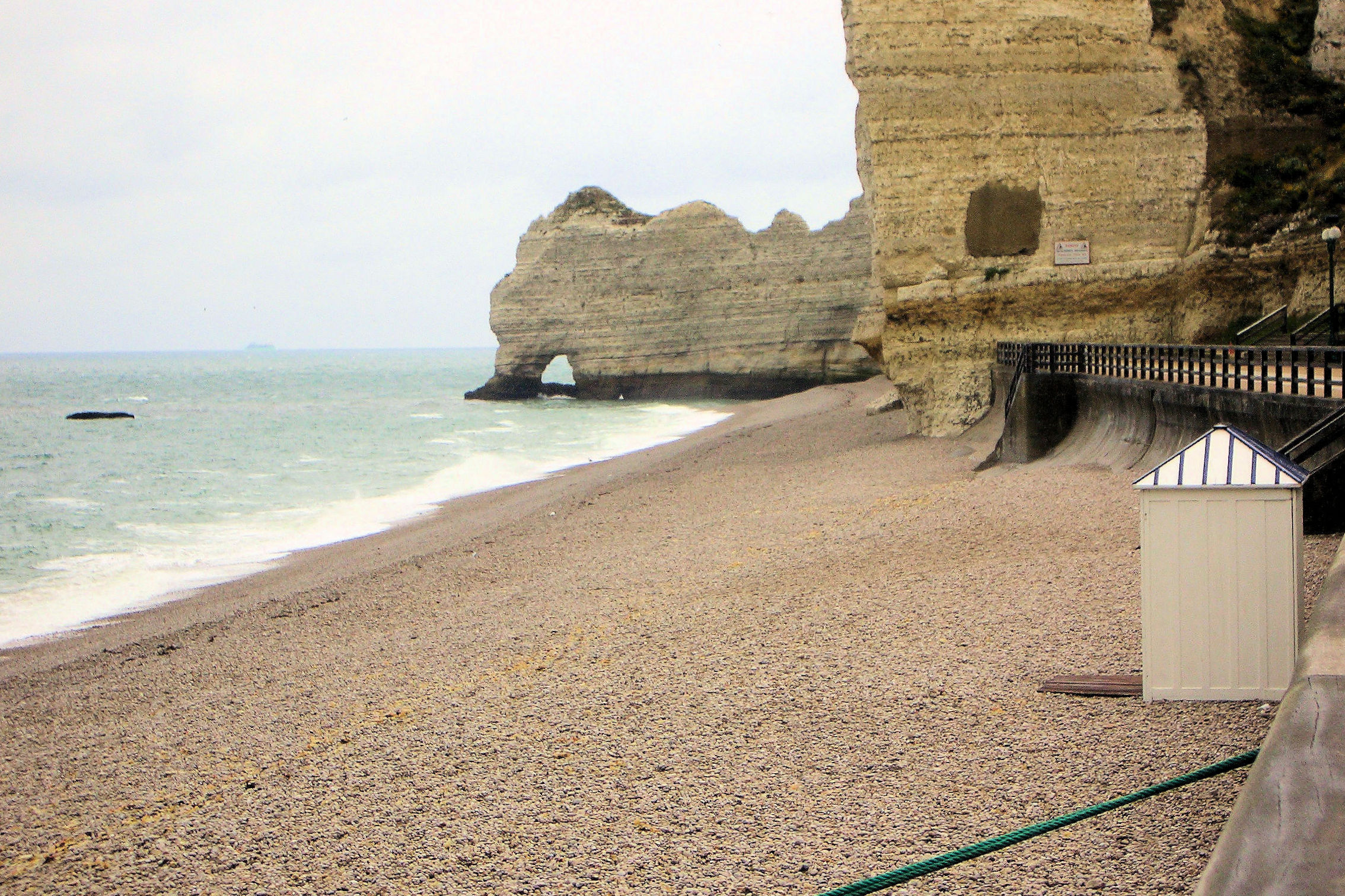
    The quality of light that floods Normandy attracted the painters to the coast at Etretat where the spectacular setting between cliffs eroded into arc-like shapes brought Boudin, Monet, Courbet, Isabey, Delacroix, Degas and Matisse here when it was still a fishing village.  They came to paint the natural arches and stone outcrops (one needle rock stands 70 metres high) shaped by the thundering waves:  they came also to paint the beach scene, for Etretat was a fashionable town in the 19th century, popular with Parisians and writers like Flaubert, Gide and Maupassant were regular visitors.

    La Porte d'Aval with L'Alguille (needle)
    La Porte d’Aval avec L’Alguile (needle)

    (It is still popular with visitors from Paris and Le Havre).  From every angle on the promenade, you can see the scenes the impressionists worked on, but the best view is found by climbing the steps from the promenade and walking along the path at the top of the cliff.

    Etretat may have attracted many visitors from nearby Le Havre, but that port city has its own magnificent steel and glass Musée Malraux right on the waterfront, recently revamped to make use of the optimum light.
    beach-3396646_1920
    The Beach at LeHavre 

    Many people pass speedily through Le Havre without realizing that the local Museum houses an unbeatable collection of paintings by the local born Raoul Dufy, full of the dazzling blues and vibrant colours for which he is known.  Eugêne Boudin, the other impressionist who lived here, is represented in the Museum by over 200 canvasses.   Monet was brought up here from the age of five (and taken under Boudin’s wing when he was 15 years old), painted several masterpieces, including the one that some believe gave the name to the group, Impression Soleil Levant (Impression Sunrise) from a position just in front of the museum.  The collection includes the square Giverny waterlily painting and one of his brooding paintings of London’s Houses of Parliament.

    le-havre-3399560_640
    LeHavre 

    I knew little of Impressionism before I went looking at the paintings with a ‘painterly’ eye but now I no longer view thundery skies with the jaundiced eye of the philistine.  If there is a bright yellow sun I know that the Impressionists would depict the shadows as violet, and if the shadows are blue I know that the sky must have had strong orange tints.  Now on my walks, when I see changeable and tumultuous clouds I think of the skies I saw, often stretched across half a canvas, and I think, “That’s a Boudin sky” and I don’t even mind that they herald rain.

    Monet hated the tag “Impressionism” but whether he liked it or not, it was this that defined the movement.  Unspoilt Normandy, rich in beguiling light, ever-changing skies and the winding Seine made the perfect studio for the painters.

    Notes:  I would hate people to think that Rouen’s Musée des Beaux-Art only has a collection of Impressionist paintings.  It also houses a fine collection of work by Renaissance and Flemish painters, plus a magnificent Caravaggio and a whole roomful of Veronese (plus it is rich in paintings of Monet’s vibrant poppies).

    If time permits, do eat at one of the glass-screened restaurants in Etretat.

    Le Havre had to be massively rebuilt after the city’s obliteration during the second world war, but it still retains some old Breton architecture in the St. Francois quarter.

  • Palermo: Caravaggio to be Returned?

    Palermo: Caravaggio to be Returned?

    You may remember that when I wrote about the Serpotta Stuccoes, I mentioned that the Caravaggio masterpiece, Nativity with St. Francis and St. Lawrence, had been stolen from the altar of the Oratorio and that the replacement painting was not something one could really admire.

    I was more than pleased, therefore, to read in The Guardian a few days ago, that there are hopes that the painting may be recovered soon as Italian investigators have received information that the painting, which was stolen in 1969, could be hidden in Switzerland.  The head of Italy’s anti-mafia commission last Thursday said that the information came from a former mobster-turned-informant who revealed that it had once been held by Gaetano Badalamenti, a ‘capo di capo’ (boss of bosses).  The informant told the mafia investigators that Badalamenti (who has since died in America where he had been convicted of heroin trafficking) had been in touch with an art dealer in Switzerland.

    To have this masterpiece returned to the Oratorio of San Lorenzo would be something wondrous for the people of Palermo, as when the criminals stole the painting by cutting it from its frame with razorblades everyone presumed it was lost forever.

    Rosy Bindi, the head of Italy’s anti-mafia commission, told The Guardian that they have collected enough evidence to launch a new investigation and to request the collaboration of foreign authorities, especially those in Switzerland.

    Leoluca Orlando, mayor of Palermo, who has helped Palermo transform itself from a  stronghold of the mafia to a European Capital of Culture, said that the city was no longer dominated by mobsters and godfathers, that it has changed and now demands the return of everything the mafia had stolen from it.

    The return of this painting to the Oratorio will be an event to be celebrated throughout Sicily.  I hope it happens soon.

    Meantime, here are a few of the pictures of the 16th-century stuccoes from the Oratorio that I originally posted.

    This slideshow requires JavaScript.