Tag: Art

  • The Shard – London’s New Viewing Attraction

    The Shard – London’s New Viewing Attraction

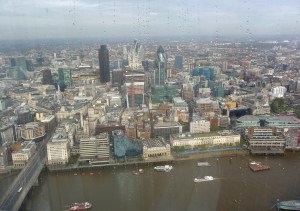
    Daytime View from The Shard, London
    Nightime View from The Shard, London

    The Shard.  Ah!  I look up from the ground and marvel at the design, at the shards of glass that catch the light and splay out at the top.  I had watched it slowly take over its London site, putting in the shade even the famous green glass building that the locals have named The Gherkin.

    Then last week during the World Travel Market at Excel, I was privileged to be invited to take a trip to the top of The Shard to experience the incredible views over London from this spectacular building designed by Master Architect Renzo Piano.  And what a vista.
    London Bridge from The Shard

    With a 360 degree view over the city to a distance of 64 km (40 miles), and from 800 feet up in the sky in the tallest building in Western Europe, London had never looked better.  The Shard is twice as high as any other viewing point in London and the only place in the city from which you can see all of London.

    The View from the Shard

    For the first time I could see how the River Thames has helped create this great city, how it snakes in and out, meandering north and south in ways I had never realized.   Tiny boats sailed on its muddy waters, like toys pushed off from river banks by little boys.

    The Majesric River Thames

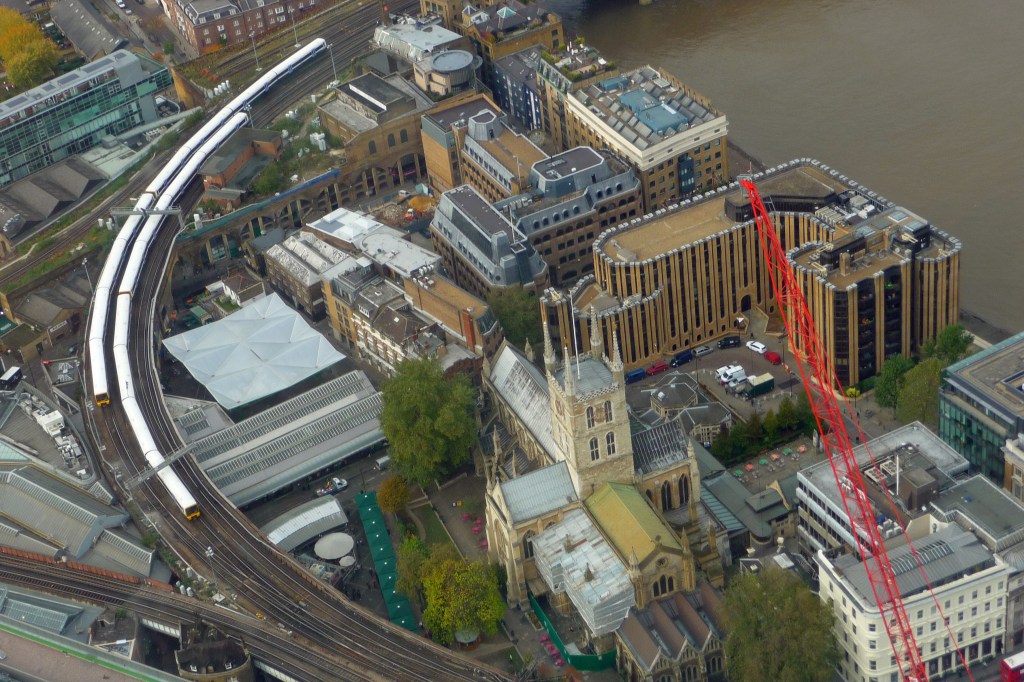
    From high in our eyrie on Level 69 we could see all of London’s famous landmarks – even on a grey drizzly day.  Easy to pick out the Emirates Stadium (home of the Arsenal football team), Wembley Stadium, Windsor Castle, St. Paul’s etc. and by following the railways with their toy-trains for all the world like the Hornby set I played with a child I could find the railway stations and using this as a guide, find lesser known sites in the area.

    Trains on London’s Railways as viewed from The Shard

    Technical Help on Viewing Platform

    One of the Tell Scopes on Level 69

    Of course there are telescopes too.  Not just telescopes, but Tell:scopes, a state of the art system that provides both day and night views of London and information in ten languages.  One thousand years of history and some of the most iconic buildings in the world lie before the viewer as digital Tell:scopes  help visitors explore the cityscape in every direction.

    From these viewing galleries it is possible to ascend even higher to Level 72 where, at the highest accessible point of The Shard, guests can stand in the open air, surrounded by the giant shards of glass that seen ti disappear into the sky.  The Shard title derives from the sculpted design which consists of glass facets that incline inwards but which do not meet at the top but instead, open to the sky to allow the building to breathe naturally.

    Rood Gardens on the City’s Important Buildings

    Further Details and how to book:

    The View from the Shard will offer a totally immersive experience of one of the greatest cities on earth when it opens to the public on February 1st 2012.

    Restaurants, offices, executive apartments and the Shangri-La Hotel their first time in London ) occupy different floors of the building.  Two lifts whisk visitors to the top in 30 seconds.

    Tickets can be reserved for dates next year at www.theviewfromtheshard.com at £24. 95 for adults and £18. 95 for children or via the box office hotline +44(0)844 499 7111.  Open 0900-2200 daily.  Nearest tube station is London Bridge, bus routes 43, 141, 148 and 521 stop there and bus 151 goes from London Bridge. Boat from Westminster Pier leaves hourly.

    Not a Job if you Suffer from Vertigo!
  • Noto – Sicily’s Perfect Baroque Town

    Noto – Sicily’s Perfect Baroque Town

    Sicily, with its dark history, rough mountains, ravishing scenery, and Etna, that brooding snow-capped volcano that is  never far from people’s thoughts, is one of the Mediterranean islands to which I am constantly drawn back.   I go there for the known attractions and for the food, heavily influenced by the cuisine of the many nations that conquered the island, and for the Baroque towns that sprang up after the earthquake of 1693 that devastated the south-east of the island.  All are beautiful, but the finest of them all is Noto, a town built of golden stone from a local quarry and a UNESCO World Heritage Site. After the earthquake, Giuseppe Lanza, Duke of Camastra, employed the best architects of the day to rebuild the city just south of the original town: the result is a triumph of urban planning and harmony.  Noto is in the province of Siracusa, itself a gem of a city and one that should not be rushed through as it has some of the most beautiful buildings in the area, plus the world famous Duomo in the Piazza of the same name, a sea-front with a wall just made for sitting on while you feast on a gelato.  Noto lies about 35 kilometers southwest of Siracusa and is easily reached by local trains which run regularly.        

    It was built almost entirely in the  prevailing style at the time, Baroque, and these near-perfect buildings are what makes Noto so special and which earned it the title of  UNESCO World Heritage site.

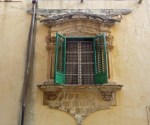
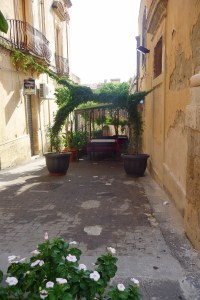
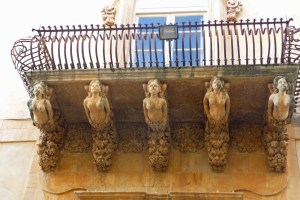
    It is a very accessible town.  You can wander the length of the graceful Corso, stopping here and there for a coffee and one of Noto’s famous cakes, or a gelato or freshly squeezed orange or lemon juice.  Take a detour down the side streets and climb the steep steps to the top where the aristocrats lived, then come down to the next level which housed the clergy and other nobility, before arriving back at street level where the ordinary people lived.   One of the best streets in which to wander is the Via Nicolaci, famous for its buttressed balconies held up with playful horses, griffons, cherubs and old men, incongruous on an otherwise severely classical façade.

    Just at the top of Via Nicolaci is the beautiful elliptical façade of the Chiesa di Montevirgine. I didn’t have time to count them, let alone visit them, but I was assured that Noto has thirty-two churches.  Think on that – thirty two churches.

    So, what to visit when you are only there for a day visit.  If time is short my advice is just to wander.  Like Florence, the history of the town is in its buildings, their façades and the sense of life in the streets.  The Cathedral rises impressively above Corso Vittorio Emmanuelle and is approached by a wide and graceful flight of steps and its simple interior  

    may well come as a surprise in contrast to its exterior.

    I had initially mistaken the flamboyant Chiesa di san Dominica for the Cathedral, flanked as it is by huge palm trees and looking more Middle East than Mediterranean. The Municipio (town hall) has an exuberant trompe l’oeil ceiling and a “magic mirror” which is just a mirror of illusion.  My own favourite interior was the Vittorio Emmanuelle Theatre, still offering productions to its patrons, a fantasy theatre with red velvet and gilded boxes lining the walls echoed by heavy drapes curving round the proscenium arch.      

    If you want to imagine what Italian towns looked like in the 17th century, then Noto should be on your list of towns to visit – it’s very special.