Category: USA
-
New Orleans: Tennessee Williams Festival
In With a Shout.
One of the Apps on my computer offers what it calls Memories. It flags up a photo taken on the same date years before. A few weeks ago, the photograph was one taken some years back at the Tennessee Williams Literary Festival in New Orleans.
My photo was one taken at a very quirky part of that festival – the ‘Stella Shouting Contest’ – a homage to A Streetcar Named Desire and the character of Stanley Kowalski, the hero/antihero of the play.

Image from Wikicommons The Stella Shouting Contest in New Orleans
“Stellllllaaaaa! Stellllllaaaaa!”
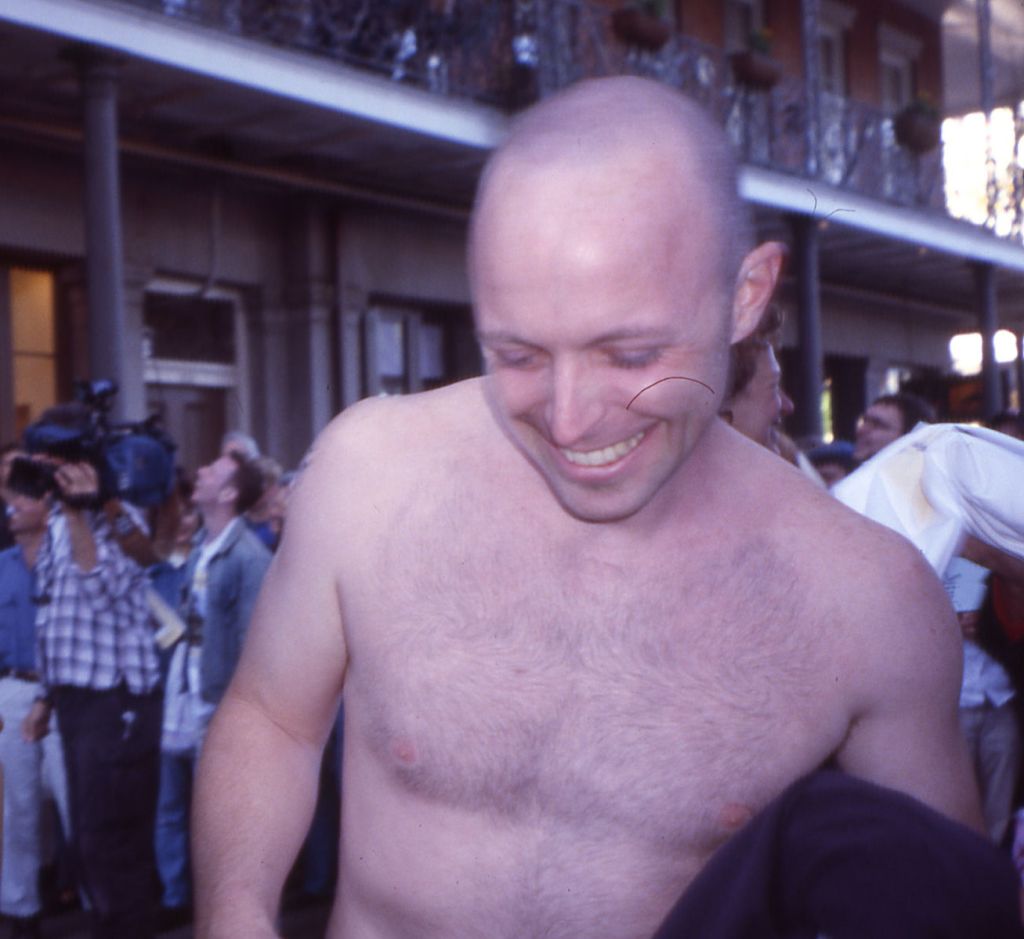
The cry reverberates around the French Quarter of New Orleans and the crowd jostling in the packed courtyard applauds. From the balcony above, Stella waves to the damp-haired man in the sweat-stained shirt below who blows kisses to the crowd as the next tee-shirted Stanley steps forward to chance his luck at outshouting the other participants.

For this is the Stella Shouting Contest, part of the Literary Festival, held for nearly 40 years in honour of New Orleans’ favourite son, the playwright, Tennessee Williams. The Stella contest pays homage to his classic A Streetcar Named Desire and for the last three decades or so, the primal screams of wannabe Stanley Kowalskis have been echoing around the magnolia-laden French Quarter to mark the Festival.

Photo credit: Tennessee Williams Literary Festival 
Photo credit: Tennessee Williams Literary Festival A Streetcar Named Desire
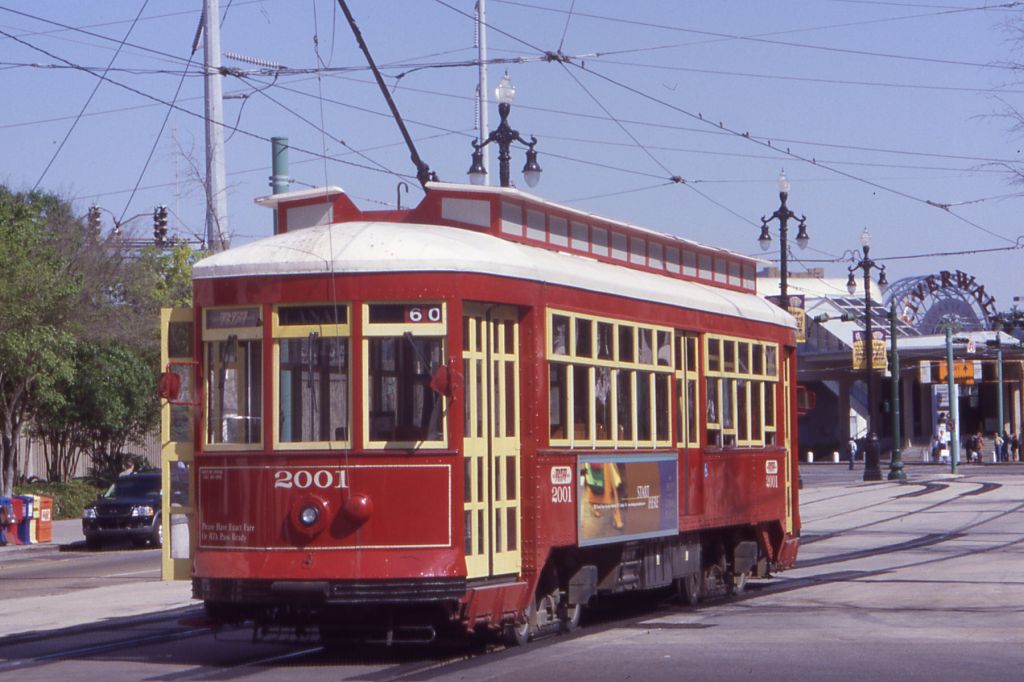
“They told me to take a street-car named Desire, and transfer to one called Cemeteries, and ride six blocks and get off at Elysian Fields”, says Blanche when she arrives at the house in which her sister Stella lives with Stanley.
Williams used the title metaphorically: there was no street-car named Desire trundling along the tramlines to Stella’s house, but there was, and is, Elysian Fields Avenue, a name is forever linked to the steamy tragedy of Stella, Stanley and Blanche.
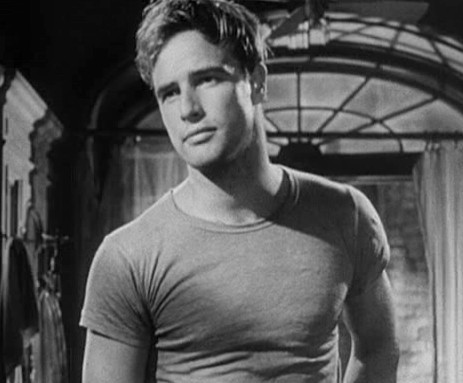
Image from Wikicommons (Brando in Streetcar) Marlon Brando in Streetcar
Marlon Brando played Stanley in the original Broadway production, and in the 1951 film adaptation of the play, he set the standard for all future Stanleys. His despairing “Stellllaaaa” echoed around cinemas and lodged in the minds of filmgoers forever when drunk, sweat-soaked and half-dressed, he stumbled onto the sidewalk and fell to his knees, bellowing for his wife, “Stellllaaaa” – probably the most famous line from any of Williams’ plays. Little did anyone guess then that this angst-ridden howl would one day become a feature of one of the USA’s Literary Festivals.
Getting into the part 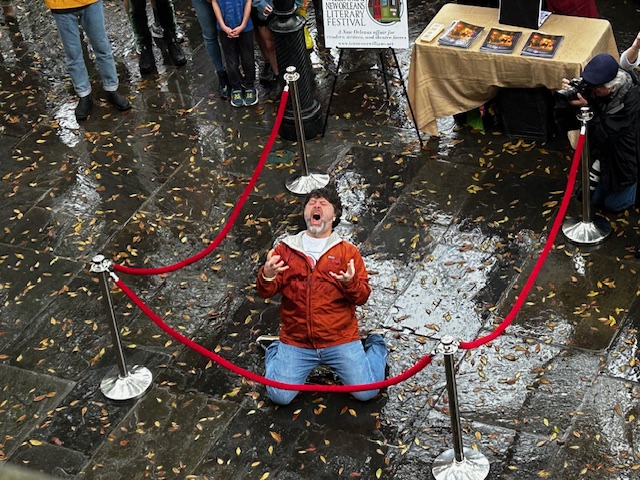
Photo credit: Tennessee Williams Literary Festival What Happens During the Literary Festival
Events like the Stella Shouting Contest, theatre productions, in-depth writing workshops, and lectures from best-selling authors on everything from scene-setting to stereotypes in fiction, attract attendees from all over the world. Giants from the world of literature and theatre mingle with would-be-playwrights and authors, to offer advice, give talks and join in the celebrations, all overlain with that N’awlins easy charm.

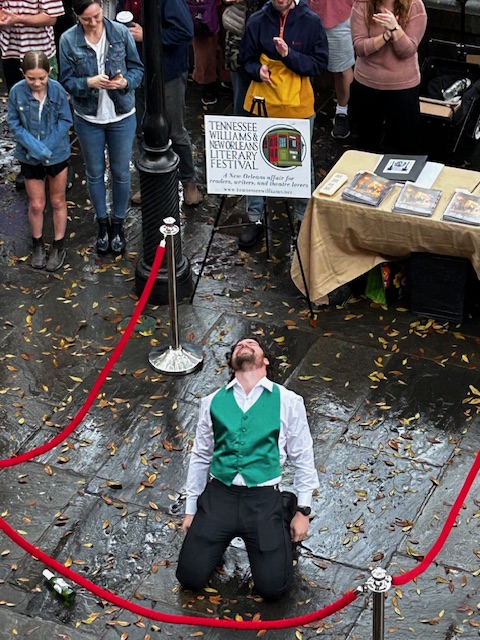
Photo credit: Tennessee Williams Literary Festival What Happens in the Stanley Shouting Contest
The famous scene, and the scream, is replayed again and again by men who come to The Big Easy to test their screams against other men. Technically it’s a Stanley/Stella shouting contest as females can also take part, but as Stella didn’t yell “Stanley” it doesn’t resonate with the public in quite the same way so there are few entries on the Stella side.
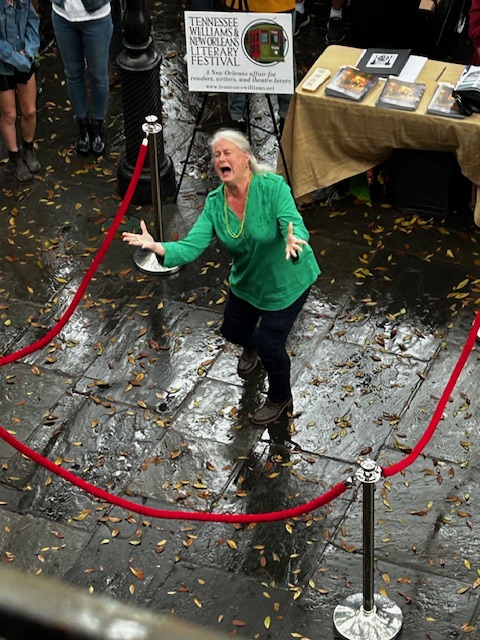
Photo credit: Tennessee Williams Literary Festival Standing beneath the filigreed balconies of the houses around the green oasis of Jackson Square the contestants direct their howls of desire and angst at local actors attired as Stella and Blanche on a balcony above. Celebrity judges lounge on adjoining balconies, while festival go-ers and voodoo hustlers jostle for positions from which to watch the fun.


One by one the contestants give it their best shot in the allotted three shouts in which they must portray Stanley’s despair, rage and emotion. They fall to their knees, tear their shirts – the iconic torn white tee-shirt is a given – and douse themselves with water to conjure up the image of Stanley’s sweat-soaked torso.
To whoops and cheers, six finalists are selected and they go on to compete a few hours later, on the main stage of Le Petit Theatre, the venue for the Festival’s workshops, play readings and lectures. We, the onlookers and audience, troop in after them, by now having a favourite to encourage in the tension-filled finals.

Interior of Le Petit Theatre On the stage at Le Petit, the Stanleys now scream with more gusto and histrionics, encouraged by their fans in the crowd. Hyped up – alcohol may play a part as well – cheering for their man and booing the opposition, the audience sounds as primal as Stanley.
All this for the grand prize of the Golden Stella Trophy, holidays in New Orleans, hampers of local goodies, and trips on Ole Miz, the muddy brown Mississippi.

Interior Courtyard of Le Petit Theatre by David Ohmer, creative commons.org/licenses/by/2.0 via Wikimedia Commons Few Festivals have such a strong performance element as the Tennessee Williams Literary Festival – two full-length plays and several one-act plays of the master are usually staged alongside film screenings, tours of the French Quarter, book signings, and jazz evenings. All this plus work-shops and lectures from writers like David Simon, James Lee Burke, Richard Ford, Laura Lipman, and dozens of others. You’re bound to meet your favourite author there and for some reason, crime writers are particularly well represented.

Tennessee Williams – Photo: Orlando Fernandez, World Telegraph staff photographer, via Wikimedia Commons New Orleans
The Big Easy still lives up to its motto of ‘Laissez les bon temps rouler’ – let the good times roll – and outside the theatre the city goes about its business, partying along Bourbon Street and entertaining the tourists in Jackson Square where the voodoo priestesses, hawkers of hats and beads, and groups of wild looking Cajun and Zydeco musicians straight from central casting come together in a gloriously chaotic, laid-back cocktail.
There are also city tours, swamp tours, plantation tours, and that old standby, shopping, and that for which New Orleans is best known – music – from trad jazz to funk, zydeco to gospel. While there you can take in a session with one of the city’s best bands, Jon Cleary and the Monster Gentlemen Band, who will take you on a jazz voyage like you’ve never experienced before.
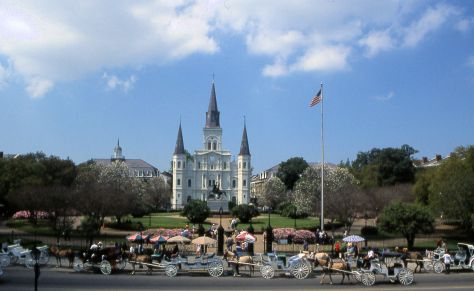
St. Louis Cathedral, New Orleans, the oldest continuous use cathedral in the USA. So if you’re in the area next March and fancy your chances of being a ripped-shirt Stanley with a voice that could persuade Stella not to leave him, then go for it.
Tennessee Williams loved this mixture of the pious and the profane, the sinners and the saints – isn’t that what all his plays are about?

Get ready to party New Orleans style. Factfile:
The 38th Annual Tennessee Williams/New Orleans Literary Festival took place this year between March 20th—24th. Next year’s dates not yet published. Sign-up for the Stella Shouting Contest will begin at 1.30 3 or 4 days prior to the opening.
The Tennessee Williams Literary Festival: 938 Lafayette Street, Suite 513, New Orleans, Louisiana 70113. Tel: 504 581 1144. info@tennesseewilliams.net
British Airways flies direct to New Orleans from £575 Return and also offers hotel bookings. Other airlines fly via Chicago – a good place for a stop-off. -
THURSDAY DOORS
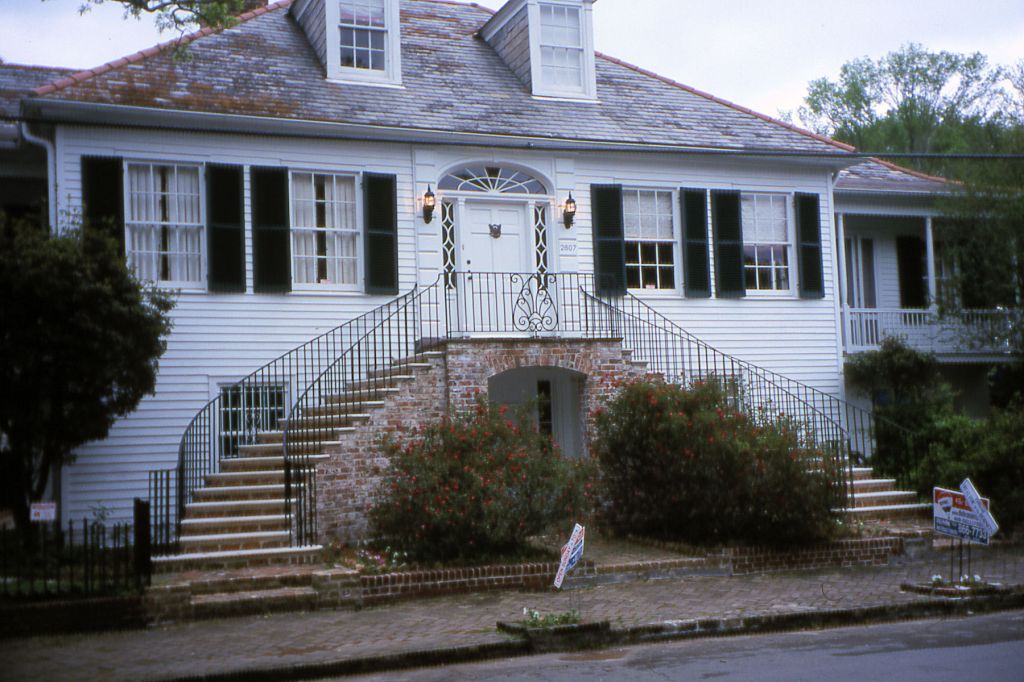
Smart doorway on house in Garden City, New Orleans (the posh bit) 
Doorways to Laffite’s House in New Orleans, formerly a smithy French-American pirates, blacksmiths and slave-runners active in the 19th century in New Orleans.
-
Silent Sunday: Trump’s World

Sign outside a church in New Orleans, USA Silence almost guaranteed on Sunday if they all leave their guns outside as this sign suggests.
-
When Democracy Ruled

Image by Carol M. Highsmith – https://commons.wikimedia.org Depressed by the current news, the arguments, the depths to which politicians and supposedly clever men and women are sinking, I think back to how years ago Franklin D. Roosevelt was a beacon of light to a world deep in a fiscal depression. As he saw America through a war and put in action methods to help Europe build itself up after the second world war, he laid the groundwork for 20th century democracy in the western world. Less than a century later, we stand to lose it.
FDR had many faults, he was a human being after all, but he was a giant compared to what we see today.
-
Sculpture Saturday: New Orleans
Statue to famous philanthropist

New Orleans Philanthropist Malcolm Woldenberg in conversation with young boy Once lined with crumbling warehouses Woldenberg Park (opened in 1984 for the World Fair) is now a pleasant walkway along the Mississippi offering scenic views of the river. It’s a great place for people watching as it attracts tourists and locals alike and a steady stream of street musicians. The Promenade gets its name from philanthropist Malcolm Woldenberg whose life-size bronze is one of many sculptures dotting the riverfront.
-
Silent Sunday: New Orleans, St. James’s Cemetery
It doesn’t get much more silent that this!

St. Louis Cemetery No. 1
It was featured in the classic 1969 film, Easy Rider, and one of the over 700 tombs there has been reserved by actor Nicholas Cage as his final resting place. Founded in 1789 the cemetery houses over 100,000 deceased, including the grave of Voodoo Queen Marie Laveau.
It was the first cemetery in New Orleans designed for above ground burial and it is claimed that it was modelled after Paris’s famous Père-Lachaise cemetery but as Père-Lachaise wasn’t used as a cemetery until 1804, that seems a bit fanciful. Also there is a significant difference in that in the Paris cemetery the bodies are usually placed in vaults in the floors of the tombs but in New Orleans the bodies are placed inside the walls of the tombs. Because of the subtropical climate, the tomb then effectively becomes an oven, the intensity of the heat causes the body to decompose in a process similar to a slow cremation and within a year only the bones are left.
This allows the tombs in New Orleans cemeteries to be used again and again. Depending on the family’s needs, after about a year the bones of the departed are swept into an opening in the floor of the tomb, now ready for its next occupant or occupants, as it is common practice to bury all the members of a family in the same tomb.
-

Sculpture Saturday – Louis Armstrong
Linked to Debbie’s here

The Man – Louis Armstrong Taking pride of place in the park named after him in New Orleans, the statue of Louis with trumpet in hand, always has a few admirers around it.
-

Tijuana – in the shade of the USA
It seems we can’t escape newspaper articles, radio reports and TV programmes about the border between the USA and Mexico, and all this has led me to think of my travels along that border some years ago. I wrote an article at the time for The Traveller magazine and I thought it might be interesting to use it as a Post on my Blog as when I was there the border seemed to benefit the American tourists almost as much as the Mexicans.
So, here it is.
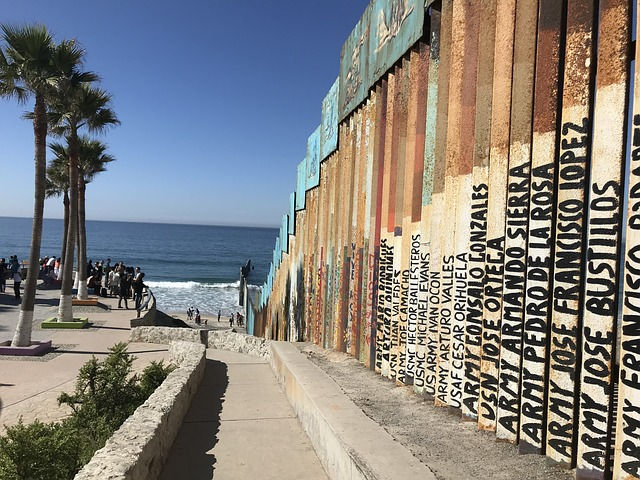
You’ll see them every evening, peering through the holes in the fence at the patrolling agents on the US side, or astride the wall, silently waiting for sundown and their chance to make that final spurt for freedom. These are the ‘chickens’ – illegal immigrants who nightly swarm across the high steel fence that snakes inland from Tijuana to San Diego. Like the old Berlin Wall, this one also has arc lights and guards equipped with night-vision cameras.
San Diego County, USA, borders Mexico for approximately 70 miles but the wall itself runs for only 14 of them. Further north, the immigrants risk a gruelling three or four day journey across tough, arid terrain, but from Tijuana to the suburbs of San Diego it is only a short run. Joselito spoke for them all. “If we don’t make it tonight, there is a chance of finding some sort of job while we wait for another day. So we stay”.
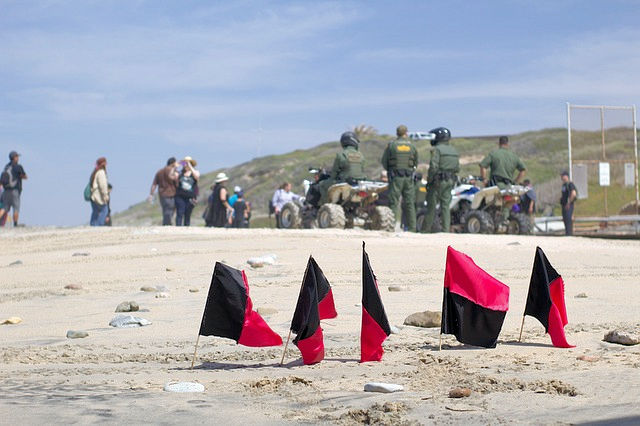
Tijuana is a tough place to live: it is noisy and dirty, the crime rate is high and drugs are easily available, but for the scores of people who arrive daily from all over Mexico, this frontier town is the gateway to new beginnings and new hopes, Many who come here to try their luck at crossing the border end up finding ways to support themselves and their families in Tijuana itself.
You will see them on the side-streets of the city: the brick-makers who squat by the streams, the farriers who tool and fashion the graceful Mexican saddles and boots, the touts who stand by the sidewalk, a damaged car door in one hand and a panel-beater in the other. Their customers are Americans who drive their cars across the border for high calibre work at one-tenth of what it would cost in California.
That’s not the only thing that attracts Americans to Tijuana. Drugs and dental treatments that are expensive in the United States are cheap and readily available in this border city. It is almost certain that the American matrons you see clutching pharmacy bags have just picked up a six-month supply of Prozac at giveaway prices, a supply of chemotherapy treatment or a mixed bag of sleeping pills and wake-up pills.
Rich and poor live in close proximity here. There are modest houses of concrete and metal alongside magnificent colonial-style mansions, interspersed with crazily leaning shacks. Plastic containers, splashed recklessly with scarlet and yellow paint and filled with scented red and pink geraniums, define the ‘garden’ space in front of these dwellings. Here and there on end walls are brilliant murals of darkly exotic flowers and oceans and skies of an impossible blue, a naive art that owes more to the capacity for gaiety and colour in the Mexican temperament than to any innate artistic talents. Even here, strolling groups of traditionally dressed Mariachi bands want to serenade you and if you have suffered six versions of Quantanamera in 30 minutes it may be prudent to know the title of one or two other Mexican songs.

Twenty years ago, Tijuana was little more than a clutch of ragged adobe houses and a few stores, a border town of such searing poverty and dirt that I was glad to leave it. Today it is a city in its own right, a city that has a future – of sorts. Above all, it has a young and vibrant population, one of the reasons why Samsung, Sanyo, General Electric, Ford and other multinationals have invested billions of dollars in the city and why they currently employ more than 100,000 workers here. The fact that there is work for thousands where before there was nothing will not halt the border crossings, but it makes the plight of the ‘chickens’ less hopeless and enables some of them to remain in their own country.
Meanwhile, the steel border, illuminated at night, adds a frisson of excitement, a charge, to life in Tijuana. And those gaunt figures that sit astride it today will be followed, inevitably, by others tomorrow.


 MARI'S TRAVELS WITH HER CAMERA