A Section of the over-10,000+ Graves at Omaha Beach Cemetery
Just back from Normandy where I’ve been touring the beaches and cliffs of the Normandy landing area where the invasion of France that led to the end of the 2nd World War took place. It was an emotional trip even though no one close to me had died in the horror that was unleashed that day, but one cannot fail to be moved when confronted with a cemetery containing 10,500 white crosses each one guarding a fallen combatant.
It was June 6th, 1944, when the assault on the French coast took place. Every type of transport at the Allies disposal was thrown into the battle and incredible ingenuity allowed Bailey bridges and the Mulberry pontoons to be shipped across the Channel without the Germans knowing. Horsa gliders towed by ‘planes carried the British 6th Airbourne Division across the channel to storm the bridges at Ranville-Bénouville (known today as Pegasus Bridge). The most intensely fought over sands, the six-mile-wide Omaha beach, largest of all the five beaches on the coast (Gold, Juno, Sword, Omaha and Utah) was to be taken by the US 1st Army led by Omar Bradley. The plan was to land infantry troops alongside armoured amphibious Sherman tanks, but the Shermans never made it. The tanks were released from their landing craft too far away from the beach as there was a much greater swell further out to sea than the Americans had bargained on and all but two of the tanks sank shortly after leaving their craft. Many units landed in the wrong place due to the strong tides and winds carrying the landing craft away from their positions.
Omaha is most remembered for the casualties the Americans took there as the German machine gun fire tore into the troops as they tried to sprint across the beach to the seawall. It was a massacre, a terrible loss of life.
Although Hollywoodish, the film The Longest Day, gives a very good impression of what that day in June was like. I watched it before I departed for France and again on my return a few days ago when I was able to recognise some of the places I’d visited. The weather didn’t favour the invaders, nor did it favour me as I walked in their footsteps: Normandy is famous for its changeable climate.
There are many wonderful Museums, and I’ve appended photographs of their leaflets below, but if there is time for only one or two, make it (1) The Memorial of Caen in the town of the same name and 2) Pegasus Museum. The Memorial of Caen, as well as artefacts, has lots of cinematic clips and chairs on which to rest while you watch – a boon for many people. It also has a great restaurant and a good snack bar/cafe. I was there for 4 hours but could have done with 6, and I didn’t have time to tour the bunker, nor to visit The Cold War Exhibition which I was told was excellent. Pegasus Museum has the bridge, a replica of the glider that landed just a few yards from it, and another glider in the grounds into which you can climb for an exploration of the conditions in which the parachutists made that journey across the channel. In the area also is the original cafe in which Major Howard set up his HQ shortly after he landed, and where the tea and coffee are pretty good.
Major John Howard’s Headquarters immediately after landing at Pegasus Bridge. Today known as The Pegasus Bridge Cafe it i still in the hands of the family who owned it in 1945.
I hope to blog about individual beaches in due course.
Perth offers a gentle welcome to the visitor heading for Australia for the first time. Its superb location by the Swan River, white sandy beaches on the nearby Indian Ocean, cultural attractions and a cuisine to rival that of Sydney, makes every visit a pleasure.
Apart from beach activities, including great surfing, the city itself offers many attractions: like King’s Park with it’s superb views over the city, the 42 acres Botanic Garden, and the Aquarium of Western Australia where you walk through a 321-foot tunnel lined with glass, behind which thousands of colourful fish, sharks, and stingrays lurk. If you want to get up close and personal with the sharks, “no probs.” as they say in Perth, you just trot off to the Discovery Pool where, if you are a qualified diver, you can have a face-to-face shark experience.
The “fun” part of the city is in the district of Northbridge where you will find a range of nightclubs, pubs, cafes and eateries, offering an eclectic mix of cultures and cuisines, but better still is “Freo” (Fremantle), located 20 minutes south of the city but almost an integral part of Perth itself. European in appearance, Freo is a café-lined port with spectacular beaches and a more sophisticated lifestyle, but still distinctly Australian with verandaed beer-houses and pub barbecues a regular sight.
From Freo, take the 80-minute ferry ride over to RottenestIsland, accompanied (sometimes) by migrating whales, dolphins and sea-lions. Once an Aboriginal penal colony, Rottenest is now a weekending town thronged with people who gather for karaoke bar singalongs as well as a closer acquaintance with the beer culture.
It would be a shame to spend all your time in the flesh-pots of Freo though, as Perth is an ideal stepping-off point for one and two-day-trips. My own favourite is the wine producing MargaretRiver region on the Indian Ocean. Although 155 miles away it is well worth a trip, if only to sample on site the lush, jammy Shirazes for which the area is famous and to revel in the ancient karri forests, beautiful countryside and heavenly beaches famed for their surf.
Second favourite is the journey north from Perth to see the Pinnacles, thousands of eerie limestone pillars up to four metres tall that dot the stark desert of the NamburgNational Park, and Monkey Mia where dolphins come into the shallow waters to feed. I combined both trips over 3 days which gave me time for sightseeing, swimming and hanging out.
Perth embraces families, adult singles and couples alike and the range of entertainment for children and adults is a fair indication of why so many people come here for a vacation and then find it hard to go back home.
CAIRNS
In sharp contrast to Perth is Cairns, right bang at the point where two world heritage sites meet – the Great Barrier Reef and the Daintree Rainforest – and the closest thing to tropical paradise I’ve found.
Few places can match Cairns’ concentration of activities, indigenous culture and pure natural splendour. The Esplanade, up and down which the pelicans parade in undisputed ownership, has budget hostels, bars, eateries, boutiques and a great night time atmosphere. The Pier waterfront complex has five-star hotels, some really super Australian designer shops and an eclectic range of restaurants.
The glitz has been totally absorbed by the town, but no matter how luxurious the suite, how chilled the champagne and how blue the pool, there is always a sense that a salt-water crocodile lurks not far away: Cairns has a primeval feel underneath the luxury, that’s what makes it different.
It’s essentially a stopping-off post for other trips, whether it be a trip to the Great Barrier Reef or any one of many rainforest trips. The GBR needs no introduction to most people as its coral reefs are one of the most photographed sites in the world. Snorkelling through the forests of staghorn coral, surrounded by round fish, flat fish, fluted fish, giant sea turtles, crimson squirrelfish, and sea cucumbers is exciting, but sensory overload really sets in when you spot the giant clams, their purple and green mottled lips open to their full 1 metre size.
There is an inner reef suitable for novices and beginners, an outer reef bordering the open sea with canyons and deep water, and the island reefs which are combination of both. If you are staying on one of the blissful Islands, then your hotel will have a boat to transport you to the reefs, but if you choose a mainland hotel, then there are plenty of snazzy boats with scheduled trips out to the reefs from the waterfront.
For my money though, the rainforest is the most awe-inspiring place outside Cairns. Having taken the Scenic Railway trip which chugs through 15 tunnels as it climbs 300 metres towards the AthertonHighlands and the village of Kuranda, and a boat ride on the crocodile infested DaintreeRiver, I was keen to spend a few days in a Rainforest Lodge. Although I wore a rain poncho most of the time, the life of the forest was so absorbing that the constant misty rain was forgotten. Central to this was the trip on Skyrail (a world first in ecotourism). Sailing high above the rainforest canopy your gondola passes over eucalypt woodland, waterfalls, and trees in which white cockatoos nest, with panoramic views to Cairns, Trinity Beach and Green and Fitzroy islands. You can alight at different stations en route to experience the forest floor from the comfort of boardwalks surrounded by trees, lush palms, ferns, animals and birdlife.
Whatever your style, Cairns can offer you an experience you won’t find anywhere else in the world.
Bratislava sits on the banks of the Danube backed by the forested hills of the Small Carpathians, and with less than half a million inhabitants, it contrasts beautifully with both Vienna and Salzburg which are near neighbours. Instead of sophistication and modernity, Bratislava offers an old-world charm and courtesy, and a way of life that allows time for relaxation in the coffee shops that are as ubiquitous here as in Vienna, and evening entertainment in the form of opera, ballet, classical music and jazz, drinking in traditional old pubs or dining in a range of classy restaurants.
Local Transport
It could be Europe’s most relaxed city as well because it has retained its human scale having been spared the development and urban sprawl that afflicts other parts of the continent. One need not spend time poring over maps on street corners, or hours finding one’s way in and out of metros or looking for the right bus to take one on to the next ‘must see’.
All this, plus the Danube, which is one of the city’s main assets, makes Bratislava my current favourite capital.
The Danube with Pleasure Boat
The city has a long and proud history that dates back to pre-Roman times and although much has been destroyed there are still traces of some of the people who lived here, Celts, Romans, Germans, Hungarians and, of course, Slovaks. Their influences can be seen not only in the architecture but in the cuisine and the startlingly good wines on offer. On the edge of the city, the vineyards on the hillsides have been producing wine for centuries and quite close to Bratislava are wine towns where you can taste the wines before buying.
Bratislava Square (Copyright Slovakia Tourist Board)
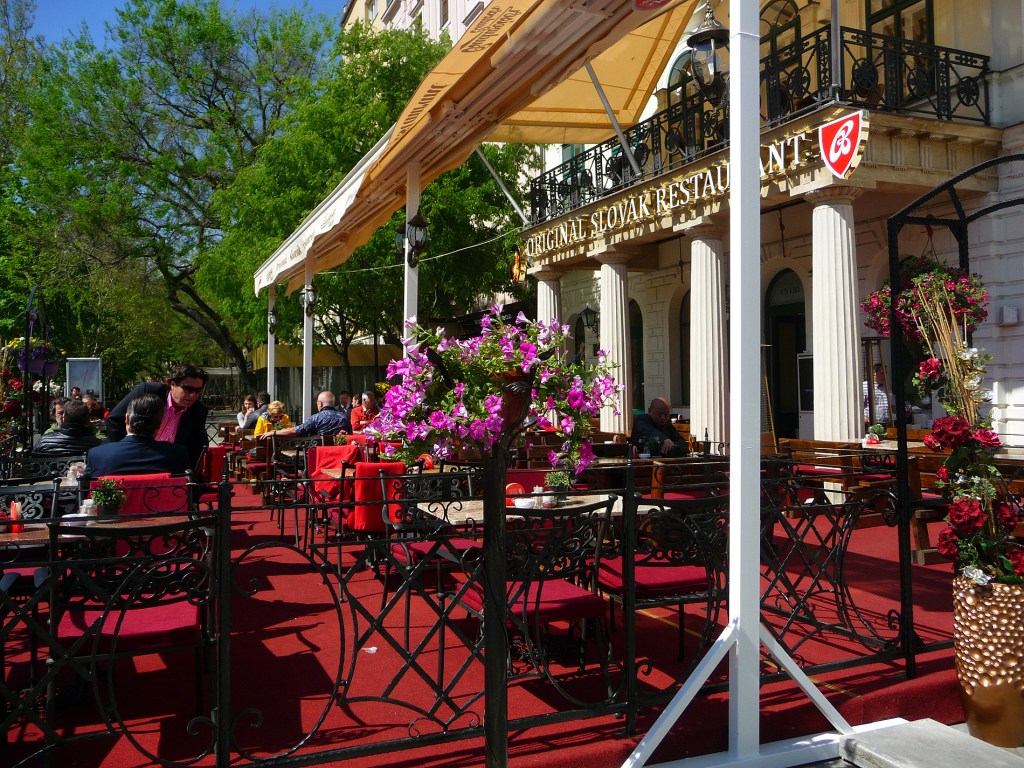
In its small historical centre the charm is concentrated. Some ten years ago they started to renovate the streets and the houses (although some are still awaiting an overhaul), and that their efforts have paid off is obvious in the multitude of cafes, bars and restaurants that have sprung up alongside souvenir shops and fashion stores. Most cafes have outdoor seating on the pavement and on warm days the tables will be bustling with life, giving the city a very Parisian atmosphere.
Centreville, BratislavaRoland’s Fountain, Bratislava
.
Awaiting Restoration
The Old Town is the place to stroll the narrow pedestrian streets lined with 18th-century buildings: many have been beautifully restored, but some are still in the process. The many sidewalk cafes that lie under the gaze of the Stone Age city castle (high up on a hill from which are great views over the old town and the Danube) are great for people watching.
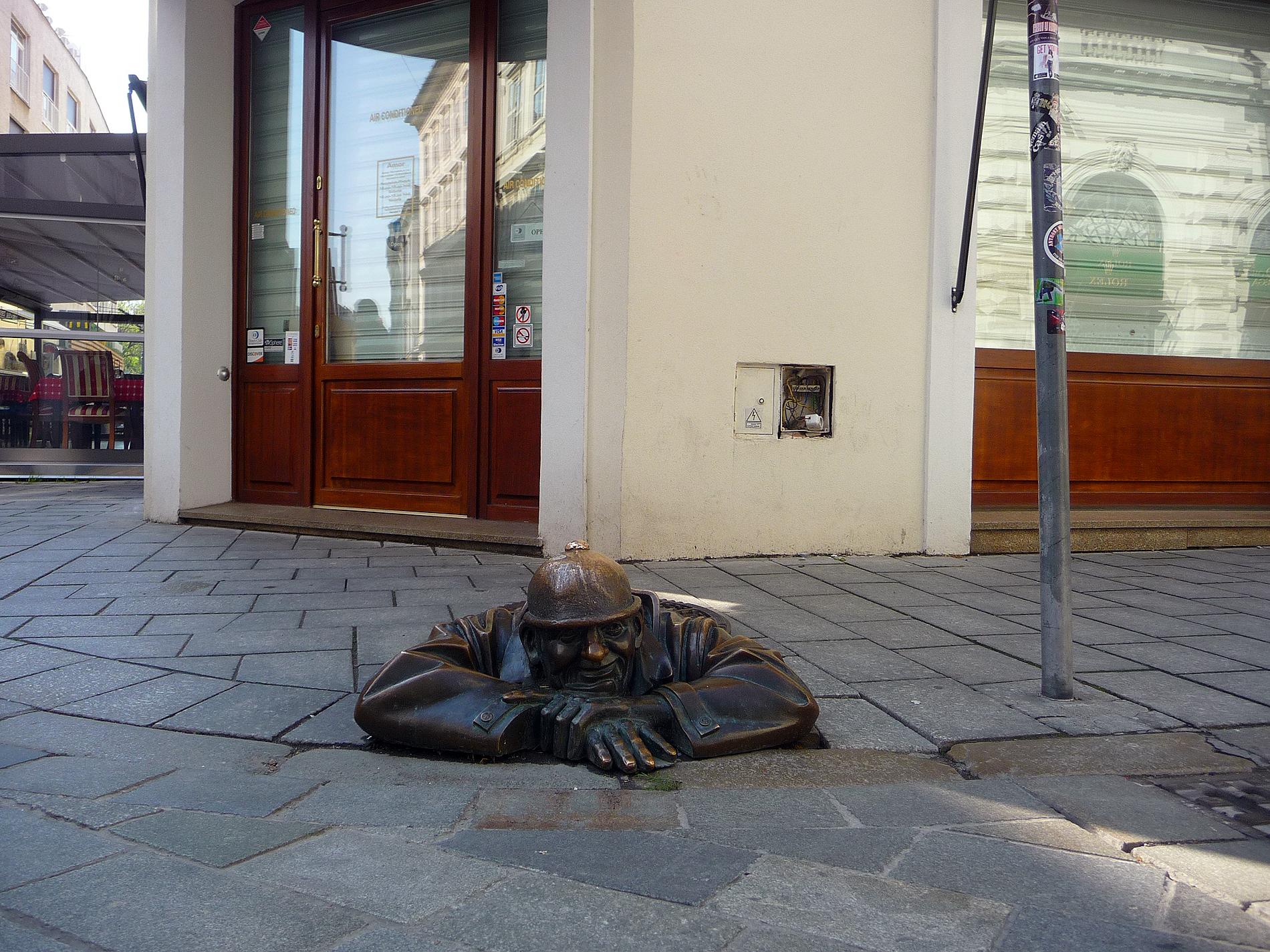
The main square, a picturesque 13th-century quadrant, is flanked by pastel-colored houses and hosts the 15th-century Old Town Hall: nearby are Roland’s Fountain (the most famous fountain in Bratislava as well as one of the city’s important landmarks), St. Michael’s Gate (the only remaining gate of the medieval fortification of the city), and the 14th century St. Martin’s Cathedral which saw the coronation of 11 Austro-Hungarian monarchs. A feature of the Old Town are bronze sculptures, but not as one imagines sculptures, these are quirky works, workmen emerging from the pavement, soldiers standing supporting lamps, and figures leaning on benches (see below).
Bronze statue with touristBronze sculpture of man emerging from groundStatue of Man with Hat at Srtreet Corner
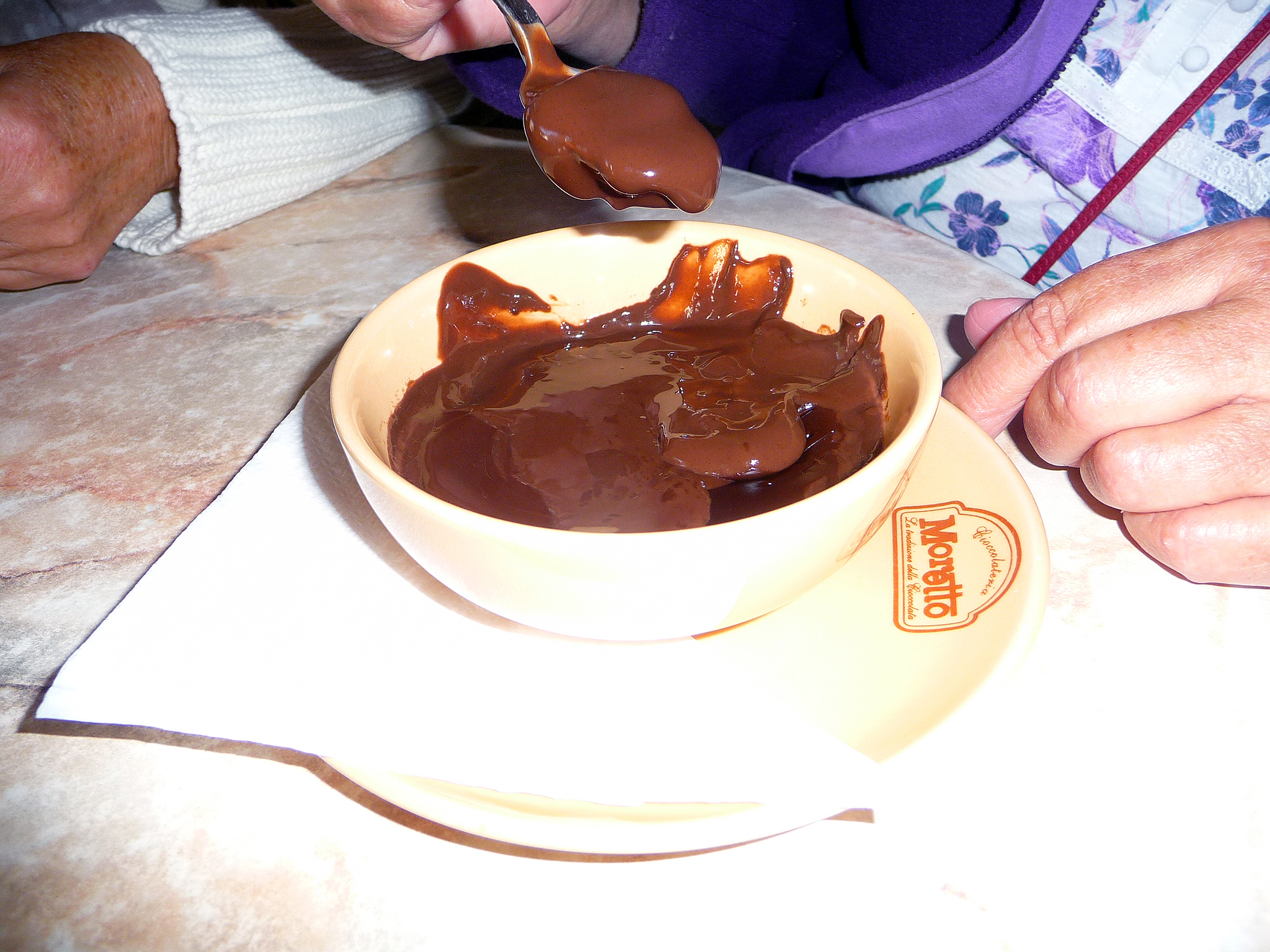
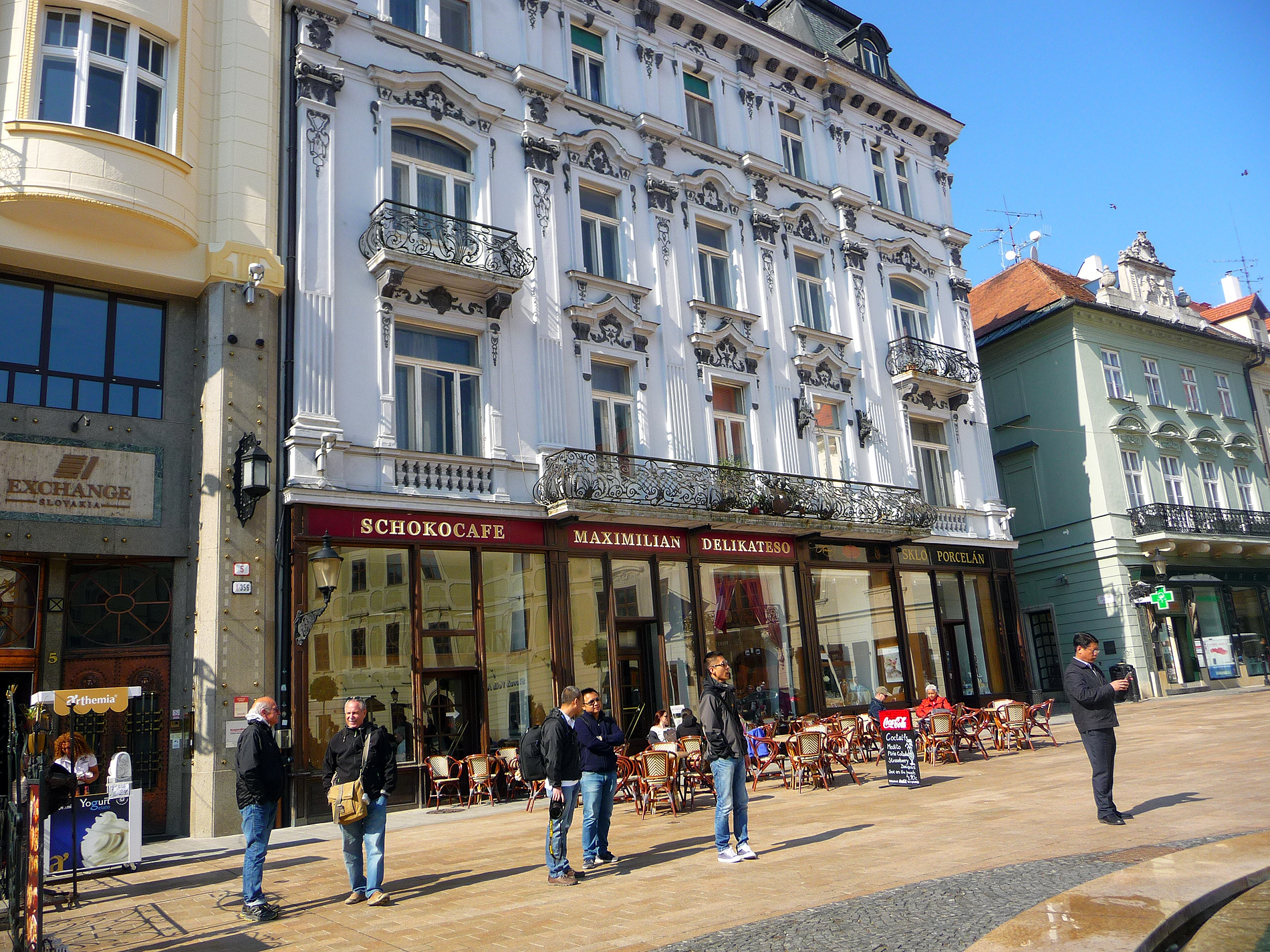
In the middle of the main square is Schokocafe Maximilian, an elegant coffee-chocolate house with a reputation second to none. I had read about the famous chocolate served in this establishment and was looking forward to my very special ‘hot chocolate’. That is exactly what I had, hot chocolate, but oh, how disappointing. Maximilian’s hot chocolate is not a drinking chocolate as we know it, rather is it a chocolate pudding, a mousse (but more dense), so thick that I could stand my spoon up in it, literally. I ordered cream in an effort to thin it down but this didn’t work either.
Coffee in MaximiliansCoffee with Creamm in Maximilians
Take my advice and have a coffee, admire the glorious wall to ceiling chocolate counter and the Art Nouveau interior or sit outdoors and admire Roland’s fountain and the old Town Hall, just two of the places to see and photograph. And if it is raining, or the weather is cold, then add a dash to the coffee of one of the local spirits such as the herbal liqueur Demänovka, or the gin-like borovička or the more famous slivovica which is made from plums for warmth.
Traditional pubs are a feature of Bratislava and most socialising is done in these places, some of which are large and noisy, some small and intimate and some very modern. I liked the ones housed in the city’s ancient cellars, the really traditional ones, as these are dying out in many parts of the continent. Just look for the beer sign and then head down the stairs. Several are housed in the city’s ancient cellars – look for a sign advertising beer, and head down the stairs. And although the beer is of high quality, its wine producing means that good wines are always available even in the brashest pub.
Beautiful facade of buildings
But Bratislava is not only about café-culture. It is also the sporting capital of Slovakia with the country’s biggest football and ice hockey teams and a purpose-built white-water rafting centre on the Danube.
Popular with walkers and cyclists, its location on the slopes of the Small Carpathian hills mean there is a wide range of hiking opportunities within the city itself and in the surrounding area where forested hillsides comprise almost one-quarter of the city’s area.
Interior of Maxamilians
For mountain-bikers the region if filled with trails but even if you are not a biker, a network of sealed walking and cycling paths through the woods leads to historic towns such as Stupava and Sväty Júr. Best place to start is the Železná Studienka valley, a short way out of the town which can be accessed by train from the main railway station (to Bratislava- Železná-studienka station) if you prefer not to negotiate the town. A trail leads up the tree-lined valley, passing several lakes and at the top a cable car connects the top of the valley to the hill-top at Koliba. Or, take the number 203 trolleybus from Hodžovo námestie (in front of the Presidential Palace), in the direction of Koliba. Go right to the end and walk up the hill in front into the forest and the trail emerges at a clearing dotted with bars and cafes.
Bratislava with the Danube Copyright Slovakia Tourist Board
The River Danube that winds through town is one of Bratislava’s great assets and it is a magnet for walkers, cyclists, inline skaters, and strollers who come to watch the commercial riverboats that cruise the river and the high speed catamaran that links Bratislava and Vienna several times a day during summer. For cyclists, a particularly popular ride is out to the Danubiana Meulensteen Art Museum at Čunovo from where it is possible to catch a boat back to the city.
Lace Work and Embroidery for sale at a stall in the Old Town
Bratislava may be a small capital city, but it offers a lot to the visitor. Slovakia has a particularly rich folk culture, and this can be seen in the local woodwork, ceramics, textiles and music. The people are proud of their heritage, and several shops offer a range of locally produced, quality goods, ranging from the distinctive blue and yellow pottery to hand embroidered children’s clothes and houehold linens, modern glassware and traditional wooden items.
The best time to see traditional hand-crafted goods is at the Christmas Markets but go anytime to this lovely city and enjoy the produce, the crafts and the hospitality – but watch out for the chocolate.
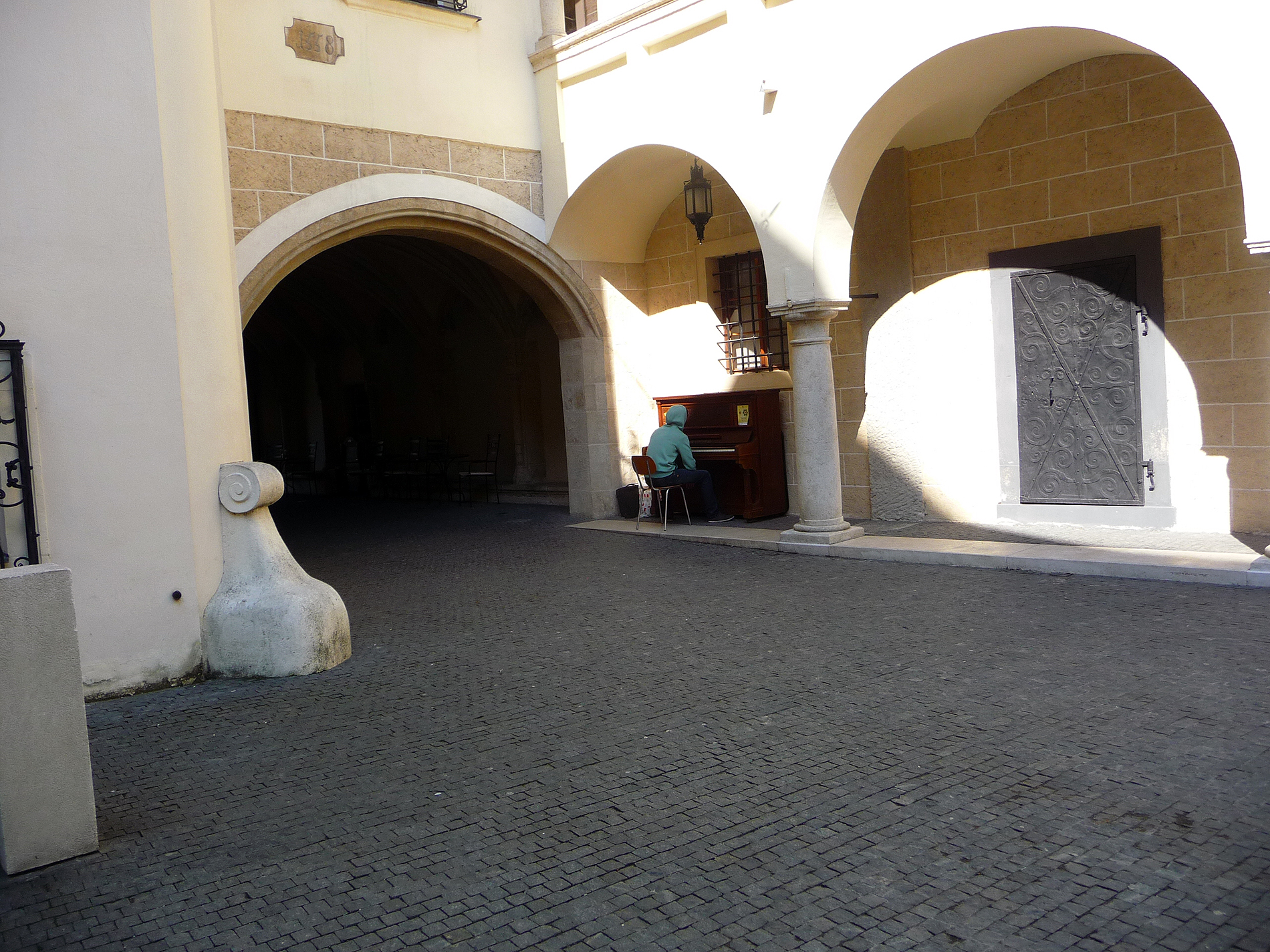
My Favourite Spot. A Piano left under an archway for practice purposes for students who had no instrument of their own.
In response to The Daily Post’s weekly photo challenge: “Creepy.”
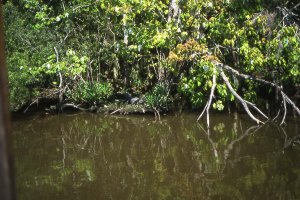
Not everyone finds the place creepy, but I do. The air is hot and humid, eerily still as the electric boat moves slowly through the swampy waters of the Louisiana bayous whose trees are hung with ghostlike, gossamer-fine, Spanish Moss. I can’t see the shore because the branches of the trees that line the banks hang far into the waters, hiding just discernible movements and deadening the squelchy noises that drift towards us. Now and then a snake plops from an overhanging branch and the shadowy form of a nutria, an animal like a river rat on steroids, can be seen slipping into the murky swamp through the yellow and purple wild irises that cover the banks. Household pets are kept indoors in these parts, cats and dawgs are all the same to a giant Nutria.
Turtles, herons, and egrets share floating logs, but trail your hand in the water and the log will move swiftly to snatch at it, for this is alligator country and ‘gators will eat anything that moves. The bayous, streams that are fed by the Mississippi River in the low-lying areas of Louisiana, make ideal homes for alligators.
The culture of the bayou is Cajun: a banjo is playing from somewhere over to the left and low voices are heard. It’s not romantic anymore, it’s creepy and scary, as my memory flashes to Deliverance (1972) John Boorman’s brilliant, action-adventure film about four suburban businessmen who encounter disaster on a summer river trip. The banjo duet and the film’s brutal action haunt me still, and this river, this boat, is a perfect scene from that film.
And I’m in the middle of it. And the banjos play on.
The Granite Cross that Dominates the Entrance to the Cemetery
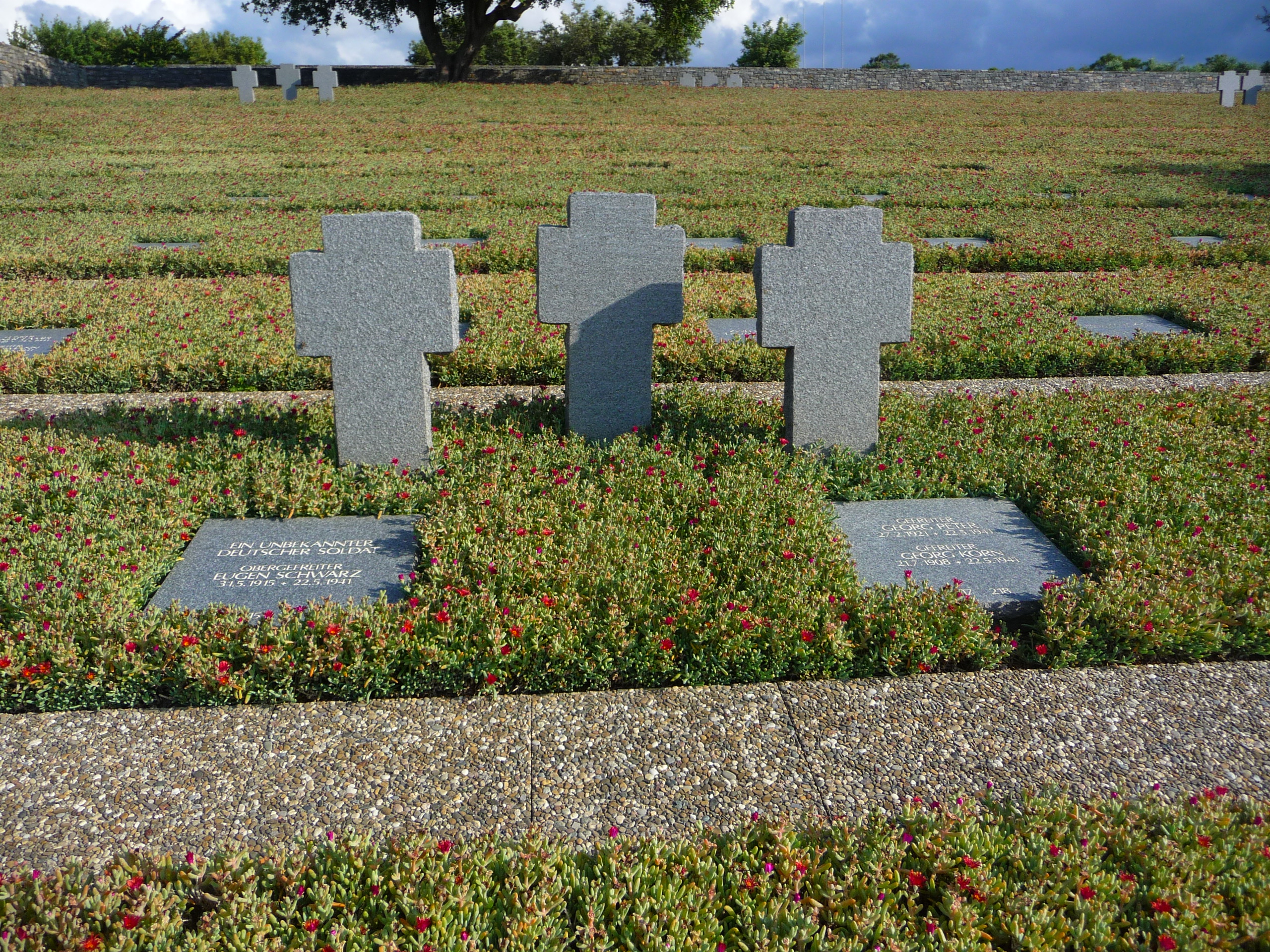
The huge granite cross, starkly outlined against the blue sky, dominates the entrance to the German War Cemetery in Malame, Crete, scene of some of the most ferocious fighting during the Second World War – the aptly named Battle of Crete. The cemetery, home to the remains of 4,700 German soldiers who died on the island, is easy to find as it is just off the coast road in Malame, a short distance from Chania.
The German Cemetery, high above Malarme
Once in the cemetery proper, one is faced with sombre, grey granite crosses dotted about the area with small granite plaques embedded in the ground, each one bearing the name of two soldiers who lie beneath. Interspersed with the grey lozenge-like plaques are tough grasses and plant forms that can withstand the dry heat and the cold, snowy winters of Crete.
Plaque to a fallen soldier
The Battle of Malame in May 1941 has become famous as one of attack and counter attack, assault and retreat, with the Cretan partisans and what remained of the Greek army on the island, fighting alongside a New Zealand infantry company, the RAF and Fleet Air Arm personnel left stranded at the airfield.
Three crosses and two plaques.
Over 500 Junkers attacked in a blitzkrieg similar to that launched on Guernica, Spain, five years earlier. Historians still query why the powers-that-be failed to realize that Hitler might try the same tactics again five years later.
Wave after wave of German paratroopers invaded the island. The Junkers were followed by an armada of paratroopers who were ferried in on gliders and parachute troop carriers and who darkened the sky as they descended in their thousands. (There were 70 gliders each one holding 10 paratroopers and these were followed by parachute troop carriers). Many were shot as they descended or were enmeshed in the surrounding olive trees.
The invaders who died in this assault were initially interred at 62 locations on the island but in 1960, following permission from the Greek Government, the Germans were permitted to recover these bodies which were then transferred to the Gonia monastery at Kolymbari. (The Monastery had been a centre for the Resistance during the Battle of Crete and the monks were imprisoned in Chania prisons, after the Germans found guns inside the chapel).
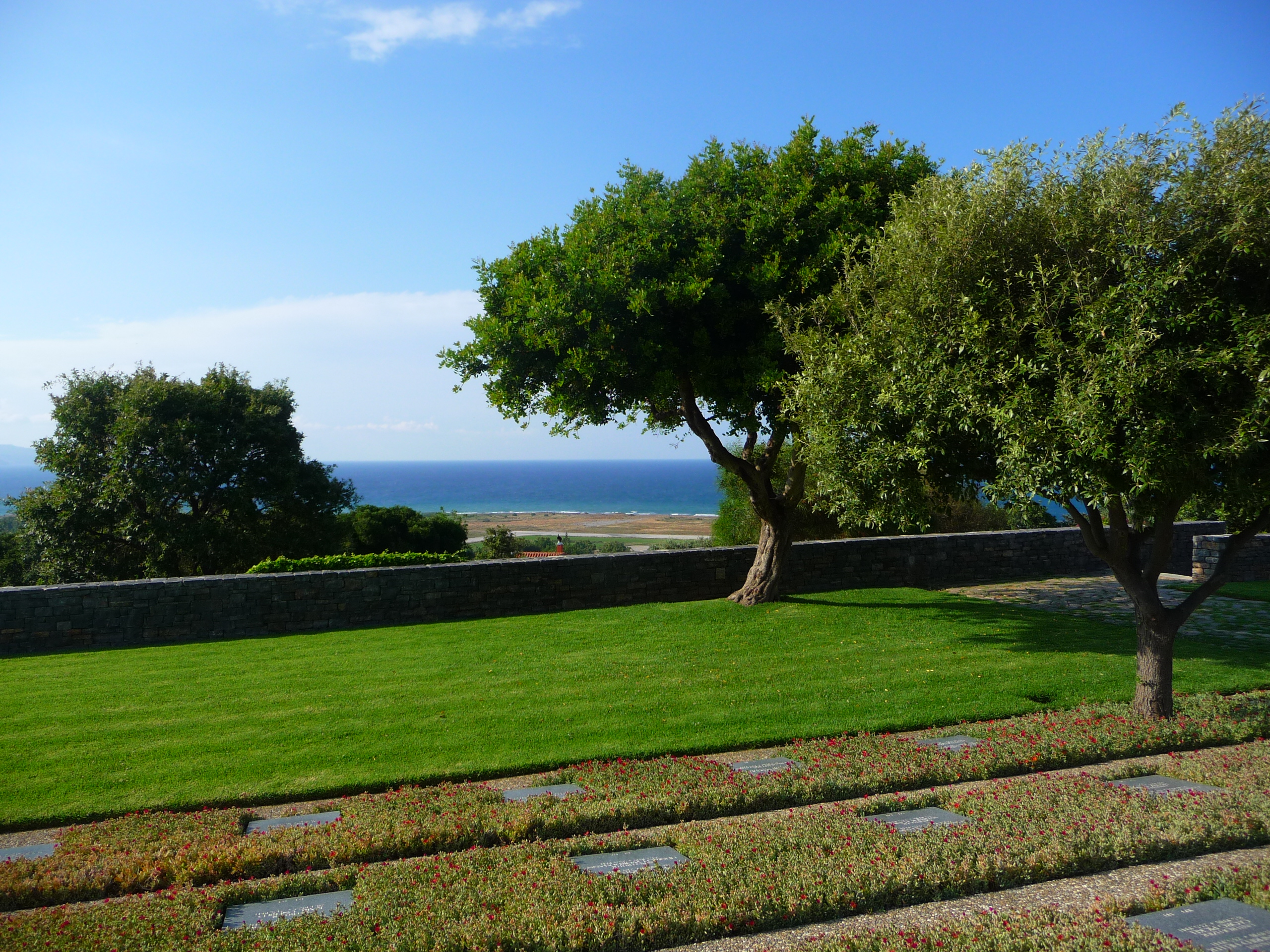
View of the German Cemetery with its crosses and granite plaques.
In 1971 the remains of 4,465 German troops were transferred to their current resting place in Malame, designed as a cemetery for the Germans who died on the four main battlegrounds of Malame, Chania, Rethymnon and Heraklion. The cemetery was consecrated on 6th October 1974.
The human cost paid by the German and Allied forces in the fight for Crete was very high. There is a little Museum on the cemetery site with information on the walls about the history of the battles but most Cretans dispute the interpretations offered.
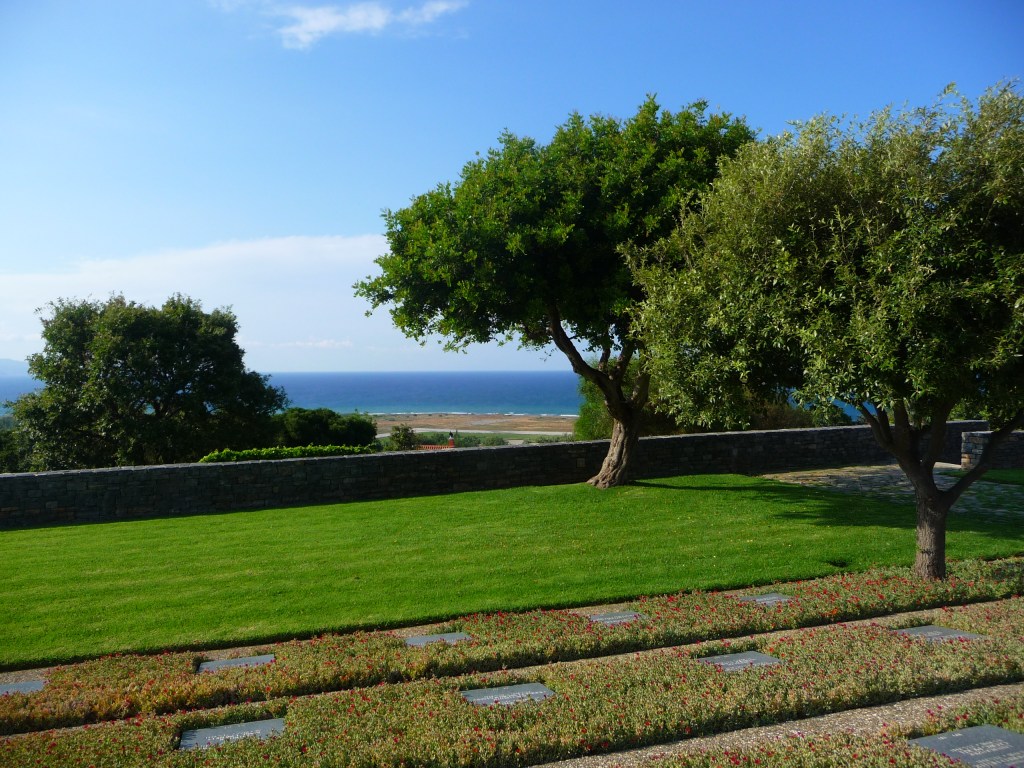
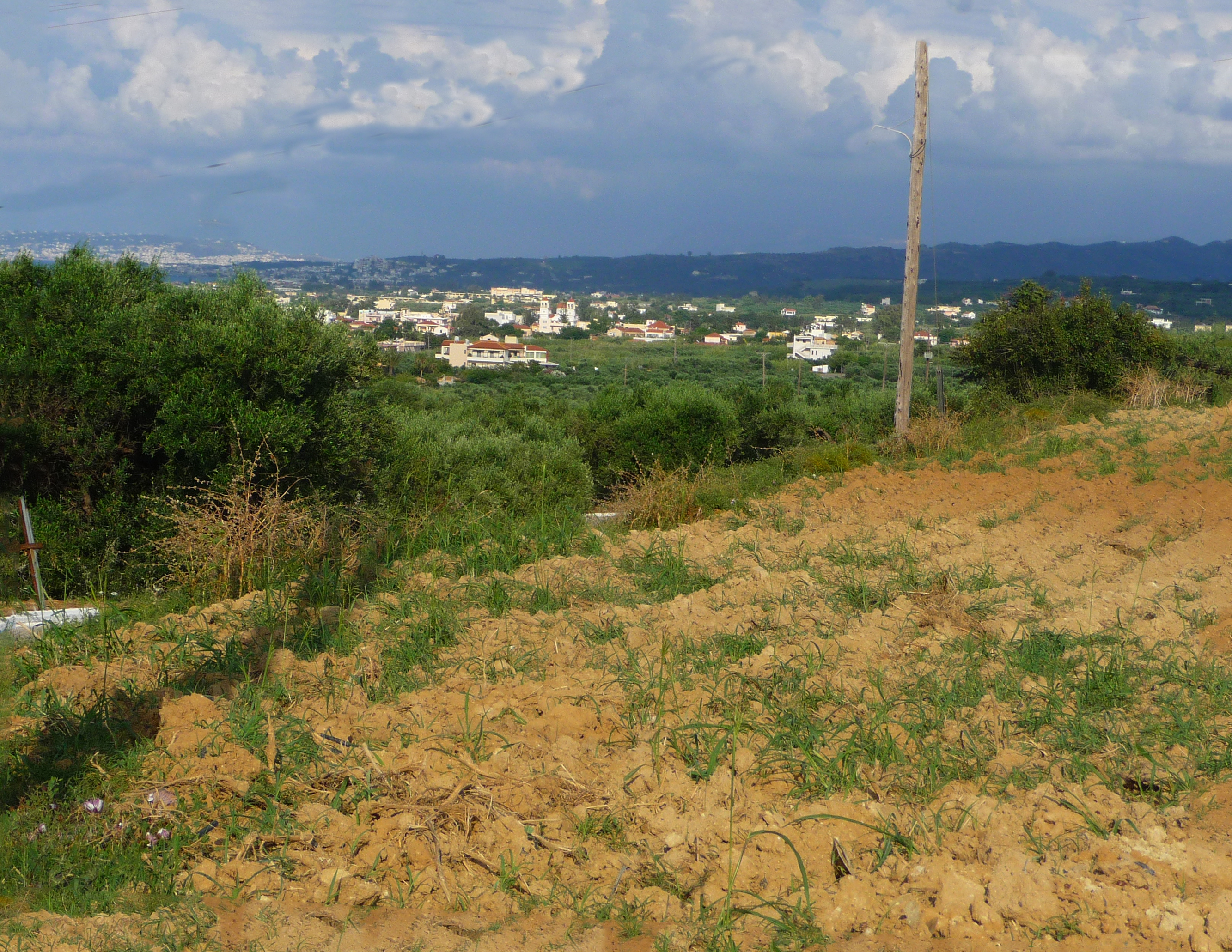
View to the Coast from the German Cemetery
From the cemetery the view to the coast is stunning. Standing at the top one can see far into the deep blue bay of Chania across hillsides dotted with olive trees, winding down to the Tavronitis River. Goats graze among the trees, their bleating rising from below sounding eerily like a child crying. A thin ribbon of road runs between the olive groves and the Aegean Sea beyond, and it is hard to imagine the horror that erupted in this peaceful area 75 years ago, or to visualize the dead and dying that littered the beaches and fields.
Neither side has exact numbers of fallen soldiers.
R.I.P.
Best books on the history of the Battle of Crete:
Crete: The Battle and the Resistance by Antony Beevor (John Murray, Paperback – a division of Hodder Headline (1991). Still regarded as the best history of Crete during WW11
The Cretan Runner by George Psychoundakis (trans. by Patrick Leigh Fermor): John Murray, Paperback (first published 1955). A first-hand account by one of the partisans from the mountains.
“If I shout ‘Duck’! It doesn’t mean look out for wildlife: it means hit the deck – now”! This was Captain Julian speaking, during instruction in safety etiquette on board the converted eight-passenger Dutch barge ANJODI, our home for the next six days as we cruised the tree-lined Canal du Midi in France.
The Anjodi Barge
The reference to ducks and wildlife was timely, for shortly after leaving our embarkation point of La Somail, a delightful little village just 45 minutes from Montpelier, our boat was surrounded by friendly ducks and drakes with their ducklings, as sleek coypus swam close to the willow-hung banks, and grey and white geese scolded us from the tow-path.
But a warning is a warning and we were careful to keep a look out for low bridges as we cruised along this, the oldest canal in France, designed by Pierre-Paul Riquet to link the Mediterranean and the Atlantic. He spent much of his fortune on the project but sadly, he didn’t live to see this magnificent feat of engineering, now a UNESCO World Heritage Site, completed in 1681.
Canal du Midi, France
Shop on the Canal du Midi
The Canal du Midi is 240 Kilometres long and runs from the city of Toulouse to the Lagoon at Thau on the Mediterranean Sea. On our six-day trip we covered only part of this fascinating waterway in which the landscape changes from pasture to vineyards and from grain crops to rice paddi as it nears the Camargue.
We soon found out what the captain meant by “duck” as we met bridges so low that even the tiller had to be removed at times – and we marvelled at the skill with which he and the crew took the barge through narrow locks just wide enough to accommodate it. The ‘ladder-lock’ at Fonserannes, a staircase of seven locks took 45 minutes to negotiate and watching this was as engrossing an experience as I’ve ever had.
The plane trees that line the Canal du Midi giving shade to the boats and barges that use the waterways were just coming into leaf, their delicate pale green leaves a perfect contrast to the bright blue skies as we journeyed further south. The banks yielded up wild irises, white snowflake flowers, primroses and poppies, and the houses we passed were already displaying geraniums, crocus and, most surprisingly, peonies. Relaxing on deck with a Kir Royale or a glass of something bubbly, watching the passing panorama and admiring the churches and chateaux silhouetted on the hillsides, was total bliss after days hunched over a computer in a stuffy office. Often it was with great reluctance that we left the comfortable chairs on the deck for our meals as there was always a feeling that there might be something exciting just around the next bend.
Camargue Wild Life
Wild Horses of the Camargue
And one day there was. Standing on the bank contemplating us with curiosity were some of the wild horses of the Camargue. Storks flew overhead and off in the distance we could just see a flock of flamingos. Too excited to grab for the cameras we just revelled in the sight of the birds as they huddled together in the lagoon devouring the shellfish that gives them their pink colour.
There were major sight-seeing jaunts in the barge’s mini-bus each morning, leaving the afternoons free for relaxing, walking or cycling along the towpath on one of the onboard cycles, and exploring the pretty villages along the way. We would catch up with the boat at the next mooring or lock – and as we always knew just how far the distance was between locks it made planning easy.
Cathar Country, Carcassonne, Minerve and Narbonne
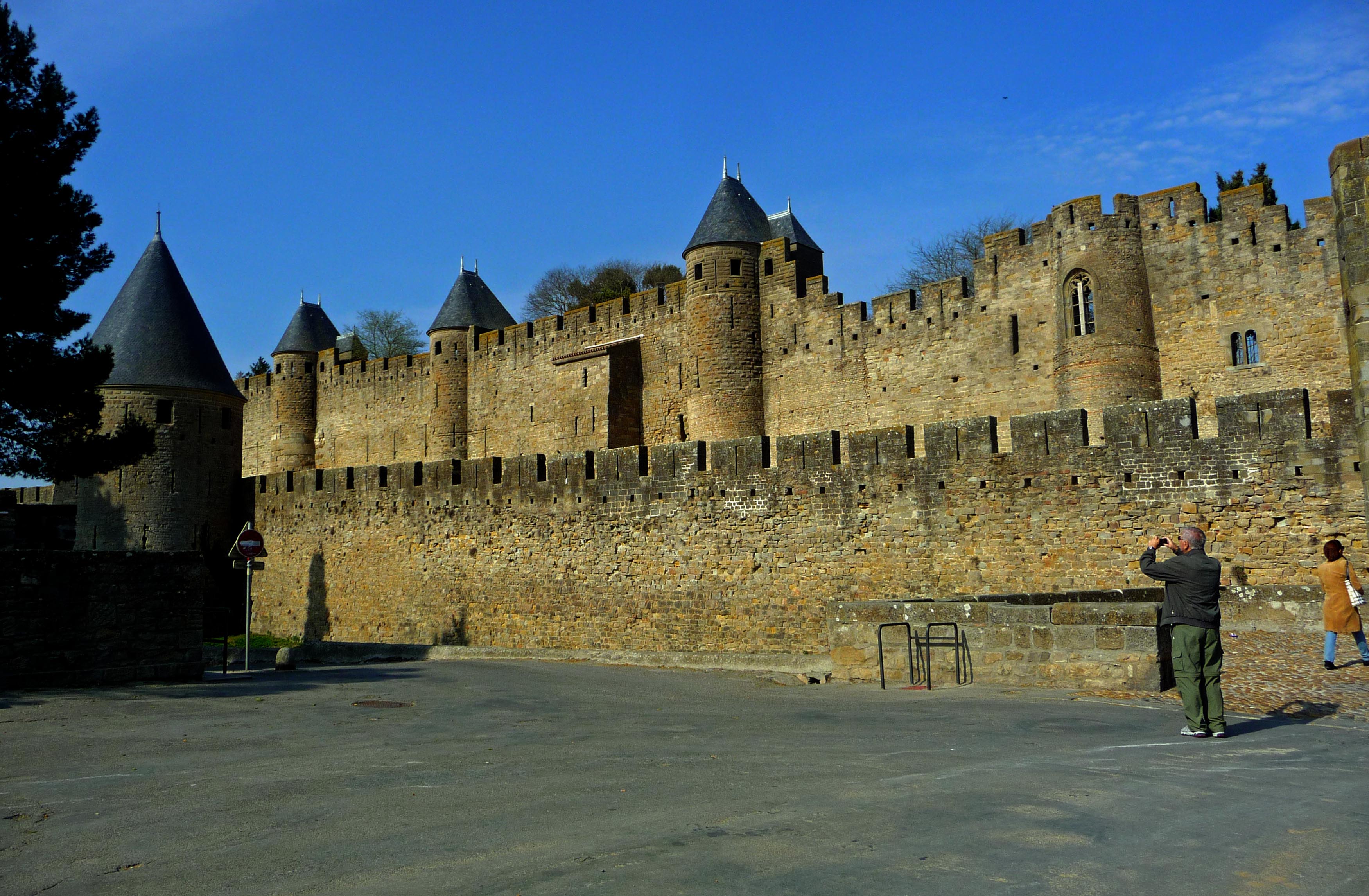
Carcassonne, France
Our barge sailed through Cathar country, a land where the memory of the massacres that occurred during the Albigensian wars is preserved like a fly in amber in the minds of the villagers. The most famous massacre may have happened in 1210, but to the people of the Languedoc, it is as though it happened yesterday. Visits to fortified hill towns like Carcassonne with its dungeons and fairy-tale like turrets that soars into the sky, to the UNESCO protected town of Minerve,
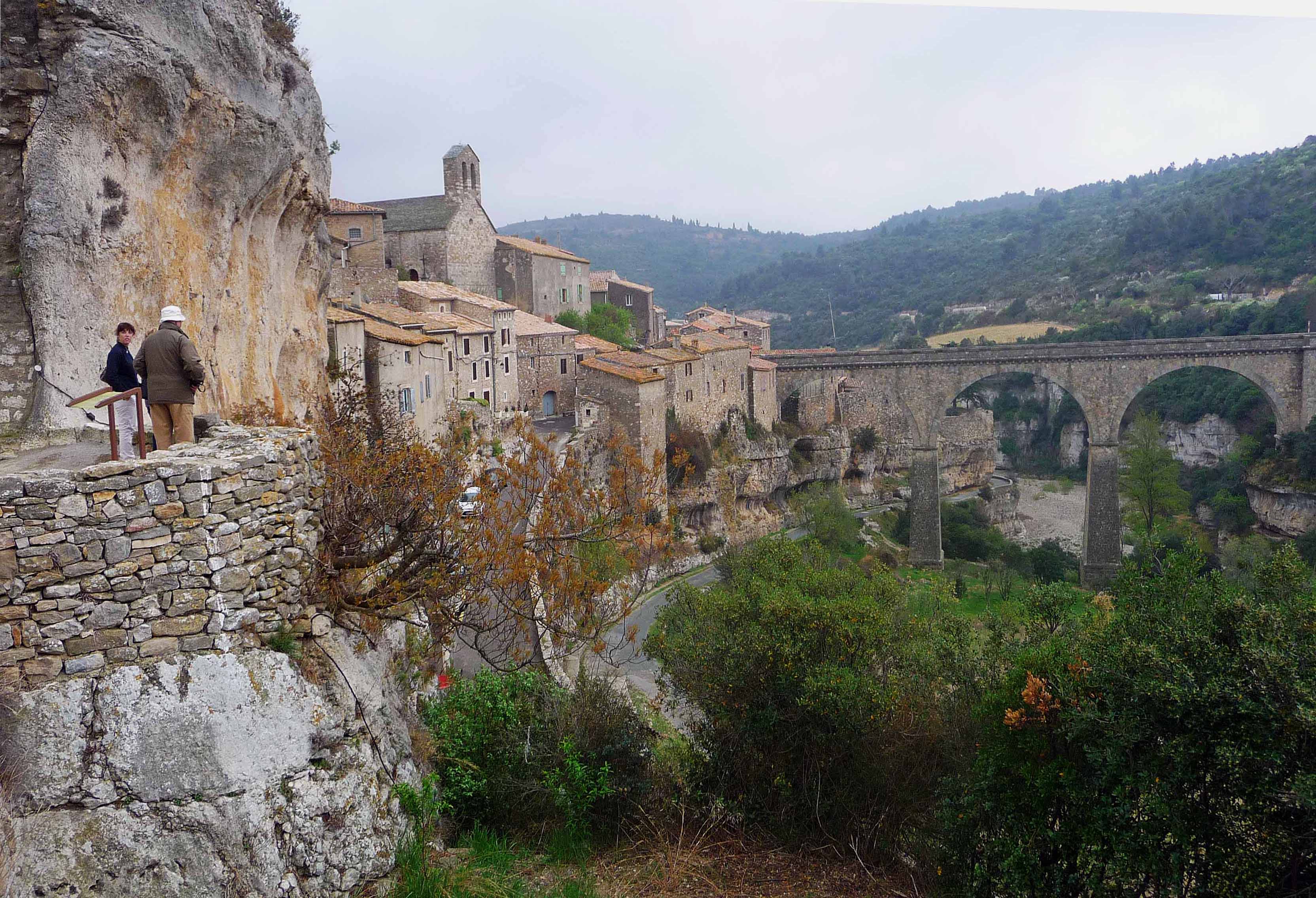
Minerve, well fortified and perched high on a cliff.
perched on a limestone plateau between the gorges of the Briant and Cesse rivers, and to Narbonne with its well-preserved Roman Road, were constant reminders of the bloody wars fought over this land.
Inside the protective battlements of these fortresses are winding alleyways and narrow streets with half-hidden shops selling distinctive local crafts and products.
Cloisters of Bishop’s Palace at Narbonne
Visits to these and other towns, like Pézanas, the birthplace of Moliere, and Villeneuve-les-Beziers, alternated with wine tastings at prestigious chateaux and a very special wine-tasting at the home of one of France’s top female sommeliers, Mdme. Jackie Bonnet.
Moliere, Pezanas
Food on Board the Barge
The Holy Trinity of the French table is wine, cheese and bread, and although our barge cruise was not solely about food and wine, it played a large part in our daily life. I’d cruised with European Waterways before and knew that the chefs and captains of the barges were chosen as much for their knowledge of regional specialities and produce as for their professional skills. Every day we sampled exquisite and unknown wines, often the product of a small single vineyard, alongside premium Crus of the great houses, and we ate the best locally sourced food available as Chef Lauren matched food to wine and cheeses to what had gone before with a skill that owed much to her knowledge of the countryside and its produce.
Chef Lauren and hostess Alex prepare pre-dinner drinks.
Leaving the barge at our last stop for the drive back to Montpelier, was a wrench. The Anjodi offered peace and tranquillity and a stress-free environment with the ambience of an upmarket family hotel. At the same time. we had been given the opportunity to make trips to the major cities along the route, we enjoyed wine tastings at famous vineyards and had even lunched out at a superb restaurant on one occasion. And all this while sailing through some of France’s most quintessential countryside. It can’t ever be better than that.
Fresh fruit always available.
FACTFILE:
The cruise is fully inclusive of gourmet meals aboard and ashore, fine wines, champagne reception, all day open bar, all excursions and admission fees, use of cycles, spa pool, and transfers to and from embarkation point. Crews are British or French but all speak perfect English and double as tour guides and drivers. Because this is a converted Dutch barge, not all of the rooms are spacious but they are all very comfortable and have air-conditioning and central heating. The lounge is elegant and comfortable, and the deck – on which meals can be taken – is equipped with deck-chairs, dining table and seating for eight.
I was tempted to use this Post as part of the Orange photo challenge, thinking Dutch/Orange, Williamstad/William of Orange, Curaçao/Orange liqueur, but I thought that might be considered an anology too far!
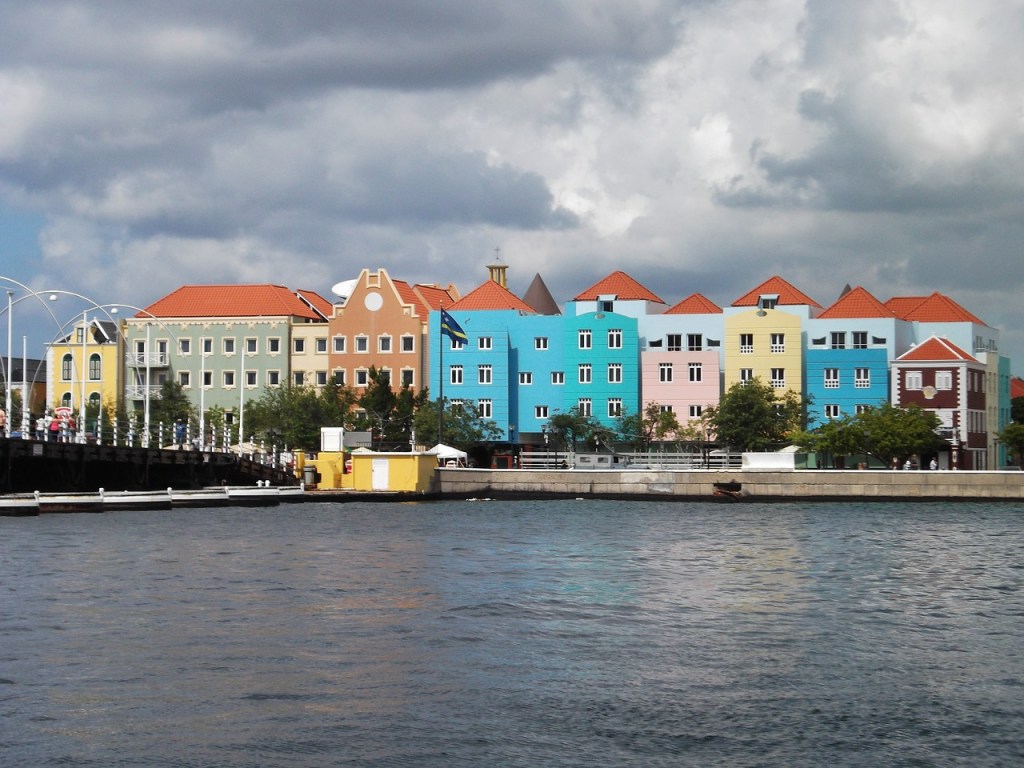
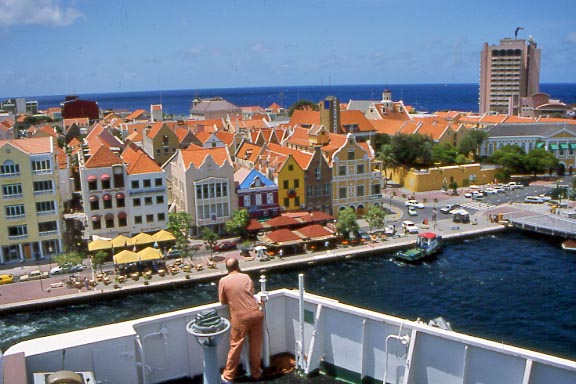
Entering Harbour at Williamstad
The ABC of the Caribbean
Aruba, Bonaire and Curaçao, the ABC of the Dutch Antilles, located in the southern Caribbean Sea just off the Venezuelan coast, are 3 of the most beautiful islands in the Caribbean Not only are they physically beautiful but the people themselves are among the friendliest and most welcoming in the Caribbean, something to do with the Netherland’s good governance of the islands it is said.
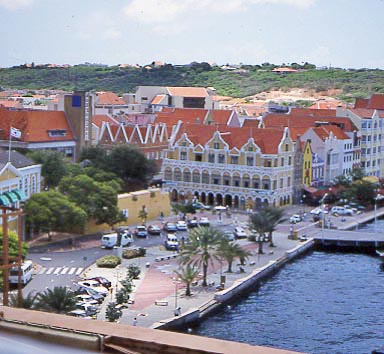
Williamstad, Capital of Curacao
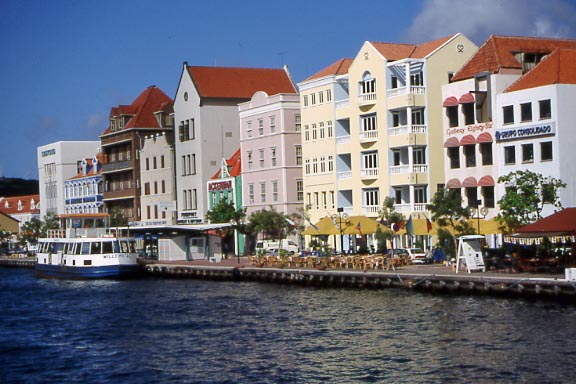
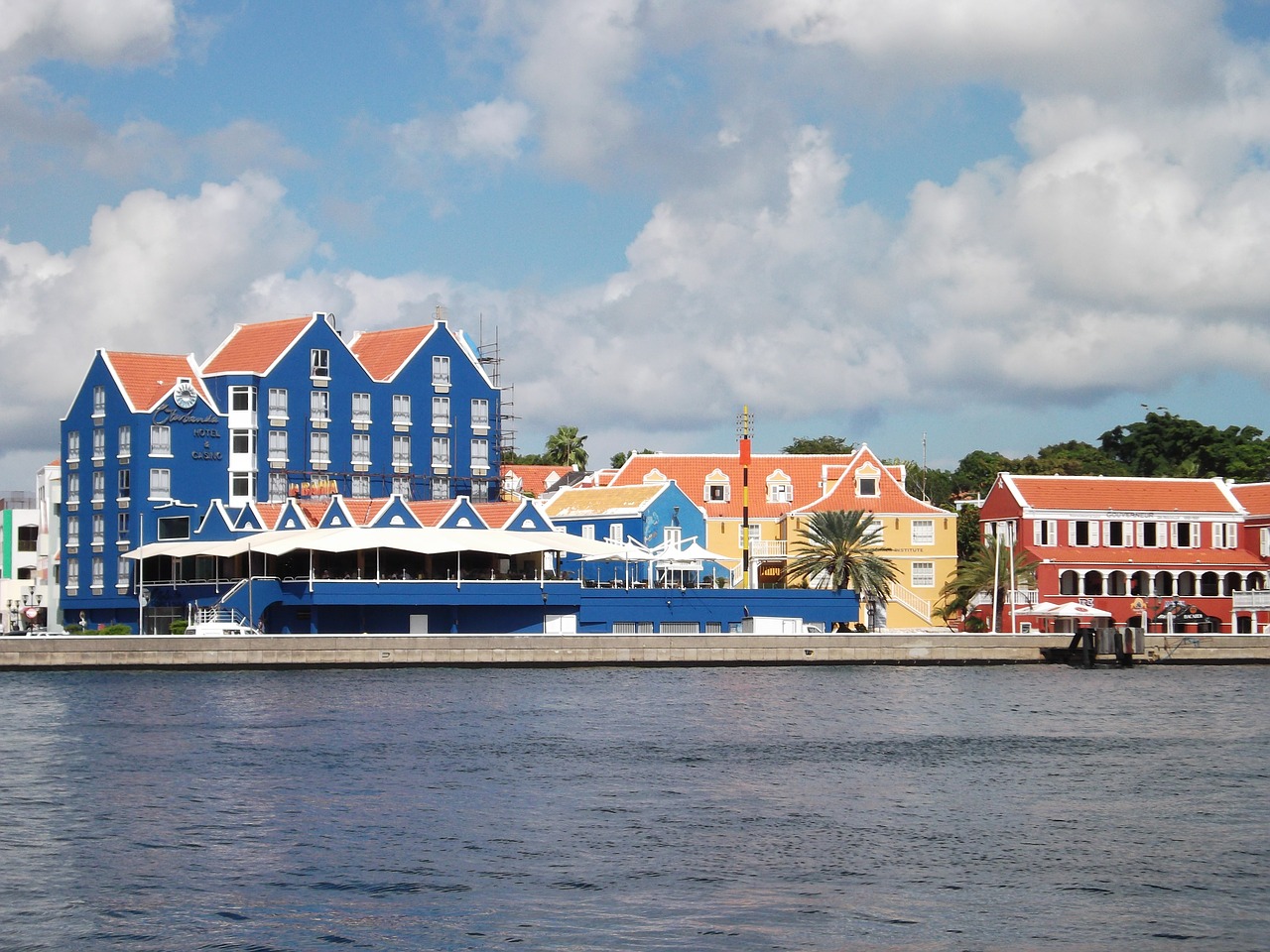
Imagine a tropical Amsterdam if you will and you have Curaçao. Williamstad, the capital, is a town of tidy Dutch-style streets with tall narrow houses in pastel colours of blue, green and pink lining the quayside, interspersed with emerald green swathes of grass and former warehouses now seerving as Museums. Prosperous and clean shops and delightful open-air bars and cafés give cheering evidence of the good husbandry of the former Dutch owners. A perfect town in which to wander, safely it must be mentioned, there are some superb restaurants and plenty of budget ones as well, great retail experiences in the Duty Free shops which stock everything from designer clothes to gold jewellery and Havana cigars, Curaçao has it all.
Beaches, Seas and Aquasports
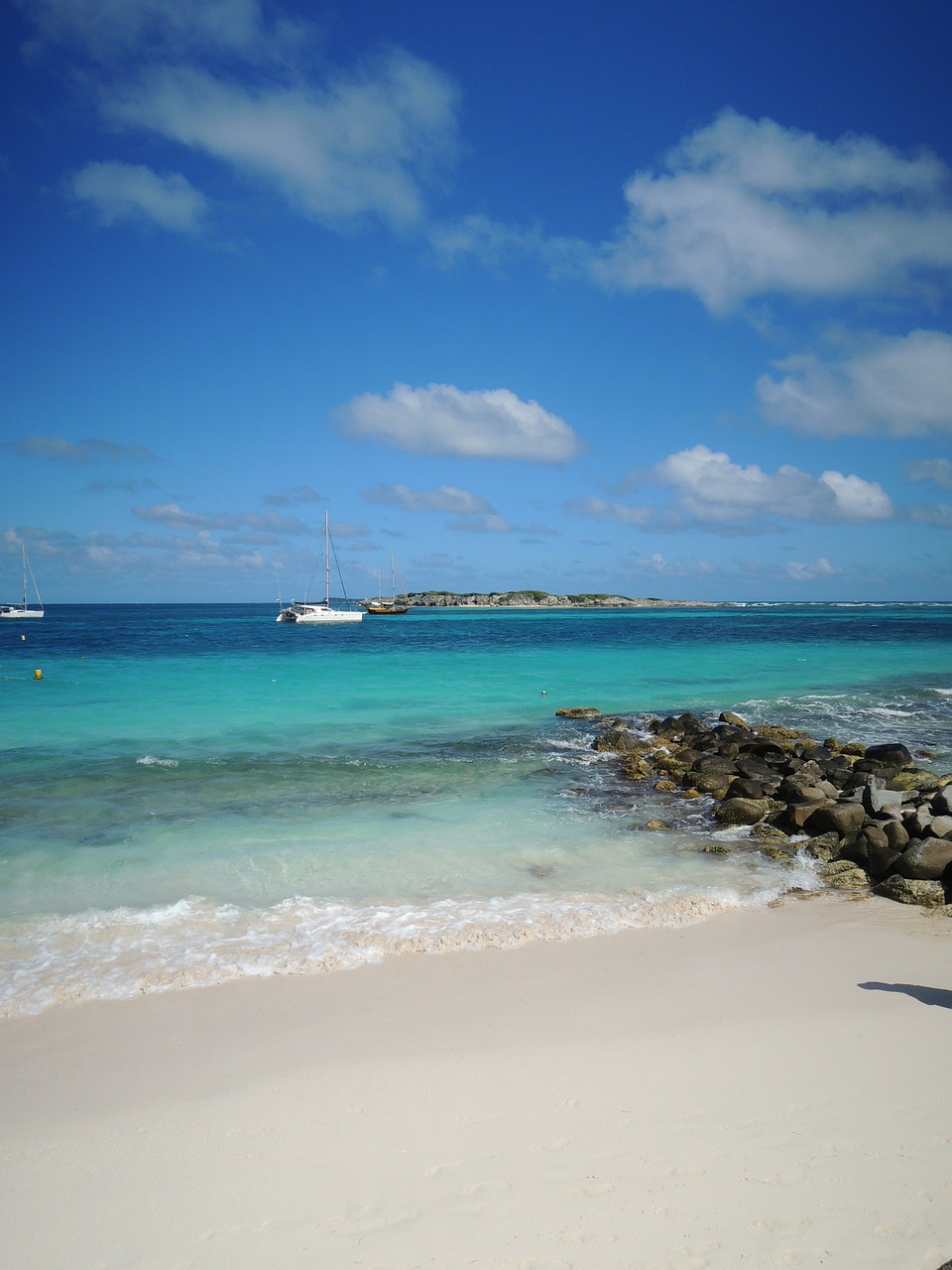
White Beaches and Turquoise Seas
Fascinating though the town is, the beaches and the tremendous amount of water sports on offer, exercise a pull on even the most dedicated of shoppers. There are 35 fantastic beaches with white sands that are really blazingly, blindingly white and with the background of the turquoise sea (yes really turquoise) this is a picture postcard tropical idyll. Swimming, snorkelling, diving or merely floating lazily on the seas around Curaçao is something everyone should do once in their lives.
Williamstad, Curacao, Habour.
I’m no diver – I’m not even a swimmer – but I was nearly tempted into taking lessons from one of the many diving schools we visited, so enticing were the waters. ‘Rubber suits aren’t necessary’ Piet said persuasively. ‘The water is very warm, between 70ᵒ and 85ᵒ’. But I shied off and now I wish I hadn’t.
The Town of Williamstad, Curacao
My partner however, sampled some of the over 65 varied dive sites including spectacularly located shipwrecks, and raved about waters with 100 foot visibility, the gentle drop offs and walls blanketed by magnificent coral formations. And I’ll swear he hasn’t been the same since he swam underwater with the turtles and the multi-coloured fish, an experience he likened to a psychedelic dream.
House in Curacao
And it’s not just swimming, snorkelling and diving. The Marine Park and Underwater Nature Reserve offer other experiences, the best of which for most people is the Curasub, the mini-submarine which takes passengers 320 metres below the sea and which is a boon for those who, for whatever reason, cannot dive. The journey last about one and a half hours and is a delight from start to finish. It is also safe as the internal pressure means that the sub can surface much more quickly than can a diver.
National Parks and Museums
There are experiences of a different king at the Christoffel Park, a naturally laid out wildlife preserve covering 4,500 acres, flanked by hills and shadowed by the majestic mount Christoffel. The park is home to rare sabal palms and orchids, iguanas, several species of birds and the shy Curaçao deer. Horseback riding and mountain biking are available and driving, hiking or strolling is easy and pleasurable.
Houses in Curacao
Surprised by the varied number of Museums on Curaçao, ranging from an Antique Furniture Museum to the Jewish Historical Museum housed in the oldest continuously operating Synagogue in the Western Hemisphere (since AD 732) I had my work cut out to fit even a few of them in. Once you’ve ticked off the museums you want to see you can then start on the many elegant Plantation Houses on the island. The Caribbean as a whole is not short of Plantation Houses but the ones on Curaçao are in a class of their own and well worth a visit.
Getting round the island
Buses are a cost-effective way of getting around the island and a useful way of meeting the friendly locals, but taxi are cheap and plentiful. For touring downtown Williamstad and to reach the Seaquarium there is an old time trolley bus with aircon at the front and fresh air in the back!
‘You must have a free ferry ride with the locals’ my hotel porter told me. ‘It operates at least 30 times a day when the Queen Emma Bridge opens to let ships pass through’. So I did, and it was fun.
WilliamstadWilliamstad, Curacao
Curaçao was discovered by one of Columbus’s lieutenants, Alonso de Ojela. It’s a pity the good Señor never had a chance to try the ice-cold beer, the only lager in the world brewed from seawater, or even ‘a sticky’, the sweet, syrupy Orange or Blue Curaçao. I think he’d have liked them.
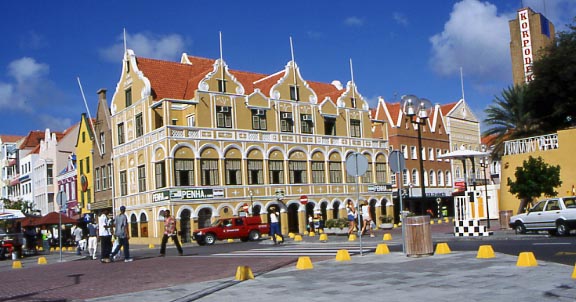
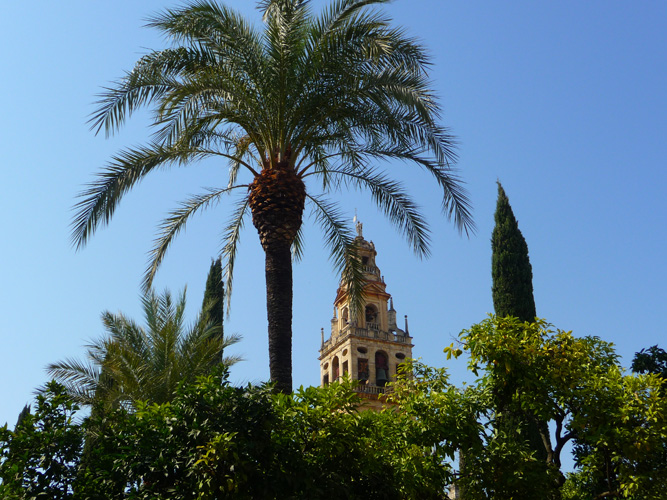
Been looking through my photographs to see what I could find that would fit this week’s challenge. Quite surprised to find very little. I thought I had an orange sunset at Wadi Rum but that turned out to be golden, and my terracotta roofs in Italy had taken on a brownish tinge by the time I blew them up. But I found a few, so herewith my selection from Spain, Italy, Thailand and Sweden.
This slideshow requires JavaScript.
Freshly squeezed juices at every corner in Palermo, Sicily
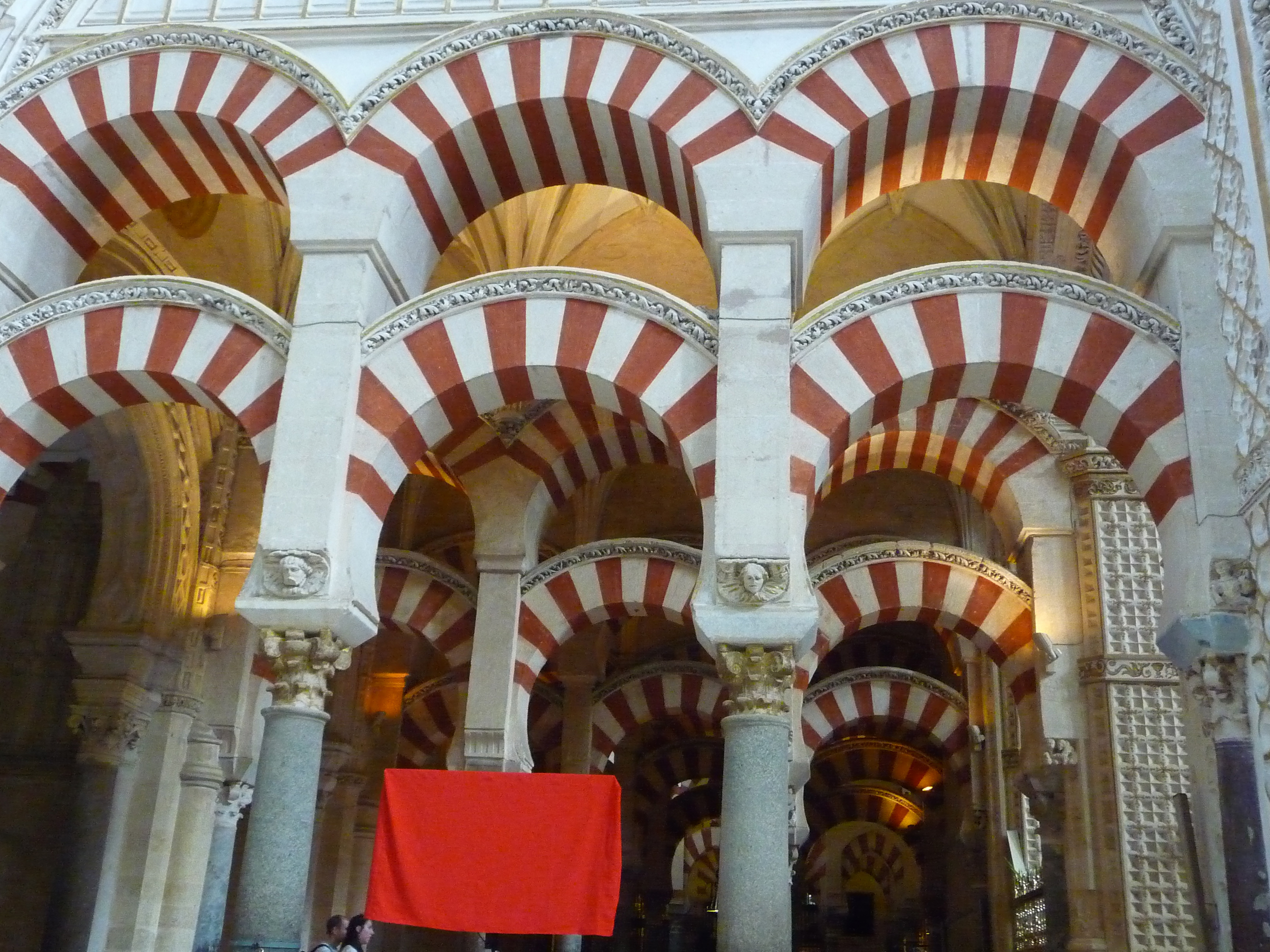
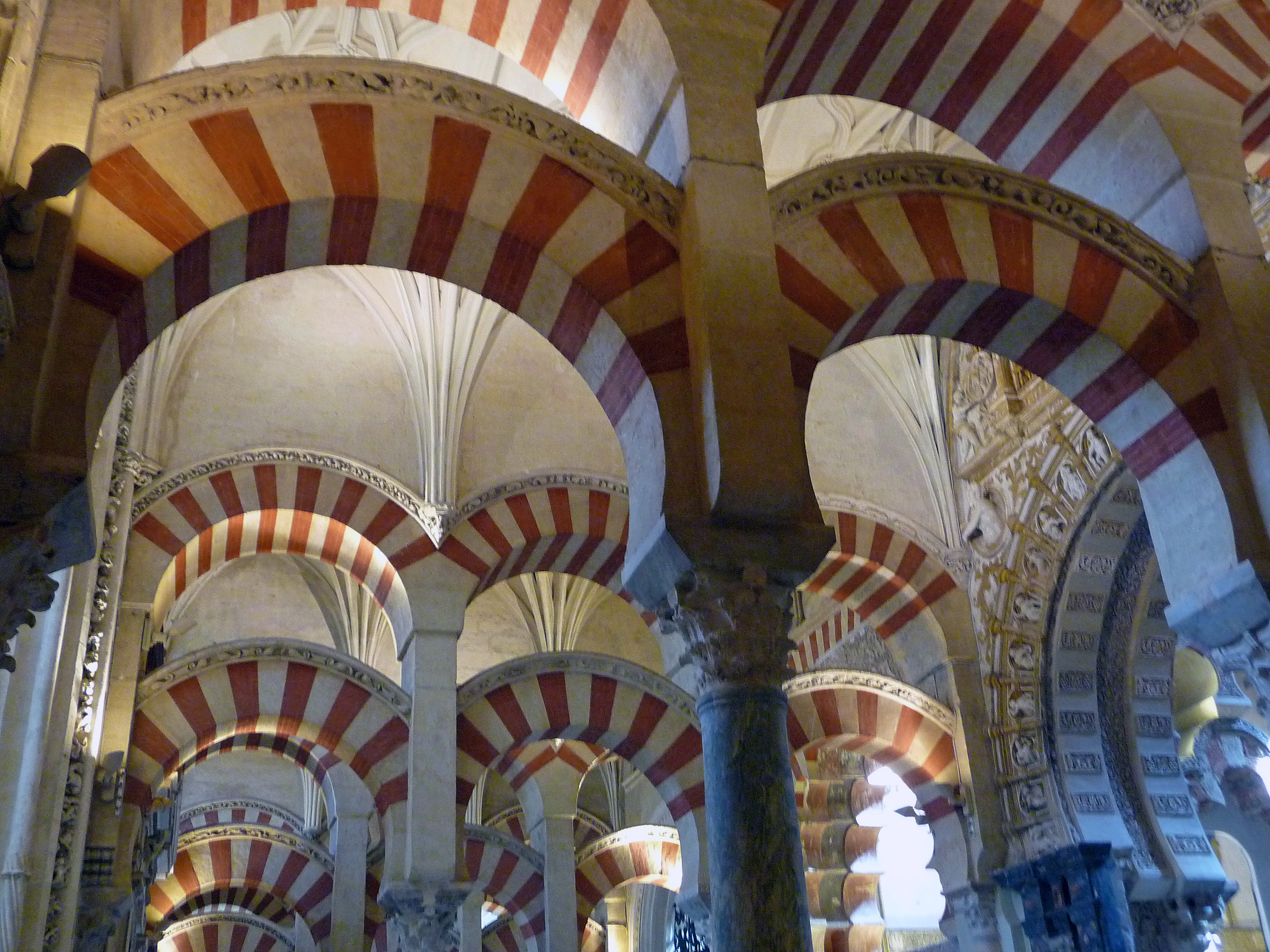
Magnificence of the Arches in the Mezquita in Cordoba
Once the centre of worship in Western Islam, the Mesquita in Cordoba, Spain, with its glorious exterior golden walls, is considered one of the architectural wonders of the world. Red and white striped arches as far as the eye can see, each one seemingly different, create patterns that leave one enchanted. More bizarre however, is the Catholic Church plonked down in the centre of the mosque, something which alone qualifies it as a most unusual place.
Originally built on the site of the Basilica of St Vincent the Martyr, a 6th century Visigothic church, then becoming a mosque and latterly a church (in use today) one can look down on the remains of the earlier building through a glass panel set in the floor, reminding us that this edifice has been owned and operated by 3 religious houses at different times.
From 785 when the Caliphate was powerful in the Iberian peninsula until the sack of the Moors in the 13th century, the Mesquita grew grander and larger under each succeeding Caliph but during all that time, all religions lived side by side in harmony, each sharing their knowledge of geometry, philosophy, algebra and other intellectual disciplines.
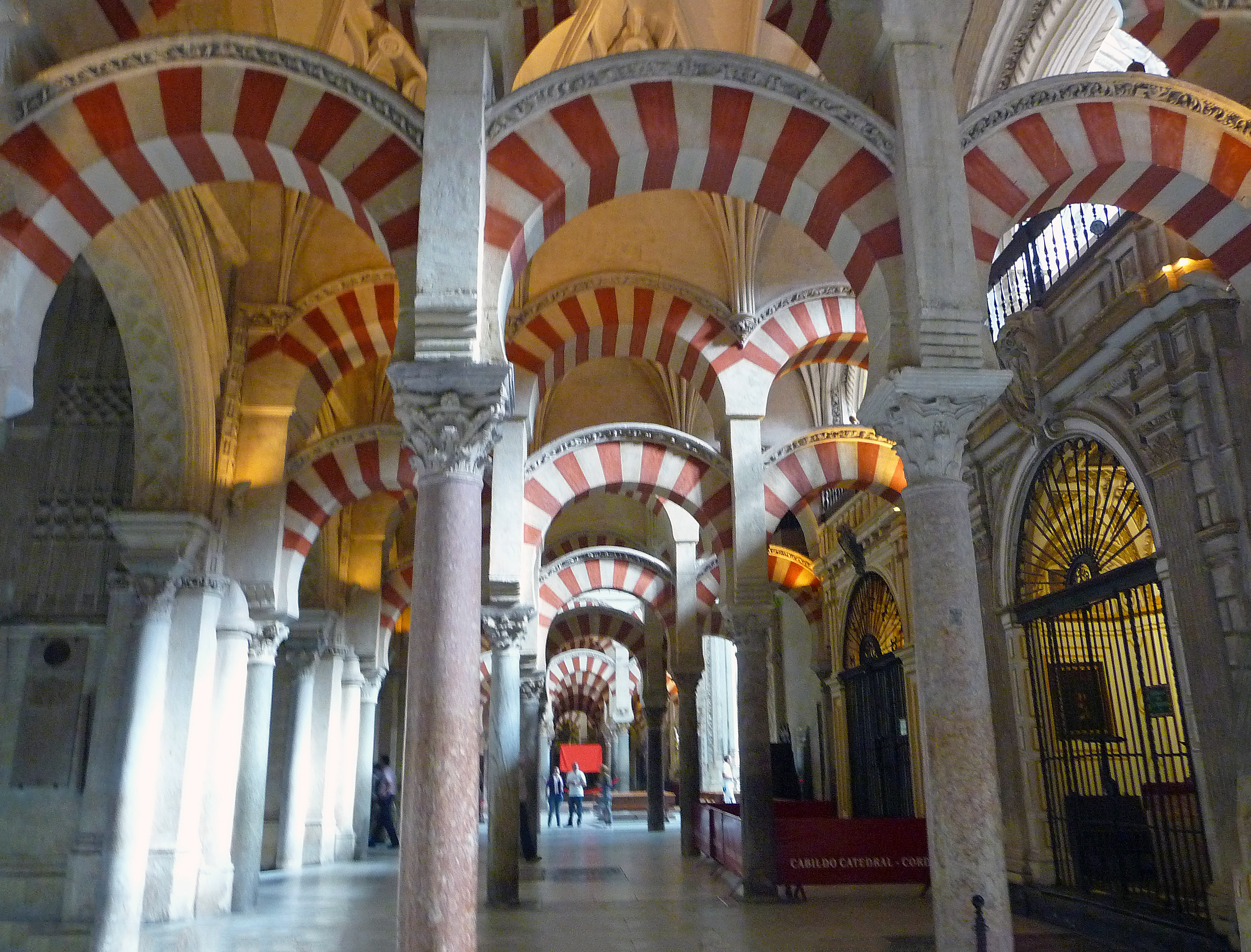
The pillars seem to go on forever. Mezquita, Cordoba, Spain
Caliph Abderramán 1 built the great hall in which there are 110 columns the capitals of which came from old Roman and Byzantine buildings Above this there is a second row of arches which creates a wonderful effect. Eight more arches were added in 833 by Abderramán II, the minaret, Mahrab and the Kliba in 962 by Alakem II. The mosque was doubled in size in 987 when Caliph Alamanzor added blue and red marble pillars and today the total of these endeavours is truly wondrous.
Arches of the Mezquita in Cordoba, Spain
It is our good luck that the Christian conquerors didn’t destroy this magnificent building as they did so many others, but choose to place their church, consecrated in 1236, inside the walls of the mosque. This bizarre placing of one religious house inside another is just one of the things that makes the Cordoba Mezquita so unusual. Against the austerity of the pillars of the mosque, the chapels full of gold and silver decoration, statues of the Madonna, marble-swathed tombs and heavy wooden carved choirster stalls, stand out defiantly but somehow, the spellbinding beauty and simplicity of the arches puts the flamboyance of the christian church in the shade.
I don’t know why I overlooked the most serene moment of my life when I started on my former blog about this subject. Maybe it was because the images to go with it are not very spectacular; certainly they don’t convey the calmness of the moment, the sense of absolute peace and tranquility, and the near total silence we experienced.
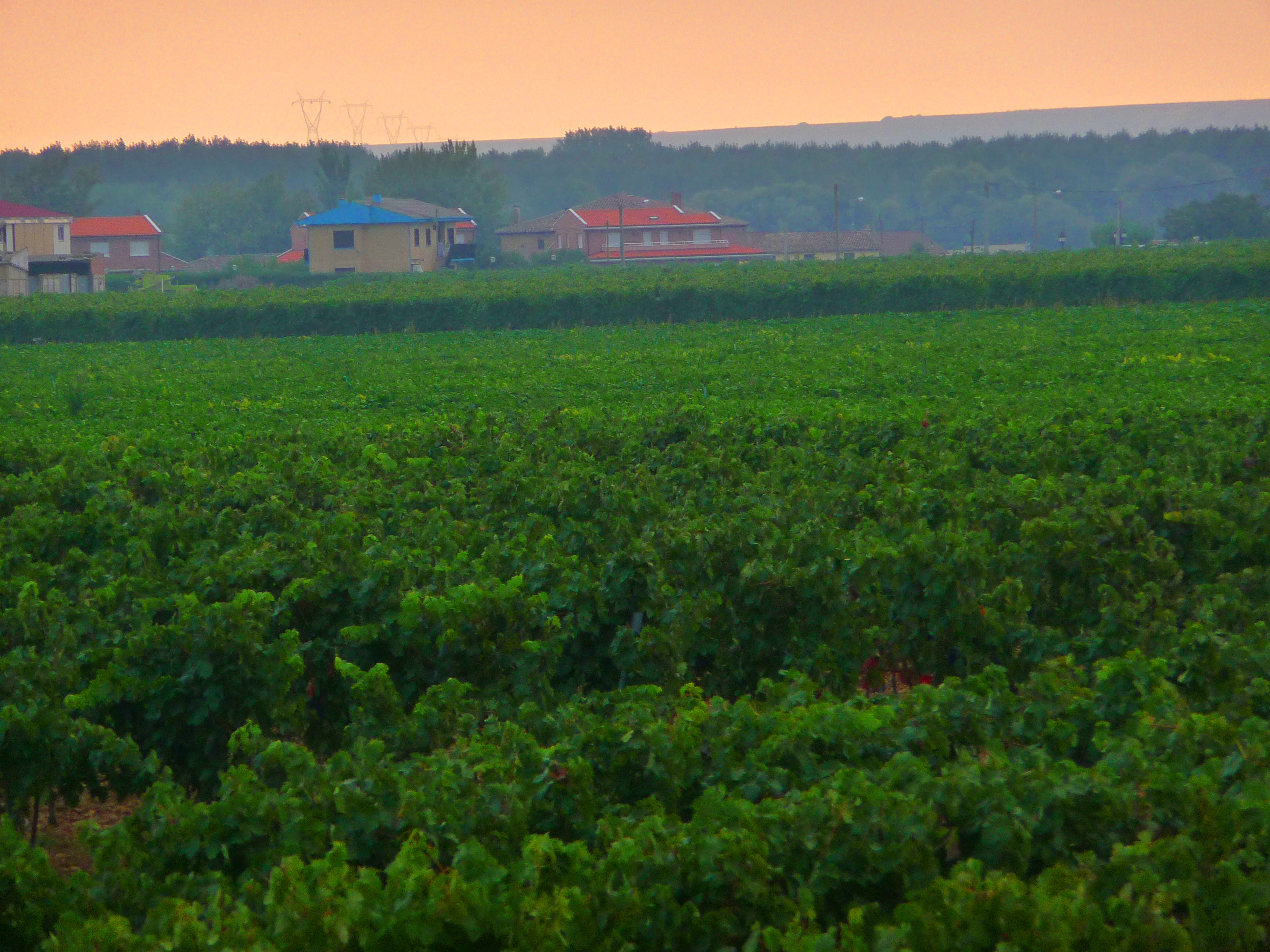
The occasion was a balloon flight over the vineyards and fincas of the wine-growing area of Rioja in Spain. We began our ascent as dawn was breaking bathing our world in a warm pinkish glow as we rose into the sky watching fields and houses below diminish in size minute by minute. Initial trepidation dissipated as soon as we started our flight and the beauty and joy of the morning filled us with awe. For once I felt at one with nature, not in the way I had done when out walking in the mountains or swimming with dolphins, but a feeling of really being part of this marvellous planet of ours.
Vineyards of the Rioja area
Up and up we went right into clouds which deadened what little sound there had been up until then. it was totally eerie, chilly and white.
Up, Up and Away, in my Beautiful Balloon
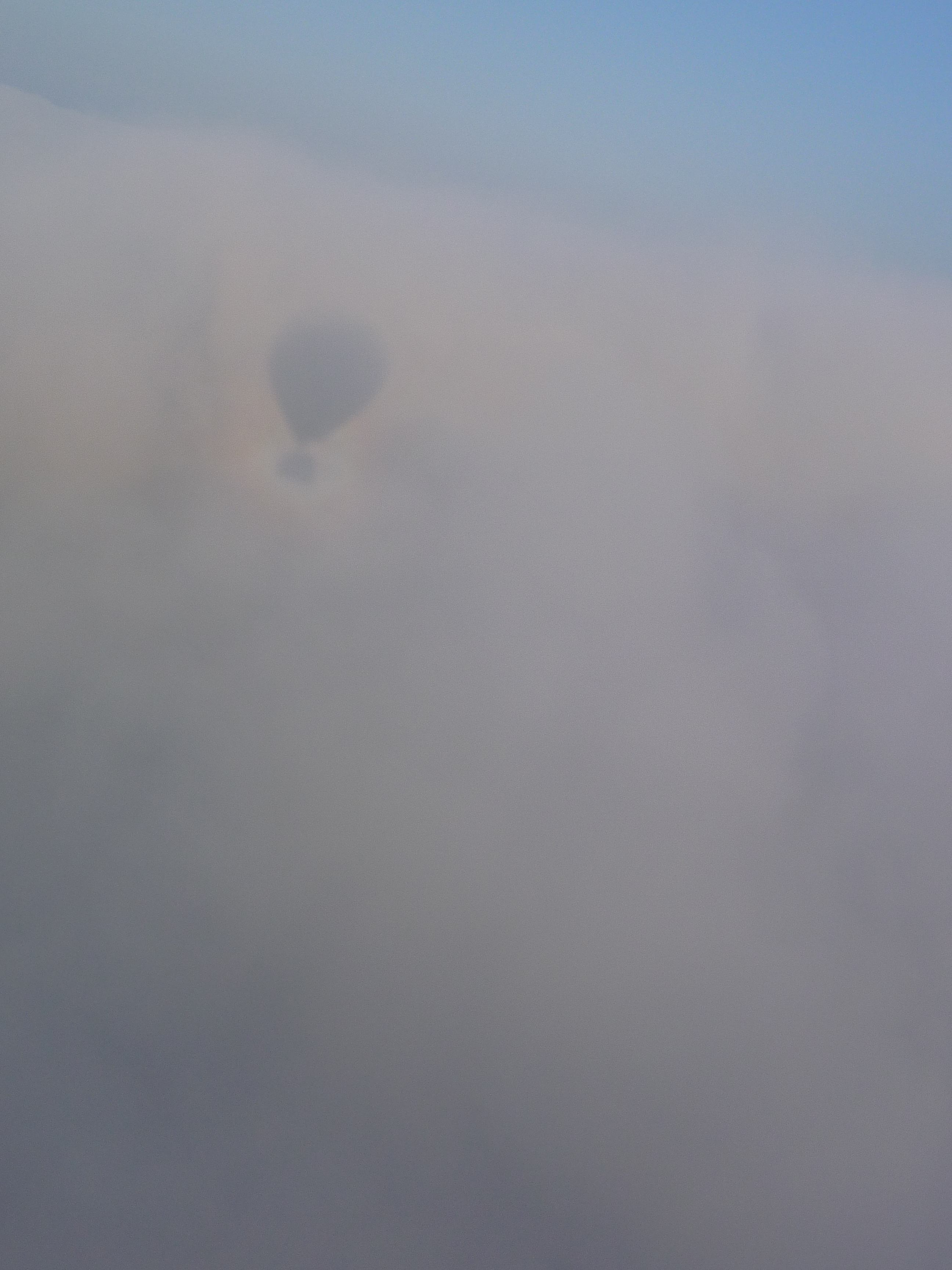
Then the pilot motioned ahead and there it was, the photo I would have died for if I’d known when on the ground that I would actually see it, our balloon shadowed on the cloud in front of us, faint but very obviously there. The moment was too precious to grab for a camera and start focusing, so in a sort of reflex action, I just clicked on the little camera I carry for emergencies like this, and here it is. My only image from my time in the clouds when I really knew the meaning of Serenity.
My Beautiful BalloonReflection of Balloon in Clouds






















 MARI'S TRAVELS WITH HER CAMERA