Overlooking the Douai Plain, the Vimy Memorial is located approximately eight kilometres northeast of Arras and is the centrepiece of a 250-acre preserved battlefield park that encompasses a portion of the area over which the Canadians made their assault during the initial Battle of Vimy Ridge. The imposing structure stands amid craters and unexploded munitions that still honeycomb the grounds which remain largely closed off to the public for reasons of safety.
The Memorial is dedicated to the Canadians who served their country in battle during the First World War, and in particular. to the 60,000 who gave their lives in France. It also bears the names of 11,000 Canadian servicemen who died there who have no known grave.
The rough terrain is because it cannot be properly excavated due to unexploded munitions.
Designed by W.S. Allward, it took 11 years to build. He had initially hoped to use marble for the facing stone but was persuaded that this would not weather in northern France. After a two year search he found a limestone of just the right colour, texture, and luminosity in the ruins of Diocletian’s Palace at Split in Croatia and managed to procure supplies from an ancient Roman quarry located in Croatia near Seget. Oscar Faber, a Danish structural engineer who designed the substructure for the Menin Gate at Ypres, prepared foundation plans and provided general supervision of the work.
Vimy Memorial from the road with designated pathway to the Monument
Postscript:
During the Second World War Germany took control of the site and held the site’s caretaker in an internment camp for Allied civilians. There were rumours that it had been desecrated and to demonstrate that this was not so, Hitler, who reportedly admired the memorial for its peaceful nature, was photographed by the press while touring it on 2 June 1940. After the war it was found that it had not been damaged in any way and that it had been carefully looked after by the Germans during the war.
The site of 250 acres, most of which is forested and off limits to visitors to ensure public safety, is of rough terrain and because unexploded munitions make the task of grass cutting too dangerous for human operators, sheep graze the open meadows of the site.
Mary Magdalene with the Risen Christ by David Wynne (1967)
This sculpture by David Wynne stands outside the entrance to St. Dunstan’s Chapel in Ely Cathedral and depicts the moment when Mary Magdalene recognizes Christ after he has risen from his tomb. Next to it is a plaque, which reads: “This striking sculpture by David Wynne captures the moment when a distraught Mary recognises Jesus on the morning of his resurrection. The figures are so thin it is as though everything has been stripped from them except the core of their being.“
I was sure I’d written about my day with the huskies a few years back but I’ve trawled through my posts and can’t find it, so here it is – maybe first time round.
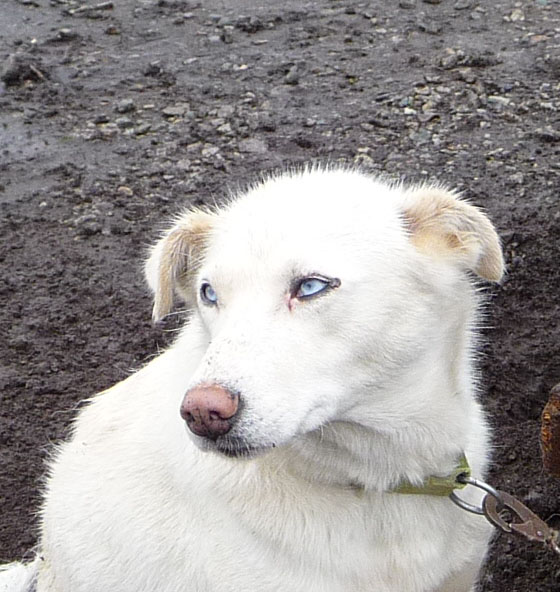
Ol’ Blue Eyes – Husky
It was when I read Jo-Jo’s blog, Snow Capped Memories of Lapland, and she described how
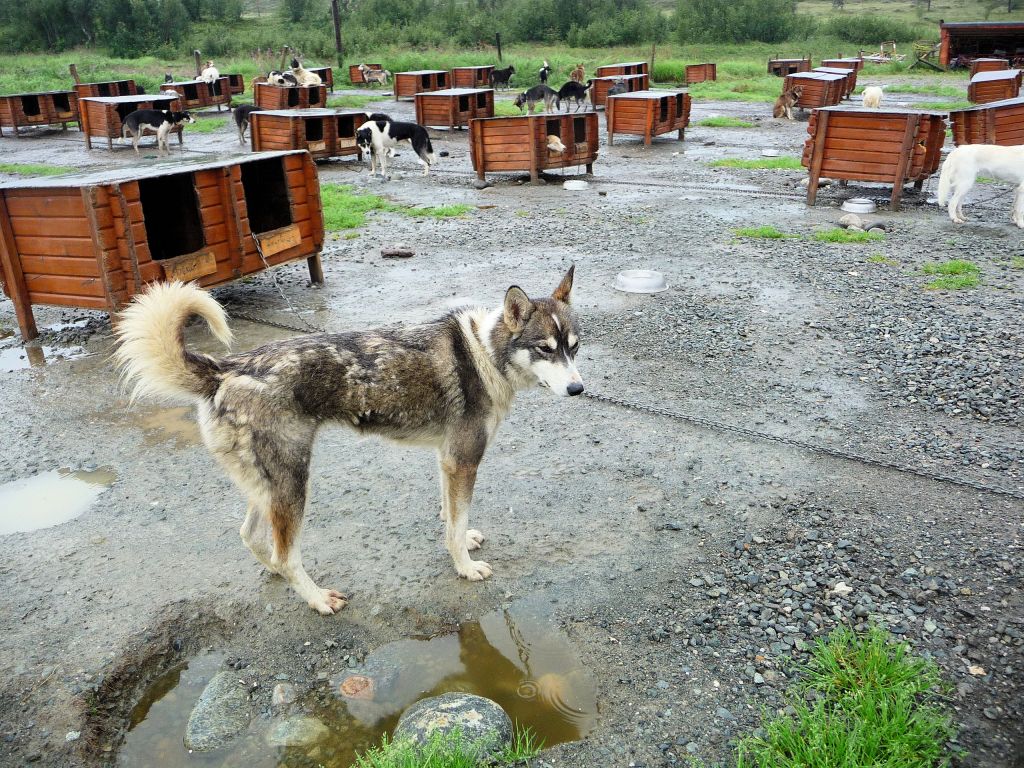
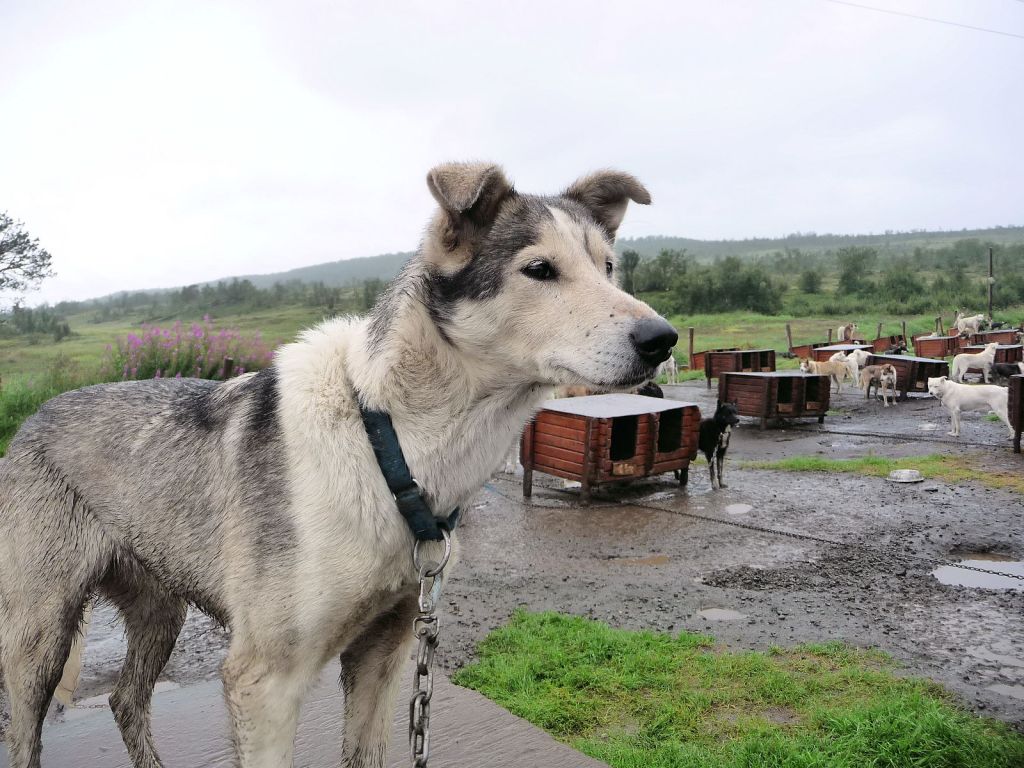
“…the dogs were much smaller and less fluffy than the pet huskys I know. Strong and lean and frisky – like highly attuned race horses just itching to take off…” that I had a vivid recollection of my day with the huskies. I, too, was surprised that the huskies were lean and much smaller than I had imagined but I was told that these are the real working dogs of northern Norway, not the heavily fur-coated ones we see on TV and films.
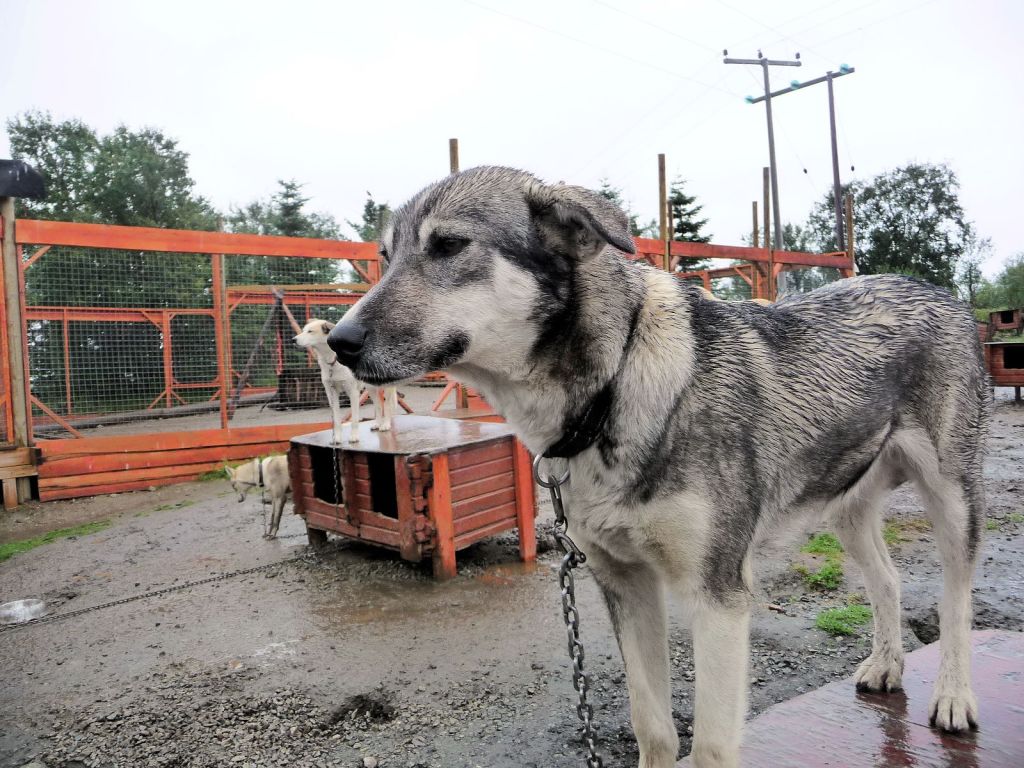
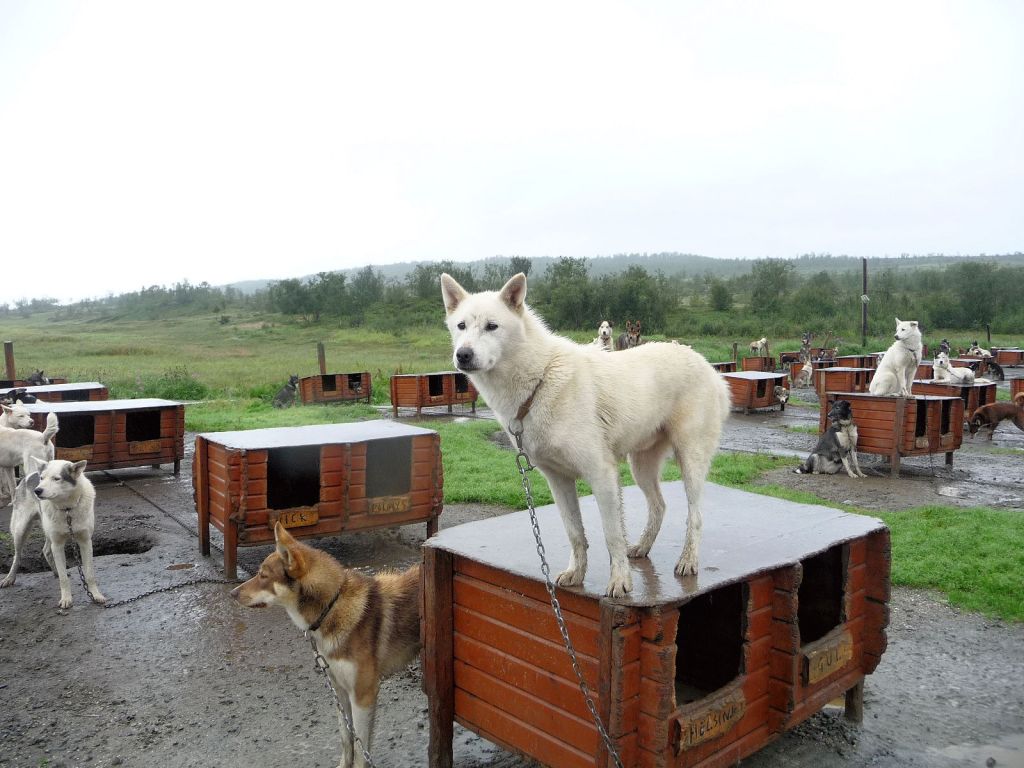
Keeping a watchful eye that nothing goes wrong.
We had made the 25 minute journey from Trondheim for a day with the huskies at TROMSØ VILLMARKSSENTER, located on Kvaløya (the Whale Island), one of the biggest adventure companies in Norway. The centre offers dog sledding trips and northern lights safaris, lasting from 4 hours to 5 days in the winter (Nov 1st – April 30th) and kayaking trips and mountain hikes in the summer (May 1st – Oct 31st) the main focus being an authentic wildlife experience with the help of their 300 huskies.
Tove Sørensen, the owner, founded the centre in 2006, the year in which she competed in the world’s longest dog sled race in Alaska, the Iditarod, and in which she won the “most inspirational musher” award. She has over 20 years experience with dog sledding and when we met her in 2018 she had already competed 16 times in the European longest dog sled race, Finnmarksløpet.
Just to prove it was summer
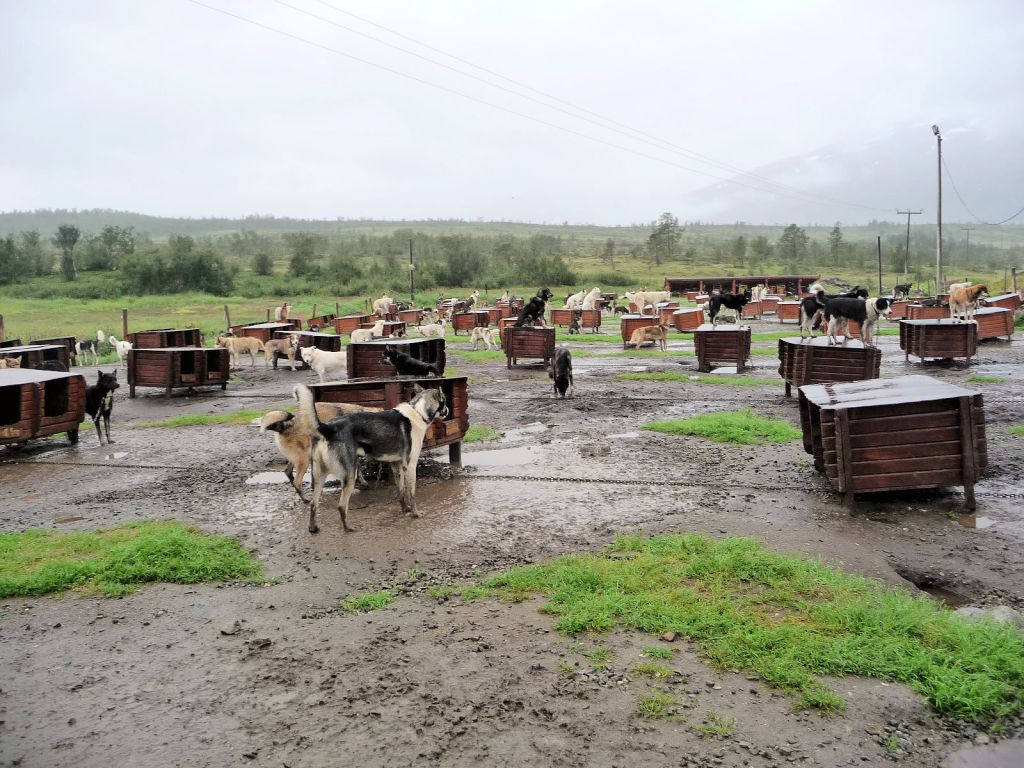
Although our visit was in June it had been raining for some days and the place was a morass. It rained all the time we were there and it was very cold forcing us to don all the warm clothes we had brought with us.
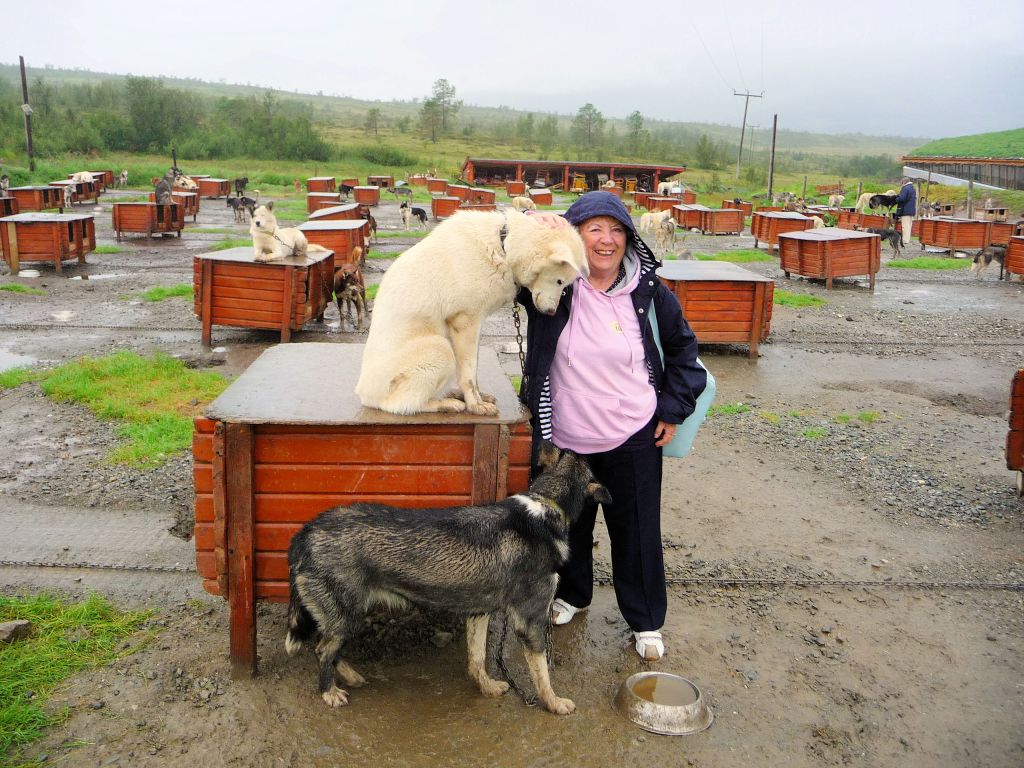
Despite the cold however, we all had smiles on our faces because the huskies were so friendly and welcoming, jumping up and covering us in mud, demanding cuddles and trying to get as close as they could. They were like children, burrowing into your arms and resting their heads any place they found, your neck, the crook of your elbow, inside your coat, all the time demanding you pet them. You ventured near them at your peril – the peril that is, of being licked to death and covered in dirty paw-marks.
Marie enveloped in layers of clothing with friends
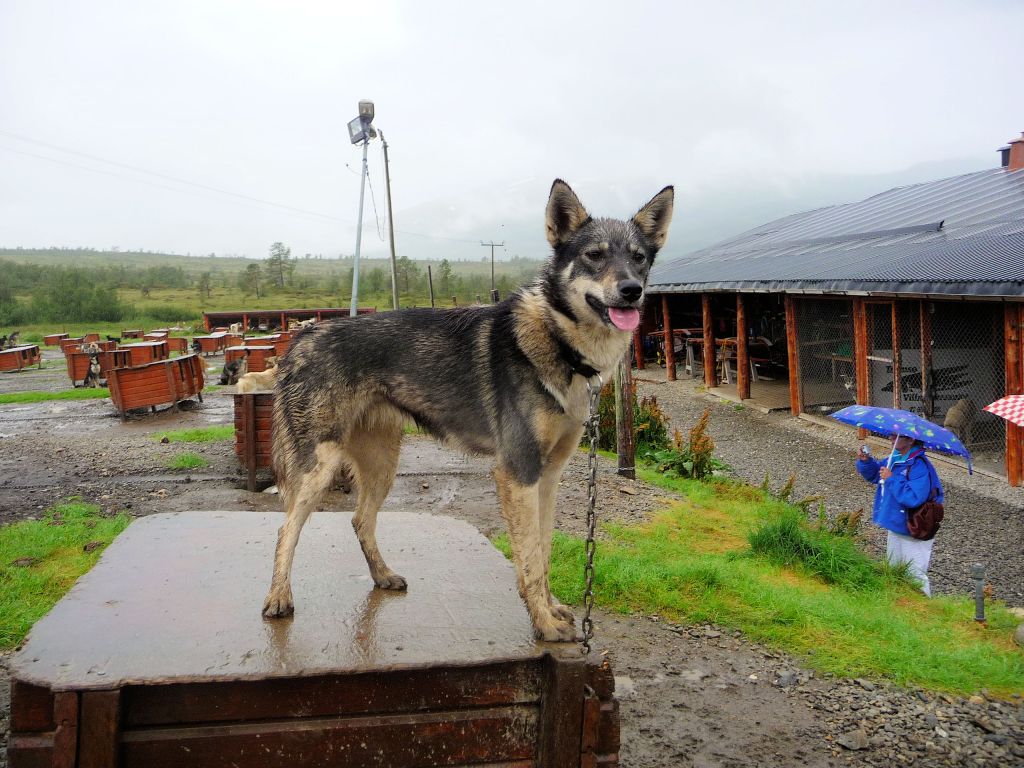
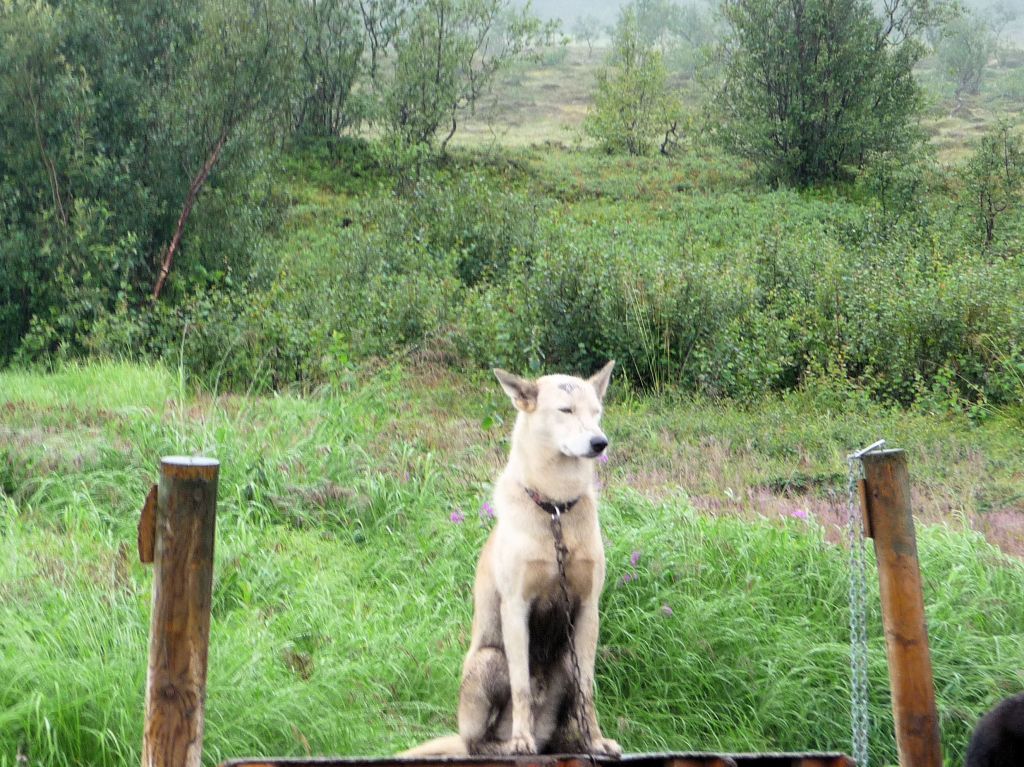
The stance says “Look at me” but this is their normal ‘at attention look’ unless they are resting.
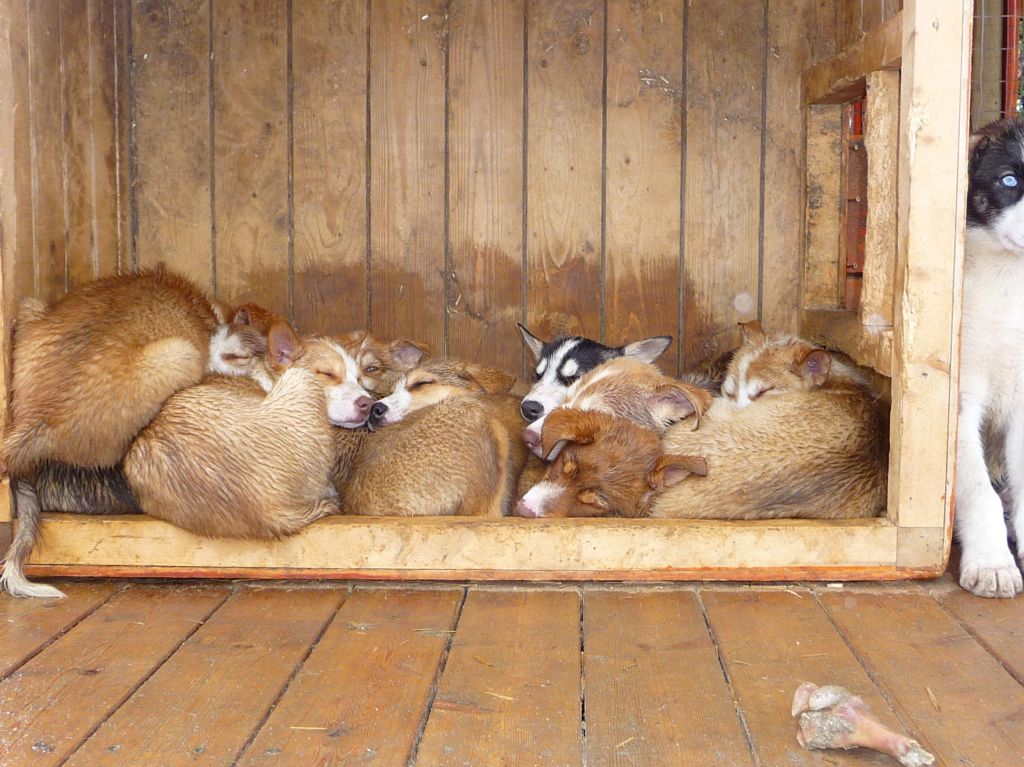
All were small, all were lean, and the heavy rain had flattened their coats so that hardly a hair stood up. Each one occupied a kennel to which it was chained but they all looked contented and were obviously well-fed. The puppies were adorable but refused to wake up while we were there. I was told they need a lot of sleep when they are young. They start training when they are six months old and are taken out for 1 hour a day to start with, increasing in half-hourly increments until they can join a main sledding group.
One blue eye keeps an eye on the sleeping puppies
You can see from my photographs how wet it was that day and how bedraggled the dogs and their visitors looked. I was lucky enough to be wearing trainers but some of the sandal-clad visitors fared badly, one or two slipping in the mud.
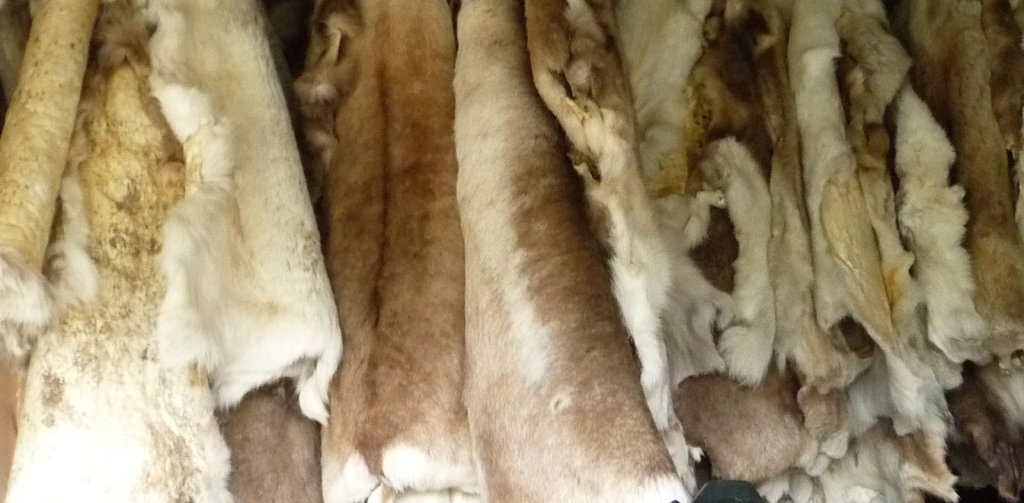
Reindeer skins for sale in the on-site shop
Should you fancy a trip to see these lovely, friendly huskies, details are below. There is a small cafe on the site and a shop selling ethnic garments (wooly hats, scares, mittens, gloves, boots, skins and suchlike), you get a chance to see an excellent film about huskie sledding and racing, and you can, of course, stay overnight.
Mention Dijon and you think of mustard, right? But did you know that the bulk of the mustard seed is now imported from Canada, due to worldwide demand for the spicy condiment. And that the mustard comes in pink, green, black, and tawny-yellow – the gritty one as the kids call it – the one we are most familiar with.
Medieval Dijon
There’s no doubt that the town lives on its mustard: virtually every shop sells the stuff. It’s the obvious souvenir to take home and the best shop for this is the well known and signposted, La Boutique Maille. The shop-owners have made it easy to find the mustard by laying a easy to follow Dijon shopping trail, just follow the brass owls laid into the pavements and you can’t miss a mustard shop! Or if you are there at the weekend, visit the Friday and Saturday markets where stalls selling the hot stuff offer intriguing flavours like Strawberry and Orange.
Dijon is more than just mustard, however: it is one of France’s great Museum cities and what’s more, all of them offer free entry! It is a medieval town with some wonderful architecture, and as the capital of Burgundy it is an ideal base for touring this famous wine region. There were over 100 hotels there at my last count as well as a number of B & Bs and some lovely “chateau hotels” tucked away in vineyards in the area of Beaune and Chablis.
Palais des Ducs and Museum of Fine Arts
Palace by PhillipedeDijon – Pixabay
This lovely old town many of whose buildings date back to before the Renaissance escaped heavy bombing during the Second World War. Some of the buildings are now Museums (the town offers seven in all) and among them is the Palais des Ducs famed as much for its interior as for its exhibits, and home to the magnificent Museum of Fine Arts one of France’s oldest museums (1787). In its 50 rooms of priceless treasures dating from antiquity to modern day are fabulous works by Yan Pei-Ming, Monet, Manet and other renowned artists, along with jewels of 15th century funerary art, the tombs of Philip the Bold and John the Fearless – extraordinary, lifelike statues held up by incredibly detailed Mourners.
Gargoyles on Church of Our Lady of Dijon by Christine Dautin, Pixabay
You could spend an entire day in the Palais des Ducs but I would recommend giving some of the treasures there a miss and exploring more of what the other museums and churches offer. Don’t miss the exterior of the Gothic Notre Dame de Dijon, its gargoyles never fail to raise a smile, although they are rather high up for good viewing.
Musée de la Vie Bourguignonne
One of my favourites and I would suggest that if you can squeeze in a visit to the quirky Museum of Burgundian Life you won’t be disappointed. The reconstructions of 19th and early 20th century Burgundian shops are really special – millinery shops, photographers, pharmacists and others, all filled with bits and pieces from the day.
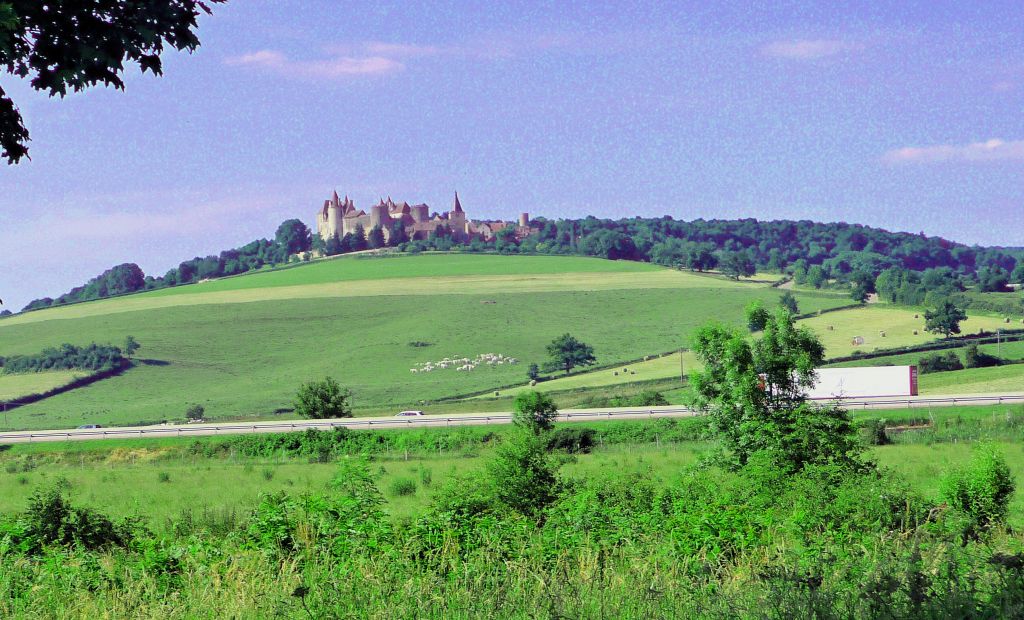
Chateau on the Hill
Le Consortium
A contemporary art venue in a former Cassis factory, Le Consortium houses more than 400 pieces dating mainly from the 1970s. It’s something rather different and the selection gives food for thought. Le Consortium publishes around 50 art books a year and if you like books you should not miss this shop with moveable bookshelves and reading area.
Maison Millièrre
This half timbered house dating to 1483 is not strictly a Museum but it is well worth a visit. Built 9 years before Christopher Columbus discovered America it has featured in the film Cyrano de Bergerac starring Gerard Depardieu. It’s courtyard is filled with plants and frescoes and there is a tea room and wine bar downstairs and a restaurant upstairs plus a shop selling local products and souvenirs. Find it at 10, rue de la Chouette, right by the magic owl of Dijon!
The Hospices de Beaune
Hospices de Beaune
Not far from Dijon and a must-see is the Hospices de Beaune dating back to the late Middle Ages whose Gothic architecture is considered to be one of the best examples of its time. Originally founded in 1443 as an almshouse and hospital for the region’s poorest people, it is one of the country’s most important historical monuments with its massive courtyard, turrets, colourful roof tiles and the vast, echoing interiors of the Room of the Poor.
Beaune – Les Hospices
There are other museums worth a visit and if time allows the City Library is recommended, but I choose the above because visiting them still allows time for strolling in some of Dijon’s parks as well, like the elegant Garden of the Fountain Creek Ouche and the Gresilles Park which are within easy walking distance and have picnic lawns.
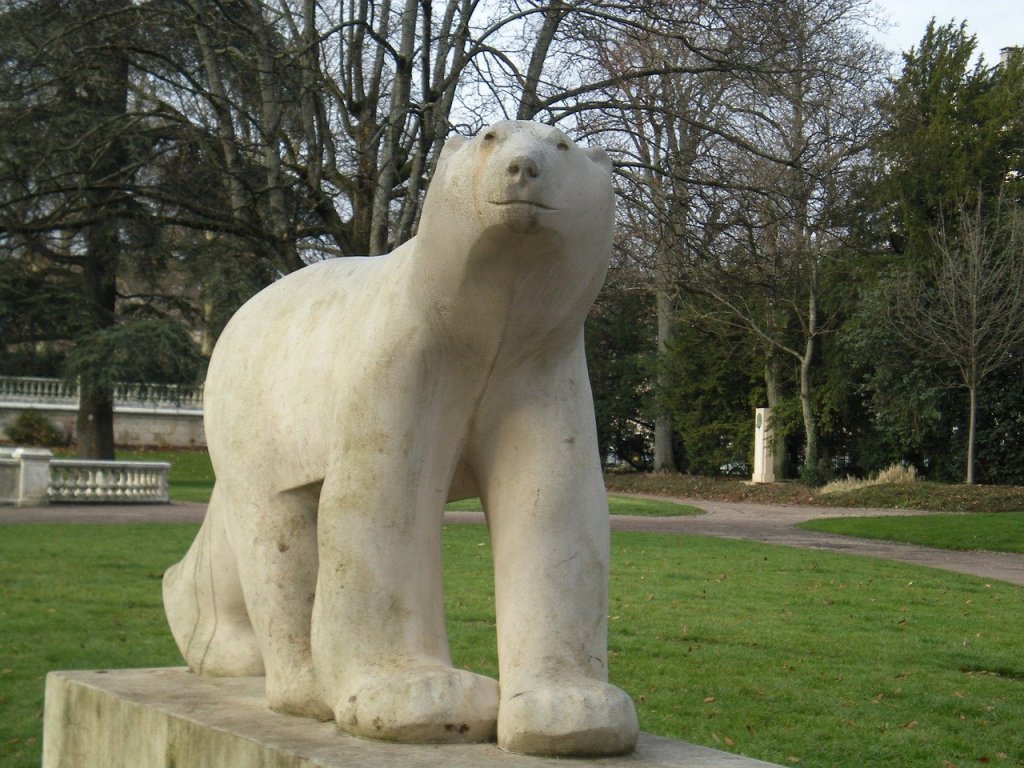
Dijon Statues: Warrior by Marabu. Bear Statue by Galletbea, both Pixabay
Dijon is one of those perfect places that offers food for the soul as well as the body, a compact, accessible town right in the rich heart of the major vineyards of Beaune, Chablis, Macon, and Fleury. Kir is the drink associated with the town, a drink composed of the blackcurrant liqueur Cassis and white wine (purists insist on a Sancerre) and available at any bar and restaurant. The ultimate though, is the Kir Royale, the same Cassis but this time served with the sparkling white wine of Burgundy, a Cremant which many people prefer to champagne.
Cellar entrance at one of the Vineyards in the region
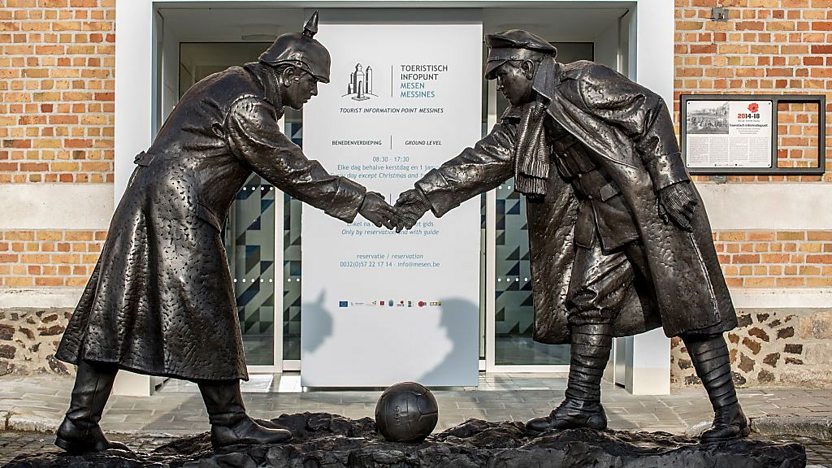
This should have gone up on Christmas Day but I didn’t schedule it for the correct date. Better late than never, this iconic statue surely needs no explanation. Not my photograph, unfortunately, but it’s one most people will understand.
In Memory of the Football Match between enemies on Christmas Day, 1914