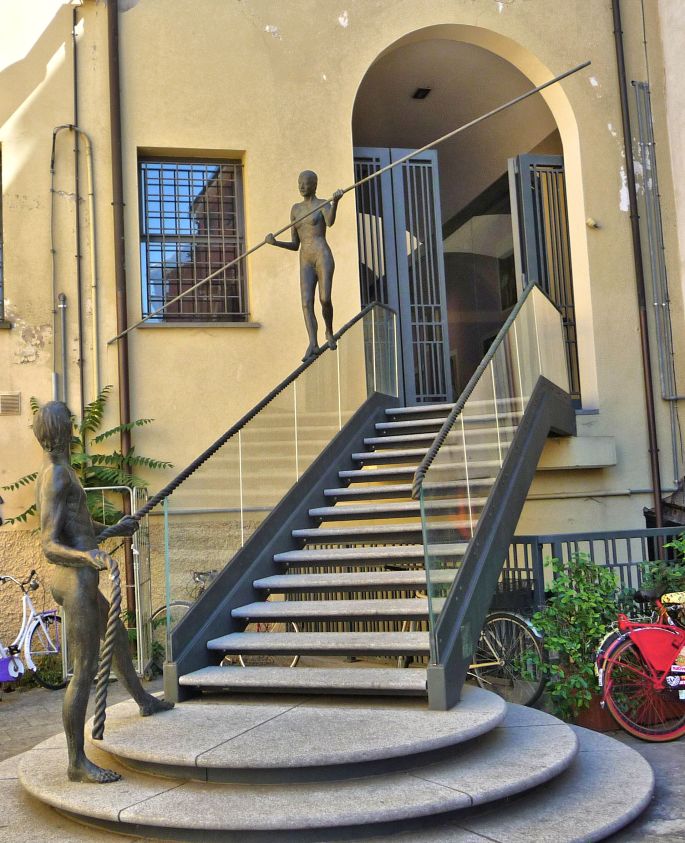
This unusual pairing of bronzes is Gli Equilibristi by sculptor Leonardo Lucchi. I took the photograph with a cheap throwaway instant camera in Cesena, Emilio Romagno in Italy, two years ago but unfortunately, my notes did not survive the trip (not a good one from the point of view of losing stuff).
Gli Equilibristi de Leonardo Lucchi
I stood before this amazing balancing figure with the corresponding male figure at the foot of the stairs for a long time, returning a few days later to try and get a better picture. I could never find a time when there were no bikes or cars or wheelbarrows parked in the space under the stairs and my efforts at removing them were not professional enough so I’ve left them in.
The sculptor lives and has his studio in Cesena, a town I an keen to return to as I only had a few hours there over two days and I wasn’t able to explore enough. Lucchi’s work is so energetic, his figures depict strong movement and I just have to see some more. If you’d like to see some more of his work, check out his website below:
It was featured in the classic 1969 film, Easy Rider, and one of the over 700 tombs there has been reserved by actor Nicholas Cage as his final resting place. Founded in 1789 the cemetery houses over 100,000 deceased, including the grave of Voodoo Queen Marie Laveau.
It was the first cemetery in New Orleans designed for above ground burial and it is claimed that it was modelled after Paris’s famous Père-Lachaise cemetery but as Père-Lachaise wasn’t used as a cemetery until 1804, that seems a bit fanciful. Also there is a significant difference in that in the Paris cemetery the bodies are usually placed in vaults in the floors of the tombs but in New Orleans the bodies are placed inside the walls of the tombs. Because of the subtropical climate, the tomb then effectively becomes an oven, the intensity of the heat causes the body to decompose in a process similar to a slow cremation and within a year only the bones are left.
This allows the tombs in New Orleans cemeteries to be used again and again. Depending on the family’s needs, after about a year the bones of the departed are swept into an opening in the floor of the tomb, now ready for its next occupant or occupants, as it is common practice to bury all the members of a family in the same tomb.
Clive Staples Lewis (known as Jack), the author of The Chronicles of Narnia, was born in Belfast on November 29th, 1898 to the comfortably off Albert James and Flora Augusta Hamilton. He grew up happily in a house called Little Lea, a house that is generally credited as the one from which he derived the inspiration for the stories which have given pleasure to so many people. It was a large, gabled house overlooking the River Lagan, with dark, narrow passages and a library that was crammed with books including two of his favourites, Treasure Island by Robert Louis Stevenson and The Secret Garden by Frances Hodgson Burnett.
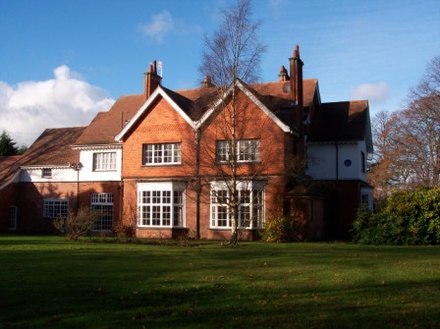
Little Lea (photo Wikkiwand)
During the second world war many London evacuee children were sent to live in Belfast’s supposedly fresh country air to avoid the bombing and the air-raids (despite the fact that the Northern Ireland capital was also subject to severe bombing). Like the Pevensie children in The Lion, the Witch and the Wardrobe, several groups of children stayed with Lewis at his country home and they played with Jack and his brother in the large overgrown garden in a Northern Ireland not then plagued by bitter civil strife, although there were always tensions.
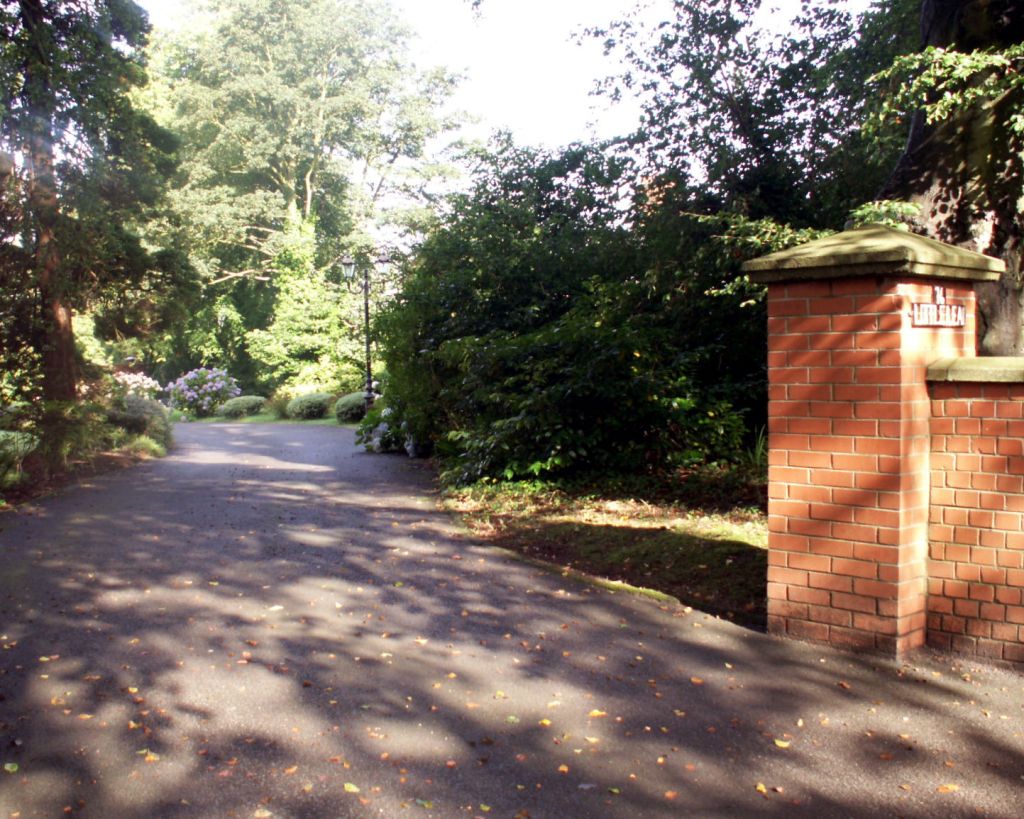
Entrance to Little Lea – photo Mari Nicholson
The first Narnia book was published in 1950, since when they have sold more than 100 million copies and been translated into over 30 languages, opening up a world of magic to children who have lapped up the stories of the mythical world found behind the wardrobe.
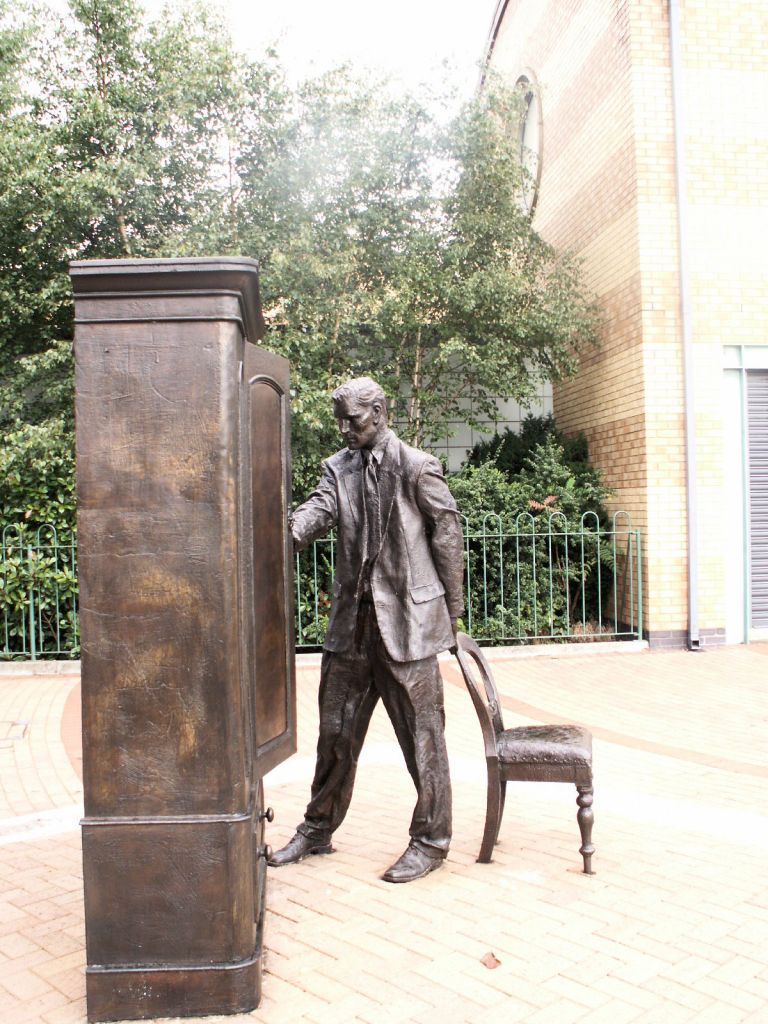
Bronze Statue by Ross Wilson in Belfast – photo Mari Nicholson
As a child, C. S. Lewis constanrtly made up stories about a place he called “Animal-Land“, a land inhabited by animals, mice and rabbits who rode out to kill cats. These stories he related to his brother as they sat among the coats in their grandfather’s old wardrobe. He even created detailed maps of the fantasy world.
The Narnia story
By chance, four young children from wartime England discover a magic land called Narnia, lying beyond and through an ordinary wardrobe. Once through the wardrobe and into the mythical land, Edmund, one of the children, betrays his siblings to a wicked witch who has been holding the world of Narnia in thrall to winter. Spring can only come to Narnia and the betrayal be forgiven when the lion, Aslan, agrees to die at the witch’s hand.
Little Lea, C.S. Lewis’s home in Belfast
Looking around the area in which he grew up, it is not hard to believe that his surroundings inspired the mythical land of Narnia. The craggy, heather-draped Mourne Mountains just a few miles away, Belfast’s own Black Mountain, and the lakes, rivers, forests and ruined castles with which the area abounds played their part as sure as the tales of hobgoblins and giants from Irish folklore and the Norse sagas which were, apparently, Lewis’s favourite reading.
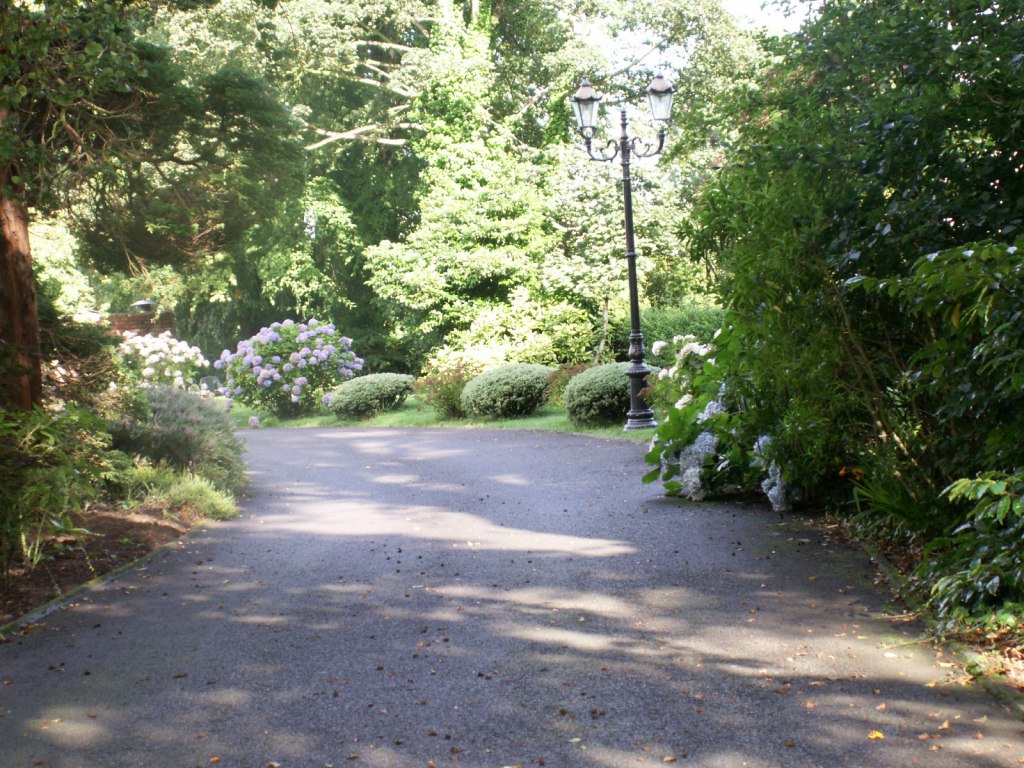
The Drive at Little Lea – photo Mari Nicholson
CS Lewis spent his childhood holidays in Rostrevor, a small seaside town about 50 miles from Belfast which faces across the Lough to Carlingford in the Republic of Ireland. In one of his letters to his brother Lewis wrote that the mountains that loom above it (the Mournes) made him feel “that at any moment a giant might raise its head over the next ridge”.
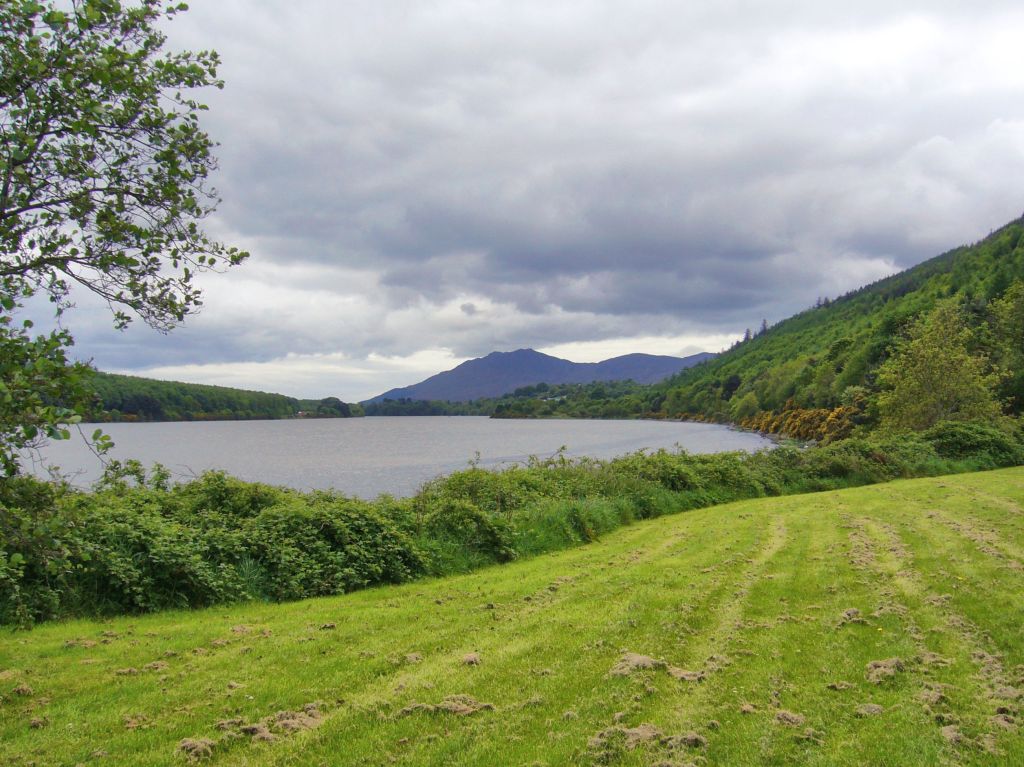
Looking towards the Mournes from Warrenpoint
At Kilbroney Park in Rostrevor, a Narnia trail will bring you into the world of Lewis’s chronicles., meeting Tree People and beavers along the way. The walk starts and finishes within Kilbroney Park and the trail is entered, like the magical world of Narnia itself, through a ‘Wardrobe Door’ and along the way you’ll find features like Tree People, The Lamp Post, The Beaver’s House and Aslan’s Table.
Enter at your peril though, as the curse of the White Witch lies upon the land. It is always winter and Christmas never comes and you run the risk of being turned into stone especially if you eat the forbidden sweets.
If there is time and if you are fit, climb the mountain to Cloughmore (trans. big stone) the granite boulder that stands 1,000 metres above Rostrevor – a perfect model for Aslan’s altar – where the final chapters of The Lion, the Witch and the Wardrobe come to life. With a little suspension of disbelief you can imagine the creatures that worship there – the Well Women, centaurs and unicorns – and, of course, the great Aslan.
Before you go. The jury is still out on some of the places that inspired Narnia but the 17th century Dunluce Castle on the Antrim Coast is believed to be the basis for Cair Paravel, the royal fortress in Narnia.
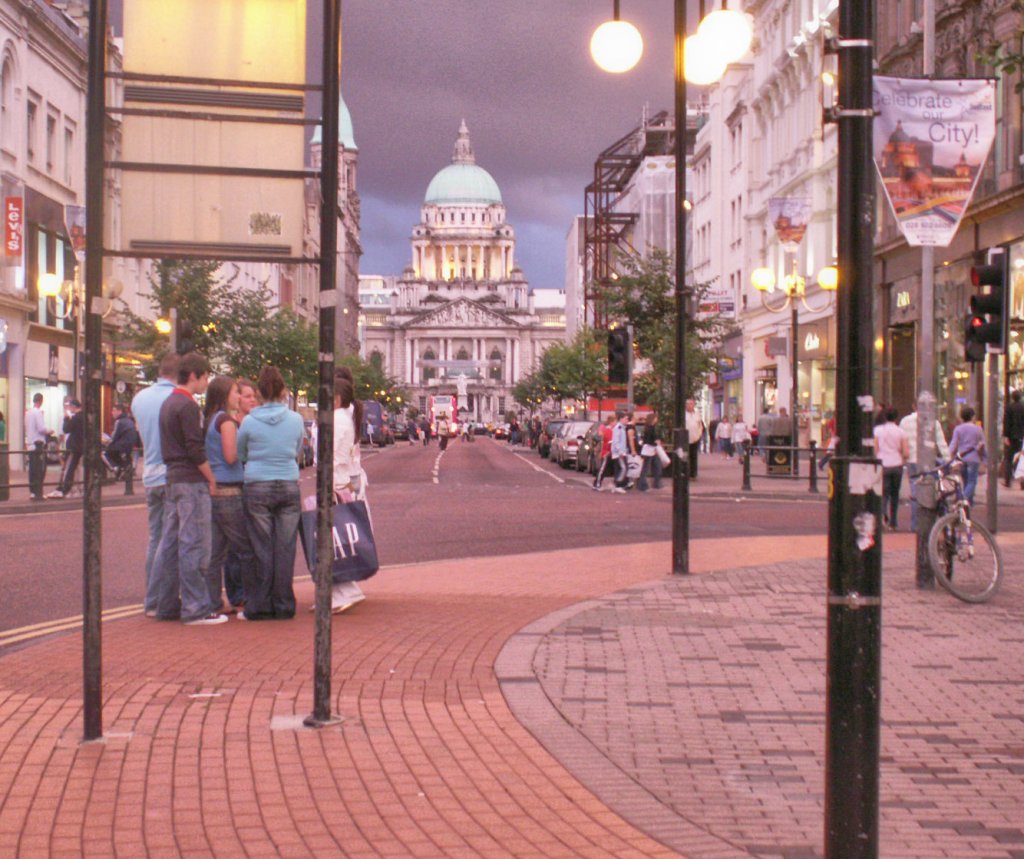
Belfast at dusk – photo Mari Nichiolson
NOTES; Unfortunately, it is not permitted to enter Little Lea, Lewis’s former home, as the house is privately owned but fans of the book seem satisfied to stand outside and gaze at the one-time family home.
Any tour of Lewis’s Belfast must encompass the magnificent bronze of The Wardrobe (called “The Searcher”) by Ross Wilson which has been erected in central Belfast and the many murals on Belfast’s walls which refer to the man and his work. However, Belfast today is one of the most vibrant cities in Europe and murals are changing rapidly. CS Lewis wouldn’t recognise today’s Belfast were he to return, from the magnificent Waterfront Concert Halls and Visitor Attractions to the Titanic Museum, but he would recognise that the soul of the city is still intact.
A private taxi tour is an excellent way of seeing the area and the Belfast Tourist Board will be happy to advise on this.
Statue of Jimi Hendrix in Freshwater, Isle of Wight.
The Isle of Wight Festival had rightly taken its place at the pinnacle of music festivals by 1970. On this small island off the south coast of the UK the August 1970 event welcomed over more than 600,000 people to tune in and freak out. It caused an uproar on what was, until then, a sedate holiday resort and divided opinion on the island like nothing before or since. Letters to The Telegraph and The Times (mostly from people who weren’t there) fuelled the debate and there was a definite sense that this was the end, or the beginning, of something. Along with Bob Dylan, Joan Baez, Joni Mitchell, Donovan, Jethro Tull, Miles Davis, The Doors, The Who, The Moody Blues, Procol Harum and more, they rocked the island. A weekend ticket would have set you back £3: in comparison, next year’s prices run from £264 to £362 per adult for the weekend.
Just a few days later, Jimi Hendrix died from a drug overdose.
Tales from the Vienna Woods by Johann Srauss was playing in the background as I worked and my thoughts drifted to the trip I’d had a few years ago through that lovely green space outside Vienna, designated a Biosphere Reserve by UNESCO. The Woods are not as portrayed in the two films I’ve seen: rather than trees and birdsong, it is more like rolling lawns and parkland, but it is, indisputably green, and I know there are copses or woods around if I’d had more time to explore.
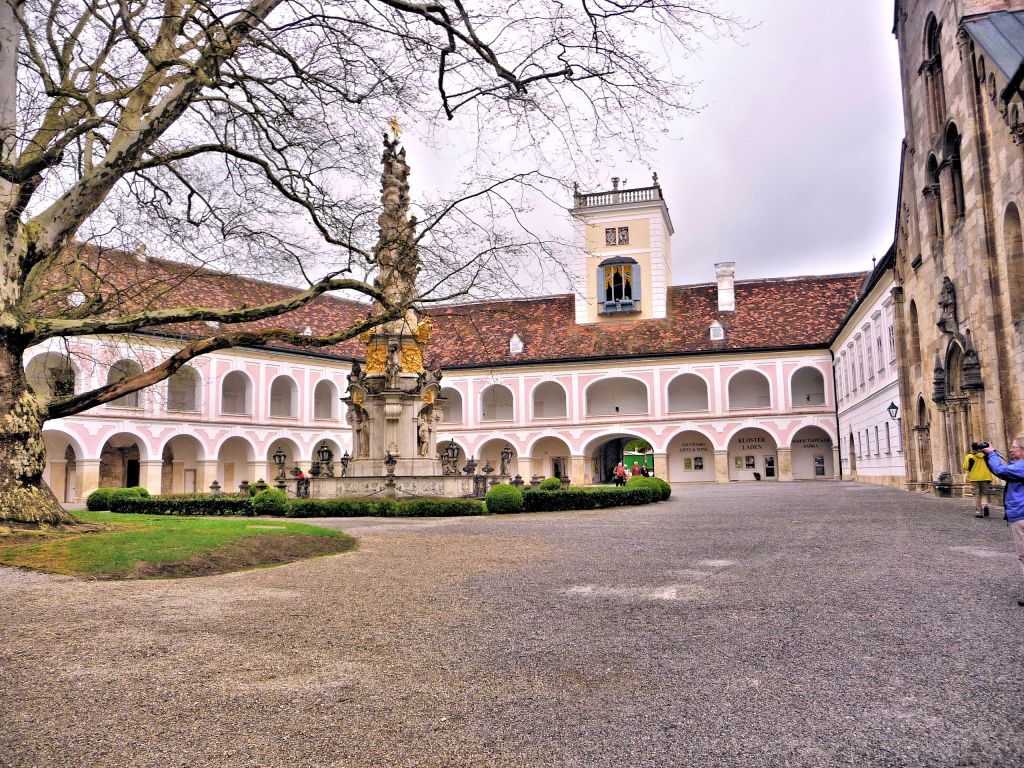
If you are not self-driving, the tours can be recommended. The Vienna Woods tour includes visits to Heiligernkreuz Abbey, a Cistercian monastery founded in the 12th century, and Mayerling Hunting Lodge where Crown Prince Rudolph committed joint suicide with his fiancee. These are followed by a choice of the picturesque town of Baden, or a visit to Seegrotte, the largest underground lake in Europe.
Mayerling from the road, the Plaque commemorating the suicides, the Monastery
I opted for the latter, knowing only that it was a lake so big that the trip actually incorporated a cruise on its waters. The lake is in Hinterbrühl, a 6,000-year-old town a mere 27 kl from the centre of Vienna and we were told that during WWll the Nazis built fighter planes there in the old underground gypsum mine that dates back to 1848.
And what a contrast to the magic of the Vienna Woods that was.
Old picture of fuselage taken from stills at Seegrotte
In a blasting accident in 1912, miners accidentally broke through some rock on the lower level (of 3) and 20 million litres of water flooded in creating the lake. The mine was then closed and forgotten about until sometime in the 1930’s when the huge lake, 66,240 square foot and four feet deep on the lower floor of the mine was re-discovered and opened as a tourist attraction.
We entered the mine through a 230m narrow, brick-lined passage and from there into a small room where our guide pointed out the broken fuselage of a jet fighter along the side of a wall: this was the HE162, the first jet fighter developed by the Nazis towards the end of the war – and the one Hitler thought would win it for him.
When the HeinkelWerke took over in 1944 and began manufacuring, they used labour from the nearby sub-camp of the Mauthausen concentration camp. From this camp 1800 slave laborers, primarily from Poland and Russia, were drafted in to build a secret underground factory in the mine. After pumping the water out of the lower floor the slave labourers, along with 300 other skilled workers, began producing fuselages for the He-162 fighter jet.
During late autumn 1944 and spring 1945, they built sub-assemblies and BMW 003 turbojet engines for the He162 – the People’s Fighter (Volksjäger) – an extremely fast plane, cheap enough to be discarded if it suffered any damage. Other factories were also making parts for the jet, sending them to Hinterbruhl for final assembly and onward shipment to airbases.
I wondered how many underground factories the Nazis had during WWll because this one, Seegrotte, reminded me very much of the one on the Channel Island of Jersey which I’d visited a few years ago, right down to the misuse of the prisoners working there.
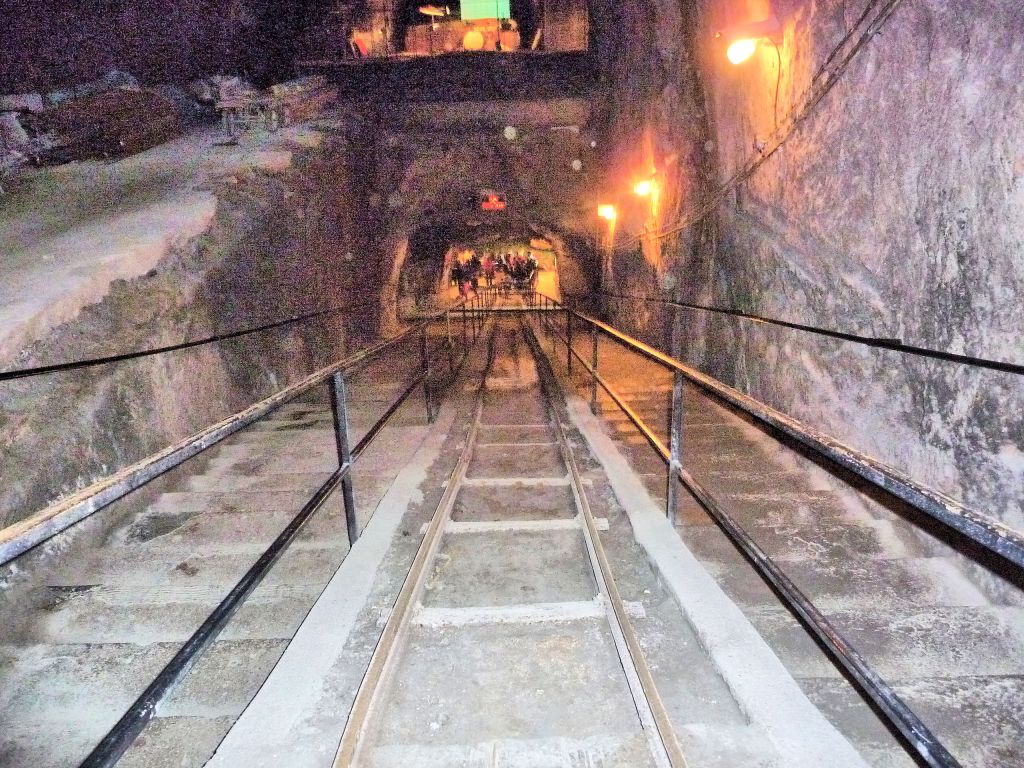
It wasn’t all about the fuselage factory though: we learned something about the original miners and their work in the 19th century. The original railway tracks on which the horse-drawn wagons moved the goods, still run along the floor. We were introduced to the life of the miners as the guide pointed out the niches in the walls displaying models of the horses, artifacts and tools which gave an idea of the mining techniques and of the life they led in those days.
Artefacts used in the old days of the mines, Plaque to those who died, and the old railway tracks
We passed stables that once housed up to 25 horses, horses intentionally blinded before they worked the mines to make them easier to control in the dark bowels of the earth. The shock of the blinding of the horses was followed by tales of more brutality. Of the more than 2,000 slave labourers and others from nearby concentration camps who worked in these damp, dark caves, only a few survived.
From further research carried out on my return home and some information I gleaned at the Third Man Museum in Vienna I learned that in the last months of the war, the remaining inmates were forced on a 200 km-long march to Mauthausen concentration camp. Many of these were Austrian Jewish citizens and 51 of them were killed by the SS with gasoline injections before the march began. Few of the remainder survived.
The 18th century miners had a particular devotion to St. Barbara and we were shown a large room with candles and a religious icon, one of several Catholic shrines to the saint within the mine. The Vienna Boys Choir occasionally sings there and apparently up to 2,000 people attend the concert (by coincidence about the same number as that of the prisoners who worked in the mine). A monument honouring the massacred men was erected in 1998 and has a place near the Saint Barbara shrine. The Holocaust Memorial on the former site of the concentration camp marks the site of the mass grave of these 51 slave labourers executed by the Nazis.*
Plaque to those who died working in the mines
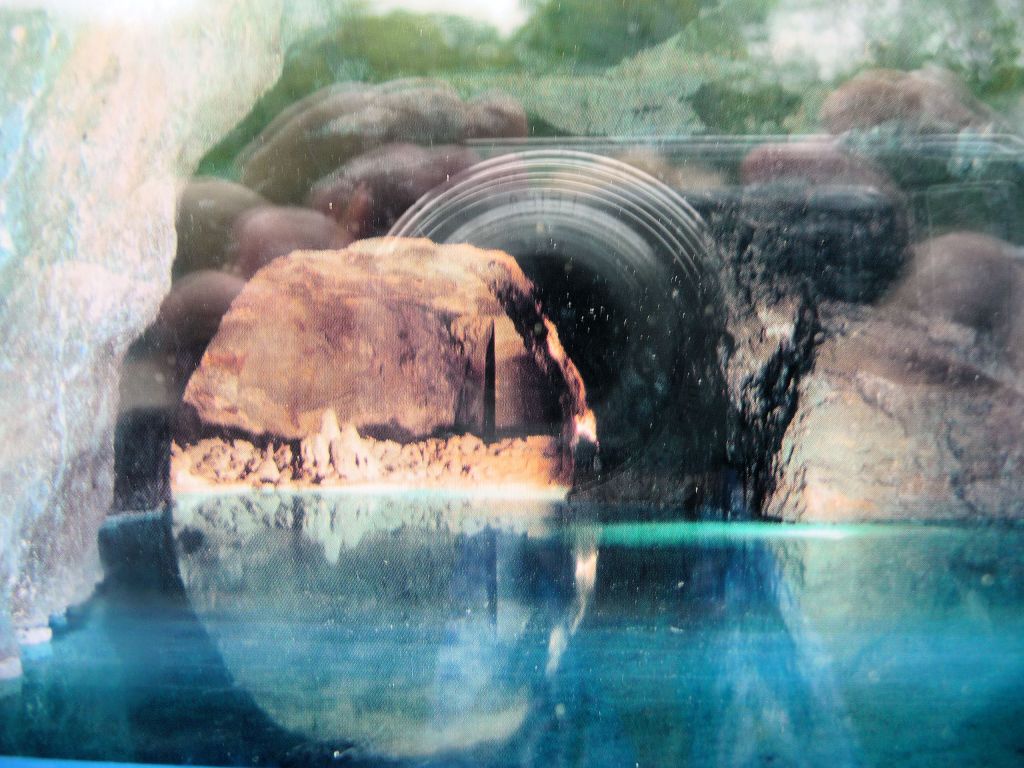
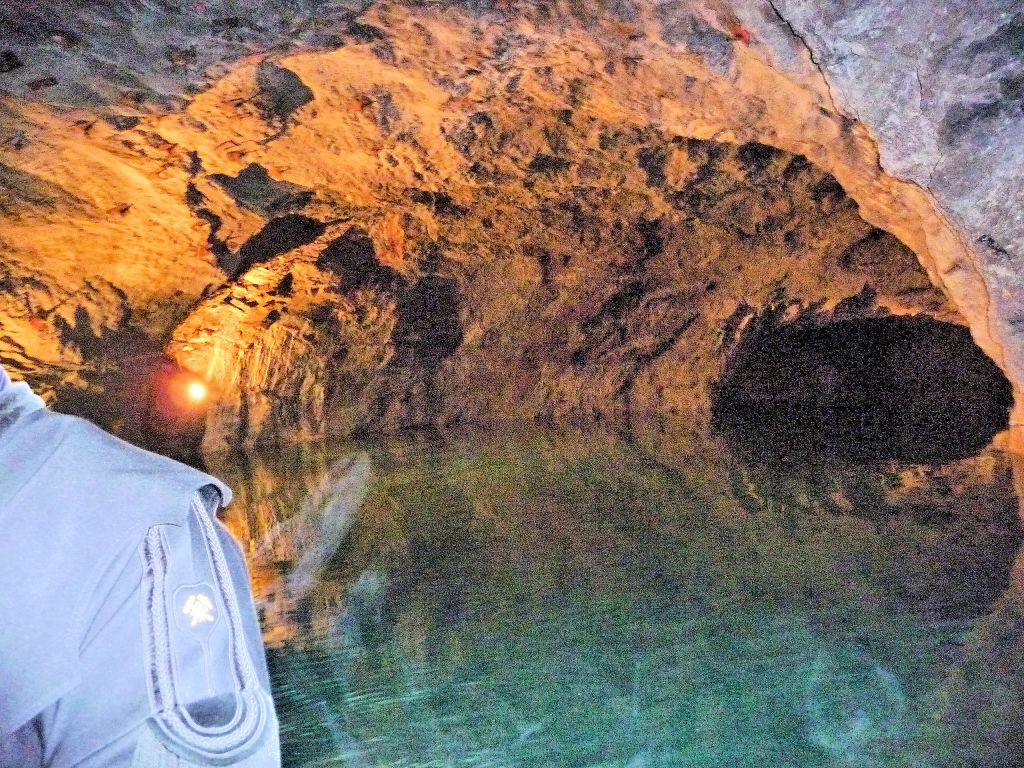
I almost forgot. The main reason for visiting this cave, the Seegrotte, was to take the trip on the lake on which was anchored the golden dragon boat used in the 1993 “Three Musketeers” movie which was shot here. We took the 20 minute glide across the Lake (but not in the Three Musketeers boat much to the disappointment of one little boy) lit by the soft glow of the cave lamps as the guide pointed out the wall through which the water had come back in 1912, and answered a few innocuous questions. The lake is placid and pure and we drifted in and out of ‘rooms’, skirting overhanging roofs, lulled by the silence and the magic that caves and water always produce.
The stories I’d just learned took something away from the trip. I think it’s probably an age thing as no one else seemed at all put out by it. Although it was enjoyable, I just felt it was a long way away from Tales from the Vienna Woods birdsong and waltzes. It certainly dispelled the sweetness of the Strudl and Strauss I’d been indulging in over the past three days.
Postscript: The mine closed in Spring 1945 by which time the Nazi prison workers had produced 198 fuselages which had been sent to the Vienna International Airport in Schwechat to be assembled. As WW2 came to an end, the Nazis tried to destroy the entire underground factory but they only managed to destroy the water removal pumps. Without the water being pumped out the mine quickly flooded again.
In Spring 1949, it reopened to the public as Seegrotte, the boat trips started then and continue to this day as a major attraction in the Vienna Woods.
* The WW2 holocaust memorial is located on Johannesstrasse, a few blocks from the Seegrotte.
Silent, if you ignored the scoldings of the howler monkeys from the river banks, the splash of nutrias as they slipped into the river and the background clicks of cicadas, but these noises being way outside normality for me, I took it for silence.
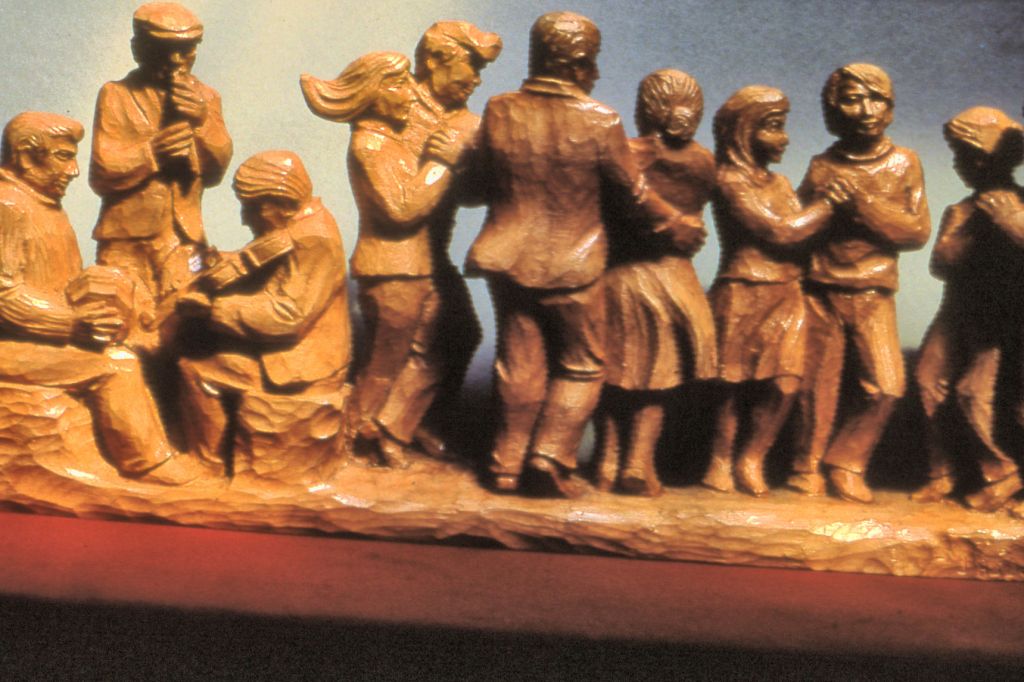
The Irish wood-carver John Haugh is not much known outside his own country but he has exhibited and sold many works in the USA. I was privileged to interview him many years ago and this sculpture “Dancing at the Crossroads” is one of my favourites of the many I saw in his studio in Carlingford, Co. Louth.
Dancing at the Crossroads by John Haugh
I especially liked the roughness of the carving which lends the work a rustic quality in keeping with the subject. This particular work dates to sometime in the late 1990’s











 MARI'S TRAVELS WITH HER CAMERA