This sculpture of a sleeping child is said to symbolize Norwegian optimism, survivability, and future life.
The design incorporates a separate pedestal, a rock from Hiroshima’s ground zero given earlier to Narvik by the mayor of Hiroshima. One of three peace sculptures in Narvik it was dedicated in 1956, 1995 and 2006 to remember the atomic bomb that was dropped on Hiroshima.
I should have blogged ages ago about my June trip to Portugal but eye problems meant that computer work was frustrating. Then a couple of weeks ago I went on a Fjord cruise with a friend, despite not being a lover of cruising, mainly because it left from my local port of Southampton. The cruise was similar to a summer one I’d done a few years ago, but this autumn/winter one promised different views of Norway’s fjords.
The tranquillity of the fjords
To mark my return to blogging, I thought I’d start, not with Portugal, but with Norway, and not with the cruise, but with my time on land and one of the delightful towns we visited.
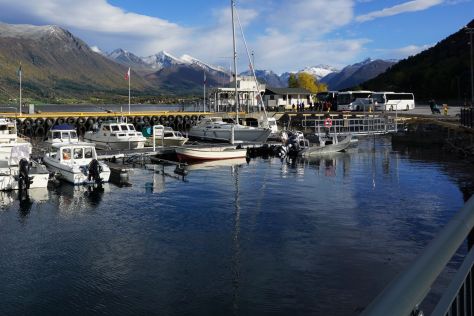
Andalsnes Harbour with Mountaineering Centre in foregroundSmall marina in Andalsnes
First up was the beautiful Romsdalsfjord and the town of Åndalsnes, located beneath towering snow-topped mountains at the mouth of the Rauma River. Its privileged position has made this Norway’s mountaineering capital, a centre for hiking, trekking and all season climbing in the impressive mountains that surround it, Romsdalshornet, Trolltinden and Vengetindan.
Early morning entry into Andslesnes
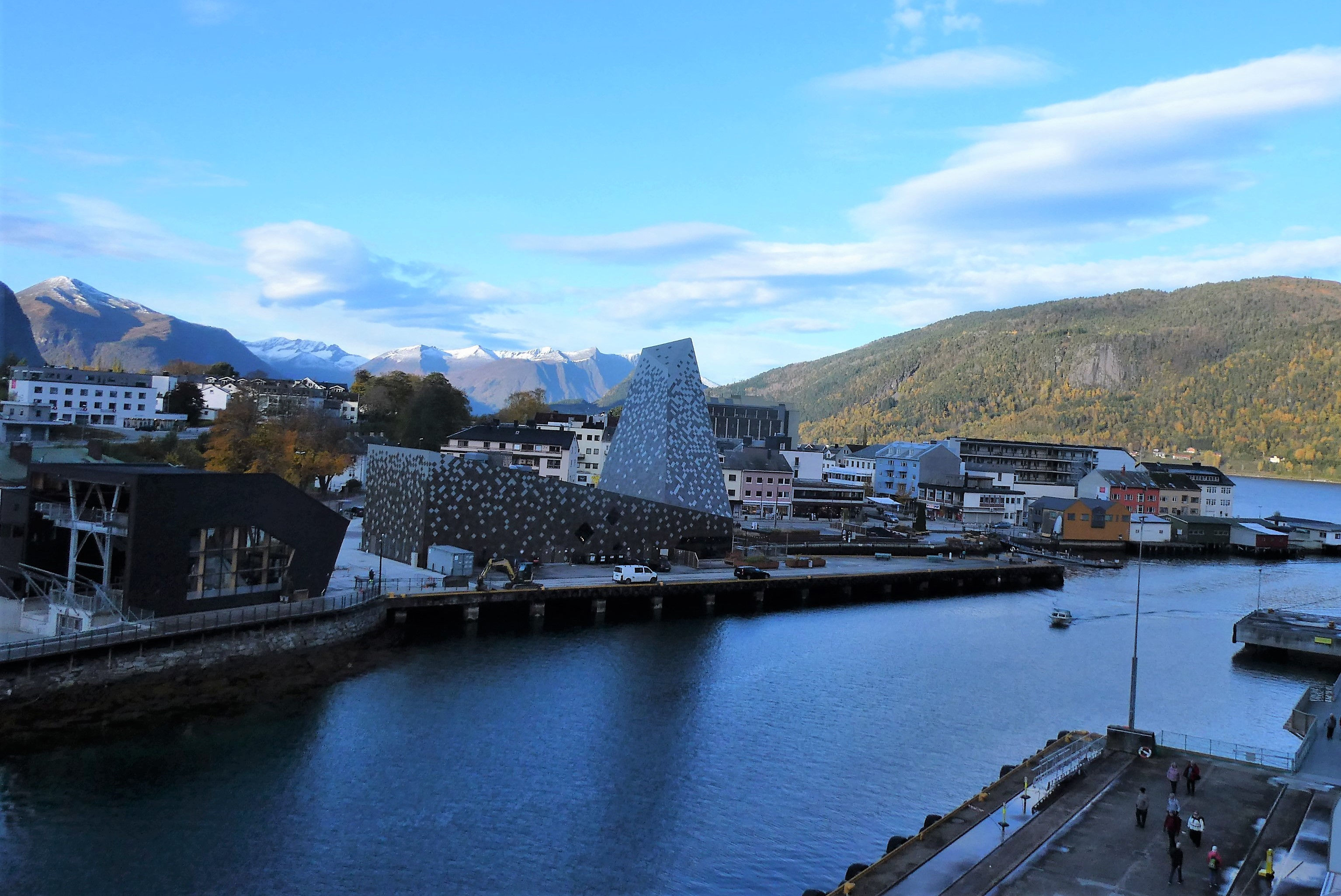
Entering the town in the early morning I was struck by its small size, it looked more like a village than a town, neat little white houses clustered around a small harbour (but a deep one that can accommodate large cruise ships which bring tourists all year round) hemmed in by snow-capped mountains.
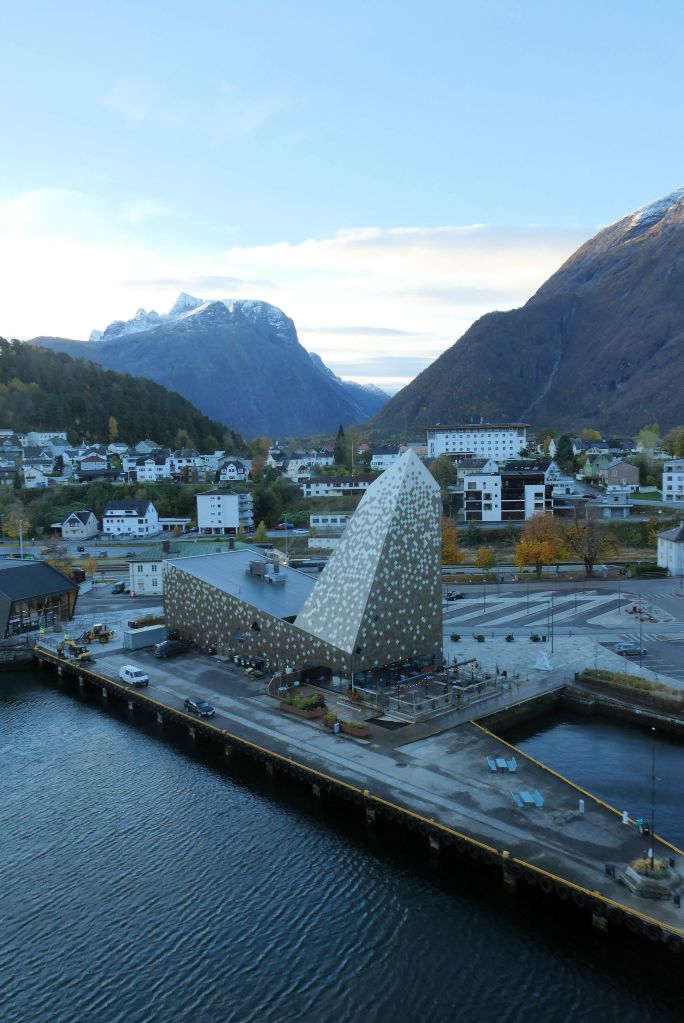
Town view with Mountaineering Centre
Looming up from the middle of the town was a building of such modernity that one immediately knew that this was no ordinary town: anywhere that had such an outstanding piece of architecture just had to have a lot going for it.
As the sky gradually lightened, I became aware of movement above the town and noticed gondolas travelling to a nearby mountain from a dark garage-like building beside the modern one. Things were looking better and better.
Gondola House (Black building)Mountaineering Centre
The very modern building turned out to be the Museum and Mountaineering Centre, something of which the town is very proud, understandably so, as not only is it a design of total modernity but it has Norway’s tallest indoor climbing wall, it offers various activities, and the full mountaineering history of the region is on display . If you want to get fit, or just to ensure you are adequately prepared for the hike ahead, you could try the 210-metre challenge, or any one of a number of the challenging climbs that are available there. People come from all over Scandinavia come here just to use this climbing wall.
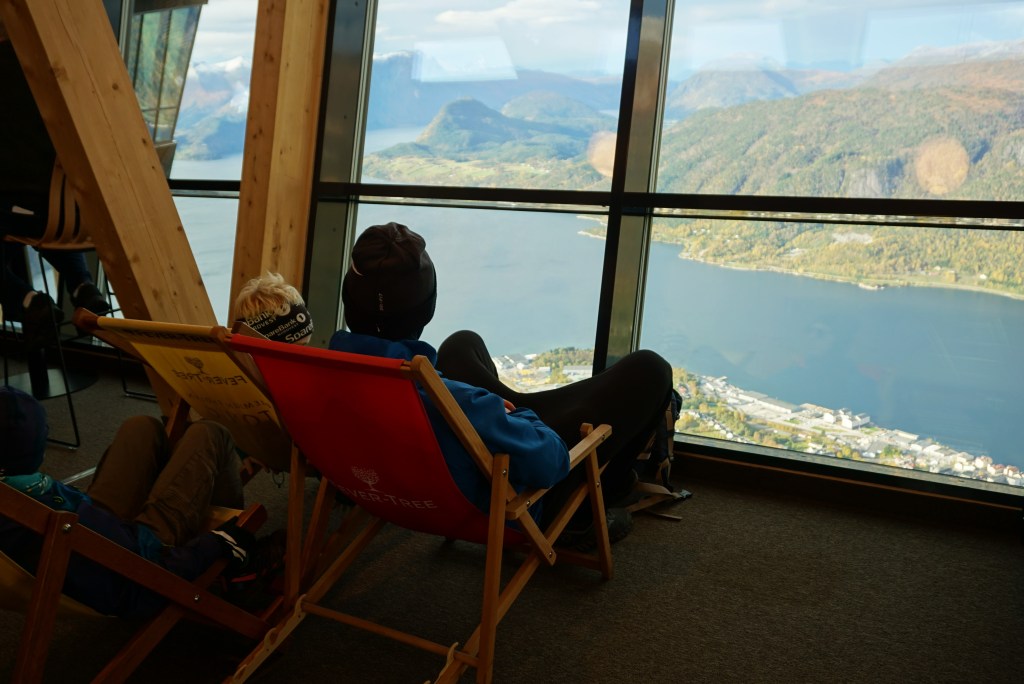
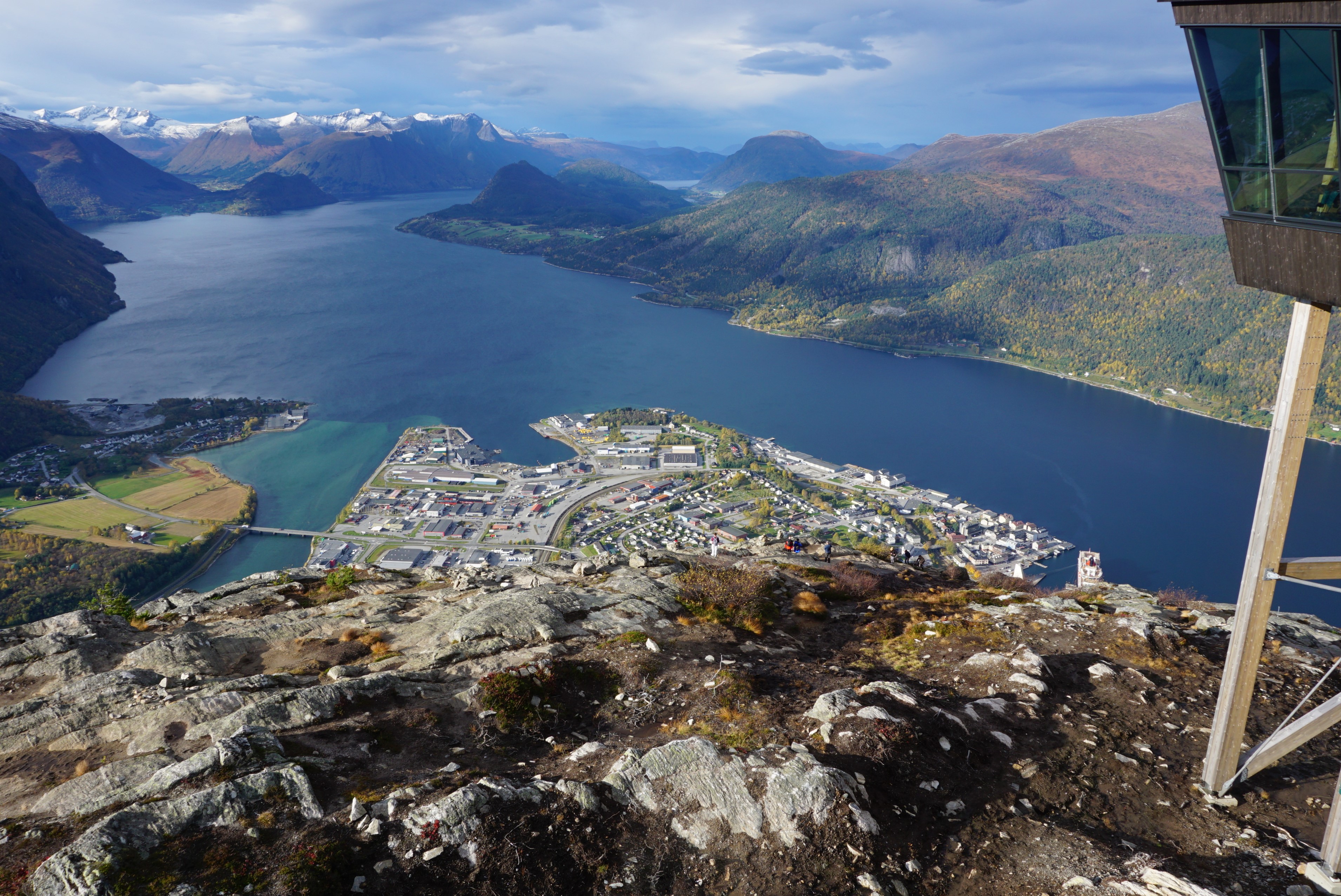
But if you’re not into climbing, or like me, not into that type of physical activity, there’s the Romsdalen Gondola right next door which will take you all the way up to the top of Nesaksla’s summit where you can walk around the top and look with delight at the magnificent scenery all around you: or climb further up to gaze on even more fantastic views of rivers, lakes, snowy mountains and tiny figures climbing up the mountain below. On the summit, the Eggon restaurant awaits with great coffee and freshly cooked Norwegian food sourced locally.
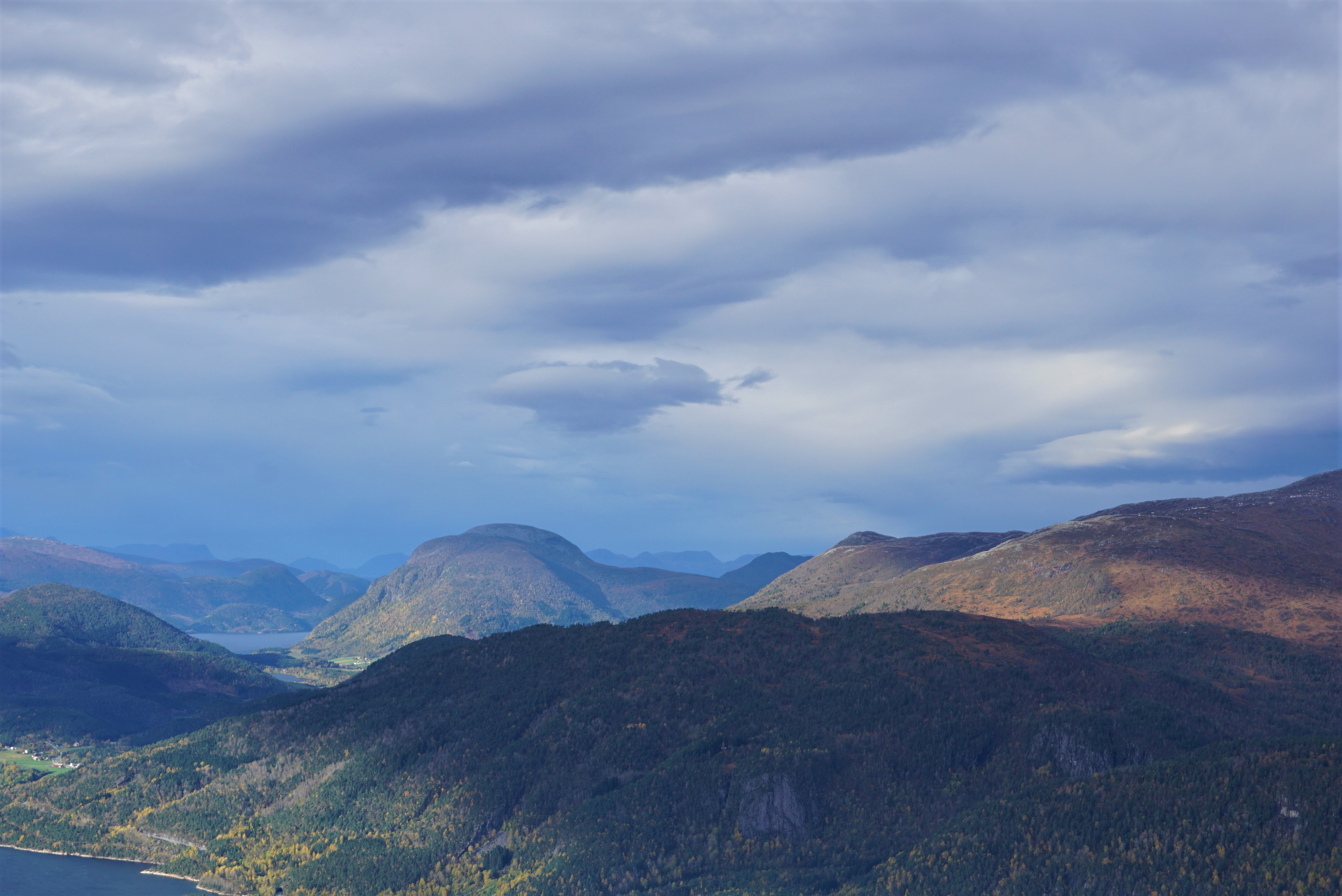
I choose the latter and spent a wonderful day just pottering on top of the mountain and watching the hikers struggle up and down the rocky face of the ridge opposite. Below were lakes, rivers and the town of Andalsnes itself, and what seemed little pockets of cultivated ground. The weather changed hourly it seemed, and went from dark and stormy to incredibly bright and sunny – but it was always cold.
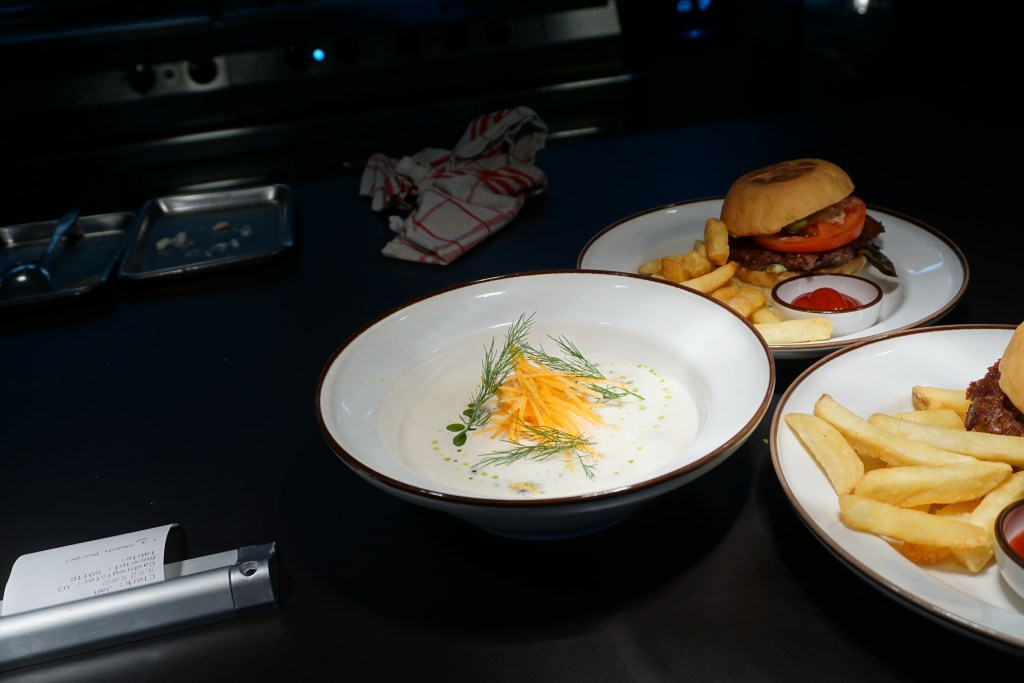
That’s where the wonderful mountaintop restaurant came into its own with nourishing food, great coffee and a selection of cakes to die for. I’m talking saucer-sized pancakes with hot sour cherries topped with whipped cream and chocolaty things that I just had to refuse or I wouldn’t have made it down the mountain again.
I could have headed for the Romsdakstraooa steps and climbed all the way to the top of Mount Nesaksla, 708 metres above Romsdalsfjord, for the same scenic views but although I love snowy mountain tops and awesome views, I gave this one a miss as I’m well past my mountain-climbing days!
Andalsnes is buzzing both summer and winter. It’s a perfect base camp for anything from mountain hiking to summit hikes, long treks with stunning vistas of the Romsdalsfjlla mountain ridge, or leisurely car, coach or train journeys through some of the most wonderful scenery you will ever see.
The town is a transport hub, being the final stop on the Rauma Railway which offers a scenic two-hour journey considered to be one of Europe’s most beautiful train journeys (Lonely Planet, 2022). It follows the course of the Rauma River as it descends into Lake Lesjaskog along which it forms many magnificent waterfalls, travels through lush valleys and mountains and crossing over the famous, natural stone Kylling Bridge with a dramatic view of the foaming river below.
That’s enough to tempt me back: that and the sour cherries on pancakes with cream!
All photographs used in this blog are mine, apart from the two which I have credited to the respective photographers, and Visit Norway which gave me permission to use these images.
Next stop NARVIK, occupied by the Germans during WWll where there is a Museum devoted entirely to its place in that war.
I don’t know if the challenge is still going and I can’t seem to find a recent post from XingfuMama, but I thought I’d post this one anyway.
I’ve posted today on Southend-on-Sea but I didn’t include this picture in the piece as I thought it would be nicer as a stand alone picture. The seat in the picture is one on Southend-on-Sea Pier, the longest pleasure pier in the world at 1.34 miles.
The wrought iron detail is fascinating, covering as it does the Victorian/Edwardian era clothes, boating, building sandcastles, and the donkeys which were used to give rides on the sands. Not too comfortable on which to spend a long time, but pleasant enough for a short stop on the way to the end of the pier.
Once a place where Kiss-me-Quick hats were almost as obligatory as a fistful of ice-cream from the famous Rossi’s, Southend-on-Sea is now a City and looking to become a proper grown-up resort.
Sunday excursions to Southend-on-Sea by train were our big break from the workplace when I lived and worked in London way, way back , so when the opportunity came to experience a day out in that fondly remembered place, my one desire was to once again walk the 1.4 mile Pier.
Southend-0n-Sea PierAmusement Park by Southend Pier
There wasn’t time to do much more because we had to fight our way to the end of the pier in a gale blowing off the North Sea, a bad-weather day that kept most people off the Pier apart from a few fishermen and a few intrepid walkers. The train still runs down the pier and we caught it back to the town (I can’t get used to calling it a city when there is a beach and an amusement park in front of me) when the clouds really turned black.
From the town there is a lift to the esplanade (photo above) but for those who don’t mind a climb and some extra leg-work, the walk down the slope past cafes, shops and ice-cream parlours is quite pleasant or there is a way down incorporating steps and platforms.
The kiosks and entertainment spots I remembered on the Pier are no longer there, just a vast expanse of boardwalk leading you to the end. So, here are just a few photographs of the Pier at Southend-on-Sea on a rainy, windy, day, when some flashes of blue lit up the sky to make us think the weather was on the change but it wasn’t, it was just nature teasing us.
Fishing on PierSit Awhile and Smell the SeaView Towards the Town Once busy kiosksLifeboat Museum at end of PierLooking Across to the Kent coast from the end of the PierStorm cloudsTrain now Approaching…Train StandingTrain PlatformTrain in Background
And when you’ve taken it all in, the views to Southend, the views across to Grain Island and the Kent Coast and the grey waters of the North Sea, then head for the modern tea-rooms, or sit on the steps as many do to enjoy the last rays of the sun, on the end of the longest pleasure pier in the world.
Tearooms on Southend Pier
Some people say that the Blue Plaque to Laurel & Hardy, on the pier, says all you need to know about the place, but it’s got more, a lot more, going for it, not least great restaurants and lovely people.
We caught the train when we saw these clouds approaching!
Recommendation: I was lucky enough to be taken to a decades-run family restaurant noted for its seafood, and if you need a recommendation I can say without hesitation that I had one of my best meals, ever (middle skate with brown butter if you’re asking) at
Tomassi’s, 9 High Street, Southend-on-Sea SS1 1JE. Open daily until 7 pm. Phone 01702 435000
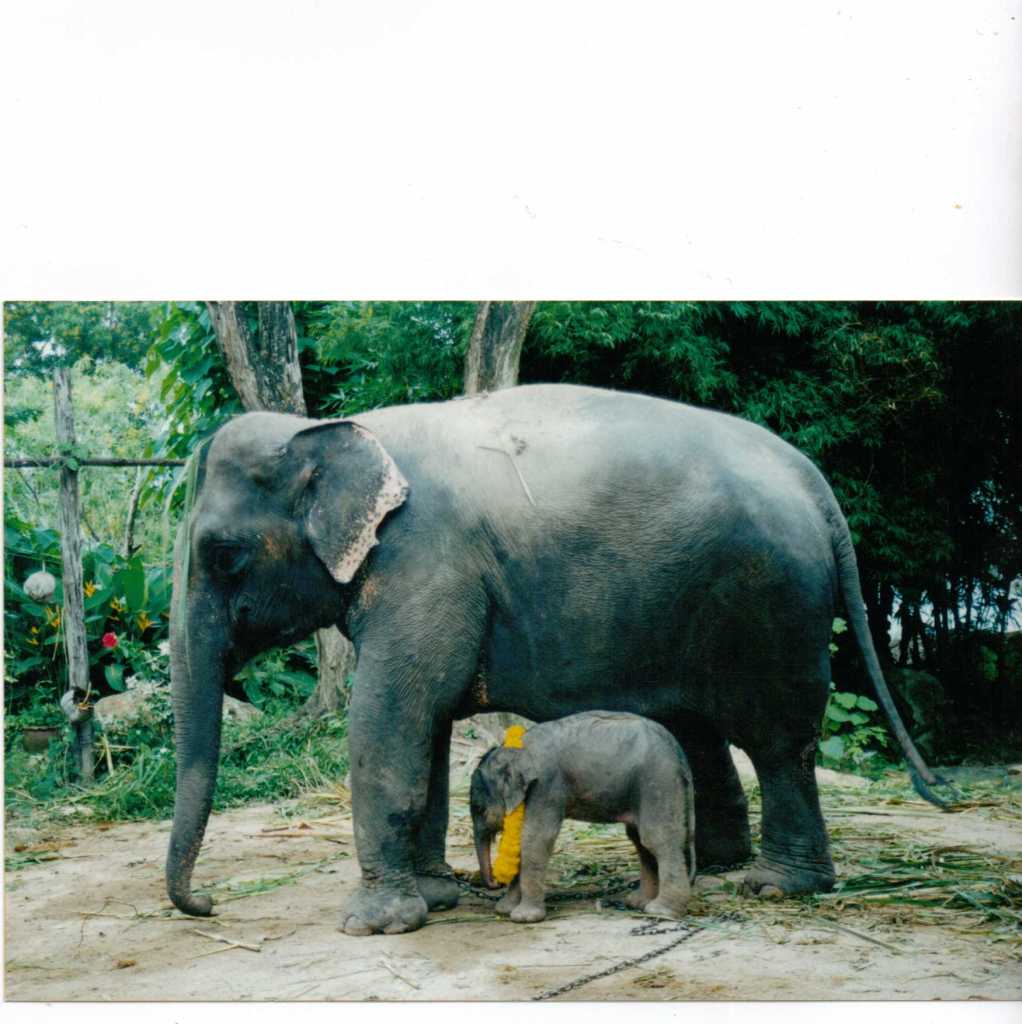
I was going to keep this one for mother’s day but I realised I’d forget all about it by next year so I thought it best to post it now.
It’s one I took when I was doing some work with the Elephant Help Clinic in Phuket many years ago. The baby elephant is wearing a lei because she’d just been blessed by the monks from the nearby temple.
I know this isn’t a site on which to post cartoons but this one just seems to apply to everyone and I thought it would make everyone smile on a day on which the news makes laughing or smiling increasingly more impossible.
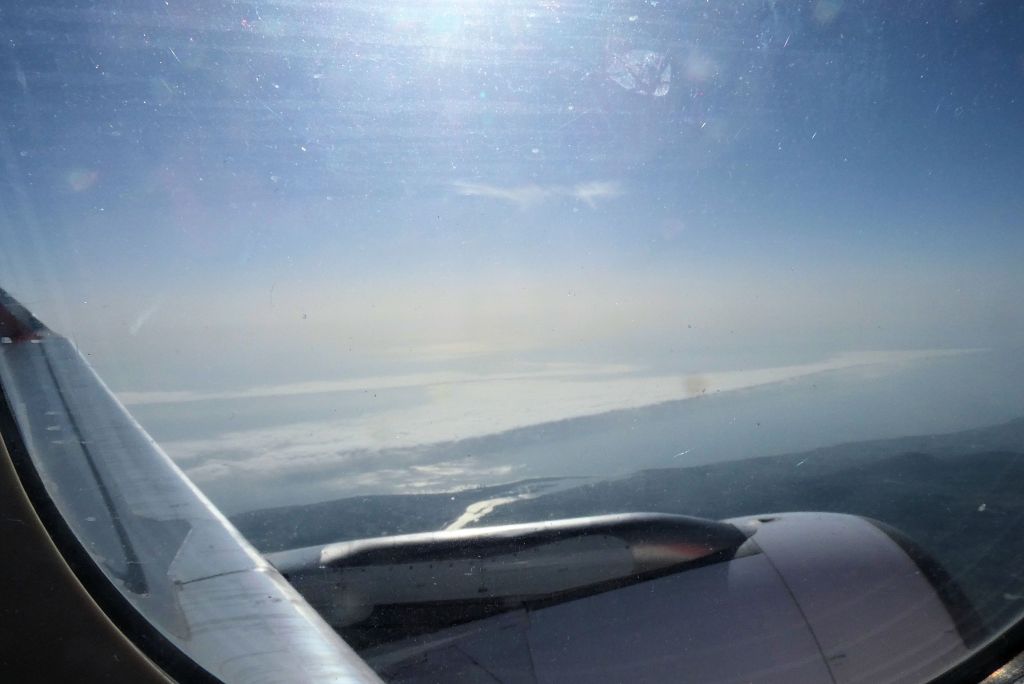
It was the last one on the card from my little Lumix, although not taken on the last day of the month. Taken as we flew out of Oporto Airport with TAP airlines a few weeks ago.
This picture is one I love because it captures, for me, a moment of total relaxation during a cargo ship cruise we took about 30 years ago. The ship was ‘The Author’, one of what I learned to call “the big whites”, boats of the South African Safmarine line.
Sunday was a big day for the crew when they had the brai, or barbeque, a tradition that was almost a religion for the South African crew on board. It was dress-down day when even the captain sported shorts and tee shirt, hair-cutting took place in quiet corners on the decks, and the crew relaxed in their ‘civvies’.
I was surprised that a barbeque was allowed on the deck, but I was assured all was perfectly safe. Eddie, the chef, had everyone’s favourite food ready, from salads to heavy carbs, fruits to exotic vegetables, and a fine selection of meats, fish and shellfish. As passenger we numbered only 7 but we had become friends with the crew over the course of our trip from Tilbury via northern Europe to South America. In fact we were their ‘shoppers’ as well, as some of the countries we stopped at would not allow the S.A. crew to disembark (political not racist) so we were given shopping lists when we disembarked – usually tee shirts for themselves and a gift for a Mum or a son or daughter.
I know this isn’t a good photograph, it’s blurry and lacks definition but it’s one of my all-time favourites because that holiday was one of the best ever and that evening sums it up so well. I must add here that I don’t go on cruises as floating hotels are not my cup of tea but a trip on a cargo-ship is a world apart.
On “The Author” we mixed with the crew as they went about their work during the day, and in the evening we socialised with them over drinks and dinner, played games in either their lounge or ours and swapped books and DVDs. Some evenings we lay on our backs on the deck and were taken through the star system by one of the crew, seen to its best away from the lights on land.
Thirty years after and I’m still in contact with one of the captains and two of the crew. It was an unforgettable holiday and I remember every minute of my time aboard “The Author”, Eddie’s great food, and the treats left in our cabin daily, from warm biscuits to gooey cake, the ever-changing menus due to the fresh produce he picked up at the different ports, and the tears and the hugs when we all said good-bye to some of the nicest people I’ve ever met.
Linked to Toonsarah who is hosting this week’s Lens Artists Challenge
It is with great trepidation that I sit down once more to enter one of the photographic challenges on the site, but I’ve been looking at various entries in different categories and especially Sarah’s today so here I am. I haven’t posted for a few months now but I have managed to dip in and out of the site and kept up with what’s been happening.
I said “with great trepidation” and I meant it, because after seeing some of the entries in today’s challenge and some of those from former weeks, I realize how far short of “artistic” my work falls. Being more interested in the words than the pictures I’ve never looked really closely at my images, or taken enough time to get them right.
Apologies over. Here are a few of my favourites, and I stress the word favourites as I can’t claim they are great!
This is one of the monuments to World War ll spotted along the coast of Normandy. I do like this picture mainly because of the sky, the clouds were wonderful on that day and seemed to change shape every few seconds so I was lucky to get them just when they looked especially good.
I didn’t get to know the Normandy coast well until a few years ago when, with a friend, I spent 10 days touring the area. I loved the horses trotting along the beach, their passengers snugly wrapped up in carriages behind them, the serious tourists with their maps and photographs of relatives who landed on these beaches during WWll, and the fact that the food in Normandy was as good as I remembered from many years back. And I loved the fact that the museums and monuments, cemeteries and commemorative parks are still there to tell the story of what happened in France between 1939-1945.
The Library of Celsus at Ephesus, Turkey
This is Ephesus in Turkey. It’s a print taken probably about 30 years ago and yes, it did win a prize.
I don’t think it’s a great image but I think it does show the magnificence of that place and when I look at it I can still remember my awe as we walked in and faced this extraordinary facade.
Ephesus was an ancient port city lying just 80 km from Izmir, and whose well-preserved ruins are in modern-day Turkey. Once considered the most important Greek city and the most important trading centre in the Mediterranean region, it survived multiple attacks and changed hands many times.
Today it is one of Turkey’s most significant ancient cities and it was added to the UNESCO World Heritage list in 2015.
Ephesus came to prominence under the ancient Greeks and became a city under the Romans in 133 BC and the capital of Asia Minor in 27 BC, seen as its historical turning point as it then became second in importance only to Rome.
Ephesus is also important from the point of view of Christian history in that St. Paul wrote his “First letter to the Corinthians” from here, St. John wrote his gospel here, and it is believed to be the final resting place of the Virgin Mary.
The facade of the library of Celsus which looms over the city and which you see above has been very carefully reconstructed from original pieces. It was originally built in 125 AD and Celsus is buried in a sarcophagus beneath it.
Apart from the facade of the library, there are many impressive ruins to see in Ephesus. Allow at least 4 hours to see it all, the amphitheatre (largest in the ancient world), the Odeon with its Corinthian-style pillars made of red granite, the 2nd century Temple of Hadrian, the aqueducts and the Agoras.
Sadly, Ephesus died, by reason of silt building up in the harbour to the point where no ships could reach the city. Without ships, trade died, and without trade the city died and was abandoned.
Torii Gate at Miyajima, Japan
I have so many Torii Gates in my files that the problem was picking out the one I like best but then the problem was, do I want one with a boat, with a beach, or set in a forest? In the end I decided on this misty morning scene.
I think everyone has seen images of Torii gates, the most famous of which is probably the above gate near Hiroshima, but there are many dotted around the seas, all calling out for a photograph.
A Torii gates represents the boundary between a sacred shrine and the human world. Once you pass through the torii gate you have entered the sacred, special space.
Originally Torii gates were white, but now they are mostly painted red because the colour symbolises vitality in Japan and it is believed red gives protection against evil. (It is also said that as red paint contains mercury, the gates are preserved for longer – practical as well as spiritual).
White was the original color of torii gates which were more common than red ones until the arrival of Buddhism in Japan. After the separation of Shinto and Buddhism was officially implemented in the mid-to-late 19th century, some shrines started to paint over their red torii gates with white again, but they are fewer in number than the red.
Although the most photographed appear to be those that are located in the waters, torii gates appear in many inland spots such as the base of famous mountains, or along forest routes. These gates are said to embody the deity which is believed to exist in nature, sacred mountains and the ocean.
If you do come across a torii gate on your travels in Japan, as a mark of respect and if you wish not to offend your hosts, it is a good idea to bow before entering through the gate.
Linked to Toonsarah who is hosting this week’s Lens Artists Challenge



















 MARI'S TRAVELS WITH HER CAMERA