I have had this image of Japan for years, of a country of kimono-clad beauties, beautiful gardens landscaped with flowers and red bridges, temples, and Bonsai, and, you know what, it is just like that.
Kimono-clad Japanese Lady
I didn’t manage to cover the whole of Japan on my trip, that will take a few years, but I did chance upon many instances of the above as well as the frenetic crackling neon of Tokyo with shopping on Ginza, the surge of people crossing the road at Shinju and suspicious bars behind curtained doorways off the main streets: the traditional craft shops in Takayama; the Ryokans where you sleep on a futon and eat only Japanese food: Kamikochi in the Japanese Alps, a sublimely tranquil place for walking and cycling, where snow-capped mountains surround fast-flowing rivers, and monkeys cavort among the bamboo, and where the birdsong is so sweet it stops you in your tracks: Kyoto, ancient capital of Japan with its traditions and spectacular sight-seeing: Hiroshima with its sombre Peace Park and its nearby island of Miyajima, and Hakone where the image of the ic0nic Mount Fuji changes depending on time of day and weather.
To say it was culture shock is putting it mildly whether it was from seeing a racoon on a lead being led along the street, to seeing a dog in a ‘dog-pram’ being wheeled around a park, to witnessing day in and day out, the regiment of ‘salarymen’ coming and going from their businesses all dressed in their uniform of black suits, white shirts and dark ties. The men of this most conservative of nations never sport coloured shirts.
Japan
The kimono-clad women and young girls I saw, and the few men I glimpsed dressed in traditional garb, I later found were often Koreans who hired the kimonos when they were in Japan. Many Japanese hire them also, as the cost of buying a good kimono, or a special one, can be astronomical, and they are nearly always worn for weddings.
So, join me as I blog about my trip on later pages, let me know if I can answer any questions you may have, or just log on and say ‘hello’.
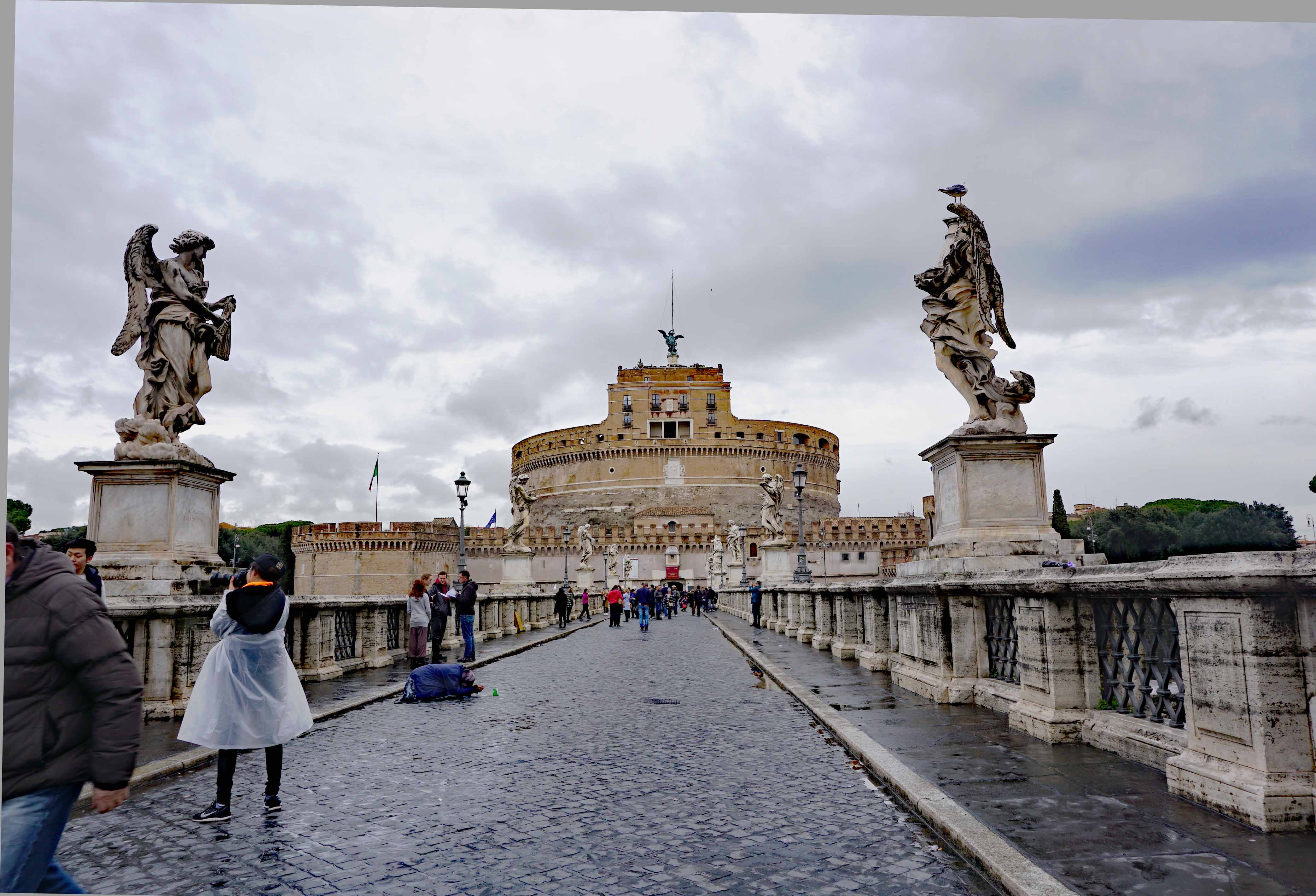
Castell Sant’Angelo across the Tiber – Photo Mari Nicholson
The Tiber has been the soul of Rome since the city’s inception, and it could be said that Rome owes its very existence to this strategically important river on whose banks the first settlements were built. The two sides of the river are joined by more than thirty bridges, creating a fascinating setting for the archeology and history of the eternal city.
Old View of the Tiber, possibly 18th century
Several of the old Roman bridges no longer exist, in Papal Rome and in the modern city seven were built in the 19th century and ten in the 20th century.
Ponte Sant’Angelo with statues
The Tiber (named after Tiberius who drowned in the river) is unlike rivers like The Danube, The Seine or The Thames as there is little activity on the water. In the summer, various boats convey tourists along the stretch of the river, but in general, it seems underused. However, along the Lungotevere, the boulevards that run alongside it, human traffic always seems to flow.
Flooding was a regular occurrence before the high embankments were built in the 19th century when there were houses located along the banks of this navigable river which was used for fishing and bathing. Over time, however, silting and sediment build-up meant that the river became unsuitable for navigation.
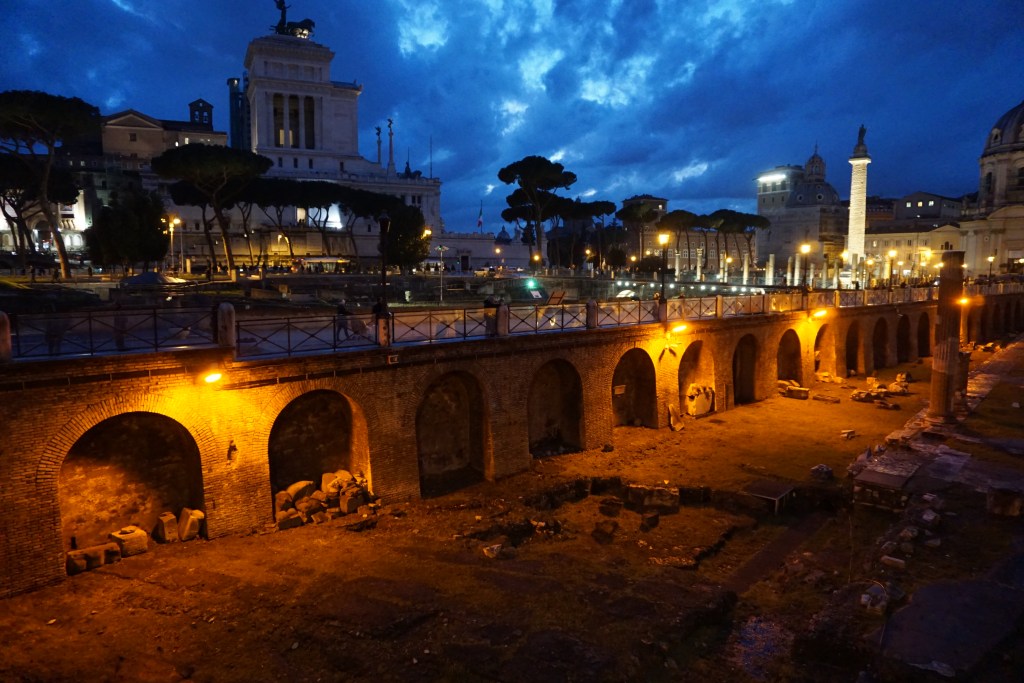
Looking down to Cavour Bridge, Rome
As in other cities such as Bangkok, Seville, London and Paris, tour boats were introduced along the river to give locals and tourists a unique opportunity to view the city. This is a great way to take in the panorama, and immerse yourself in one of the most evocative cities in the world.
A stroll along the Boulevard is also a favourite pastime and a visit to Castell Sant’Angelo and the Jewish Ghetto and Synagogue, which are both situated along the Tiber can be combined in a “Tiber walk”. There are many restaurants, cafes, and bars down by the river so sustenance is not a problem: these are very noticeable at night when the warm lights from their windows illuminate the Boulevards.
The Tiber, Rome – Mari Nicholson
Whether you opt for a dinner cruise, a daytime hop-on-hop-off cruise, or a private jaunt, along the way you can admire the great Palace of Justice, designed by William Calderoni; Sant’Angelo Castle, one of the oldest monuments of Rome; St. Peter’s Basilica, Tiberina Island, a picturesque island linked by one of the most famous bridges in the city, and the innumerable bridges that span the Tiber.
Ponte Sant’Angelo Looking towards the Castle – Mari Nicholson
When the surface of the Tiber is calm and the monuments that span the river are reflected in the still waters, they increase one’s delight in the vista they offer across Rome. Ponte Sant’Angelo (by the castle of the same name), Ponte Fabricio, Ponte Rotto, Ponte Garibaldi, they all offer a sense of the history of the city.
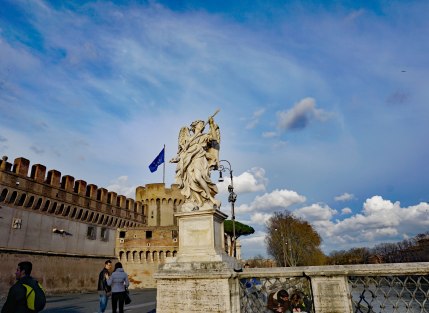
Angel on Pone Sant’Angelo – Mari NicholsonAngel on Ponte Sant’Angelo
The first named, Ponte Sant’Angela is the most spectacular, being embellished with angels carrying the instruments of Christ’s passion, and was designed by Gian Lorenzo Bernini whose fountain in Piazza Navona is one of the most photographed in Rome.
The Ponte Sant’Angelo was erected to ease the movement between the Vatican (which was also connected to the Castell Sant’Angelo) and the commercial area across the river.
The Vatican City is the only zone controlled by the papacy today, but in earlier centuries papal dominion was exercised over the entire city, hence the need for easy connection with the commercial area of the settlement. Three energetic popes, Urban VIII (1623–44), Innocent X (1644–55), and Alexander VII (1655–67), harnessed the versatile talents of the great artists nd sculptors of the day to build monuments and beautify areas all over Rome but especially in the Vatican area.
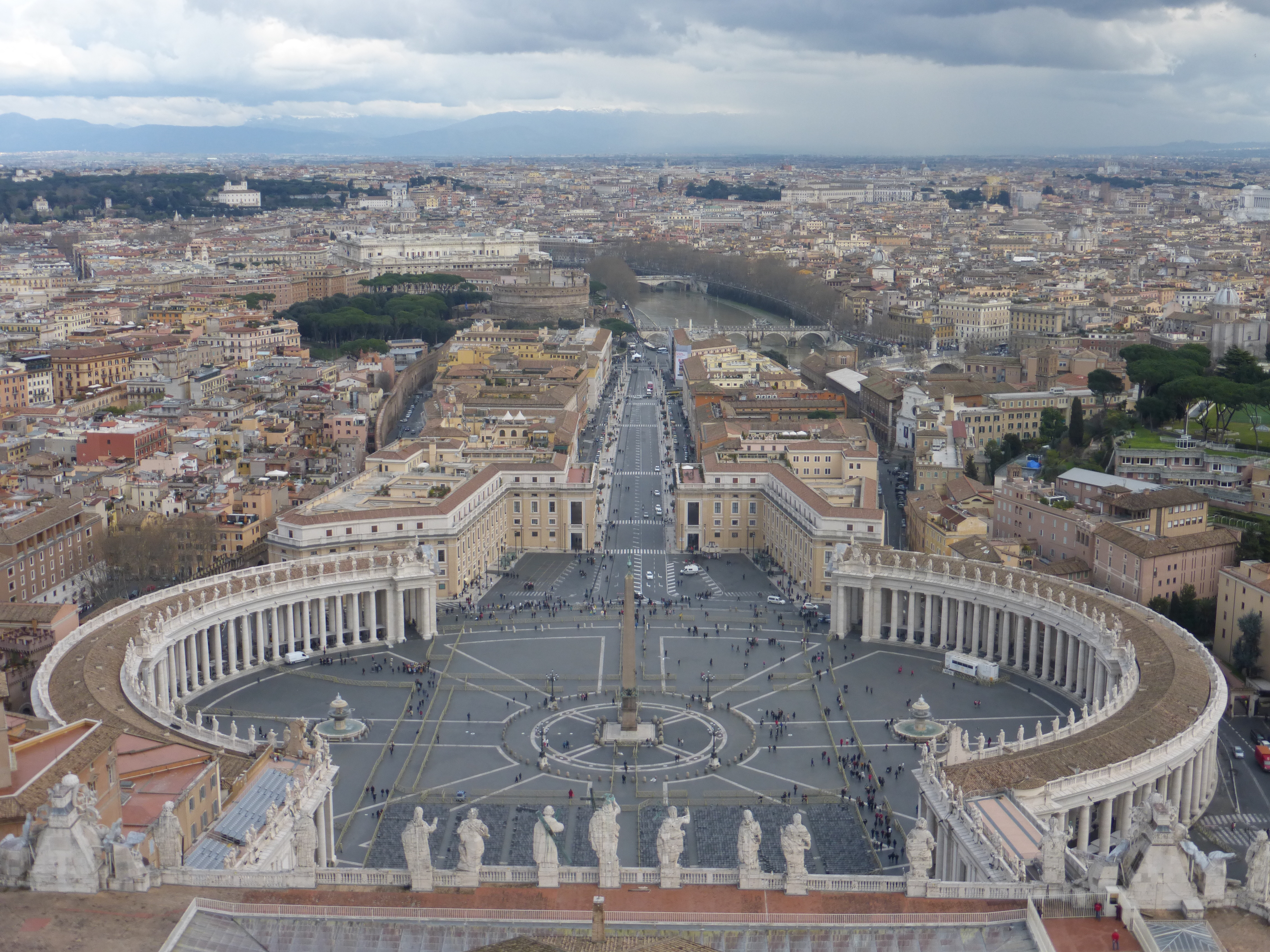
View from the Vatican to Ponte Sant’Angelo – Photo Solange Hando
A walk along the Tiber, and then up the imposing obelisk and olive-tree-lined road to the Vatican is an exercise in itself and you can be forgiven if you decide to postpone visiting St. Peter’s Basilica and the Vatican Museum until another day. It can take a long time to do justice to them both. A trip to the top of St. Peter’s is a worthwhile exercise but be warned, there are many steps to the top. A lift goes part way only.
Part of Bernini’s Magnificent 4-Rivers Fountain in Piazza Navona – Photo Mari Nicholson
How to get there: Ponte Sant’Angelo: Metro Line A, Lepanto stop. Boats leave from nearby. Buses 23, 34, 40, 49, 62, 280, 492, and 990. Tram 19.
This is the AFTER photograph. I wasn’t there to take the BEFORE shot, but most of us will have seen the terrible pictures of the 1944 D-Day Landings in Normandy, France, even seen the film The Longest Day, in which the graphic images of the horrors of that day and the terrible happenings on the beaches code-named Utah, Omaha, Gold, Juno and Sword are now part of history. It was a Time of heroism on a grand scale and a Time of mistakes on an equally grand scale. It heralded the end of the beginning of the war that tore Europe apart, the one we call The Second World War, but it also heralded a Time of hope when it seemed that Peace might finally descend on Europe.
To me, this Memorial to some of those who lost their lives on the beaches of Normandy signifies Time Past and Time Remembered.
Postman’s Park in London contains a simple but evocative Memorial to unsung heroes of the 19th and early 20th century, in the form of a collection of glazed Doulton plaques on a wall protected from the elements by a loggia. Each of these plaques commemorates someone who, in tragic circumstances, died a hero, trying to save the lives of others.
What and where is Postman’s Park in the City of London?
First the name: the park acquired the Postman’s Park name because during it’s heyday in the 19th century and before it became the site of the Memorial, it was popular as a lunchtime retreat with workers from the General Post Office in nearby Clerkenwell, long since demolished.
Situated between King Edward Street, Little Britain and Angel Street and just round the corner from St Paul’s Cathedral whose steps are normally crowded with tourists hugging backpacks and guitars and where the streets are full of bankers and financiers bursting with self-importance, it contains a gallery of tiled memorials to extraordinary people who were, nonetheless, just ordinary citizens.
St. Paul’s Cathedral – Mari Nicholson
The brainchild of the Victorian painter and philanthropist, G.F. Watts (1817-1904), a radical socialist who felt deeply about the dreadful conditions of the London poor, and who had twice refused a Baronetcy, it is now regarded as a Memorial to Watts who made no attempt to hide his dislike of the greed of the upper classes of the time.
About the Tiled Memorials
Plaque to one of the child heroes on the Memorial of Heroic Self Sacrifice in Postman’s Park, London – Photo Mari Nicholson
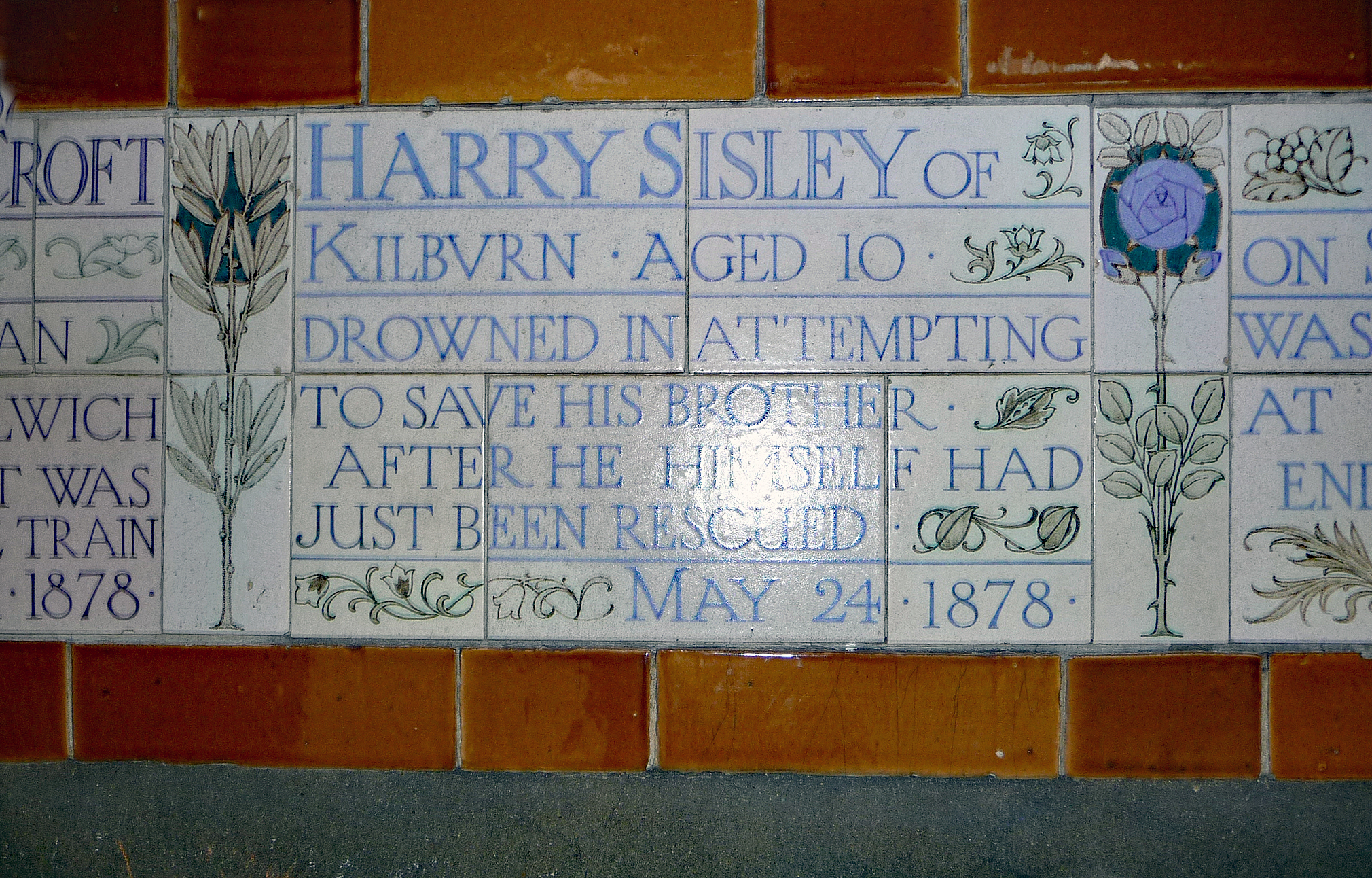
A long, high wall covered with Royal Doulton ceramic plaques, decorated in burnt orange and blue, names, ages, occupations and means of death engraved on the tiles – this is a wall before which people have been known to stand with tears in their eyes. Tragedy after tragedy told in a few simple phrases, bring to life drownings, raging fires, train disasters, and runaway horse accidents, in which these workers and children had saved someone’s life by giving their own.
There is seating under the plaques and the garden area of the park is a restful place with bright flower beds and a gently trickling fountain, interesting shrubs and flowering plants. Of special interest are the large banana tree, musa basjoo, which flowers in late summer, and the dove tree, davidia involucrata. In fact, Postman’s Park is a perfect place for a lunchtime picnic.
In 1887, Watts wrote to The Times to suggest the creation of a park to commemorate ‘heroic men and women’ who had given their lives attempting to save others. This, he said, would be a worthy way to mark Queen Victoria’s Golden Jubilee year.
His letter to The Times did not stimulate any interest, however, but in 1898, St Botolph’s Church at Aldersgate purchased land that had previously been owned by the City Parochial Foundation, and they approached him regarding the Memorial. So, on the site of the former churchyard of St. Bolophs, there was erected a 50ft long open gallery along the wall of which he planned to place glazed Doulton tablets commemorating acts of bravery, each one detailing a heroic act.
One of Britain’s leading tile designers at that time, William de Morgan, agreed to work with Watts. Their collaboration, first unveiled in 1900, is what you see on the early plaques when you visit Postman’s Park.
About the Tiles and Plaques
Plaque to William Goodrum, a 60-year-old Hero, honoured on the Memorial wall in Postman’s Park – Photo Mari Nicholson
The plaques could easily be overlooked in the somewhat hidden corner of the park, but these beautiful hand-lettered tiles hand-painted at the Royal Doulton factory, when once you see them, live with you forever. Each one tells the story of a boy or girl, man or woman, who died trying to save another at the expense of his own. Told in a few poignant words, they nevertheless manage to paint a picture of a life unfulfilled that ended in tragedy. Take, for instance,
the young Alice “daughter of a bricklayer’s labourer who by intrepid conduct saved 3 children from a burning house in Union Street Borough at the cost of her own young life”. Or
William “drowned in the Lea trying to save a lad from a dangerous entanglement of weed”.
The stories seem almost Dickensian until the very real tragedies these plaques represent hit home and one realises that this was real life, not fiction. Life was harsh for those who didn’t own land or property of some sort in those days: violence and disease were everyday events. Prostitution and child abuse were rife in late-Victorian London, and these children who died, many of them orphans or ‘indentured workers’, each and every one of them would have been working at some poorly paid job.
Reading the tiles one is struck by the occupations that don’t exist any more and the causes of death that remind one of nothing so much as a Victorian engraving – a runaway carriage of four with a child trampled beneath the horses, a boy in the Thames (probably a mudlark) attempting to swim to land with his friend in his arms.
London’s Child Heroes, 10-year-old Harry Sisley, honoured here in a Doulton plaque on the Memorial in Postman’s Park, London – Photo Mari Nicholson
G.F. Watts and his Reasons for Erecting the Memorial
GF Watts wanted to use his art as a force for social change and his intention was to build a memorial that honoured ordinary people, people who would not have had a burial tomb at Highgate, Brompton or even St. Pancras & Islington Cemetery.
Watts had for many years collected newspaper reports of heroic actions and the plaques were based on these cuttings.
It was planned to have one hundred and twenty tiles in place for the opening, but sadly, it was only possible to erect four. By this time Watts was too ill to attend the unveiling and only nine more were added during his lifetime. His wife Mary, took over the work and added what she could before her death. Then, 78 years later, in 2009, the Diocese of London added a new tablet to commemorate one Leigh Pitt who rescued a nine-year-old boy from drowning in a canal. The plaque reads:
Leigh Pitt, Reprographic operator, aged 30, saved a drowning boy from the canal at Thamesmead, but sadly was unable to save himself. June 7, 2007.
Today you can see rows of blank spaces, although no doubt there were unsung heroes in the intervening years who were never commemorated.
This wall of tiled plaques to these forgottenLondoners is one of the city’s most moving Memorials and in 1972, along with other key elements in the park, it was Listed as a Grade ll site.
Postman’s Park in Recent Film
The BAFTA and Golden Globe-winning film Closer which stars Natalie Portman, Julia Roberts, Jude Law and Clive Owen (based on the play of the same name by Patrick Marber) references Postman’s Park in that the character Alice Ayres (Natalie Portman) fabricates her identity based on Ayers’ tablet on the Memorial which the film character had read.
It seems a shame that King Alfred, the man who defeated the Danes and united the English, has gone down in popular history merely as the man who burnt the cakes. But the city he made his capital does the man proud and it is impossible to stroll through the ancient streets of Winchester and not be aware of how “the Great” came to be added to Alfred’s name.
An unspoilt city and England’s ancient capital (the Court was mobile during the Anglo-Saxon period but the city was considered the capital of Wessex and England at the time), the cobblestones, buildings and monuments of Winchester, just an hour from London, ring with history. If you like big bangs and all things military, it is also home to a host of museums dedicated to all things warlike. Surrounded by water meadows and rolling downland, it offers the best of city life – modern shopping, quirky open air events, and great entertainment and it can be covered in a day (although a couple of days will show more of what is on offer and allow trips into the surrounding villages).
Fulling Mill Cottage and River Arle
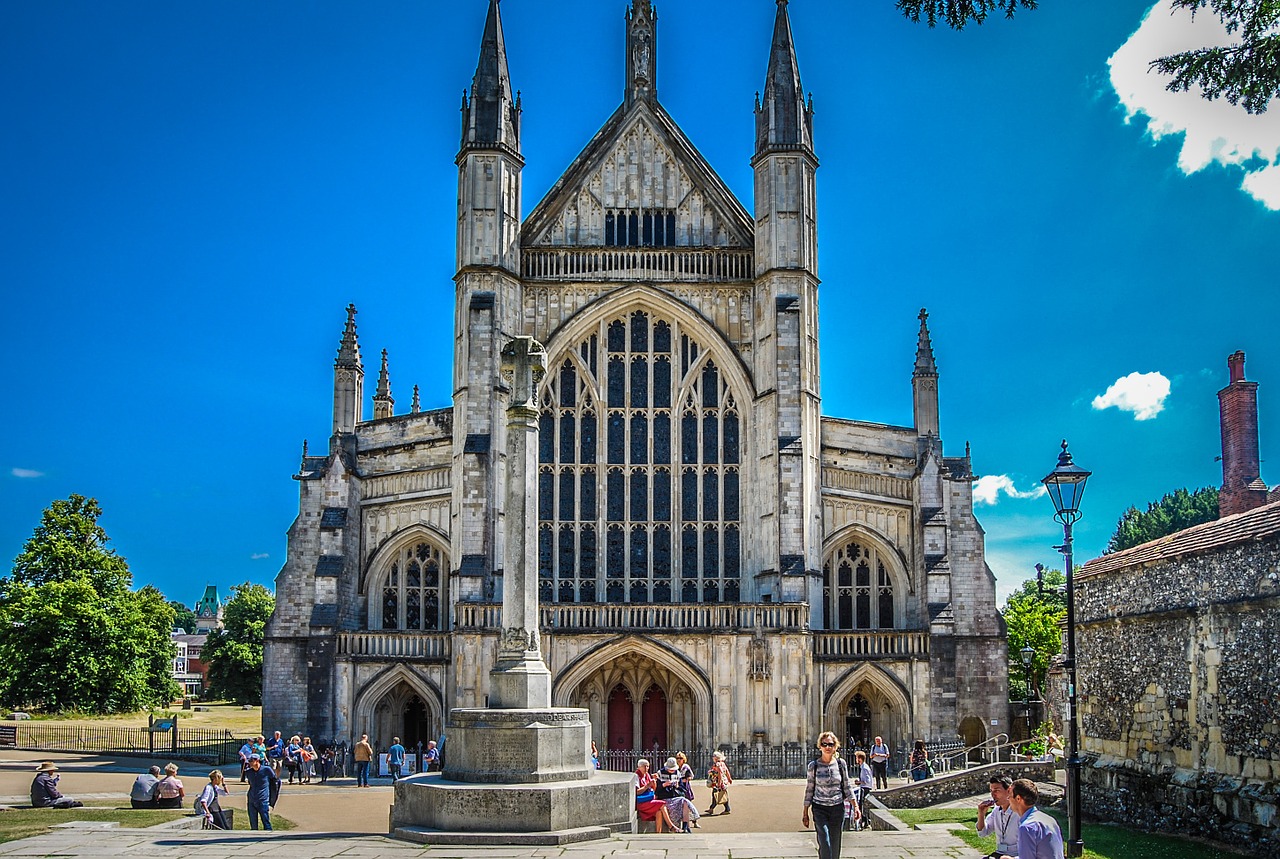
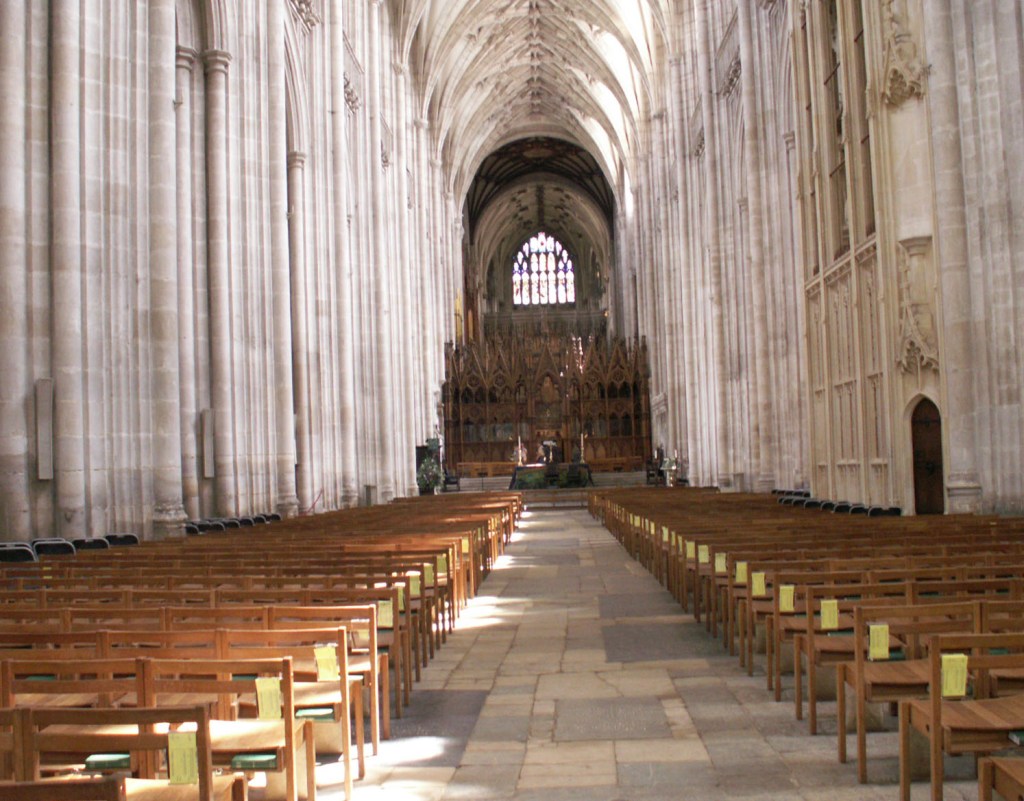
To get a panoramic view of the streets and buildings laid out according to the original Saxon plan, a good starting point is St. Giles’ Hill (a great spot for a picnic), from where you can pick out Hamo Thorneycroft’s famous statue of King Alfred. Then follow in the King’s footsteps from the walls erected to keep out the Danes to what is the largest medieval cathedral in the world. Famous for its treasures, from the sumptuously illustrated 12th century Bible to medieval paintings and a 16-metre stained-glass window 66% of which dates from medieval times, Winchester Cathedral is that much-overused word, awesome.
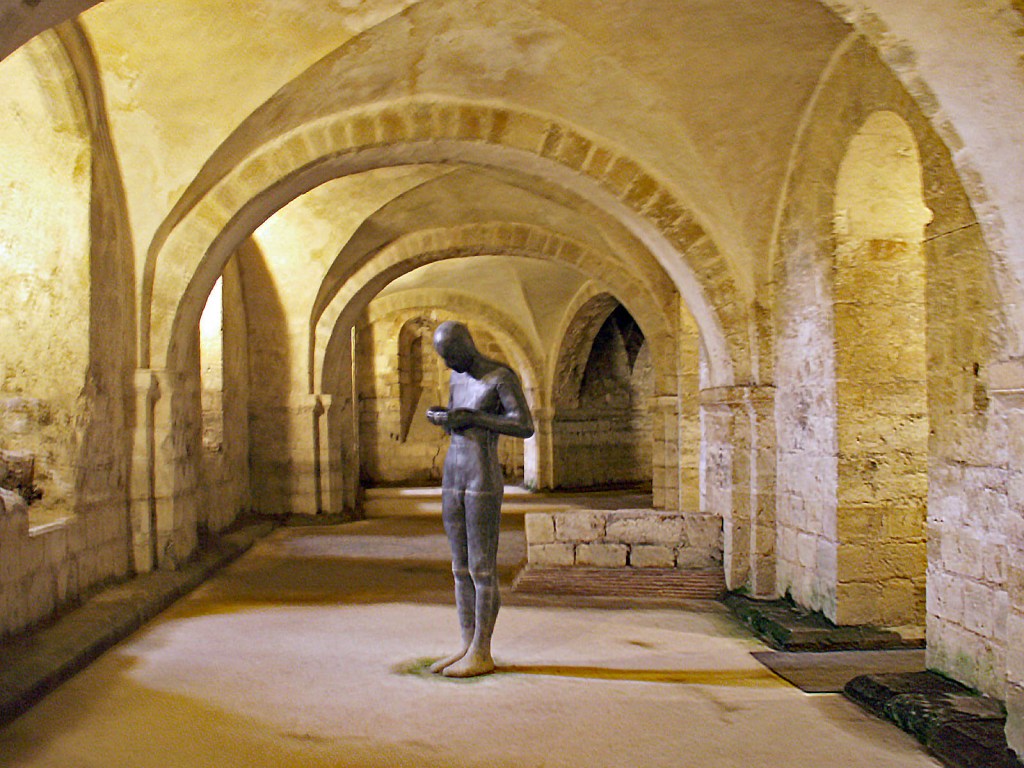
One of the Gormley statues in the Crypt of Winchester CathedralThe Crypt, Winchester Cathedral
The newest acquisition is Sound ll, the Antony Gormley sculpture now permanently installed in the cathedral’s crypt where it looks particularly striking when the crypt floods which it frequently does. Even if you don’t make a habit of visiting cathedrals, do make an exception to view this magnificent Gormley work.
The Cloisters, Winchester Cathedral
Fans of The Da Vinci Code will be interested to know that the cathedral’s North transept doubles as the Vatican in the film of the book, but those of a more classical bent will head for the tomb of Jane Austen which can be found in the nave where there is also a stained glass window to her memory.
Jane Austen Plaque in Winchester Cathedral
The novelist died in Winchester on 18 July 1817 and is buried in the cathedral. While in this part of the cathedral, take note of the black font which depicts St. Nicholas of Smyrna giving an old man three bags of gold for his three daughters, said to be the forerunner of the pawnbrokers sign of three golden balls.
Continuing in the footsteps of King Alfred you could then head up the High Street to the Great Hall, all that remains of Winchester castle, and which for 700 years has housed the legendary Round Table. Old it certainly is, and round, but it hangs on a wall where with its red, black and white colouring it resembles an enormous dartboard. According to myth, the original was created by the wizard Merlin, but carbon dating in 1976 proved that this particular table was not made in the Arthurian 6th century but in the 13th, and this use of HyperPhysics sadly put paid to the legend.
The Round Table, High up on the Wall
Just outside the south door of the Great Hall, is Eleanor’s Garden, a re-creation of a medieval herbarium with turf seats and a camomile lawn, named after Eleanor, wife of Henry III, and Eleanor, wife of Edward I. All the plants you see would have been grown in the 13th century, when floral symbols had priority over design. The rose, lily, iris and strawberry plants represent aspects of religion while the greens – the grass, ivy, bay and holly represent faithfulness.
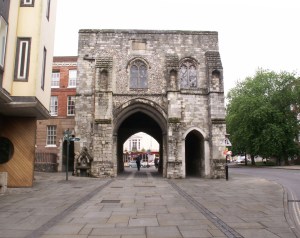
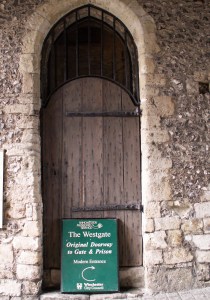
The oldest continuously running school in the country, 14th century Winchester College which became a model for Eton and for King’s College, Cambridge is nearby. You can join a guided tour for an intriguing glimpse into the medieval heart of the college, the 14th century Gothic chapel with its early example of a wooden vaulted roof, the cloisters (where graffiti carved into the stones during the 16th and 17th centuries is still visible) and the original scholars’ dining-room. As a complete contrast, you could later check out medieval Westgate, a fortified gateway which served as a debtors’ prison for 150 years and where prisoners graffiti is also still intact, albeit rather different from that of the scholars!
Westgate
One expects to find ghosts in most ancient cities and Winchester is no exception. The most famous haunted Inn is The Eclipse in The Square, where the spectre of Alicia Lisle haunts the corridors. Seventy-one years old when she was found guilty of harbouring rebel cavaliers and sentenced to death by Hanging Judge Jeffreys, she spent her last night here in 1685 listening to the scaffold being erected for her hanging.
Old Prison Gate
At the Theatre Royal in Jewry Street, a wandering apparition haunts the dress-circle and gallery looking for her long lost lover while in the 18th century High Street offices formerly occupied by the county newspaper, the rattling chains of a woman dressed in grey has been known to rattle the staff on more than one occasion.
Streams and waterways punctuate the streets of the city giving it a homely atmosphere – especially when you see someone hauling a fine trout out of the river – and the Bikeabout Scheme means that you can tour around for most of the day for the small registration fee of £10. Reflective jackets and helmets are also available.
Half-timbered hous in Winchester
You don’t need to cycle of course: there is a good transport system from Winchester to the picturesque villages of the Itchen and Meon Valleys, handsome Georgian colour-washed Alresford (pronounced Allsford) for instance, home of the famous Watercress Steam Railway where you can make a childhood dream come true by riding on the footplate. Later, stroll down the town’s elegant streets with their antique shops, and discreet fashion boutiques or along the riverside where the thatched timber-framed Fulling Mill straddles the River Arle. Alresford is the home of watercress farming in the UK, so expect to sample gourmet dishes made of the green stuff – watercress pudding, watercress quiche and even watercress scones with afternoon tea – in smart bistros, tea rooms and old-fashioned pubs like the Wykeham Arms with its award-winning menu.
If there are children in the party, then don’t miss Marwell Zoo. Home to over 200 species of animals and birds, from meerkats to sand cats, and some of the world’s rarest big cats including the Amur leopard and the snow leopard. There are volunteer guides around the park to help visitors and to explain and illustrate the efforts the zoo is making to rehabilitate endangered animals back in their habitat.
And after all that history and ancient stones, Winchester can still surprise you with its pedestrian-friendly streets, colourful markets and exquisite boutiques nestling beside large-scale stores. The High Street – once the Roman’s east-west route through the city – is home to stylish shops with Regency and Elizabethan bow-fronted windows, while The Square offers quaint pubs and restaurants after your exertions, and everywhere you’ll find bronze and stone carvings, many by famous sculptors. It lies just one hour by train from London, 40 minutes from Portsmouth Ferry Terminal, and 15 minutes from Southampton Airport.
Very Old Barn, NB date of erection in grey bricks at bottom of building.
Winchester’s a winner, and whether you taste runs to real ale or English wines, pub grub or gourmet dining, Goth outfits to designer chic, you’ll find it all here amidst the quiet stones that hold history’s secrets.
The Granite Cross that Dominates the Entrance to the Cemetery
The huge granite cross, starkly outlined against the blue sky, dominates the entrance to the German War Cemetery in Malame, Crete, scene of some of the most ferocious fighting during the Second World War – the aptly named Battle of Crete. The cemetery, home to the remains of 4,700 German soldiers who died on the island, is easy to find as it is just off the coast road in Malame, a short distance from Chania.
The German Cemetery, high above Malarme
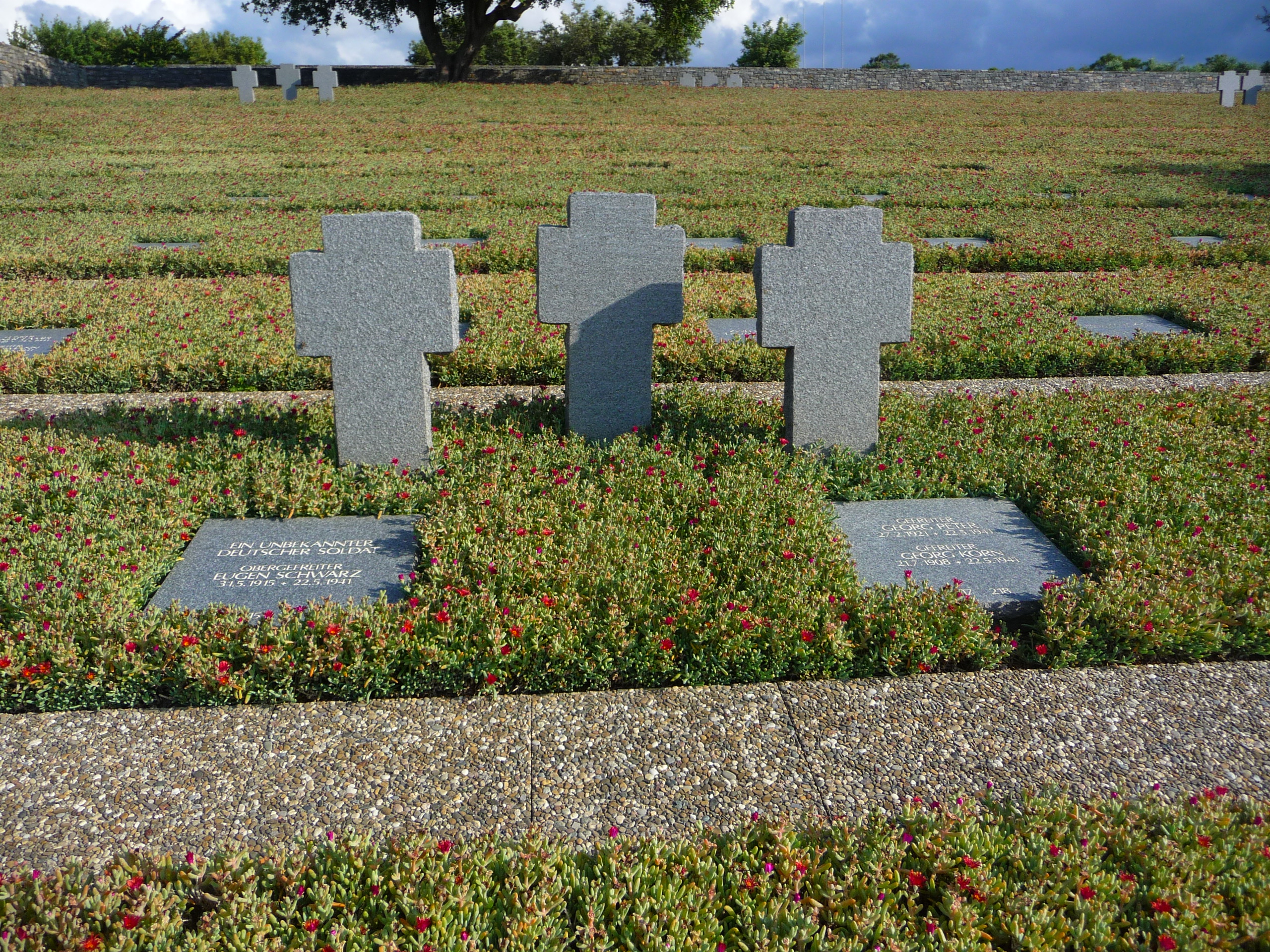
Once in the cemetery proper, one is faced with sombre, grey granite crosses dotted about the area with small granite plaques embedded in the ground, each one bearing the name of two soldiers who lie beneath. Interspersed with the grey lozenge-like plaques are tough grasses and plant forms that can withstand the dry heat and the cold, snowy winters of Crete.
Plaque to a fallen soldier
The Battle of Malame in May 1941 has become famous as one of attack and counter attack, assault and retreat, with the Cretan partisans and what remained of the Greek army on the island, fighting alongside a New Zealand infantry company, the RAF and Fleet Air Arm personnel left stranded at the airfield.
Three crosses and two plaques.
Over 500 Junkers attacked in a blitzkrieg similar to that launched on Guernica, Spain, five years earlier. Historians still query why the powers-that-be failed to realize that Hitler might try the same tactics again five years later.
Wave after wave of German paratroopers invaded the island. The Junkers were followed by an armada of paratroopers who were ferried in on gliders and parachute troop carriers and who darkened the sky as they descended in their thousands. (There were 70 gliders each one holding 10 paratroopers and these were followed by parachute troop carriers). Many were shot as they descended or were enmeshed in the surrounding olive trees.
The invaders who died in this assault were initially interred at 62 locations on the island but in 1960, following permission from the Greek Government, the Germans were permitted to recover these bodies which were then transferred to the Gonia monastery at Kolymbari. (The Monastery had been a centre for the Resistance during the Battle of Crete and the monks were imprisoned in Chania prisons, after the Germans found guns inside the chapel).
View of the German Cemetery with its crosses and granite plaques.
In 1971 the remains of 4,465 German troops were transferred to their current resting place in Malame, designed as a cemetery for the Germans who died on the four main battlegrounds of Malame, Chania, Rethymnon and Heraklion. The cemetery was consecrated on 6th October 1974.
The human cost paid by the German and Allied forces in the fight for Crete was very high. There is a little Museum on the cemetery site with information on the walls about the history of the battles but most Cretans dispute the interpretations offered.
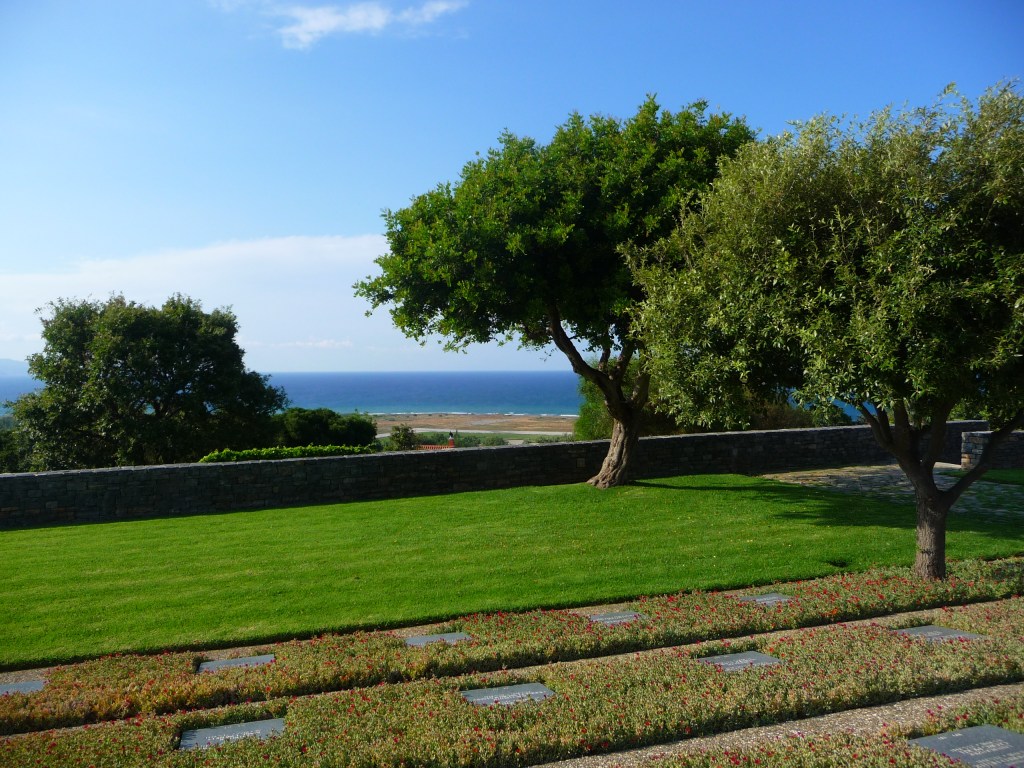
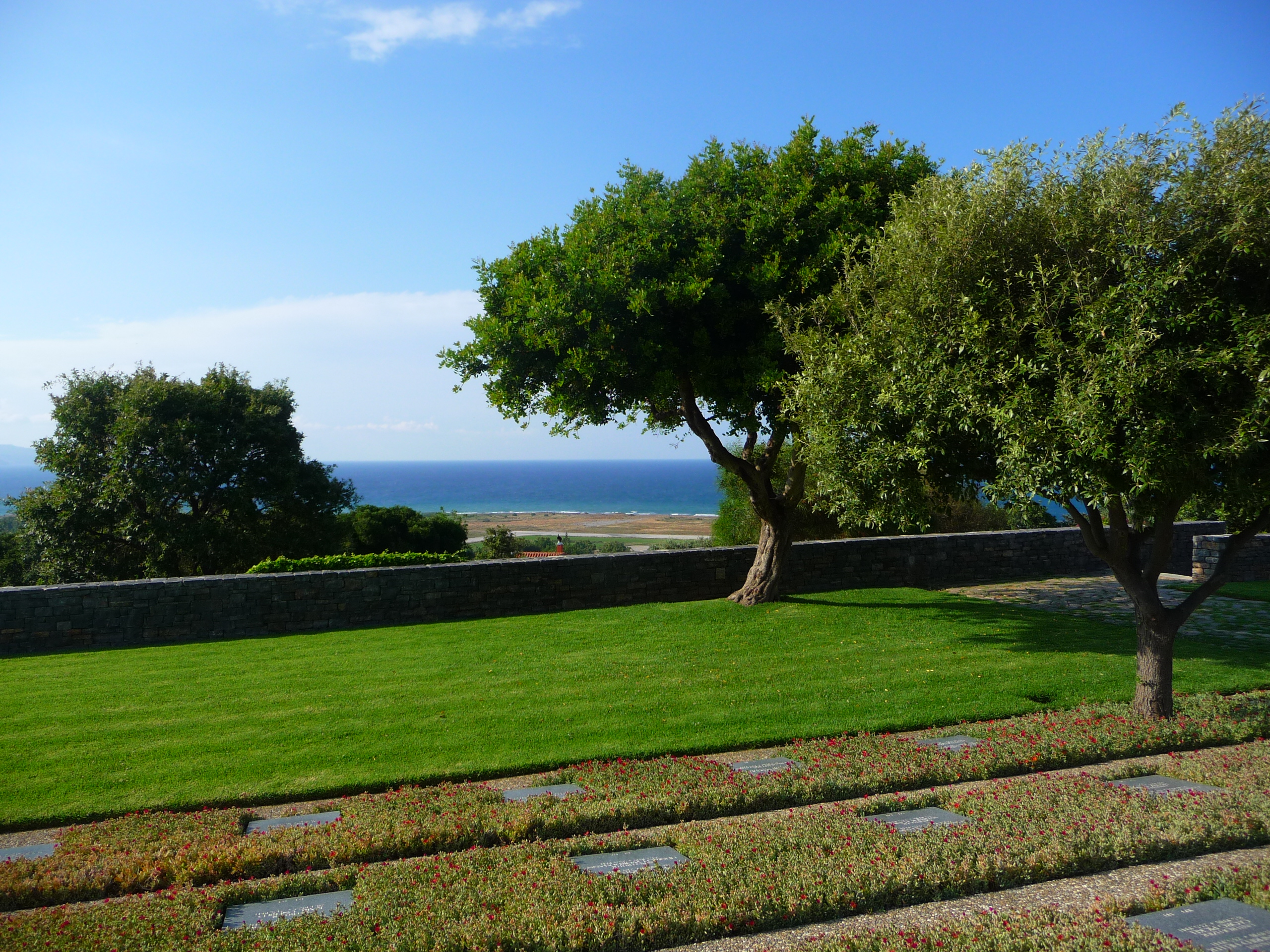
View to the Coast from the German Cemetery
From the cemetery the view to the coast is stunning. Standing at the top one can see far into the deep blue bay of Chania across hillsides dotted with olive trees, winding down to the Tavronitis River. Goats graze among the trees, their bleating rising from below sounding eerily like a child crying. A thin ribbon of road runs between the olive groves and the Aegean Sea beyond, and it is hard to imagine the horror that erupted in this peaceful area 75 years ago, or to visualize the dead and dying that littered the beaches and fields.
Neither side has exact numbers of fallen soldiers.
R.I.P.
Best books on the history of the Battle of Crete:
Crete: The Battle and the Resistance by Antony Beevor (John Murray, Paperback – a division of Hodder Headline (1991). Still regarded as the best history of Crete during WW11
The Cretan Runner by George Psychoundakis (trans. by Patrick Leigh Fermor): John Murray, Paperback (first published 1955). A first-hand account by one of the partisans from the mountains.


















 MARI'S TRAVELS WITH HER CAMERA