Does this count? Can it make it into the Bench challenge? It’s a bench seat in a Gondola in Venice (where else)?

Bench photo linked with Jude here.
Does this count? Can it make it into the Bench challenge? It’s a bench seat in a Gondola in Venice (where else)?
Bench photo linked with Jude here.

They work in silence over a hole in the ground, on their knees, lying flat on their stomachs to access the dig. On a table nearby are some bones, skulls too. The harsh sun has bleached the surrounding terrain but there is a little shade in the nearby wooded area and under the gazebo tented area in which they work.


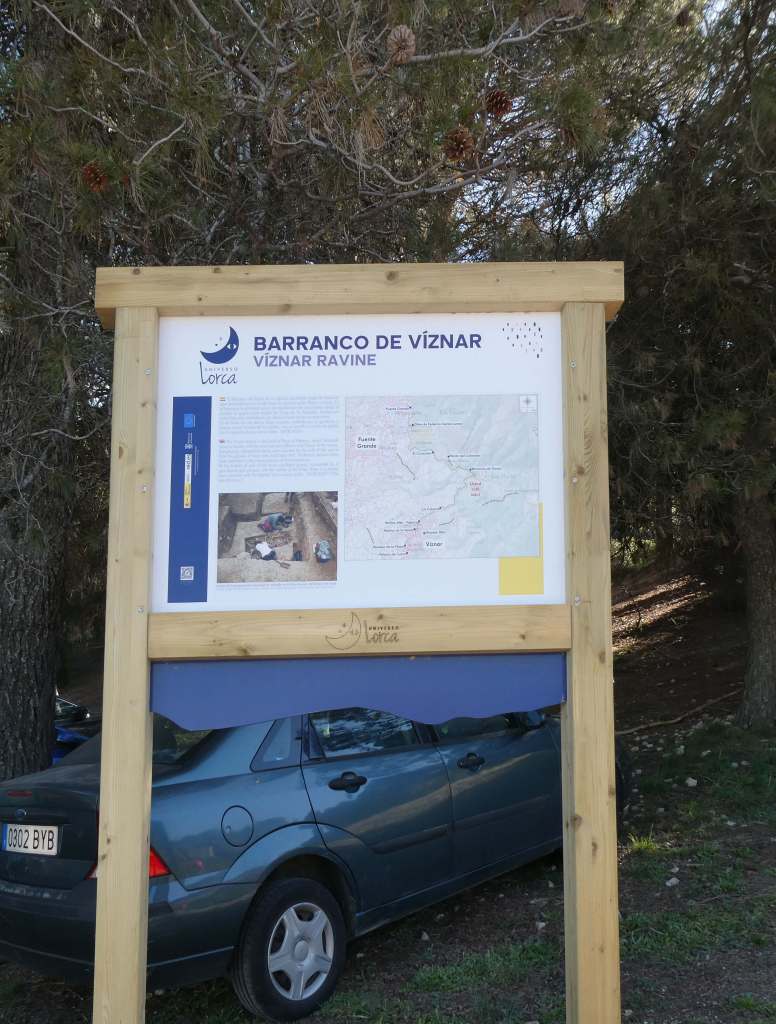
The Barranco de Viznar has been declared a Place of Historical Memory in Granada, Spain, and as a life-long student of the Spanish Civil War, standing in this sloping, wooded area of about 10,000 square meters on a sharp curve of the road between Alfacar and Viznar, just has to be one of the best moment of 2024 for me.

We know where the bodies are
Imagine being given the opportunity to visit the site where the exhumation of thousands of young men assassinated by Franco’s troops during the Spanish civil war is taking place. Between September and November 1936, at the start of the Spanish Civil War (1936-1939), it is reckoned that at least 173 people were killed here and thrown into mass graves. Even earlier, in July and August, just after the coup d’état that triggered the war, there had been other assassinations, including that of the poet Federico García Lorca, but no record was left of them.
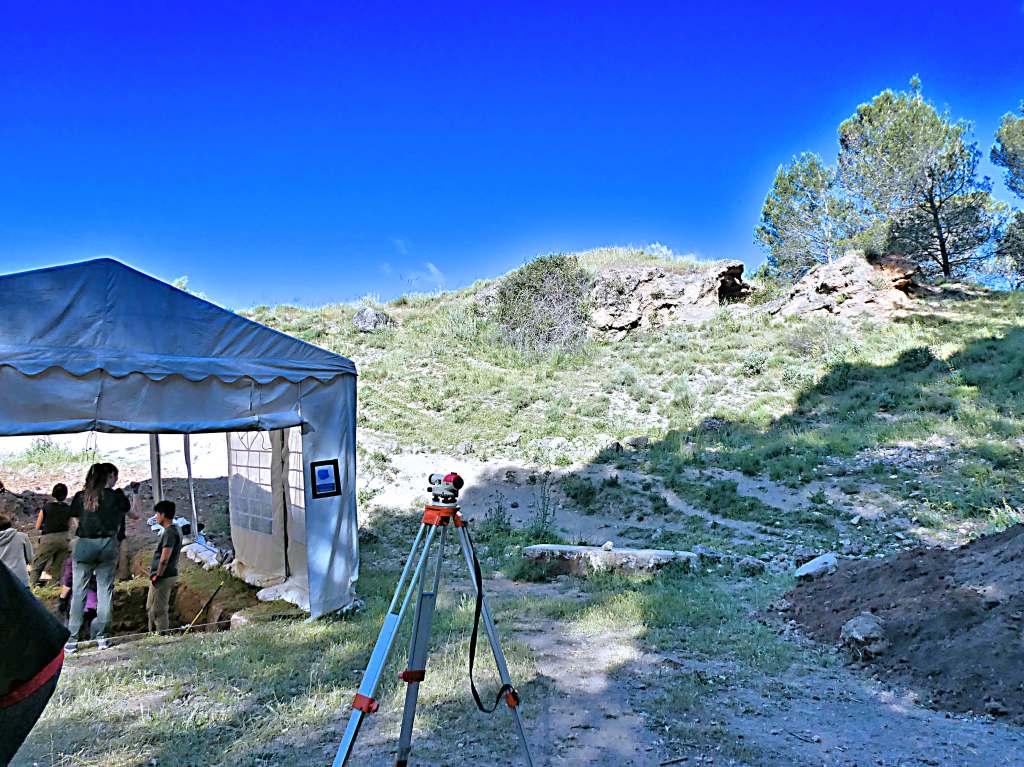
Imagine how overwhelming it was , as a lover of Lorca’s poetry and plays, to be given the privilege of visiting the place where his assassination is presumed to have taken place in the opening days of that terrible conflict, and to talk with those involved in the ‘dig’.
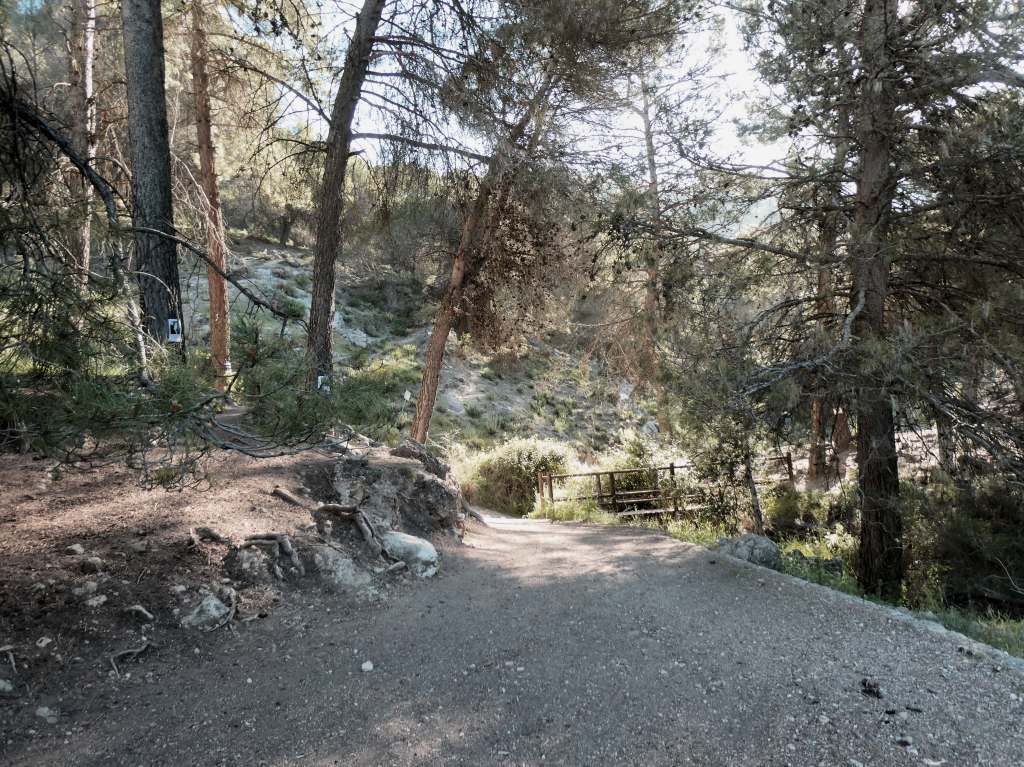
In Lorca’s Footsteps in Granada
That is what happened when my friend Kathleen and I visited Granada recently to renew our acquaintance with a city that had charmed us both decades ago. We found it virtually unchanged, still intensely Spanish, catering mainly to Spanish visitors and still with the best tapas bars in Spain, but giving nods to a more modern vibe with the addition of Gin bars!
Our idea was to walk In the Footsteps of Federico Garcia Lorca, guided by the Ian Gibson book of the same name, and it was while we were doing this that we had a serendipitous encounter with a Granada local who shared our enthusiasm and who invited us to visit the dig in Viznar.

The Barranco de Viznar and its secrets
The Barranco de Víznar is a ravine in the province of Granada, Spain, where a team of researchers made up of archaeologists, geophysicists, anthropologists, forensic experts and historians led by Francisco Carrión Méndez, a Senior Lecturer in Prehistory and Archaeology at the University of Granada has been searching for the bodies of the those assassinated during the Spanish Civil War, and searching for one in particular, the poet and playwright, Federico Garcia Lorca, one of the first to be killed.
How Many Assassinations
No one knows exactly how many were assassinated in the Spanish Civil War but it is estimated that it was more than 500,000, thousands of whom were massacred in the Province of Granada, some, including Lorca, even before Franco’s military coup.
In the area of Viznar, to date, they have located 16 mass graves and recovered 124 bodies. In one mass grave they found the bodies of 10 people with gunshot wounds to the head and their hands tied behind their backs.
The area of Barranco de Víznar was replanted with a thick forest of pine trees which has covered up the graves left after the mass executions committed by platoons of assault guards, part of the ferocious repression that followed the uprising.
How is the Dig Funded
The project is funded by the state and the regional government and is being conducted under the 1922 Democratic Memory Law which was enacted following the coming to power of the government of Pedro Sánchez. However, there are fears that this could be in jeopardy and the excavation stopped under a new government.

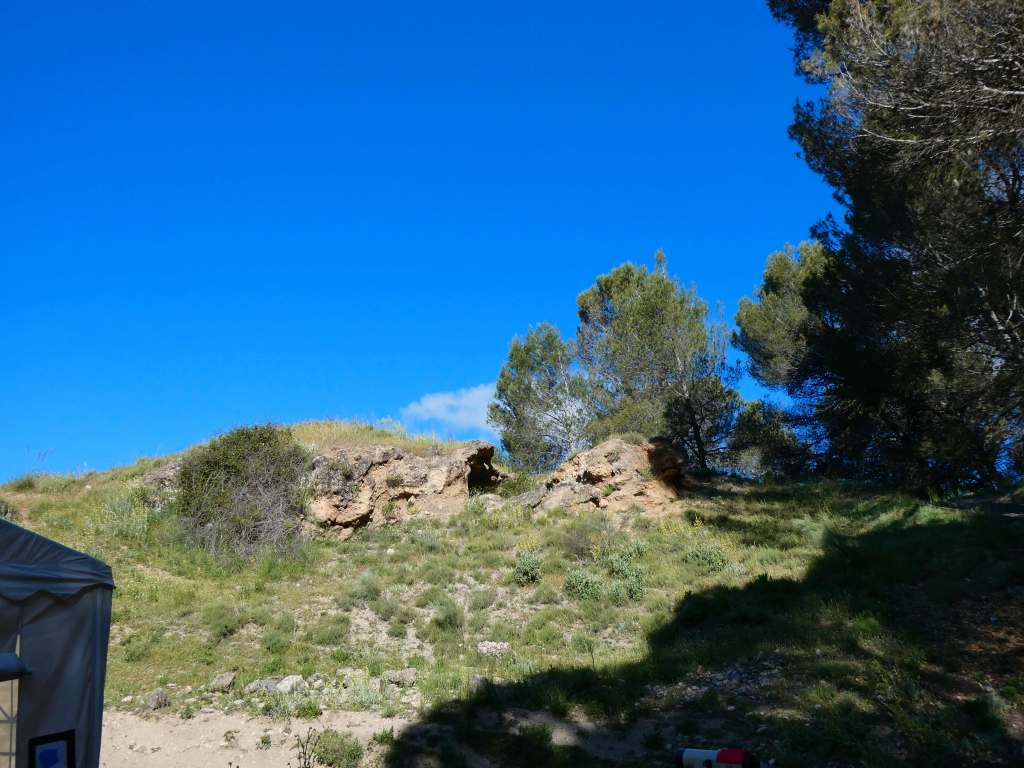

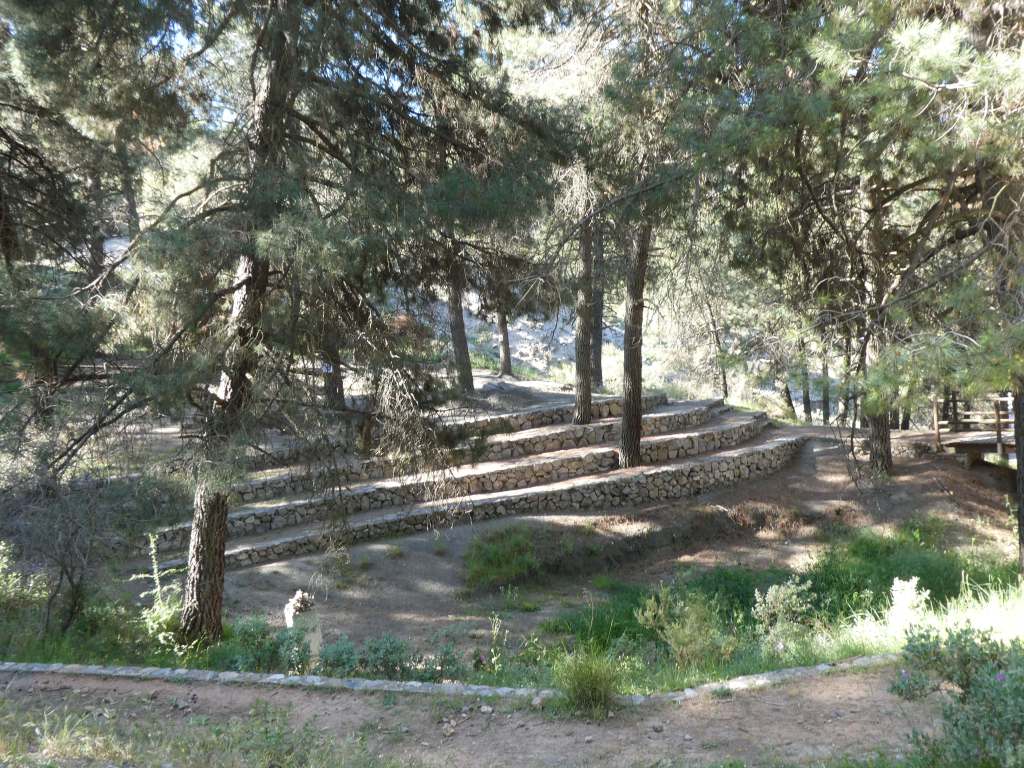
Some scenes of the Barranco, above. Throughout the woods are dotted tents where the archaeologists and forensic scientists are working, in difficult terrain and extreme heat.

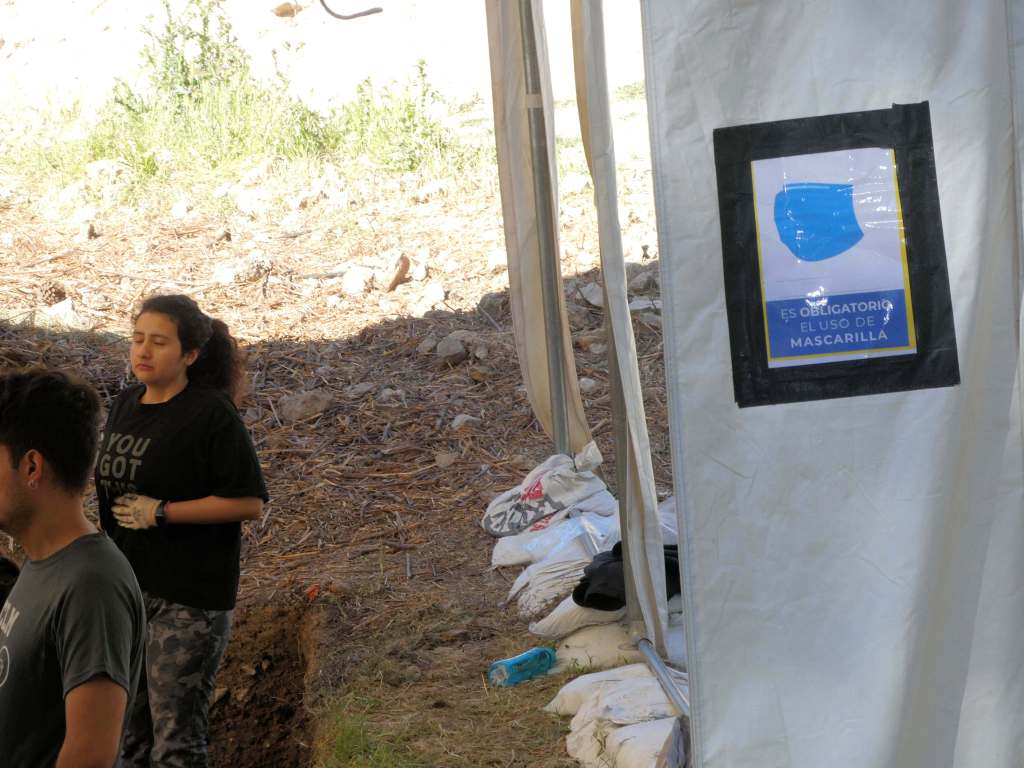


One of the volunteers told me it usually takes four to six weeks to complete an exhumation, to excavate the personal effects and log, photograph and do the paperwork. Fortunately, the soil in the ravine of Víznar has managed to preserve the bones remarkably well, helpful in identifying the age and sex of the victims, as well as the injuries and the type of violence to which they were subjected. The DNA results can take a long time to come in but when the families are re-united with a family member, it is a great moment.

Each tree could be a Memorial
When a family is linked with a body from one of the mass graves via the DNA their permission is requested for a photograph of the victim to be displayed on a tree. Most families agree and it was an emotional moment to wander amongst the trees, see the photographs and read the names and occupations – some academics, a bullfighter but mostly ordinary citizens, killed because of their sympathies with the legally elected Republican government.
Among the bones of those discovered is a former Rector of the University of Granada, Salvador Vila (above) who was brought from Salamanca to Granada and shot on October 22nd 1936. His wife, Gerda Leimdörfer, daughter of the editor-in-chief of Berlin’s leading Jewish newspaper, the Berliner Zeitung am Mittag, was spared thanks to the mediation of Manuel de Falla, the Spanish composer, who obtained a pardon in exchange for her conversion from Judaism to Catholicism.


The burial area is accessed over uneven terrain and a paved dirt path has been laid by the City Council of Víznar that after a detour, leads to the main grave which is surrounded by a stone gallery filled with small metal plaques bearing the names and circumstances of those killed, placed there by Historical Memory Associations and the heirs of those shot.

The Death of Lorca
Lorca was spending time in the home of family friends, the Rosales, on Angulo Street, on 17th August 1936, when he was arrested and taken just 300 metres away to the Civil Government building, at that time a centre of terror: from there he was quickly transferred to Alfacar and Víznar, two small towns located only ten kilometres away where Franco’s rebel army had created a centre for the extermination of left-wing sympathizers. He was assassinated not only because of his beliefs and his ideology, but because he was homosexual.

All Were Lorca memorial stone
Within the area there is a simple stone with the legend “All were Lorca. 18-08-2002″ and each year, on August 19, a poetry event takes place here beginning at midnight and lasting until the early hours of the morning. This celebration of Lorca’s poetry originally started as a clandestine event during the last years of the dictatorship and was the first open-air commemoration of Lorca’s assassination.

To date, Lorca’s body has not been discovered but hope remains high that one day it will be among those exhumed.

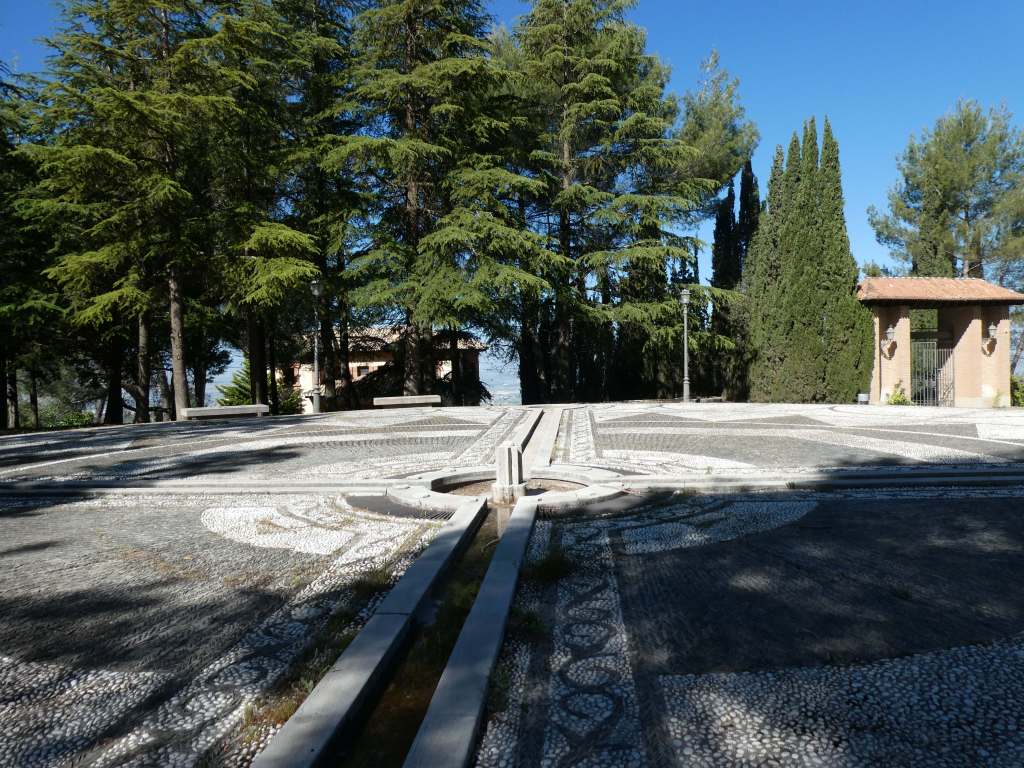
Postscript:
The project in the ravine, which is in its fourth and final phase, is now funded by the state and the regional government and is being conducted under the new Democratic Memory Law passed in 2022. It is not certain that this will continue if a more right-wing government should be installed in Madrid.
Essential Reading
For the politics of Spain during the Civil War and since, anything by Peter Preston is to be recommended.
Ian Gibson: Federico García Lorca: A Life (Faber & Faber)
Ian Gibson: The Assassination of Federico García Lorca (Penguin)
Ian Gibson: Lorca’s Granada (Faber & Faber): This is a great guide book to Granada as it takes you on ten routes, step by step from his birthplace to the site of his execution outside the city via the poets best-loved places in Granada.
Granada Tourist Board – Patronato Provincial de Turismo de Granada
Cárcel Baja, 3. 18001 Granada
Tel: +34 958 24 71 27
www.turgranada.es<http://www.turgranada.es/>

Our battle was with the weather, and we were in Battle, Sussex, scene of the Battle of Hastings. If the wind and rain had been as bad in 1066 as it was during part of our stay, I think the Normans might have turned tail and gone back home.
As it was, we did what we Brits always do, grumbled a bit and then got on with it, struggling against the elements and elbowing our way into cafes to drink mugs of hot chocolate, in between sampling the Award winning local beer, Abbey Pale Ipa brewed by Battle Brewery. A shout out here to the very welcoming Abbey Pub just opposite the Abbey where the fire in the cosy nook added to the welcome.
English Heritage Accommodation
We had five days in the area so we managed to see and do a lot. We had a car, lots of reading matter and fabulous accommodation at The Lodge at Battle Abbey, an English Heritage rental which provided us with some of the best self-catering I’ve ever had. It was warm, the heating was superb, the bedrooms were luxurious and comfortable, the kitchen had everything one could wish for, from Jasper Conran china to Joseph utensils and state-of-the-art means of cooking. Oh, and a lovely hamper of local produce to start us off.


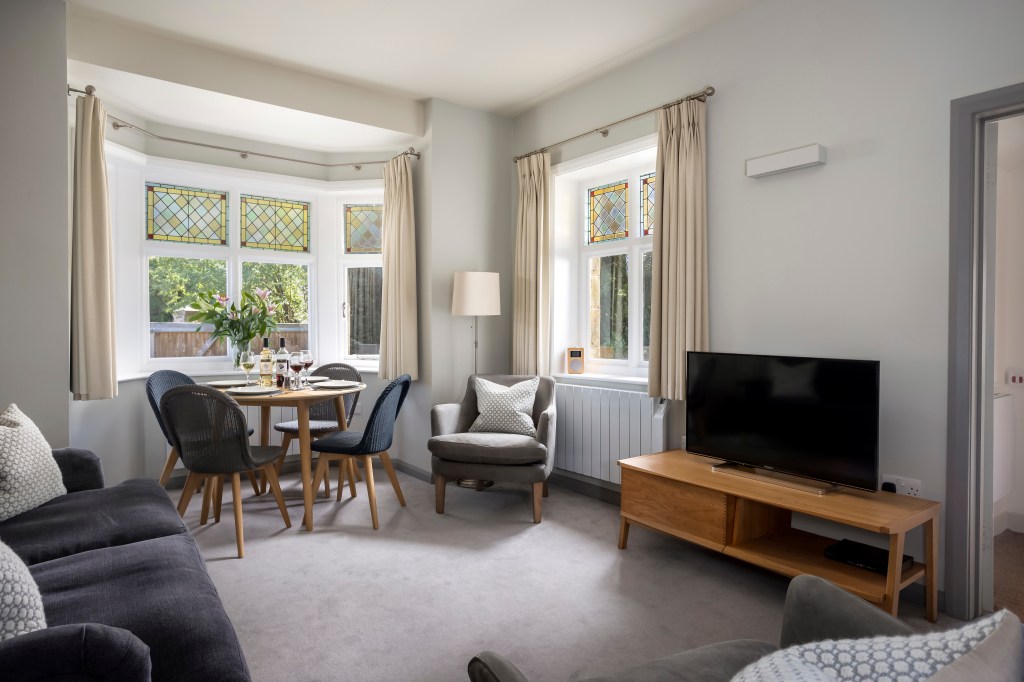


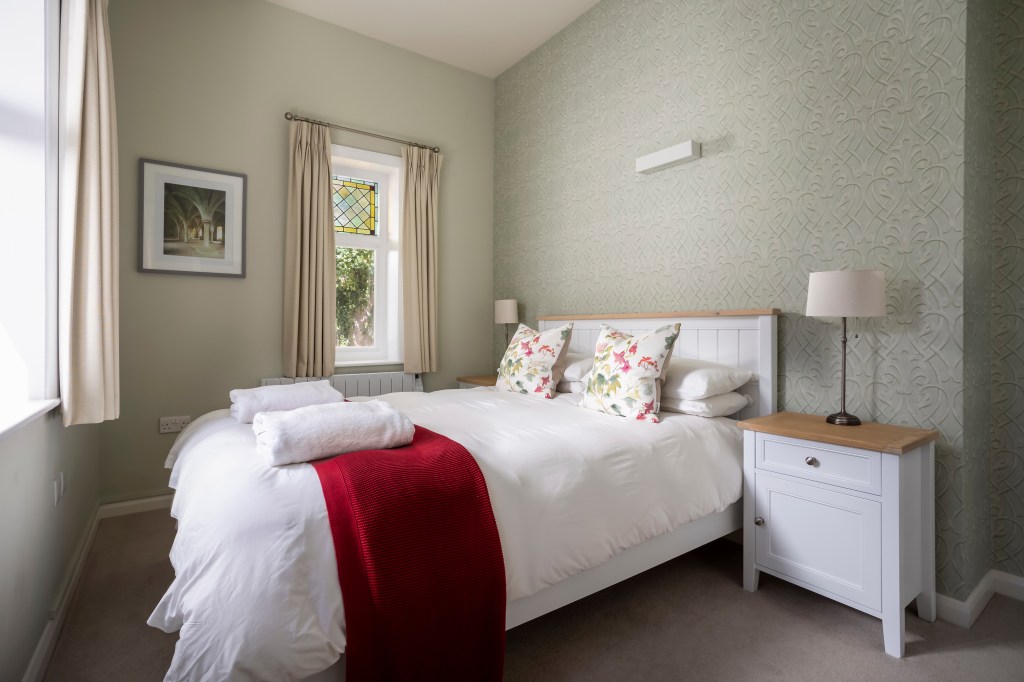
Photographs of The Lodge at Battle provided by English Heritage
We looked out on green fields where the sheep safely grazed and a flowering crab apple lit up the garden, our rental included VIP tickets to English Heritage sites in the area, discount in the shops and cafes, and access to the Abbey through the grounds in which our Lodge was situated. What more could travellers, history buffs and walkers want?

Location of Battle?
Lying just 50 miles from London and 27 miles from Brighton, Battle is well placed for visitors to the UK to include a day trip to see the attractive town and its Abbey. It gets its name from the Battle of Hastings, fought between Harold the Saxon king and William the Conqueror in 1066, a battle that changed the course of English history.
Battle Abbey & St. Mary’s Church
After he won the battle, William built the Abbey of St. Martin, something he’d vowed to do if he won. Built between 1070 and 1094, the high altar is believed to have been placed on the spot where Harold fell, although this fact is disputed today.

The Abbey ruins and the battlefield are a magnificent sight as you look down the length of Battle’s High Street, past the Georgian buildings that line the street. At the northern end can be found the Almonry, built in 1090, which now houses the Town Council and the Battle Museum of Local History.
At the other end of the street, the cottages and houses near the Abbey date from around 1700. The nearby parish church of St. Mary is for the most part 12th century in construction. This lovely old church is worth a visit for its rare 14th century wall paintings and its Norman font, but it also houses a modern tapestry in the style of the Bayeux tapestry, a community project conceived and designed by local inhabitant, Tina Greene. The contemporary tapestry is a three-metre long depiction of how the town of Battle might have grown between the years following the Battle of Hastings in 1066 to the founding of St Mary’s Parish Church in 1115. Started in 2016 and with contributions from 741 registered stitchers, not only from Battle but from the rest of the UK and abroad, the tapestry was finally completed in January 2017.
Dissolution of the Monastery in 1538
Battle’s influence grew over the years until the Dissolution of the Monasteries under Henry Vlll and the closure of the Abbey in 1538. In later centuries however, the town achieved fame through its charcoal-making technique and Battle became famous in the 17th and 18th centuries for its gunpowder, rated by Daniel Defoe as the finest in Europe.


Battle Today
Now today, this quiet market town concentrates on the finer things in life and, apart from its great historical appeal, it offers the visitor great food experiences from the comfort of tiny cafés and tea rooms that spill out onto the pavements (and a special mention here to Bluebells Tea Rooms) to fine dining at chef Paul Webbe’s The Wild Mushroom, in nearby Westfield, right up to tastings at Oastbrook Estate Vineyard.
Shopping is a delight too, as Battle’s historic high street features many of the type of shops you don’t often see elsewhere, independent clothes shops, craft shops, wool shops and book shops, and my favourite, the delightful British Design British Made, showing the best of British design. For beer lovers, Battle Brewery and Bottle Shop is a don’t-miss, offering beer from their own microbrewery as well as other locally produced ciders, wines and snacks.


There are mapped walks ranging from 4.5 miles to 37 miles and the helpful tourist office can offer guidance on these.
In fact, the weather doesn’t really matter in Battle as there is just so much to do. I know this for a fact, five days in Battle flew by and we even made time to visit Hastings (more about that another day).
Facts:
For a selection of English Heritage accommodation: https://www.english-heritage.org.uk/visit/holiday-cottages/ I have previously stayed at Walmar Castle in Deal and Osborne House on the Isle of Wight, both of which I highly recommend.
In With a Shout.
One of the Apps on my computer offers what it calls Memories. It flags up a photo taken on the same date years before. A few weeks ago, the photograph was one taken some years back at the Tennessee Williams Literary Festival in New Orleans.
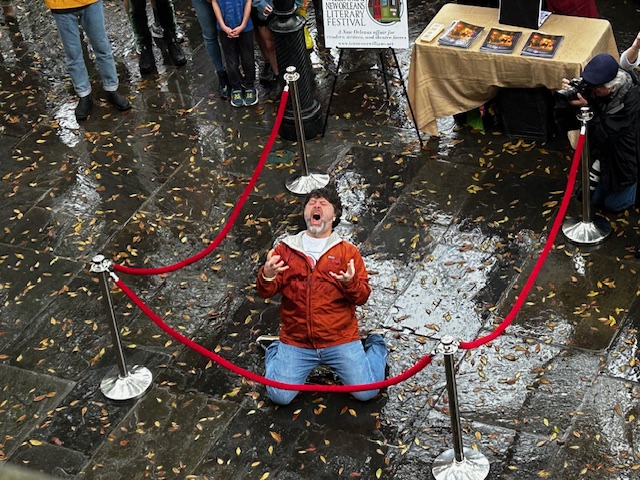
My photo was one taken at a very quirky part of that festival – the ‘Stella Shouting Contest’ – a homage to A Streetcar Named Desire and the character of Stanley Kowalski, the hero/antihero of the play.

The Stella Shouting Contest in New Orleans
“Stellllllaaaaa! Stellllllaaaaa!”
The cry reverberates around the French Quarter of New Orleans and the crowd jostling in the packed courtyard applauds. From the balcony above, Stella waves to the damp-haired man in the sweat-stained shirt below who blows kisses to the crowd as the next tee-shirted Stanley steps forward to chance his luck at outshouting the other participants.

For this is the Stella Shouting Contest, part of the Literary Festival, held for nearly 40 years in honour of New Orleans’ favourite son, the playwright, Tennessee Williams. The Stella contest pays homage to his classic A Streetcar Named Desire and for the last three decades or so, the primal screams of wannabe Stanley Kowalskis have been echoing around the magnolia-laden French Quarter to mark the Festival.


A Streetcar Named Desire
“They told me to take a street-car named Desire, and transfer to one called Cemeteries, and ride six blocks and get off at Elysian Fields”, says Blanche when she arrives at the house in which her sister Stella lives with Stanley.
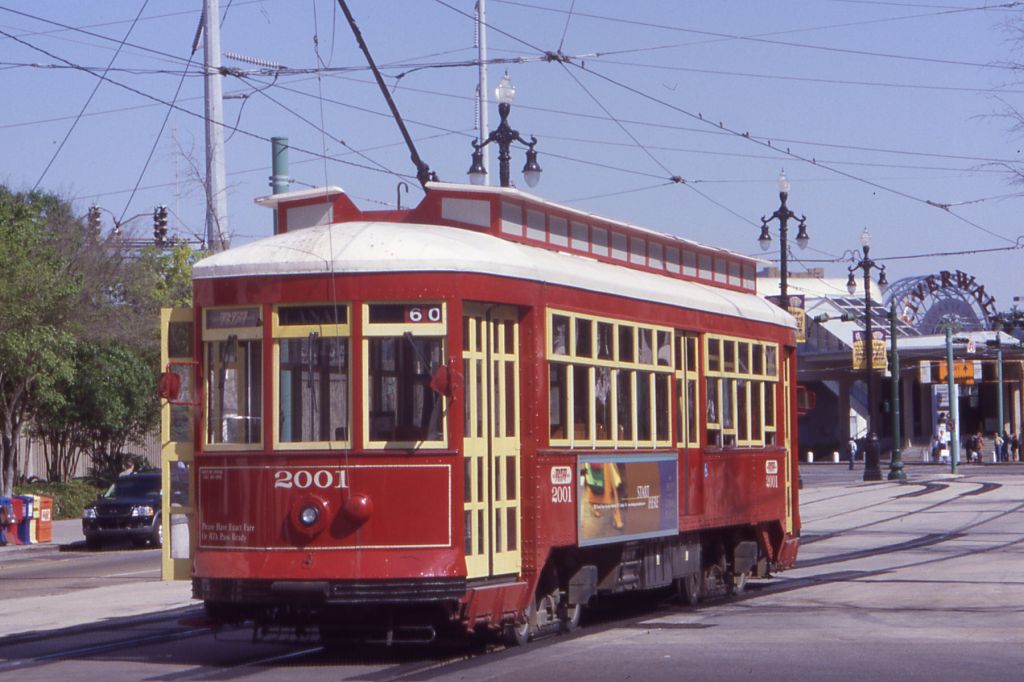
Williams used the title metaphorically: there was no street-car named Desire trundling along the tramlines to Stella’s house, but there was, and is, Elysian Fields Avenue, a name is forever linked to the steamy tragedy of Stella, Stanley and Blanche.
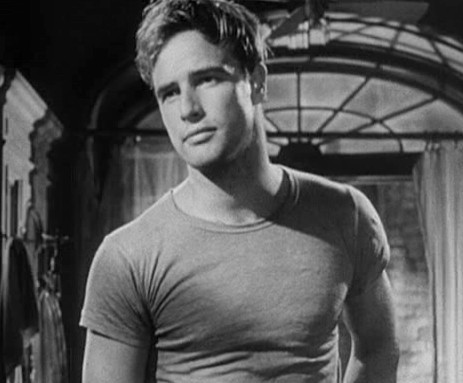
Marlon Brando in Streetcar
Marlon Brando played Stanley in the original Broadway production, and in the 1951 film adaptation of the play, he set the standard for all future Stanleys. His despairing “Stellllaaaa” echoed around cinemas and lodged in the minds of filmgoers forever when drunk, sweat-soaked and half-dressed, he stumbled onto the sidewalk and fell to his knees, bellowing for his wife, “Stellllaaaa” – probably the most famous line from any of Williams’ plays. Little did anyone guess then that this angst-ridden howl would one day become a feature of one of the USA’s Literary Festivals.
What Happens During the Literary Festival
Events like the Stella Shouting Contest, theatre productions, in-depth writing workshops, and lectures from best-selling authors on everything from scene-setting to stereotypes in fiction, attract attendees from all over the world. Giants from the world of literature and theatre mingle with would-be-playwrights and authors, to offer advice, give talks and join in the celebrations, all overlain with that N’awlins easy charm.

What Happens in the Stanley Shouting Contest
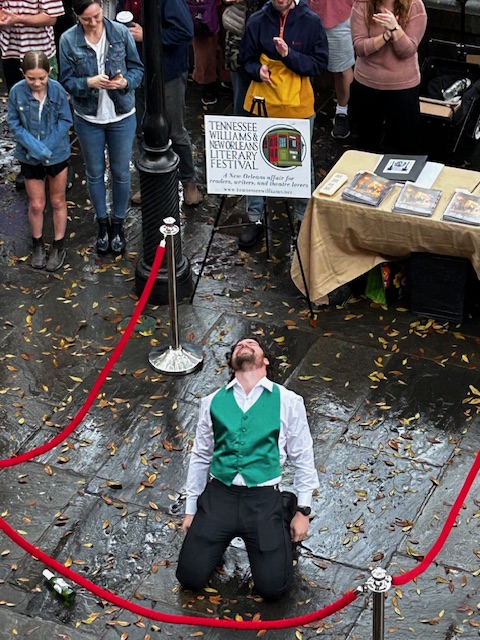
The famous scene, and the scream, is replayed again and again by men who come to The Big Easy to test their screams against other men. Technically it’s a Stanley/Stella shouting contest as females can also take part, but as Stella didn’t yell “Stanley” it doesn’t resonate with the public in quite the same way so there are few entries on the Stella side.
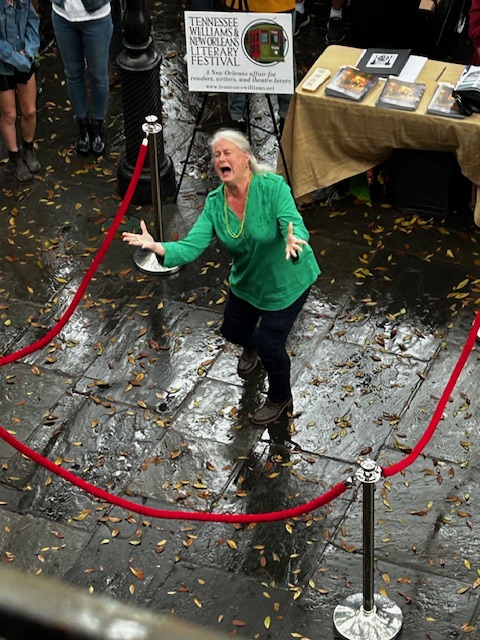
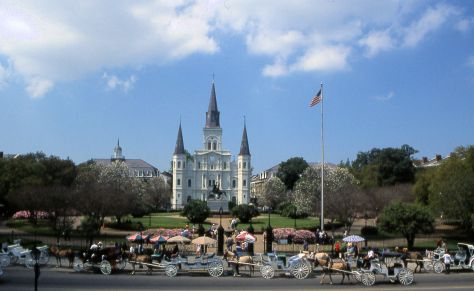
Standing beneath the filigreed balconies of the houses around the green oasis of Jackson Square the contestants direct their howls of desire and angst at local actors attired as Stella and Blanche on a balcony above. Celebrity judges lounge on adjoining balconies, while festival go-ers and voodoo hustlers jostle for positions from which to watch the fun.


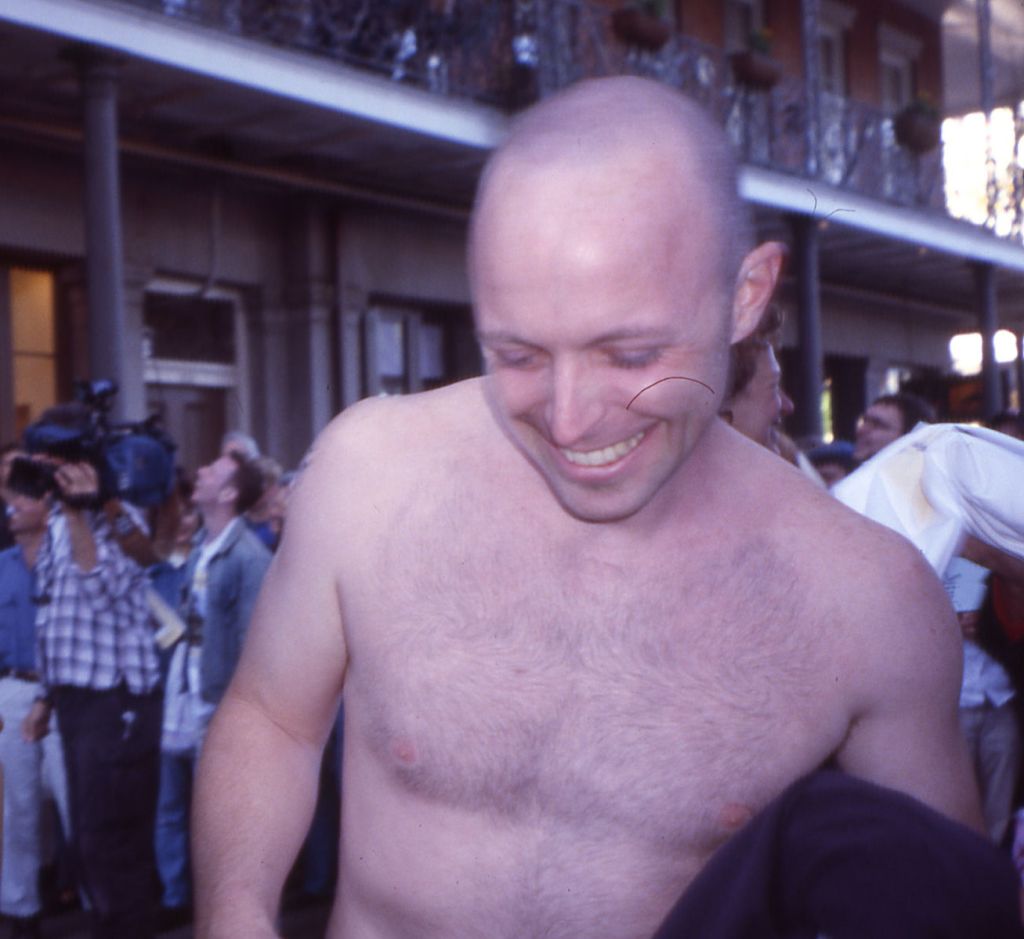
One by one the contestants give it their best shot in the allotted three shouts in which they must portray Stanley’s despair, rage and emotion. They fall to their knees, tear their shirts – the iconic torn white tee-shirt is a given – and douse themselves with water to conjure up the image of Stanley’s sweat-soaked torso.
To whoops and cheers, six finalists are selected and they go on to compete a few hours later, on the main stage of Le Petit Theatre, the venue for the Festival’s workshops, play readings and lectures. We, the onlookers and audience, troop in after them, by now having a favourite to encourage in the tension-filled finals.

On the stage at Le Petit, the Stanleys now scream with more gusto and histrionics, encouraged by their fans in the crowd. Hyped up – alcohol may play a part as well – cheering for their man and booing the opposition, the audience sounds as primal as Stanley.
All this for the grand prize of the Golden Stella Trophy, holidays in New Orleans, hampers of local goodies, and trips on Ole Miz, the muddy brown Mississippi.

Few Festivals have such a strong performance element as the Tennessee Williams Literary Festival – two full-length plays and several one-act plays of the master are usually staged alongside film screenings, tours of the French Quarter, book signings, and jazz evenings. All this plus work-shops and lectures from writers like David Simon, James Lee Burke, Richard Ford, Laura Lipman, and dozens of others. You’re bound to meet your favourite author there and for some reason, crime writers are particularly well represented.

New Orleans
The Big Easy still lives up to its motto of ‘Laissez les bon temps rouler’ – let the good times roll – and outside the theatre the city goes about its business, partying along Bourbon Street and entertaining the tourists in Jackson Square where the voodoo priestesses, hawkers of hats and beads, and groups of wild looking Cajun and Zydeco musicians straight from central casting come together in a gloriously chaotic, laid-back cocktail.
There are also city tours, swamp tours, plantation tours, and that old standby, shopping, and that for which New Orleans is best known – music – from trad jazz to funk, zydeco to gospel. While there you can take in a session with one of the city’s best bands, Jon Cleary and the Monster Gentlemen Band, who will take you on a jazz voyage like you’ve never experienced before.
So if you’re in the area next March and fancy your chances of being a ripped-shirt Stanley with a voice that could persuade Stella not to leave him, then go for it.
Tennessee Williams loved this mixture of the pious and the profane, the sinners and the saints – isn’t that what all his plays are about?

Factfile:
The 38th Annual Tennessee Williams/New Orleans Literary Festival took place this year between March 20th—24th. Next year’s dates not yet published. Sign-up for the Stella Shouting Contest will begin at 1.30 3 or 4 days prior to the opening.
The Tennessee Williams Literary Festival: 938 Lafayette Street, Suite 513, New Orleans, Louisiana 70113. Tel: 504 581 1144. info@tennesseewilliams.net
British Airways flies direct to New Orleans from £575 Return and also offers hotel bookings. Other airlines fly via Chicago – a good place for a stop-off.
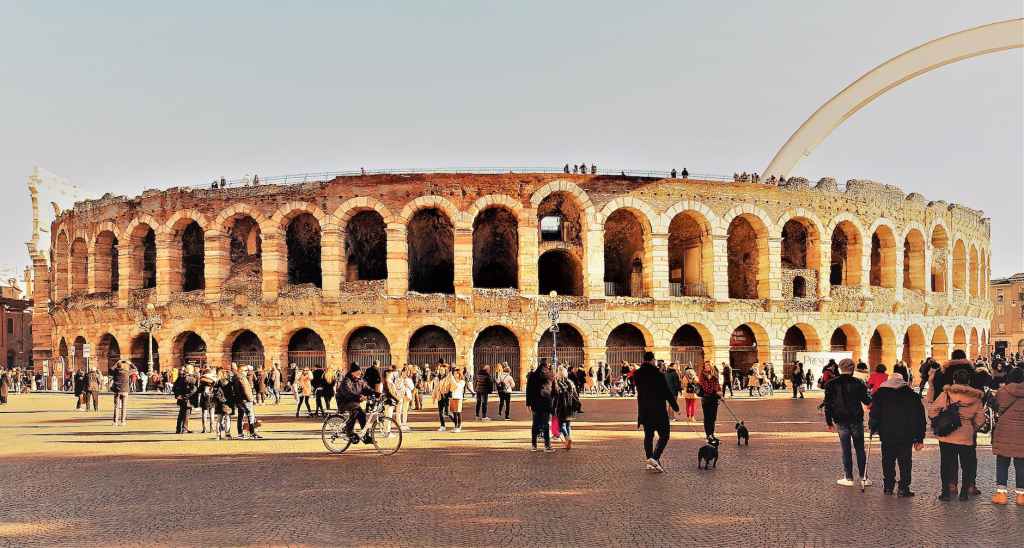
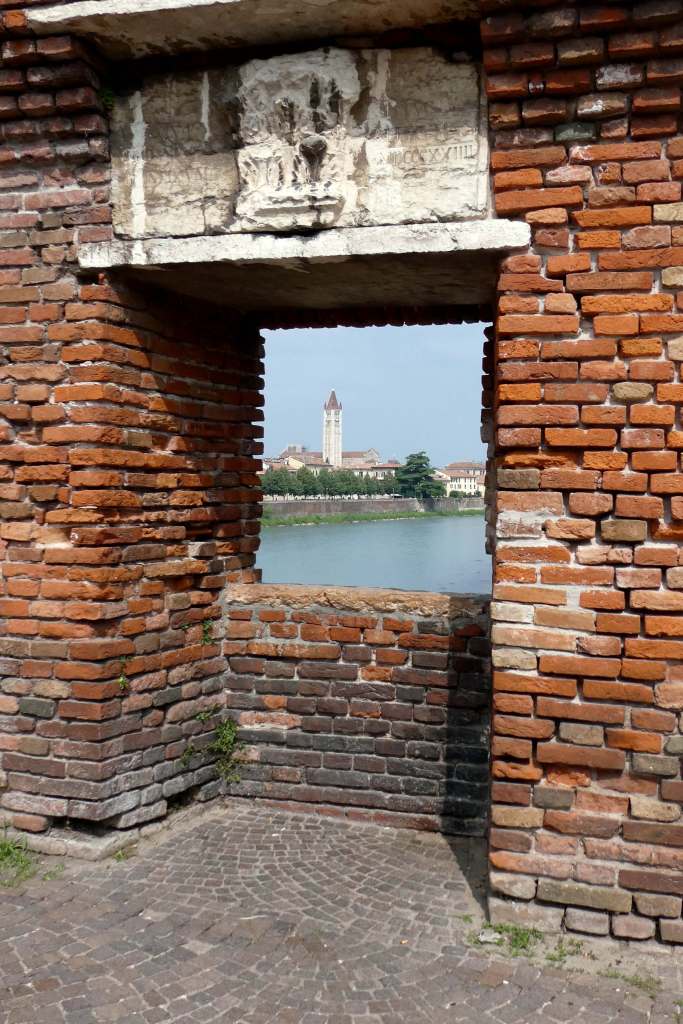
It’s no secret that I love Verona, and just two of the reasons for loving it are a) the city is highly walkable, and b) it is a place where tourists take second place to locals who live and work in its historic centre.
That’s not to say that visitors aren’t everywhere, but as you stroll through the medieval streets, charmed by faded frescoes and hidden gardens, or sit at the foot of an enigmatic marble statue in one of the huge piazzas, you never feel part of mass tourism.
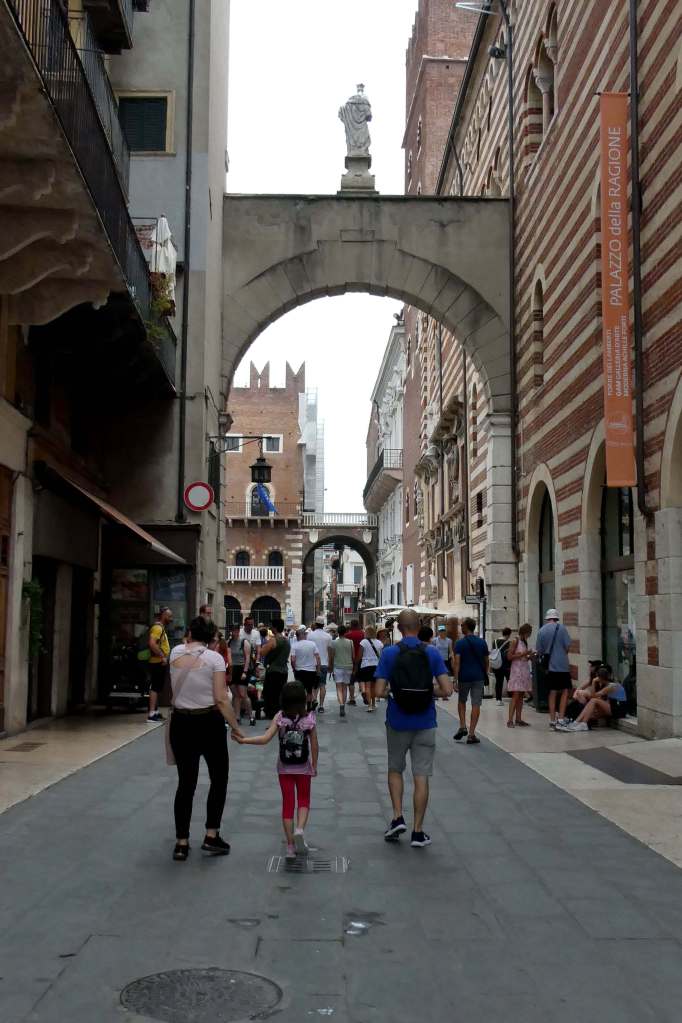
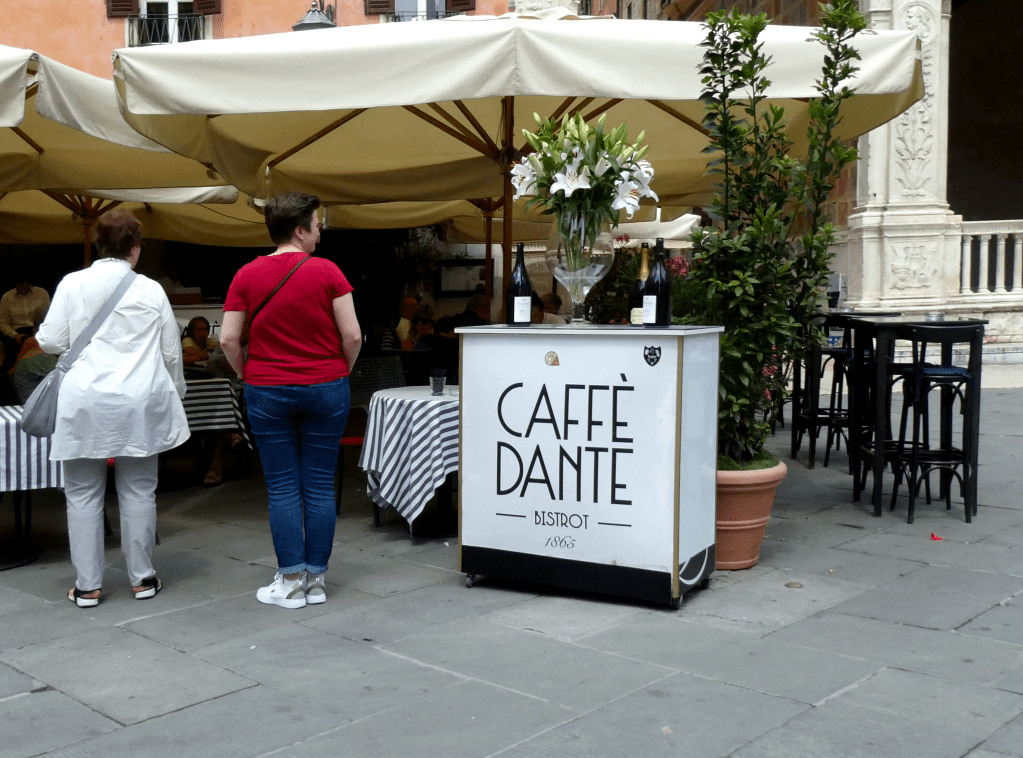
Simply strolling through Verona leads one to magical places, like the splendid Piazza del Signori. Italy’s most famous poet, Alighieri Dante, lodged nearby with the ruling Della Scala family during his exile from Florence in the 14th century, and so the square also answers to the name of Piazza Dante. Surrounded by ancient buildings which played an important role in Verona’s early civic life, whose façades, although faded, are still beautiful, the square still resonates with a sense of medieval life.
Scaligeri, Napoleon and Castelvecchio
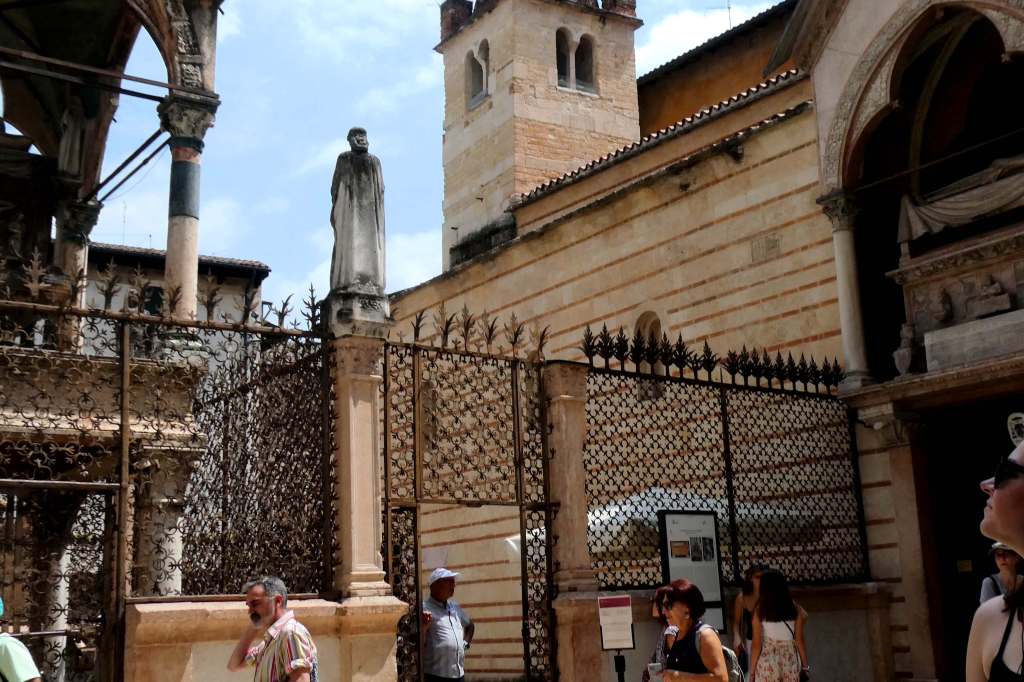

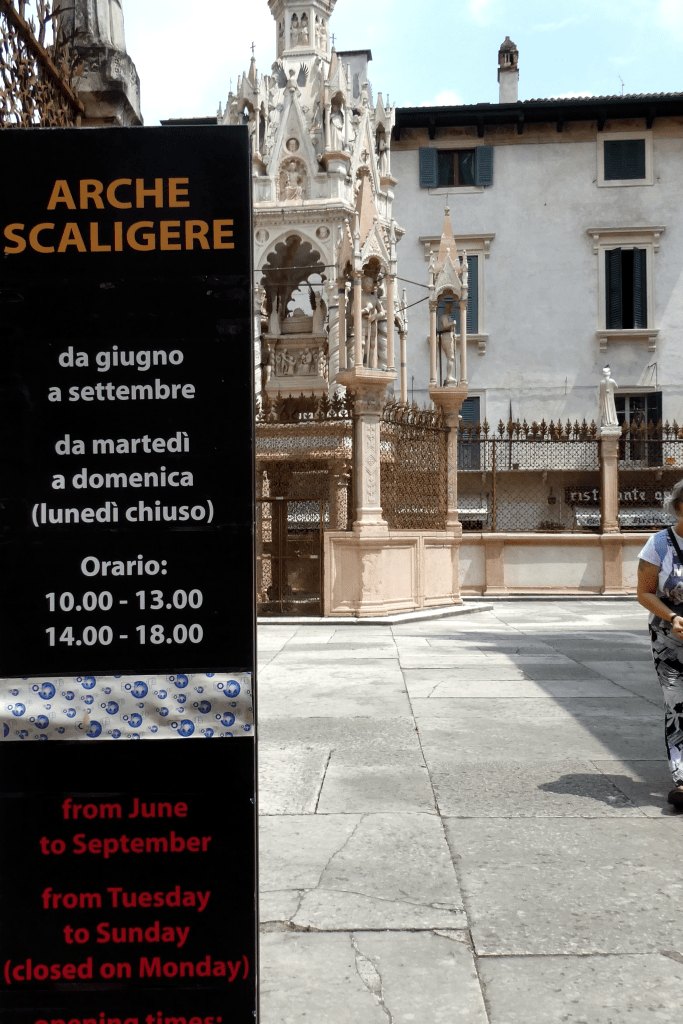

Nearby is another tiny square in which can be found the tombs of the Scaligeri family. They dominate the area, massive Gothic-like edifices, some behind a gated courtyard, and one above the church door. Intriguing, certainly, and something not to be mi
More Scaligeri family history can be found at Castelvecchio, best approached along the Adige River and across the bridge into the city proper. Castelvecchio (in Italian ‘the old castle), a red brick building with crenelated walls and square turrets was built by the ruthless Scaligeris in the 1350’s as a home and a fortress. A later ruler also used it as his residence, during his time in Verona – one Napoleon Bonaparte who had conquered most of Northern Italy in the early 1800’s.
During the 1920’s it was converted into a Museum and then in 1985, a renovation project to repair the damage done during the second world war was started by Italian architect Cala Scarpa. The result of that renovation is the splendid red brick castle one sees today the interior of which has been converted into one of the best Museums in Northern Italy.


Romeo & Juliet
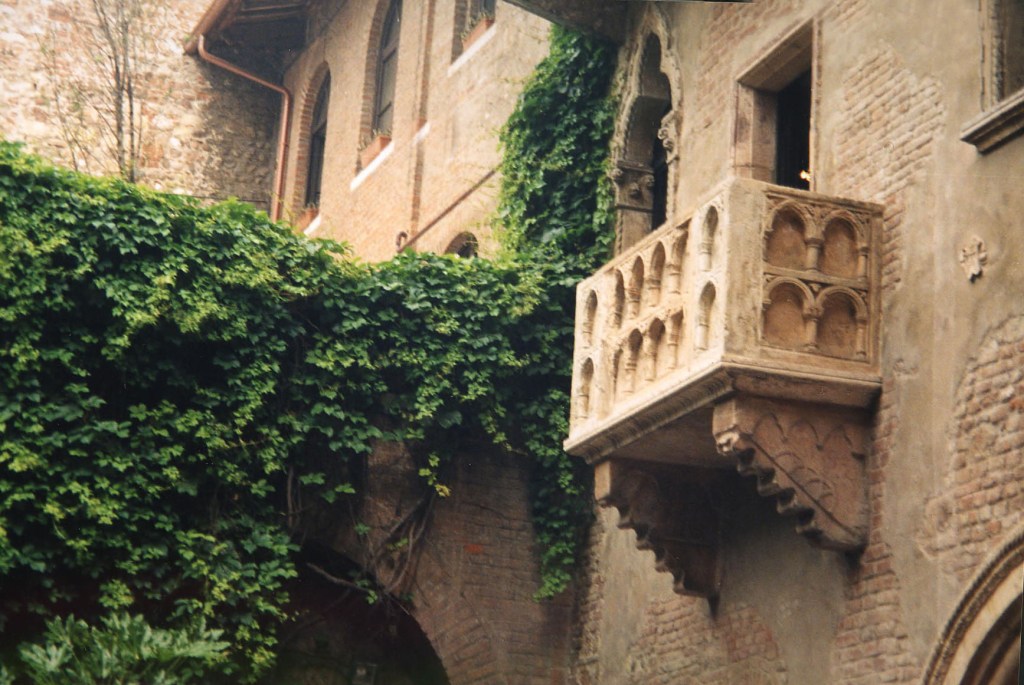
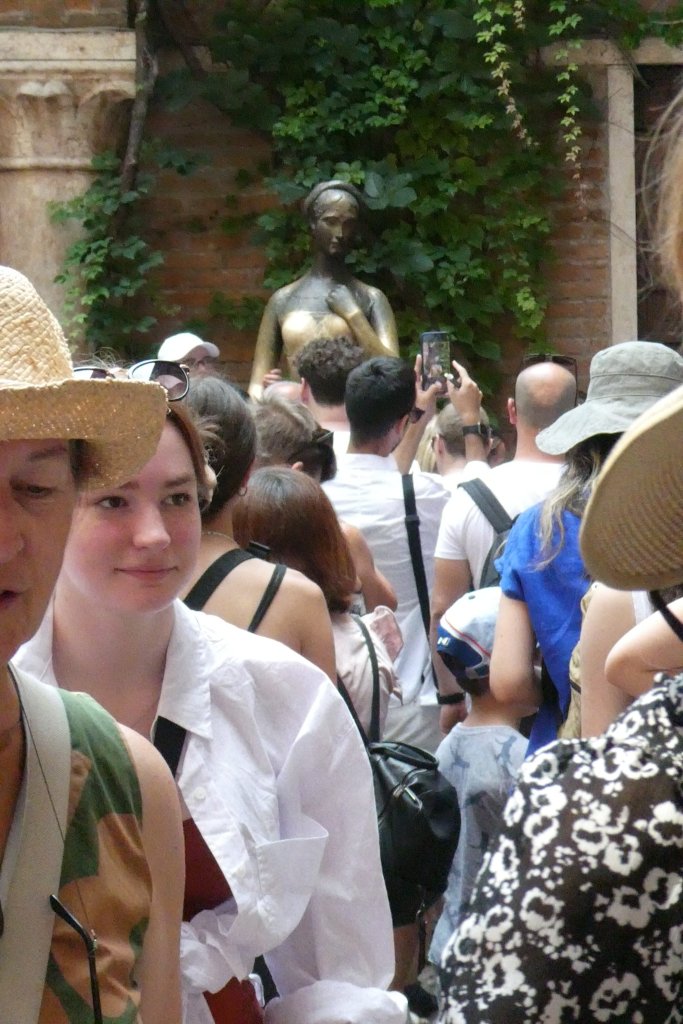
Everyone knows that Romeo & Juliet are fictitious characters dreamt up by William Shakespeare, but that doesn’t stop the crowds pouring into the courtyard of the supposed home of Juliet in Via Cappello, to touch the statue of the young heroine, and to pose on the balcony for a selfie. So many people have touched Nereo Costantini’s bronze statue that her right breast has now been burnished to gold. But even though the balcony you see today was erected only because tourists kept demanding to see the balcony, it is worth a visit even if you are in Verona for only one day. The house once belonged to the rich Veronese Dal Cappello family, and to visit the house and its courtyard gives an idea of how families lived in Verona in the 14th century.

My last visit was some 14 or so years ago, the courtyard then was almost empty, we had time to explore the house and surroundings and even read some of the letters received daily asking for advice. This time, however, the search for the ultimate selfie by the crowds queueing and surging into the small space under Juliet’s balcony was a major distraction, yet I would still return to feel the magic that the place possesses. It is but a short step away from the city’s two major Piazzas linked by its famous shopping street, Via Mazzini.
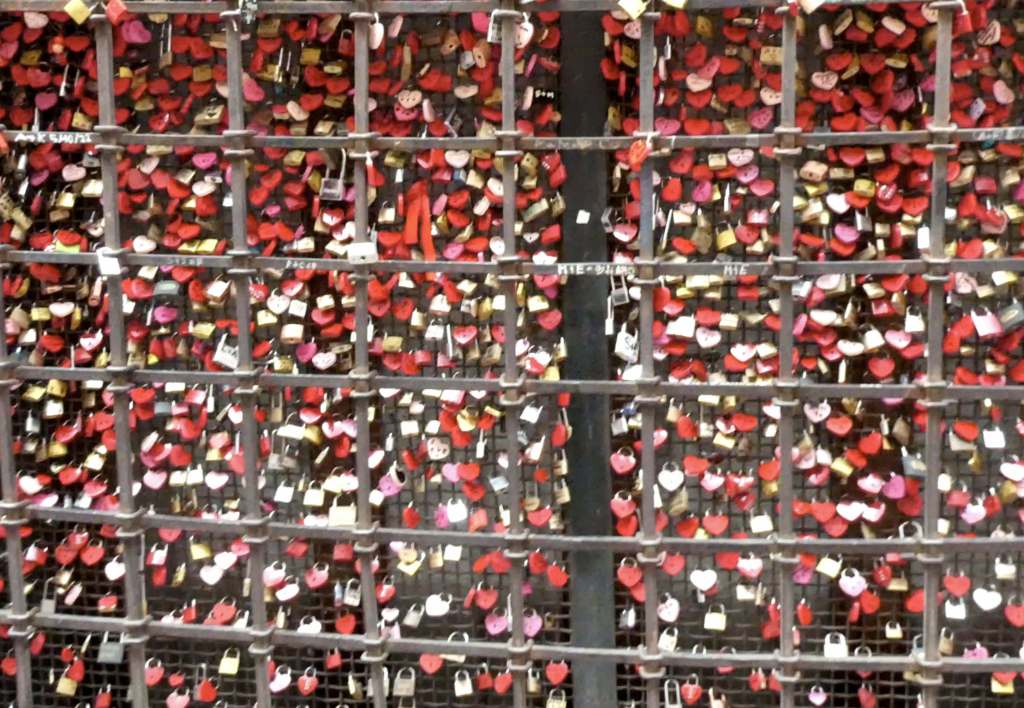
Lovers’ Locks
Piazza del Erbe and Piazza Bra
Piazza del Erbe, named after the spices that were once sold there, (erbe=spices in Italian), Verona’s most ancient piazza, was ‘the Forum’ during Roman times. It is now Verona’s commercial centre, a hub for shopping, café life, and people watching. Beautiful old buildings surround the Piazza in front of which lively market stalls sell food, spices and household goods, while the traders entertain the public as they have done since Roman times. It is around this area that you will find the prettiest streets and alleyways.

The Via Mazzini, a high-end shopping area where the shops all bear famous fashion names, from Chanel to Dolce & Gabbana, links Piazza del Erbe with Piazza Bra, home to the famous Amphitheatre of Verona, usually called The Arena. Elegant ladies with tiny dogs parade down this street which on Sundays can become very crowded when it is time for the passeggiata, the ritual Sunday evening parade when all Italy turns out to display la bella figura.
I kept the best till last. The impeccably preserved Amphitheatre in the heart of old Verona and the city’s most famous site, is deserving of that much abused word, awesome. Rows of arches and curves dominate the skyline and form a centrepiece in Piazza Bra, the city’s largest public square.
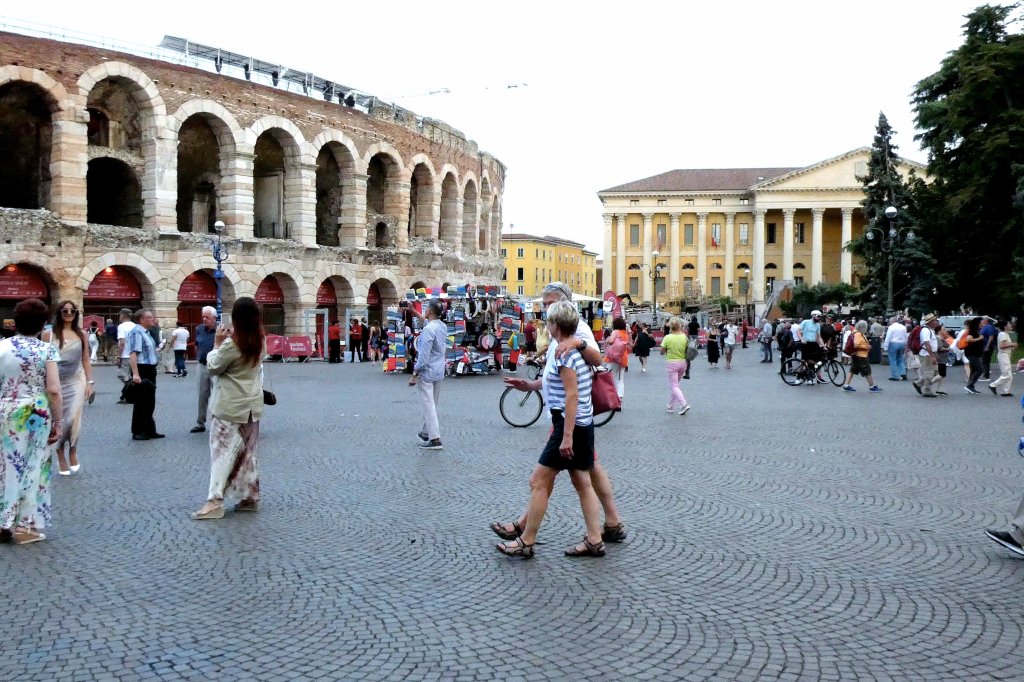
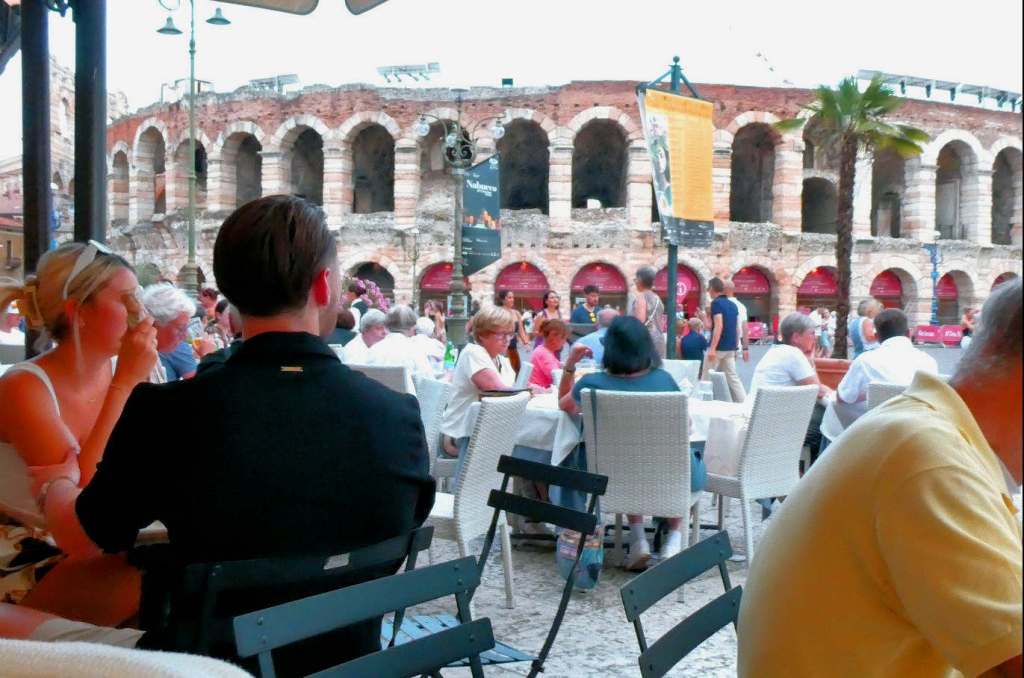
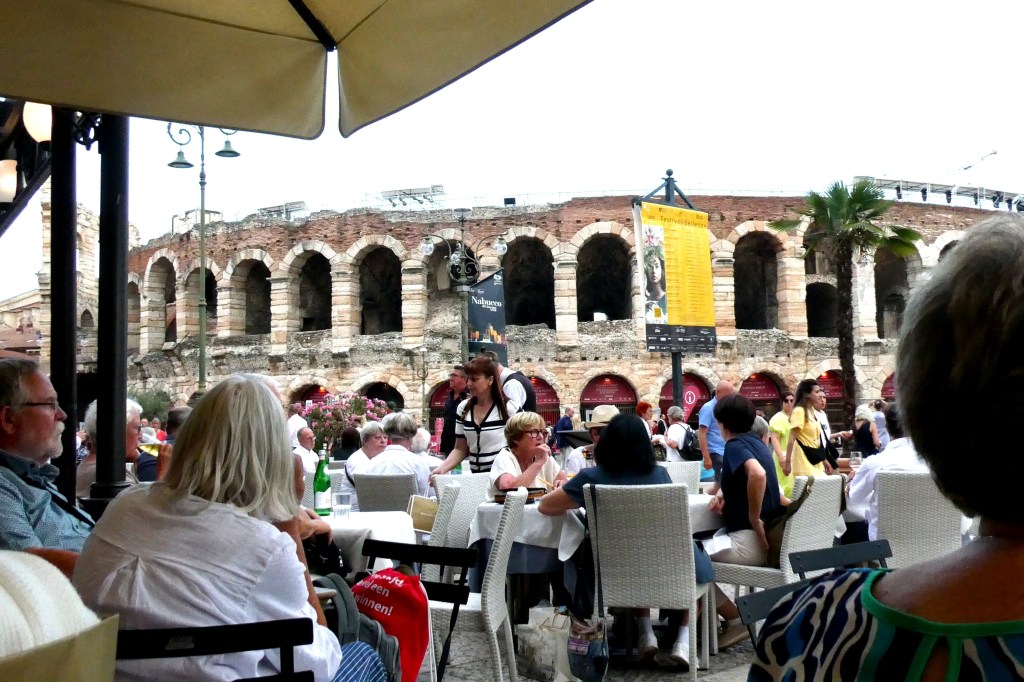
The square is lined with bustling restaurants and imposing buildings, notably the 19th century Palazzo Barbieri, a yellow building with a neoclassical façade that now serves as Verona’s Town Hall. Nearly two millennia old, the Colosseum used to hold up to 30,000 spectators at gladiatorial fights between men and men and men and beasts, who fought to the death on the sandy stage. And this glorious arena is not a dead relic of the past: it still entertains the masses although in a different way. No more are the crowds offered bread and circuses but performances of high art, most notably the world famous Verona Opera Festival which takes place every summer.


Verona is a city for all, young and old, the seeker after history & ancient cultures and lovers looking to re-kindle an old love or find a new one, opera lovers who fill the Arena night after night during the summer, and fans of William Shakespeare who watch his dramas play out under the stars. There’s a jazz festival, a festival of street games, and even a horse fair. As I said, Verona is a city for everyone.

A Sunday lunch with Spanish friends can never be silent, in fact it will be quite the opposite. We had enjoyed lunch with old friends in Arco and were driving back to Ronda when we turned a corner, and there was a scene of such solitude and calm that we paused by the roadside to savour it. There must have been birdsong and goats bleating, but I can’t remember any sounds at all.


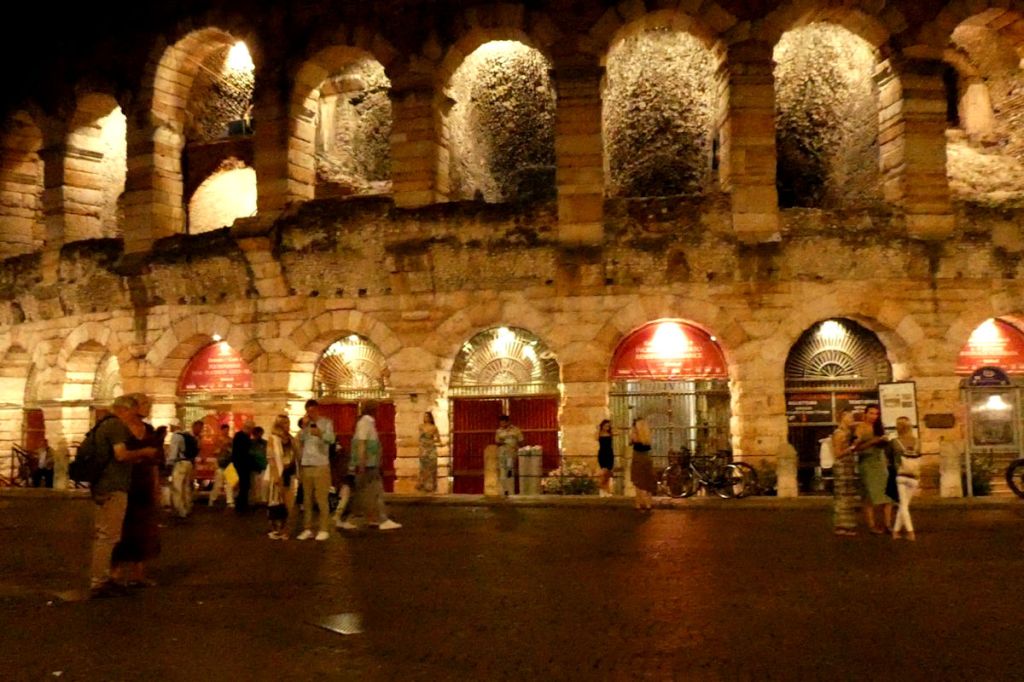
We came, we saw and we were conquered. Not just by the city but by the by-product of that city, opera, for we were in Verona for the 100th Anniversary of the performance held in the ancient arena, an arena older than the Colosseum in Rome. In ancient times it held 30,000 people for its circuses and gladiatorial events but as the stage for opera performances decreases the available seating, it now has places for only 22,000.
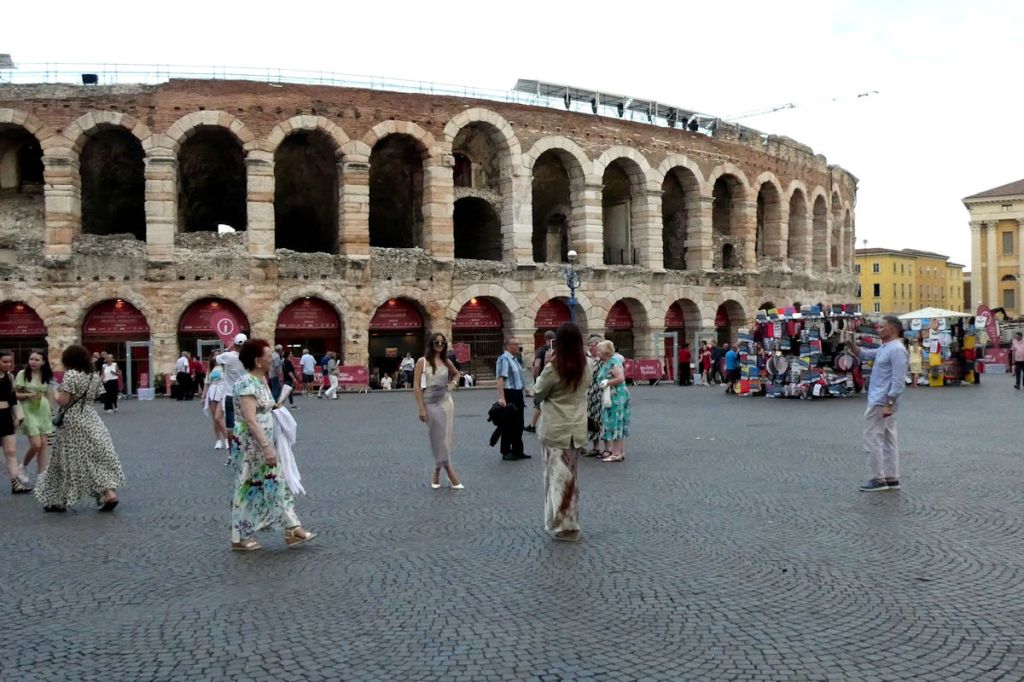
We came to Verona, my friend Jane and I, for Giuseppe Verdi’s Aida, the signature opera of the city. Although there had been some productions during the 1850s, it wasn’t until 1913 that opera began in earnest in the Arena, due to the zeal of the famous Italian tenor Giovanni Zenatello and the impresario Ottono Royato. The first opera to be produced in the arena on 10th August 1913 to mark the centenary of Verdi’s birth in 1813, was Aida, and since then, Aida opens the yearly festival of opera.

As dusk settled over the amphitheatre and a pale moon floated in the velvety blue sky above, anticipation was high. We’d watched the stage-hands sweep the tiered stage, watched the lighting engineers fiddle with the lamps, and wondered at the meaning of the objects that decorated the set, crystal pyramids, giant hands, and lighting designs which, although technologically modern, blended easily into the ancient Roman amphitheatre. Later I read that the giant white hands that dominated the stage represented power.

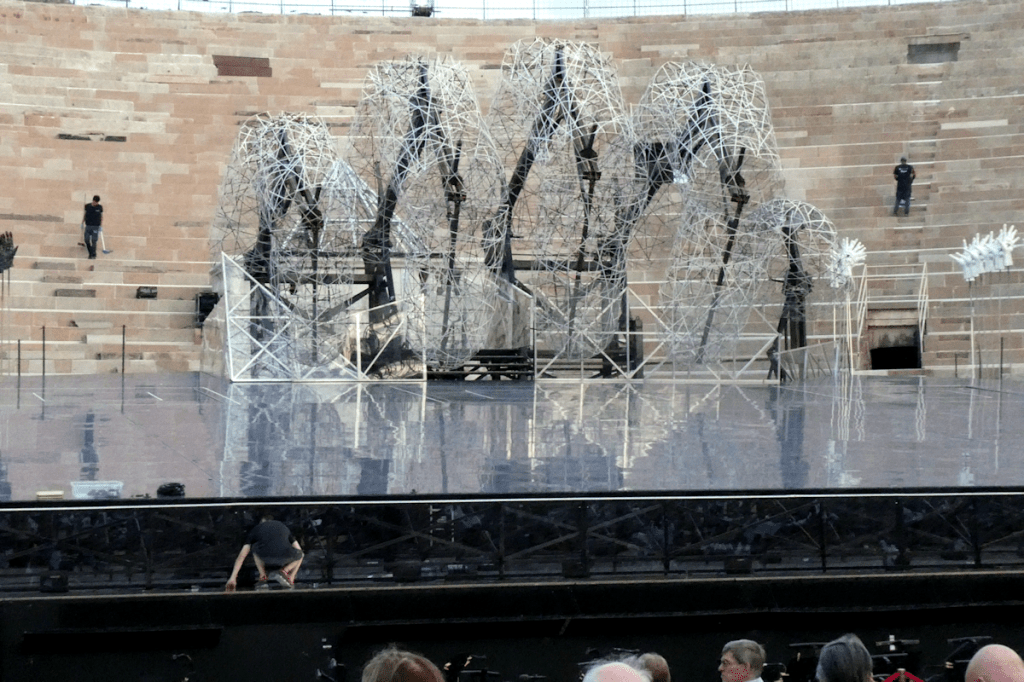

The arena was full, from the front padded seats to the tier upon tier of stone seats (no back rests but with hired cushions for comfort), and the audience milled around taking photographs, chatting in groups and in Italian fashion, jumping over seats to shake hands with old friends before the performance began at 9.30 pm. It was an audience as enthusiastic as any I’d ever seen – and noisier than most.


Then suddenly the orchestra was filing on to rapturous applause and the opera was about to begin.

There was a hush as Alexander Vinogradov as Ramfis began singing, a hush that continued throughout the First Act and every subsequent Act. I have never, ever, known an audience be so quiet, enraptured even, so receptive of the story being told in voice and music from the stage, so totally engrossed in what was happening in front of them.
I can’t even begin to guess how wide the stage was: one’s eye just couldn’t take it all in at once, yet somehow, the war-stricken world of Aida materialised in an intimate setting on the vast arena stage, as over 300 performers – soloists, chorus members, dancers and mimes – cast their spell. Their costumes were inspired by Paco Rabanne and Capucci, silver robes and helmets radiating brilliance across the expanse of the tiered stage.

The gigantic wire hands which towered over the stage and had puzzled us when we first saw them now moved menacingly or soothingly as the music and the story demanded. Stefano Podo’s avant-garde production included LED-laser lights that formed shapes and changed colours from red to blue to green, to great effect, plus impressive lighting effects at the back of the arena as actors brandished what looked like light rods used to great effect during the judgment scene.

And as for the Arena itself! Built in AD30 out of white and pink Valpolicella limestone (a few repairs since then), the arena has perfect acoustics (amplification was only brought in in 2011). In its heyday it hosted gladiatorial fights and blood sports, horse races and medieval jousts but nowadays the crowds come not for blood and gore in the sand but to be transported to another realm by the beauty of the human voice.
I’m failing as a writer here because I can’t describe what the experience of seeing and hearing the opera was like; it was a spectacle that needed to be seen in order to understand the power it had. I had been to the Arena years ago when the stage effects for Aida included ancient Egyptian scenes to rival those of Cairo. We were younger then, my husband and I, and we sat on the stone seats way, way up on the terraces. The excitement of opera under the stars past midnight (it starts about 9.30 pm and finishes, usually, around 2.00 or 2.30 am) – meant that I wasn’t aware of any discomfort.
But the 2023 100th Anniversary Performance was even better, it was uncomplicatedly magical. Possibly helped by the fact that age now demands a padded seat and some space so we had expensive seats front centre (still nearly half what a similar seat would cost at Covent Garden). I would recommend paying that bit extra for the comfort if you are aged from 30 upwards!

And then jostling for seating at the café opposite the Arena with others who’d shared the experience, sipping a glass of wine at 2.30 am when the heat from the ochre-coloured stones was still intense, not wanting to go back to the hotel, and feeling part of something great and grand was somehow life-affirming.
Was it the settings? The music? The atmosphere? Maybe some of the silver dust drifted from the costumes and covered us with its magic? I don’t want to be a third-rate critic so I’ve found a clip on You Tube with a selection of scenes from the performance in Verona and if there are any opera fans among you, you might like to take a look and enjoy what we enjoyed.
Factfile:
Purchase tickets directly online, at www.arena.it/buy. You can check the availability of seats by consulting the seating plan, which can be found on each performance date. You will be asked to give a password so have one ready. If you want to book by phone, call +39 0458005151 Monday to Saturday 9 am to 6 pm.
British Airways flies direct to Verona.

Linked to the Sandy Chronicles

This picture is one I love because it captures, for me, a moment of total relaxation during a cargo ship cruise we took about 30 years ago. The ship was ‘The Author’, one of what I learned to call “the big whites”, boats of the South African Safmarine line.
Sunday was a big day for the crew when they had the brai, or barbeque, a tradition that was almost a religion for the South African crew on board. It was dress-down day when even the captain sported shorts and tee shirt, hair-cutting took place in quiet corners on the decks, and the crew relaxed in their ‘civvies’.
I was surprised that a barbeque was allowed on the deck, but I was assured all was perfectly safe. Eddie, the chef, had everyone’s favourite food ready, from salads to heavy carbs, fruits to exotic vegetables, and a fine selection of meats, fish and shellfish. As passenger we numbered only 7 but we had become friends with the crew over the course of our trip from Tilbury via northern Europe to South America. In fact we were their ‘shoppers’ as well, as some of the countries we stopped at would not allow the S.A. crew to disembark (political not racist) so we were given shopping lists when we disembarked – usually tee shirts for themselves and a gift for a Mum or a son or daughter.
I know this isn’t a good photograph, it’s blurry and lacks definition but it’s one of my all-time favourites because that holiday was one of the best ever and that evening sums it up so well. I must add here that I don’t go on cruises as floating hotels are not my cup of tea but a trip on a cargo-ship is a world apart.
On “The Author” we mixed with the crew as they went about their work during the day, and in the evening we socialised with them over drinks and dinner, played games in either their lounge or ours and swapped books and DVDs. Some evenings we lay on our backs on the deck and were taken through the star system by one of the crew, seen to its best away from the lights on land.
Thirty years after and I’m still in contact with one of the captains and two of the crew. It was an unforgettable holiday and I remember every minute of my time aboard “The Author”, Eddie’s great food, and the treats left in our cabin daily, from warm biscuits to gooey cake, the ever-changing menus due to the fresh produce he picked up at the different ports, and the tears and the hugs when we all said good-bye to some of the nicest people I’ve ever met.



 MARI'S TRAVELS WITH HER CAMERA