Tag: travel

  • A Walk on the Ramparts of Ypres

    A Walk on the Ramparts of Ypres

    I didn’t imagine it would be so difficult to write about my walk on the Ypres Salient in Belgium, as I followed the course of the World War l battle of 1917 but it’s impossible to write about the horrors of the 3rd Battle of Ypres (also known as Passchendaele) without including great chunks of history to explain just why we were walking there, and a blog is no place for a history essay.   That being the case, I have to forget my idea of doing a Monday walk for Jo and just add a few photos with connecting text. A few historical notes will be appended at the end of the blog for those who want to read them.

    Menin Gate at night
    The Menin Gate just before the ceremony of The Last Post

    First though, a few details.

    During the course of the war, Ypres was all but obliterated by artillery fire.  At the end of what we now call The Great War, it lay in ruins, only a handful of buildings left standing.  First-time visitors to Ypres find it hard to believe that this magnificent town with its enormous square surrounded by medieval and Renaissance buildings was completely flattened by 1918.   Virtually the whole of the town you see today was reconstructed from scratch, stone by stone, brick by brick during the 1920’s and 1930’s.  Rubble that could be incorporated into the buildings was collected, cleaned and re-used and the planners, by referring to the medieval sketches and diagrams that had survived, were able to painstakingly rebuild the squares, streets and beautiful buildings of this ancient Flemish town.

    Throughout the town, you will see bronze plaques bearing the outline of the Cloth Hall, the Cathedral and the Menin Gate at street corners.  These are the signposts for the 5.5km  provincial Heritage Footpath,  the most complete footpath in the Ypres inner city.

    Ypres Panorama (sort of)
    Panoramic View of Ypres centre with the famous Cloth Hall on the left – © Mari Nicholson
    Ypres by night
    Ypres at Night with famous Cloth Hall on left –  © Mari Nicholson

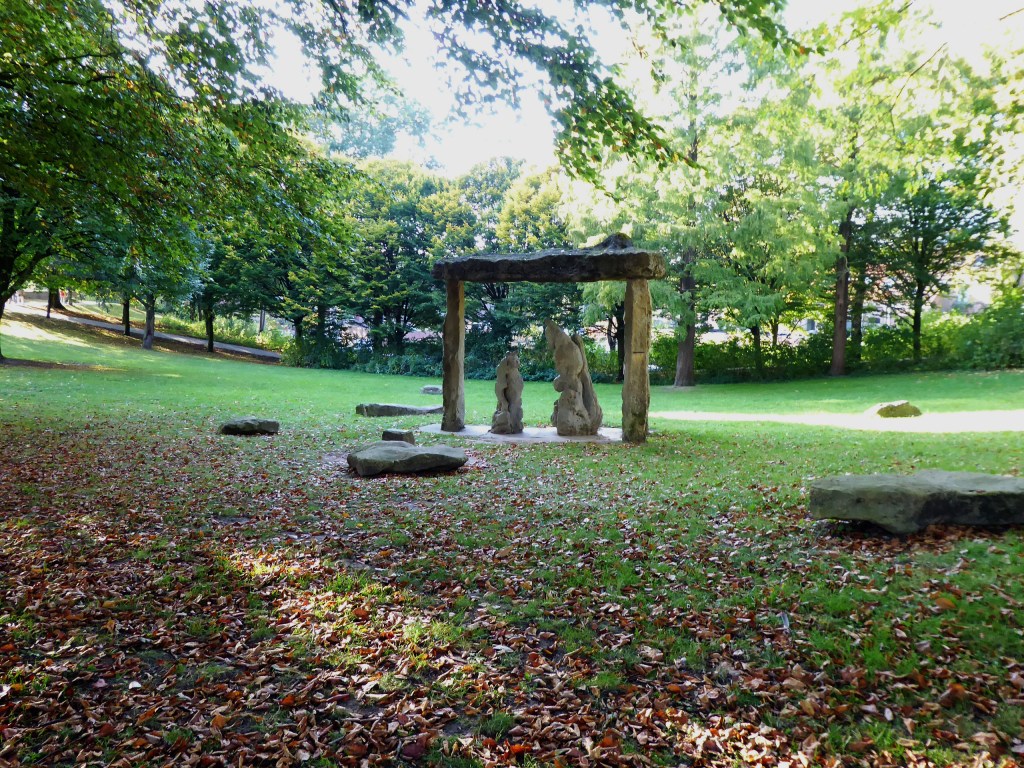
    Ypres had been fortified since about the 10th century and the Ypres ramparts are the best preserved in the country.  The town originated on the banks of the Ieperlee and some ten centuries ago it was contained within little more than an earth wall and some moats, parts of which, dating from 1385, still survive.  Later, stone walls and towers were added and later still, under occupation by the Habsburgs and then the French in the 17th and 18th centuries, the walls were strengthened, and bastions, advanced redoubts and more moats were added.  The Lille Gate is the only city gate left out of the many that existed in the past.
    Ramparts Walk 2
    On the Ramparts at Ypres – © Mari Nicholson
    Ramparts Walk
    Ypres Ramparts

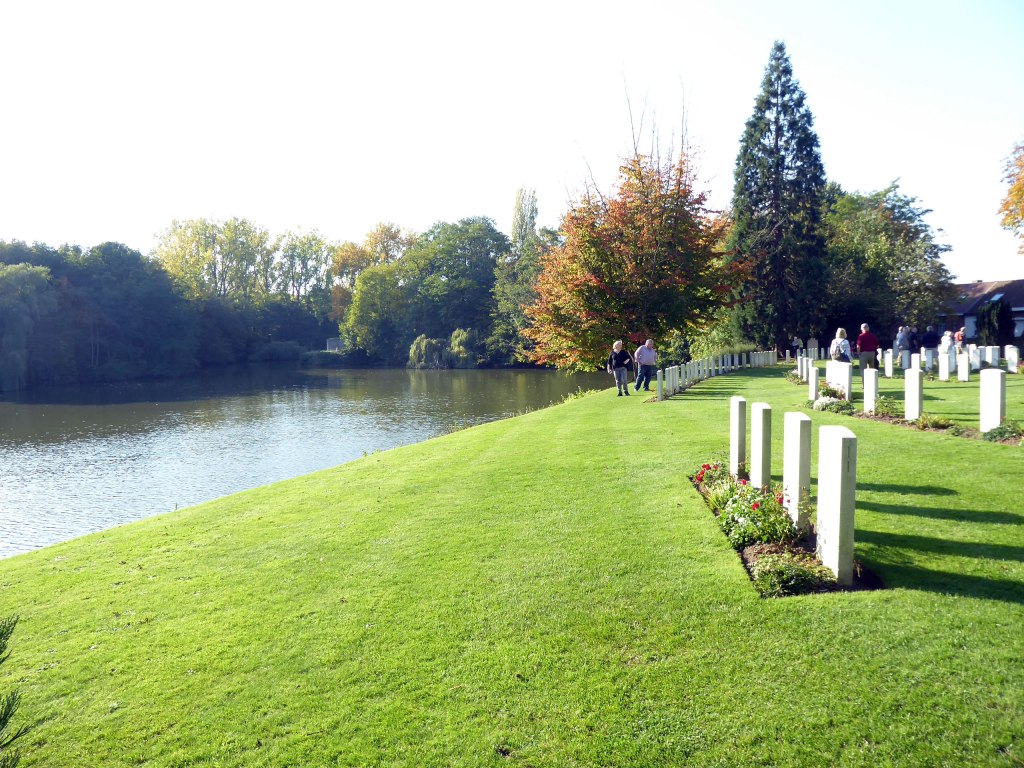
    The Ypres Ramparts are wide: strolling them in autumn is delightful as the falling leaves cushion the feet of the walker.  The signposted route is 2.6 km long and meanders past lakes and ponds (the remains of the moat), interesting statuary, and through the Lille Gate into a small W.W.l military cemetery filled with the upright white headstones erected by the Commonwealth War Graves Commission, a sight all too familiar to visitors to France and Belgium.  The municipal museum is located not far from the gate.  Along the route, 23 panels provide information on the various points of Vauban’s ramparts.
    Ypres-cemetery---peaceful-now,-but-it-was-once-a-scene-of-horrow

    A peaceful spot in the Lille Cemetery on Ypres’ Ramparts – © Mari Nicholson

    There are 198 soldiers buried here, among them the graves of six New Zealand troops who were killed simultaneously by the same shell:  their graves are now symbolically grouped together.

    Ypres-cemetery---Headstones-to-a-few-of-the-fallen
    Six New Zealand soldiers buried here together as they were killed by the same shell – © Mari

    There follows some photographs I took on this walk which ended at the back of the Menin Gate, in some ways more beautiful than the gate whose picture we are familiar with at which buglers from the local Fire Brigade play the Last Post every night at 8 p.m. This custom has continued since 1928 when it was first inaugurated, save for 4 years during World War ll when the German occupation prevented it.  This year being an Anniversary Year it attracts a few hundred people every night but sometimes there are just a few onlookers, yet the volunteer buglers nightly continue their tribute to the fallen.

    Menin Gate (back of)
    The Menin Gate from the Ramparts side


    This slideshow requires JavaScript.


    Notes:

    A.  Engraved on The Menin Gate Memorial are the names of over 54,000 officers and men of the United Kingdom and Commonwealth Forces who died in the Ypres Salient before 16th August 1917 and who have no known grave.  Tyne Cot has 35,000 names and there are  75,000 engraved on the Thiepval Memorial.

    B.  Menin Gate Last Post:  At 7.30pm the police arrive and all traffic is stopped from    driving through the Menin Gate until 8.30pm.  For one hour the noise of traffic ceases.  A   stillness descends and the crowd is hushed.

    7.55pm: Buglers of the local volunteer Fire Brigade arrive and stand ready at the eastern entrance of the Menin Gate Memorial.  They then step into the roadway under the Memorial arch facing towards the town.  The Last Post is played.

     C.   Of the battles, the largest and most costly in terms of human suffering was the Third   Battle of Ypres (31 July to 6 November 1917, also known as the Battle of Passchendaele),   in which the British, Canadian, ANZAC, and French forces recaptured the Passchendaele  Ridge east of the city at a terrible cost of lives.   It had been a battle across muddy,  swampy fields taken and lost, then lost and taken again.  After months of fighting only a few miles of ground had been won by the Allied forces at a cost of nearly half a million casualties on all sides.

    D.  The defence of Ypres was essential for the Allied forces as the town was a strategic point blocking the route of the Imperial German Army to the Belgian and French coastal ports (the ‘race to the sea’).   Thousands of Allied troops died in the rubble of its buildings, the shattered farmland around it and in the fields and meadows that had been deliberately flooded by the Belgian King to try and prevent the enemy from gaining a foothold.   Both sides fought ferocious battles and lived in inhuman conditions to maintain possession.  The Allied losses were horrendous but thousands of German lives were also lost on the battlefields around Ypres during their four years of offensive and defensive battles.

     

    Passchendaels-Banner

  • Strasbourg – Cross Roads of Europe

    Strasbourg – Cross Roads of Europe

    With the UK about to depart the EU albeit with an extremely narrow margin of Leave votes, my thoughts turned to my visit a few years ago to Strasbourg, site of the European Council and European Parliament and one of the loveliest places in Alsace.

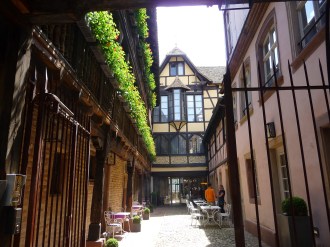
    A-Strasbourg-Square

    P1110743

    This delightful city with its medieval churches and half-timbered houses seems to have become a byword for what some in the UK see as a hijacker of British sovereignty.   Which is a shame, because that idea is blinding people to an elegant, international city of great charm that in the Middle Ages was referred to as The Crossroads of Europe.  At that time, goods from the Baltic, Britain, the Mediterranean and the Far East poured across the borders to be traded for wines, grain and fabrics and just like today, when the languages of the 46 member states can be heard in the squares and streets of the city, traders speaking a dozen different languages, met and conducted business.  The city continues to be the crossroads of Europe  as people from different countries work and mingle in Strasbourg’s squares just as they did hundreds of years ago.

    Once a free city within the Holy Roman Empire, Strasbourg later came under periods of French and German rule, which has given the ancient centre a unique appearance, half-timbered medieval houses sitting alongside elegant French-style mansions.  In 1988, UNESCO classified Strasbourg as a World Monument, the first time such an honour was given to an entire city centre.

    It is an easy place for visitors to discover as the traffic problems that beset most big cities have been solved here with a combination of canal boats, a sleek and comfortable light rail system, local buses, and pedestrianised squares.  Although it presents itself as a folksy-like small town, Strasbourg is very international, cosmopolitan and multilingual.

    GRAND ILE ISLAND

    This is the historic part of the city where you will find the main sights and using the 142-metre high spire of the Cathedral as your landmark, you will soon find your way around Strasbourg.

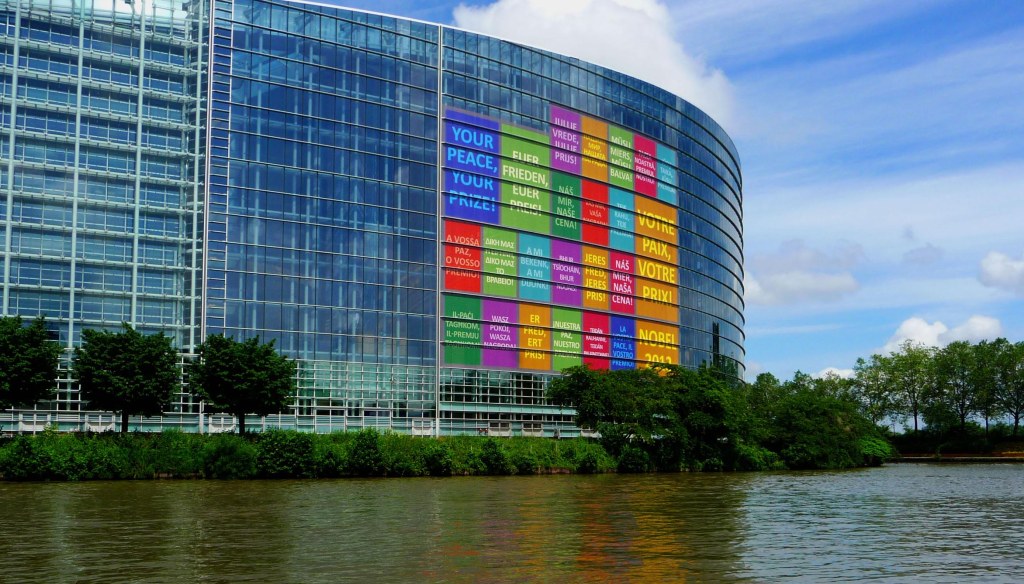
    The city’s charm has much to do with its canals which surround the Grand Ill island where Petite France, is located.  A 70-minute boat trip (open-top in fine weather) on Batorama’s Twenty Centuries of History, circumnavigates the whole of the Grande-Île before skirting the 19th-century German Quarter.  The turn-around point and good photo opportunity is where the European Parliament, Council of Europe and European Court of Human Rights are head-quartered, a magnificent display of concrete, steel and glass.

    Flags-of-all-Nations

    On the boat cruise you will see the Vauban Dam, near the confluence of canals by the Pont Couverts, a defensive lock which allowed the entire southern part of the city to be flooded in times of war.  It is P1110618

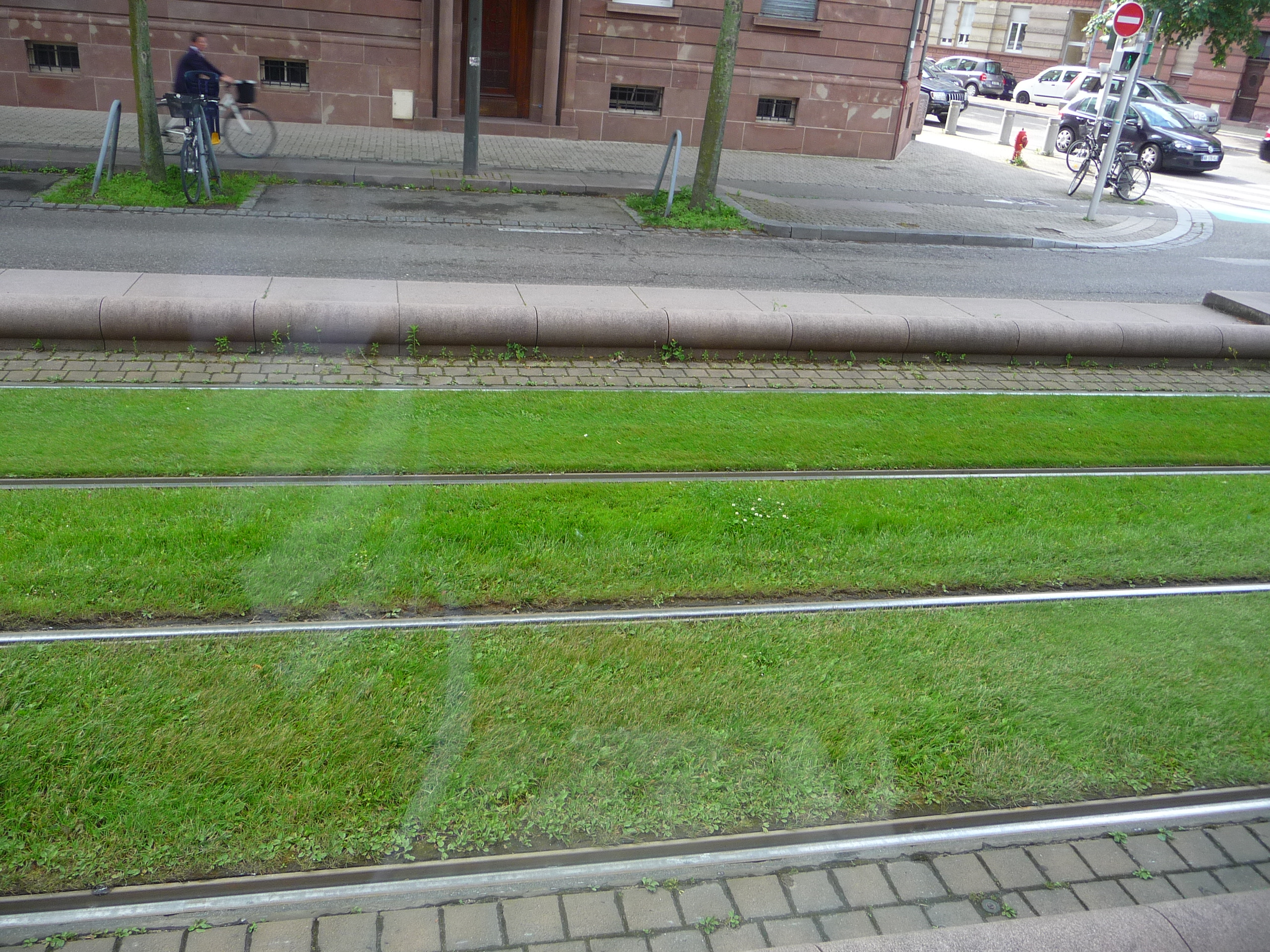
    They even grow grass between the tramlines in the street

    Walking around the canals, especially in the early part of the year when everything seems green and lush and the spring flowers are out in abundance is an equally attractive way of seeing the main sights.  This is a city that loves nature and it takes pride in decorating every bridge and windowsill with baskets of flowers, changed according to the seasons.

    PETITE FRANCE, STRASBOURG (a UNESCO site)

    The number one attraction in Strasbourg is Petite France, a photographic cluster of 16th and 17th-century half-timbered houses reflected in the waters of the canal.  These houses were originally built for the millers, fishermen and tanners who used to live and work in this part of town.  If you have taken the boat tour, you may like also to take a tour of the historic centre with an audio guide (€5.50) from the Tourist Office which will introduce you, via a winding route through the narrow streets, to a truly fascinating old town.

    NOTRE DAME CATHEDRAL Opening hours: 7am-7pm

    Cathedral-from-the-canal

    The Cathedral, an imposing red sandstone edifice, stands alone in its square and towers above the city.  It was the tallest building in the world until the 19th century and is the second most visited cathedral in France after Notre Dame in Paris, receiving 4 million visitors a year.  Built in 1439 it is considered to be an outstanding masterpiece of Romanesque and late Gothic art with outstanding 12th-century stained glass windows. Inside is one of the world’s largest astronomical clocks.

    Try to arrive at the cathedral by noon to get a good viewpoint for the 12.30 display of the famous Astronomical Clock.  The procession of sixteenth-century automata was designed to remind us of our mortality.   Afterwards, you can climb 332 steps to the platform below the cathedral’s twin towers for a stunning view.

    The narrow street that leads to the cathedral and the Place de Cathedral are the liveliest places in Strasbourg, especially in summer, and are filled with outdoor restaurants that remain open late into the night.  Entertainment is in the form of jazz musicians, mime artists and clowns.

    Oldest-House-in-Strasbourg
    This is the oldest house in Strasbourg

    And finally, Strasbourg’s Christmas Market has a high reputation but its popularity may be its undoing.  After a few evenings of mulled wine, yuletide cake, Silent Night and Adeste Fidelis, a spring or autumn visit begins to look very attractive.

    Strasbourg is a city that has a very special charm at any time of the year and the organisations that dominate its life are what still guarantees peace in Europe.  If you are looking for culture, cuisine and character, Strasbourg is hard to beat.

    Facade-of-the-Oldest-House-in-Strasbourg

    A few recommended eating places:  Expect the usual French coq au vin, boeuf bourguignon, crème Brulee and crepe Suzette, but be prepared also for the German influence of pork and sauerkraut.

    First up though, is wine.  Strasbourg is the capital of one of France’s premier wine regions and if you are in the mood to sample some of the best, head for Terres à Vin, 1 Rue du Miroir, tel +33 3 88 51 37 20, with several by-the-glass options from €3.20 to over €10).

    Pain d’Epices, 14 Rue des Dentelles, for indulgent gingerbreads and cake and for the heady scents of spices.

    Master-Patissier, Christian Mayer, offers a tea room second to none in Strasbourg at 10 Rue Mercière, just a few yards from the cathedral.

    Maison Kammerzell 16 Place du Cathédrale, tel +33 3 88 32 42 14, where the oldest section dates back to 1427, is a Strasbourg institution.  Occupying rooms on four floors, you can sample the house speciality of fish sauerkraut if you fancy that but there are many less thought-provoking dishes from which to choose, average €40 for three courses.

    Au Pont Corbeau, 21 Quai Saint-Nicolas, tel +33 3 88 35 60 68, – a warm and welcoming place where the onion soup is so thick you could stand your spoon up in it.  A modest but excellent wine list available.  Average €32 for three courses.

    The Batorama Tour departs from the Quai outside Palais Rohan, adults €12.50.

    A ticket with unlimited tram and bus trips valid for 24 hours is available for €4.30. Also, you can rent bikes (vélhop) for $5 per day.

    Tourist Office, 17 Place de la Cathédrale

  • Weekly Photo Challenge: H2O

    No rain promised in my area for a while so I’ve looked through my photos to see what I could come up with and here are two.  Both of these were taken in Thailand, one in Koh Samui, the other in Hua Hin on the Gulf of Siam just a couple of hours drive from Bangkok.

    you-can-have-fun-with-a-polystyrene-box-lid-even-without-an-x-box
    Having fun at Hua Hin, Thailand

    This little boy was having the time of his life on his polystyrene box lid which served as a raft from which he was trying to catch fish.  I don’t think it mattered whether he caught any or not, the fun was in trying, and in having such a marvellous float to carry him along the seashore.  Don’t worry, Dad was trawling the near water keeping an eye out so that he didn’t drift off.  They had little money, it was obvious.  Mum was digging in the sand for tiny little sandfish and crabs for supper and his sisters were gathering leaves from the hedges around.  Tech toys were unknown to him and even though I am sure he hankered after them, I confess I hoped he could continue to enjoy the childlike life he was having at the moment I took this photograph.

    koh-samuii-in-rainstorm
    Torrential rain in Koh Samui, Thailand

    Oh dear, it wasn’t supposed to rain in Koh Samui, but it did, and heavily.  Two days of torrential rain rendered the hotel’s umbrellas unusable, the decking awash, and the grey sea a hazard if one wanted to swim.   Day and night it pounded the beach, the noise like thunder at night.  Room service was needed but by the time food got to the rooms it was cold – and sometimes very wet – so everyone waded through the water to the restaurant where the staff did their best to serve us with hot food.

    Two days later it was all over.  We woke up to sunshine, dry decking, dry beaches and a placid blue sea.  Had it really been as bad as I remember?   As the locals say, “TIT” – This is Thailand”.