An odd one this. We came across this still-being-worked-on monument to the Vietnam War in Hanoi back in 2008. I haven’t been back since so I presume it’s now finished. I was intrigued to discover that the men working on it were not sculptors but stone-masons who were working to a plan drawn up by a ‘government artist’.
One of the workers spoke reasonable English and told me that their parents had all been involved in the ‘American War’ as they called it. They were very keen on education and one of them in particular examined the book I was carrying very thoroughly. I forget now what it was but I gave it to him and he shook my hand so much in gratitude I though it would dislodge from its socket. I still wonder at their lack of bitterness.
Today I changed my walking route, left the sea behind me and turned inland. I had no plans, no set route to follow and no idea of what I wanted to photograph.
First, I meandered through Los Altos Park which was deserted: it was eerie having this space all to myself. Normally a place full of dog-walkers, chattering children, and elderly folk sitting on the benches reading, today it was empty despite a temperature of 16 degrees, blue skies, warm sun and no wind. Covid space? Too late in the day? Who knows, but the place was all mine.
Los Altos Park, Sandown
Los Altos Park, Sandown
Not far from here was what used to be one of the area’s oldest hotels but unfortunately, it closed this year due to a series of misfortunes. The grounds are now deserted, the building, once a grand manor, now stands forlorn its windows no longer shining a light to welcome visitors. There was no one to disturb me or chase me away and I felt a terrible sadness at the loss of this great mansion, its tennis courts now a coach park, and its grounds being overtaken by nature.
The lane in front of the hotel. I didn’t go further into that darkness!
Looks as though the hydrangea can’t make up its mind. Is i winter or summer?
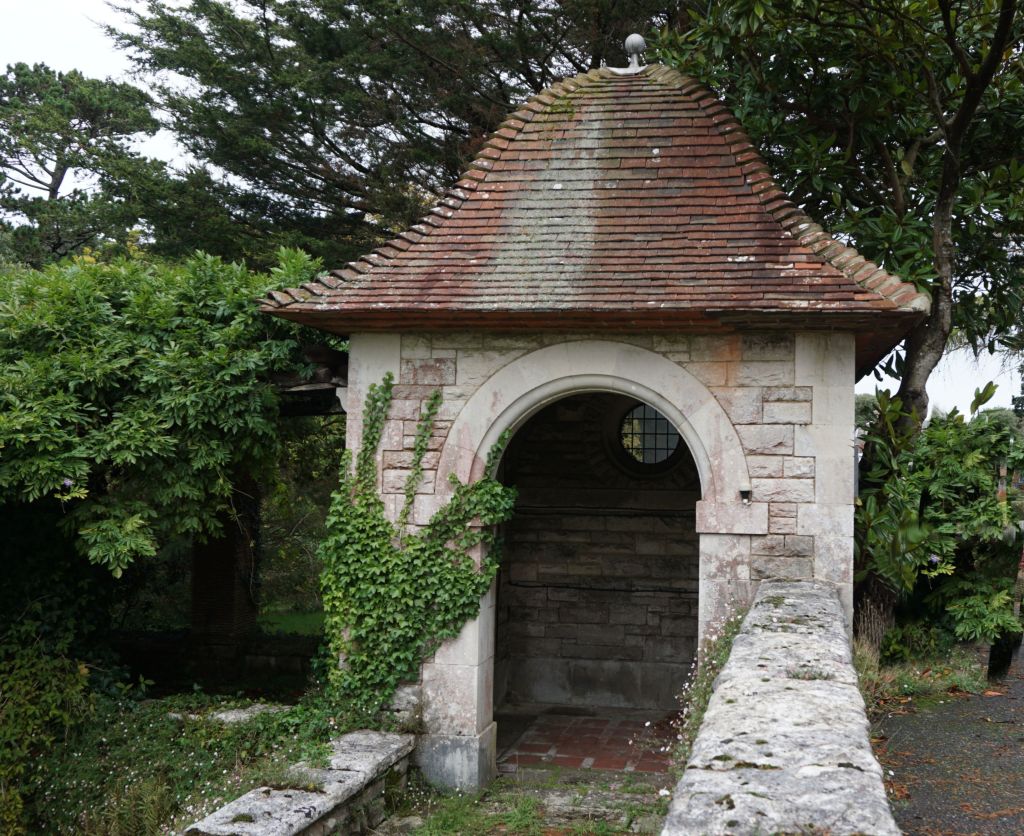
Further into the gardens I came across these seats looking so forlorn as they sat amid the falling leaves. Nearby a couple of palm trees, stretched towards the light, valiantly fighting to survive. They were definitely in need of some TLC.
Although I felt sad that the bracken (or was it fern) was now running rampant over the garden wall I cheered myself up with the thought that this would provide a cosy home for the winter for the wildlife I’d seen on my walk (a couple of hedgehogs, lots of spiders and odd creepy-crawlies and I’m sure there were lots more keeping out of my way).
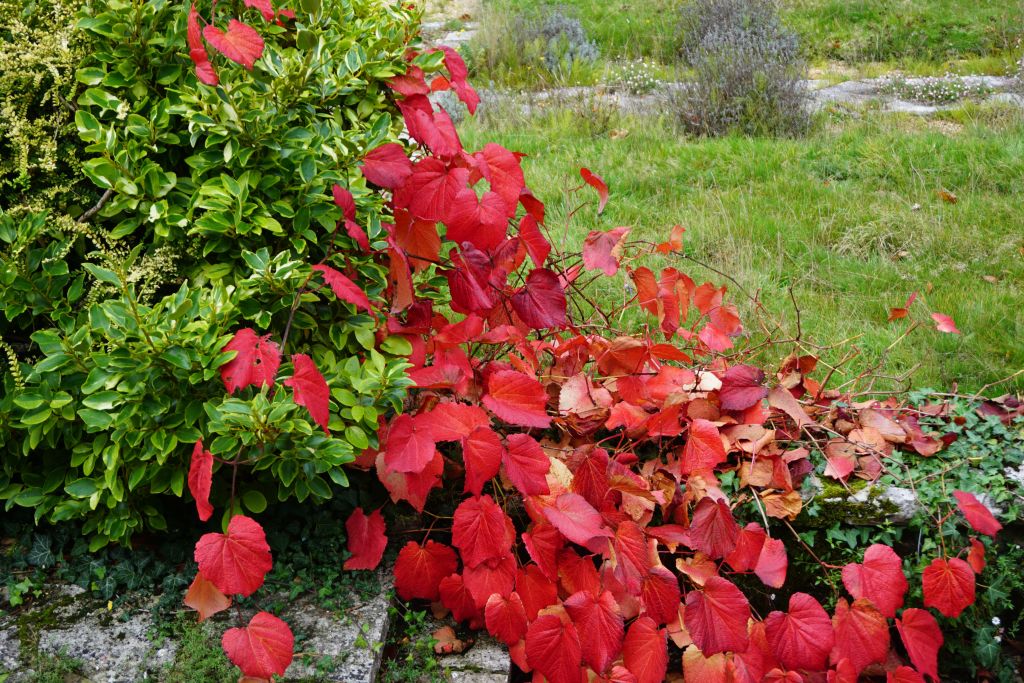
And then I came upon the sunken garden and this splash of colour, a glorious cascade of scarlet leaves, Virginia Creeper I think, that must have migrated from the wall of the old house and settled here to decorate these steps. And just a bit further on, the brilliant red of the Holly berries – a dazzling display of colour amid the dying of the year. It seemed the autumnal red of the Virginia creeper led me to the winter of the Holly.
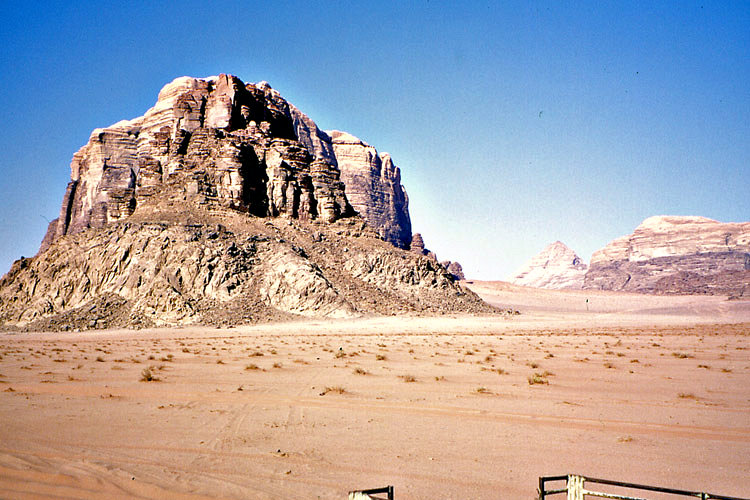
The BBC should be showing the marvellous David Lean film Lawrence of Arabia in its new Film Club series on Thursday nights and as always, that film takes me back to my trip to Jordan some years ago, to Petra, Aqaba and Wadi Rum. This is Petra.
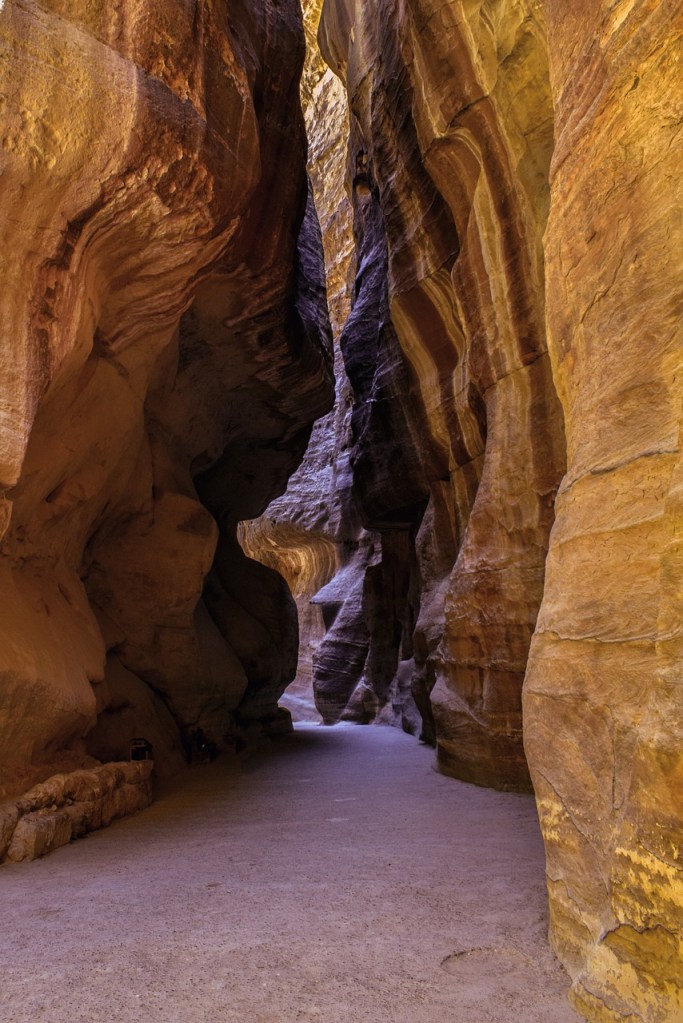
Ahmed shines his torch upwards on to the rock-like walls that rise on either side of us to a slit of night sky hundreds of feet above and whispers “Be careful”. I place my feet carefully on the narrow path trodden by ancient tribes centuries ago, a path along which we tourists now travel to view the hidden city of Petra.
Al-Siq, leading to The Treasury
Nothing I had read prepared me for my first sight of the fabled Treasury – the most photographed place on the site, a richly deep-hued pink building that had been carved from the mountainside. In the centre of the building was a huge doorway in front of which camels swirled about as their owners petitioned customers to hire their beasts (all guaranteed very tame and ‘no spitting, madam’). In hindsight I think it was good that camels were there to spoil the effect as without them one could well suffer from the Stendhal syndrome (a fainting fit when overcome by the beauty of a place, first recorded by the author in Florence).
This image by Heidelbergerin at Pixabay
In the centre of the doorway stood a Royal Palace guard, resplendent in a long tan-coloured robe liberally bedecked with red bandoliers slung casually over his shoulders the bullets for which were also topped with red, a dagger worn centre stomach, red tasselled sashes and the obligatory red and white chequered kufiyah. I was awestruck.
Royal Jordanian Palace Guard at Petra
This was 2012, exactly two centuries after its rediscovery by the explorer Burckhardt, and I was visiting the ‘rose-red city’ of Petra which had lain in ruins for 500 years since its abandonment after the Crusades. Now famous once more due to the work of explorers, painters and film-makers, it still has the power to excite awe and wonder and the approach to it through the narrow gorge is the perfect way to come upon it. Take a guide if you can, chances are he will have been born in one of the caves on the site before the advent of tourism and will have a host of stories to tell you.
Petra’s vast wealth derived from its position as a crossroads of the world where it traded in frankincense from Arabia, spices from India and silks from China. I struggled to imagine caravans of 5,000 camels arriving at this once mighty trading post which Ahmed assured me was the case. How did they negotiate the narrow passages to the entrance? Where did they all live? How did they live? And how did they cope with the smell? Ahmed just smiled. “It is true”, he said, “don’t question, live in the magic”. But it’s not magic; the history books tell me it was so.
Roman Soldiers’ Tombs
Roman Theatre
Royal Tombs
From the Roman Days
Away from the Treasury you are in an ancient city of ruined streets lined with Classical façades, a city that housed approximately 30,000 people at its peak, who spoke Aramaic, the language of the Dead Sea Scrolls – in fact, the language of Jesus Christ. Over 80% of the site remains to be excavated and the heaps of rubble you see dotted around were once houses, shops, and communal buildings.
If it’s not too hot (always go early morning if possible) and you have the energy, it is worth climbing the mountain gorge to the High Sacrificial Place, 850 well-cut steps past extraordinary coloured rocks to where there is a façade even larger than that of the Treasury: a doorway and columns 150 feet high. Your reward is breathtaking views over Petra. No one knows for certain what took place here, whether the sacrifices were of animal or human, but evidence of human sacrifices have been found in surrounding towns/cities. Your other reward can be the freshest lemonade with soda you’ll ever have from the very essential café at the top.
Historical bit: The original inhabitants of this 6th-century BC world of temples, Roman theatres, monasteries and chambers, the Nabateans, set up their city-state, defending their home with ease until 106 AD when it fell to the Romans. After the Romans came the Byzantines, then the Crusaders, until by the 16th century Petra was all but lost to the west. A Swiss Explorer, Louis Burckhard, penetrated the hidden city in 1812 and the world became aware of the wondrous city that had once been the centre of a trading empire that stretched from Saudi Arabia to Damascus.
There were few tourists when I visited Petra in 2012 just after the conclusion of one of the many disputes in that part of the world. My guide was fond of saying “We are a small friendly family with some noisy, disruptive neighbours but we welcome visitors” and that was the extent of our political discussion. Now once again I fear there will be few, if any, tourists, and the friendly, welcoming people of the area will miss the tourists. Go visit if you can, when things get better. These friendly people needs and welcomes tourists.
First up is Impregnable and I give you The White Cliffs of Dover. We don’t know if they are but it’s a good song and a nice idea.
The White Cliffs of Dover
and not far from here is Dover Castle which commands the Strait of Dover, the shortest sea crossing between England and continental Europe, a position of strategic importance throughout history and whose underground tunnels housed troops. war rooms and hospitals from the early 19th century right up until the Second World War 1939-45.
The castle visible today was established by Henry II (r.1154–89), in the decade 1179–89, creating at Dover the most advanced castle design in Europe, a sophisticated building that combined defence with a palatial residence.
Dover Castle, Kent
Next word is Volte Face and there are so many in the political field today that it’s hard to choose. However, anyone who reads politics these days must agree that the winner in any volte face competition has to be
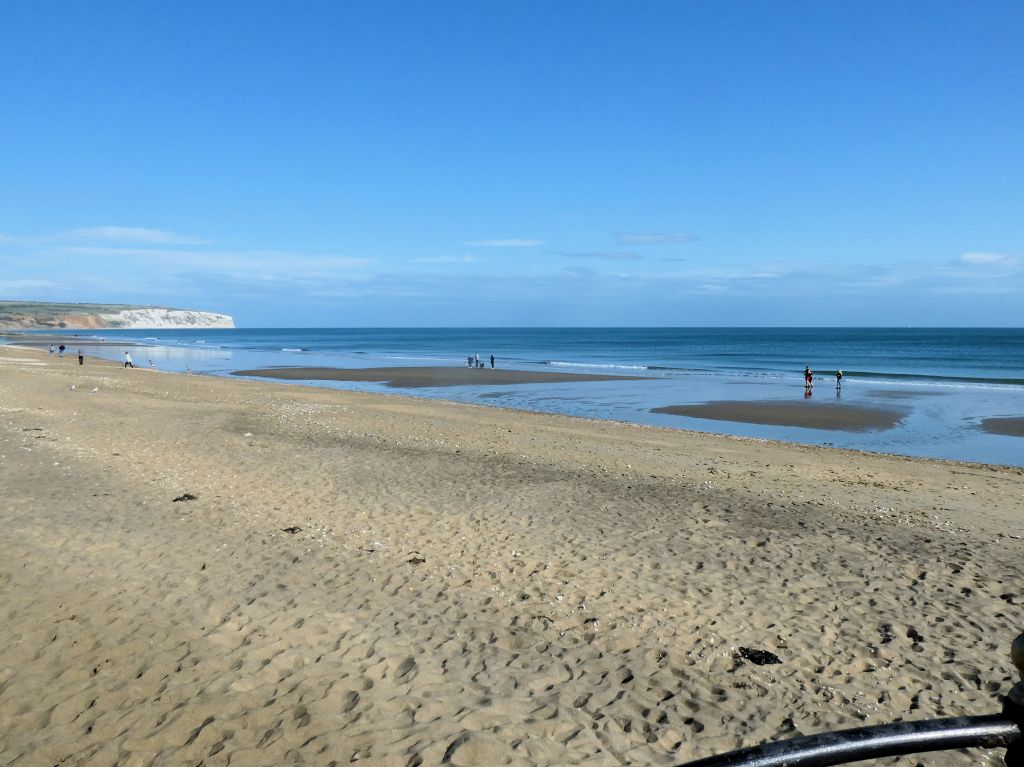
It’s not just Covid-19. The weather forecast influences people’s decisions but often the meteorological office gets it wrong. And so it was today. The temperature was supposed to be around 17ᵒ with cloudy patches but we had wall-to-wall sunshine and it felt like mid-20s. The result was that only a handful of people were walking on the esplanade and fewer still on the beach.
One lonely figure sat wrapped in a blanket on the beach guarding the clothes of the two boys fishing by the pier who were wearing only swimming trunks so at least someone was benefiting from this burst of sunshine.
The Bay sands, once golden, are now less so, and many blame this on the 7 – 9 liners and tankers that used the Bay during the Covid outbreak when they couldn’t get into Portsmouth or Southampton harbours to unload their cargoes of people and goods. For some weeks they sat on the horizon, their engines pumping away to keep the ships ventilated and facilities ongoing. The noise from this was so great that a complaint was made and the harbour masters requested to speed up the entry into port.
Premier Inn opening soon in Sandown, Isle of Wight
Sandown has a new Premier Inn due to open soon on the Esplanade and it was good to see this finished at last. The Covid outbreak had stopped building work earlier in the year and we wondered if it would open for business at all this year. Now it’s looking smart and new and ready to welcome autumn and winter visitors to the town, where the winters are mild and pleasant and the temperature usually about 5ᵒ above that of the mainland.
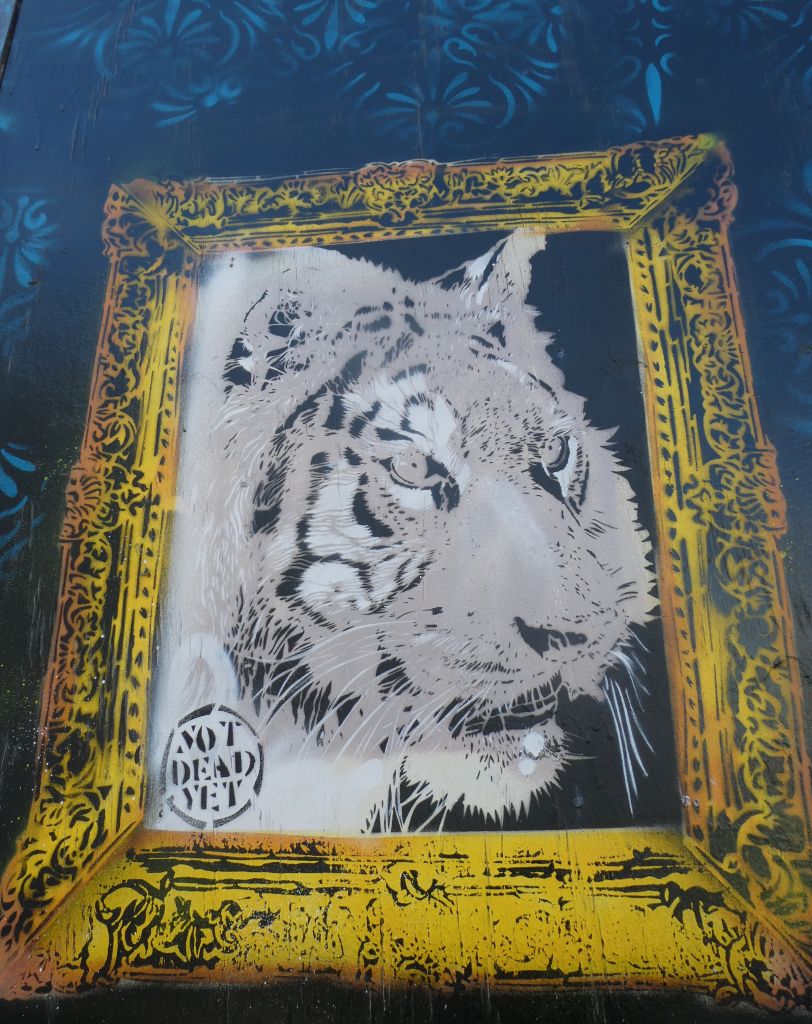
The High Street was quiet with only a few shoppers hunting souvenirs and tea-rooms. But I noticed that one of our closed-up Banks (a few years ago 3 of the big five operated here) has been graffitied but a theme is not discernible. Intriguing yes, and from what I can see it is a community venture and they are appealing for donations. I wonder if the Bank has thought to donate something to improve the boarded up look of their building? Or am I being naive?
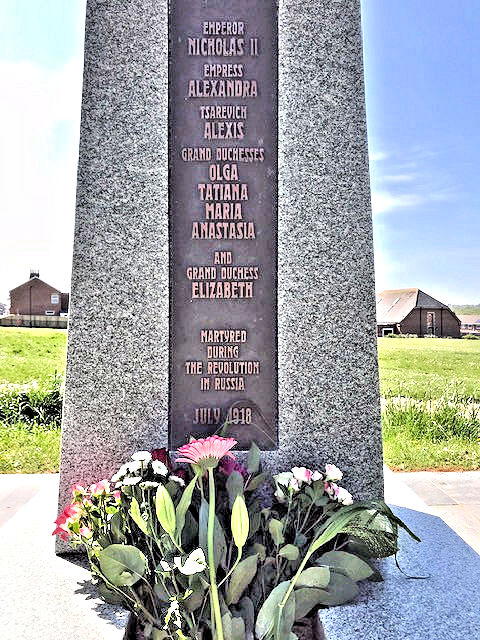
Elena Bezborodova‘s memorial to the Royal Family of Russia, murdered by the Bolsheviks in 1918. This Memorial was erected at East Cowes, Isle of Wight to commemorate the 100th Anniversary of their deaths.
In 1909, Tsar Nicolas ll and Tsarina Alexandra of Russia (Princess Alix of Hesse-Darmstadt, grand-daughter of Queen Victoria) along with their five children, visited Cowes, Isle of Wight at the invitation of King Edward Vll. The occasion was Cowes Regatta, one of the longest-running and most important regattas in the world at that time. A home-movie taken during that visit and shown on UK television last year, shows two of the children, Grand Duchess Olga and Grand Duchess Tatiana who had never experienced such freedom before, enjoying a walk around the town, diving into shops and buying postcards and sweets. An interesting account is to be found here.
On 7th July, 2018 during a weekend of events that remembered the 100th Anniversary of the assassination of the family and their close servants at Yekaterinburg, a 3-metre high granite memorial with bronze decoration was unveiled to commemorate the close connection between the Imperial Romanov family and East Cowes. This magnificent monument was unveiled in the presence of their surviving descendants, Russian Orthodox bishops, the Moscow sculptor of the work Elena Bezborodova, and a choir from Minsk, Belarus.
Top of the Memorial with its bronze relief of individual members of the family
The memorial was gifted by members of the Grand Duchess Elizabeth Romanov Society who revere the Tsar’s sister-in-law who was later made a saint. It stands in the Jubilee Recreation Ground close to Osborne House the former home of Queen Victoria and Prince Albert which the Romanov family visited on their trip to the island in 1909. The Tsar had also been a naval cadet at the then Royal Naval College Osborne House.
The 18th/19th century photos are courtesy of Wikicommons. The Photographs of the Memorial at Cowes are from David Hill, local coordinator for the event working with the Grand Duchess Elizabeth Romanov Society.
Historical Note: Tsar Nicholas II and his family were assassinated by the Bolsheviks on 17 July 1918. They were buried in unmarked graves, and in 1979 some remains were discovered but were concealed until the fall of communism. In 1991 the graves were excavated and a state funeral was organised for five family members. Remains of two other children were found in 2007 but these are undergoing additional examinations.
Two days of torrential rain had cleared the beaches of all but the most hardy but then on the third day, came the sun and the world changed for the better. The hotel was better, the food was better and even the yapping dog in the next room that woke us at dawn, became bearable. What a difference the sun makes.