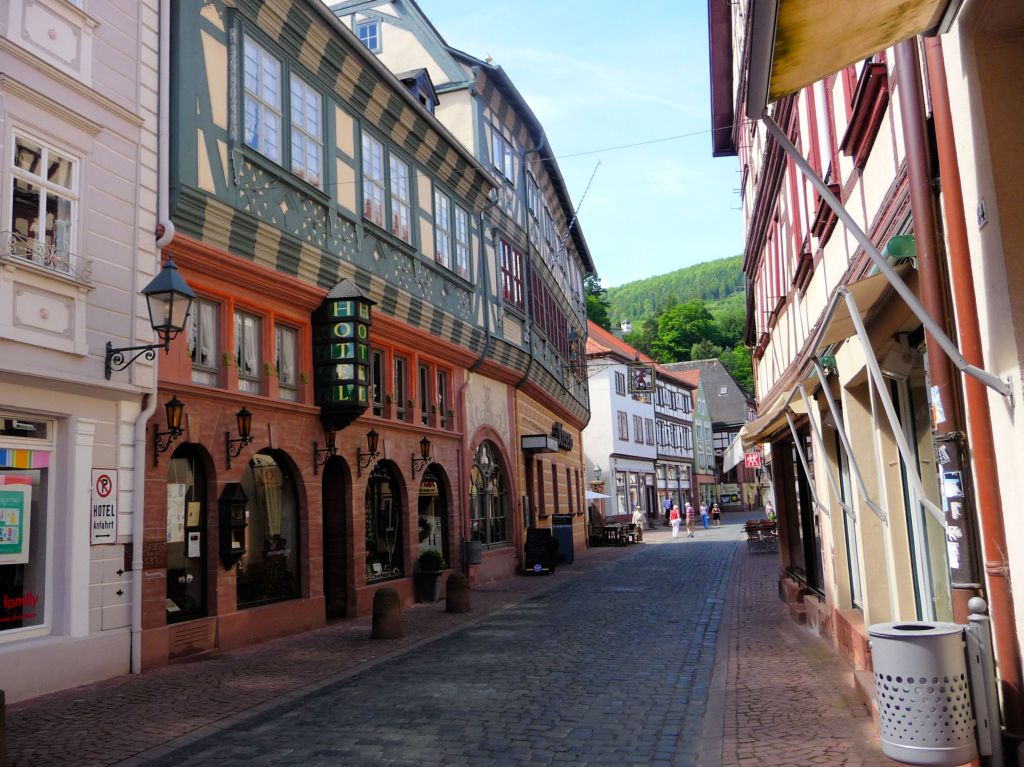
It’s been a few years since I last visited the villages along the River Main in Germany but it was once a favourite driving holiday, especially in early spring when the flowers were in bloom and the street stalls were full of jewel coloured blooms, wrapped in flimsy coloured paper, just asking to be taken home. Of all the lovely medieval villages along the route one of my favourites was Miltenberg, a town with a wide main street lined with half-timbered houses and small medieval alleys.
Main Street, Tables Ready for Lunch
The beautiful houses that line its main street span the 15th – 17th centuries and the oldest dates back to 1339: what is so unusual is that all of these half-timbered dwellings are lived in. In consequence, there is no feeling that this is a tourist site, a place where we come to gawp and take photographs. Instead, we wander and look, dive into interesting looking shops, and stop off at cosy taverns serving local cuisine along with the wine of the area – and, of course, beer.
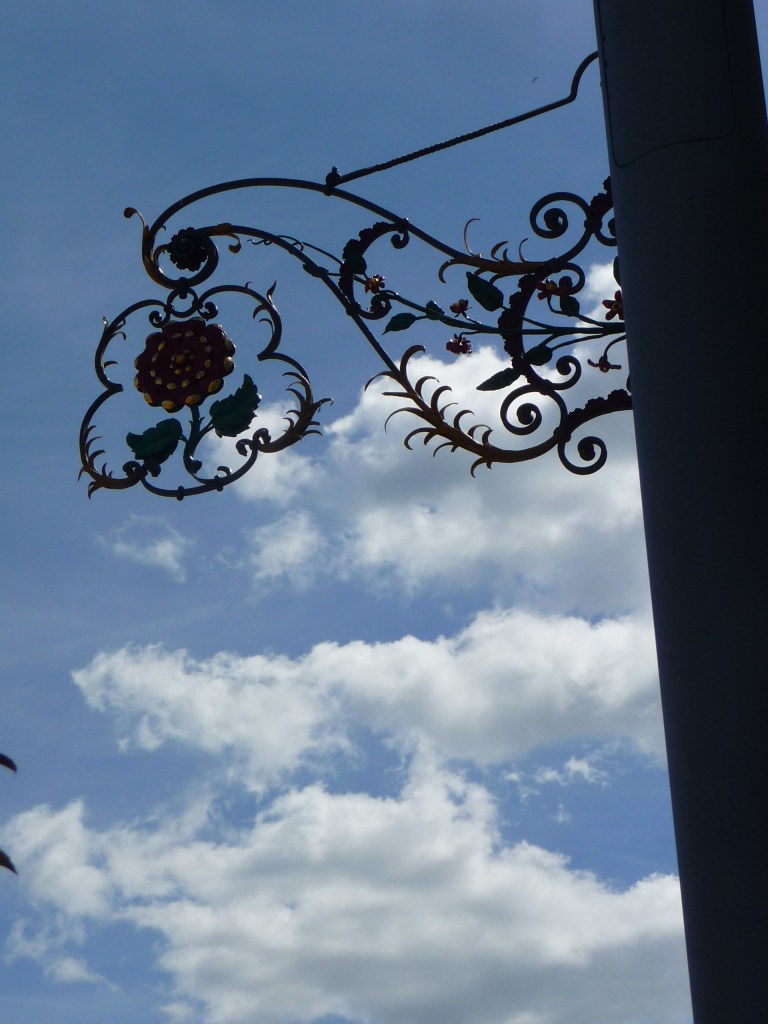
Wrought Iron Signs
Wines of the Region
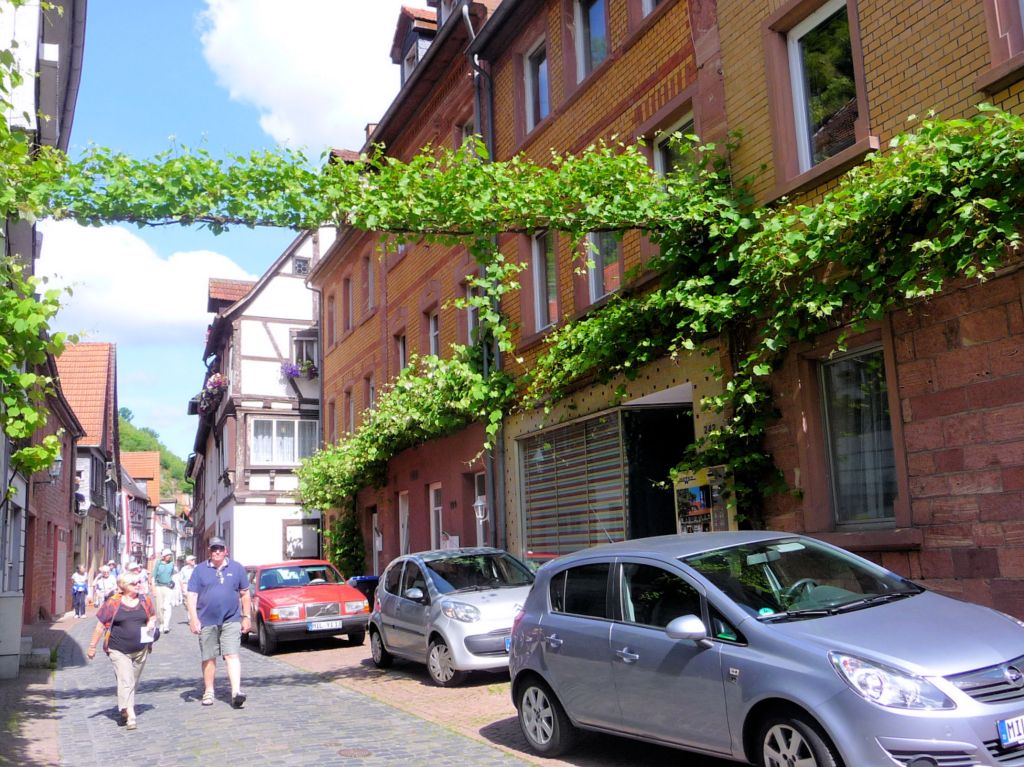
Vines Across the Street
Stag’s Heads
Main Beer Keller
A Green Haven
The town has a few interesting sculptures dotted around the streets most of them honouring local artisans. I was also impressed by the quality of the goods for sale in the shops, at a quality-high price I may add. Even the mannikins that modelled the clothes looked beautiful as you can see from the picture below.
Viniculture and the wine trade, wood from the surrounding forests and stone, and the fact that the town was well-placed on the river for transportintg goods, was favourable to this location at the trading artery of Nuremberg and Frankfurt and the town grew rich.
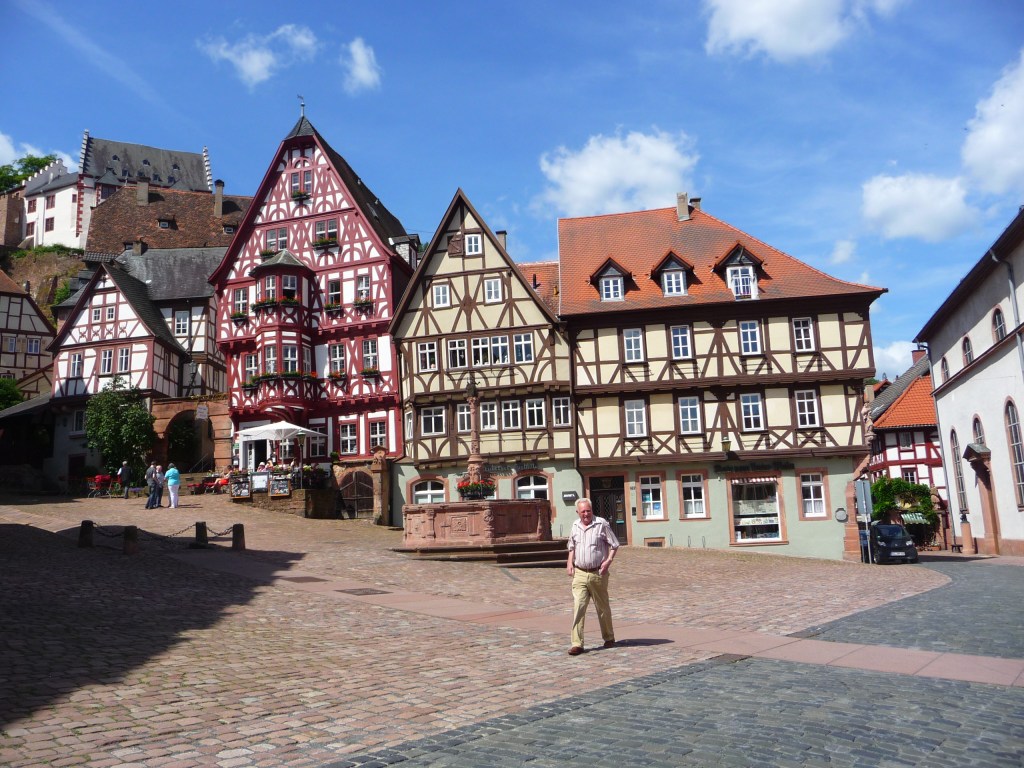
The Old Marketplatz
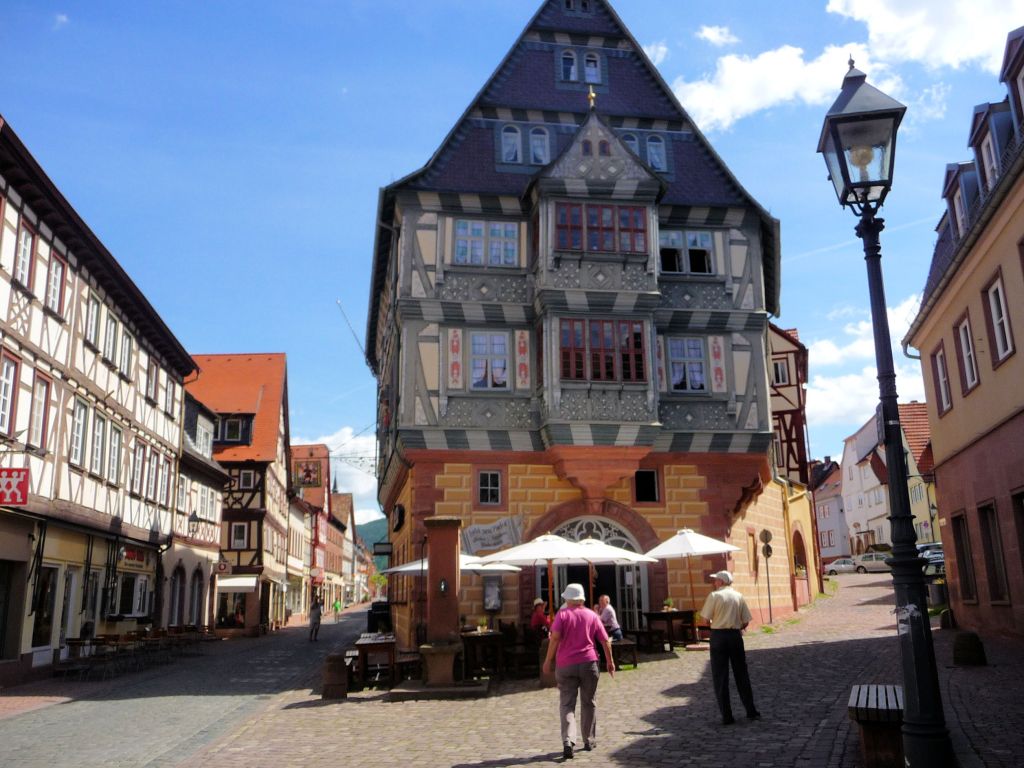
One can see Miltenberg’s importance from the magnificent half-timbered houses, especially those in the Old Market Place (the Schnatterloch) and Germany’s oldest Inn, the Gasthaus zum Riesen, dating from 1590. It claims to be Germany’s oldest Inn and an historical document tells us that a local owner at the time was granted the right to fell a hundred oak trees for its construction. It is known for serving some of the best food in town and is especially noted for its roast salmon.
Germany’s Oldest Inn, Gasthaus ZumReisen, dating from 1590
From the Market Square to Mildenburg Castle, which was constructed in 1200 under the aegis of the Archbishop of Mainz, is an easy walk. The castle doesn’t really comare to other castles in Germany being a relatively small fortress, but it is worth the walk if only for the wonderful views of the old city.
A small town but a supremely beautiful one, and a recommended stop on the way to or from Nuremberg or Frankfurt.
To Chichester last week to see I’m Sorry I Haven’t a Clue, the stage performance of the popular Radio 4 satirical quiz starring Jack Dee, Rory Bremner, Miles Jupp, Tim Brooke-Taylor and Tony Hawks. A superb – and hilarious – evening in a packed Chichester Festival Theatre where the audience laughed their way through two and a half hours of clever, satirical humour.
But this post isn’t about the performance, brilliant though it was, it’s about Chichester, a hidden gem of a City, located less than two hours from London and within easy distance of Brighton, Southampton, Portsmouth and the S.E. coast.
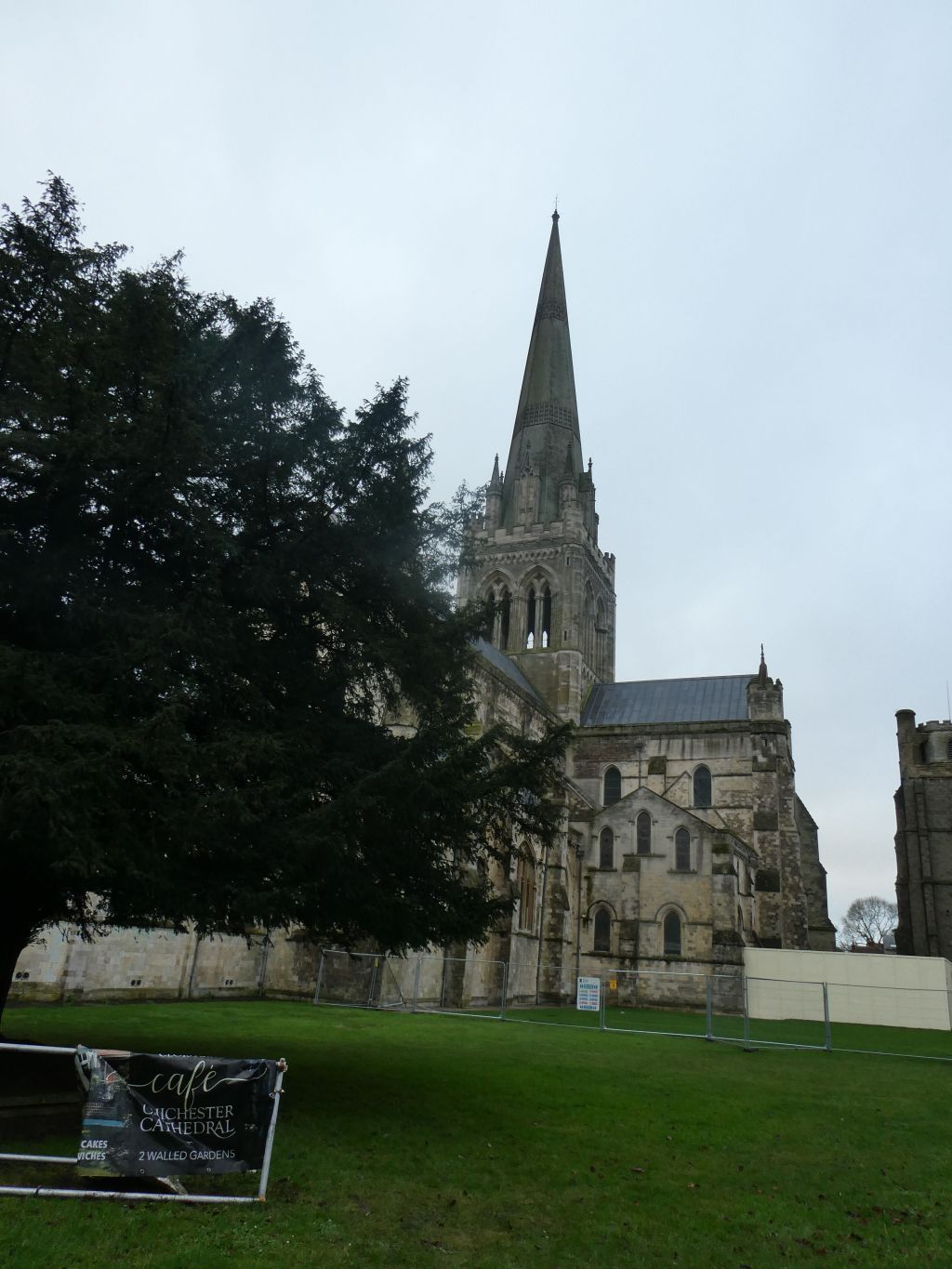
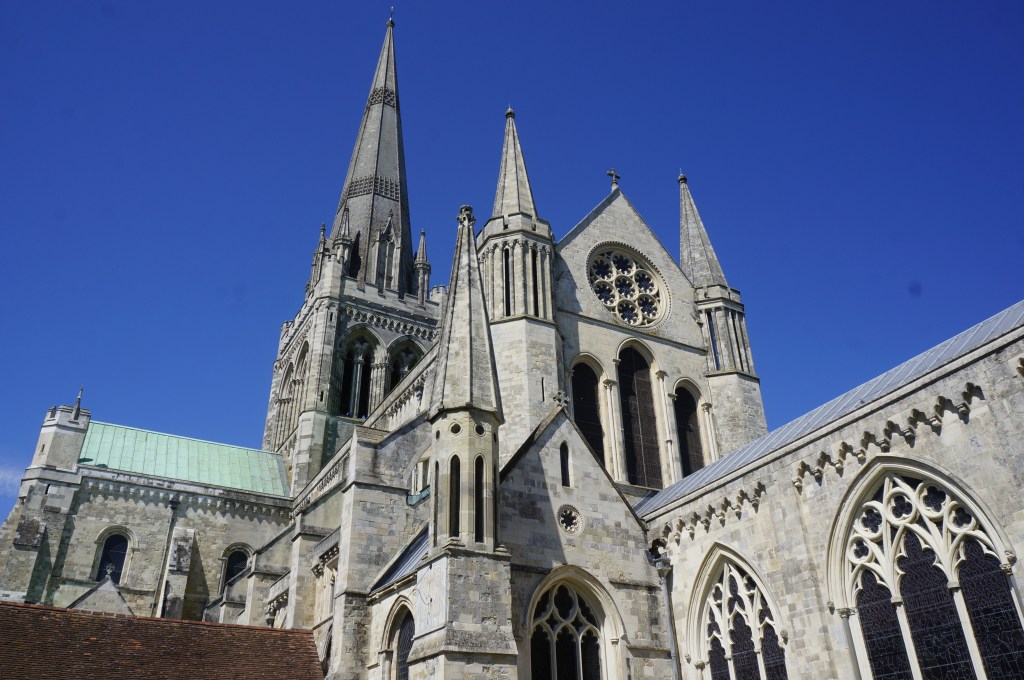
Chichester Cathedral (Photo Steve Moore)
We stayed overnight, Chichester being well supplied with hotels and guest houses, the only drawback being the weather which wasn’t kind to us. Rain and wind are not conducive to walking slowly through cobbled streets steeped in history, along canal banks, through green parks and along the City Walls, not to mention walking to and from the Theatre.
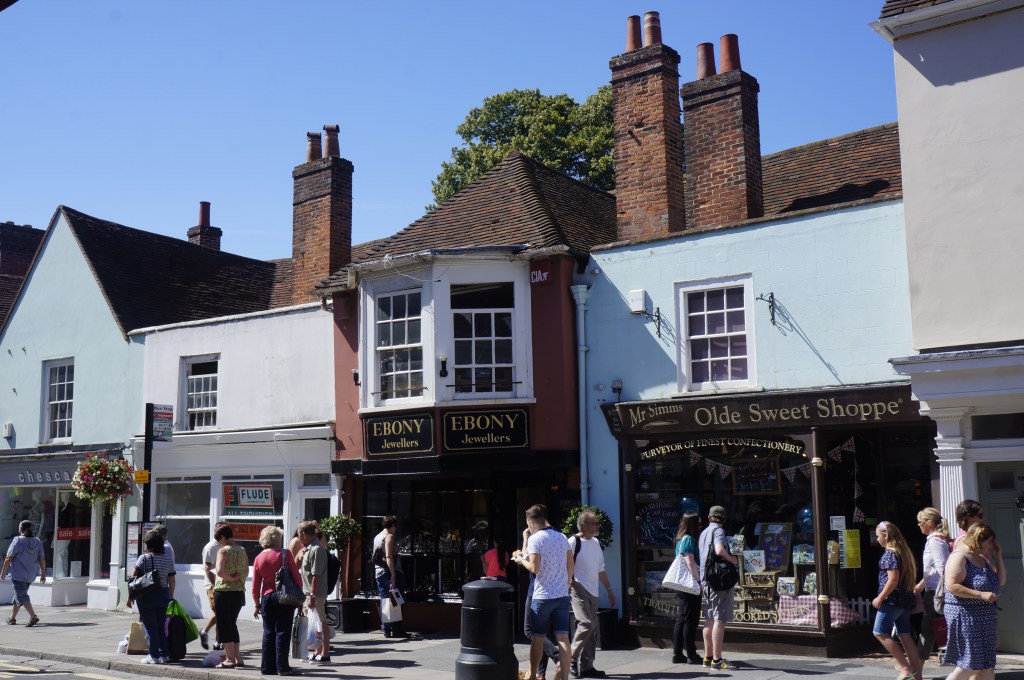
Very old Cobbles Stones and buildings in Chicheser
For that reason the outdoor photographs here were all taken last year. I go there at least once a month to the The Festival Theatre and its sister theatre, The Minerva both of which offer first-class productions of drama, musicals, and newly written plays, most of which transfer to the West End after their run in Chichester. There are also two good restaurants on the site (booking essential).
Chichester Festival Theatre and Restaurant at Theatre
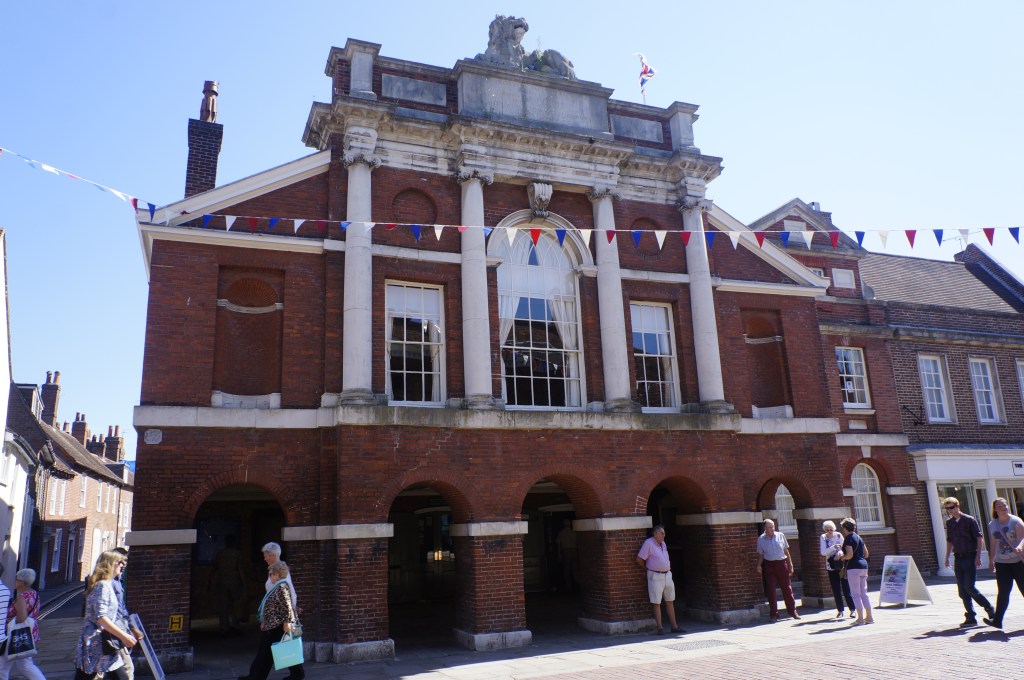
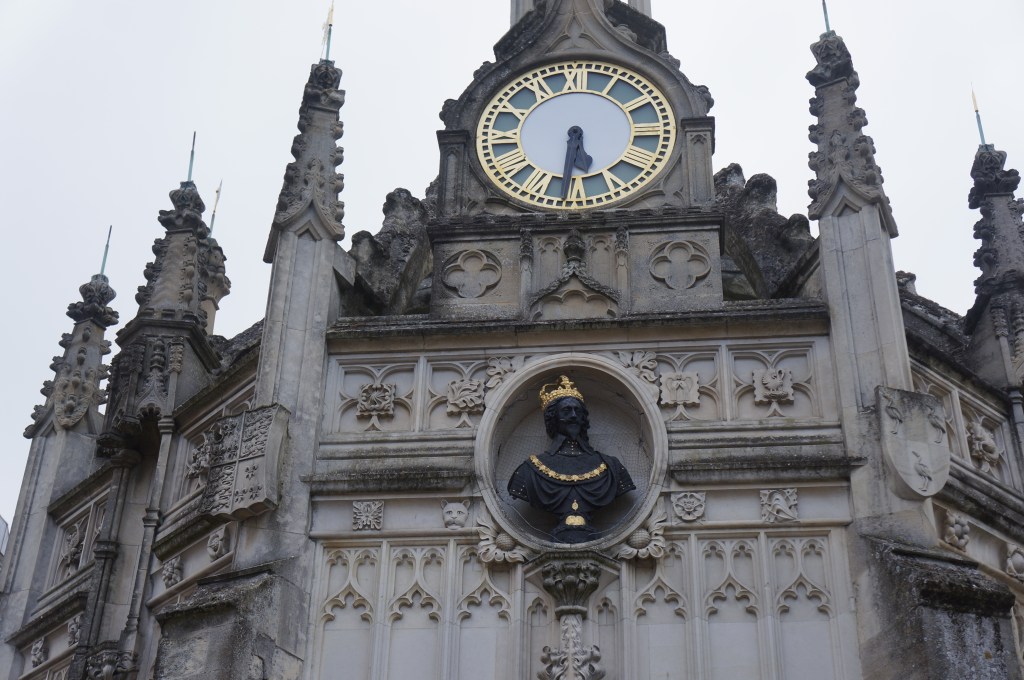
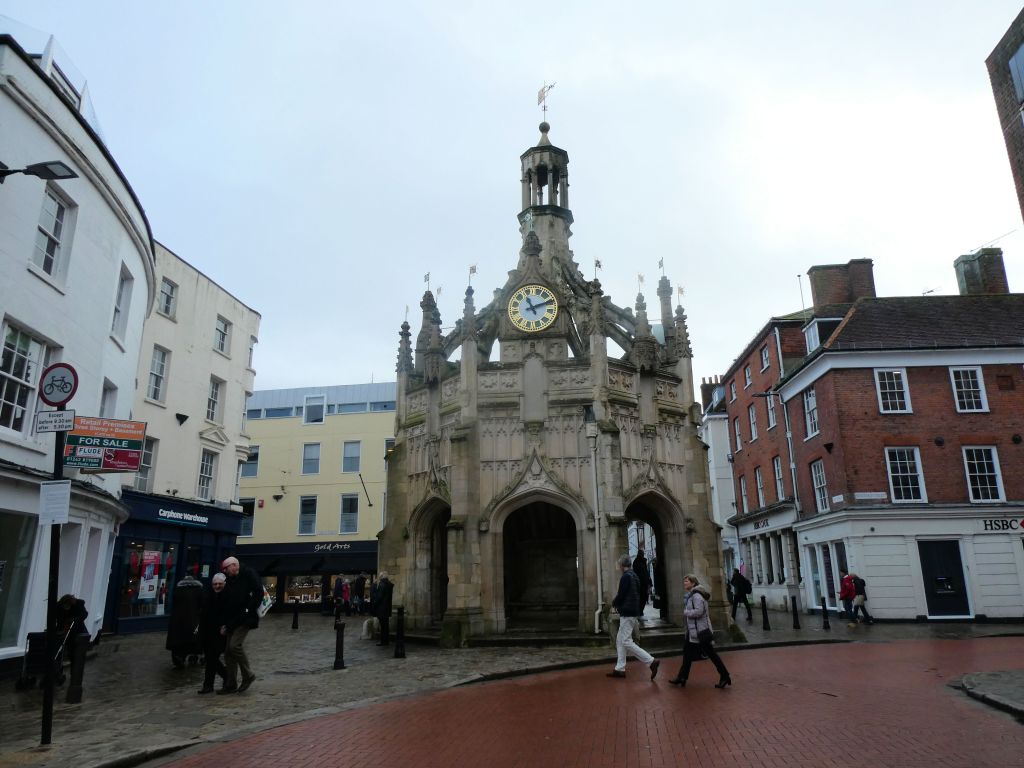
The city’s Roman influence is reflected in the main street pattern, and it is not difficult to spot historic buildings that line the streets and the little alleys that lead off them. One of the city’s most iconic features is The Market Cross, believed to have been built in 1501 by Bishop Edward Story, who paid £10 to the Mayor of Chichester for the ground on which it is built. The Bishop allowed peasants to trade under the Market Cross without paying a toll, and it’s still a gathering point for the community today and for sellers of fruits in summer and umbrellas and plastic ponchos last week!
Market Cross
You will see the Roman name Noviomagus Reginorum in various places in the city and to find out what that means, the best thing is to take a walk along the City Walls, the most intact circuit of Roman town defences in Southern England. You can start the 1.5 mile walk anywhere along the wall and stop to admire the impressive views over the rooftops at any point.
If the weather is not conducive to walking the walls, then head to the free Novium Museum, built over the remains of a vast Roman bath house which can be seen from the ground floor, for an in-depth insight into the history of the City and wider district.
Another indoor attraction is the Pallant House Gallery (rated second only to the Tate for modern British art by the Guardian) which explores new perspectives on British art from 1900 to now. It is housed in what is considered to be one of the most important 18th century townhouses in England and one of very few Queen Anne houses open to the public.
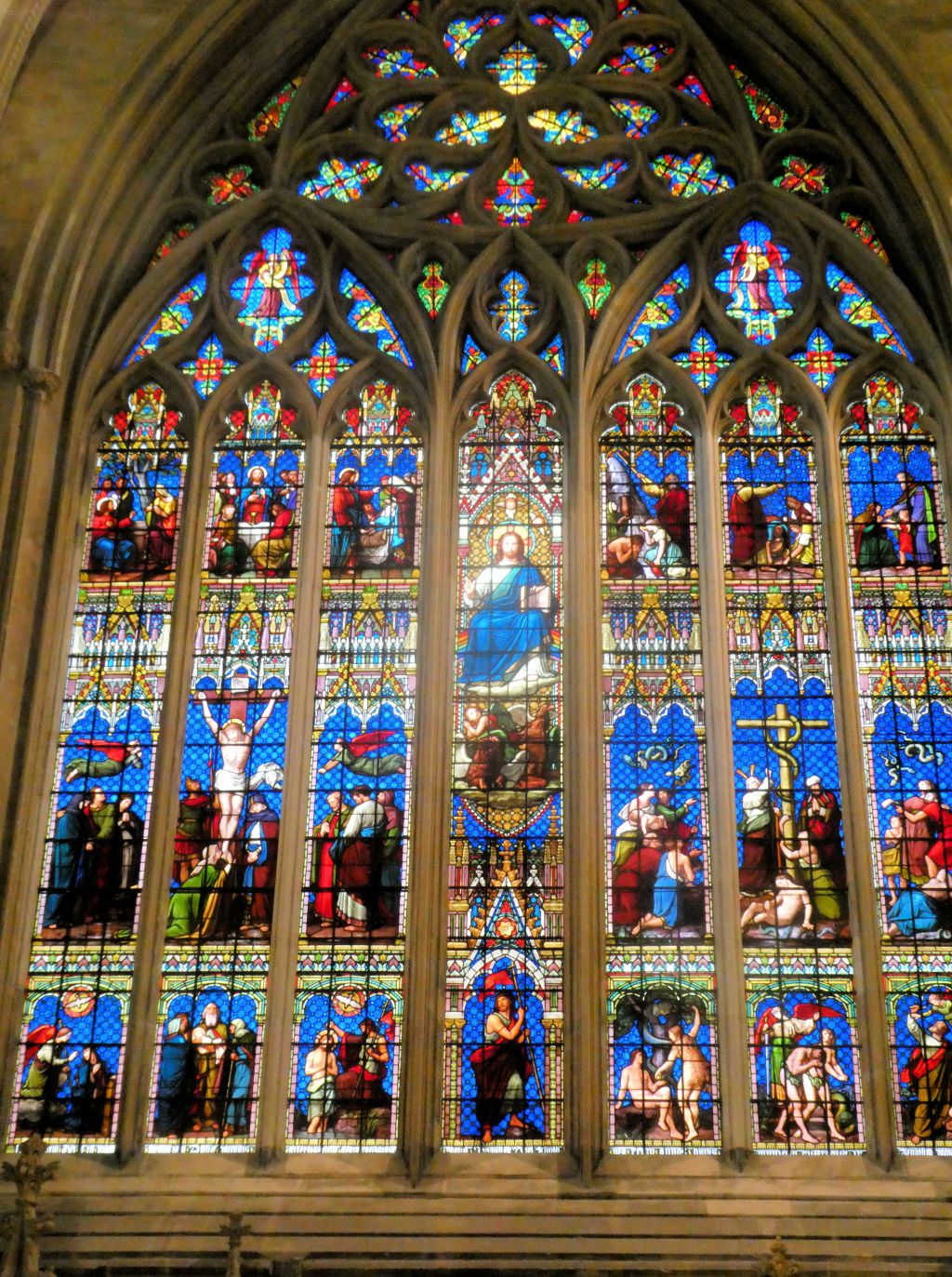
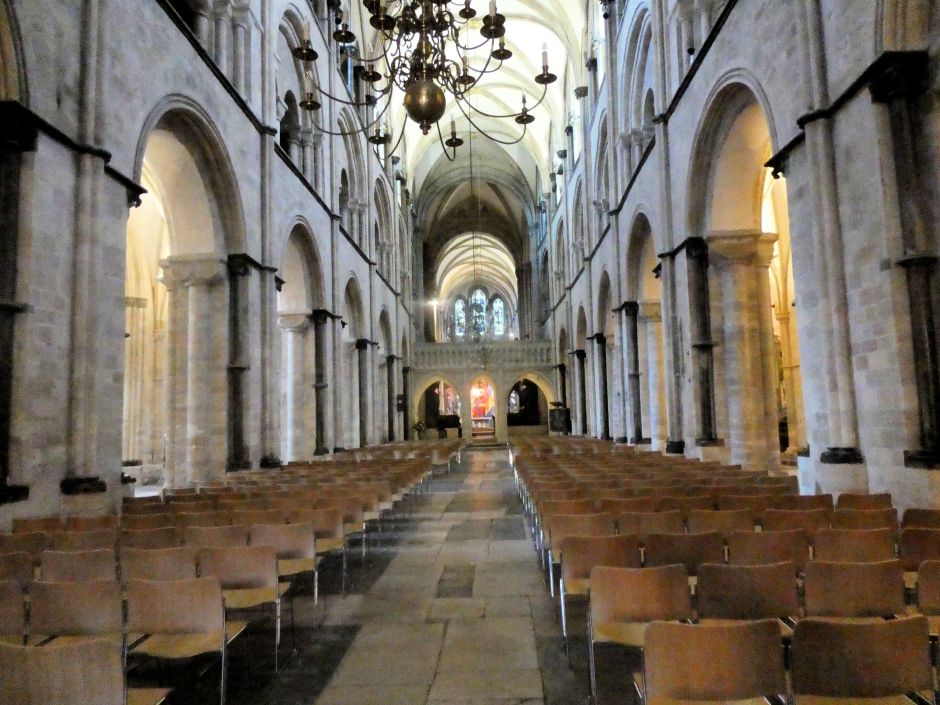
The Cathedral is one of the most impressive in S.E. England and has a wealth of art inside that makes a visit there worth more than a visit to many other grander buildings. See linked post.
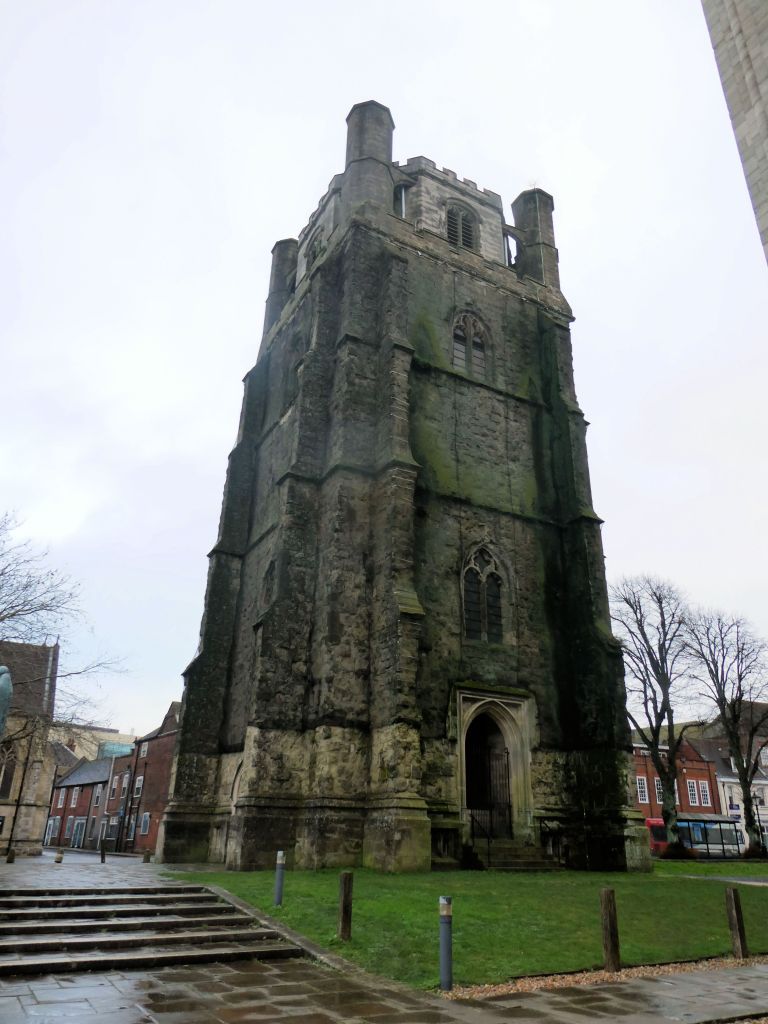
I am not a frequent visitor to churches and cathedrals but I make an exception for the 7thCentury Chichester Cathedral because it contains art that speaks to me. The Cathedral is a classic Norman building with round arch windows and west facing twin towers and is the only English Cathedral with a surviving detached medieval Bell Tower dating back to 681 when Saint Wilfred brought Christianity to Sussex.
Medieval Bell Tower, Chichester Cathedral
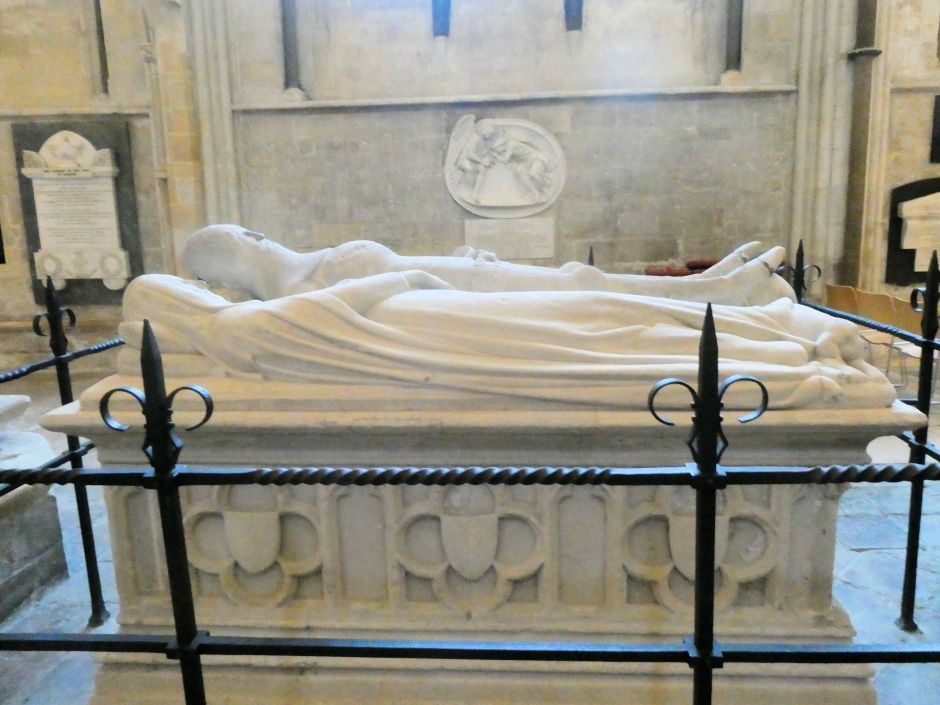
It was raining heavily on the day after the theatre performance so we spent most of the time before lunch and our departure, in the Cathedral. I wanted to re-visit the Arundel Tomb, subject of a poem by one of my favourite poets, Philip Larkin. I have been re-reading Larkin recently and that particular poem has being going round and round in my head and I knew I could only dislodge it by visiting the tomb.
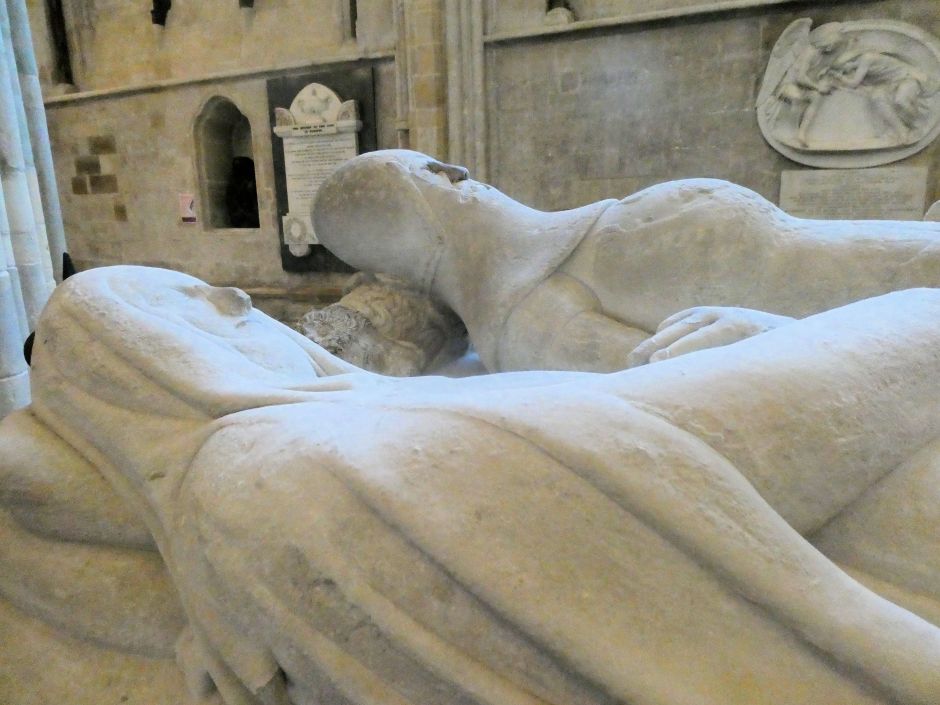
The Arundel Tomb
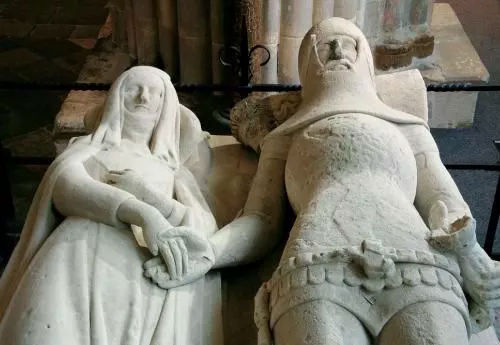
The Arundel Tomb was brought from Lewes Priory sometime after its dissolution in 1537. On top of the carved stone tomb lie the figures of Richard Fitzalan, Earl of Arundel, and his second wife, Eleanor of Lancaster. The tomb was restored at the beginning of the 19th century by Edward Richardson, a well-known sculptor of the day.
I know the poem off by heart and I was able to sit there for a long time and listen to the music of the words in my head and ‘see’ what Larkin saw when he wrote the poem. Without his words, I would have walked by this tomb and missed what he saw “what will survive of us is love”. If copyright allowed, I would have liked to add the poem here, but it wasn’t possible.
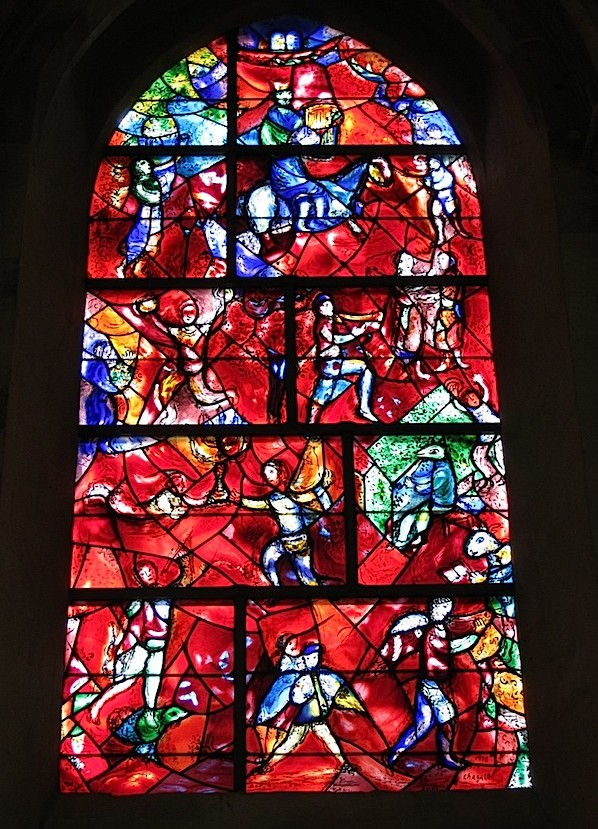
I also wanted another chance to see the Chagall stained-glass window and the Gustav Holst plaque. The Chagall window, installed in 1978, is unusual in that the glass is predominantly red when Chagall usually worked in blue. It is absolutely gorgeous and I could have stayed longer just drinking in the beauty of the luminous jewel cololurs.
Stained Glass Window by Chagall – Photo by David Spender CC.
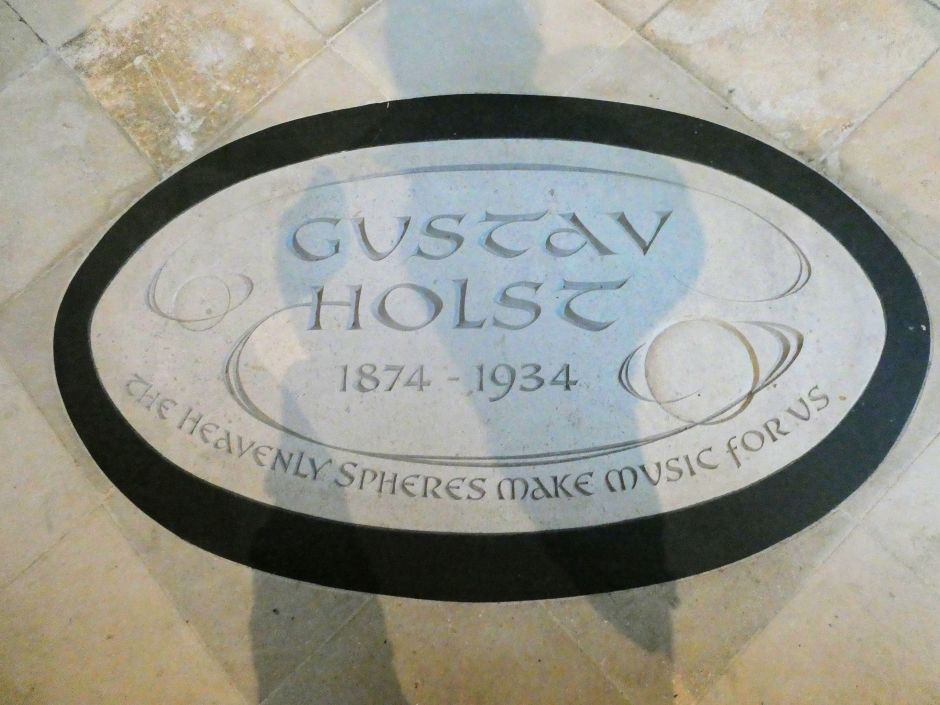
Gustav Holst, composer of The Planets Suite, one of the greats in British 20th century music, had a special connection to Chichester Cathedral having worked with Bishop Bell on the Whitsuntide Festivals. On his death on 25th May, 1934, aged 59, his ashes were interred in the Cathedral under the plaque on the floor in the North Transept near to a memorial to his favourite Tudor composer, Thomas Weelkes.
Plaque in Memorium Gustav Holst
I shall no doubt visit again on my next trip to Chichester because there is more art to be seen in the cathedral. There is a John Piper tapestry on the High Altar, a vividly coloured work which I have yet to take to: there is a Graham Sutherland painting and there are various sculptures worth searching out.
Our trips to Thailand were not sudden decisions but a given: we knew we would go to Thailand every year, spend time with good friends, travel in the country, venture outside it, and have new experiences, so the anticipation was tied up with warm thoughts of friendships renewed and meals shared again.
Group photograph after dedication of new spirit house at Dusit Thani Hotel, Hua Hin, includes the monk who performed the ceremony, the GM, electrician, housekeeper, gardener, various room and restaurant staff – and myself and husband.
But why Thailand in the 1970’s? Well, our travel agent had invited us to an evening of Thai culture and food earlier that year and we were bowled over by the experience of meeting Thais, their charm, their smiles and their sincerity and so our first holiday turned into one of many.
When we first started visiting Thailand, we packed essential foods as Western foods weren’t easily available outside 5* Hotels so biscuits, tea bags, and bags of toffees and other long-lasting sweets had to be purchased (my husband had a notoriously sweet tooth). In later years the bags of sweets increased as our Thai friends became addicted to them also. Mosquitoes were a big problem – especially in Bangkok – so lots of anti-mozzie repellent was required along with sun cream and such like.
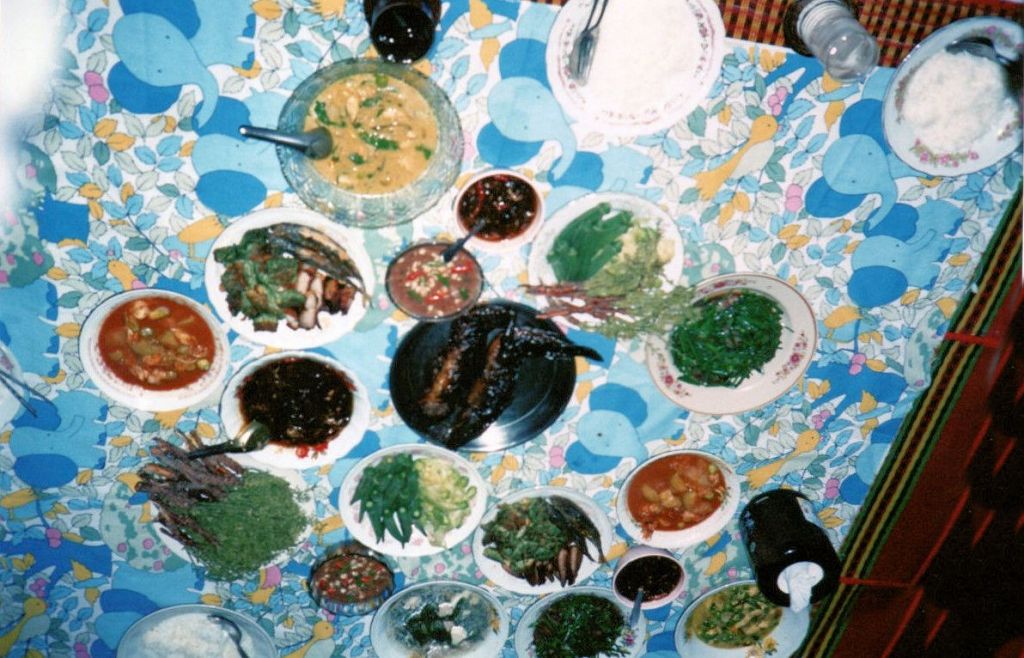
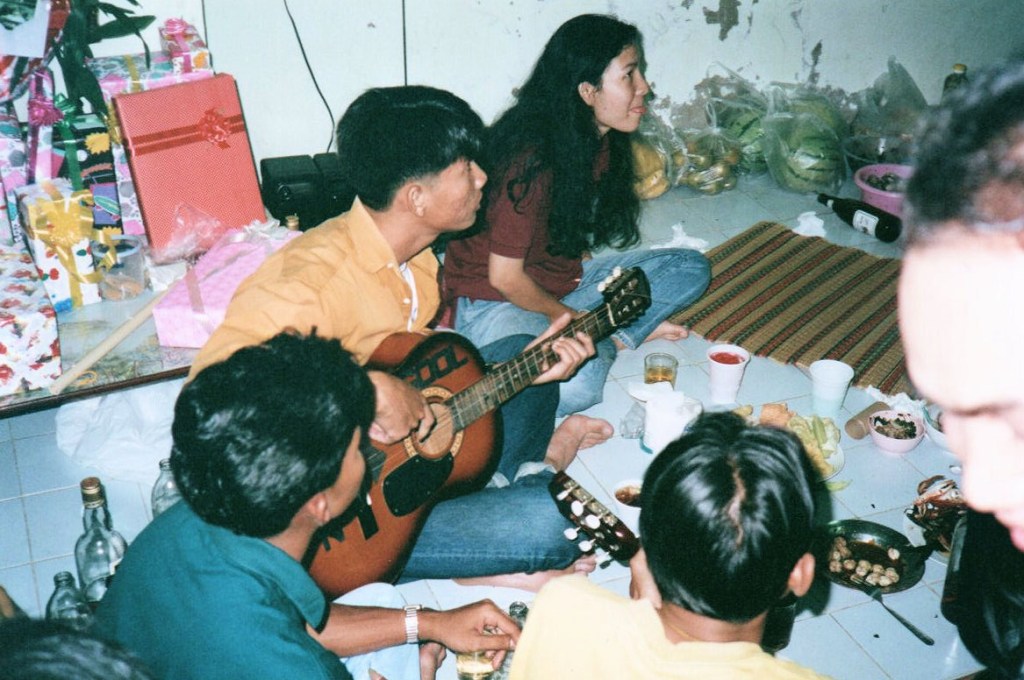
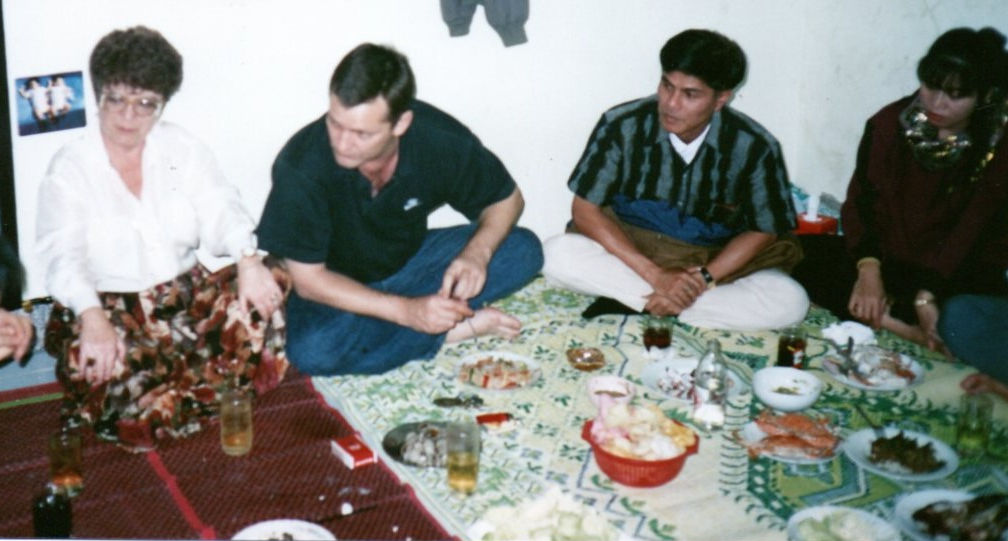
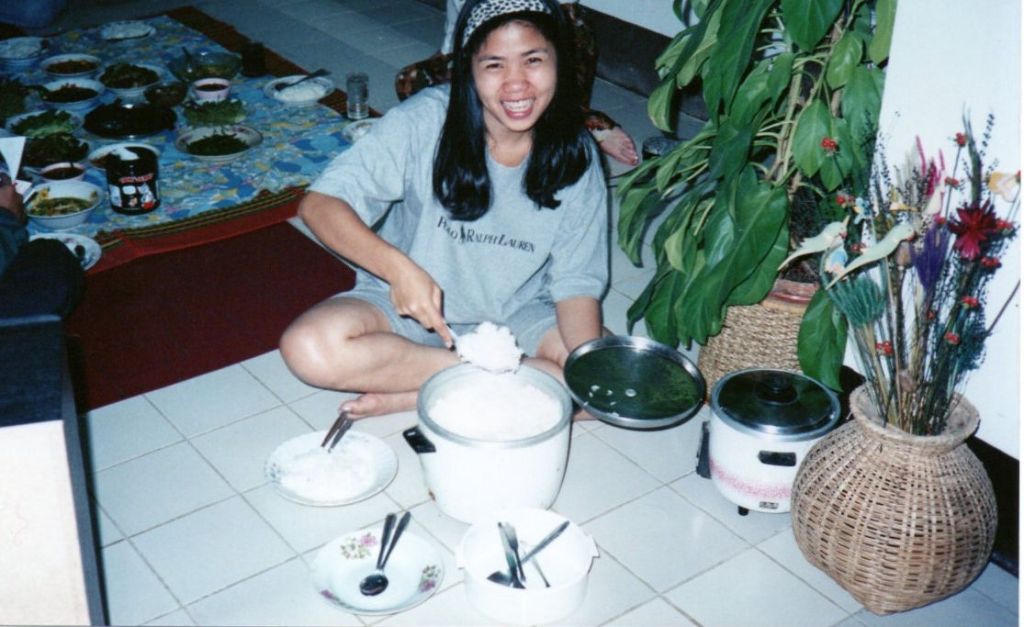
Eating with Thai friends. Food laid out on the floor. Who needs chairs when the food is so good and the smiles so lovely?
Initially we alternated Thailand with other destinations but after our circle of friends there grew and the pull of friendship and place began, it became our regular vacation spot.
After our first few visits, preparations had to include the buying of presents. We tried to ensure the presents were as ‘local’ to our area as we could get and even though no one every made tea in a teapot, they all adored English teapots, and all things English. The exchanging of presents in Thailand is very important and the correct etiquette is not to open the gift in front of the giver. I had to get used to the fact that no one ever came back to say what a lovely present I had given them, but they showed their delight in other ways and the exchange of presents was always successful. I was invariably there for my birthday and not opening my presents was difficult, as I would be deluged with exquisitely wrapped hand-made presents, Buddha medals, unusual gifts purchased in remote villages (like a necklace made from the bone of an logging-elephant), carvings, fruits, foods and pictures.
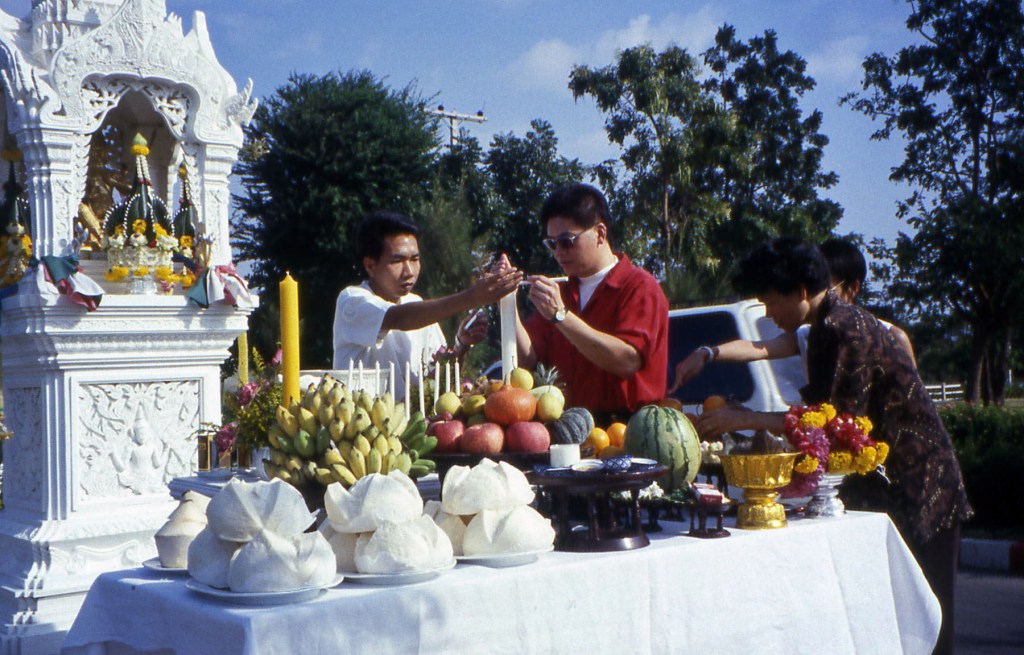
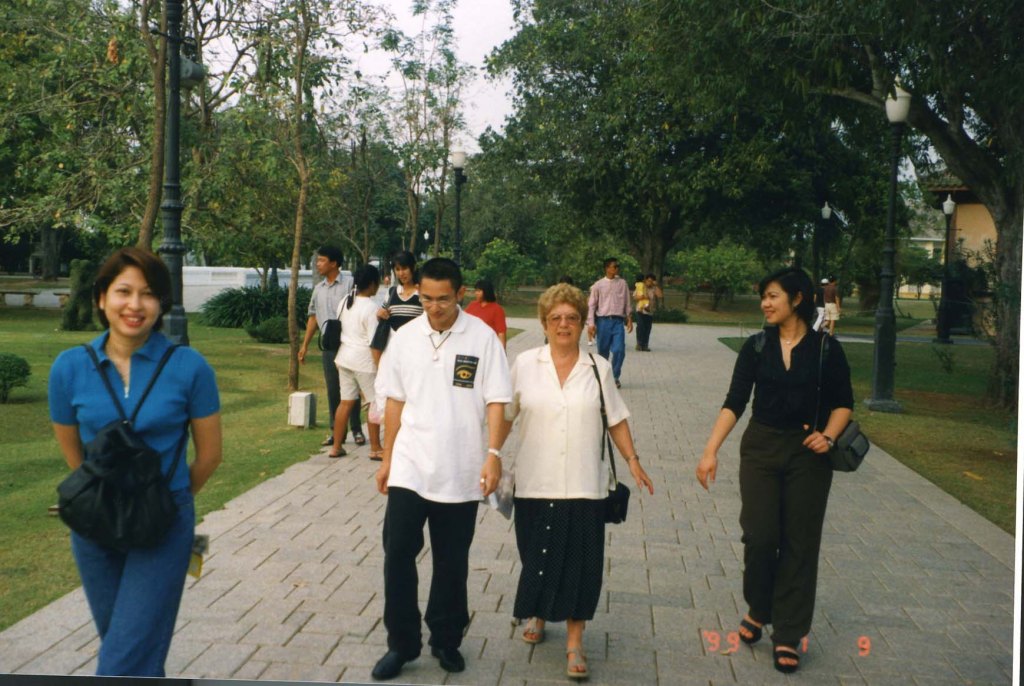
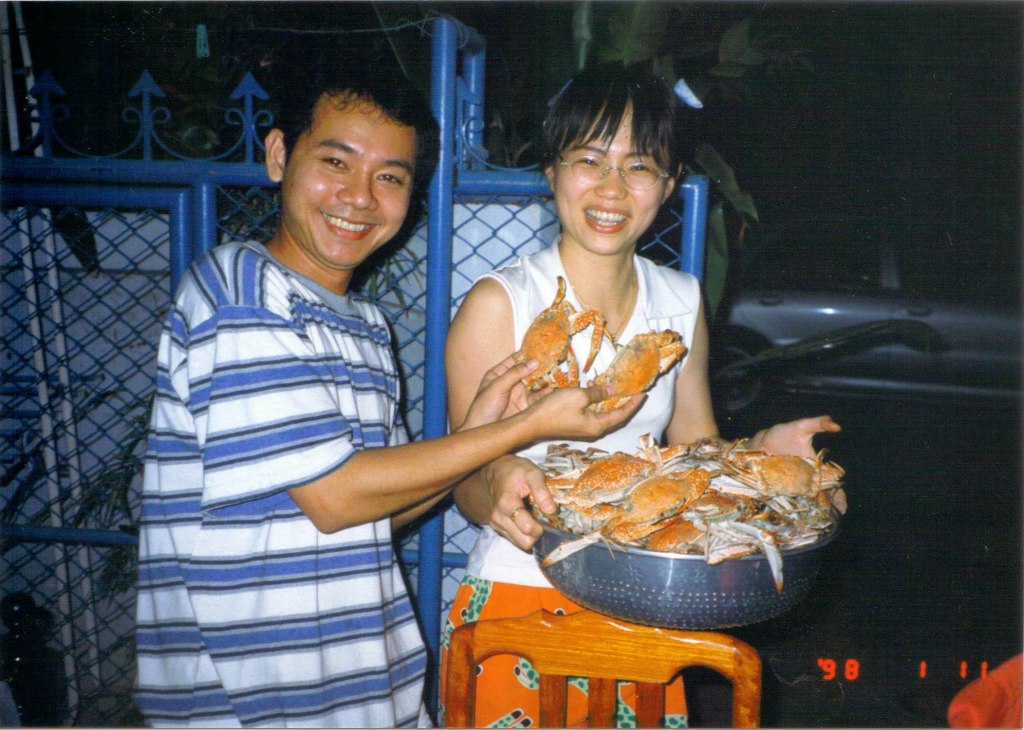
1. Leaving food for the spirits. 2. In Ayutthaya with Yasmin, Nucha & Boom. 3. Crab barbeque at the home of Gai and Darina
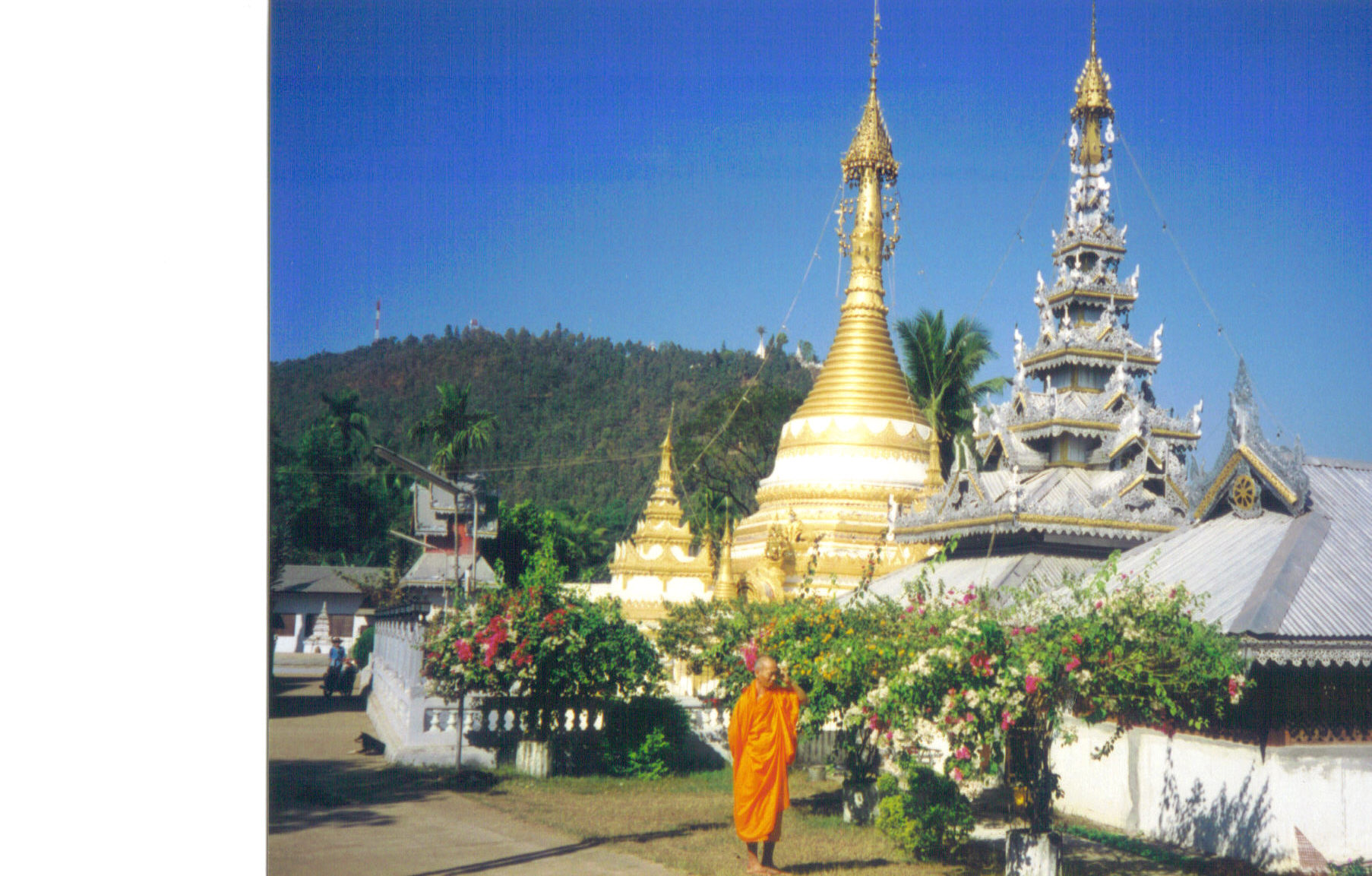
We would always visit a Temple or two and often attend functions where monks were present so packing had to include cover-ups and easy-to-slip-out-of shoes. Apart from ceremonies where monks were present, like weddings, funerals, donating of robes, and blessing of houses etc., I occasionally lined up at dawn with my Thai hosts to offer the monks food for the day (purchased a few minutes before from the market), I made offerings to the spirits at various spirit houses – and always to those in the houses of the friends I stayed with, to ensure my good health while there and to avert disasters.
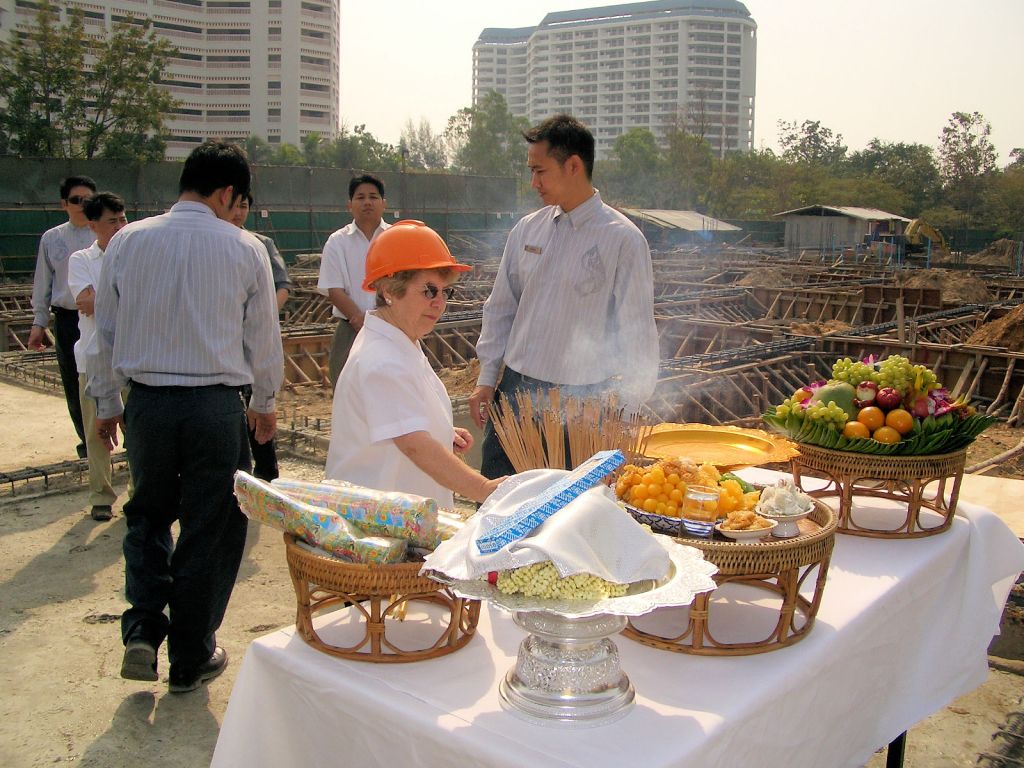
Hard hat area. The laying of foundations for a new dwelling cannot proceed until the spirits have been appeased for disturbing them – hence the feast laid out for them.
I packed a mini-library because English books – apart from a few places in Bangkok – weren’t easily available in Thailand in the seventies. As we both read voraciously we took as many as we could and swapped with other English-readers we met on our travels. In remote parts of the country we would often find books left in bars and cafes which could be exchanged for another one.
Apart from that, no preparations. Books, presents, tea-bags and biscuits, sweets and the duty-free booze from the airport, and we were prepped and ready for holiday.
After our friends had been to the spirit house at the airport and given thanks for our safe arrival, we would pile into a car/taxi/mini-bus /whatever they had arranged and head off either for Bangkok or Hua Hin, a two hour drive away. The next few days were spent relaxing, recovering from the flight and adjusting to the heat, then the discussion as to where we would go began.
Over the years we’ve covered the four corners of Thailand and seen things we’d never have seen if we’d been alone. From our base in Thailand we’ve made long trips to Cambodia, Laos, and Vietnam with contacts in each country lined up for us.
Our first trip was in 1972, the year of the major coup, and in that year we saw the two faces of Thai, the angry revolutionary and the quiet, peaceful one – both smiled. Politics are once again ugly in that country and I am sad about much of what is happening there. We don’t discuss the current situation much, my Thai friends and I, it’s a sensitive subject, and that too saddens me.
Before Thailand became our major holiday destination we travelled extensively in other parts of the world. We enjoyed every country we visited, but with Thailand it was love at first sight and it remains close to my heart.
I still have hopes of visiting again, to make and receive the wai as I join my hands together, smile, and say Sawasdee, Ka.
Don’t be fooled by the dirndls and schnitzels, the chocolate box houses and the cuckoo clocks. Lucerne’s Alpine charm hides an up-to-the-minute city crammed full of attractions from minimalist, boutique hotels like *The Hotel to the sleek KKK (Culture and Convention Centre) perched on the lake, both designed by Jean Nouvel. What’s more to the point, Lucerne has achieved this modernity without losing its old-fashioned charm, allowing it to be both hip and graceful at the same time.
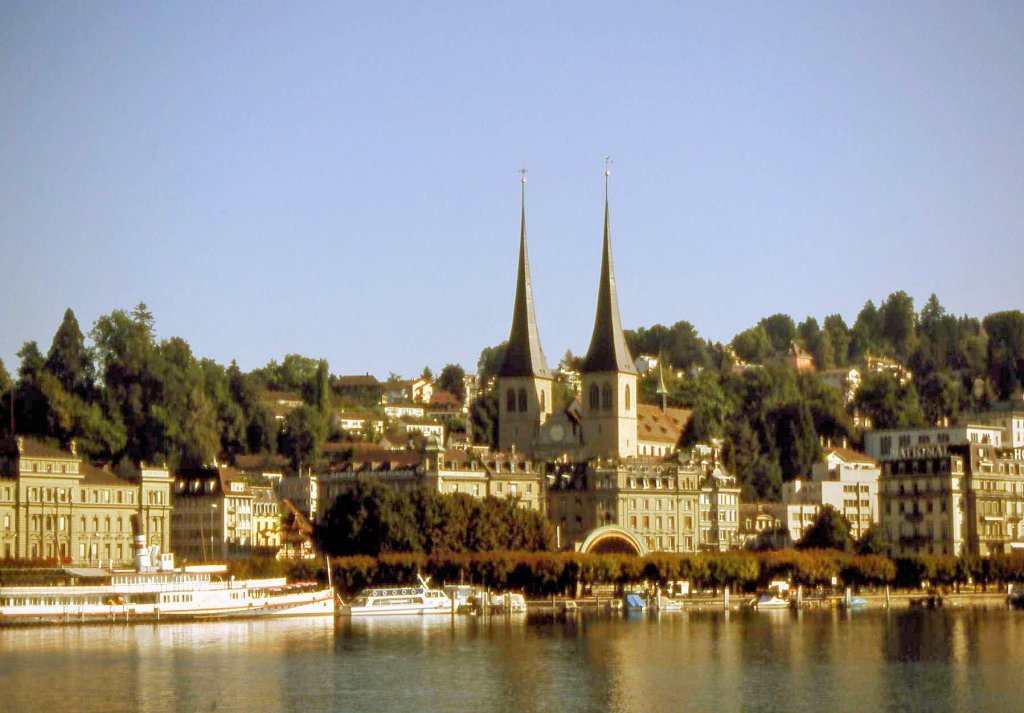
Lucerne from the Lake
Years ago, the best way to arrive in the city was by the white Rolls Royce of the Schweizerhof Hotel. Today, one effortless hour on the smooth, comfortable train from Zürich airport decants you on to the lakeside quay where you are face-to-face with picture postcard Switzerland – paddle steamers criss-crossing the lake backed by a panorama of snow-capped mountains, the Rigi, Pilatus, and the the pinnacled range of the Uri and Engelberg. Grand hotels of the Belle Epoque that played host to poets, writers and musicians (as well as Queen Victoria of England), line the promenade.
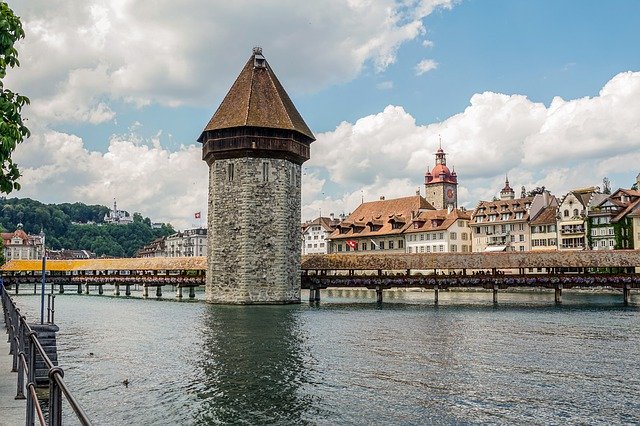
Lucerne with Tower and Painted Bridge in foreground
An elegant city, medieval Lucerne with its fairytale-like turrets and covered wooden bridges, is one of the world’s most agreeable cities in which to spend time. It is an easy place to get around: it offers not just stunning scenery and sightseeing, but year round artistic events and enough Museums to keep any culture-vulture happy for weeks. Among the best are the Rosengart Collection on Pilatusstrasse (a treasure chest of Klees, Braques, Picassos), The Picasso Museum featuring original paintings by the artist and the quirky Museum of Art housed in the KKK which offers eclectic exhibitions at different times.
Like Florence and Venice the outdoor artwork is equally attractive. The KKK is a sleek, polished cube of over 7,000 sq. metres of entertainment and conference space which appears to float on the waters of the lake, a modernist contrast to the old town just a few steps away. Here, frescoes of knights and their ladies cover the Renaissance façades of buildings in the cobbled streets and squares and glimpses of ancient Swiss architecture, turrets and balconies meet your eye wherever you look.
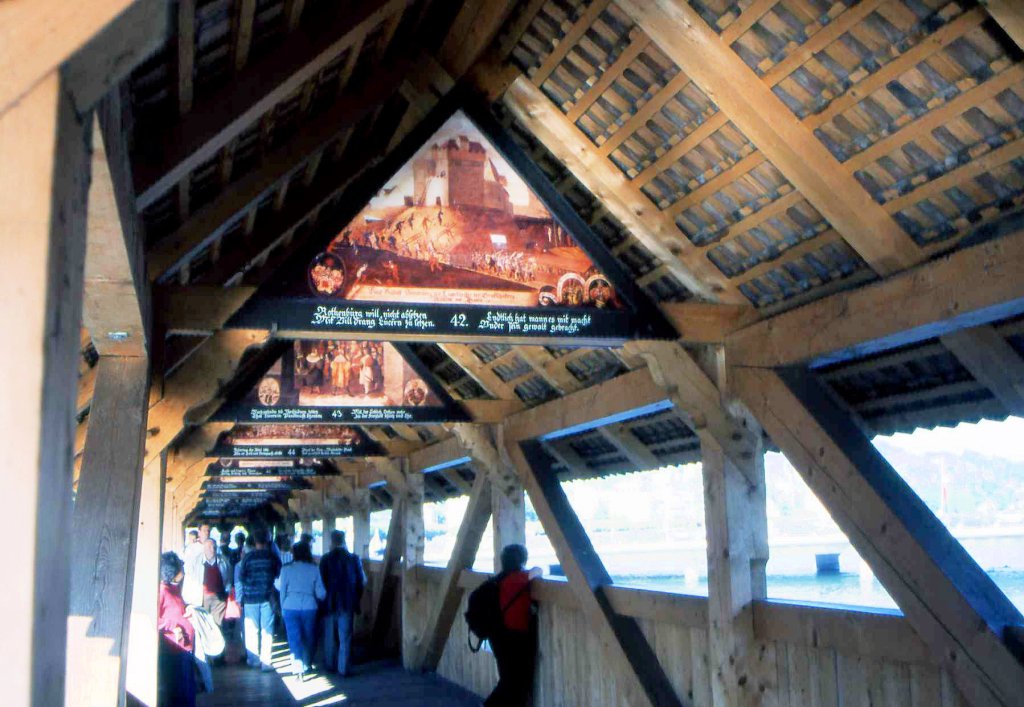
The Painted Bridge
The Painted Bridge
Lucerne is bisected by the fast-flowing Reuss River which is crossed by two famous wooden bridges. The larger of the two, the Kapellbrucke – burnt down in 1993 but since rebuilt – is the oldest preserved wooden bridge in Europe and displays a series of 17th century paintings on 67 triangular panels under its eaves, depicting the Dance of Death. The nearby Water Tower originally formed part of the city fortifications.
Lucerne’s Sad Lion
The second most photographed site is probably the Löwendenkmal, which Mark Twain described as “the saddest and most moving piece of rock in the world”. Carved into a natural sandstone wall in the centre of the town is a statue of a lion pierced by a lance and resting a paw on a shield depicting the Bourbon Lily. It was erected to commemorate the massacre of Swiss mercenaries fighting on the royalist side after the French revolution and Twain’s remark is understandable because it is, without doubt, the saddest looking lion you are ever likely to see.
Mountain view with spring flowers
There is a thriving music scene throughout the year, but the hills really come alive with the sound of music in August and September when Lucerne takes the world stage with a classical Music Festival that attracts performers and an audience, from around the world. Inaugerated in 1938 when Arturo Toscaninni conducted Richard Wagner’s Siegfried Idyll in Lucerne, the festival now offers more than 100 events comprising concerts, ballet, opera, chamber music, dance and theatre, in the acoustically perfect KKK and at various venues around the city. And every week-end sees magnificent firework displays which make the waters of Lake Lucerne sparkle and glow – especially when watched from the open air terrace of the KKK.
June sees the very local Altstadtfest (Old Town Festival) when the streets resound to the music of the local oompah bands and visitors are invited to join in the dancing. And if it’s jazz your after then make sure you’re there for the Blue Balls Festival in July with music from soul to R. & B. and funk.
For a spot of retail therapy, both sides of the Reuss can be recommended. For top name watches go to the Bucherer and Gübelin stores which are easy to find: just look for the long queues of Chinese shoppers outside the store. If you’ve already got a Rolex, then you can wander along the right hand bank of the river every Tuesday and Saturday morning and enjoy the fruit, flower and vegetable market, perhaps stopping off at the Rathaus Brauei for a beer or a coffee, or the famous Swiss Chocolate. Authentic Swiss cuisine can be found at Galliker, Wilden Mann Burgerstube, and Old Swiss House.
Cuckoo clocks, musical boxes and Swiss Army Knives, are well made, traditional gifts from Switzerland that are usually appreciated, and a fine collection of these can be found at the Old Swiss Shop nestling at the foot of the Hofkirche and run by the charming multi-lingual Madam Lydia who has thoughfully placed a table and chair outside her shop for weary sightseers.
Hot Chestnuts are a favourite
Switzerland has a surprisingly good nightlife and Lucerne has the coolest clubs and bars. The Grand Casino Luzern offers live entertainment and in summer, the Stadkeller, an excellent restaurant, hosts some great concerts, but the really good thing to do is to take the night boat out on the River Reuss to listen to traditional Swiss music and join in the dancing.
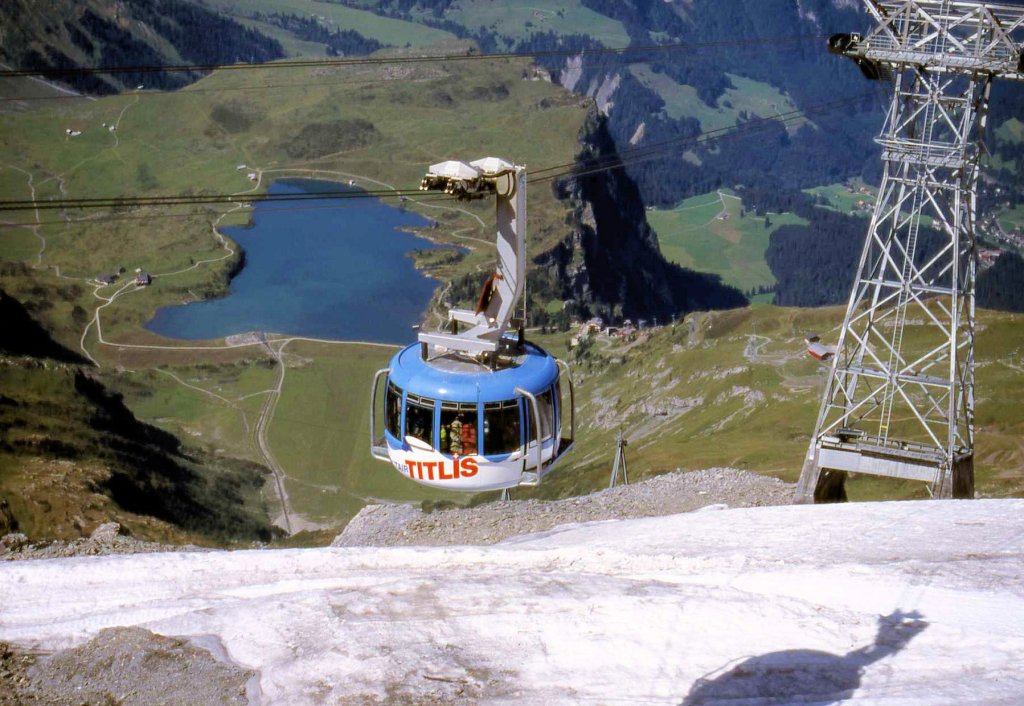
The Gondola to Pilatus
As well as trips on the old-fashioned paddle-steamers to surrounding towns and villages like Viznau, Interlaken, and Brienz (if you don’t fancy this, just relax and enjoy the ravishing views from the steamer while you sip a coffee or have lunch), no one should leave Lucerne without making an excursion to the summit of the city’s own snow-covered Mount Pilatus from which the views are stunning.
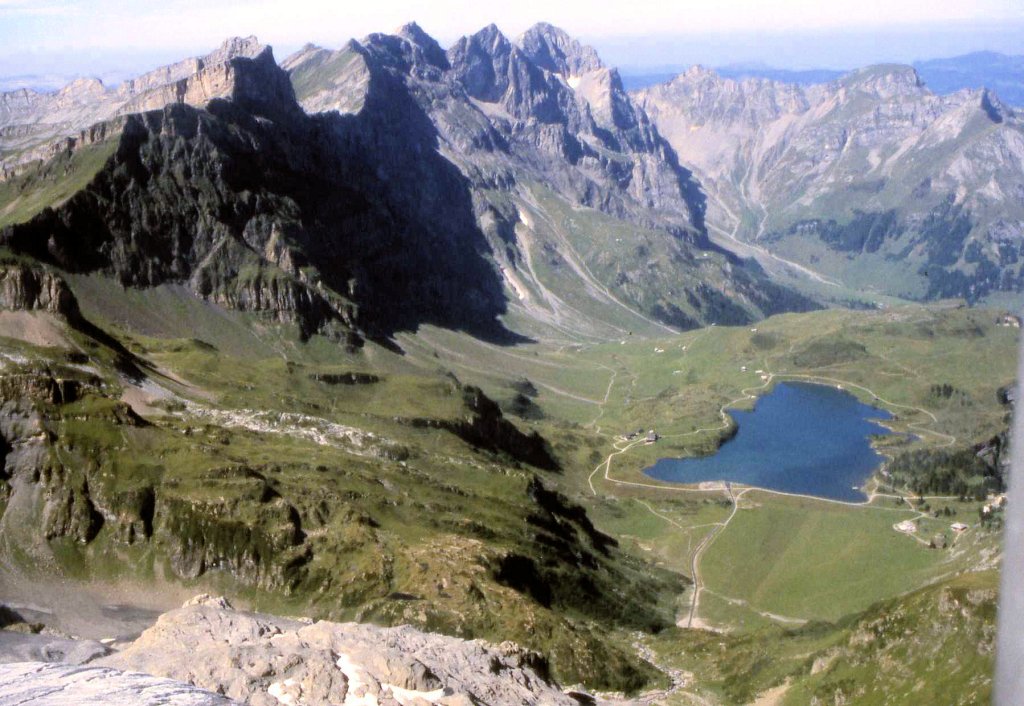
Looking down on Trubsee
Factor in lunch on the summit to get maximum enjoyment from a trip that utilises lake steamer, cable car, gondola, and the world’s steepest cogwheel railway that climbs through flower-carpeted meadows dotted with clumps of intense blue gentians and wooden Swiss chalets hung with red and pink geraniums. You won’t hear much yodelling here but you will be aware of the chiming of the bells around the necks of the gravity defying brown and white cows grazing on impossibly steep slopes.
The tiny White Building in the centre is a mountain church.
If this whets your appetite for mountain views, then make for Stanserhorn where there is a 100 kl. Alpine vista of 10 Swiss Lakes and Gerrmany’s Black Forest. There are opportunities for easy hiking at the summit, as well as lunching on the classic local dish of Luzerner Kügelipastete, a large puff-pastry shell filled with a rich stew of veal and mushrooms in a creamy sauce!
Lucerne has something for everyone and an evening cruise on the lake or a stroll along the promenade, will allow you to experience the essence of Switzerland in the place the Swiss call City of Lights – an essence that is in the air, the changing shapes of the mountains, the changing colours of the water and, above all, the magical light.
** The Hotel, a “concept” hotel (member of the Autograph group) where the ceilings are painted with scenes from art house films (think Fellini, Fassbinder). Tel: +41 41 226 86 86 www.the-hotel.ch
NOTES:
Don’t leave home without your Swiss Pass which entitles you to either unlimited travel or half-price travel, plus entrance to Museums, depending on which one you purchase. In the UK contact sales@stc.co.uk
Ten minute outside town with magnificent views, the family-run Hotel Balm Meggen (Tel: +41 41 377 11 35 www.balm.ch
On the principal that anything banned by a puritan like Oliver Cromwell has to be good, I should like Christmas Pudding: however, I find today’s offerings a bit too sweet and rich. When my mother was alive and cooked one for each member of the family (starting it in February and giving it time to mature instead of following tradition and making it on the Sunday before Advent) I used to love it, especially fried in butter on Christmas morning. I’m a lazy cook however and as I don’t like the store-bought versions, I usually serve something like a Pavlova for Christmas dessert.
Image by Linda Tacey from Pixabay
I once had the idea of cooking a Christmas pudding by usng the original receipe but I gave up on that as a) finding the origins of the pudding wasn’t easy and b) when I delved deeper it sounded revolting. It seems that at the end of the winter solstice (or towards the time of the pagan festival which had been co-opted into the Christian festival of Christmas) all the good things from the recent harvest were poured into a huge cauldron and boiled up, things like hulled wheat, milk, apples, spices, honey and whatever was left in the barns and the larders. The resulting concoction was called a porridge.
Image by Karen from Pixabay
The story has it that every member of the household had to stir the pudding to ensure good health in the coming year but I like to think that as stirring this enormous cauldron wasn’t easy for the cook of the house (always the woman) the ritual of everyone in the household from the youngest to the oldest, including servants, being required to stir the pot, was devised by her to reduce the work. This tradition is still adhered to in families where the pudding is still made – it certainly was in mine.
Image from OpenClipartVectors from Pixabay
Over the centuries the mixture was improved by the addition of dried fruits, meat and alcoholic spirits, although I would argue that meat may not necessarily have improved it. When the Elizabethans added prunes (dried plums) it became plum porridge but no one can say for certain when plum porridge became plum pudding. It may well have been when meat was dropped from the recipe in the late 18th/early 19th century.
Image by Gerd Altman from Pixabay
In its early incarnation it was boiled in a cloth dusted with flour which gave the pudding the traditional round ball shape, so familiar from Christmas card illustrations and Dickensian prints. Although my mother never baked one in a floured cloth, she always wrapped the pudding basin in a cloth which was loosely tied at the top to allow the pudding to rise and for the top to take on a round shape. Silver sixpences were always included in the pudding as a symbol of future wealth for the family, but we children were delighted with the ones we got in the here and now.
Charles Dickens immortalised it in A Christmas Carol the performance of which is now an essential part of Christmas: Queen Victoria and Prince Albert are said to have loved it: and along with Christmas cards, Christmas trees, tinsel and turkey, I think we can say that the Christmas pudding as part of the Christmas festivities, is here to stay.
For years now I’ve been totally in love with the region of Emilio-Romagna in Italy, mostly, I admit, because of its food, but my first flirtation with the area came when I visited Cesenatico. It was here that I discovered that the canal that runs through the centre of the town, was designed by Leonardo da Vinci and I was immediately charmed. That the genius who produced so much art could also put his mind to something so mundane, seemed so wonderful. Is there nothing he didn’t design? How had it escaped me?
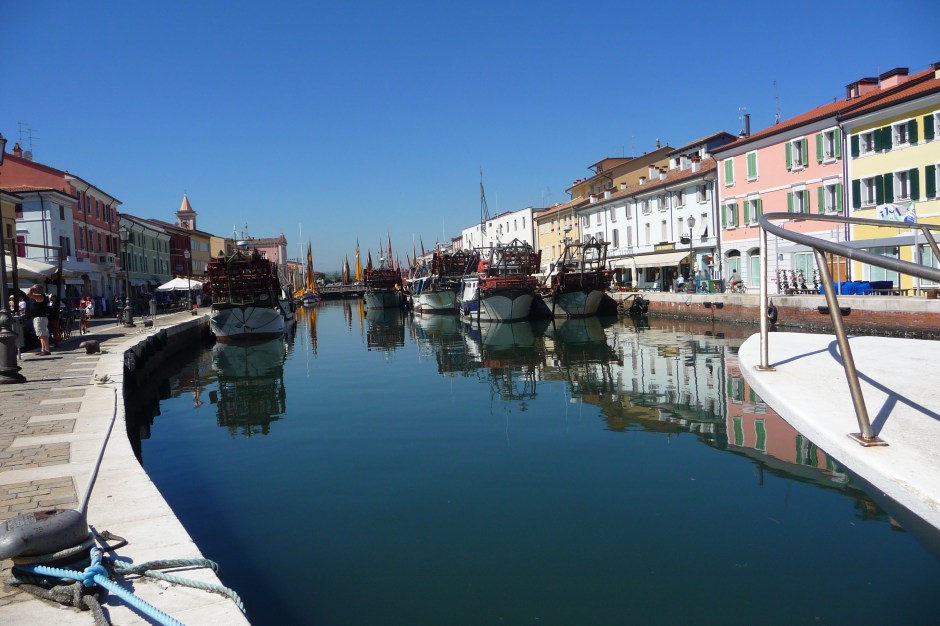
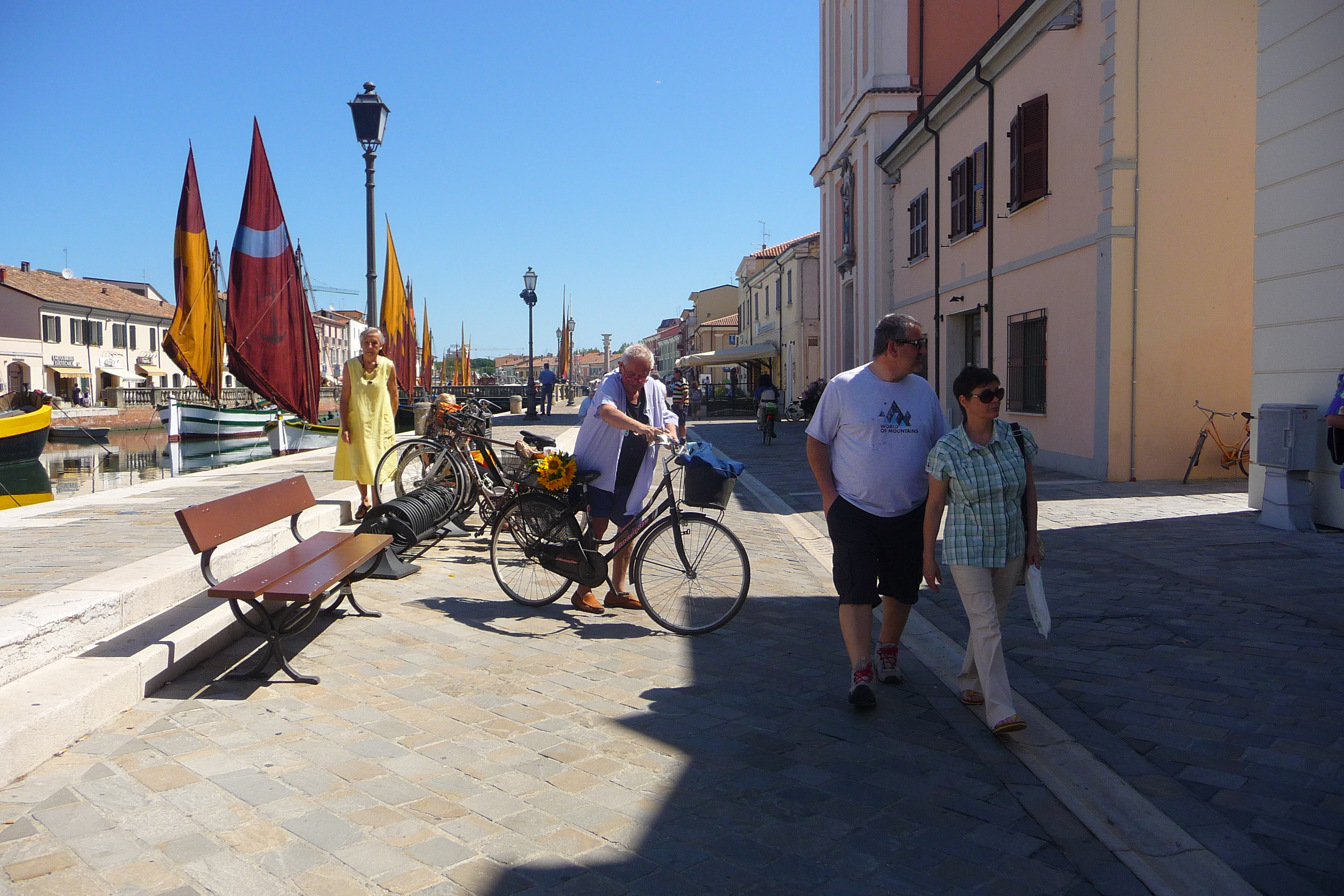
Canal and Port
Cesenatico has been a popular seaside resort for Italian visitors since the early 20th century, but it wasn’t until the end of the Second World War when people began to seek pleasure in sandy beaches and sun that its tourist trade really took off : Cesenatico’s beaches stretch for over five kilometres. More recently, the town has seen an influx of visitors attracted by the beaches and shallow waters of the Adriatic, the bars, bistros, elegant shops and gelateria that line the canalside, and the near perfect weather.
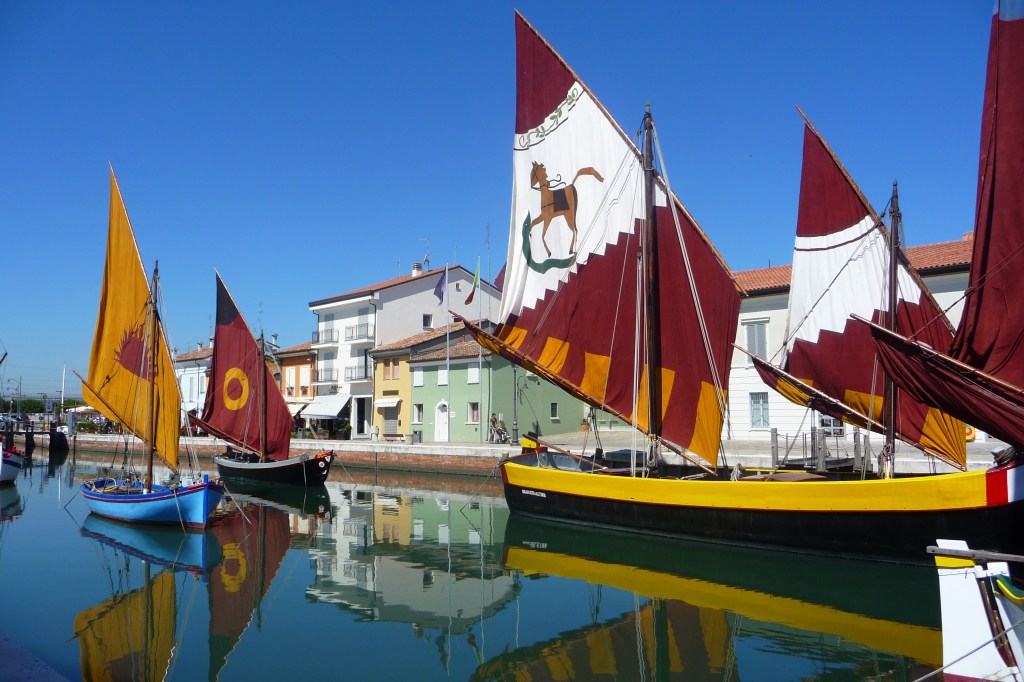
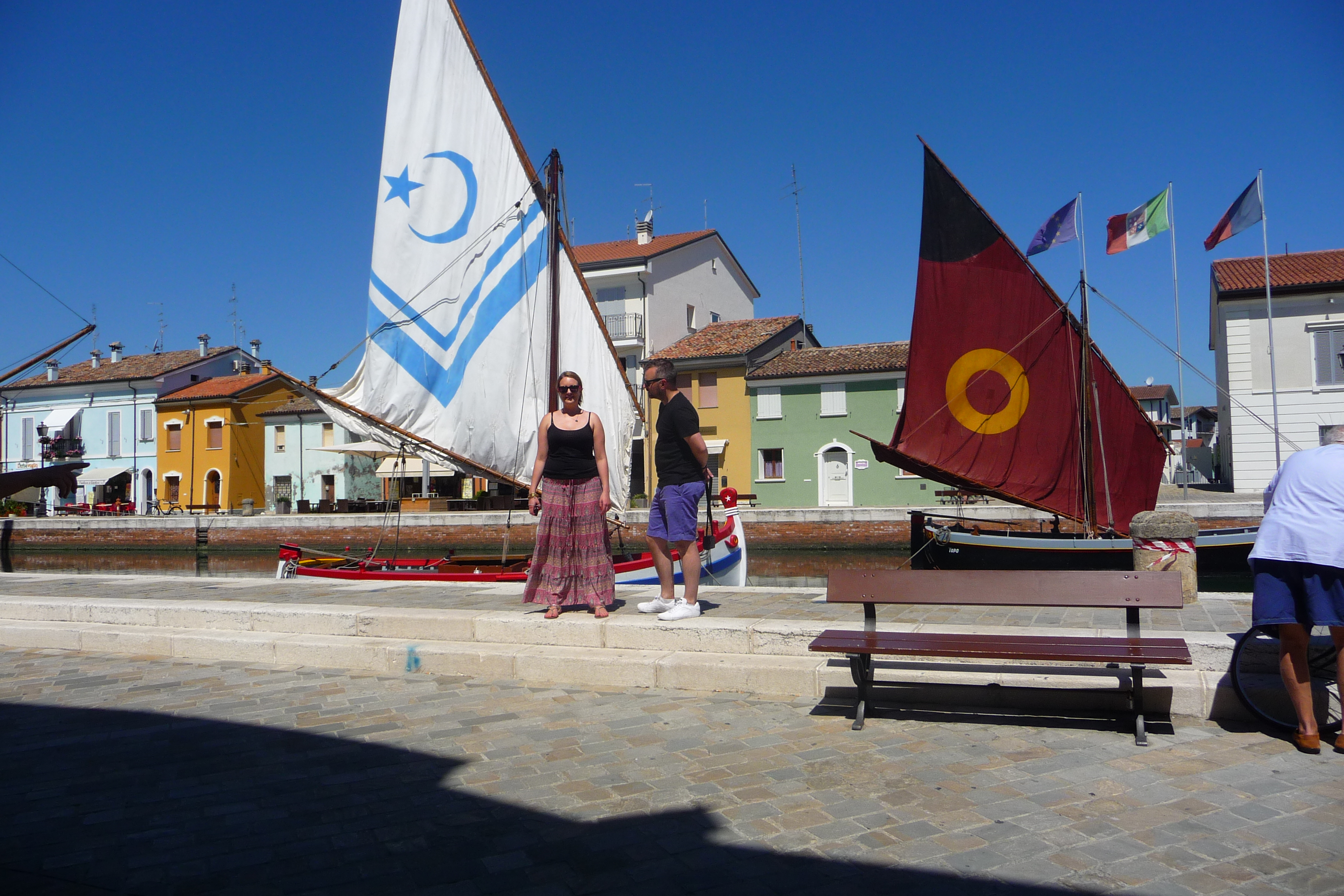
Outdoor Museum of Boats on the Canal
This is as medieval as it gets and it rings with names from history. The ancient fishing harbour was designed in 1502 by da Vinci on the orders of Cesare Borgia, two names to set the mind racing. One part of the canal has been closed off to accommodate the Floating Museum of Marine History in which eight perfectly restored boats of the type that were once used locally for trade in the upper and middle Adriatic are on display. Painted in the natural colours that were used in the past, each sail represents a different fishing family from the area. This was done originally so that the boats could be recognised at a distance: today they are a lesson in maritime history.
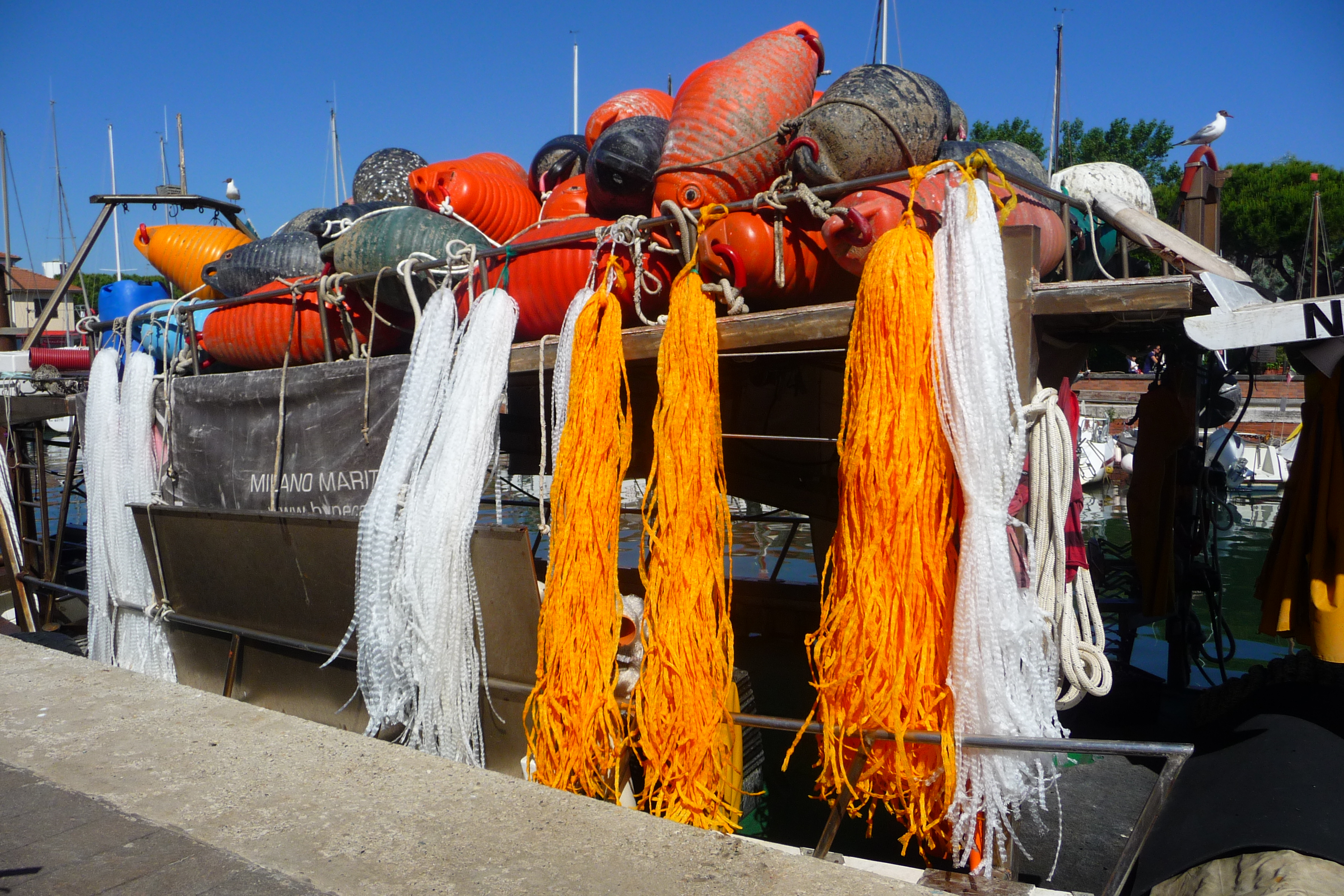
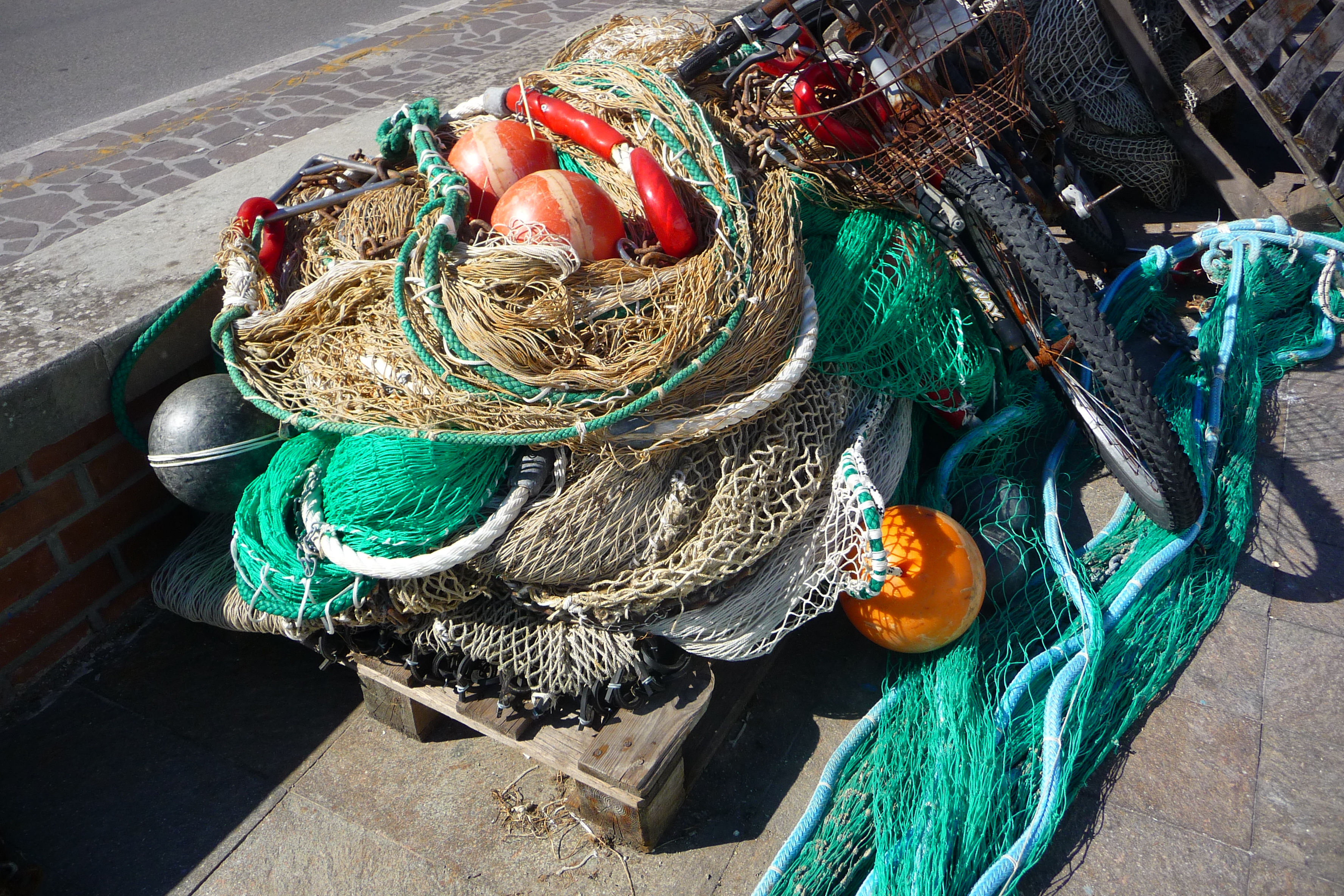
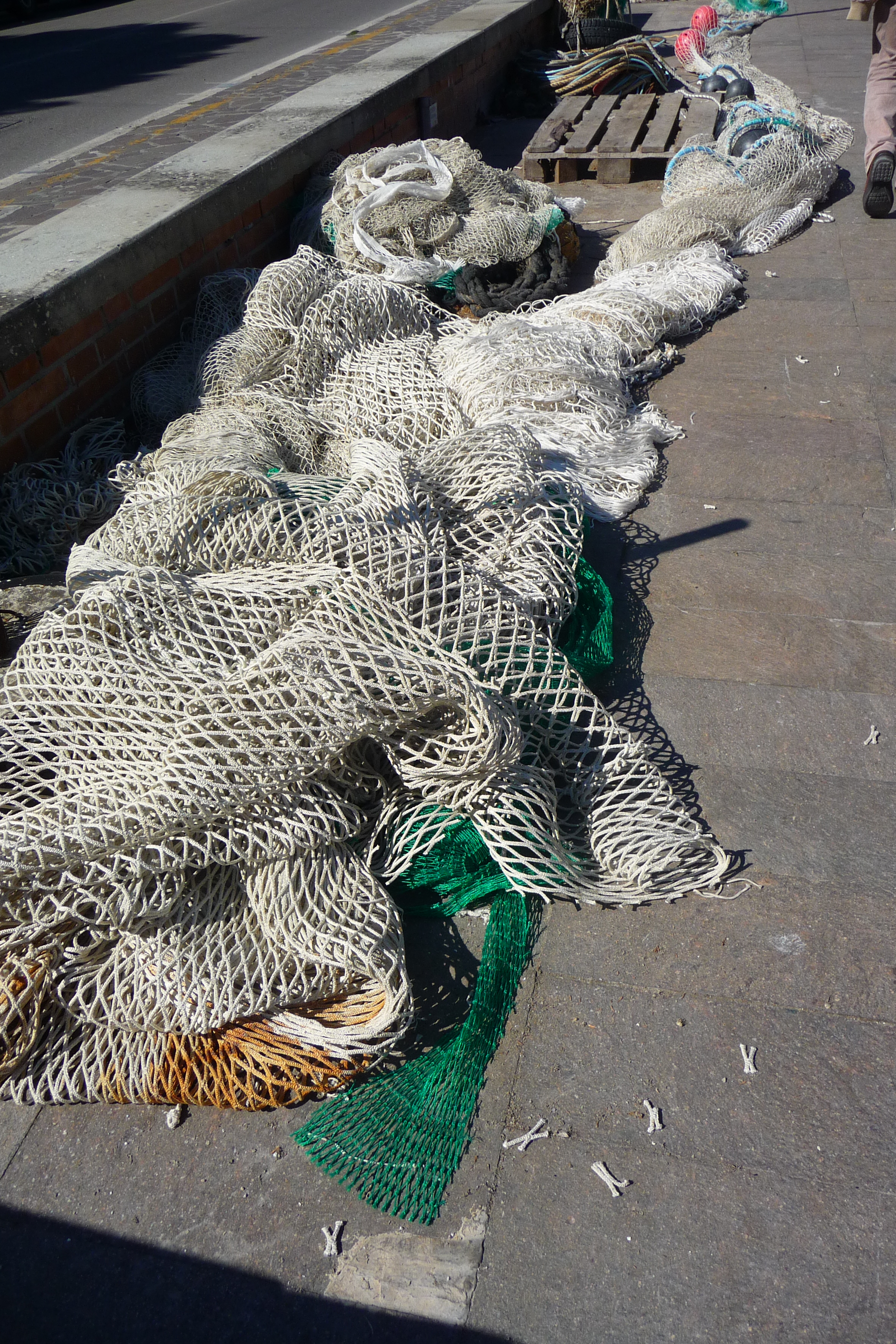
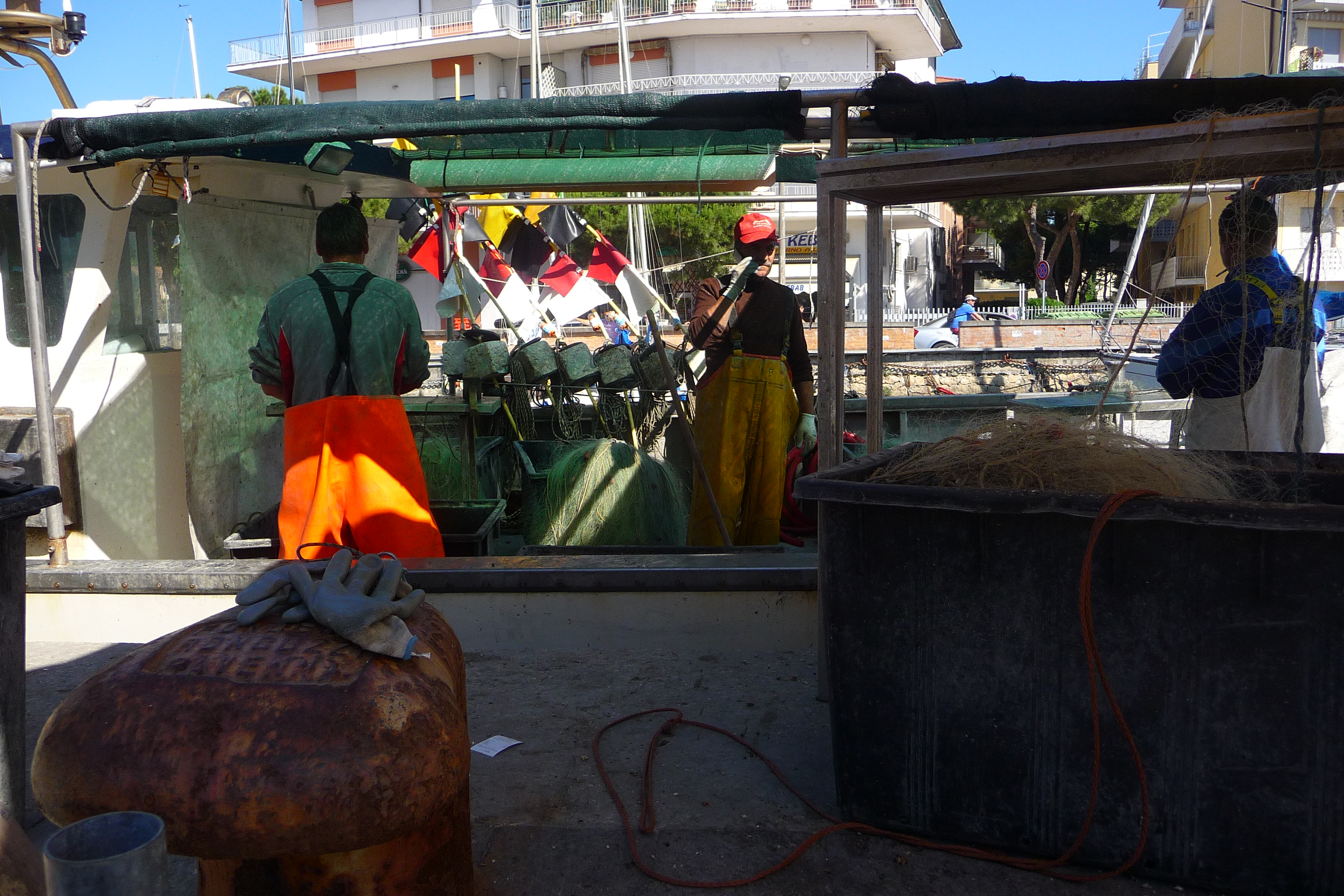
Alongside the canal the indoor Maritime Museum houses artefacts and documents dating back to the prehistory of navigation. As the port supports today’s fishing industry the canal bustles with working boats, many of which sell their catch from the boat. Weaving in and out are small yachts and leisure craft for the canal has an attraction for all who love messing about on boats.
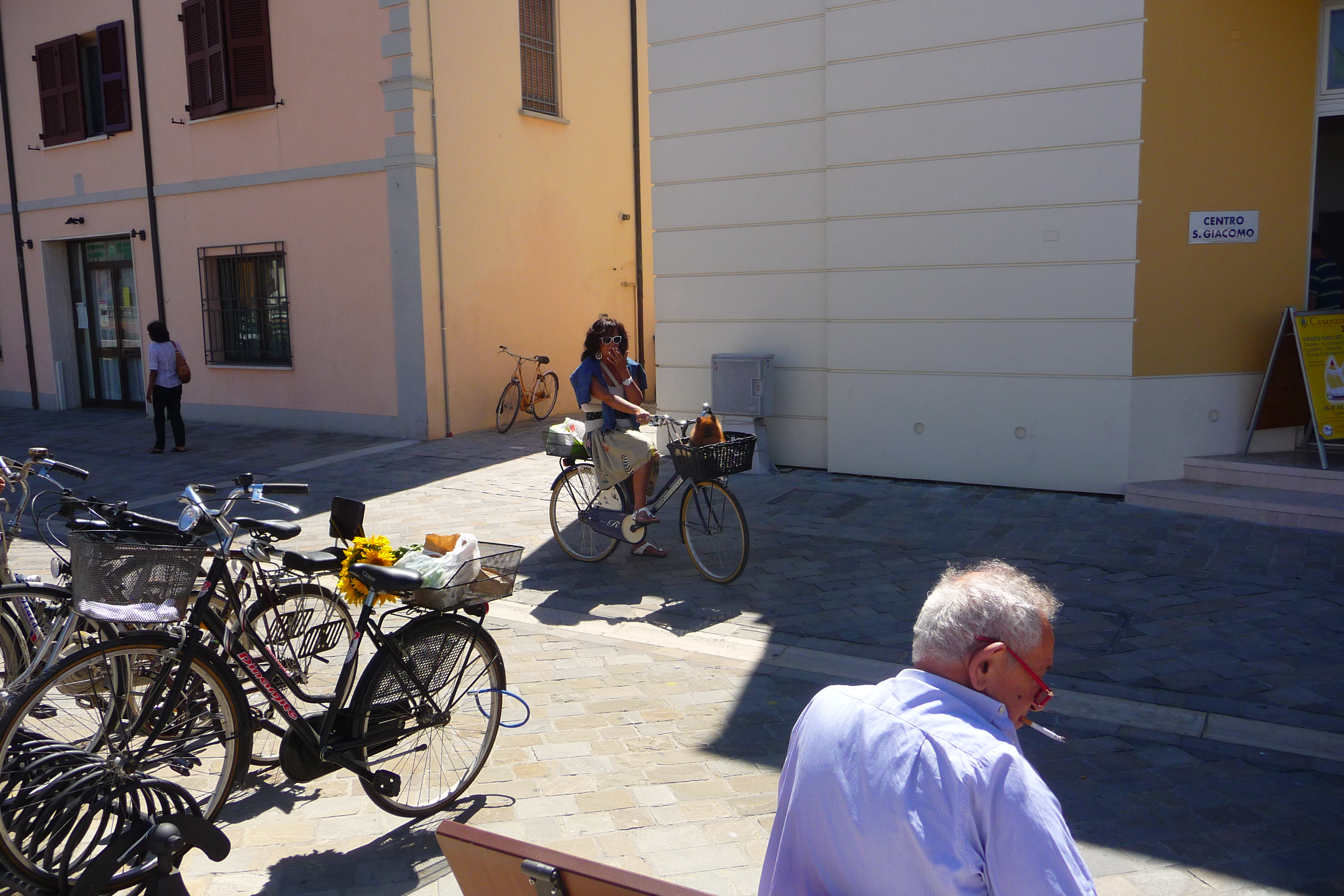
If it’s a sunny day and being indoors is not to your liking, then admire the collection of medieval boats on the canal while sitting at a nearby café with a glass of the delicious local wine. If you are there on a Sunday expect to see elegant ladies tottering about on their Louboutins, tiny dogs clutched in their arms, impeccably dressed young men making the passagieta with or without their girlfriends, and old men sitting outside the bars nursing espressos and smoking.
Cesenatico was the first Italian town to erect a monument in honour of the great Liberator of Italy, Giuseppe Garibaldi, to signify his connection to the town and this statue can be seen in Piazza Pisacane. In August of 1849, the great man, his wife, and other patriots fleeing from Rome were hunted down here.
There are a few other monuments to visit if you can drag yourself away from the port and its charms or the beach and the calm waters. The birthplace of the poet Moretti is now a centre for the study of 20th century Italian literature with a display of his books and papers, and the Theatre built by the architect Candido Panzani which, having survived damage sustained during the Second World War was restored in 1992, is architecturally very interesting.
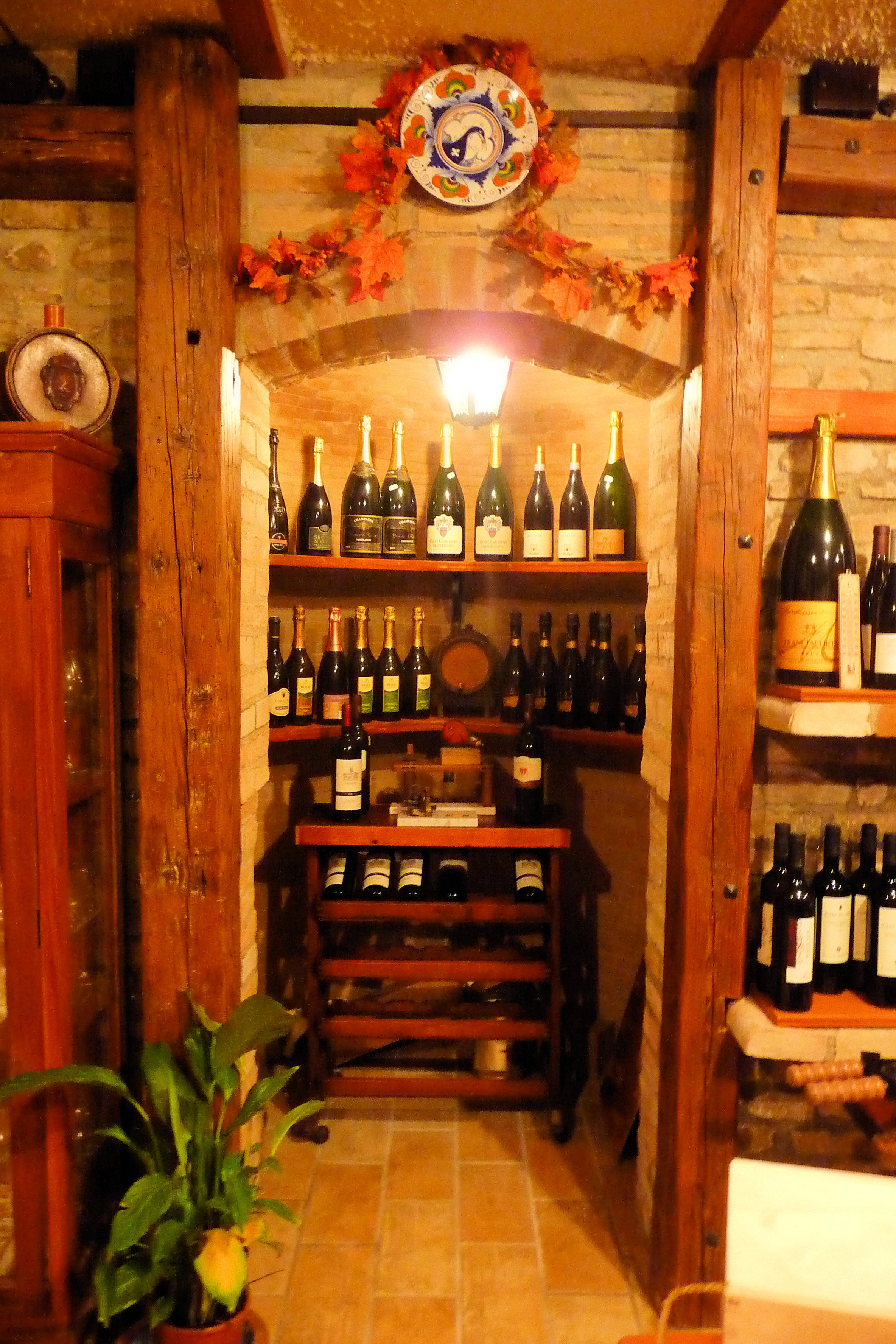
But Cesenatico is really a place made for relaxation, for doing what the locals do, chill out with a coffee and grappa, lunch al fresco with local wines, or dine elegantly while watching the world go by.
The region of Emilia-Romagna in Italy has many lovely towns and villages but none, apart from Cesenatico, has a canal designed by Leonardo da Vinci, running through it.
The underground memorial site at Arras, the Wellington Quarry – Carrière Wellington – should be high on the list of things to see when visiting the historic town in northern France.
Most people are familiar with the Somme Battles, Passchendaele and Ypres, but fewer are aware of the sacrifices that were made at Arras: France alone lost 30,000 men. A visit to The Wellington Quarry, which is in the middle of the old city of Arras, reveals a little-known story of World War I and is a good place from which to try and understand the horrors of World War I.
Pill Box with Cut Out at Wellington Quarry
First, a little bit of history to set the scene.
The battles of Verdun which involved the French, and the battles of the Somme which involved the British and Commonwealth in 1916 had been disasters with terrible loss of life. Arras was strategic to the Allies and, uniquely in World War 1, was under British command from 1916-1918, but was under continual bombardment from German troops. To create a new offensive on the Vimy-Arras front, the Allied High Command decided to tunnel through the chalk quarries under Arras which had been dug out centuries before to provide building material for the town. The plan was to construct a sort of barracks, a series of rooms and passages in which 24,000 Allied troops could hide in readiness for the planned attack and for the tunnels to go right to the edge of the enemy’s front line which would allow them to burst out and surprise them.
The Wellington Quarry Museum tells this story of this quarrying, the lives of the townspeople and the troops, and the lead up to the battle of Arras on April 9th, 1917 and a walk through the tunnels lets you experience something of what it was like to live in these depths for two years.
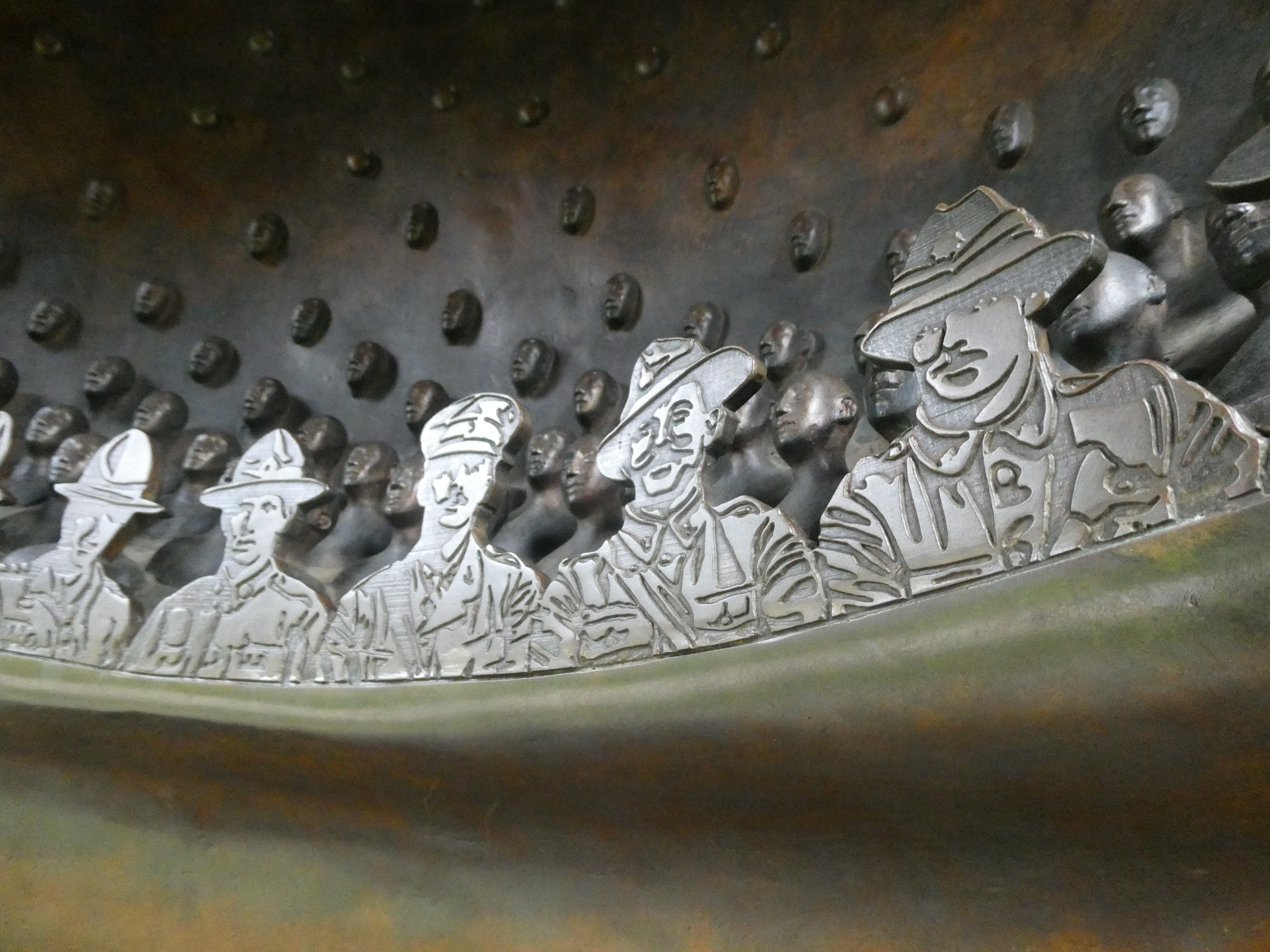
In March 1916 the first of the skilled men required for this job arrived on the Western Front – 500 miners of the New Zealand Tunnelling Company, mostly Maori and Pacific Islanders, gold miners from Waihi and Karangahake, coal miners from the South Island and labourers from the Railways. Discouraged from enlisting due to the essential nature of their industry, they were now plunged right into the thick of it, working alongside experienced miners of the Royal Engineer tunnelling company, miners from the Yorkshire mines and tunnellers who had worked to dig out the London Underground.
The first task was to create primitive underground living-quarters, and with superhuman effort they dug 80 metres per day to construct two interlinking labyrinths. They worked only with pick axes and shovels as the Germans were just above them so no explosives could be used . Conditions were primitive and dangerous and although the temperature was a regular 11 degrees, it was continually damp: there were many deaths, many injuries.
By April 1917 they had created a working underground city with running water, lighting, kitchens and latrines: a rail system and a hospital were up and running and space for 20,000 soldiers was found even if it was cramped. Completed in less than six months 25 kms of tunnels eventually accommodated 24,000 British and Commonwealth soldiers who, as with the battlefields above ground, gave their sectors the names of their home towns. For the British it was London, Liverpool and Manchester, for the New Zealanders it was Wellington, Nelson and Blenheim. Nowadays, Wellington is the only one of the quarries that can be visited, the others now mostly lost or covered over by buildings and car parks.
In dim light, a lift takes you 20 metres underground, during which the guide starts the extraordinary story of the Wellington Quarry tunnellers against a recorded background of men talking, pick axes hitting stone and the occasional explosion. In breaks in the tunnels small screens pop out with black and white images of soldiers working or at ease and disappear just as quickly.
You’re told about the one bucket of water to a dozen men. You feel the presence of the soldiers, and you hear voices. “Bonjour Tommy” says a Frenchman against footage of civilians and soldiers chatting in the streets. You hear letters written home, and poems from the war poets, like Siegfried Sassoon’s The General.
“Good morning. Good morning” the General said
When we met him last week on our way to the line.
Now the soldiers he smiled at are most of ‘em dead,
And we’re cursing his staff for incompetent swine.
“He’s a cheery old card”, grunted Harry to Jack
As they slogged up to Arras with rifle and pack
. . . . . . .
But he did for them both by his plan of attack.
Artefacts left behind by the soldiers are on display, helmets, dog tags, bottles, boots, electrical fittings, railway carts, bullets. Pictures scratched in the chalk of the walls are pointed out, names of sweethearts, and humourous signs like “Wanted, Housekeeper”.
Projected map on the wall of the tunnel
You are almost lulled into a false sense of normality as you listen to the sounds of men talking and laughing. Then you reach the end and your guide points to where the exits were dynamited to enable the men to go up the sloping passageway that led to the light, over the top and into battle at 05.30 on the morning of 9th April, 1917. It was snowing and deathly cold when the order was given to burst out of the quarries. It was Easter Monday.
Light at the end of the tunnel – up and over the top to the Battlefield
24,000 men erupted from the earth: initially the assault was a success. The Canadians seized Vimy Ridge; Monchy-le-Preux was taken; the soldiers of Australia, Britain and the Commonwealth fought hard and the Germans, taken by surprise, were pushed back 11 km. But then the Allied troops, on orders from above, were told to hold back, during which time the Germans, who had retreated, re-formed and called up re-inforcements. Every day, for two months after that, 4,000 commonwealth soldiers died, before the offensive was eventually called of.
This is part of a brass surround that is inside the Pillbox above.
The film of the battle (which those in charge considered a success by the standards of the time) can be seen upstairs as you exit.
Facts:
Wellington Quarry,
Rue Deletoille
Arras
Tel.: 00 33 (0)3 21 51 26 95
Entrance adult 6.90 euros, child under 18 years 3.20 euros
Open Daily 10am-12:30pm, 1:30-6pm
Closed Jan 1st, Jan 4th-29th, 2016, Dec 25th, 2016
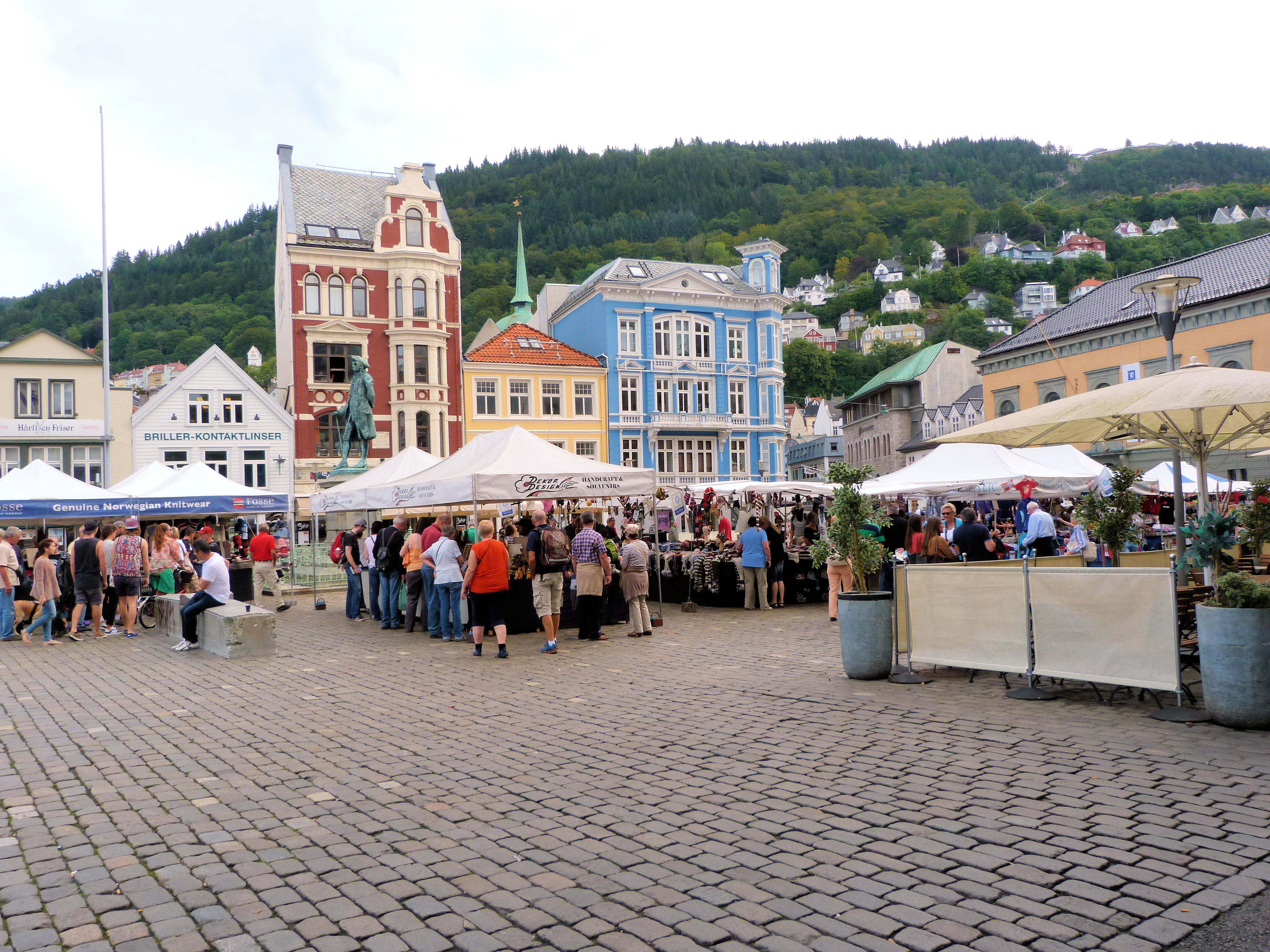
Everyone is familiar with the old wooden houses in the area known as Bryggen in the port city of Bergen, which was rebuilt on 12th century foundations after the fire that ravaged the city in 1702. Bryggen has a place on UNESCO’S World Heritage List, but the whole city of Bergen is a designated World Heritage City. It was the largest town in Scandinavia during the middle ages and because of its position as one of the Hanseatic League’s four most important trading centres, it dominated trade for almost 400 years from its incorporation in 1360.
The world heritage site consists of the old Hanseatic wharf and buildings, an attractive place for tourists and locals and a photographer’s delight. To stroll through Bryggen’s narrow alleyways is to wander back to a bygone age: many of the small wooden houses that line these streets date back to the 18th century and have been restored and refurbished in recent years to their current impeccable state. Not only is this a heritage site but it is a living, breathing one, part of a culture still active in this historical part of the city.
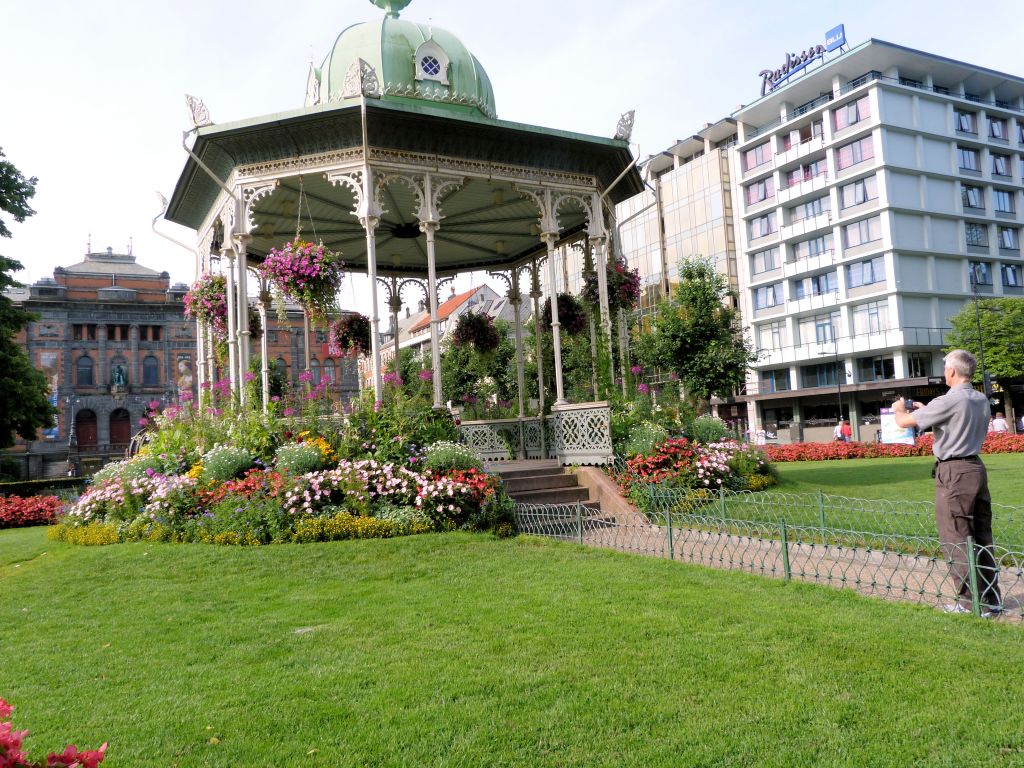
I can’t think of any other city that more deserves the designation of World Heritage City: it has a fairy-tale air with a charm and atmosphere not often found in busy places. Seven mountains form the backdrop to the city and everywhere are small wooden houses, their doorways flanked by pots of brightly-coloured flowers, old cobbled streets and alleyways, and of course, Bryggen.
Surrounded by fiords and a fantastic coastline with thousands of islands, Bergen is a base for active experiences such as fiord and river rafting, scuba diving, ocean rafting, sailing, kayaking, cycling and paragliding. Those whose liking is for mountains are spoiled for choice here as all seven of the mountains that surround the city have great walking trails (the tourist board will provide maps).
If the active life is not for you, then shopping could not be better in this city of traders, (take the hop-on hop-off bus), hop on the little sight-seeing train and be guided around the area, or take one of the many guided tours on land or by boat.
And it’s said that you’ve not seen Bergen until you’ve taken a trip on the Fløibanen funicular to the top of Mt. Fløyen to view the city from the spectacular viewing platform 200m above.
Cafes, restaurants, galleries and shops abound in the area, many of them selling traditional and unique crafts. Bryggen’s Museum is the place to learn about the history of the city and an impressive collection of art is housed in a row of galleries lining the picturesque Lille Lungegärdsvann Lake in the heart of the city (Art Street); or visit the Grieg Museum for a half-hour lunchtime concert and a visit to the site of the composer’s unique grave.
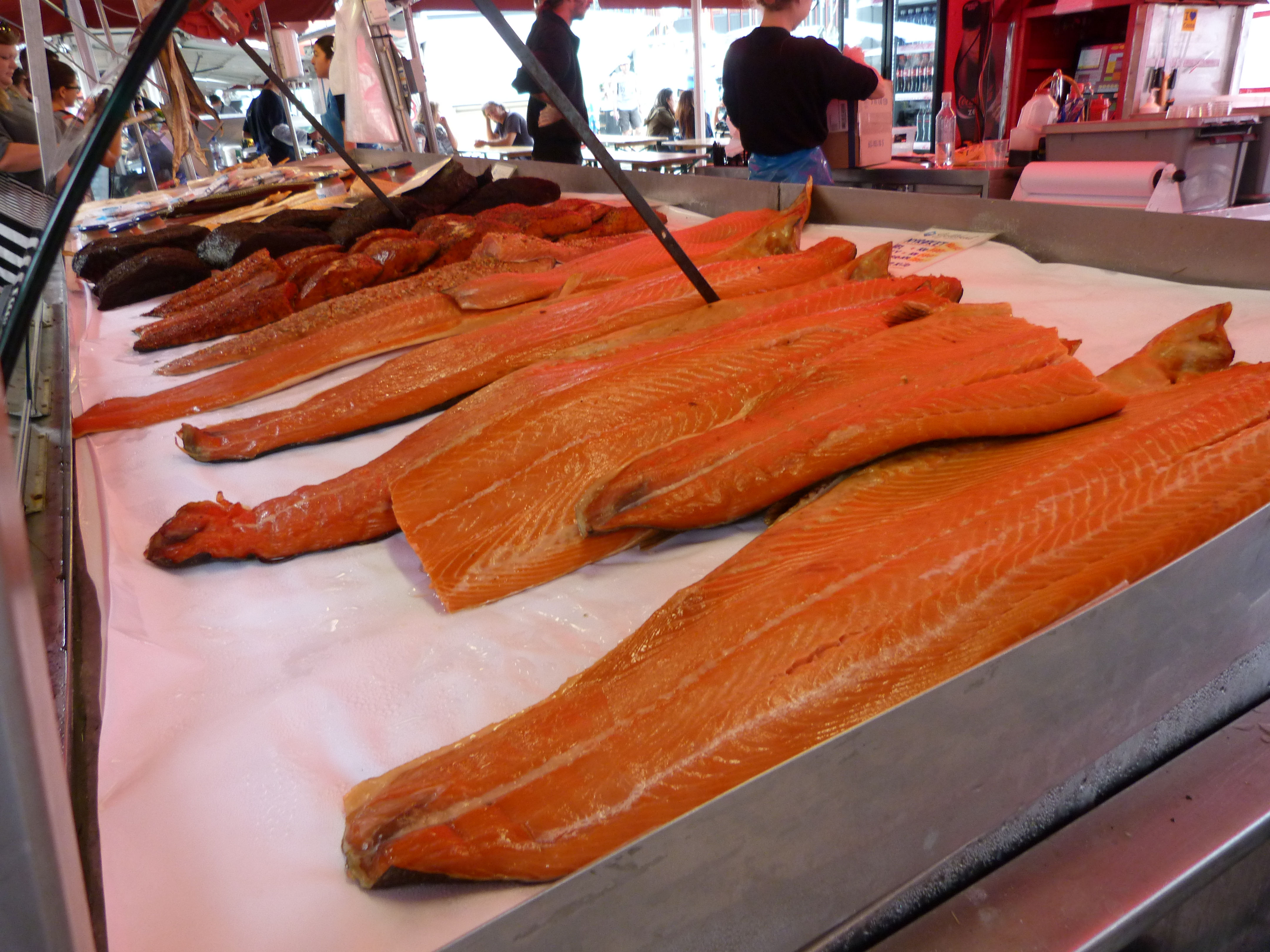
If museums are not your thing, then just step into the Fish Market, the open-air fruit and veg market with its stalls full of the freshest berries I’ve ever seen, wander around the wharf and admire the fishing boats, tourist boats and naval vessels. Locals resting on the seats around the basin will be eager to chat with you, fishermen tending their nets will happily talk about fish and the ever-changing kaleidoscope will keep you entertained for hours.
I didn’t spend long enough there, a mere 3 days, but it gave me a taster of what the city and its environs can offer. Some people I spoke to had arrived by cruise ship and seemed happy with their half day there. I wouldn’t have been. I think I might have cried if I’d had to leave such a gorgeous place after only a few hours. But whether its 3 hours or 3 days, Bergen will offer the visitor a lot to see and a lot to think about.
NB. Best buy – The Bergen Card: Free entrances to many Museums and activities, heavily discounted entrance fees to other places. Travel free on the Light Rail and buses. 24 hours NOK 280, senior & students 224, children 100: 48 hour NOK 360, senior & students 288, children 130
The Queen Mary in Bergen. A sad sight to see such a big cruise ship in this lovely little place.




























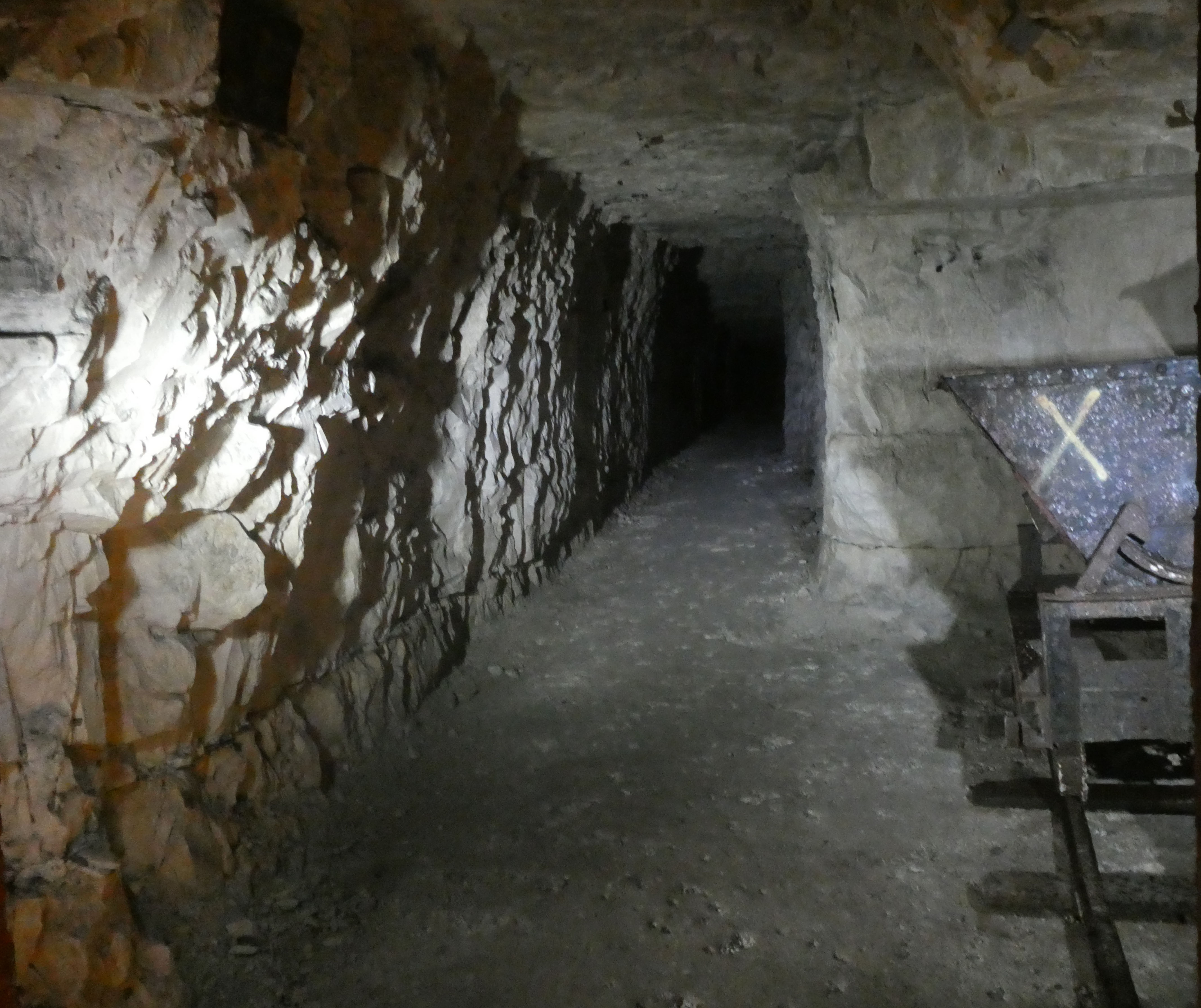
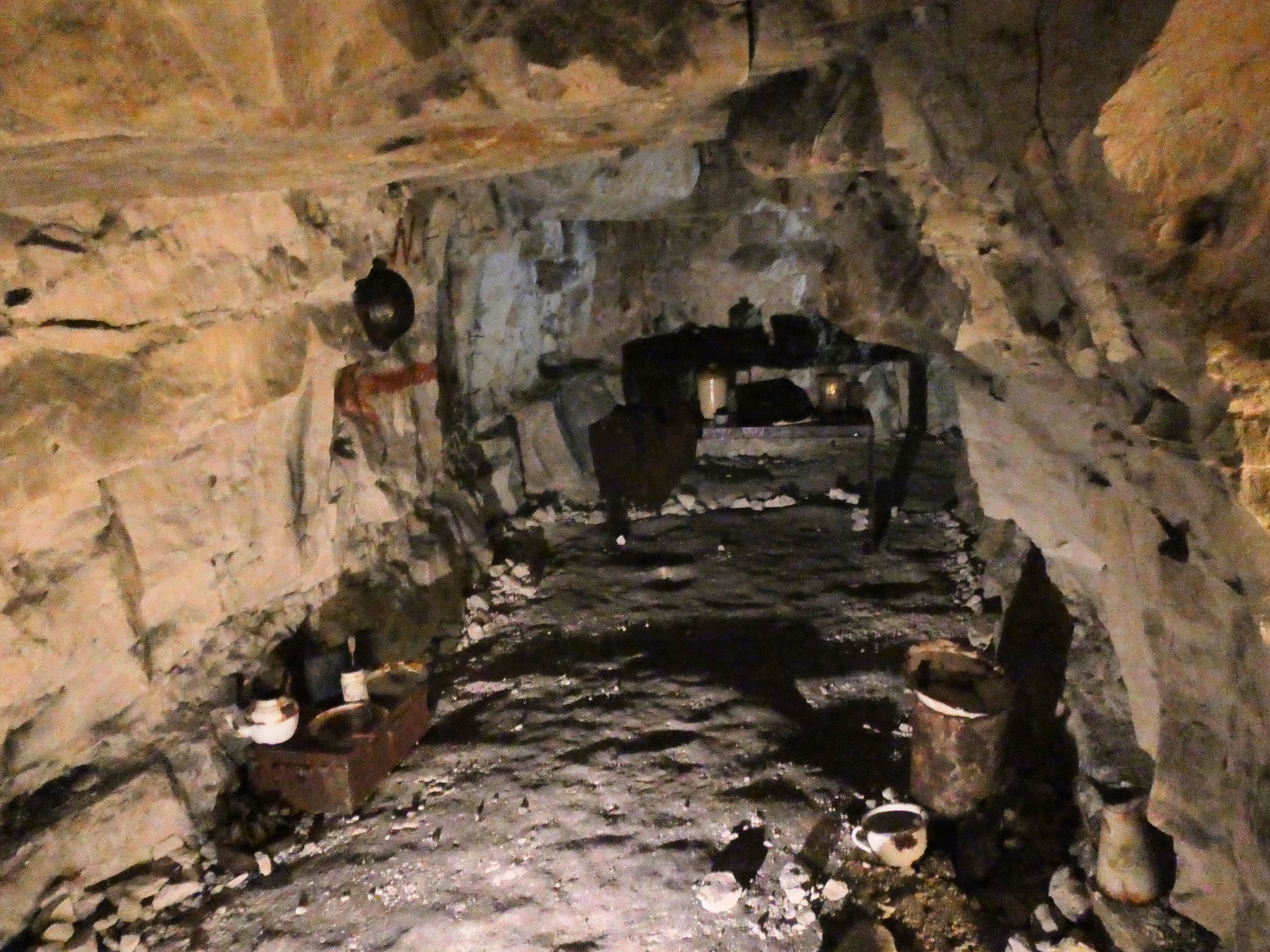


 You’re told about the one bucket of water to a dozen men. You feel the presence of the soldiers, and you hear voices. “Bonjour Tommy” says a Frenchman against footage of civilians and soldiers chatting in the streets. You hear letters written home, and poems from the war poets, like Siegfried Sassoon’s The General.