
Category: Europe – Northern Europe & Scandinavia
Austria, Belgium, Germany, Scandinavia, Croatia, Bosnia & Herzogovina
-
Six Word Saturday
Linked to https://travelwithintent.com/2020/11/21/beauties-once-soaring-fir-tree-
Not Yet Christmas, Here Comes Spring.
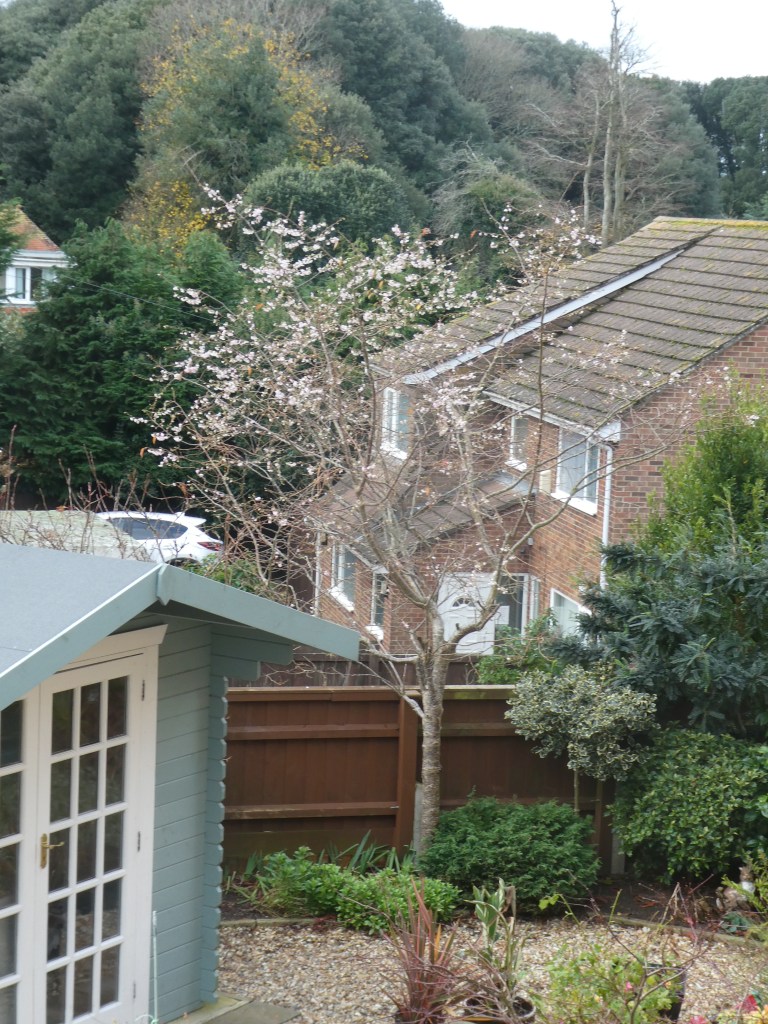
Not yet Christmas, here comes spring. This wasn’t here yesterday. Seen from my balcony this morning my neighbour’s tree has burst into blossom. Maybe not ‘burst’ but showing the flag anyway.
-
Silent Sunday on the Gota Canal

The Göta Canal which links Sweden’s two cities Stockholm and Gothenburg, runs through the heart of Sweden. A one-way trip on one of the historic ships that plies the route takes 6 days; it is like a journey into another world.
Cruising through archipelagos with thousands of small islands, one river, eight lakes, two seas and three canals with 66 locks (in one case ascending 91 metres) the ship makes several stops at places of interest along the way.
The ships used were built between 1874 and 1831 and are considered historically important. Furnished in a period style there is neither radio nor TV on board any of the ships, and the use of mobile phones is discouraged. Between 40-50 guests are accommodated in small cabins about the size of a sleeping compartment on a train with bunk beds and a wash basin with hot ad cold water. Communal showers only, I’m afraid, but the food makes up for it.
Fresh lake fish every day, game from the forest, the freshest of vegetables and saladings, lots of the berries for which Scandinavia is famous and of course that marvellous coffee and cake.
This journey along one of the world’s great canals is an experience like no other but is only available during the summer months. And in those cabins you really get to experience what travelling was like in the 19th century on board these ships that carried immigrants from rural Sweden out to America.
The 190 kilometres of the Göta Canal were dug out by hand between 1810 and 1832 and it runs from Sjötorp in the west to Mem in the east, it is three metres deep and approximately 14 metres wide.
-
Wanted: Hot Chestnuts

Hot Chestnuts for sale in Lucerne, Switzerland It’s a cold and wintry day here, the skies are grey, not blue like they were yesterday, and my mind flies back to this time last year in Lucerne where, along the lake dotted with boats and swans, the hot chestnut sellers were doing a roaring trade. I can smell them now and I long for some. Some Swiss chocolate wouldn’t come amiss either.
-

Walking Towards Autumn
Today I changed my walking route, left the sea behind me and turned inland. I had no plans, no set route to follow and no idea of what I wanted to photograph.
First, I meandered through Los Altos Park which was deserted: it was eerie having this space all to myself. Normally a place full of dog-walkers, chattering children, and elderly folk sitting on the benches reading, today it was empty despite a temperature of 16 degrees, blue skies, warm sun and no wind. Covid space? Too late in the day? Who knows, but the place was all mine.

Los Altos Park, Sandown Los Altos Park, Sandown Not far from here was what used to be one of the area’s oldest hotels but unfortunately, it closed this year due to a series of misfortunes. The grounds are now deserted, the building, once a grand manor, now stands forlorn its windows no longer shining a light to welcome visitors. There was no one to disturb me or chase me away and I felt a terrible sadness at the loss of this great mansion, its tennis courts now a coach park, and its grounds being overtaken by nature.

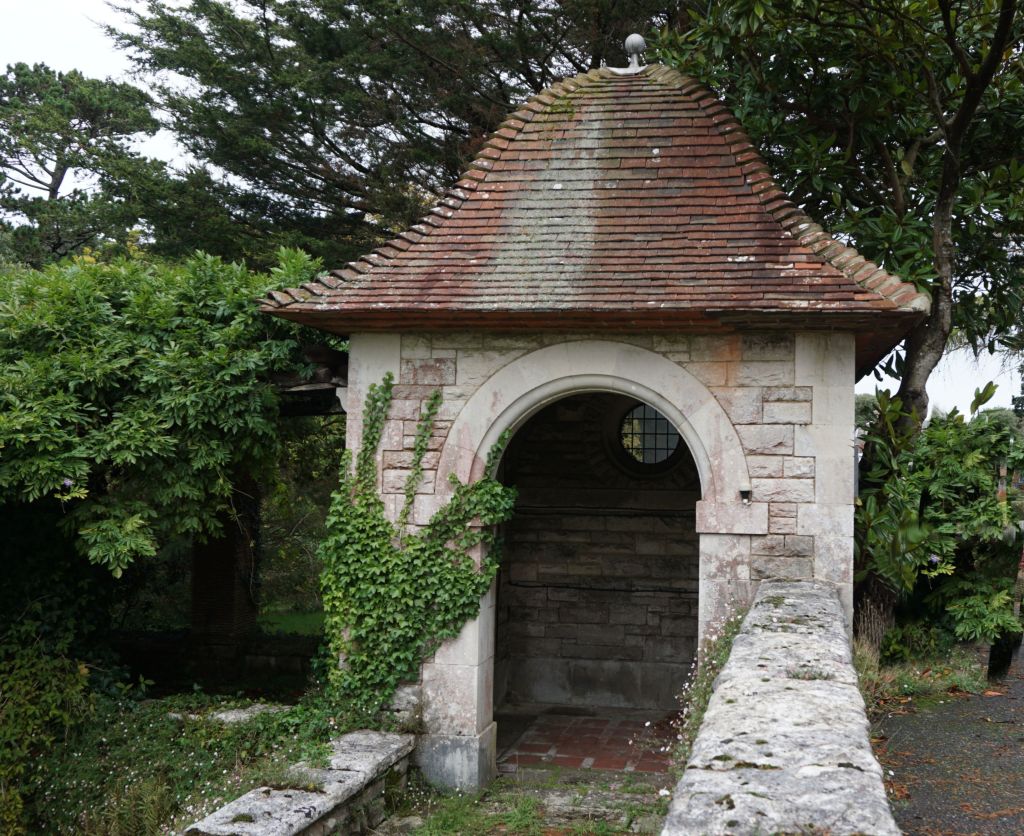
The lane in front of the hotel. I didn’t go further into that darkness! Looks as though the hydrangea can’t make up its mind. Is i winter or summer? Further into the gardens I came across these seats looking so forlorn as they sat amid the falling leaves. Nearby a couple of palm trees, stretched towards the light, valiantly fighting to survive. They were definitely in need of some TLC.


Although I felt sad that the bracken (or was it fern) was now running rampant over the garden wall I cheered myself up with the thought that this would provide a cosy home for the winter for the wildlife I’d seen on my walk (a couple of hedgehogs, lots of spiders and odd creepy-crawlies and I’m sure there were lots more keeping out of my way).

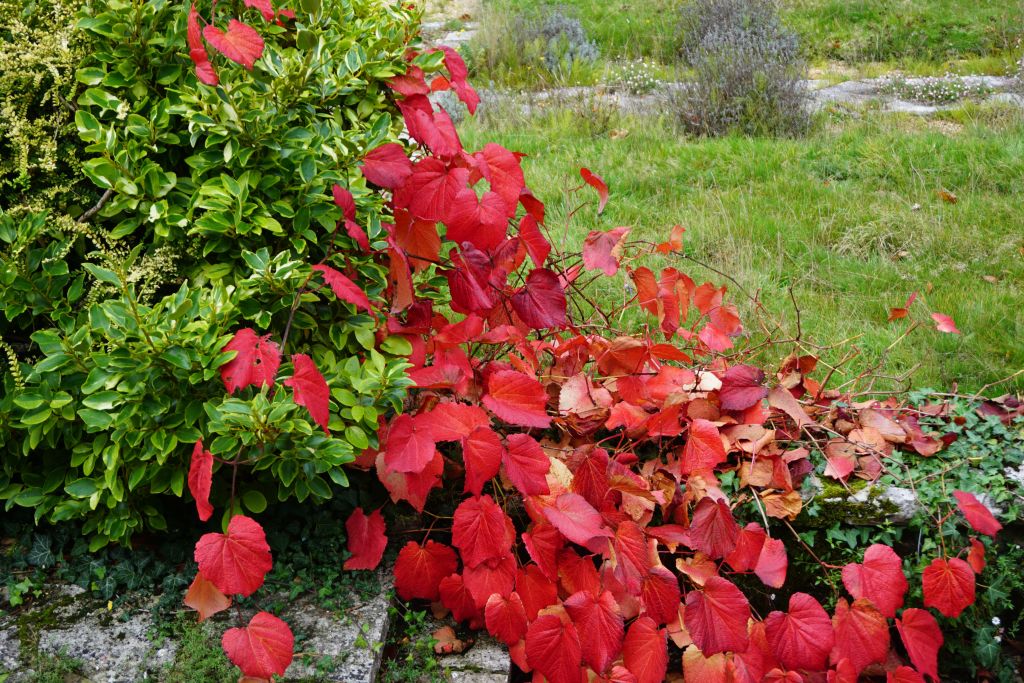
And then I came upon the sunken garden and this splash of colour, a glorious cascade of scarlet leaves, Virginia Creeper I think, that must have migrated from the wall of the old house and settled here to decorate these steps. And just a bit further on, the brilliant red of the Holly berries – a dazzling display of colour amid the dying of the year. It seemed the autumnal red of the Virginia creeper led me to the winter of the Holly.

-
What I saw on my walk today
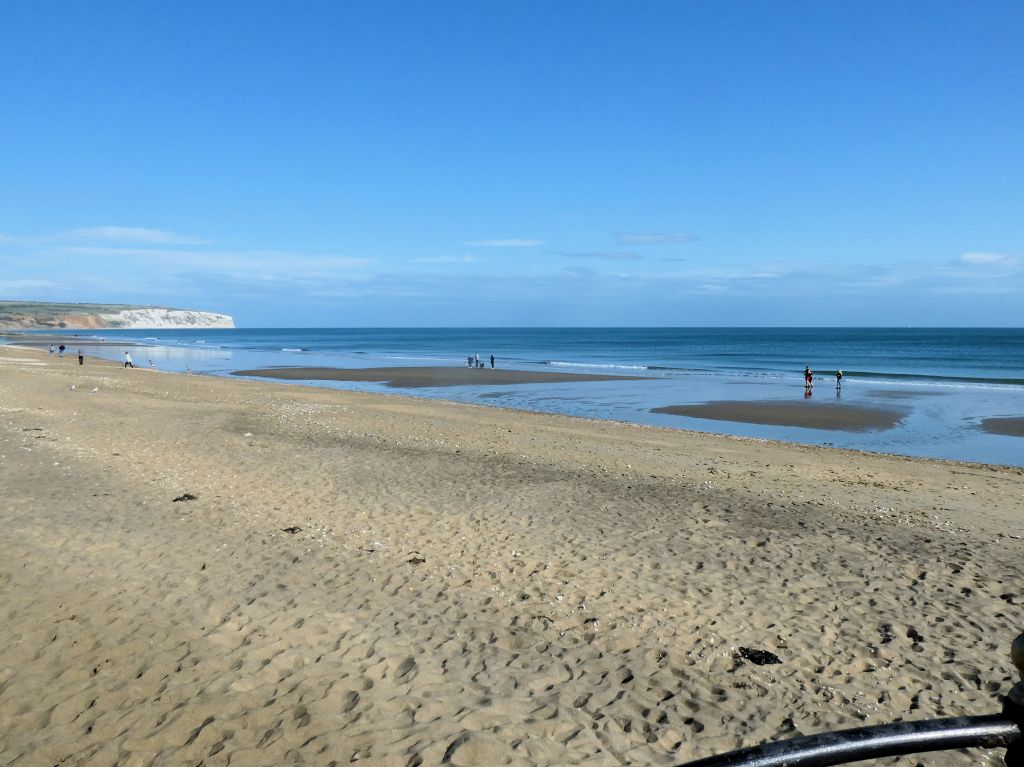
A glorious sunny day but few people It’s not just Covid-19. The weather forecast influences people’s decisions but often the meteorological office gets it wrong. And so it was today. The temperature was supposed to be around 17ᵒ with cloudy patches but we had wall-to-wall sunshine and it felt like mid-20s. The result was that only a handful of people were walking on the esplanade and fewer still on the beach.
One lonely figure sat wrapped in a blanket on the beach guarding the clothes of the two boys fishing by the pier who were wearing only swimming trunks so at least someone was benefiting from this burst of sunshine.
The Bay sands, once golden, are now less so, and many blame this on the 7 – 9 liners and tankers that used the Bay during the Covid outbreak when they couldn’t get into Portsmouth or Southampton harbours to unload their cargoes of people and goods. For some weeks they sat on the horizon, their engines pumping away to keep the ships ventilated and facilities ongoing. The noise from this was so great that a complaint was made and the harbour masters requested to speed up the entry into port.

Premier Inn opening soon in Sandown, Isle of Wight Sandown has a new Premier Inn due to open soon on the Esplanade and it was good to see this finished at last. The Covid outbreak had stopped building work earlier in the year and we wondered if it would open for business at all this year. Now it’s looking smart and new and ready to welcome autumn and winter visitors to the town, where the winters are mild and pleasant and the temperature usually about 5ᵒ above that of the mainland.
The High Street was quiet with only a few shoppers hunting souvenirs and tea-rooms. But I noticed that one of our closed-up Banks (a few years ago 3 of the big five operated here) has been graffitied but a theme is not discernible. Intriguing yes, and from what I can see it is a community venture and they are appealing for donations. I wonder if the Bank has thought to donate something to improve the boarded up look of their building? Or am I being naive?
Graffiti on wall of closed-up bank in Sandown -
Sculpture Saturday: The Romanovs on the Isle of Wight

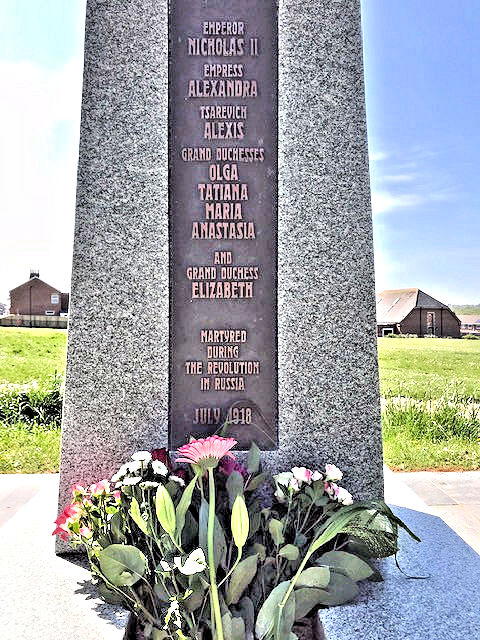
Elena Bezborodova‘s memorial to the Royal Family of Russia, murdered by the Bolsheviks in 1918. This Memorial was erected at East Cowes, Isle of Wight to commemorate the 100th Anniversary of their deaths. In 1909, Tsar Nicolas ll and Tsarina Alexandra of Russia (Princess Alix of Hesse-Darmstadt, grand-daughter of Queen Victoria) along with their five children, visited Cowes, Isle of Wight at the invitation of King Edward Vll. The occasion was Cowes Regatta, one of the longest-running and most important regattas in the world at that time. A home-movie taken during that visit and shown on UK television last year, shows two of the children, Grand Duchess Olga and Grand Duchess Tatiana who had never experienced such freedom before, enjoying a walk around the town, diving into shops and buying postcards and sweets. An interesting account is to be found here.

On 7th July, 2018 during a weekend of events that remembered the 100th Anniversary of the assassination of the family and their close servants at Yekaterinburg, a 3-metre high granite memorial with bronze decoration was unveiled to commemorate the close connection between the Imperial Romanov family and East Cowes. This magnificent monument was unveiled in the presence of their surviving descendants, Russian Orthodox bishops, the Moscow sculptor of the work Elena Bezborodova, and a choir from Minsk, Belarus.

Top of the Memorial with its bronze relief of individual members of the family The memorial was gifted by members of the Grand Duchess Elizabeth Romanov Society who revere the Tsar’s sister-in-law who was later made a saint. It stands in the Jubilee Recreation Ground close to Osborne House the former home of Queen Victoria and Prince Albert which the Romanov family visited on their trip to the island in 1909. The Tsar had also been a naval cadet at the then Royal Naval College Osborne House.

The 18th/19th century photos are courtesy of Wikicommons. The Photographs of the Memorial at Cowes are from David Hill, local coordinator for the event working with the Grand Duchess Elizabeth Romanov Society.
Historical Note: Tsar Nicholas II and his family were assassinated by the Bolsheviks on 17 July 1918. They were buried in unmarked graves, and in 1979 some remains were discovered but were concealed until the fall of communism. In 1991 the graves were excavated and a state funeral was organised for five family members. Remains of two other children were found in 2007 but these are undergoing additional examinations.
This post linked to https://smkelly8.com/ for Sculpture Saturday Challenge
-

Bautzen: The Sorbs in Saxony
Just 40 Kl from Görlitz in German Saxony lies Bautzen, the town famous for the fact that all political prisoners were sent here at one time, and which celebrated its 1000-year-old existence just a few years ago. Although heavily damaged during World War II Bautzen has been well restored but it still retains the air of a small country town.
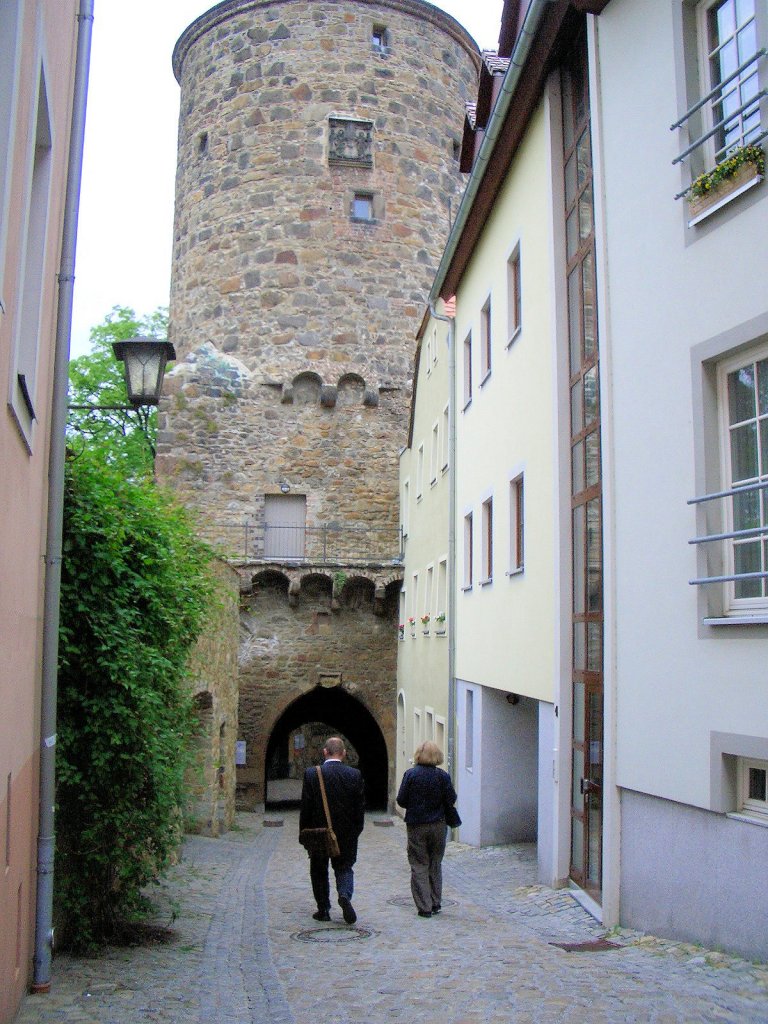
Although a small town it is the capital of Upper Lusatia, the region inhabited by the West Slav Sorbian minority since the 7th century. It is a typical German small town with a castle dating back to the 10th century, an interesting church, a town hall, and a main street lined with colourful old houses.
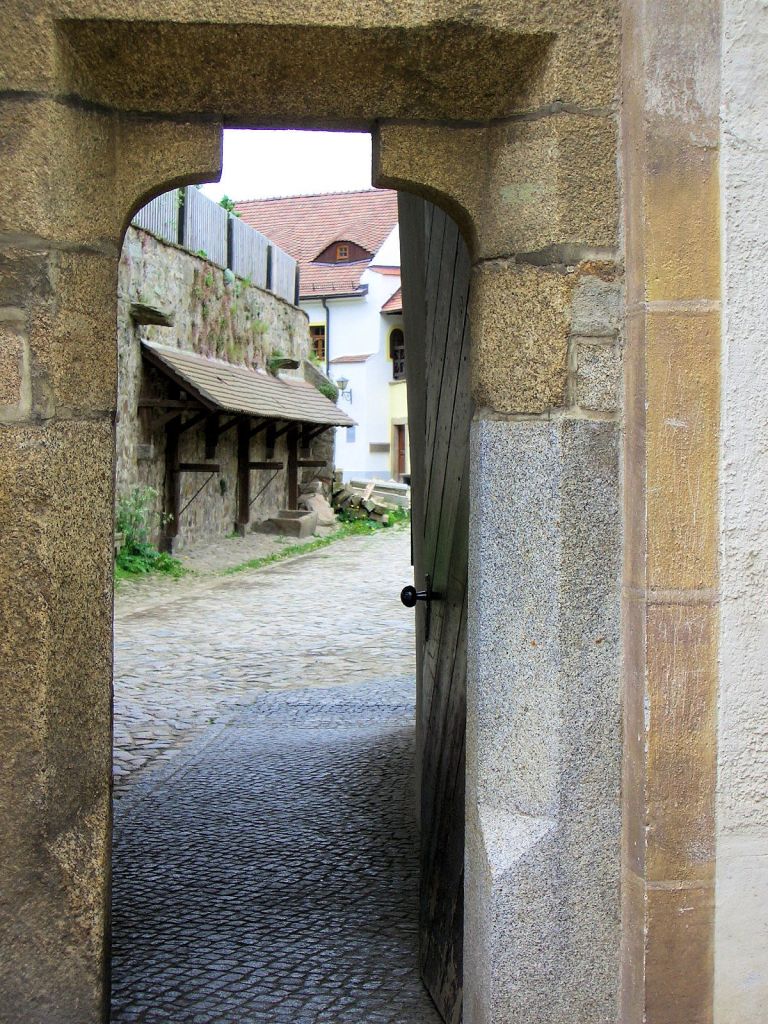
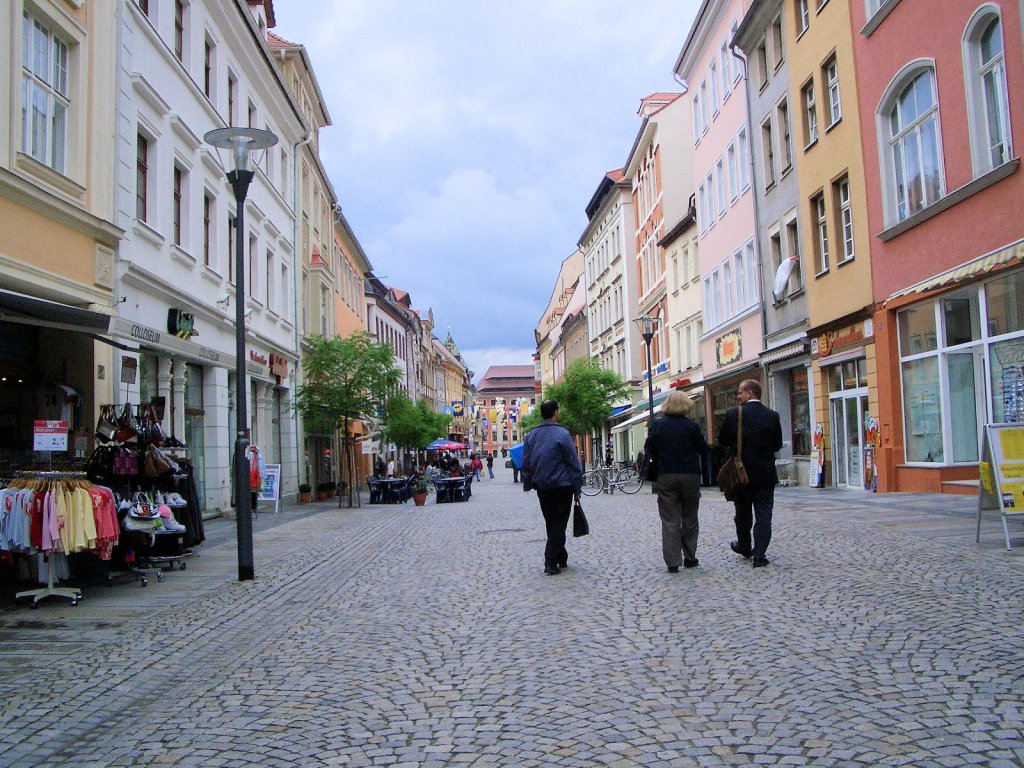


Image by Rico Lob (Pixabay)
Bautzen It may be but a short hop but Bautzen is a world apart from Görlitz by virtue of the fact that it is the centre of Sorbian culture and the seat of the Sorbian nation. It would take more than a few posts to summarise the history of the Sorbian nation but it helps to know that the modern nation was founded by Moravians and Bohemians who had separated from the Catholic Church, long before Luther made his break from Rome. Both Catholics and Protestants live peacefully together although Catholic women wear white caps whereas Protestant women wear black, so one feels there may be some small tension there. Sorbs can be found across Central Europe, in Czechoslovakia and Poland.
The Sorb culture was suppressed by the Nazis during World War II but the end of the war saw the territory under the control of the Soviet Union, and it was this that was a factor in helping them re-establish their culture in 1945. As the communists wanted to prove they were better rulers than the Nazis, they made special efforts to re-instate the traditions and language of this Slavic minority with the result that today, the town is bi-lingual, the Sorbians dress as they did over 100 years ago, publish their own newspapers, have their own radio, perform in and support Germany’s only bi-lingual folk-theatre, educate their children in Sorbian traditions, speak their own language, and have been effective in ensuring that road signs and official notices in the area are in both German and Sorbian. The cultural museum in Ortenburg Castle tells the story of this Slavic people whose language closely resembles that of Czechoslovakia.

Traditional Dress of a Sorbian Woman Bautzen is unique in other ways too, being positioned on a granite plateau above the Spree river and from the Friedensbrücke Bridge there is an awe-inspiring panorama of the 23 medieval towers that dominate what remains of the town wall. In the town centre stands, or leans, another tower, the 1000 year old Reichen Tower, which is 1.44 metres off the perpendicular. Visitors should climb to the top for a view of the town centre, rebuilt in Baroque style after the 30-years war in the 17th century.
And after all that sightseeing, the essential thing is to visit the famous Wjelbik restaurant with its splendid stained-glass windows for a typical Sorb meal. This may be served by the owner dressed in her 102 year old traditional Sorb costume who will take great delight in explaining every dish to you, from the dumplings in horseradish sauce to the home-made cinnamon ice-cream, or charming waitresses in national Sorb costumes.

Image by Rico Lob (Pixabay) 


The food is heavy on carbs, lots of dumplings, but the icecream is fantastic. Bautzen and Görlitz once formed part of a six-city alliance which wielded power over the whole of Upper Lusatia. That power has waned, but composers, castles, architecture and arts, are once more energising the life of this beautiful province and its power to charm the visitor is once again its greatest attraction.

Still a few interesting ruins around Featured Image by Rico Lob (Pixabay)
Tourist information for Bautzen: Touristinfo Bautzen/Budyšin, Hauptmarkt 1, 02625 Bautzen: email: www.bautzen.de
Sorb Restaurant: Wjelbik, Kornstrasse 7, Bautzen (tel: +49 (0)35 91 4 20 60)
-

Gorlitz: Stunning in Saxony
For over half a century the delights of German Saxony remained hidden from a large part of the world due to it being part of the former East Germany. Since German reunification however, this lovely state in south east Germany is once again attracting visitors drawn there by its archecture, its craftwork and its traditions.

Sign for hand-made porcelain, Gorlitz In Saxony, culture goes hand-in-hand with nature, and one of the many pleasures awaiting the visitor is driving or cycling on roads almost free of traffic. We drove from Leipzig through Dresden and on towards the medieval towns of Görlitz and Bautzen on nearly empty roads, bordered by massive tracts of yellow rape (the size of the fields a relic of communist collectivisation), the wind turbines on the horizon like giants with flailing arms striding across the hills.
The nearly 1,000-year-old town of Gőrlitz shares a border with Poland and Czechoslovakia (Prague is a mere 160 Kl. away) its glorious architecture virtually untouched despite the wars that raged across the land. To stand on the German side of the Peace Bridge and look at the blue, yellow and pink facades of the houses across the river in Zgorzelec on the Polish side, is to feel the full weight of recent history.

View of the Lusiarian Niesse River and the Polish town of Zygorzelic from the bridge in Gorlitz Prior to World War II, Gőrlitz straddled both banks of the River Neisse but when the Allies redrew the boundaries after the war and divided Germany between the western powers and the Soviet Union, it lost its eastern suburbs. Fortunately for posterity, the Soviets did not knock down and rebuild the town in utilitarian style as they did in most of Dresden and Leipzig.
A walk through the crooked, narrow streets on the 15th century basalt cobblestones, forged from the mountain just outside the town, takes you on a fascinating journey through the past. Throughout its history, this former textile trading town has exercised political importance, initially by its position and dominance as a medieval trading post and then by its transformation into a residence for the bourgeoisie in the 19th and 20th centuries. If some parts of it look familiar to you it is because it has been used as a location for more than one popular film, the most recent being The Grand Budapest Hotel.

A View to the Round Tower, a popular landmark in the town Its position on the trade route to important places like Frankfurt, Leipzig, and Krakow and to special privileges granted to the town, meant that all merchants passing through were obliged to offer their wares in Gőrlitz. This gave rise to some spectacular architecture in the building of houses with impressive inner yards where the textiles could be displayed. Enormous squares, the sides lined by the houses of the rich merchants who dealt in wool and furs, richly decorated house fronts, fortifications and fortified towers, buildings from the Gothic, Renaissance, Baroque, and Art Nouveau eras have made the town a 3-dimensional reference book of architectural history.
A few of the beautiful façades of the houses in Gorlitz In the part-arcaded Untermarkt (Lower Market Place) is grouped one of the finest collection of Renaissance and Baroque town houses to be seen in Europe, a place of pilgrimage for architects the world over. In fact, 4,000 of Gőrlitz’s late Gothic, Renaissance, Baroque, Gründerzeit (German Industrial Revolution) and Art Nouveau buildings, are protected as National Monuments.

Once a Bishop’s Palace now a Museum in Gorlitz The older buildings blend harmoniously with the Gründerzeit and Art Nouveau quarters, the Strassbourg Arcade Department Store with its stunningly beautiful chandeliers and the Art Noveau Karstadt Department Store being prime examples.
Gorlitz has a small town charm despite its centuries of architecture and is a good place to see craftsmen work in traditional trades like jewellery making, porcelain painting and toy-making: it is also an ideal place to sample the local specialities – Landskron beer and a fruit schnapps called Görlitzer Geister.

The Schönhof If you are spending time in the region and want a break from the culture overload, there are many kilometres of cycle and hiking tracks along the Oder-Neisse to explore and guided tours by bicycle through the cultural regions of Upper Lusatia, Lower Silesia and Bohemia are available. Frequent stops are made in beer-gardens along the river for local delicacies washed down with the very special local beer or the equally delicious white wine of the region.
Dresden is only 100 kl. away and easily reachable by train or bus but I’m mindful of the fact that you may come to Gorlitz from Dresden, so I would suggest instead a trip to the fantastic town of Bautzen where Sorbian language and traditions still rule.
Bautzen will be the subject of my next blog.

This Image by Candid_Shots from Pixabay
All other images by Mari Nicholson
Cycling tours to Prague and Poland and along the Oder/Neisse are easily arranged by any of the cycling organizations in town.
Tourist information for Görlitz : Görlitzinformation, Brüderstrasse 1, 02828 Görlitz,
Email: http://www.gorlitz.de
-
Silent Sunday: Austria
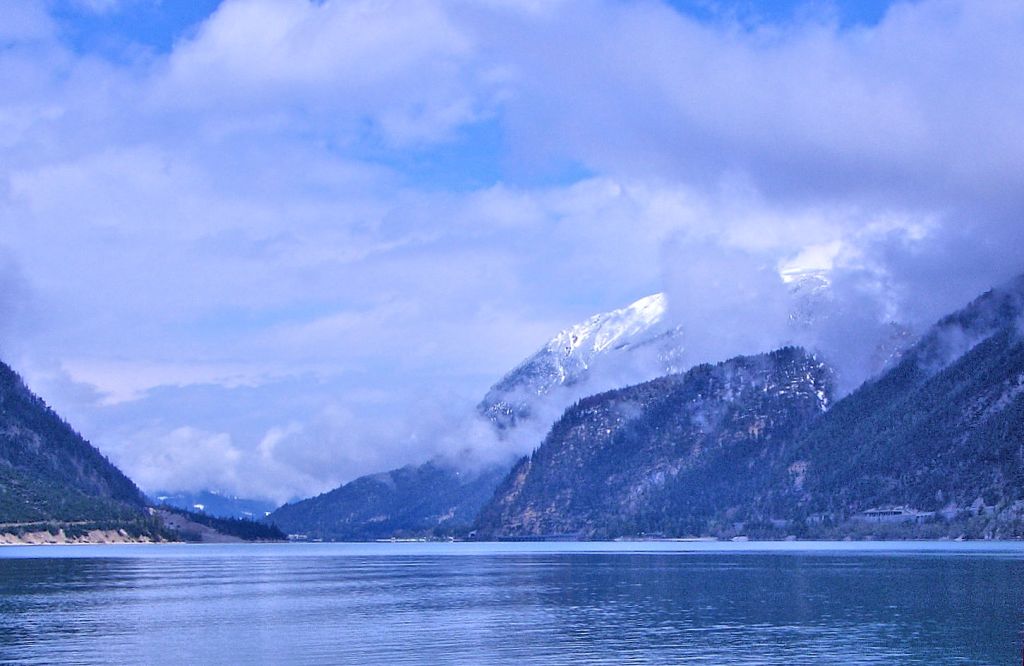
A Blue Day in Austria Between lakes and mountains on an unforgettable trip in the South Tyrol. This was late evening on my way to a Spa hotel where they had a vibrating bed!











 MARI'S TRAVELS WITH HER CAMERA