Silent Sunday because the people are all in church – the Samoans are great church goers and they love hymn singing.
This is a typical Samoan dwelling, open to the elements and to the curious gaze of passers-by. They like people looking in and stopping to gaze at their possessions. In some houses you will see maybe 6 or 7 mattresses piled one atop the other, a sign of wealth, but wealth does not much matter here – or it didn’t when I visited many years ago – as the villages live as real communities and help each other, sharing food and resources as needed. If a storm is approaching they cover the openings with large banana leaves and suchlike .
New Orleans Philanthropist Malcolm Woldenberg in conversation with young boy
Once lined with crumbling warehouses Woldenberg Park (opened in 1984 for the World Fair) is now a pleasant walkway along the Mississippi offering scenic views of the river. It’s a great place for people watching as it attracts tourists and locals alike and a steady stream of street musicians. The Promenade gets its name from philanthropist Malcolm Woldenberg whose life-size bronze is one of many sculptures dotting the riverfront.
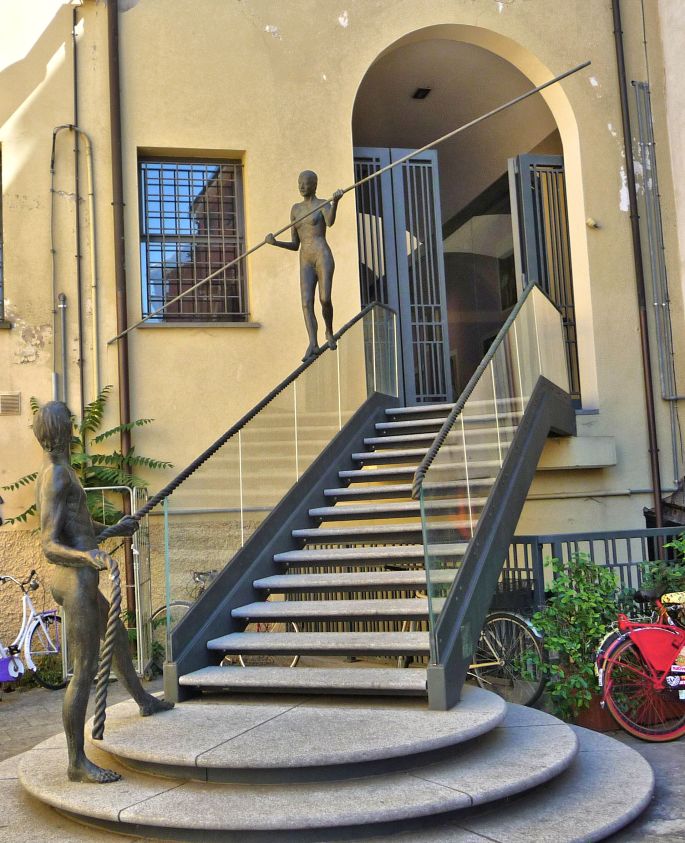
This unusual pairing of bronzes is Gli Equilibristi by sculptor Leonardo Lucchi. I took the photograph with a cheap throwaway instant camera in Cesena, Emilio Romagno in Italy, two years ago but unfortunately, my notes did not survive the trip (not a good one from the point of view of losing stuff).
Gli Equilibristi de Leonardo Lucchi
I stood before this amazing balancing figure with the corresponding male figure at the foot of the stairs for a long time, returning a few days later to try and get a better picture. I could never find a time when there were no bikes or cars or wheelbarrows parked in the space under the stairs and my efforts at removing them were not professional enough so I’ve left them in.
The sculptor lives and has his studio in Cesena, a town I an keen to return to as I only had a few hours there over two days and I wasn’t able to explore enough. Lucchi’s work is so energetic, his figures depict strong movement and I just have to see some more. If you’d like to see some more of his work, check out his website below:
Silent, if you ignored the scoldings of the howler monkeys from the river banks, the splash of nutrias as they slipped into the river and the background clicks of cicadas, but these noises being way outside normality for me, I took it for silence.
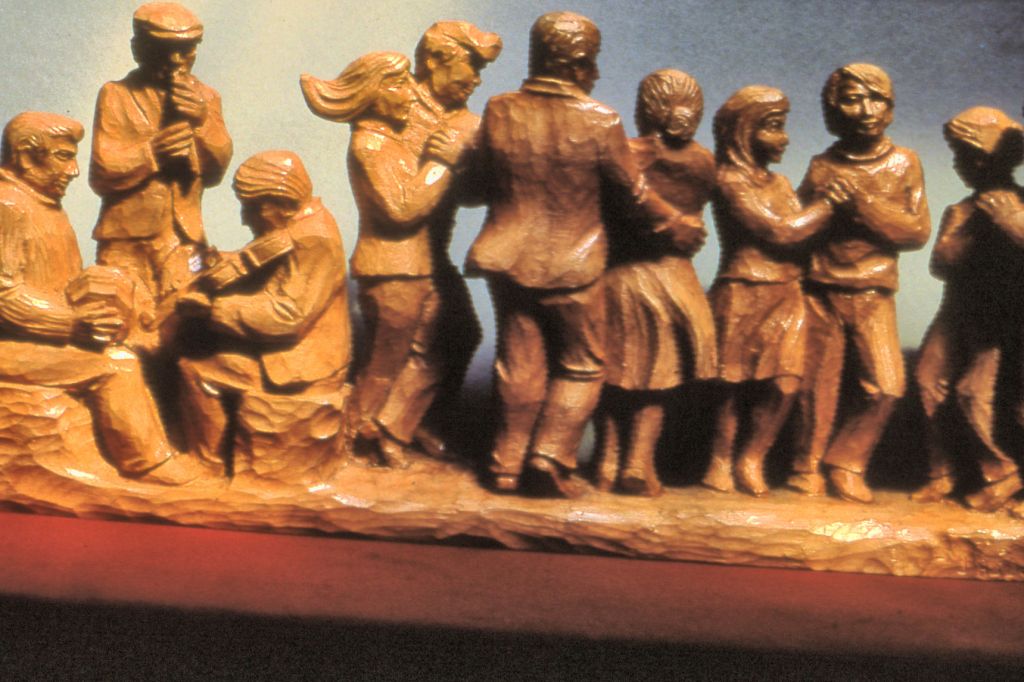
The Irish wood-carver John Haugh is not much known outside his own country but he has exhibited and sold many works in the USA. I was privileged to interview him many years ago and this sculpture “Dancing at the Crossroads” is one of my favourites of the many I saw in his studio in Carlingford, Co. Louth.
Dancing at the Crossroads by John Haugh
I especially liked the roughness of the carving which lends the work a rustic quality in keeping with the subject. This particular work dates to sometime in the late 1990’s
And now, for something completely different (thank you Monty Python).
(this was still in my Drafts folder so I’m re-posting it as I’m unsure what is happening. Another mix-up with Blocks?)
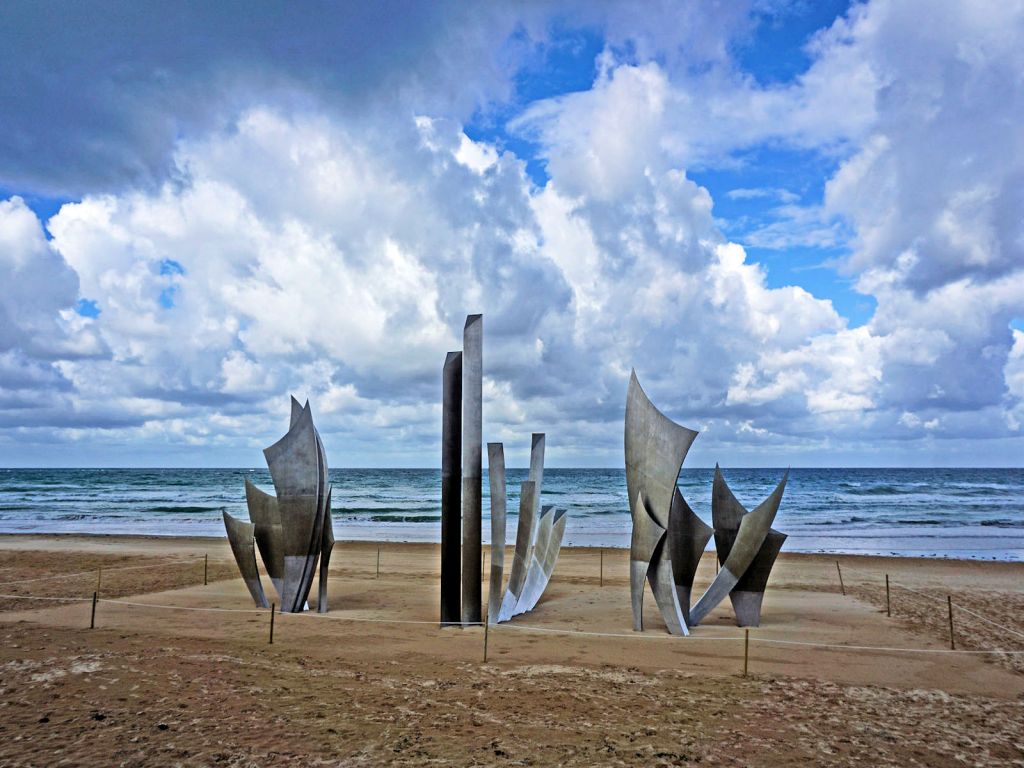
Les Braves by Anilore Banonon on Omaha Beach, Normandy
Commissioned by the French government on the 60th Anniversary of WWll and erected in 2004 as a monument to the Americans who helped liberate France, this moving sculpture stands at the centre of Omaha Beach.
The beach today is an place of calm and tranquillity but 76 years ago it was an inferno of noise, smoke and slaughter. Here, along a five-mile stretch of shoreline, the men of the American 1st and 29th Divisions, caught off-guard as they had not expected to meet such opposition, battled their way through fierce German defences.
Thousands of Allied troops were killed in the D-Day battle of Omaha Beach on June 6, 1944, but it was perhaps the single greatest turning point of World War II.t.
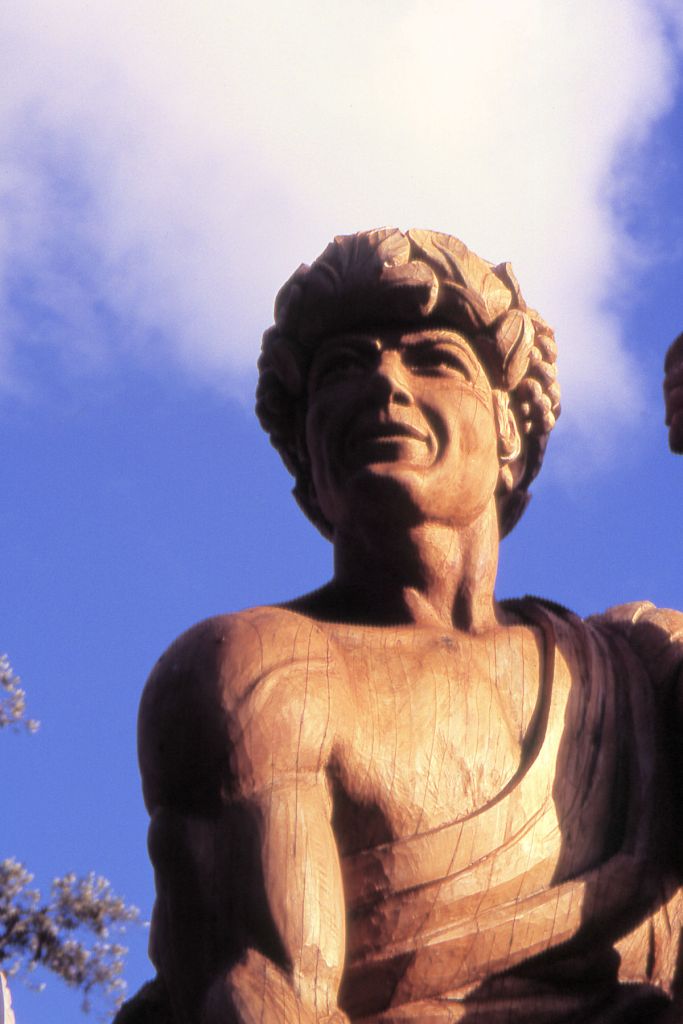
When the great storm of 1987 raged across the country, one of the old trees in the grounds of Barton Manor on the Isle of Wight, blew down. The then owner, film producer and impresario, Robert Stigwood, best known for theatrical productions like Hair and Jesus Christ Superstar, and film productions like Grease and Saturday Night Fever, asked the local marine carver and expert in wood, Norman Gaches to make something from the remains of the tree. As Barton Manor was then producing wine, it was decided to go with the theme of Dionysus the Greek God of wine (or Bacchus if you are looking at the Roman version) and his family, and here is part of the result, a golden Dionysus (Bacchus) rising from the tree.
Dionysus, Greek God of Wine
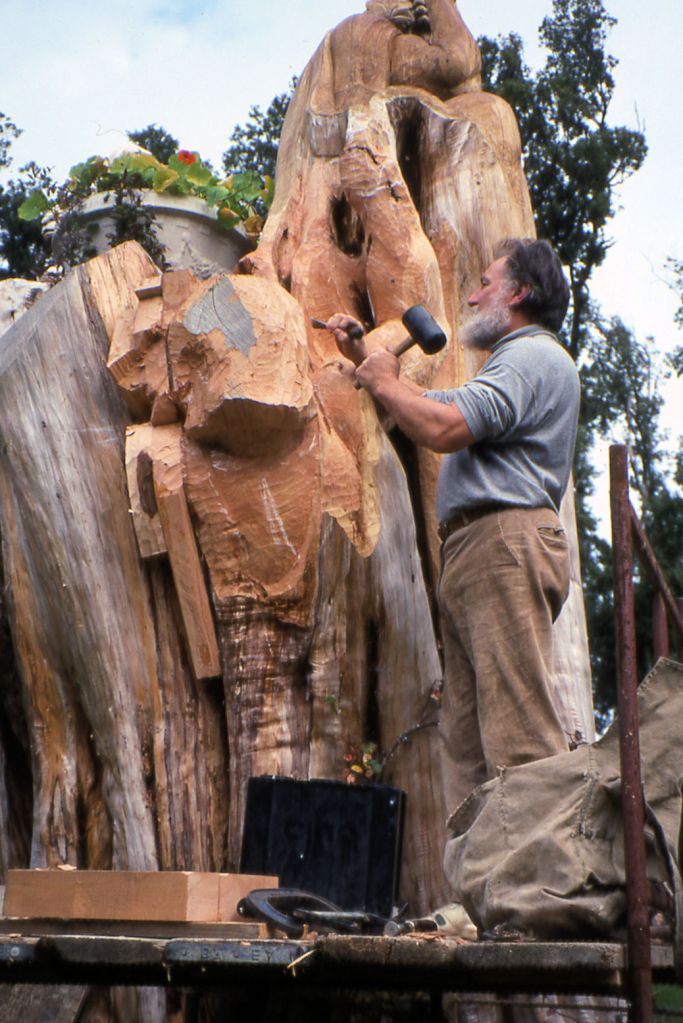
And here is a picture of the talented Norman Gaches working on the tree at the time.
Norman Gaches, Isle of Wight marine carver
Bacchus was the Roman name for the Greek god Dionysus, the god of agriculture and wine and the son of Jupiter (Zeus in Greek mythology). He wandered the earth, showing people how to grow vines and process the grapes for wine, until he took his place as a God on Olympus. Somewhere along the way the name – and the God – Bacchus became associated with intoxication and around 200 BC a wild and mystic festival, The Bacchanalia, notorious for its sexual character, was introduced in Rome. Stick to the Greek version, the story of Dionysus, and you have a less decadent young god, more interested in the production of wine than in wild women and song.






 MARI'S TRAVELS WITH HER CAMERA