Lock down helps remind us of old friends. It also reminds me of when I used to send and receive a lot of postcards, and I remembered also the blog I wrote some years ago. Maybe now is the time to re-blog (and as it’s such a lovely day I can relax outdoors without feeling I should get on with sorting out my photographs for a new blog)!
Today I got a postcard from abroad! So what? you may think.
So absolutely fantastic that I did an impromptu jig in the hallway when I picked it up before reverently placing it in a prominent position so that I could look at it and admire it for a few more days.
THE AZORES
Do you remember how exciting it was to receive a postcard in the days when people sent you postcards? Those mountain views, seascapes, hotels with the X placed just where the sender’s room was? The whiff of abroad that unsettled you as you sweltered in a stuffy office or maybe dreamed in your kitchen or garage as the evenings grew shorter and the winter light faded? You remember it now?
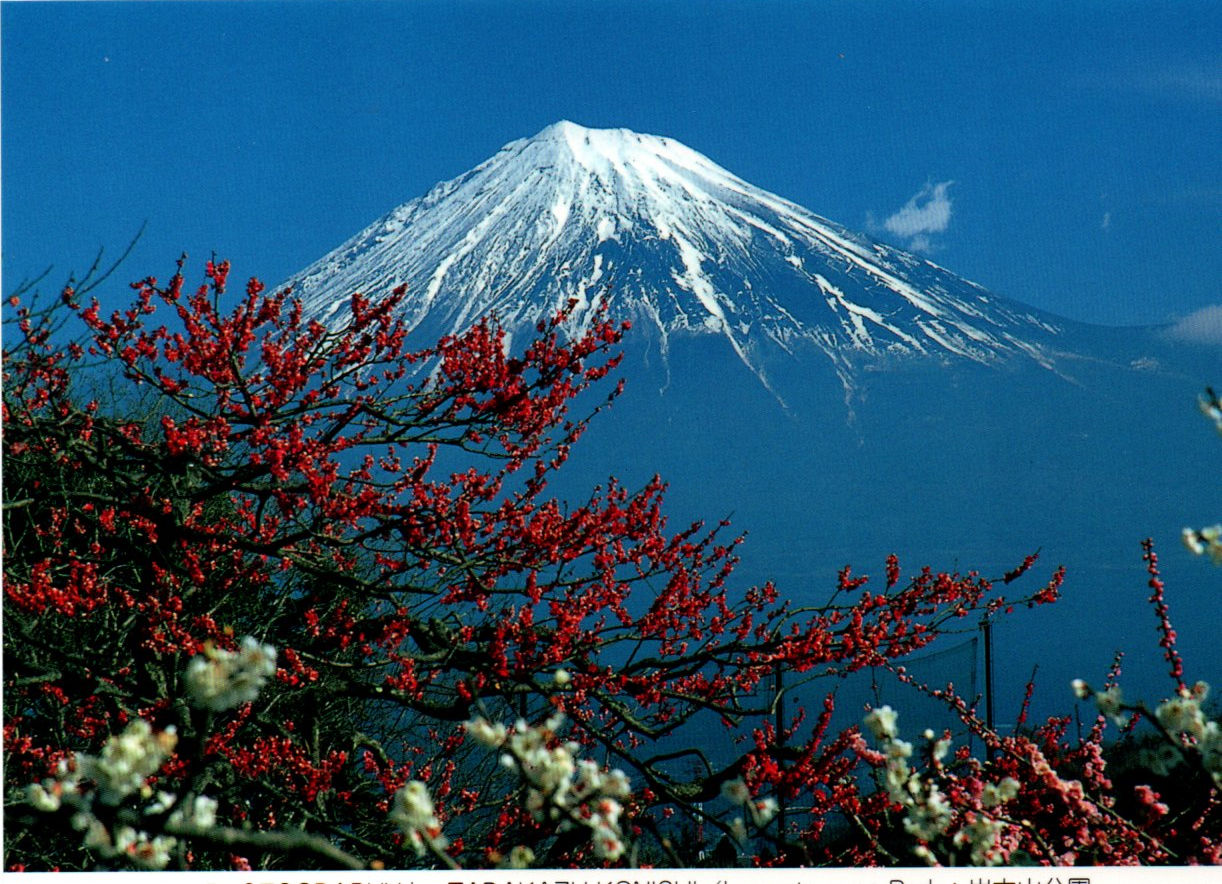
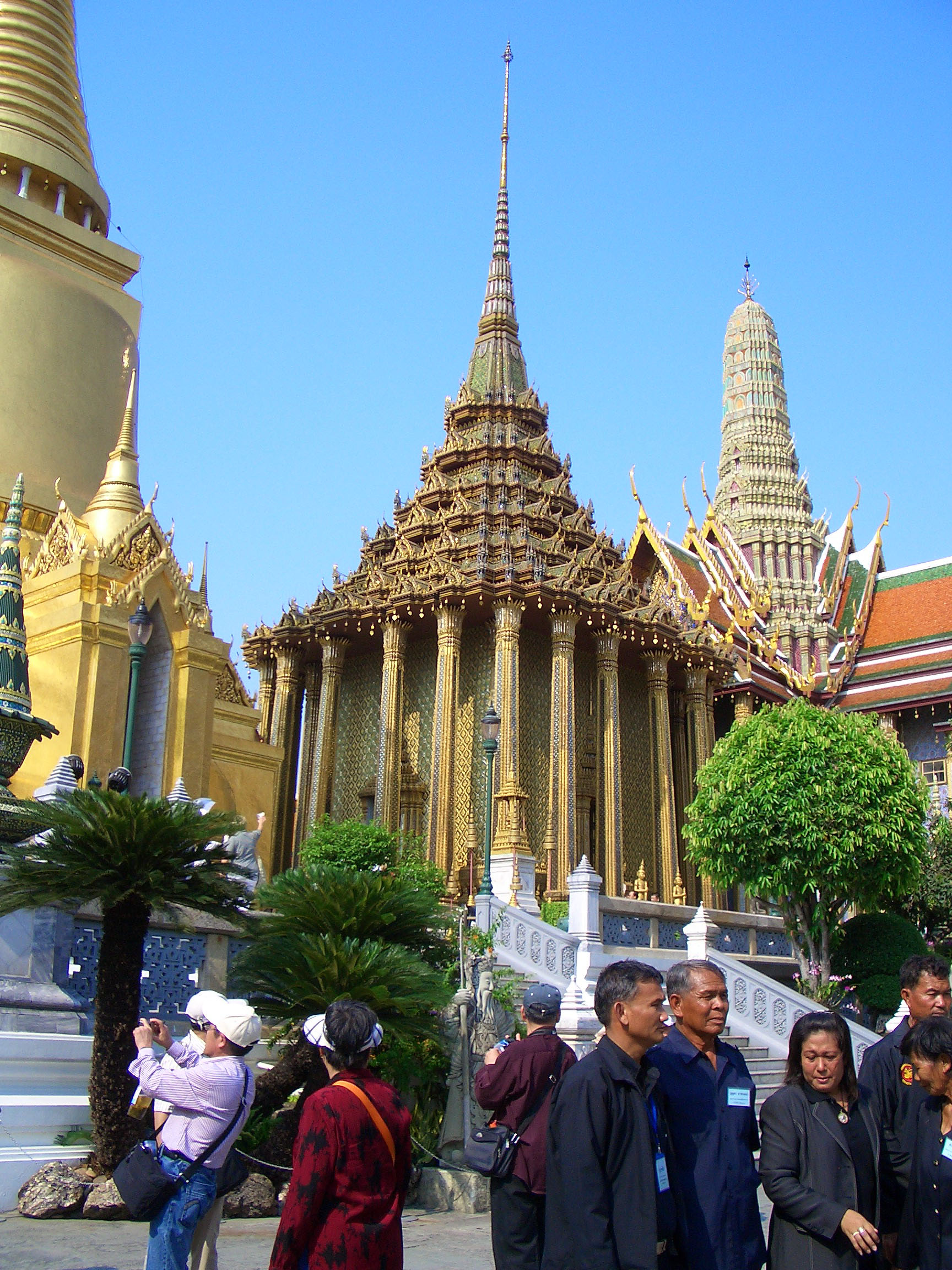
Mount Fuji, Japan
Next time you’re away from home, put away your smartphone, pack up the tablet, venture out and into the touristy gift shops and…
Day something in the great lock down and my place is tidier than a monk’s cell so while I’m thinking of what past travels to write about, I’m sorting half a lifetime’s accumulation of trivia, travel books, cards and pamphlets kept from the last great tidying session when I downsized six years ago. It’s been hard, but hey, I’ve managed to throw out two books, and at least five pamphlets I’ll never read again and I have put some of the postcards aside to send to friends! The rest will have to stay put until the next national crisis. More I cannot do!
So here are just a few pictures that remind me of happy times.
This Can Only be Bondi Beach
Sunset: Fisherman in Fiji
Me in Cuba 1981
Midsummer in Stockholm
Negotiating Locks in France
Memories are Made of photos like these
Sifting through my memory box I relive and recall trips which have slipped to the back of my mind. These in turn encourage me to look out photographs, some prints, some transparencies which I must get down to converting to digital images one of these days. Black and white prints, slides, then coloured prints and finally digital prints and computer discs. And then there are the old family photos and my husbands wartime photos in Burma to be sorted through one day.
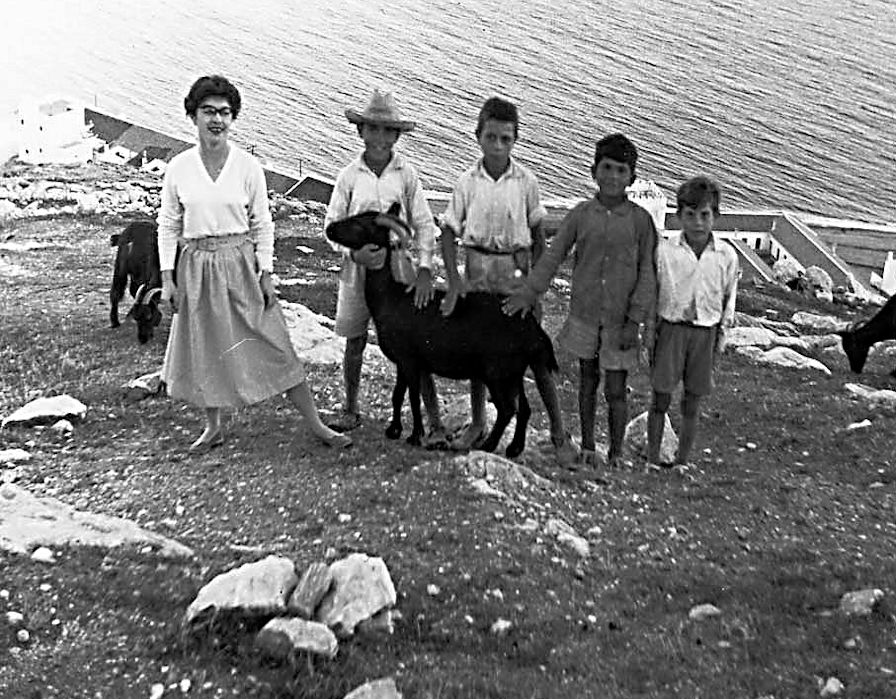
Mari & Goatherds at Castel de Ferro
Breakdown on road to Granada
Castel de Ferro
Avenida Hotel, Benidorm
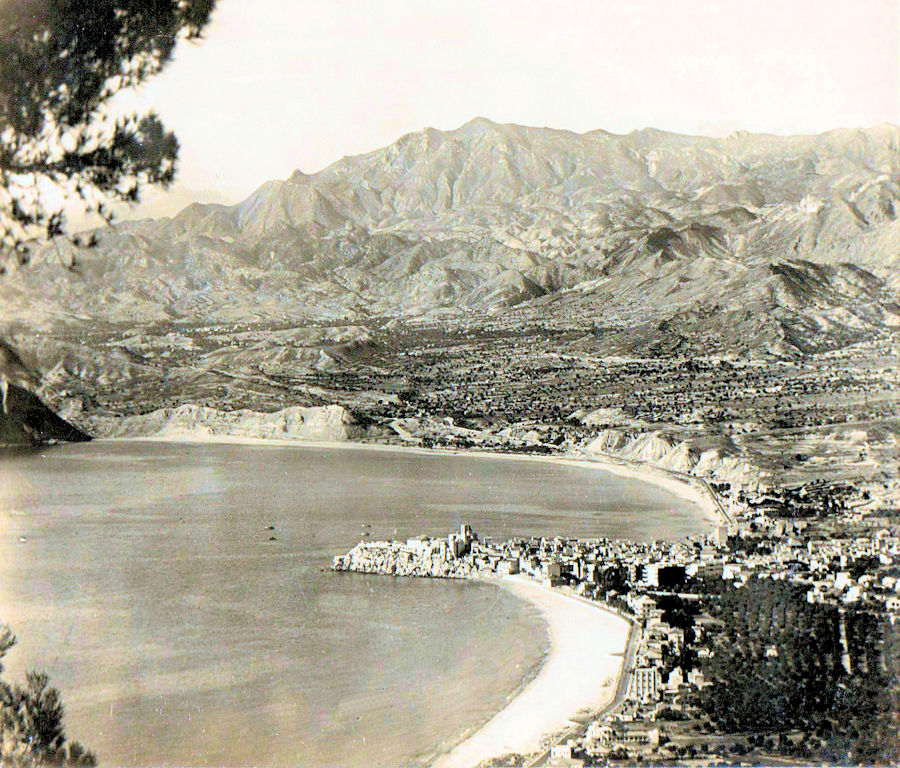
Benidorm before Mass Tourism
Late Fifties, early sixties Spain
It was the early sixties when we discovered a little village called Castel de Ferro when the son of the owner of the only hotel there jumped out in front of our car to stop us and invite us in to see the new swimming pool. Those were innocent days when we politely stopped and they actually thought it was a good way to get tourists to stay with them.
And stay we did, for two weeks or so, during which time the local boy-goatherds followed me around wherever I went. They had never seen a ‘foreigner’ before and when my husband took them all for a ride in the green Austin van we had in those days, their giddy pleasure knew no bounds. We spent many hours with them and we’d supply a picnic as they were on the mountains from dawn till dusk with only a few scraps to eat, caring for the skinny goats. On the day we left all the little boys were crying and it near broke my heart.
Spain opened to tourism sometime in the fifties, and those of us who went then were greeted with warmth and friendliness. Franco had kept Spain out of World War Two (it was a broken country after the Civil War 1936-39 anyway) but as he leaned heavily towards the Axis’ powers help was not forthcoming to re-structure the country. Until the advent of the Cold War and the West’s fear of Russia that is, when the need for strategic military basis and airports ushered in the Marshall Plan, and Spain, along with other countries in Europe received aid, mainly from the USA, which helped it get back on its feet again.
It took a long time though, for the infrastructure to get into place. For many years the roads throughout Spain bore the chalked message “Franco, Mas Arboles, Mas Agua, Mas Carreteras” (more trees, more water, more roads). Not only were the existing roads in dire states but there were few of them. The above photo of the car breakdown took place on the main road between Valencia and Granada. Our car hit a rock or stone in the middle of the road and combined with driving on many untarmacked roads throughout our trip, it brought us to a halt. Local farm-workers helped move it and we managed to limp on until we came to a repair shop/garage.
Nowadays Spain has some of the best roads in Europe.
The photo of Benidorm is of the town before it became the biggest thing in tourism and the Avenida Hotel (still there) was one of only a handful in 1959. We stayed there in a room where our balcony looked on to the open air cinema which showed mainly very old, heavily censored films, but with a cheap bottle of wine and some nibbles to enjoy, it made for a fun night. I say ‘night’ because the cinema didn’t start until midnight or later – no-one worried about the possibility of people not being able to sleep. You either slept or you went to the cinema. What? You want another option?
Typical scene in Southern Spain
Orchids always remind me of Thailand
I drank lots of Manzanilla in this bar in Arcos de la Frontera
Serrano Ham & Garlic
Still in Spain, but one photo of orchids in Thailand has crept in.
I think I’d better stop there as the post is getting too long. I’ve still got a bunch of photographs on the computer which I hope to downsize and caption and I’ll put a few more up after I’ve tussled with the garden where the weeds are in a defiant mood. I’ve got to get them under control before they master me.
I don’t know if anyone out there can help me. I’ve been unable to Post for 2-3 weeks now because I cannot upload images. Last year I Upgraded in order to have the extra space for images along with other facilities and I have the receipt for this and account shows that it is not due for renewal until October 2020 when it will be taken from my account.
When I changed my theme accidentally a few weeks ago, it reverted to a Free theme and I think this is why it will not allow me to add more images, although why it should have reverted I cannot imagine.
I have put 5 Help messages up on the Forum but although my query is acknowledge and I am told someone will get back to me I have never heard again from anyone. After delving into the murky innards of my account with WP I discovered that the email address there was an old one which I discarded over two years ago. I re-validated this to ensure they had my current email address even though I receive regular notifications from them at this current address.
I don’t know what else to do except to discard the whole thing and start all over again with a new WP site but I am loathe to go down this road. There seems to be no way of contacting them other than putting a message on the Forums (done) and sending a message to the Helpline (done). I gave them my current email address and also pointed out that my WP is travelswithmycamera.blog not travelswithmycamera.com which is the only site showing.
Hey, I hadn’t realized I had changed my blog theme!
I had ‘lost’ my blog, something I’d also done six years ago, and it’s taken me 2-3 days to get it sorted out with the help of the nice people on the WP Help Forum. Meantime, passing the time I was looking at other Themes and clicking on them to see what they looked like. I hadn’t meant to change my theme, but obviously, I have done so – even using one of their header photos. It’s not a bad theme, but when I have more time I shall have to come back and change it again, either to what I had before or something different.
When I have more time, that’s a joke isn’t it? but it seems that the more time I have on lock-down the less time I seem to have to do essential things. Mind you, I’ve done a lot of sorting out, (bags full of stuff for the charity shops when they re-open), tidying up in general, and fulfilling those halfhearted resolutions I made at New Year. Half my day seems to be spent making lists for the grocery slots I might get!
I haven’t posted for some weeks now as I’ve been tied up trying to recover virtually my entire photographic collection. I had a serious mishap with my computer and everything disappeared. Most of the documents I managed to recover but they are now in a different format and with the expenditure of quite a sum of money I got most of them back. Some were originally in an older version of Windows but had been converted but have now reverted to the former version.
The photographs are a different problem though. I managed to get quite a lot back but they are all mixed up. Not only are they in a jumble of dates but the captions have disappeared completely, leaving me at a loss as to where some were taken, when, and for what reason. Imagine trying to differentiate 100 churches or more, all taken at different periods in different countries and landscapes without any defining features, and you’ll have an idea of my problem.
My back-up went the same way and neither of the two computer experts I’ve had looking at it can understand why. Maybe because it is kept plugged in to my desktop all the time, to make a backup?
My older photographs I always put on DVDs (or CDs in the earlier days) and these are OK, but since I bought the Iomega backup machine I haven’t bothered. Lesson learned.
I am just about to put up a blog post but it won’t have the photographs I had planned to use of the volunteers working together on our project at Brading, Isle of Wight, and this after I’d got everyone’s permission to use the images!
And now to continue my search through thousands of images to try and re-caption them, date them (vaguely) and otherwise restore them.
Posted in answer to Wander Essence’s prompt to pick a book, turn to page 79, 4th line down and write a travel piece based on that. The book is New Finnish Grammar (a novel) by Diego Marani trans. by Judith Landry and the sentence is: She was pressing her hands together desperately thinking of something to say.
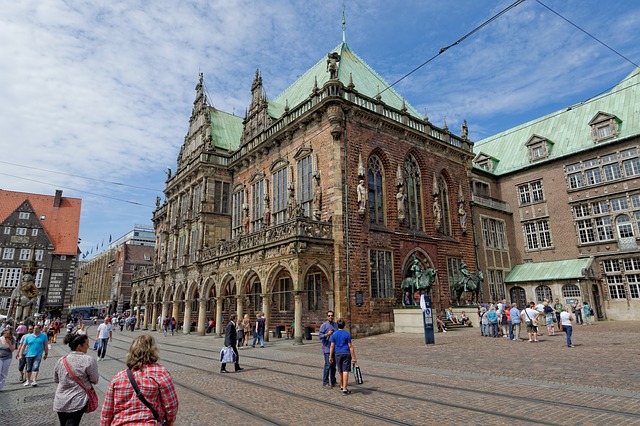
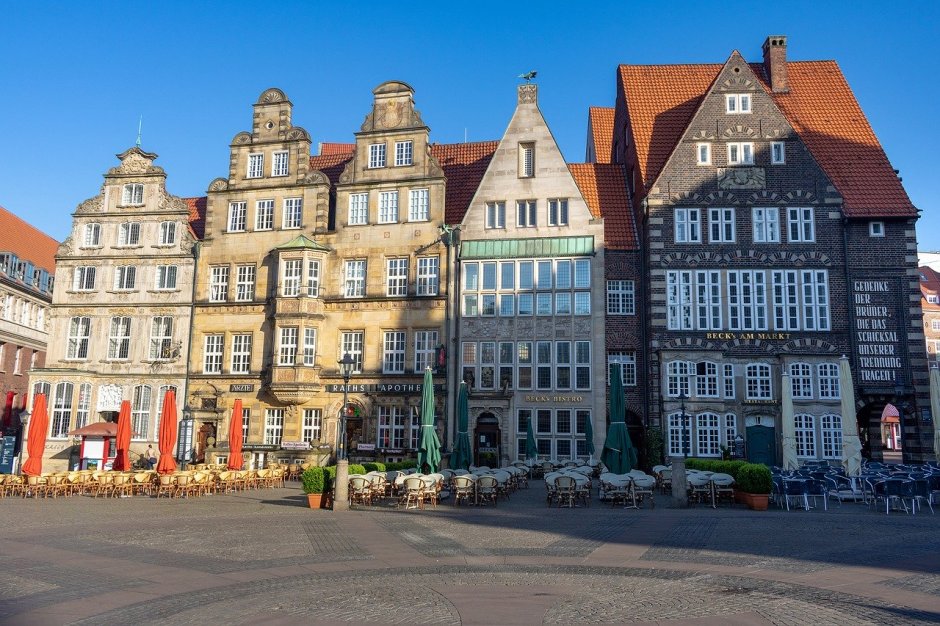
Marketplace, Bremen: Photo by SofiLayla at Pixabay
‘Don’t mention the war’ they said, when I told them I was off to Bremerhaven. But Max behaved impeccably when the subject came up.
‘Shame the old cobble stones were dug up’ I said, as he showed off his immaculate town. ‘Oh, we didn’t dig them up,’ he said, casually, ‘They were destroyed by bombing during the war.’ Oops. I couldn’t think of a thing to say.
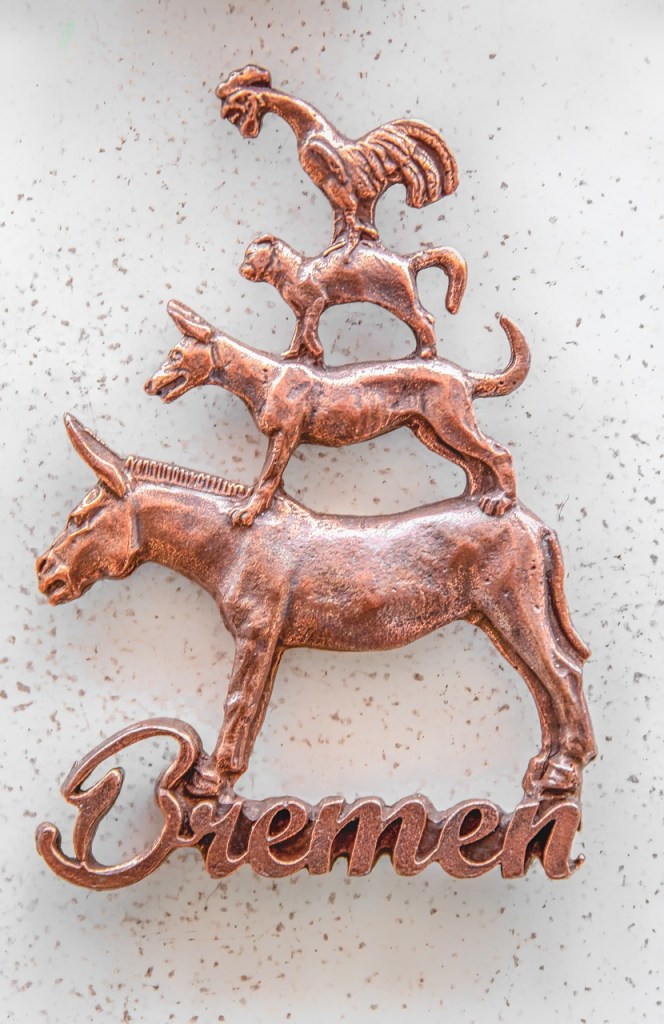
Town Musicians: Photo by SofiLayla at Pixabay
I’d come to Bremerhaven to visit Max and to see for myself if a port could be as pretty as it looked in the photographs he kept sending me.
It’s the largest fishing port in Europe and a major seaport for world trade, but it’s also a fun place. Art Nouveau styled houses with brightly coloured façades lend a cheery air to the serious merchant area. Street musicians, a pedestrianised shopping paradise along the waterfront, sleepy cafes and tree lined boulevards, – all this plus beaches!
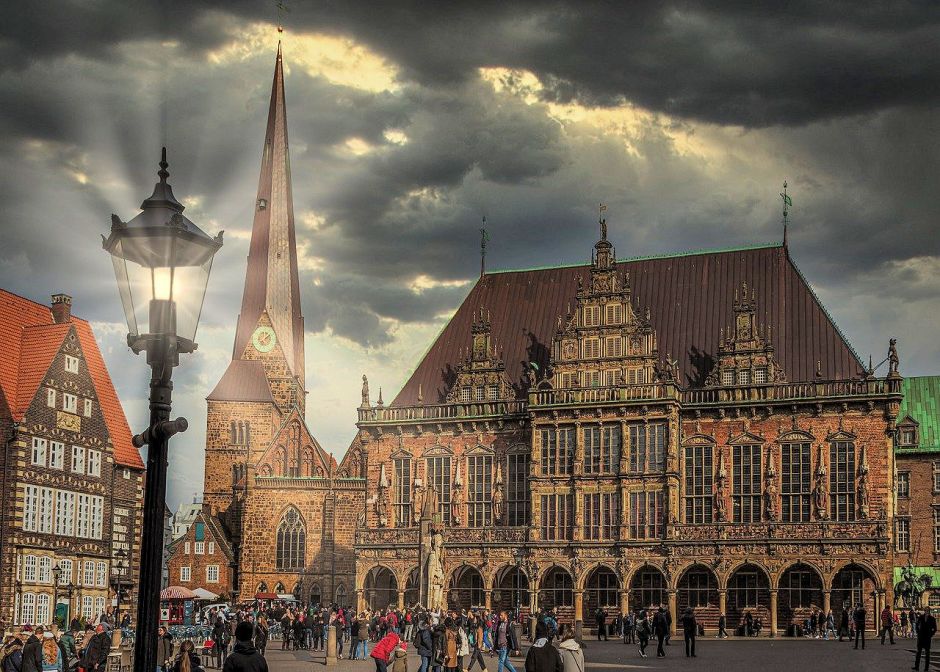
Town Hall, Bremen: Photo by analogicus at Pixabay
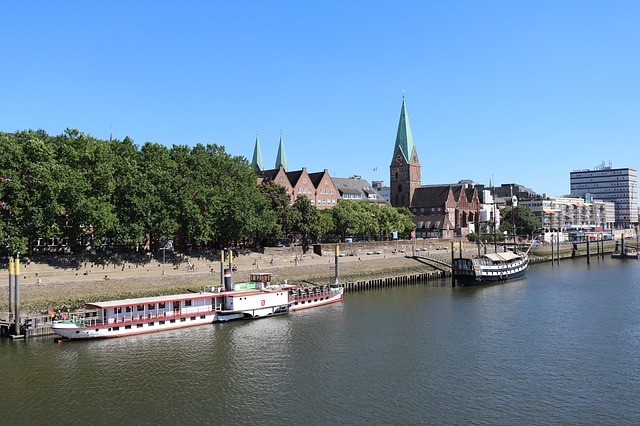
In this flat land, somewhat reminiscent of Holland, even I could look proficient on a bike and it wasn’t long before Max and I were mounted on comfortable cycles. The banks of the River Geeste and the surrounding forests are ideal for hiking and cycling and large parks within the city are havens of quiet when you want a rest. We sat on the banks of the Weser for a while and watched the ships go by and then we took ourselves off to Bremerhaven’s own beach, the Weser Lido, for a spot of sunbathing with the locals.
The Weser: Photo by Nicole Pankalla at Pixabay
Just a short train ride away was the Free Hanseatic City of Bremen, the pulsating heart of Northwest Germany. With more than 1200 years of history in its streets and buildings there is enough architecture here to keep the hungriest culture vulture well satisfied.
Centre of the city is Market Place, where the Schutting, seat of Bremen’s merchants for four centuries, St. Peter’s Cathedral whose towers give stunning views over the city, and the The Rathaus, dating back to 1405, are a reminder of Bremen’s glorious past.
Marketplace, Bremen: Photo by Peter Hauschild at Pixabay
We lunched in the Town Hall cellar (the Ratskeller), which has served as an eating place for more than 500 years, sitting under a low barrel-vaulted ceiling in a cloister-like atmosphere and choosing a wine from one of over 600 fine German wines they keep in stock. Dark wooden cubicles lined one wall (doors kept open by law!) and huge crested barrels dominate the centre of the room. I decided on the pigs knuckle with sauerkraut, fried potatoes and pickled cucumber but I wish I had been forewarned about the size of the pig’s knuckle. German pigs are BIG!
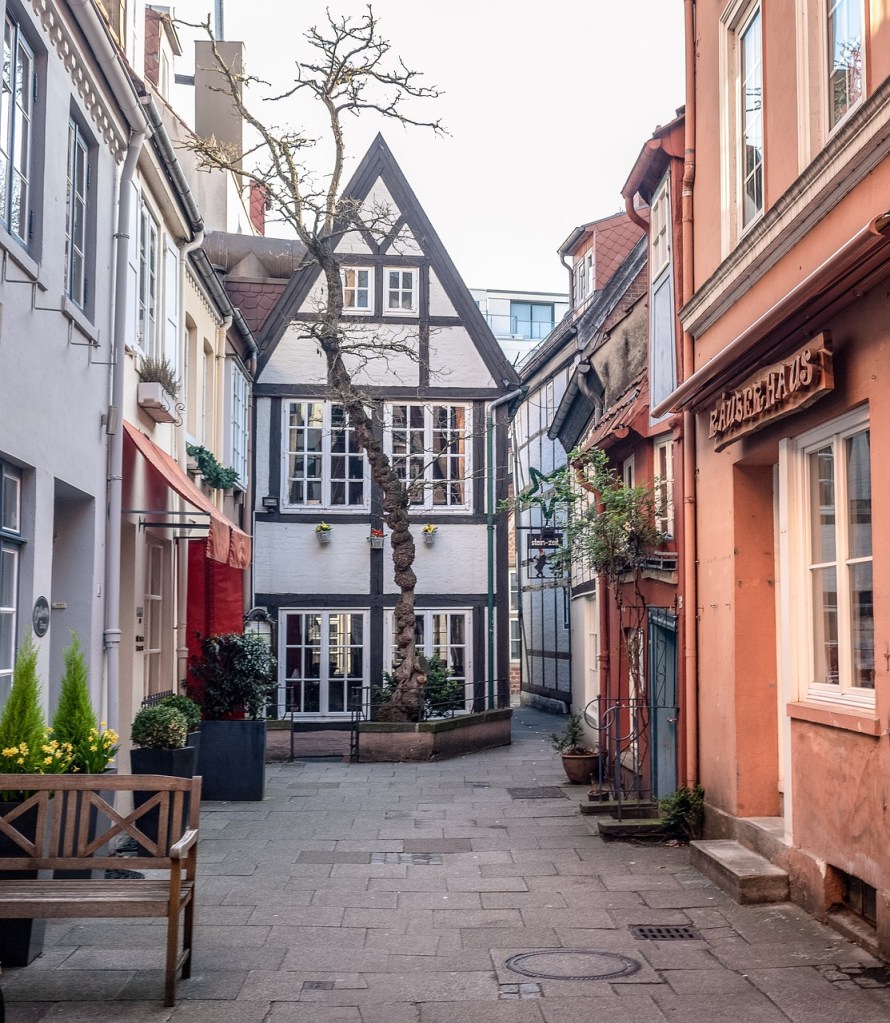
Snoor House: Phoro by Nicole Pankalla at Pixabay
Max suggested a visit to the vaults beneath the Cathedral to see the mummified bodies but post lunch squeamishness made me refuse. Instead we wandered through Bremen’s oldest area, the medieval Schnoor district, once home to fishermen and sailors but now housing artists’ studios and craft shops selling unusual things like life size puppets, designer kites and dolls’ houses. Also worth noting are the top class restaurants and shops that crowd the area. The district was renovated in the late 1950’s, but fortunately the developers didn’t destroy the medieval charm of the district or make the place into a Museum.
There were craft shops too, in nearby Bottcherstrasse, where the zany house fronts with carved wall panels brought a smile to my face and the carillon made of Meissen porcelain made me marvel. The inventor of decaffeinated coffee, one Ludwig Roselius, commissioned these buildings on the tumbledown alley he had purchased early in the 19th century.
Evening saw us in Das Viertel, the centre of Bremen’s nightlife and cafe society, the like of which I’d only seen before in old Montemartre. Moroccan and Turkish snack bars vied with beer joints and shady looking clubs, and Dali-esque people in designer clothes clogged the pavements. Too rich a mix for me after such a hard day’s sightseeing, so we wandered back to a quiet tavern in Schnoor for a satisfying tankard of Bremen’s best.
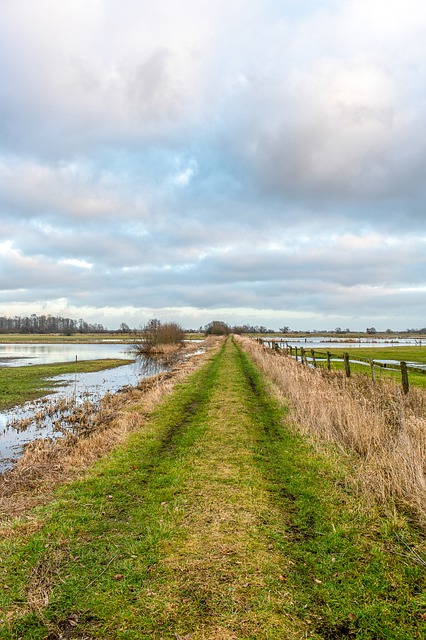
Blockland, Bremen: Photo by SofiLayla at Pixabay
Yes, Bremen was different. ‘You know, Hitler never came here’ Max said as he saw me off at the station. ‘We were always anti-fascist and he knew that.’
That’s how different they were: they mentioned the war.
Details:
Best time to go is for the Freimarkt in October, Bremen’s answer to Munich’s Octoberfest, a huge celebration of food and drink, beer tents and sausage kiosks. Be warned, outrageous behaviour is the order of the day.
Carnival, Bremen: Photo by SofiLayla at Pixabay
Beck’s inn Snoor is the place to sample the local draught beer. They also serve good seafood. There are plenty of snack bars round and about and the food is always good and plentiful.
Restaurants: Do keep enough dosh to eat at Natusch Fischerihafen Restaurant in Bremerhaven for great fish served almost straight from the boat. The place is full of hearty eaters, and they often come around to ask if you want more. Fish dishes from €25 Euros, Grills from €21. Table d’hote Menu from €31.50 for 3 courses. Very large portions so check what other are eating and maybe settle just for one course. Wines by the glass very reasonable.
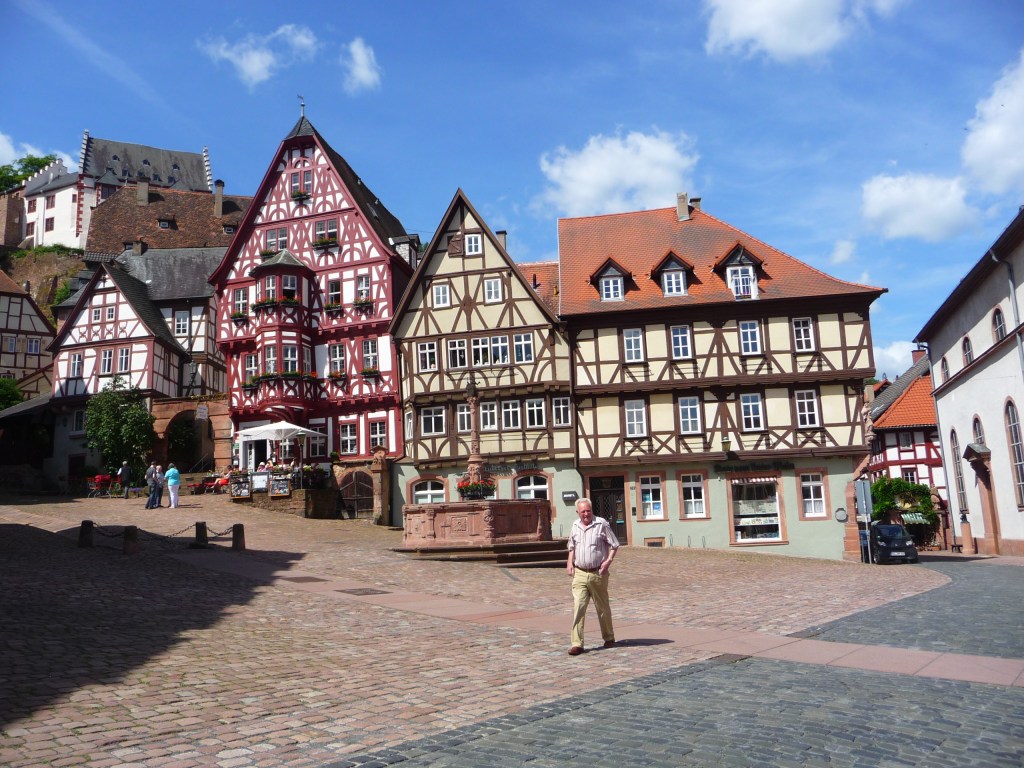
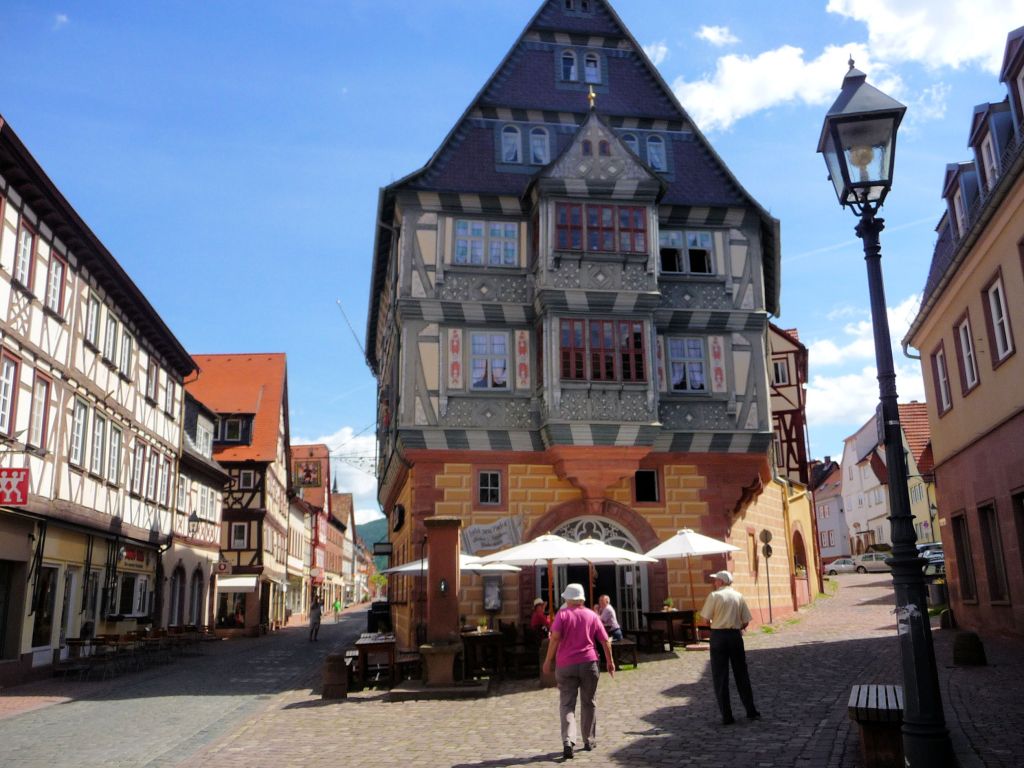
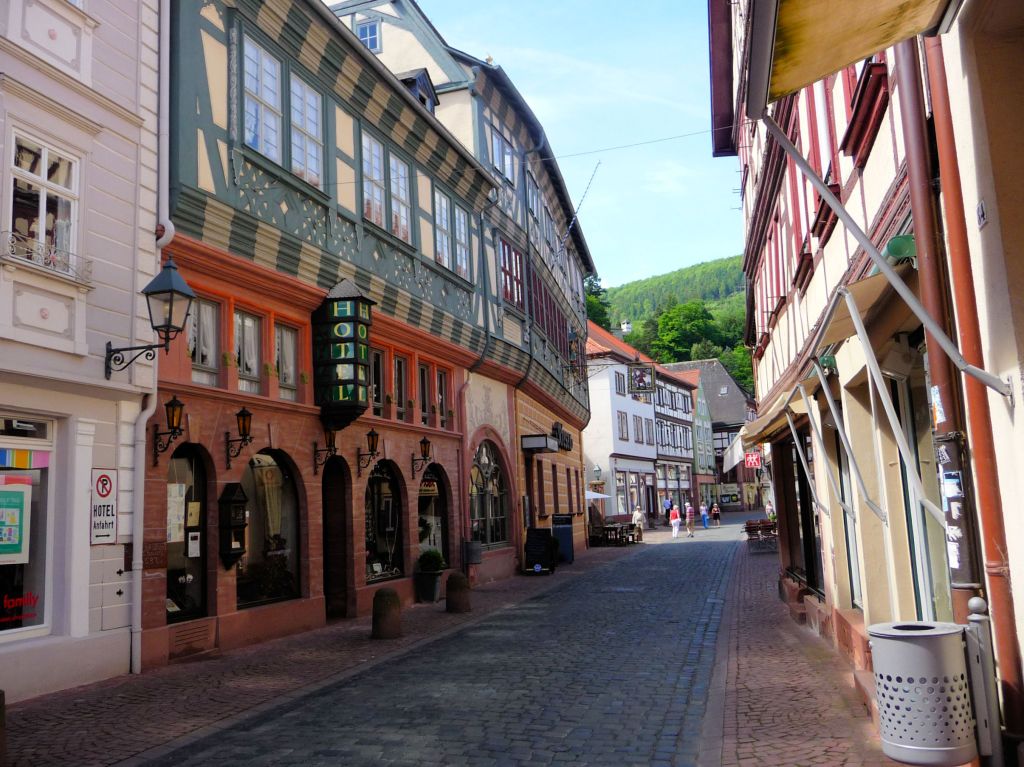
It’s been a few years since I last visited the villages along the River Main in Germany but it was once a favourite driving holiday, especially in early spring when the flowers were in bloom and the street stalls were full of jewel coloured blooms, wrapped in flimsy coloured paper, just asking to be taken home. Of all the lovely medieval villages along the route one of my favourites was Miltenberg, a town with a wide main street lined with half-timbered houses and small medieval alleys.
Main Street, Tables Ready for Lunch
The beautiful houses that line its main street span the 15th – 17th centuries and the oldest dates back to 1339: what is so unusual is that all of these half-timbered dwellings are lived in. In consequence, there is no feeling that this is a tourist site, a place where we come to gawp and take photographs. Instead, we wander and look, dive into interesting looking shops, and stop off at cosy taverns serving local cuisine along with the wine of the area – and, of course, beer.
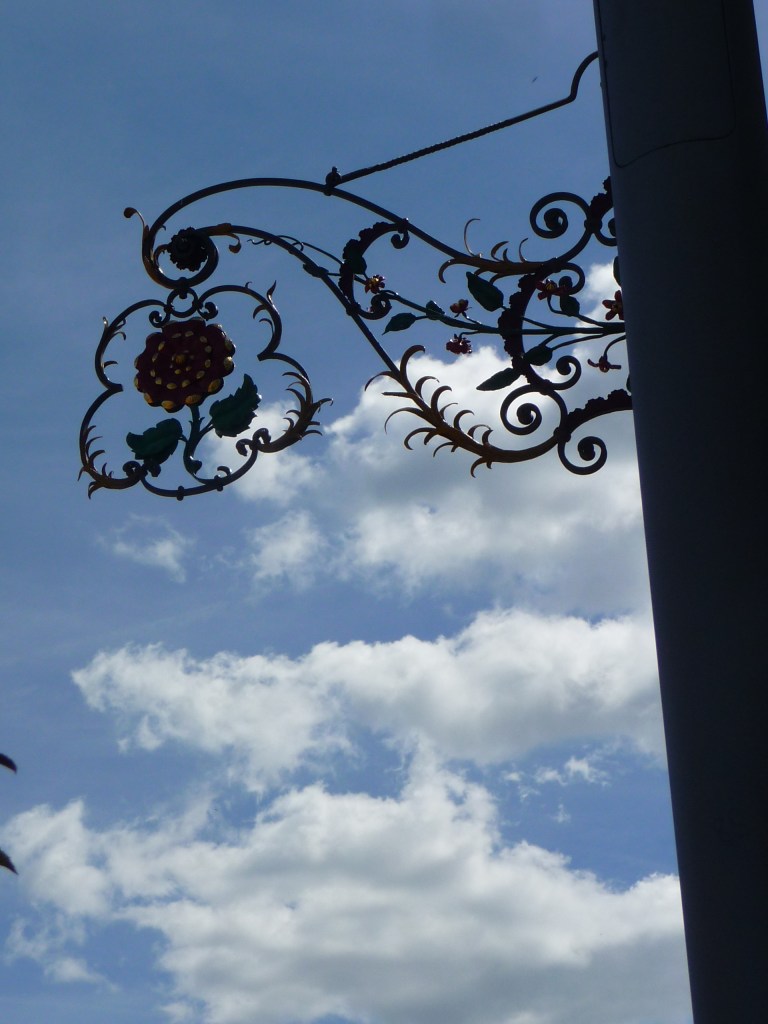
Wrought Iron Signs
Wines of the Region
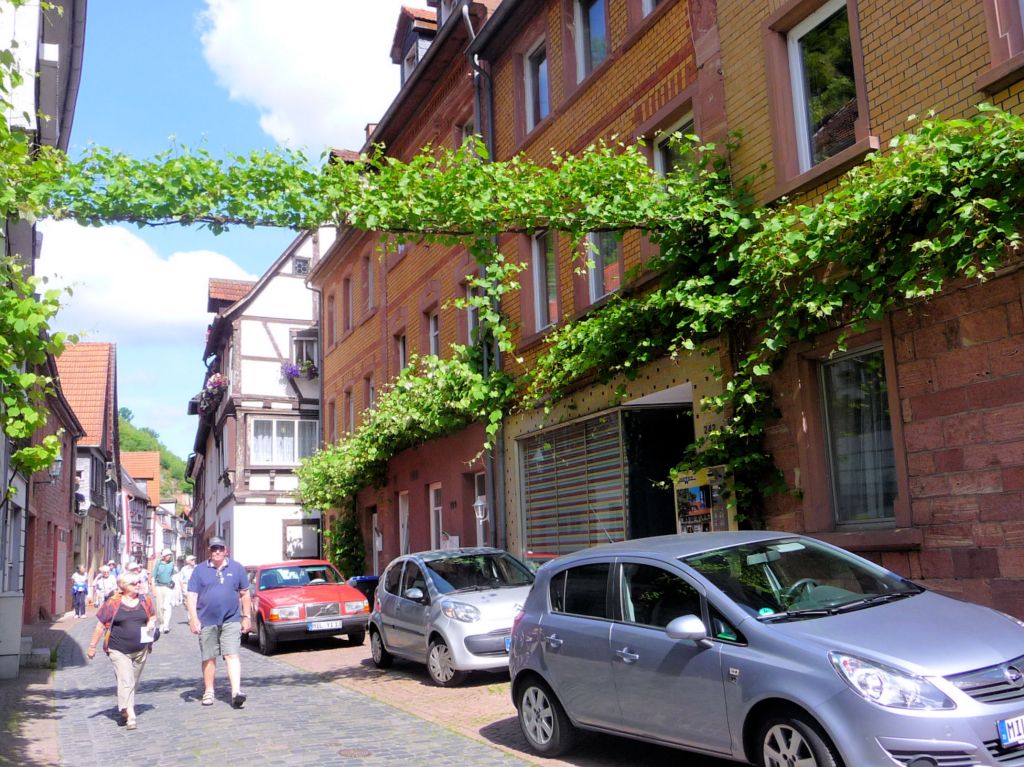
Vines Across the Street
Stag’s Heads
Main Beer Keller
A Green Haven
The town has a few interesting sculptures dotted around the streets most of them honouring local artisans. I was also impressed by the quality of the goods for sale in the shops, at a quality-high price I may add. Even the mannikins that modelled the clothes looked beautiful as you can see from the picture below.
Viniculture and the wine trade, wood from the surrounding forests and stone, and the fact that the town was well-placed on the river for transportintg goods, was favourable to this location at the trading artery of Nuremberg and Frankfurt and the town grew rich.
The Old Marketplatz
One can see Miltenberg’s importance from the magnificent half-timbered houses, especially those in the Old Market Place (the Schnatterloch) and Germany’s oldest Inn, the Gasthaus zum Riesen, dating from 1590. It claims to be Germany’s oldest Inn and an historical document tells us that a local owner at the time was granted the right to fell a hundred oak trees for its construction. It is known for serving some of the best food in town and is especially noted for its roast salmon.
Germany’s Oldest Inn, Gasthaus ZumReisen, dating from 1590
From the Market Square to Mildenburg Castle, which was constructed in 1200 under the aegis of the Archbishop of Mainz, is an easy walk. The castle doesn’t really comare to other castles in Germany being a relatively small fortress, but it is worth the walk if only for the wonderful views of the old city.
A small town but a supremely beautiful one, and a recommended stop on the way to or from Nuremberg or Frankfurt.
To Chichester last week to see I’m Sorry I Haven’t a Clue, the stage performance of the popular Radio 4 satirical quiz starring Jack Dee, Rory Bremner, Miles Jupp, Tim Brooke-Taylor and Tony Hawks. A superb – and hilarious – evening in a packed Chichester Festival Theatre where the audience laughed their way through two and a half hours of clever, satirical humour.
But this post isn’t about the performance, brilliant though it was, it’s about Chichester, a hidden gem of a City, located less than two hours from London and within easy distance of Brighton, Southampton, Portsmouth and the S.E. coast.
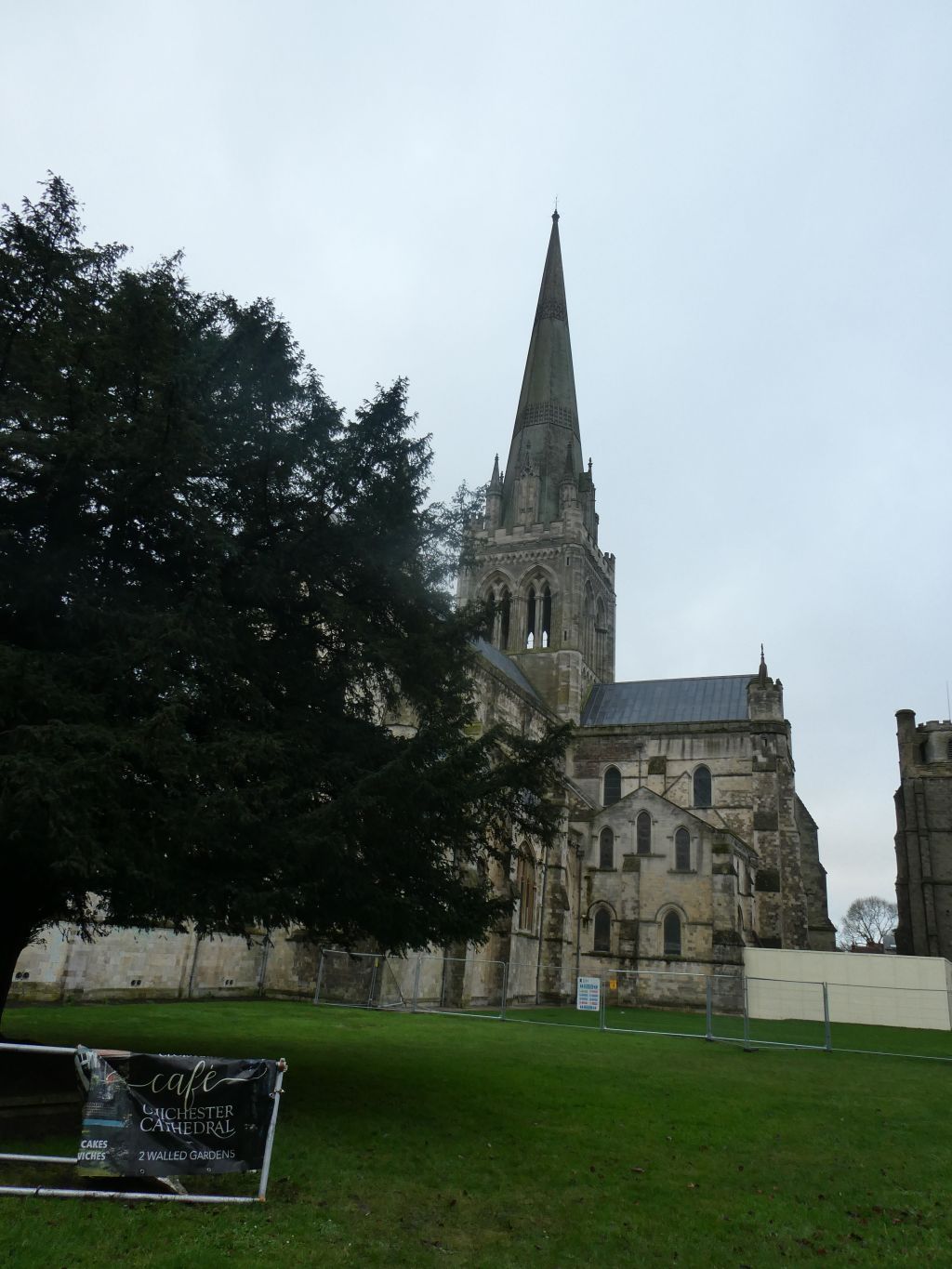
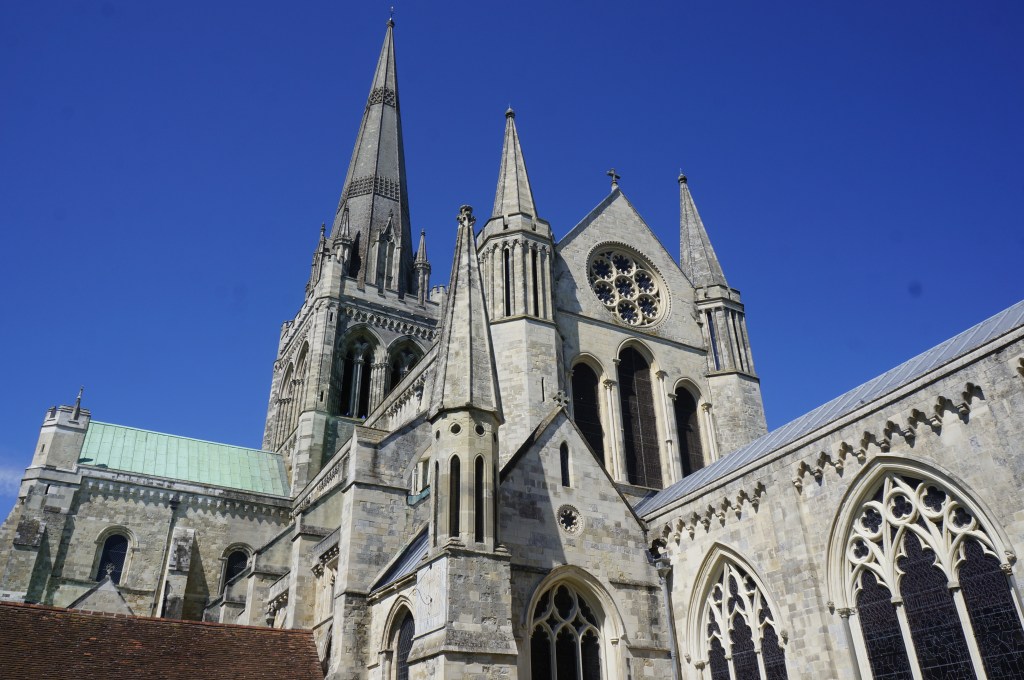
Chichester Cathedral (Photo Steve Moore)
We stayed overnight, Chichester being well supplied with hotels and guest houses, the only drawback being the weather which wasn’t kind to us. Rain and wind are not conducive to walking slowly through cobbled streets steeped in history, along canal banks, through green parks and along the City Walls, not to mention walking to and from the Theatre.
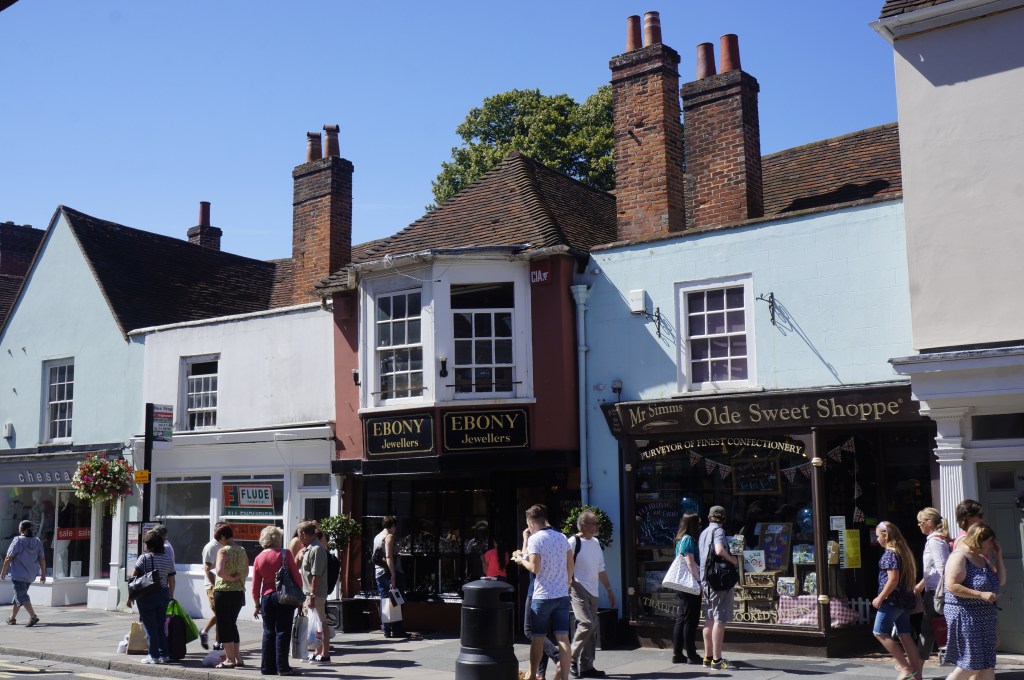
Very old Cobbles Stones and buildings in Chicheser
For that reason the outdoor photographs here were all taken last year. I go there at least once a month to the The Festival Theatre and its sister theatre, The Minerva both of which offer first-class productions of drama, musicals, and newly written plays, most of which transfer to the West End after their run in Chichester. There are also two good restaurants on the site (booking essential).
Chichester Festival Theatre and Restaurant at Theatre
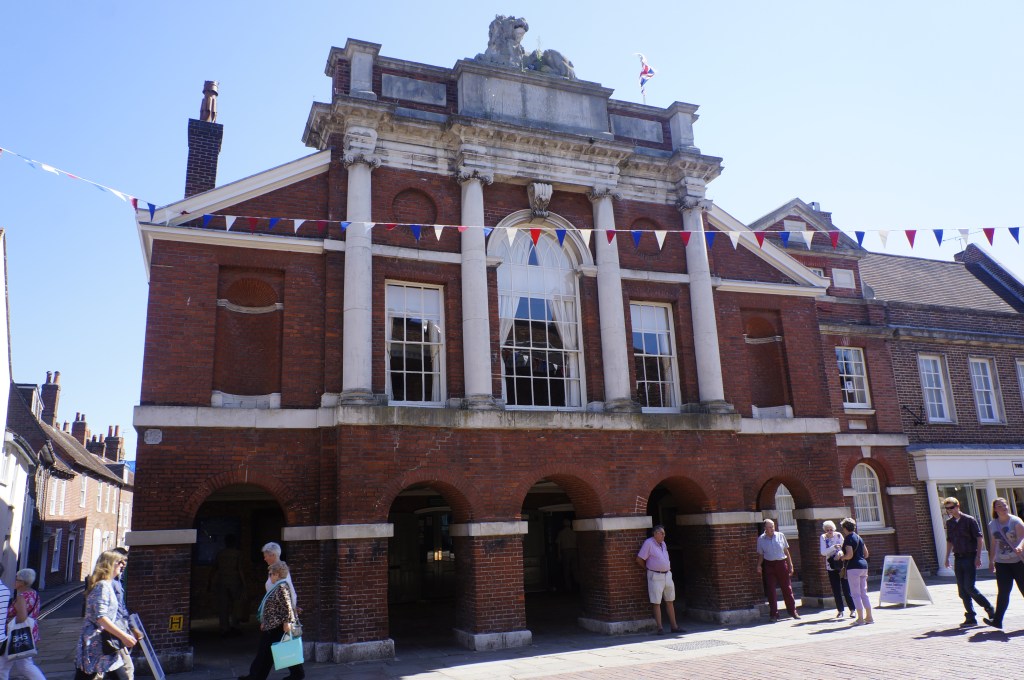
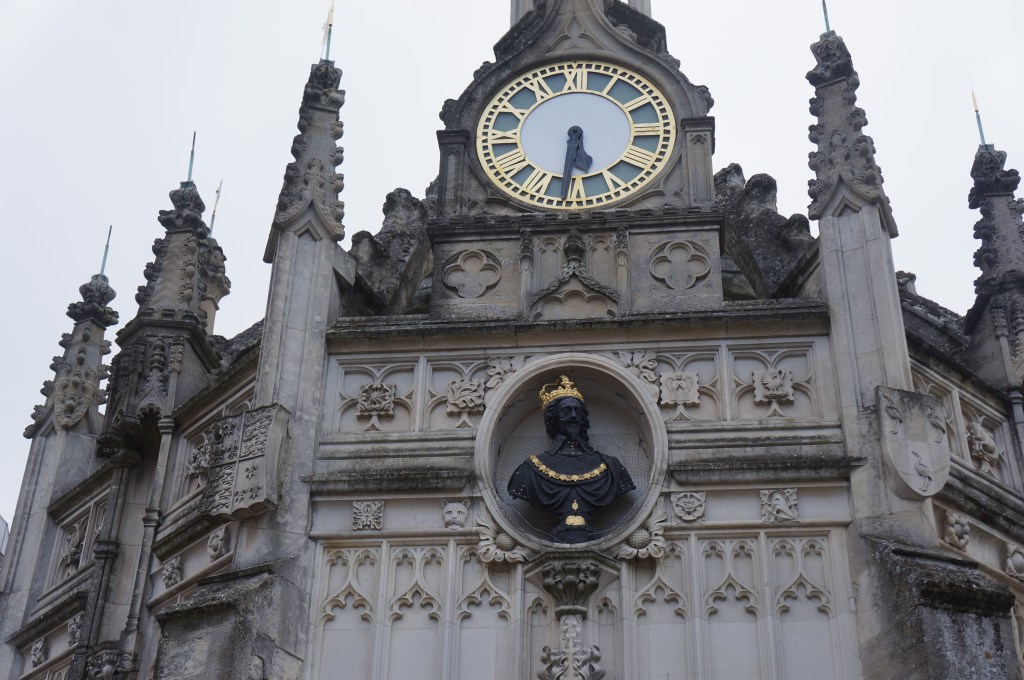
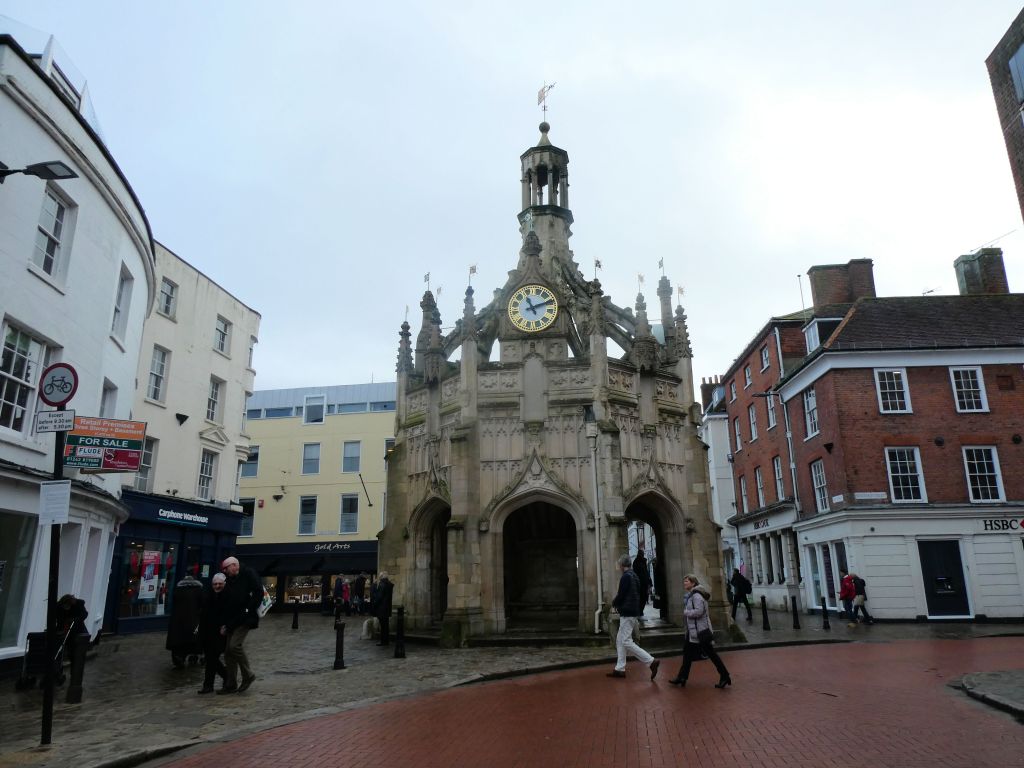
The city’s Roman influence is reflected in the main street pattern, and it is not difficult to spot historic buildings that line the streets and the little alleys that lead off them. One of the city’s most iconic features is The Market Cross, believed to have been built in 1501 by Bishop Edward Story, who paid £10 to the Mayor of Chichester for the ground on which it is built. The Bishop allowed peasants to trade under the Market Cross without paying a toll, and it’s still a gathering point for the community today and for sellers of fruits in summer and umbrellas and plastic ponchos last week!
Market Cross
You will see the Roman name Noviomagus Reginorum in various places in the city and to find out what that means, the best thing is to take a walk along the City Walls, the most intact circuit of Roman town defences in Southern England. You can start the 1.5 mile walk anywhere along the wall and stop to admire the impressive views over the rooftops at any point.
If the weather is not conducive to walking the walls, then head to the free Novium Museum, built over the remains of a vast Roman bath house which can be seen from the ground floor, for an in-depth insight into the history of the City and wider district.
Another indoor attraction is the Pallant House Gallery (rated second only to the Tate for modern British art by the Guardian) which explores new perspectives on British art from 1900 to now. It is housed in what is considered to be one of the most important 18th century townhouses in England and one of very few Queen Anne houses open to the public.
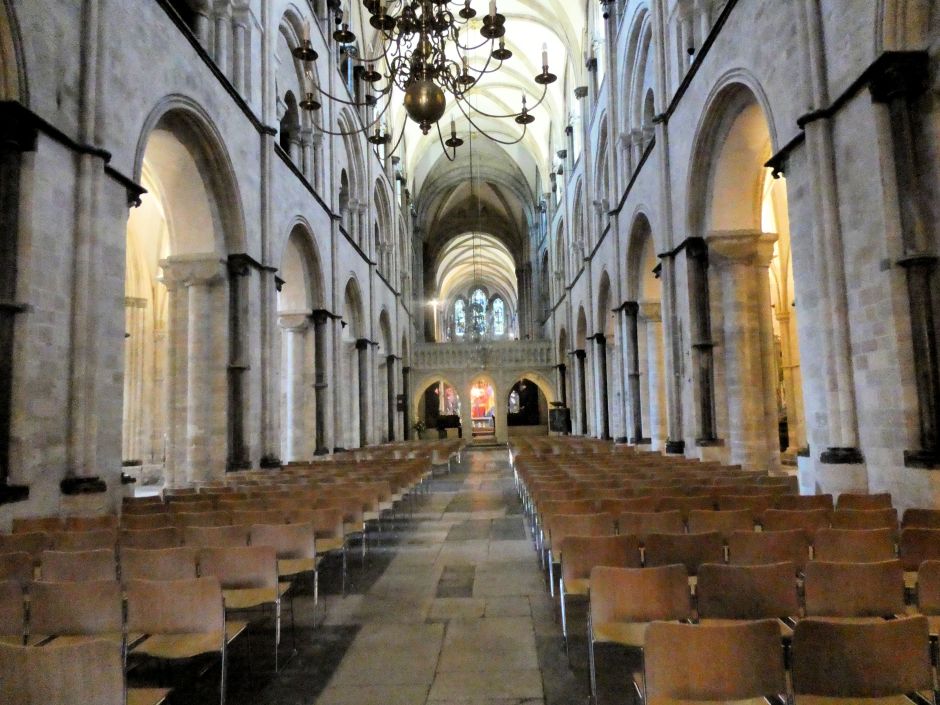
The Cathedral is one of the most impressive in S.E. England and has a wealth of art inside that makes a visit there worth more than a visit to many other grander buildings. See linked post.
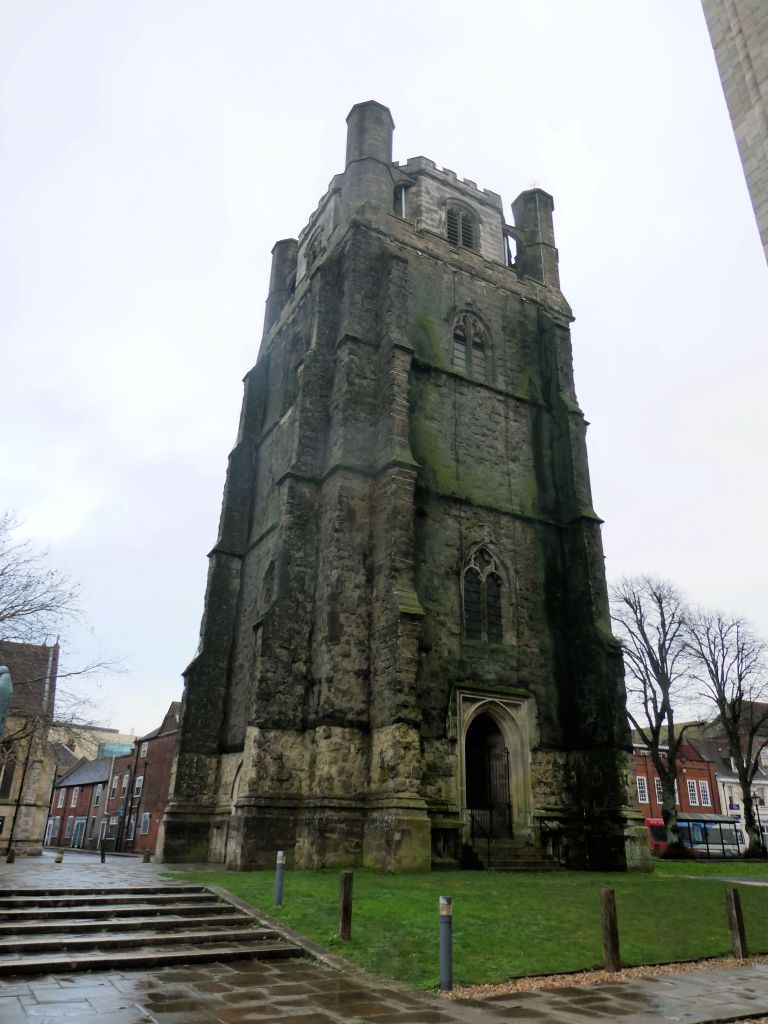
I am not a frequent visitor to churches and cathedrals but I make an exception for the 7thCentury Chichester Cathedral because it contains art that speaks to me. The Cathedral is a classic Norman building with round arch windows and west facing twin towers and is the only English Cathedral with a surviving detached medieval Bell Tower dating back to 681 when Saint Wilfred brought Christianity to Sussex.
Medieval Bell Tower, Chichester Cathedral
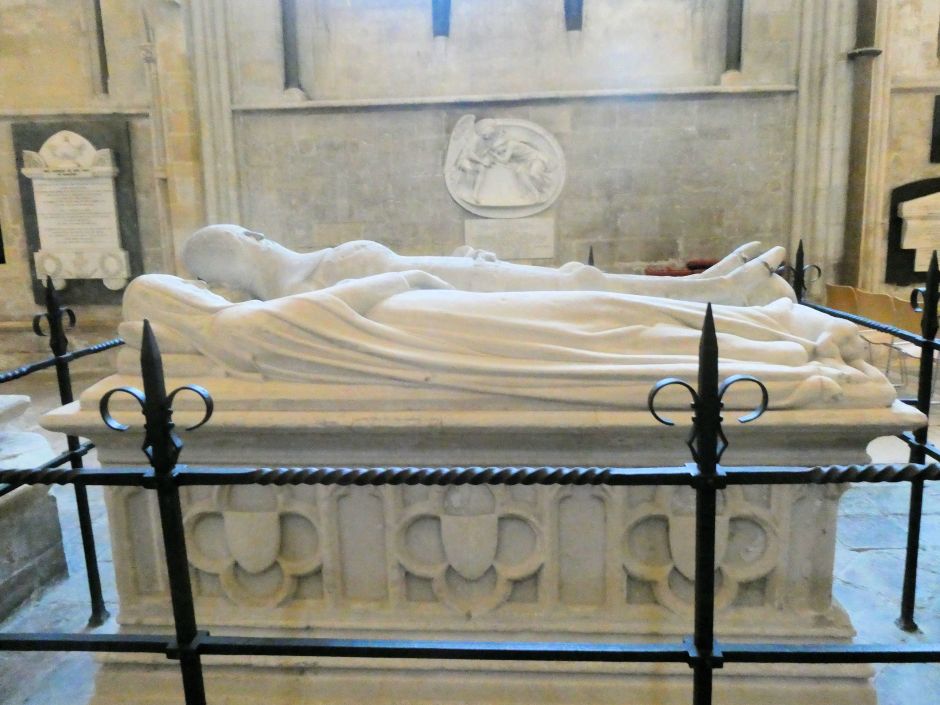
It was raining heavily on the day after the theatre performance so we spent most of the time before lunch and our departure, in the Cathedral. I wanted to re-visit the Arundel Tomb, subject of a poem by one of my favourite poets, Philip Larkin. I have been re-reading Larkin recently and that particular poem has being going round and round in my head and I knew I could only dislodge it by visiting the tomb.
The Arundel Tomb
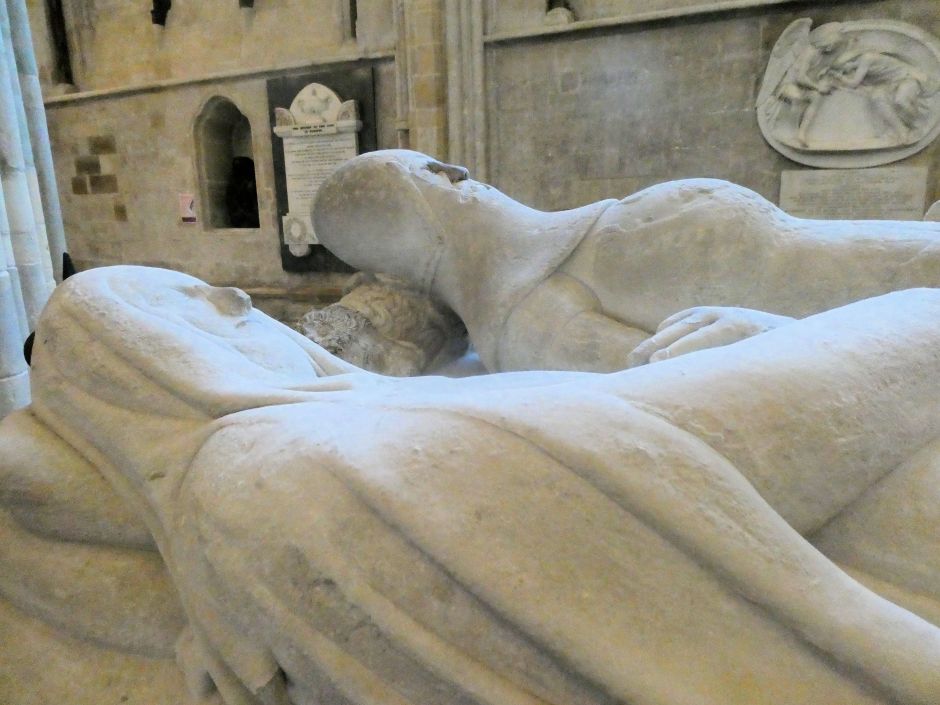
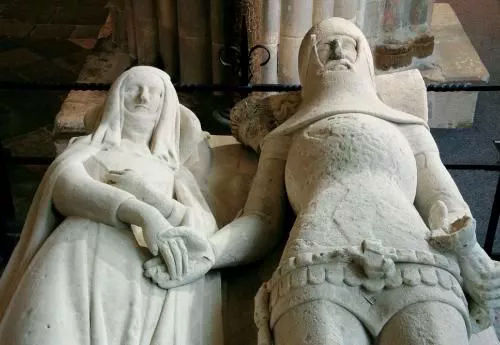
The Arundel Tomb was brought from Lewes Priory sometime after its dissolution in 1537. On top of the carved stone tomb lie the figures of Richard Fitzalan, Earl of Arundel, and his second wife, Eleanor of Lancaster. The tomb was restored at the beginning of the 19th century by Edward Richardson, a well-known sculptor of the day.
I know the poem off by heart and I was able to sit there for a long time and listen to the music of the words in my head and ‘see’ what Larkin saw when he wrote the poem. Without his words, I would have walked by this tomb and missed what he saw “what will survive of us is love”. If copyright allowed, I would have liked to add the poem here, but it wasn’t possible.
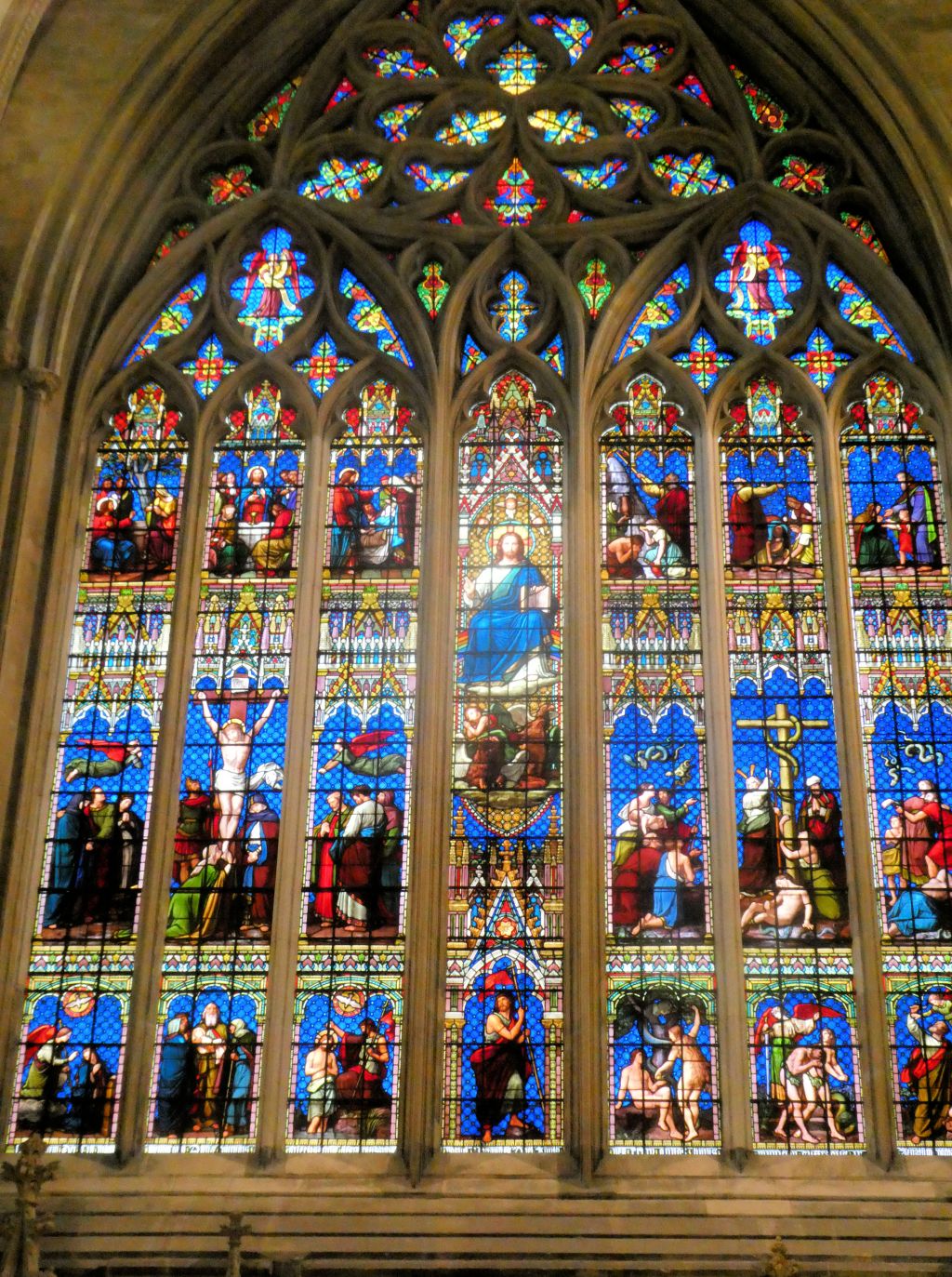
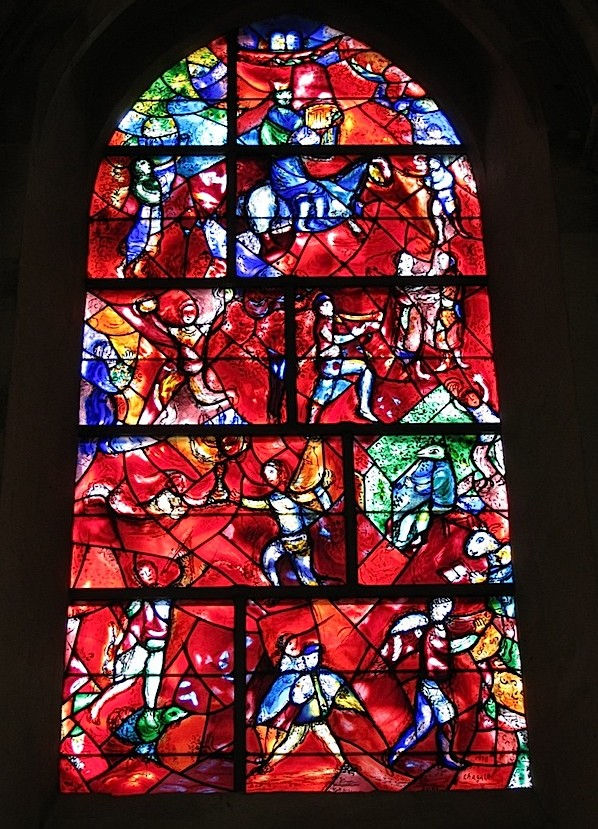
I also wanted another chance to see the Chagall stained-glass window and the Gustav Holst plaque. The Chagall window, installed in 1978, is unusual in that the glass is predominantly red when Chagall usually worked in blue. It is absolutely gorgeous and I could have stayed longer just drinking in the beauty of the luminous jewel cololurs.
Stained Glass Window by Chagall – Photo by David Spender CC.
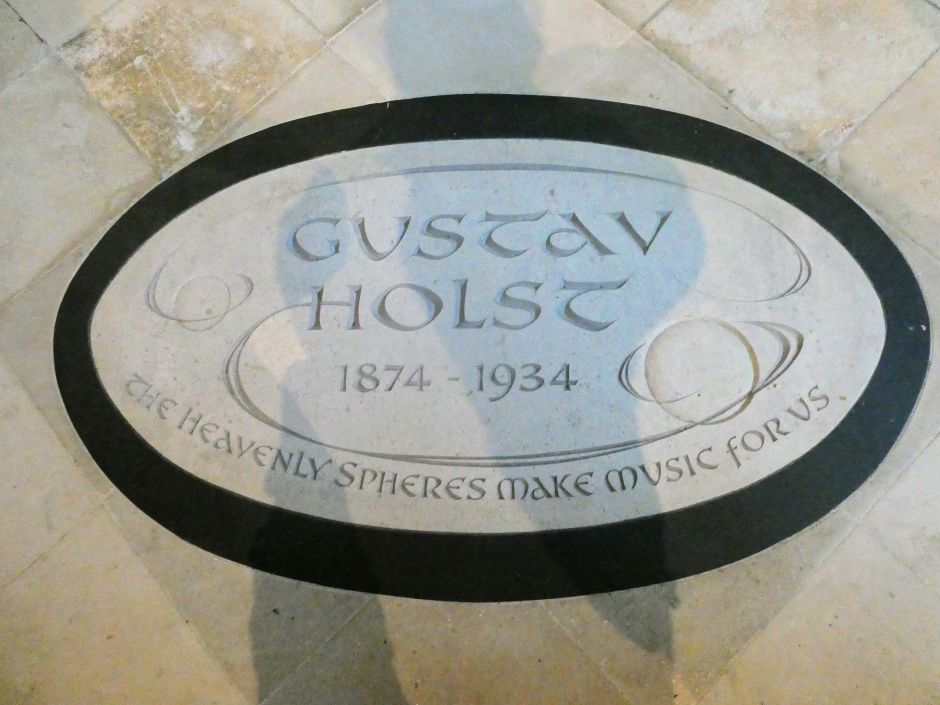
Gustav Holst, composer of The Planets Suite, one of the greats in British 20th century music, had a special connection to Chichester Cathedral having worked with Bishop Bell on the Whitsuntide Festivals. On his death on 25th May, 1934, aged 59, his ashes were interred in the Cathedral under the plaque on the floor in the North Transept near to a memorial to his favourite Tudor composer, Thomas Weelkes.
Plaque in Memorium Gustav Holst
I shall no doubt visit again on my next trip to Chichester because there is more art to be seen in the cathedral. There is a John Piper tapestry on the High Altar, a vividly coloured work which I have yet to take to: there is a Graham Sutherland painting and there are various sculptures worth searching out.
Our trips to Thailand were not sudden decisions but a given: we knew we would go to Thailand every year, spend time with good friends, travel in the country, venture outside it, and have new experiences, so the anticipation was tied up with warm thoughts of friendships renewed and meals shared again.
Group photograph after dedication of new spirit house at Dusit Thani Hotel, Hua Hin, includes the monk who performed the ceremony, the GM, electrician, housekeeper, gardener, various room and restaurant staff – and myself and husband.
But why Thailand in the 1970’s? Well, our travel agent had invited us to an evening of Thai culture and food earlier that year and we were bowled over by the experience of meeting Thais, their charm, their smiles and their sincerity and so our first holiday turned into one of many.
When we first started visiting Thailand, we packed essential foods as Western foods weren’t easily available outside 5* Hotels so biscuits, tea bags, and bags of toffees and other long-lasting sweets had to be purchased (my husband had a notoriously sweet tooth). In later years the bags of sweets increased as our Thai friends became addicted to them also. Mosquitoes were a big problem – especially in Bangkok – so lots of anti-mozzie repellent was required along with sun cream and such like.
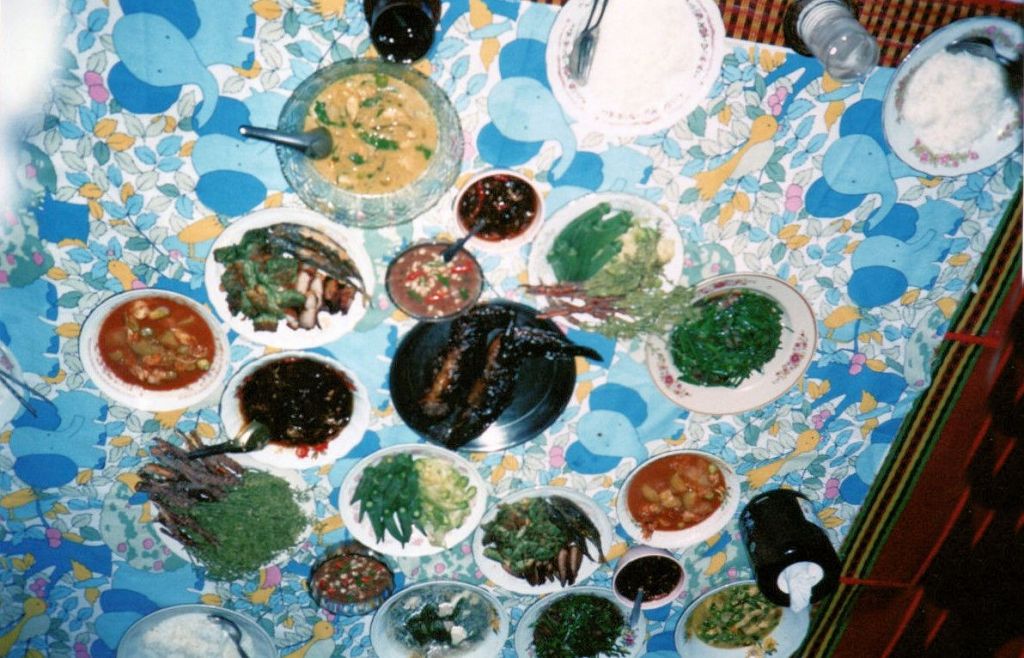
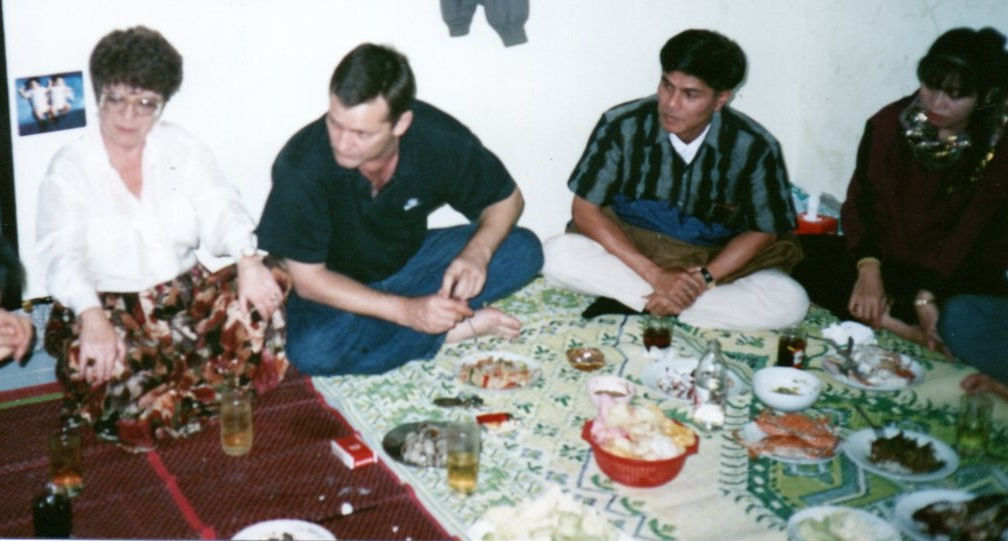
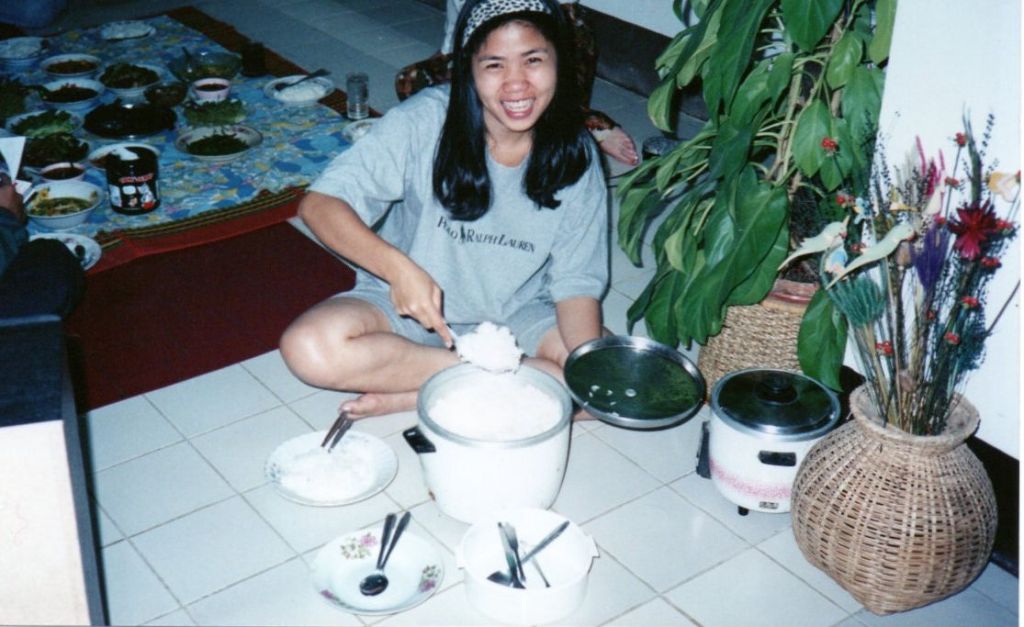
Eating with Thai friends. Food laid out on the floor. Who needs chairs when the food is so good and the smiles so lovely?
Initially we alternated Thailand with other destinations but after our circle of friends there grew and the pull of friendship and place began, it became our regular vacation spot.
After our first few visits, preparations had to include the buying of presents. We tried to ensure the presents were as ‘local’ to our area as we could get and even though no one every made tea in a teapot, they all adored English teapots, and all things English. The exchanging of presents in Thailand is very important and the correct etiquette is not to open the gift in front of the giver. I had to get used to the fact that no one ever came back to say what a lovely present I had given them, but they showed their delight in other ways and the exchange of presents was always successful. I was invariably there for my birthday and not opening my presents was difficult, as I would be deluged with exquisitely wrapped hand-made presents, Buddha medals, unusual gifts purchased in remote villages (like a necklace made from the bone of an logging-elephant), carvings, fruits, foods and pictures.
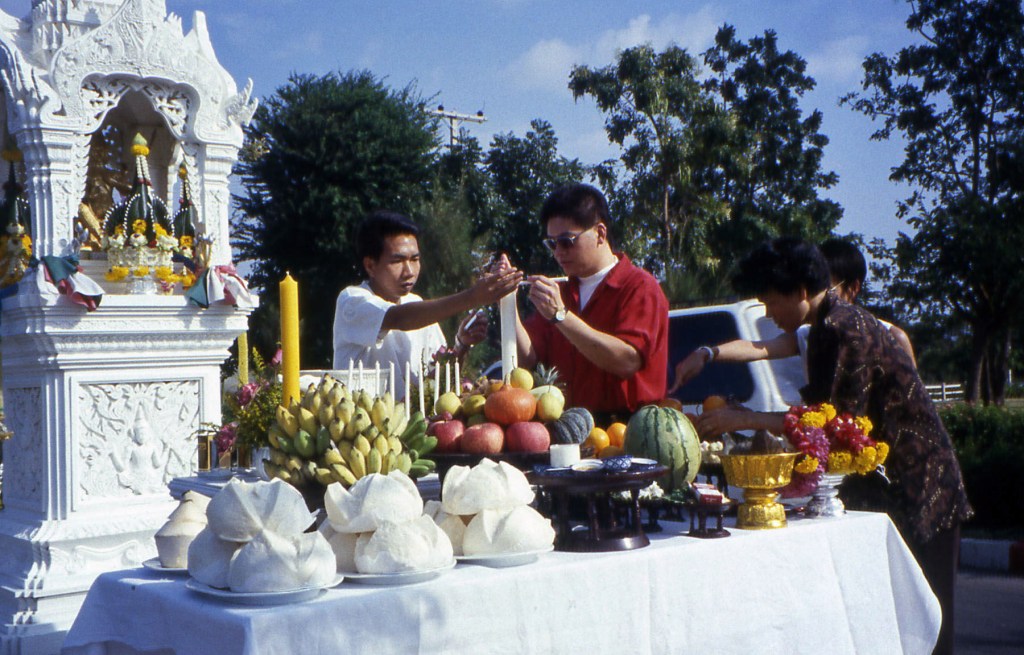
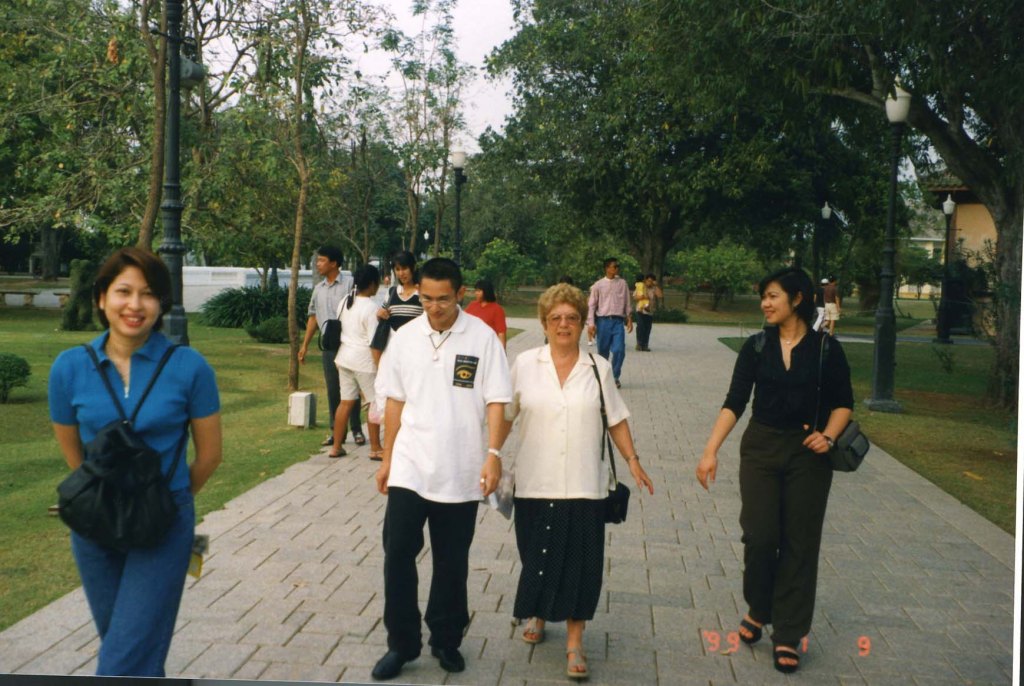
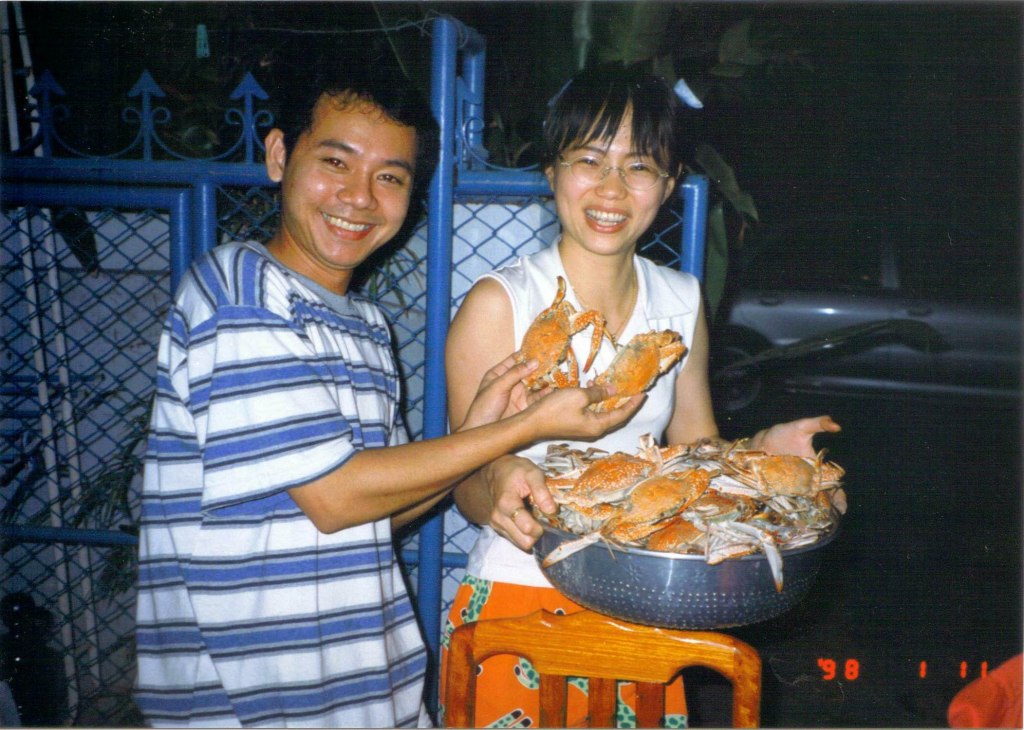
1. Leaving food for the spirits. 2. In Ayutthaya with Yasmin, Nucha & Boom. 3. Crab barbeque at the home of Gai and Darina
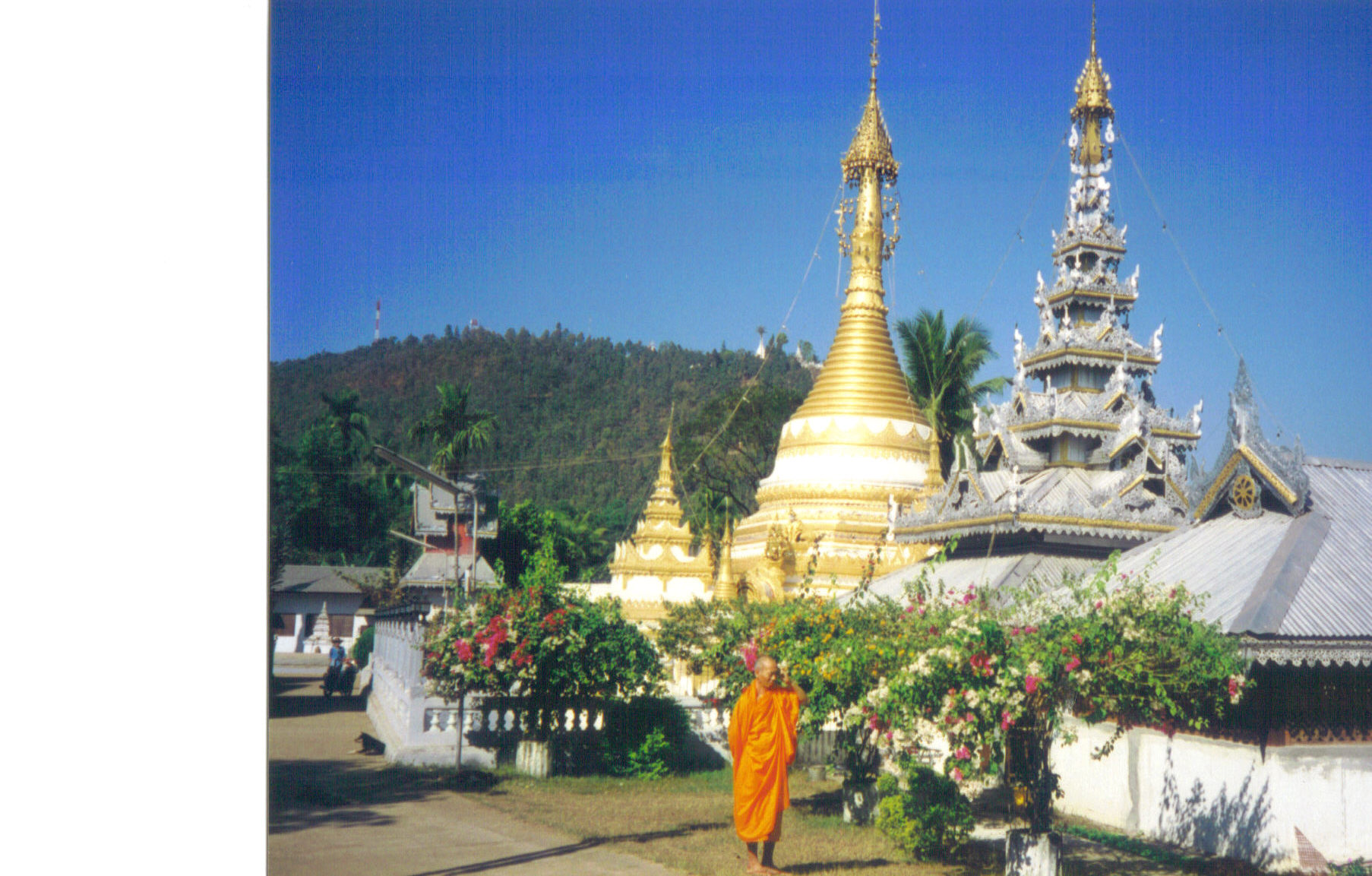
We would always visit a Temple or two and often attend functions where monks were present so packing had to include cover-ups and easy-to-slip-out-of shoes. Apart from ceremonies where monks were present, like weddings, funerals, donating of robes, and blessing of houses etc., I occasionally lined up at dawn with my Thai hosts to offer the monks food for the day (purchased a few minutes before from the market), I made offerings to the spirits at various spirit houses – and always to those in the houses of the friends I stayed with, to ensure my good health while there and to avert disasters.
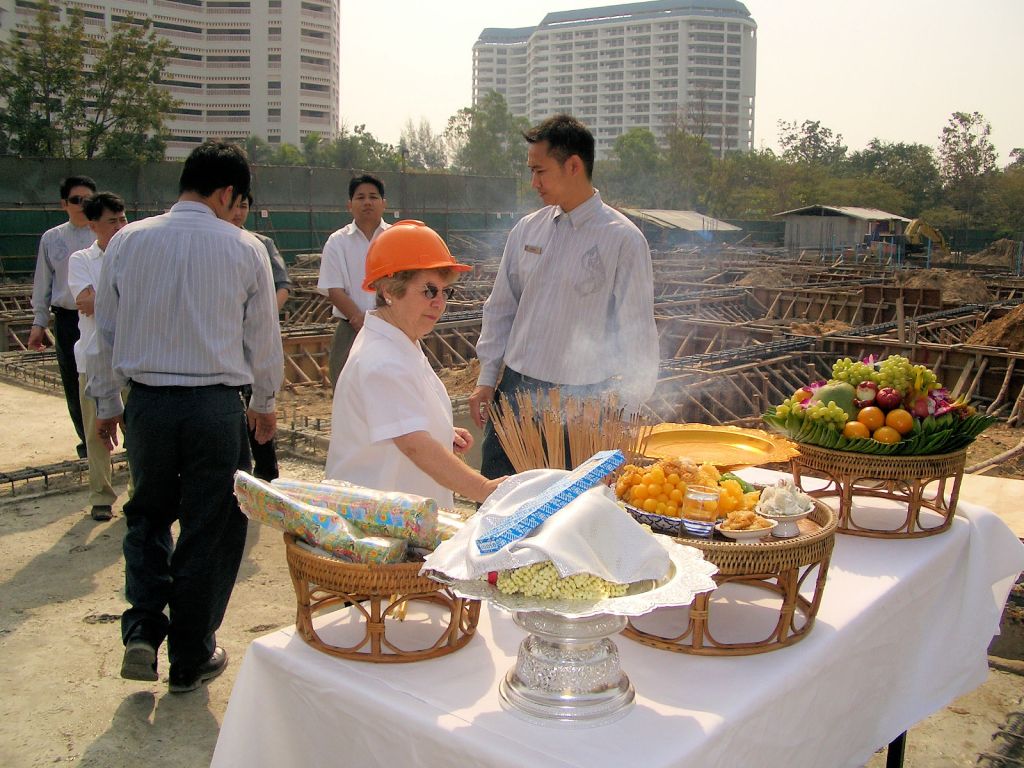
Hard hat area. The laying of foundations for a new dwelling cannot proceed until the spirits have been appeased for disturbing them – hence the feast laid out for them.
I packed a mini-library because English books – apart from a few places in Bangkok – weren’t easily available in Thailand in the seventies. As we both read voraciously we took as many as we could and swapped with other English-readers we met on our travels. In remote parts of the country we would often find books left in bars and cafes which could be exchanged for another one.
Apart from that, no preparations. Books, presents, tea-bags and biscuits, sweets and the duty-free booze from the airport, and we were prepped and ready for holiday.
After our friends had been to the spirit house at the airport and given thanks for our safe arrival, we would pile into a car/taxi/mini-bus /whatever they had arranged and head off either for Bangkok or Hua Hin, a two hour drive away. The next few days were spent relaxing, recovering from the flight and adjusting to the heat, then the discussion as to where we would go began.
Over the years we’ve covered the four corners of Thailand and seen things we’d never have seen if we’d been alone. From our base in Thailand we’ve made long trips to Cambodia, Laos, and Vietnam with contacts in each country lined up for us.
Our first trip was in 1972, the year of the major coup, and in that year we saw the two faces of Thai, the angry revolutionary and the quiet, peaceful one – both smiled. Politics are once again ugly in that country and I am sad about much of what is happening there. We don’t discuss the current situation much, my Thai friends and I, it’s a sensitive subject, and that too saddens me.
Before Thailand became our major holiday destination we travelled extensively in other parts of the world. We enjoyed every country we visited, but with Thailand it was love at first sight and it remains close to my heart.
I still have hopes of visiting again, to make and receive the wai as I join my hands together, smile, and say Sawasdee, Ka.