You may remember that when I wrote about the Serpotta Stuccoes, I mentioned that the Caravaggio masterpiece, Nativity with St. Francis and St. Lawrence, had been stolen from the altar of the Oratorio and that the replacement painting was not something one could really admire.
I was more than pleased, therefore, to read in The Guardian a few days ago, that there are hopes that the painting may be recovered soon as Italian investigators have received information that the painting, which was stolen in 1969, could be hidden in Switzerland. The head of Italy’s anti-mafia commission last Thursday said that the information came from a former mobster-turned-informant who revealed that it had once been held by Gaetano Badalamenti, a ‘capo di capo’ (boss of bosses). The informant told the mafia investigators that Badalamenti (who has since died in America where he had been convicted of heroin trafficking) had been in touch with an art dealer in Switzerland.
To have this masterpiece returned to the Oratorio of San Lorenzo would be something wondrous for the people of Palermo, as when the criminals stole the painting by cutting it from its frame with razorblades everyone presumed it was lost forever.
Rosy Bindi, the head of Italy’s anti-mafia commission, told The Guardian that they have collected enough evidence to launch a new investigation and to request the collaboration of foreign authorities, especially those in Switzerland.
Leoluca Orlando, mayor of Palermo, who has helped Palermo transform itself from a stronghold of the mafia to a European Capital of Culture, said that the city was no longer dominated by mobsters and godfathers, that it has changed and now demands the return of everything the mafia had stolen from it.
The return of this painting to the Oratorio will be an event to be celebrated throughout Sicily. I hope it happens soon.
Meantime, here are a few of the pictures of the 16th-century stuccoes from the Oratorio that I originally posted.
A town often overlooked in the Languedoc area is Pézenas, graced with elegant 17th and 18th-century houses of mellow, honey-coloured stone adorned with graceful, wrought iron balconies.
It was once the capital of Languedoc but lost that honour in the late 17th century although it continued to thrive as a trading centre for over 100 years afterwards: if you are there on a Saturday you should visit the market which hasn’t changed much since those days. It further declined as a trading hub when it was bypassed by the railways in the 19th century and became something of a backwater. This could be seen to have been to its benefit, however, as it has managed to preserve much of its charm from earlier days and to have escaped the ravages of over-development that have afflicted so many other French towns in the area.
During the town’s heyday, Pézenas was one of the favourite towns for the cosmopolitan elite to visit. Travelling players made regular stops here and provided the main entertainment of the day, one of whom, Jean Baptiste Poquelin, known to us as Molière, frequently made Pézanas his base.
Homage to Molière in the centre of the town
The famous playwright toured with a troupe of jobbing actors and in the process of acting and playwriting in Pézenas, he became the town’s favourite son. In fact, so popular was he that he acquired the patronage of the Prince of Conti, governor of Languedoc, at whose court in Pézenas they often performed.
At the Place Gambetta lies the heart of this medieval town and this is where Molière would spend much of his day chatting and drinking coffee in the cafes, and visiting the tradesmen in the square among whom he had many friends. Today, the square is a place of many delightful cafes and it gives one the chance to sit and relax while thinking about the famous resident, and maybe even reading some of his work which is available from many of the shops around.
As you wander through the old town you will sometimes find yourself in a different world, alleys lined with houses with chimneys, gables, arches, windows and doors dating from the 14th right up to the 19th century. It is here that you will find the medieval Jewish quarter, just one road where a few buildings carry a Jewish emblem. Jews were able to live quietly here, in an amicable relationship with their Christian neighbours despite having been expelled from France in 1394 under the orders of King Charles Vl. (When I was there a few years ago there was talk of a Jewish Museum being opened in the quarter).
A shop full of handmade wooden toys
Pézenas has a tradition of fine craftsmanship and you will find many craft shops on your walks through the town, from woodwork to stone carving. New crafts are well represented too in the form of boutique-style fashion shops where the designs range from quirky to haute couture.
The Tourist Office on Place des Etats du Languedoc is one of the most interesting I’ve ever come across, as it is contained, along with the town’s ancient prison, inside the Hôtel Peyrant on Place des Etats du Languedoc.
The Tourist Office
The building is interesting in its own right, once offering accommodation to aristocrats as well as prisoners. You can explore the old jail but to get the best out of a visit to the Hôtel, try to make time to see the wonderful Scenovision Moliere, a 3D show about the famous playwright that takes place over five acts, each performed in a different room of the building. Details herewith.
Scenovision Moliere
The 3D film show in French and English is presented on the upper floors of the tourist office. daily 9am-noon and 2-6pm Monday to Saturday (from 10am on Sun) with a break for lunch, with extended hours over the peak summer season with no lunch break. Adults €6: children €4: families €15
Pézenas Tourist Office, Hotel Peyrat, Place des Etats du Languedoc
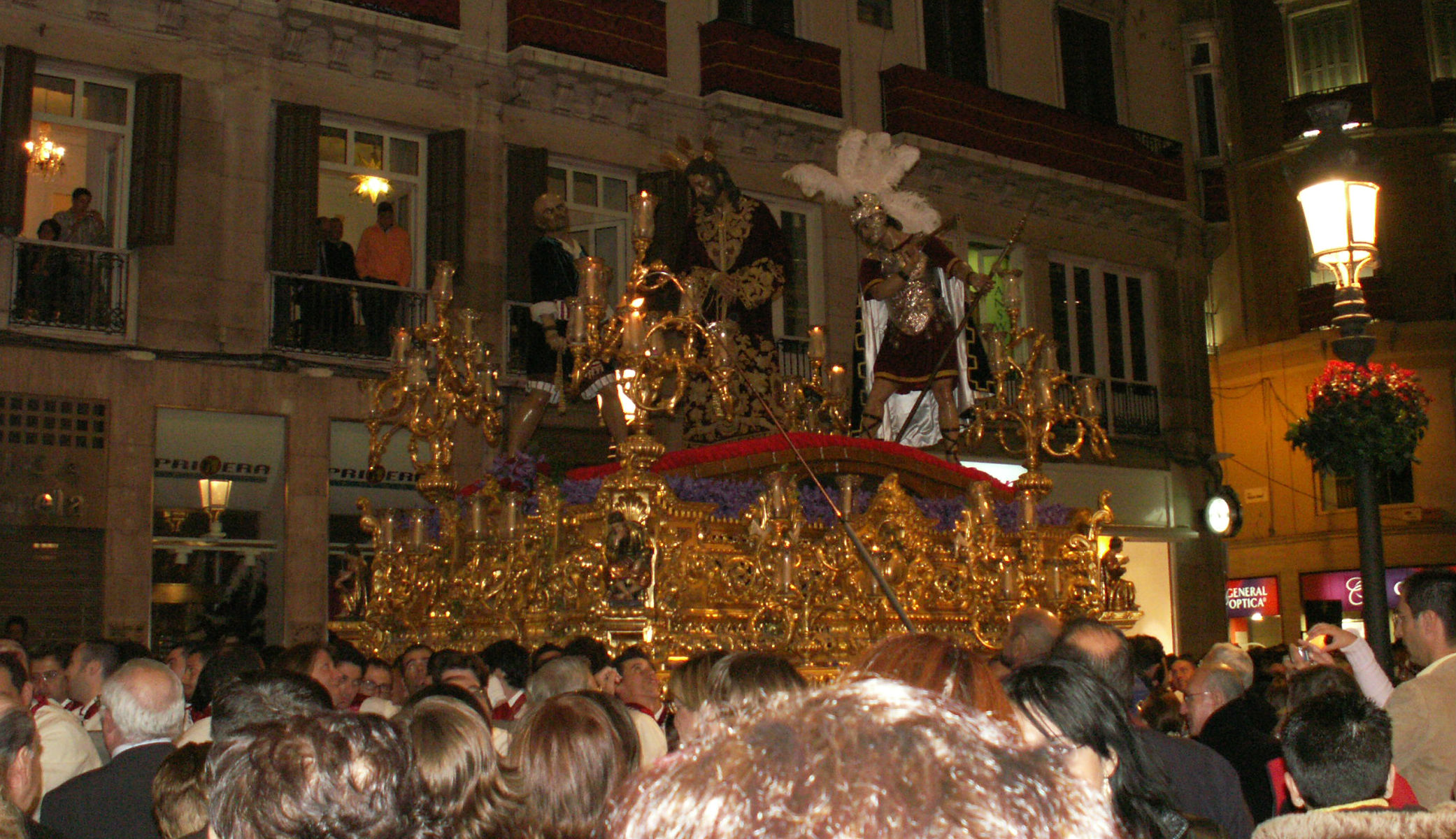
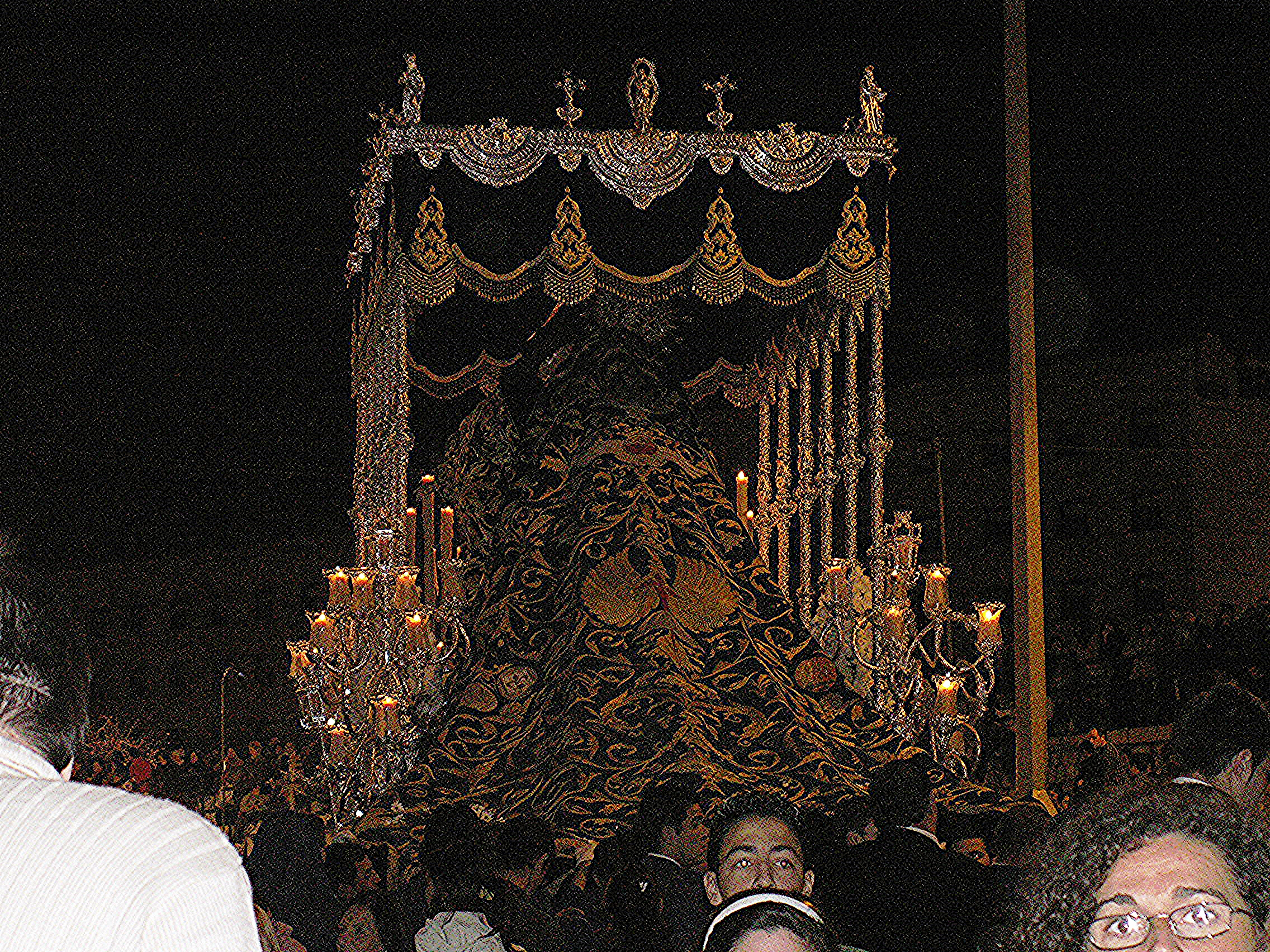
As Easter approaches, I am reminded of a visit to some Spanish friends in Malaga a few years ago when I joined in that city’s celebrations for Semana Santa (Holy Week), an unforgettable event. My photographs are not good, a combination of flashing lights, reflections, and crowded balconies and pavements: I apologise in advance.
Strictly speaking, Semana Santa is a religious festival, but with the solemnity comes carousing and fun, bars open until the early hours and entire families, from grandparents to babes in arms staying up until two and three in the morning. The two main Spanish cities in which to witness this extraordinary event are Seville and Malaga.
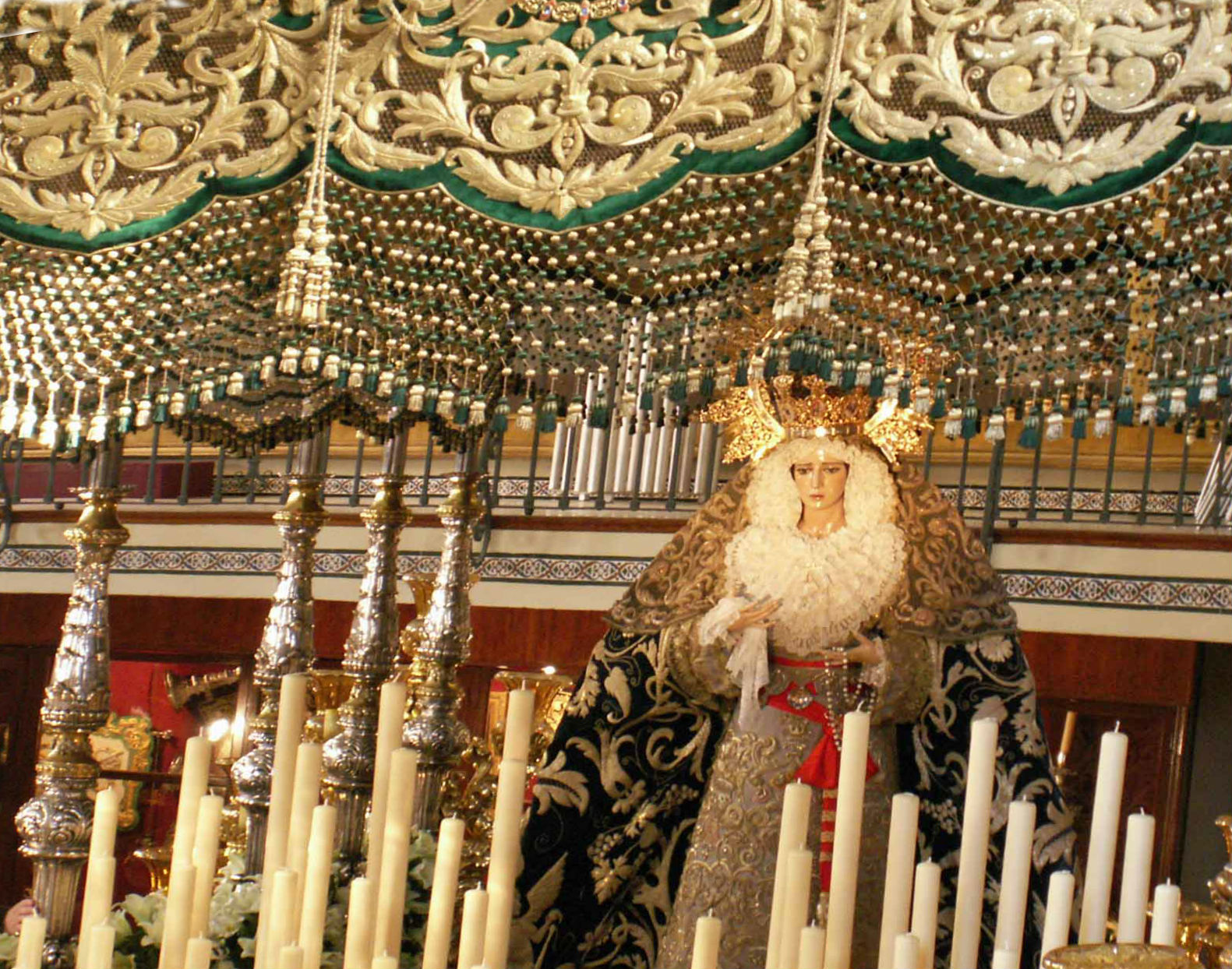
During Holy Week from early afternoon until well after midnight, elaborate floats – huge statues of the Virgin Mary and Christ swaying dangerously atop them – weave through the streets and alleys, carried on the shoulders of men called submarinos,hidden by the float’s draperies. They are accompanied by Brotherhoods and Penitents carrying candles and incense burners behind which come musicians playing hymns that have faint hints of flamenco. Good Friday is the climax.
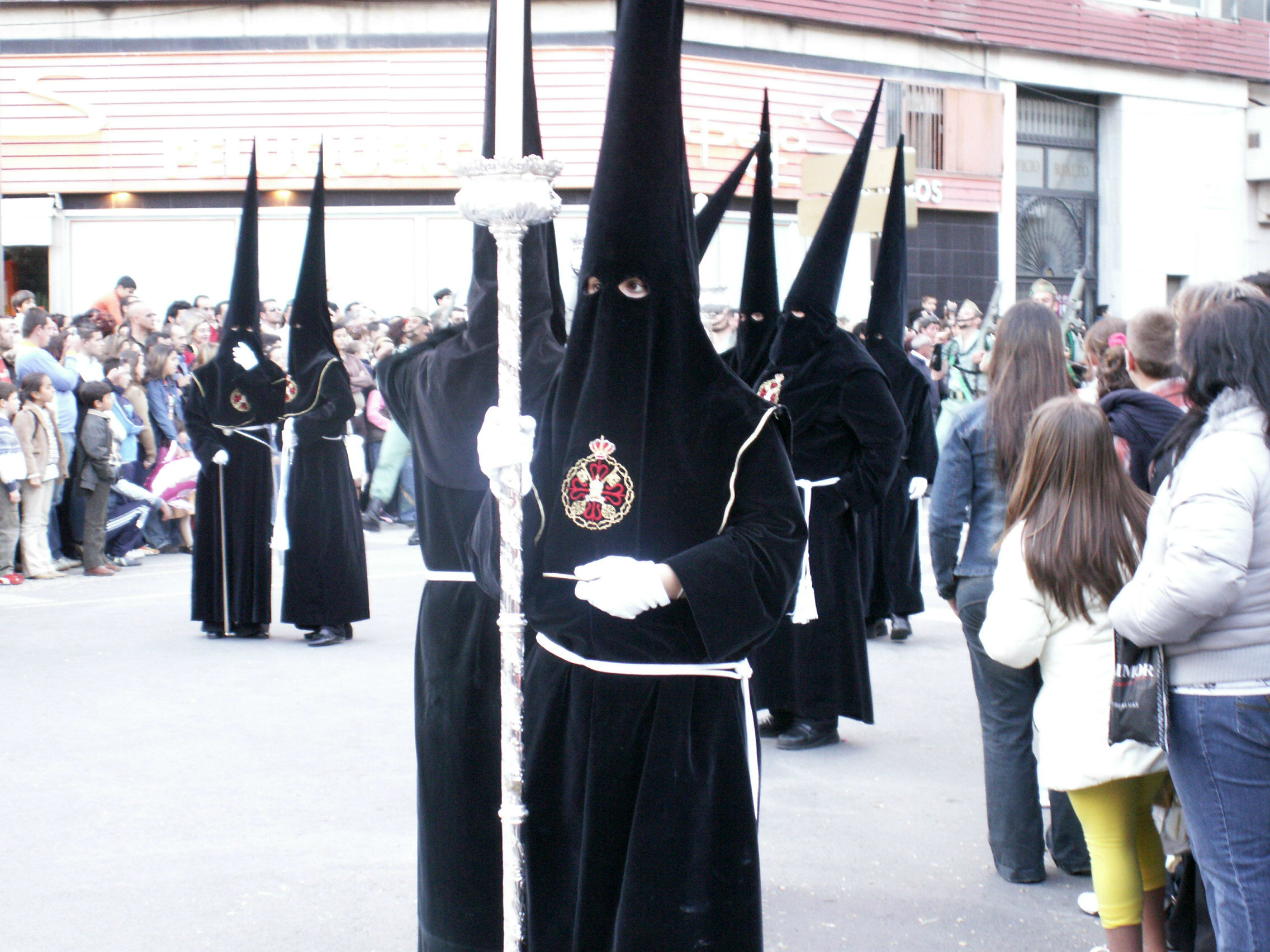
With its aroma of burning candles, the mournful trumpets, the menacing appearance of the penitents in their white robes and white pointed hats, towns and cities across the region are literally transformed.
My friends had booked a room in a hotel overlooking one of the streets down which the procession came. The reservation included food and wine which were replenished throughout the night (I told you there was fun as well) and the party continued well into the early hours of the morning.
A bell tolled to herald the approach of a wildly swaying float supporting a statue of the silver-crowned Virgin Mary with a dazzling blue velvet cloak richly embroidered in gold stretching some six metres behind her. Hundreds of wax candles surrounded the statue, illuminating the golden float, the somberly attired attendants, and the onlookers.
Among the Brotherhood members, whose honour it is to support and carry the floats which can weigh up to six tons, can often be found celebrities from the Spanish film and TV world, but they will be incognito, the submarinos who support the float from beneath a curtain which hides them from view. During my visit I was told that Antonio Banderas was one such submarino, as he is known to attend most years.
In the hotels that line the route, the partygoers rush to the balconies as the clanging of the bell and the dull thud of the drums announces the passing of the procession. On tiered seats in alleyways, streets and plazas, the rest of the onlookers wait patiently, as they have done for up to seven hours, children, round-eyed and excited by the occasion, grandmothers fingering their rosary beads.
Those participating, whether as devotees or spectators, are often visibly affected by the rhythms of the music, the swaying pace of the bearers, the wailing of the sacred saeta (not unlike flamenco) and the build-up of emotion brought about by the statues of tear-stained Christ and Madonna figures.
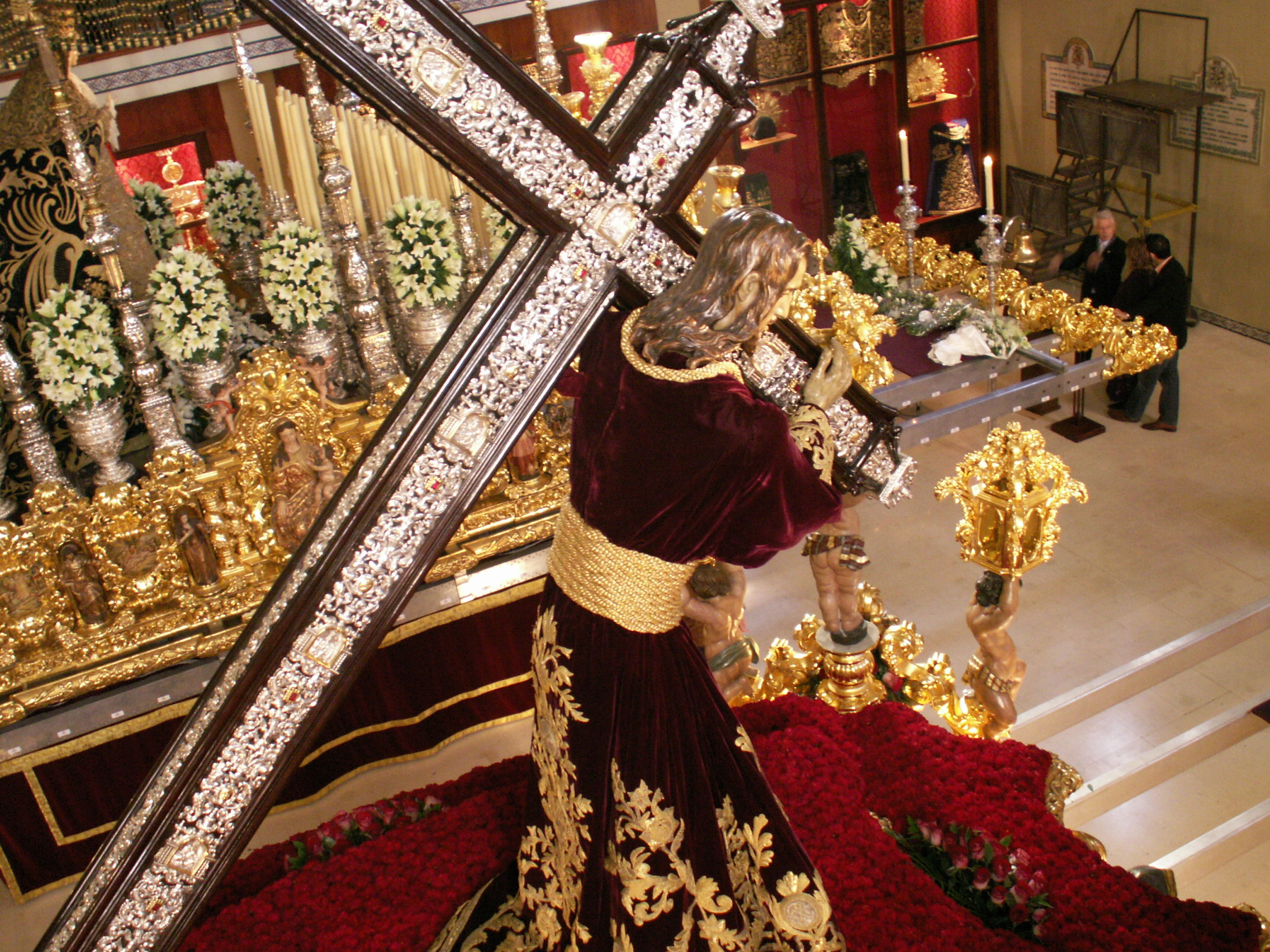
Again, the bell tolls, and on a golden float lit by the candles carried by penitents walking alongside it, is a life-size statue of Christ carrying his cross on the road to Calvary, light catching the lavish gold embroidery on his scarlet velvet robe and glittering from the silver cross he carried on his shoulder. The costeleros sway to the slow rhythmic beating of the drums and the wailing of a flamenco song. The real Christ was not dressed in velvet stitched with silver as he carried a plain wooden cross on the road to Calvary but such details can be ignored on this occasion when to dress the statue well is to honour Christ.
The Christ Tableau ready to leave the Chapel
Behind comes the Nazarenos, followers dressed in white or black hooded robes that cover the entire body, the headpiece a pointed hood with space for the eyes only, the whole scene reminiscent of a Klu Klux Klan convention. It could feel sinister were it not for the party atmosphere among the watching people.
Goya could have done justice to the scene in front of me, a scene where art and religion merged into one theatrical event reflecting the culture and spirit of the Spanish people.
It was an experience like no other I’d ever had. I must admit also, that there was a frisson of excitement, akin to apprehension, in that the floats swayed alarmingly in the narrow streets and I was fearful that the candles would catch the trappings on the tronos or the costumes of the penitents or Nazarenos.
In villages, towns and cities all over Spain – especially in Andalucía – processions take place from Palm Sunday to Good Friday. Religious beliefs are not needed for one to take part. To a visitor, it can be a fun-filled Fiesta or a week of reflection, but it will invariably be moving. The only thing to remember is to dress with respect, i.e. no tee shirts or shorts.
Seats should be booked early, either in a hotel with a view of the processions, or along the route of the procession.
SEMANA SANTAin 2018 Sunday, March 25th – Sunday, April 1st.
Palermo is this year’s Italian City of Culture. The city has stunning architecture, beautiful churches and art that is equal to that in many other parts of Italy, but for me, Palermo’s gem is the baroque Oratory of the Rosario in Santa Cita.
The Playful Putti
Tucked away in a back street of the capital, this exuberant masterpiece is often overlooked as one stumbles from one opulent Baroque creation to the next in this very theatrical city. The flamboyance is all inside the building, because the Oratory, by its nature, had to be simple. Perhaps that is why it is often missed by visitors to Palermo.
I first saw the Oratorio on the 1912 BBC series Unpacking Sicily, presented by art historian Andrew Graham-Dixon and chef Giorgio Locatelli. As the presenters walked us into a room whose walls were covered with sparkling white putti climbing and curling around pillars, playing with and teasing the allegorical statues I fell in love with the place. It seemed to me to be redolent of joy and happiness as the impossibly round and naked infants cavorted along the walls oblivious to saints or sinners.
Two allegorical figures sit ledges while all around are figures, faces, leaves, fruit.
Giacomo Serpotta (1652-1732) the Sicilian artist responsible for the interior of the Oratory was a sculptor of genius whose work in stucco* produced a very distinctive style. His work was already sited all over Palermo when he was commissioned in 1699 to transform the Oratorio and according to art historian Anthony Blunt, he was provided with an artistically complex iconographical plan for the oratory.
In his use of stucco, he created a new art form. Sacheverell Sitwell, who considered his female figures to be the equivalent of those in portraits by Gainsborough, states that the sculptor lifted a minor art “out of itself into an eminence of its own”.
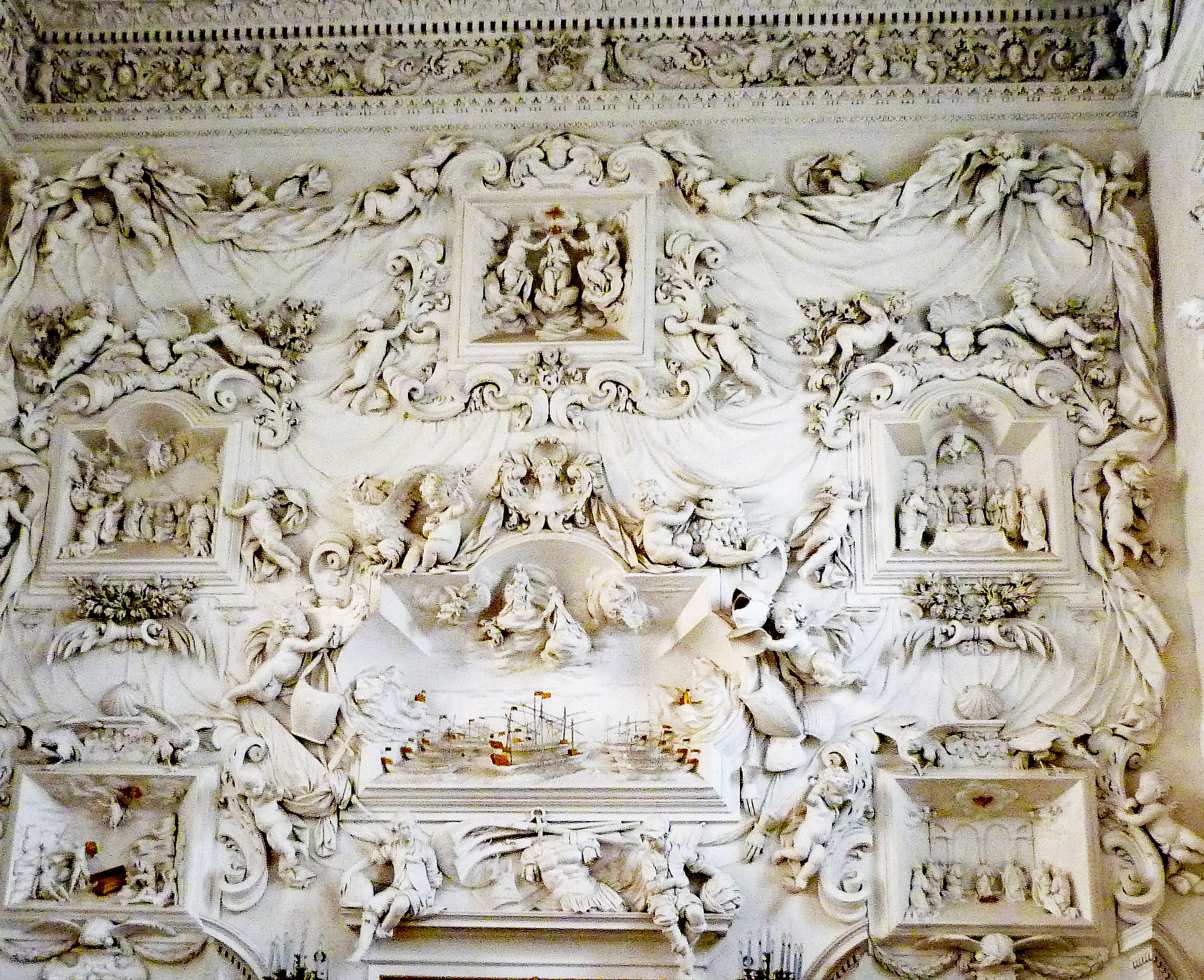
One of three Oratorios (the others being San Dominico and Santa Zita a few metres away) the Oratorio of San Lorenzo is a masterpiece of Sicilian Baroque. The artist worked on this interior between 1698 and 1710, and apart from the cavorting, mischievous cherubs, it features a series of 10 symbolic statues, plus panels detailing the lives of Christ, the lives of St. Francis and St. Lawrence, and one that tells the story of the Battle of Lepanto.
Of extraordinary elegance, white swathes of stucco supported by a swarm of putti flow over the walls; life-size allegorical figures sit casually on ledges as though at a picnic while cherubs play with the draperies of their skirts and blow kisses, and a cornucopia of fruit and flowers adds joy to the scenes.
The Battle of Lepanto panel. Below the ship sit two boys, one Christian and a victor, the other an Infidel and a loser in the battle, but they are alike in their sorrow.A less-happy trio of cherubs, one has already lost a foot, one is supporting him and one is crying.These could be today’s urchins from the streets around Palermo, clothes, stance, everything. In the middle the detritis of war.
The Battle of Lepanto is the panel in front of which people stand for a long time absorbing the detail of the battle, the virgin protecting the fleet, the stormy seas, and the two boys sitting on the edge of the panel, one Christian and one infidel, who resemble in every way – even down to their clothes – the street urchins one can still see playing in the streets of Palermo.
The 16th century Battle of Lepanto was the largest naval battle since antiquity and the last major engagement fought between more than 400 rowing vessels. A fleet of the Holy League, a coalition of European Catholic maritime states of which the Venetian and Spanish Empires were the main powers, inflicted a major defeat on the Ottoman Empire in the Gulf of Patras. Miguel de Cervantes, the author of Don Quixote, was one of those injured in the battle.
I think it fair to say that Serpotta displays in this work, an anti-war sentiment, or if not anti-war then a compassion for the enemy unusual at that time.
In 2015 a rather poor digital copy of the altarpiece was placed in the vacant space but it cannot be considered even a good copy.
And now I’ll let the pictures fill in the gaps.
This slideshow requires JavaScript.
*Stucco: The artist first constructed a model using frames of wood, wire and rags, held together by sand and lime. Over the model a mix of lime and plaster was applied, to which marble dust was added to achieve the smooth surface glaze, This was the invention that lifted Stucco to a higher level and Giacomo Serpotta is credited with creating an original technique that imparted to his work a lustre, not unlike that of stone or marble. Great skill and dexterity were needed as plaster mix dried very quickly but it was valued as it allows the artist not only to build up forms but to carve into them as well.
Address: Via Immacolatella, 90133, Palermo. Tel: 0921 582370
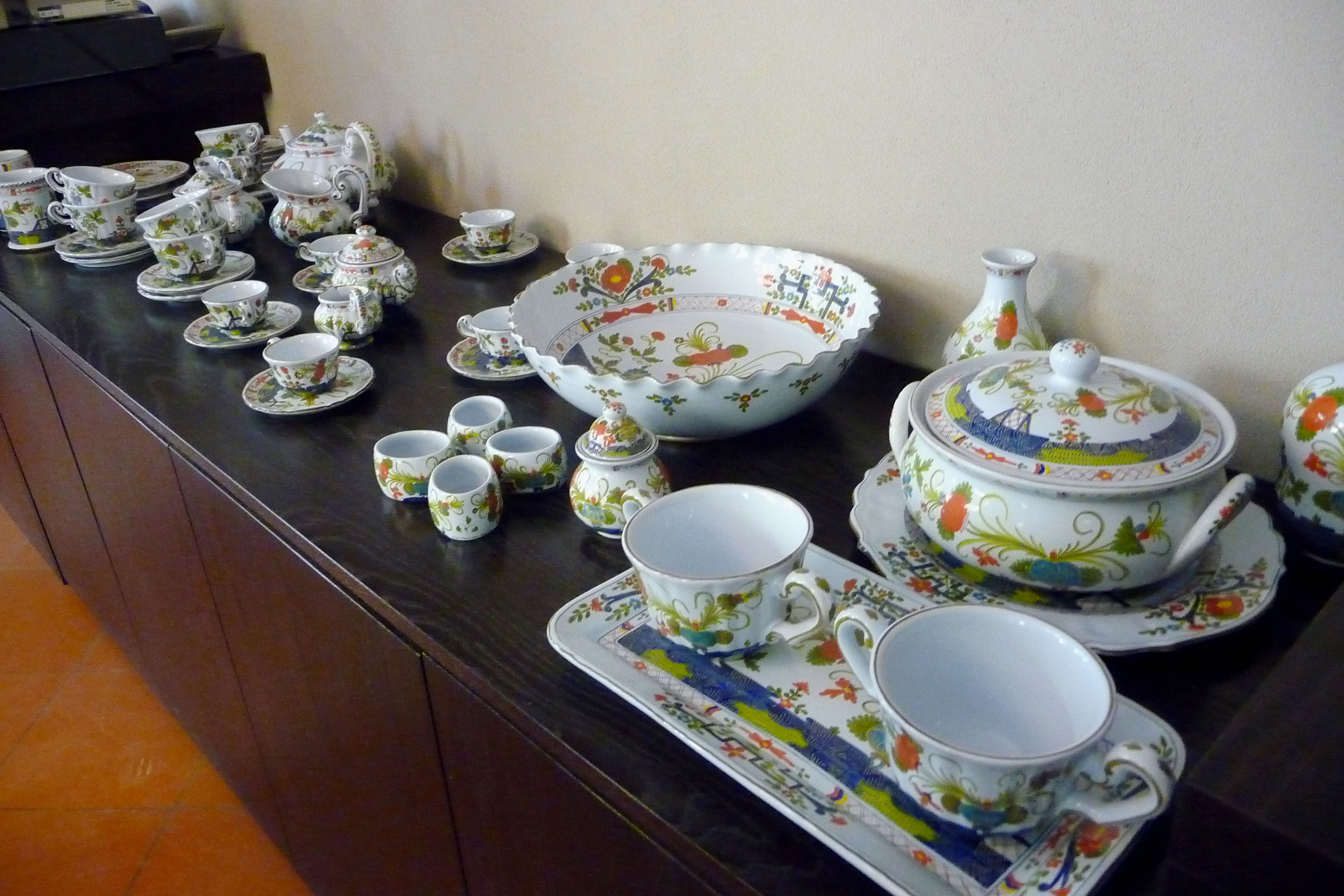
Becky’s lovely Tavira vase post reminded me of the beautiful ceramics we saw a few years ago on a trip to Faenza in Italy, the town between Bologna and Florence which produces work of great originality from old, traditional, designs and occasional new designs. These ceramics go by different names, depending on who is speaking about them: sometimes they are called Majolica ware, and sometimes they are called Faience, the French word for the ceramic, and the word from which the town derives its name.
Faenza has been a flourishing city from the 2nd century AD; from the 11th century it started to really expand and grow and by the Renaissance period it had reached its peak, thanks to good relations with nearby Florence, the centre of Italian artistic life. The city we see today with fine Renaissance architecture and Neo-classical monuments is a testament to this period of prosperity and growth.
Faenza majolica was born here because the land was rich in the type of clay needed for the production of fine pottery and because the inhabitants were able to mould the clay into beautiful objects. Over the years the craftsmen absorbed the knowledge flowing from Florence and became experts in shape and line as they perfected the pottery and became artists.
Crowns are one of the most popular objects and are very traditional
Majolica is terracotta clay, glazed with powder and water which makes the object waterproof and gives it a high gloss surface on which traditional designs are painted. Sometimes the object is fired twice to give it strength and sometimes it is baked in a plaster cast which is then broken to expose the piece.
The designs are etched on to the glaze, or sometimes the object is covered in paper on which pin-pricks are made, after which black coal-dust is used to stamp the lines through the pin-pricks – a form of stencilling. Precious metals are also used and this makes the object more expensive, of course, as gold, silver and platinum need 3 firings and to be heated to 750 degrees.
This set is given to a woman when she gives birth. It is for her first meal and includes a soup-bowl, egg-cups, plates, teapot etc.
This is the sign for the oldest workshop in Faenza
In September and October international contemporary and classical ceramic art events draw majolica amateurs, collectors and artists to Faenza from all over the world.
The ‘silver’ stripe is actually platinum and the vase was priced at €1,400.
The ceramics alone make the trip to Faenza worthwhile and there are over 50 workshops most of which welcome visitors – look for the signs outside the shops (see one above).
However, Faenza is also a town of outstanding artistic and architectural features, two beautiful squares in Renaissance style, elegant arcaded streets, palaces, a 15th-century cathedral and an 18th-century theatre add to the aesthetic enjoyment while the food is superb.
Not to be missed: The magnificent Museo Internazionale delle Ceramiche in Faenza has some of the world’s most beautiful pieces of majolica from every epoch and from all over the world, including a section dedicated to pottery from the Renaissance period.
Most items here are expensive. For example, the animal skin ceramic tea set was €400.
FOOTNOTE=
A ‘Majolica line’ can be traced from Faenza to the UK, through the centuries right up to the nineteenth when the technique of tin and lead glazing was further developed in London and Brighton before moving to Stoke-on-Trent, Staffordshire. Herbert Minton’s porcelain factory in Stoke on Trent was already quite famous when, Leon Arnoux, the great French ceramic chemist joined it in 1841 to help regenerate the production of lead-glazed pottery based on Renaissance designs.
These early pieces were destined for English gardens as the lead glaze protected urns, fountains, garden seats and ornaments from the English weather. Minton then used the same process for their fast-growing trade in culinary dishes, each piece descriptive of the food that would be served on it, oyster plates, fish platters crab, lobster and sardine boxes, and game dishes showing rabbit, partridge, pheasant and quail.
(I have seen references to the effect that the word Majolica refers to the fact that the goods were first exported to Majorca and then re-imported, It seems plausible but I haven’t been able to ascertain that this is, in fact, where the word came from).
My one and only balloon trip was over the vineyards of Rioja and the town of Lograno in Northern Spain. It was both exhilarating and exciting but I’m not sure I would do it again! It was dark when we got to the spot and dawn was just breaking when we took off – it was magical, wonderful, and a time I shall always remember.
Here are a few photographs of the Ascent.
I apologise to the readers, I cannot get rid of the white space between two of the photographs. I shall have to work on this and try and re-edit.
Righting the Balloon
It’s scary when the flame goes Whoosh (Is she praying, by the way?)
I may look calm ……A Pink DawnHigh Above the CloudsRioja’s vineyards
One of the prettiest towns on Lake Orta, it charms with its pebble-studded lanes and stepped alleys branching off from Piazza Motta, the long narrow street behind the lakeshore with its wonderful selection of traditional food shops. Rising high above it is the Monte Sacro (Sacred Mountain), a destination for pilgrims who come to pray at the many chapels on the hill.
Sitting facing the waters of the lake, shaded by chestnut trees and serenaded by the birds, I drank in the panoramic view of the tiny, but beautiful, Island of San Giulio which sits in the middle of the lake (which I had visited the previous day) and wondered if this perhaps, wasn’t the most beautiful spot along the lakes.
The town is a typical Italian town, narrow streets lined with ochre-coloured houses from which jutted wrought-iron balconies hung with geraniums and ferns. The buildings date mainly from the 17th and 18th century but behind the main square, Piazza Motta, there are some dating back to medieval times. These you will see if you make the climb up to the parish church of Santa Maria Assunta and to the SacroMonte.
There are small baroque palaces here and there with open galleries, pergolas and flower-filled balconies as well as hidden courtyards behind wrought-iron gates through which can be glimpsed lush vegetation. On the corner of the square stands the little Palazzo della Comunita which bears the coat of arms of the lake communities that took part in its construction in the 11th century.
I have to confess that I didn’t make the trip to the top of the hill to visit the Santa Maria Assunta church. The pebble-stoned pavements were very difficult to walk on, but when I got halfway up and turned to look around, my old friend vertigo decided to pay me a visit and I was halted in my steps and had to be helped down again! Luckily, my friend and fellow-traveller, Solange Hando, was able to continue to the top and she has kindly allowed me to use some of the photographs she took from the top.
Very Steep pebbled stoned street from Sacro Monte
The Sacro Monte’s most important building is the Sanctuary which is made up of 20 chapels built between 1591 and 1757, differing in style but blending well into the natural surroundings. Originally it was intended to erect 30 chapels which would narrate the life of St. Francis of Assisi, but in the end only 20 were built. The interior of the chapels are decorated with frescoes and sculptures most of which are the work of the early 17th century Milanese painters, Giovanni Battista, Giovanni Mauro della Rovere, Giovanni d’Enrico, and the sculptor Christoforo Prestinari. In all, there are estimated to be 900 frescoes in the complex.
Church of Santa Maria Assunta
I was sorry not to have seen these frescoes and to have missed walking in the tranquillity of this remarkable site, but perhaps another year I may have more luck.
Meantime, here are some photographs of this beautiful town, and the food shops piled high with mushrooms of every type, truffles, olive oils, balsamic vinegars (I saw one priced at over £100), and breads of every shape and taste.
I went to Cremona last winter and two things from that trip I remember clearly: one was how cold it was, so cold that I had to buy a woollen hat from a street trader who charged me an outrageous €20 for a very inferior product: the second, but most important, was my meeting with violin maker, Stefano Conia, a master luthier, an intense young man who makes violins with passion, violins that are bought and played by some of the world’s finest musicians.
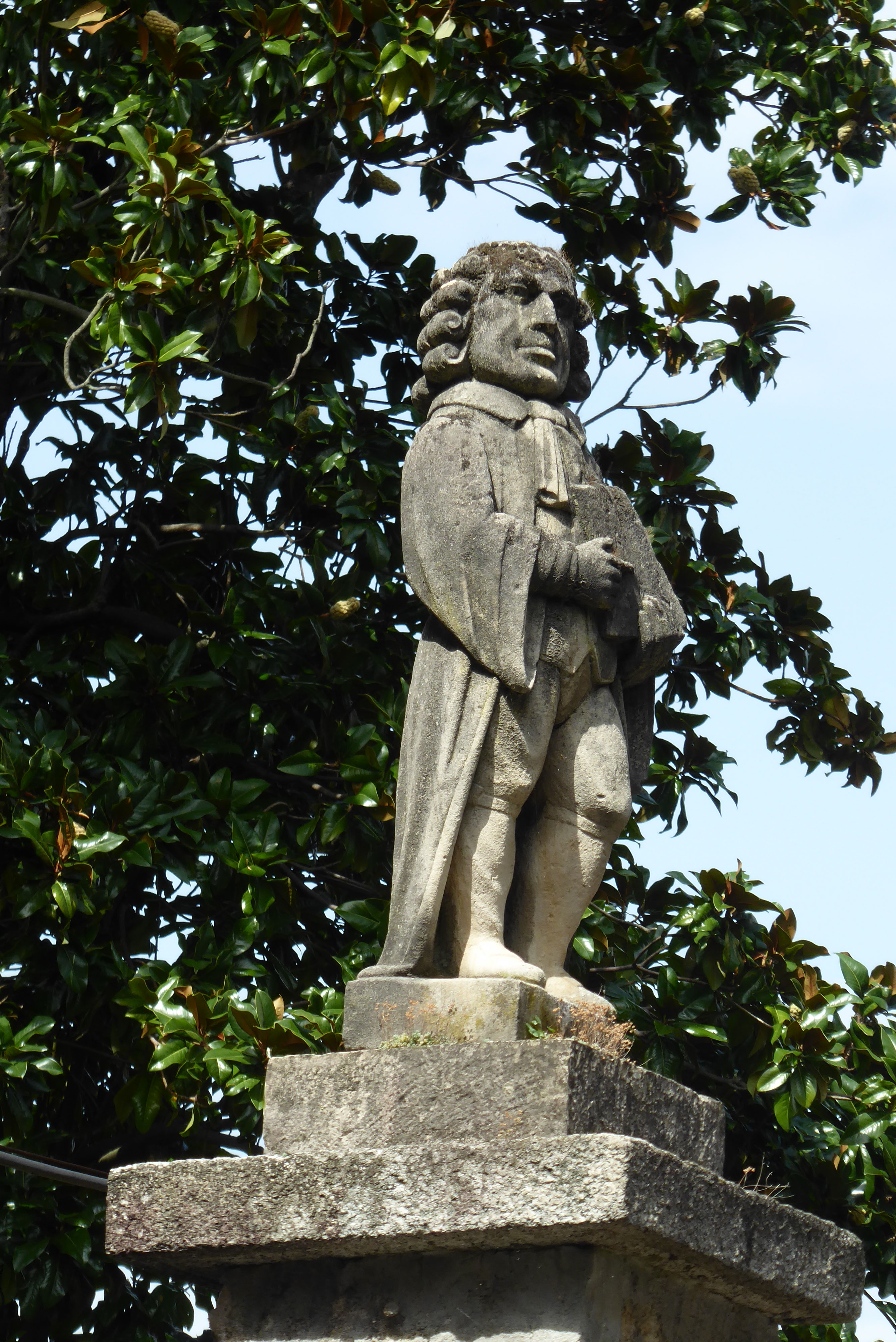
Cremona has been important in Italy’s cultural life since Roman times, located as it is on the banks of the Po River, a major junction for trade and commerce. The narrow streets of the city are rich in history, the red brick medieval towers and the Renaissance buildings shading the many statues of its famous sons, Antonio Stradivari and Claudio Monteverdi.
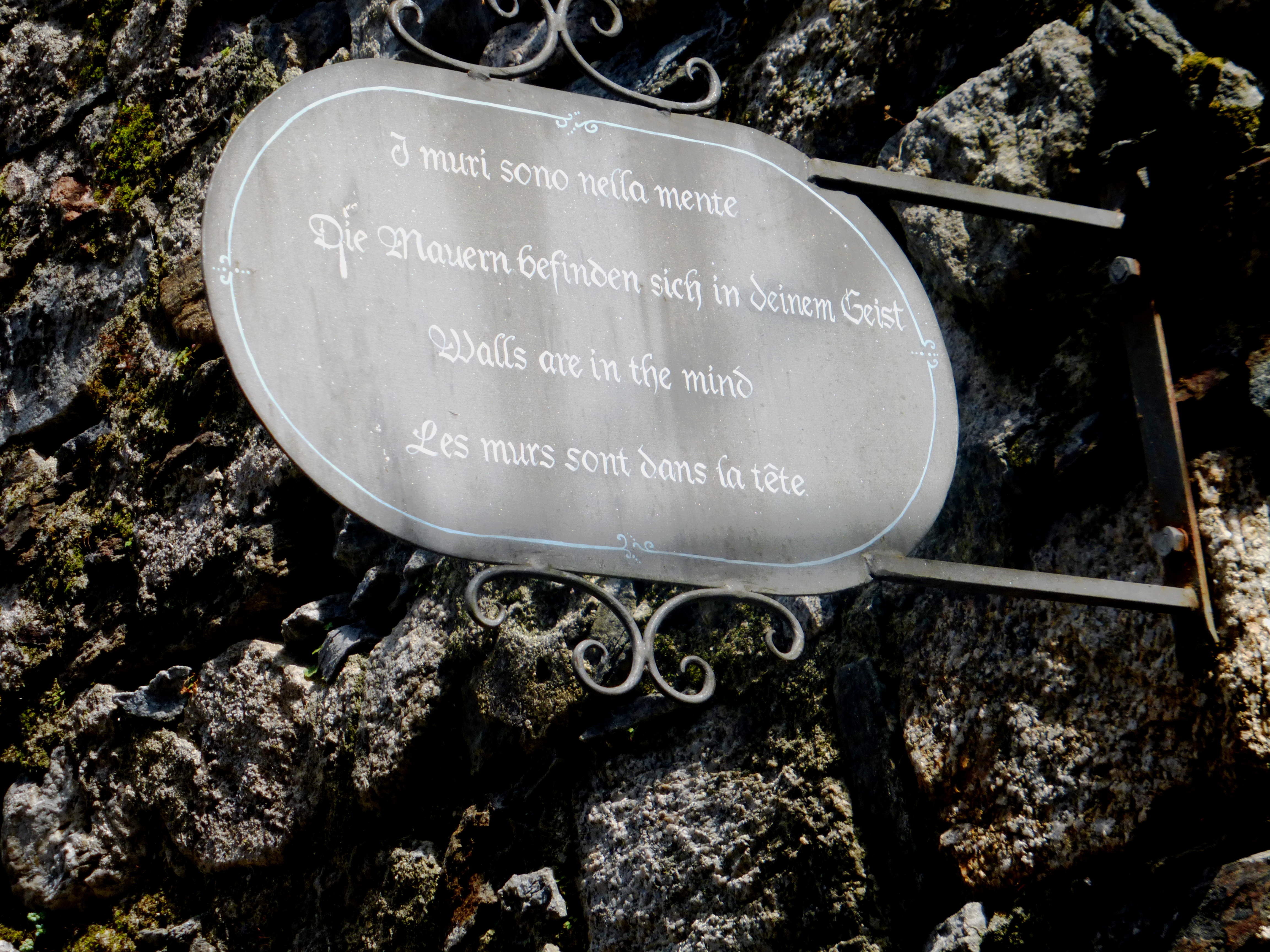
It’s not a walk around Lake Orta, but rather a walk around the small Isola San Giulio (St. Julius’s island) a short boat ride from the town of the same name on the lake. I have to confess it’s not up there with Jo’s Monday Walk, as it takes no more than ten minutes to walk around the entire island. That said, I spent forty minutes on the walk as I stopped often to listen to the sounds and to think about the words printed on plaques high up on the walls in phrases like “Listen to the silence” and “The Walls are in your Mind”.
Lake Orta is one of the prettiest lakes in Northern Italy, as far from the touristy Lake Como as it’s possible to be, and San Giulio is possibly the prettiest town on the lake. It is named after St. Giulio who is credited with expelling snakes and dragons from the island when he arrived in 390 AD (via a raft miraculously made from his cloak) in order that he could build his 100th church there. The Basilica one sees today is dedicated to him and was built on that same site in the ninth century.
Isola San Giulio taken from a hill opposite by Solange Hando
Today as one approaches the island, one sees a cluster of buildings built right at the edge of the water, private residences now but once the homes of priests who lived on the island. Inside this ring of villas is the basilica and a Benedictine Abbey where 70 nuns dedicate themselves to silent contemplation and prayer. In a world without words, they go about their work of repairing ecclesiastical garments.
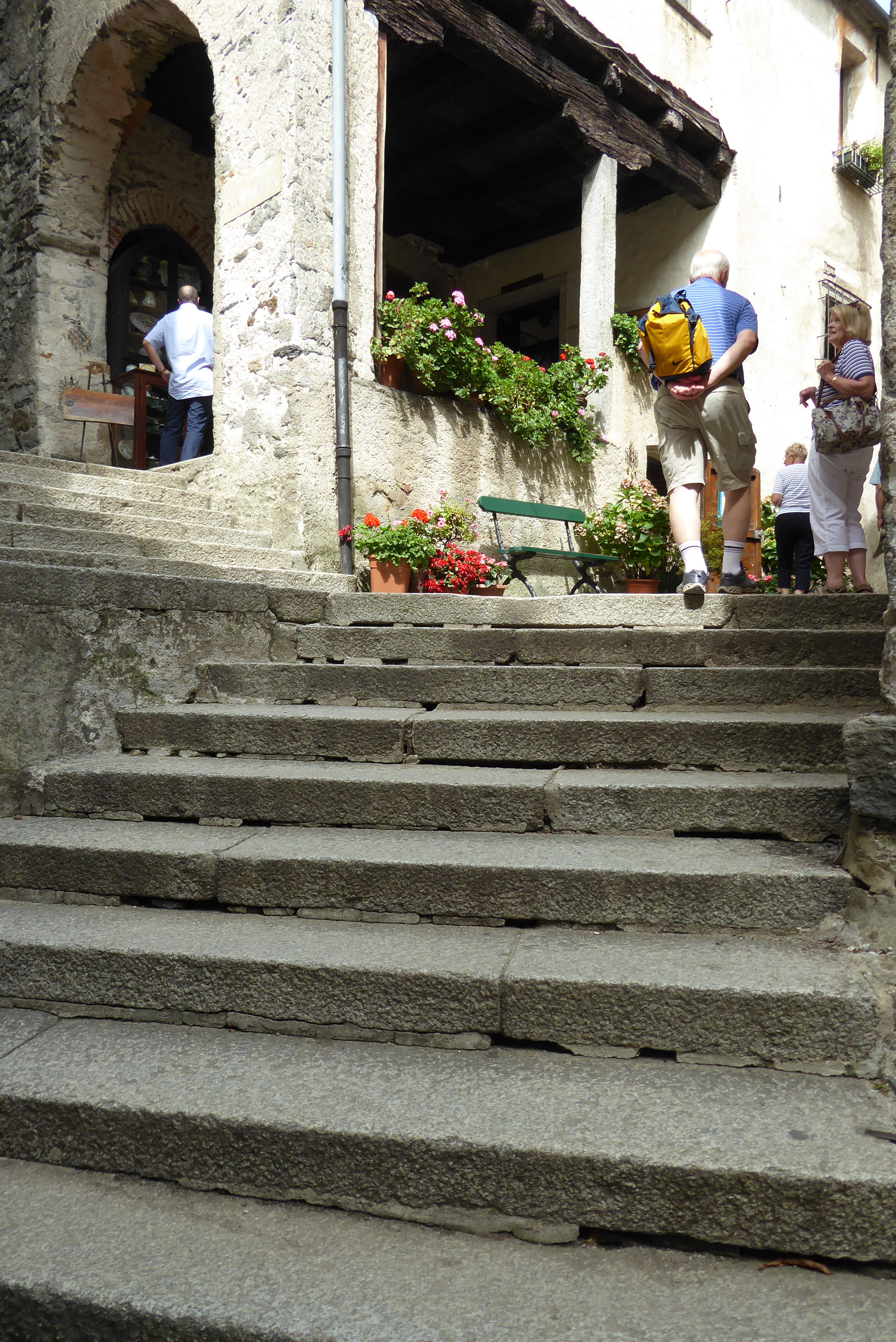
The entrance to the area is through a small arched doorway at the top of a set of stone steps and once through this one is faced with the Romanesque basilica which contains a feast of frescoes and sculpture.
Sometimes called The Way of Silence, other times The Walk of Meditation, it is a cobble-stoned alleyway that circles the island, enclosed by towering grey stone walls topped with green ferny plants that reach for the sky. From the walls project ornamental signs in four languages, one side of which instructs you to listen out for particular sounds while the other side lays down inspirational advice – ‘Listen to the water, the wind, your steps’.
My interest was in the walk, however, so I didn’t spend much time in the church but hurried outside to the cool path that curved around the island, shaded by the buildings on one side and the outer wall of the monastery grounds on the other. There were visitors aplenty on the walk, most observing silence, but there were pockets of noise from one or two groups who didn’t keep to the spirit of the place. There was no discernible movement behind the windows overlooking the path so no doubt the nuns are used to a certain amount of noise.
I completed the loop in about 20 minutes by meandering rather slowly and absorbing the ambience. There are no benches or seats along the way on which to rest which seems a pity, not because I felt tired, but because I felt it would have added to the experience to be able to sit and meditate for a few minutes in these very special surroundings.
Having reached the end, I turned and walked back along the “Way of Meditation” in order to read the words from the other side of the plaques: then I exited through the arched door to board the boat that would take me back to the town of San Giulio for a much-needed café e gelato!
Before I left the island I sat on a boulder overlooking the sea and listened to the silence, a silence only slightly disturbed by the lapping of the waves, the wind sighing in the trees and in the distance, the phut-phut of a motor-boat. I tried to imagine what it would be like to sit here as dawn broke over the lake and the mist rose from the shoreline opposite. The nuns sing Matins every day at 4.30 and in my mind I heard the sound of music drifting from the Abbey as day broke, and I promised myself that I would return one day to experience this moment.
There are a few rooms available and the Abbey welcomes visitors seeking a retreat from the world.
The round-trip fare is 5.50 Euros and the boats shuttle across the bay all day.
Lake Como has always been a fashionable resort but never so much as now when its permanent residents include George Clooney and his wife, Amal Alamuddin Clooney. Before this, the most famous residents were probably, Pliney the Elder and Pliney the Younger. And the Italian Lakes, of which Como is but one, offers visitors some of the most beautiful scenery in Italy.
I can see why the Clooneys chose to make Como their home. Apart from the beauty of its setting – green hills running down to the blue waters of the villa-rimmed lake, just yards from the historic centre, it has the charm of a small town while actually being a large city, a city that has easy access to mountain walks, ski-slopes and plateau parks. It has excellent transport connections (30 minutes to Milan by train), just a few miles from the Swiss border, and ferries and buses service the lake front.
The City Walls of Como with Gateway
Because of its lake, it is often overlooked that Como is actually a walled city and around which can be found a huge daily market selling everything from leather bags to lentils.
Market Beneath the City Walls
As in any large Italian town, the most important sight is the Duomo, an imposing cathedral built over a period of several centuries, from 1396 through to 1740, Although the façade dates from the 15th century and the dome was designed in the 18th century, the main influences are chiefly Renaissance and Gothic.
The Duomo, Como
Having seen the Duomo – and it is worth seeing – there are many more churches, museums and architectural gems to check out, too many to list all here, but I would especially recommend the Boletto, the unusual striped-marble building which stands next to the Duomo and which is Como’s 13th century town hall, the 10th century Basilica di San Fedele and the Porta Vittoria, the tall stone gateway defending the old town walls.
Readers of Battery Connections (marketed by publisher Don Cleary) should head for The Tempio Voltiano where they can spend many happy hours browsing the exhibits. This unusual Museum is dedicated to Alessandro Volta, after whom the volt was named, and contains much of his working equipment – a truly unique place.
Como is known for its grand buildings, like 18th-century Villa Olmo, Villa del Grumello, and
Villa Sucota on the waterfront and, of course, the long-established, elegant resort of Bellagio, the small village between the two southern branches of Lake Como with a population of only 200. It’s an excellent place to spend a relaxing day, with gardens, lovely views, upmarket boutiques, lots of restaurants and bars. But be warned, it is probably the most expensive spot along the lakes!
But sight-seeing can be hard on the feet and that’s where the boat trip comes in. The regular service of Navigazione Lago di Como steamboat company will take you around the lake, with stop-offs at Cernobbio, Moltrasio, Torno and Blevio. Cernobbio is a charming tourist resort on the shores of the lake and along its banks, there are some beautiful villas, including Villa d’Este and Villa Erba, Villa Bernasconi and Villa Pizzo. The two to see are Villa Erba and Villa d’Este, the former an architectural gem built at the end of the nineteenth century and today important as an exhibition centre, the latter now the famous luxury hotel of world renown.
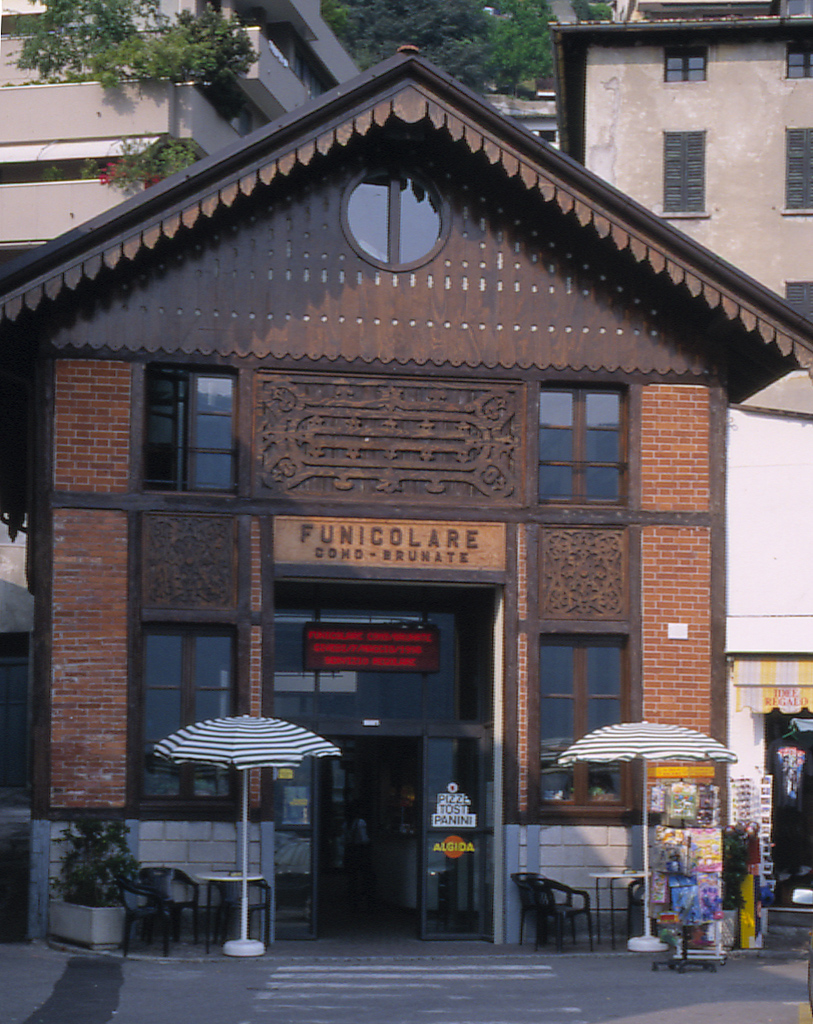
But my favourite is always to head for the mountains where possible, and all along the lakes, this is very possible. In Como, the funicular railway that opened in 1894, is in Piazza De Gasperi and you can’t miss it. It is a red, half-timbered house with carved woodwork trimmings: once through the gate, you are faced with a platform with one of the steepest inclines I’ve ever seen.
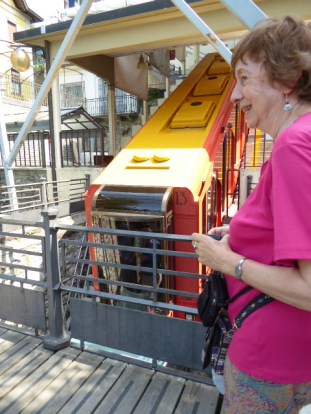
The cable-car is listed as ‘unmanned’ but fear not, this just means that the operator doesn’t actually ride on the car but is still in control over the external engine that drives it. The Funicular ascends through a tunnel that gives way to an open line above ground. Halfway up you meet an identical car coming down.
The Liberty-style houses on top of the hill, 750 metres above Como, are mainly summer homes for wealthy families fleeing from the heat of north Italian cities. During the winter months, when a thick carpet of snow covers the mountains, there are few permanent residents. There is a restaurant, a café, and a souvenir shop but you won’t have come here to shop but to take in the views which are stunning. On a clear day you can see the lake, the city of Como and the outline of its historic centre, the antique Roman castrum, neighbouring towns Tavernola and Cernobbio, the Alps and the Brianza plain. In the mosaic of my photographs taken from 750 metres above the lake, (below) you can see the Duomo in the middle of the town, its copper copula now verdegrised, glinting in the sunlight.
Above mosaic of pictures taken from the viewpoint at Brunate.
Once you’ve admired the views and stocked up with water, there are quite a few hiking trails around Brunate. A popular one is a 30-minute walk to the Volta Lighthouse, and the trails are well sigh-posted.
On the return journey, you will find most people crowding the front cabins to take selfies as they make the steep descent. I think it’s better not to fight for space and just to enjoy the trip and the magnificent views.
And at the end of the day, I decided this was the most enjoyable thing I had done in Como – and that included the two ice-creams I’d had!














 Statue of Claudio Monteverdi, in…









 MARI'S TRAVELS WITH HER CAMERA