END OF SPRING, BEGINNING OF SUMMER
Linked to Debbie’s Six Word Saturday

END OF SPRING, BEGINNING OF SUMMER
Linked to Debbie’s Six Word Saturday
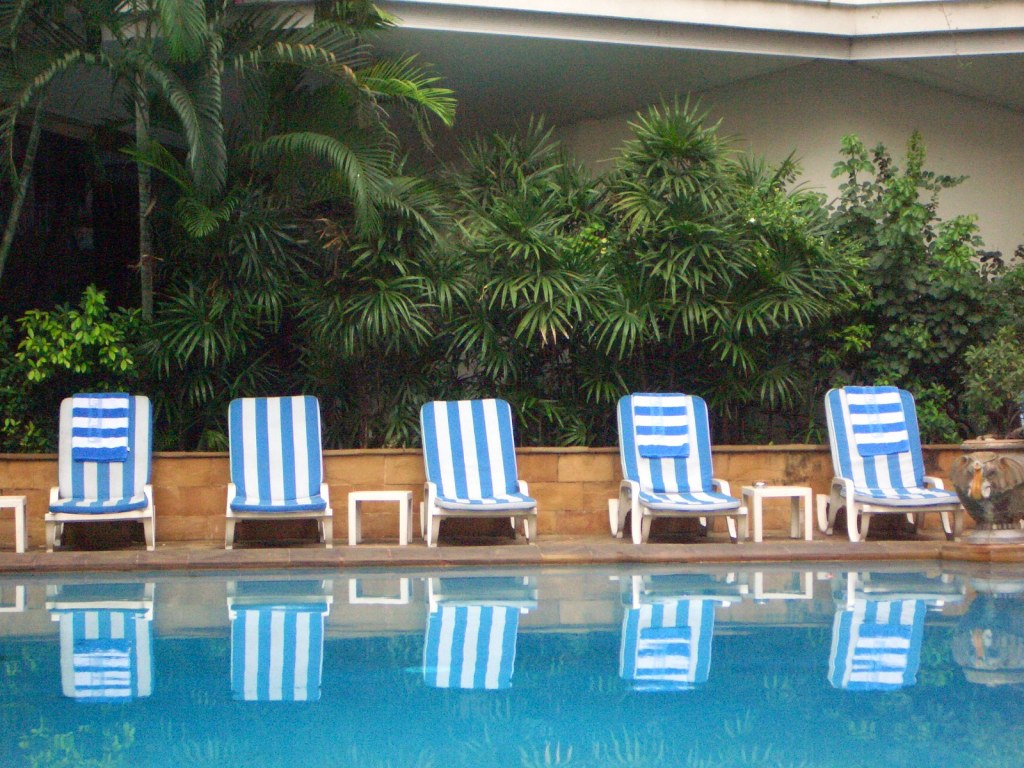
This week’s theme from Debbie for One Word Sunday is BLUE and it has been a more difficult challenge. Although I have lots of blue skies and blue waters, I was hard put to find pictures that showed a blue theme. I managed in the end and it was good for me to re-visit photos I haven’t looked at for some time, even if I did spend too long in a nostalgic wander through the past!


This week’s theme from Debbie for One Word Sunday is BLUE
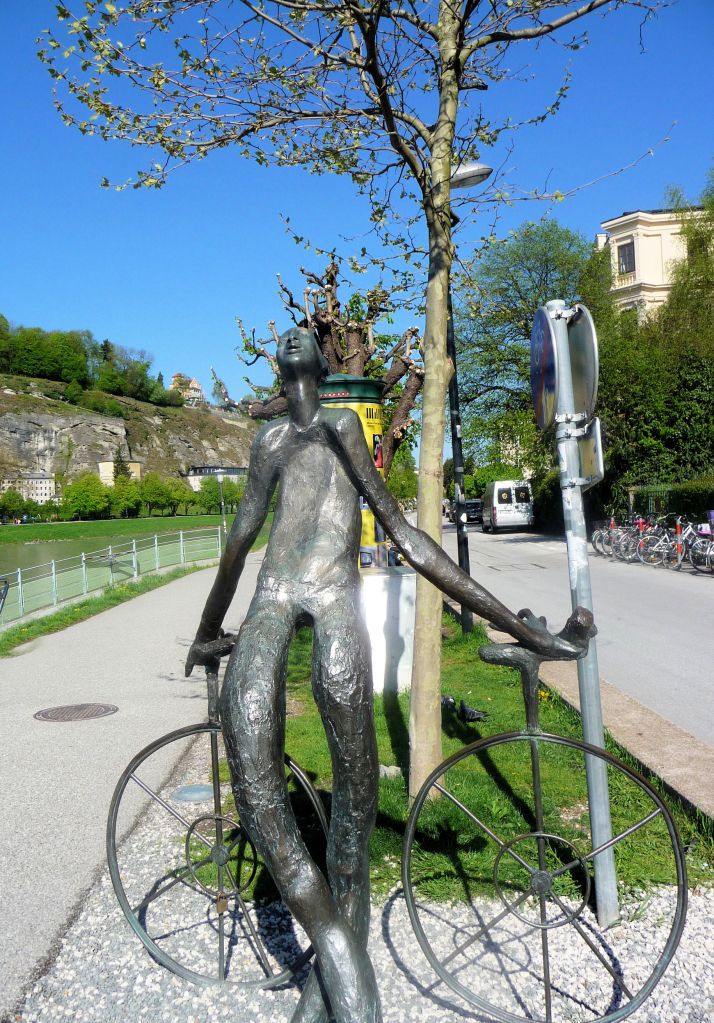
I loved the statue but I committed one of the biggest sins in photography by not managing to cut out the post on the right which makes it look as though my cyclist is holding it up. My photoshop skills aren’t up to removing it either!
Link to Sculpture Saturday


After too long an absence from WP due to health problems, I was struggling to find a subject to write about, or more exactly, a place to write about. Travel’ to me has always been about places away from home, so local sights didn’t inspire me.
Then along came US President, Joe Biden, who, last week visited Carlingford in Co. Louth, Ireland, and my memory flew back to my day spent there on a Leprechaun hunt way back in the late nineties. My photographs are quite old and the place may have changed in the intervening years but I have been told that the changes are minor.
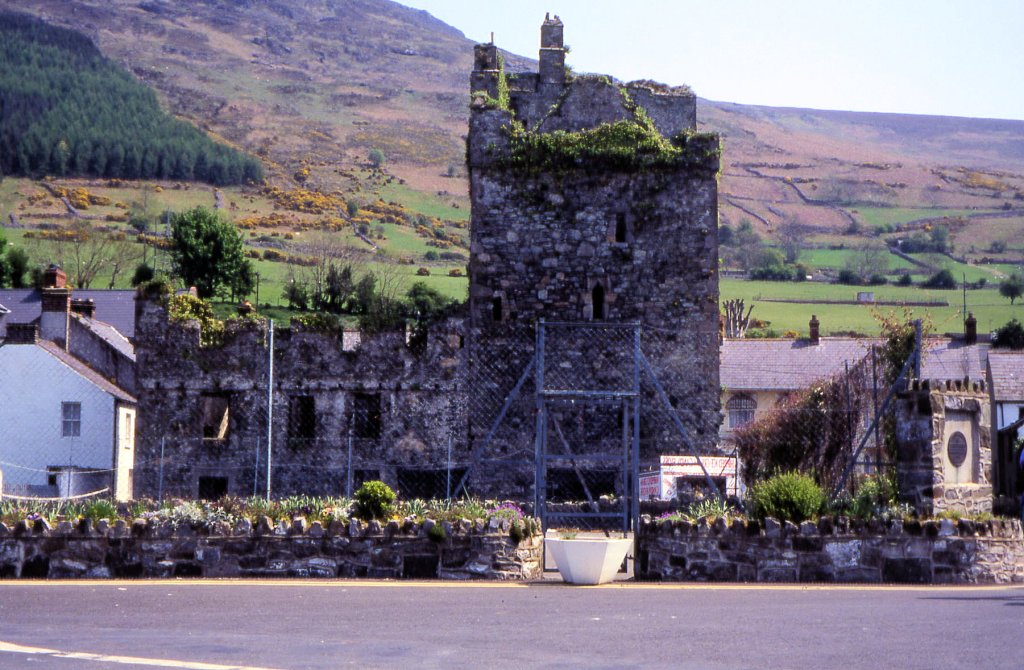
My story started in the border town of Newry, where I’d been watching television in a pub with some friends, about 1996-7 I reckon. A local farmer appeared on the screen, maybe on the local news, with an extraordinary tale. I can’t remember exactly what was said from this point in time, but I’ll try and paraphrase what I can recall.
He held up a finger and thumb about 2 inches apart, “It was about this height” he said, “the usual colours, green top and red trousers”.
The interviewer nodded, “I see” he said, “so, you were bringing the cattle home, there was a sudden blinding flash and then ….”?
“Well, I rushed up to where the lights had been but there was nothing there, nothing at all – but, “he continued, “the ground round about was all charred and in the centre was the wee suit. And this”. And he produced some charred paper from his pocket. “Fairy money”.
The pub had been quiet while he’d been talking: now all eyes were on the TV as we leaned forward the easier to see this remarkable money. A communal expiration of breath broke the tension and nods were exchanged among those who knew the habits of the leprechauns.

“Well,” said the old man in the corner “there’s proof enough. That’s fairy money to be sure. You’ve seen it with your own eyes on the TV. That leprechaun dissolved himself but the clothes didn’t burn, so, he’ll be back for them”.
“Wouldn’t you know they’d do something devilish” said my host Finbar. “Your wee man came in over the border and the price of a jar there is twice what it is here. But sure, we’ll go and have a look for him.

There are fairies at the bottom of virtually every garden in Ireland, especially in the area of the Mourne and the Cooley Mountains. Their habitats are easy to see – trees standing in isolation in the middle of fields, there because the farmer will not cut a fairy tree down because of the resultant bad luck that would come from such destruction. They seem forlorn but are held in warm affection even by the farmers whose planting they interrupt and around which he has to manoeuvre the harvesting machinery.
It’s not generally known that as well as their positive image of keepers of the pot of gold at the end of the rainbow, the negative side of leprechauns is their malevolent nature. They have been known to bring terrible misfortune to those who have injured their trees, dealing out punishments that range from breaking legs and tipping people down wells to causing the death of farm animals and (for minor offences) ensuring the bread doesn’t rise. They can be merely mischievous at times, and can cause the loss of a bicycle, or a shoe, or even make someone lose their way home from the pub. It all depends on the perceived offence.
The expedition to look for the leprechaun had to be postponed until Sunday to enable as many people as possible to take part. Time was also needed for individual families to get their supplies together, for there’s no point having a leprechaun hunt that’s not convivial. Picnic baskets had to be prepared, the refreshments purchased and carefully packed – soft drinks for the children, something stronger for the adults.
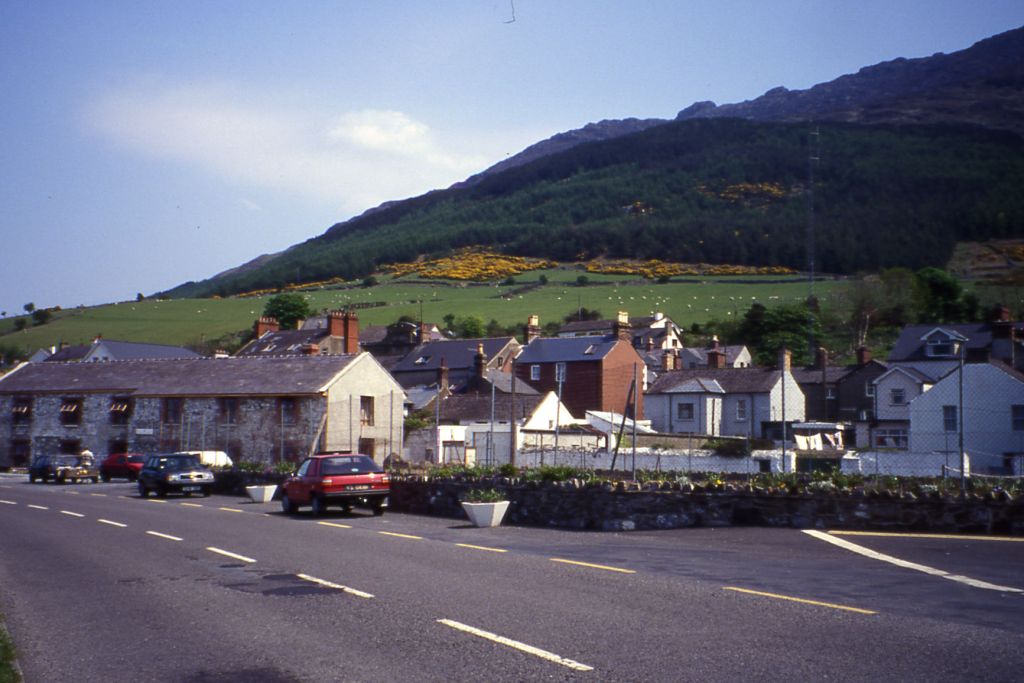
It was a happening in the best sense of the word. No one organized it, no one directed it. It just seemed that on Sunday afternoon a mass exodus took place from the town. Some travelled by car, some by bicycle, some on foot, crossing the border that divides Ulster from the rest of the island of Ireland at different points, to the confusion of the British Army surveillance helicopters overhead (this was before the Peace Agreement of 1998), as we all made our way towards the small coastal town of Carlingford, the area of the leprechaun sighting.
We joined the walking party which was in spirited mood well before we set off. Ballads and folk songs were sung as we ambled along. One or two had brought the flutes and pipes with them and there were a couple of fiddlers in the crowd who would provide the music for a ceili when we got there. Those who had already broached the Bushmills and the Guinness were in a rare mood to sing and occasionally had to be persuaded to rejoin the walk, as they were inclined to fall out and give solo renditions of “Sweet Sixteen” or “Danny Boy” as the spirits took them.
And then we were there. The spot where the wee man himself had disappeared in a puff of smoke. But we weren’t the first to arrive. The travelling people had got there earlier along with stall-holders, ice-cream sellers and hot-dog salesmen. The white heather that grows wild and which we had been walking on as we trekked across the mountain was now ‘Lucky White Heather’ and on offer at only 50p a sprig. Ice-cream was only twice what it normally cost and for an undisclosed sum, one of the gypsy fortune-tellers would divulge the true path to the leprechaun’s hideout.
But the most popular stall was that selling butterfly nets. Large ones, small ones, some that looked as though they’d already spent a summer shrimping, they were all grabbed up quickly. How else would you catch a leprechaun but with a butterfly net? Then in groups, for who would be alone on a day like this, we set off to snare the elusive one.

I gave up after about half an hour as the tantalising sounds of the ceili taking place at the bottom of the hill was calling me. I’d leave the wee man to the local people I decided, after all, he mightn’t like a foreigner being the one to snare him and I didn’t want a broken leg!
At ‘base camp’ more people had arrived and a grand party was a progress. The fiddlers had been joined by an accordionist and the dancing was in full swing. Groups of people had laid out their food and drink and the picnic was well under way. Now and then a shout from above would create a bit of excitement but as the afternoon wore on, the consensus was that the leprechauns had fooled us all again.
“He’s around, never you fear” said Finbar as we packed up to go home. “They can hide under a blade of grass when they like and as he hasn’t got a suit, he’ll be well hidden the day. Anyway, wasn’t it the grand time we had”?
“But we didn’t catch the leprechaun” I said.
He looked at me with a smile. “But, we got a brave bit of craic, and we had the singin’ and dancin’. Sure, the fairies gave us a grand day altogether”.

I’ve still got my butterfly net. It lives in my garden shed, a treasure from that day spent in the mountains that surround the little town of Carlingford in Ireland. I wonder if Joe Biden’s memories will be as vivid as mine as he looks back on his day in the village nestled in the Cooley mountains on the banks of Carlingford Lough. Somehow, I don’t think so, but I’m sure he had a wonderful time, because I remember Carlingford as being one of the most welcoming towns in Ireland, the country of a hundred thousand welcomes.

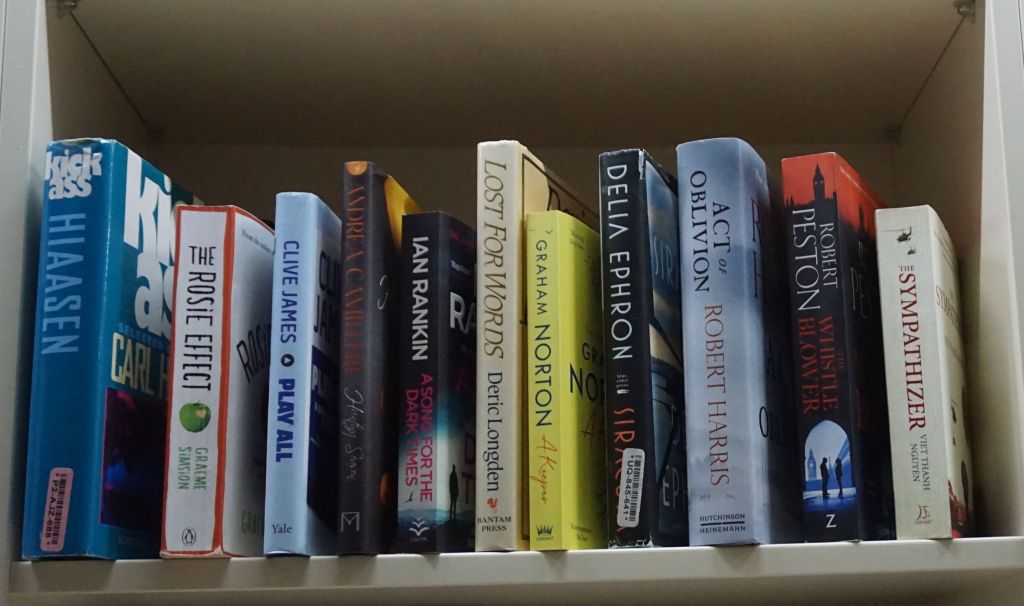

I thought I’d better try and post something before the year ends and then up popped Cathy at 746 books with her meme My Year in Books. I can never resist a quiz or a challenge, so I looked through some of the books I’d read this year and answered her prompts. Here is the result.
In high school I was Lost for Words (Deric Longden).
People might be surprised by Siracusa (Delia Ephron).
I will never be The Whistleblower (Robert Preston).
My life post-lockdown was Act of Oblivion (Robert Harris)
My fantasy job is The Assassination of Margaret Thatcher (Hilary Mantel)
At the end of a long day, I need The Rosie Effect (Graeme Simsion)
I hate being A Keeper (Graham Norton)
I wish I had A Song for Dark Times (Ian Rankin)
My family reunions are Play All (Clive James)
At a party you’d find me with The Sympathizer (Viet Thanh Nguen)
I’ve never been to The Salt Path (Raynor Winn)
A happy day includes House of Fun (Simon Hoggart)
Motto I live by: Kick Ass (Carl Hiassen)
On my bucket list is Hunting Season (Andrea Camilleri)
In my next life, I want to have Nada (Carmen Laforet)
If you feel like joining in, just do your own list from the prompts and let Cathy know.


The bells were ringing when I took this photo in Stresa in Italy, a few years ago, so it was a Sunday. In the garden it was silent but outside it was a typical Italian Sunday, the animated passeggiata, the queues at the gelateria, and the family groups, grandparents to babes in arms, all out to enjoy Sunday.

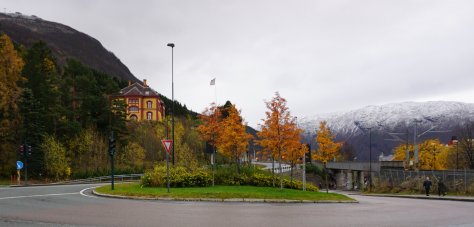
I didn’t know what to expect of this Norwegian town that saw so much horror during the Second World War, a horror made worse I suspect, by it being inflicted on a neutral country. I found that the war had left a deep scar on Narvik, at its most evident in the Museum devoted to the conflict and in the many statues dotted around the town.
Lying just 137 miles inside the Arctic Circle, and like Andalsnes encircled by mountains, Narvik is one of the world’s most northerly towns, but warm North Atlantic Currents and the mountains that shelter the town ensure relatively stable and high water temperatures even in winter. Unlike the Arctic Sea, the Norwegian Sea is ice-free throughout the year which means that Narvik’s naturally large port is always negotiable; this allows boats of virtually any size to anchor.

Although known to be inhabited since the bronze age little was known about the inhabitants of Narvik until the port was developed to receive the ore from Sweden’s Kiruna and Gallivare iron mines in 1883.
Today this town, grown rich on its iron-ore industry, is a quiet place, but it was the iron-ore plus the advantages of its deep sea port that were the cause of its being invaded and subjected to a blitzkrieg that flattened the city in 1940.

A brief history of Narvik’s role in the war.
Poorly armed, neutral Norway became the first victim of the war in western Europe in April 1940. Neither the Allies nor Germany respected Norwegian neutrality and both sides wanted to get their hands on the iron ore mined in northern Sweden and transported to Narvik. Both Britain and Germany were a also aware of the importance of the town’s deep port and both had been pressuring Norway’s strict neutrality since early 1940 when they realized how important this ore was to the war effort. By April, both sides were hastily preparing forces to land in Norway (Britain had earlier sought to interrupt the flow of iron ore by mining the sea lanes) but Germany got there first.
A full scale invasion was launched on 9 April 1940 and in a series of attacks, the Germans seized Oslo, Bergen, Trondheim and Narvik. Despite initial gains and losses on both sides, the poorly equipped Norwegian and Allied troops were outnumbered and outgunned and by 2nd May most had been withdrawn. Fighting continued at Narvik until Germany invaded France and Belgium, after which the remaining 24,000 Allied troops were evacuated for use elsewhere. Before they left, the troops destroyed the port and the railway and blanket bombing by Germany followed. The town was re-built after the war, which accounts for its somewhat bland appearance today, notwithstanding one or two outstanding buildings.

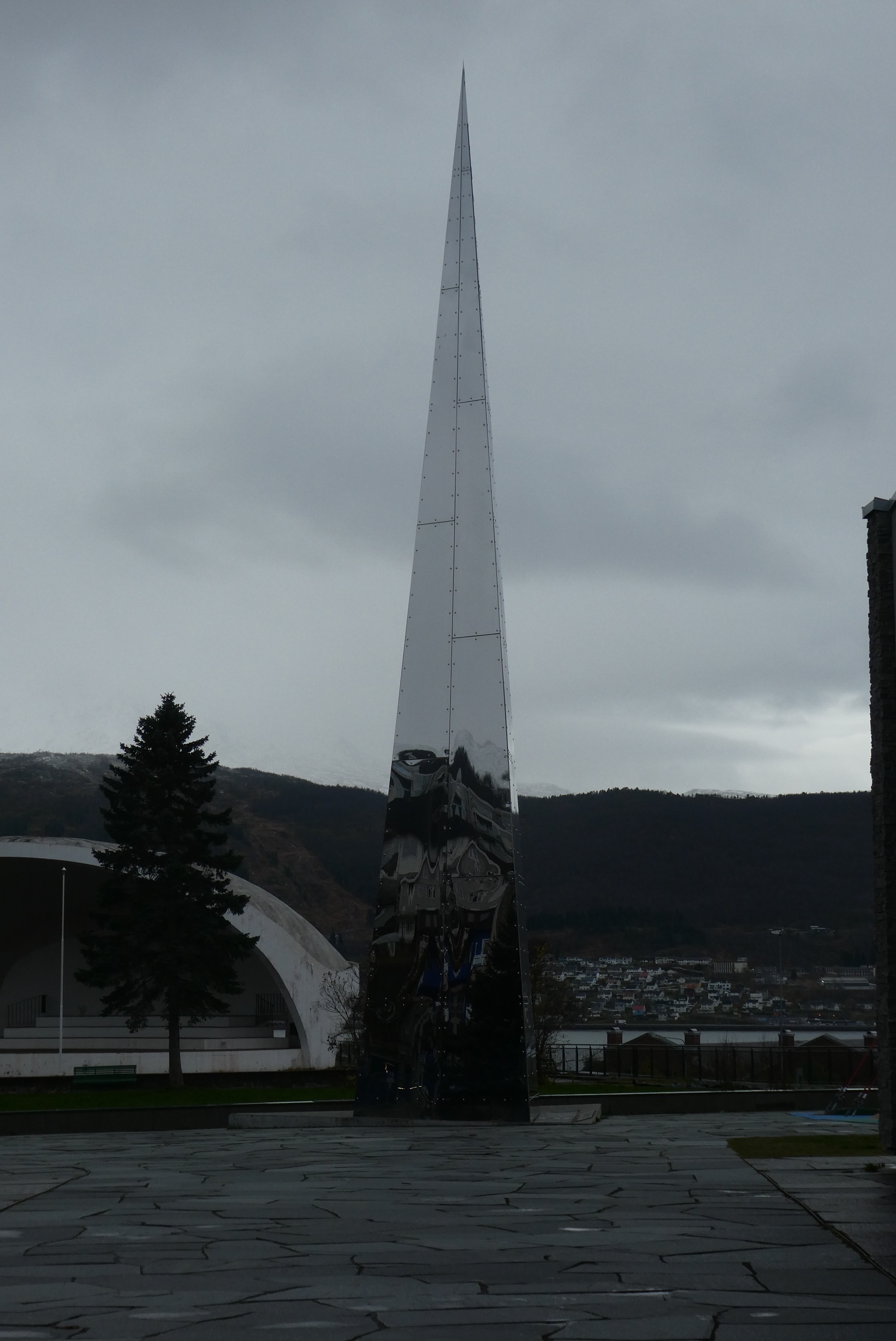
The above image is Narvik’s National Freedom Monument, a mirrored triangle by Espen Gangvik, a gift from the Norwegian government to mark the 50th anniversary of the liberation in 1945. The inscription reads “For peace and freedom. Thanks to our allies 1940-45. Thanks to those who fought.” Made of high polished steel it is 59 feet tall and is located in the town center near the War Museum. Two more views of the Monument are below.

Narvik would appear not to have a lot of English-speaking tourists – although all the people in the town with whom I had contact, spoke the language perfectly – because there was little information in English about the statues and monuments, and the inscriptions on the statues were only in Norwegian. In fact, the tourist office assistant apologised charmingly about this fact, saying with a smile, “We have a long way to go yet, but we are trying”!


I bought an guide book in English from the Tourist Office, and as it was raining outside I put it straight into my bag. Not until much later did I find that it wasn’t in English, but in Norwegian! So, I got most of my information by stopping young people in the street and asking them: they were fine with the translations but not so good with the history!

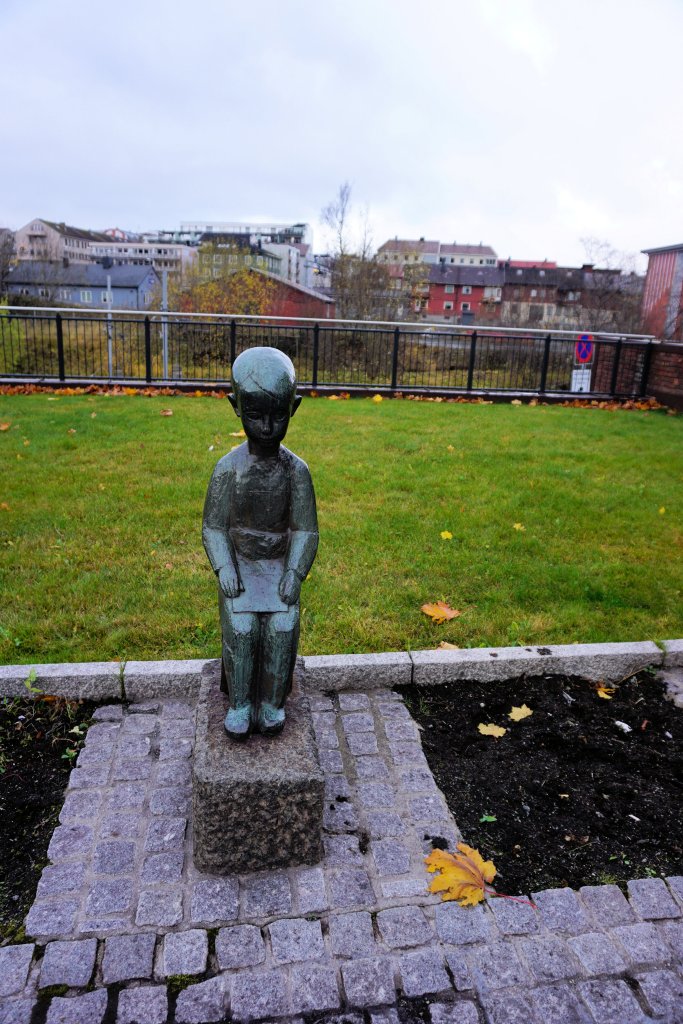
This is Lille Petter by Jozef Marek. I couldn’t find any information about this sculpture, but his face is haunting and I’d love to know the story.
And here are a couple of very modern pieces, make of them what you will. The white one really has me puzzled.


I wouldn’t like you to think that Narvik is only about past war history, there is a lot more to do there if one has time. The great disadvantage of a cruise is the lack of time allowed to explore the places one stops in, en route. Narvik is teeming with things to do and places to go – apart from the War Museum where you can spend half a day at least.

Bandstand in centre of town
What To Do in Narvik
There are City Bike Rides on electric bikes with a guide, city walks with or without a guide, climbing and trekking in the mountains which surround the town, and of course, the world’s most northernmost animal park, the famous Polar Park, opened in 1994. Home to Norway’s large predators such as bears, wolves, and lynx, as well as deer, moose, reindeer and muskox, all in their natural surroundings, you can easily spend a whole day there seeing and interacting with the animals in their near-natural habitat. Add to this, dog-sledding, husky wagonning, snowmobiling in the winter light and you can see that Narvik offers the visitor a tremendous amount of things to do.
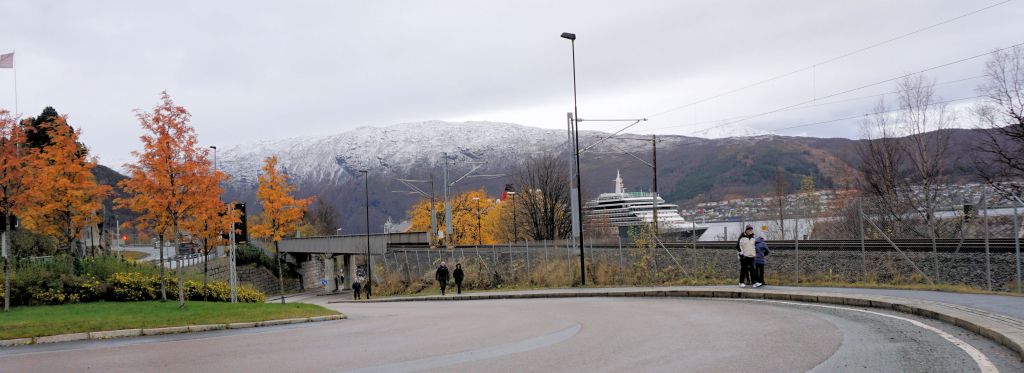
The very brave may fancy some ice-fishing, and best of all perhaps, the fantastic cable-car ride to the Narvikfjellet Restaurant at 656 m, which is the perfect starting point for hiking, skiing, northern lights hunting, snowshoeing and tobogganing. From the upper cable car station you get a panoramic view of the deep fjords, the historic iron ore harbour and Narvik city, which makes the cable car ride an experience in itself, much like the one I did in Andalsnes.

But I didn’t get to do any of these! I spent too long in the fascinating Museum of the War and then got so engrossed in chasing up the names of the artists who did the carvings that I missed my chance to visit the Polar Park. The weather turned nasty, it began to rain so the cable-car was out as the mountain top was covered in black clouds, so there was nothing for it but to adjourn to a warm coffee house and find some inner sustenance in the form of venison sausage and mash served with a local beer.
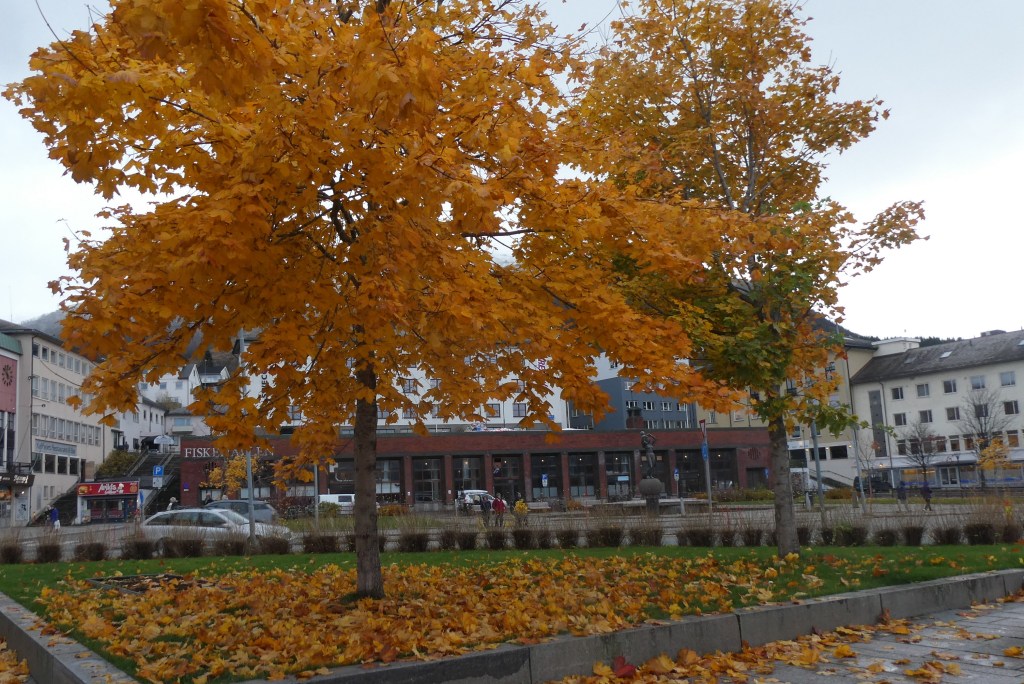
So, I’ll go back to Narvik one day, maybe in summer time, to do that cable-car ride, to get up close and friendly with a wolf, cuddle a husky and come face to face with a growling brown bear. And to get some better photographs on a day on which the sky won’t be black!

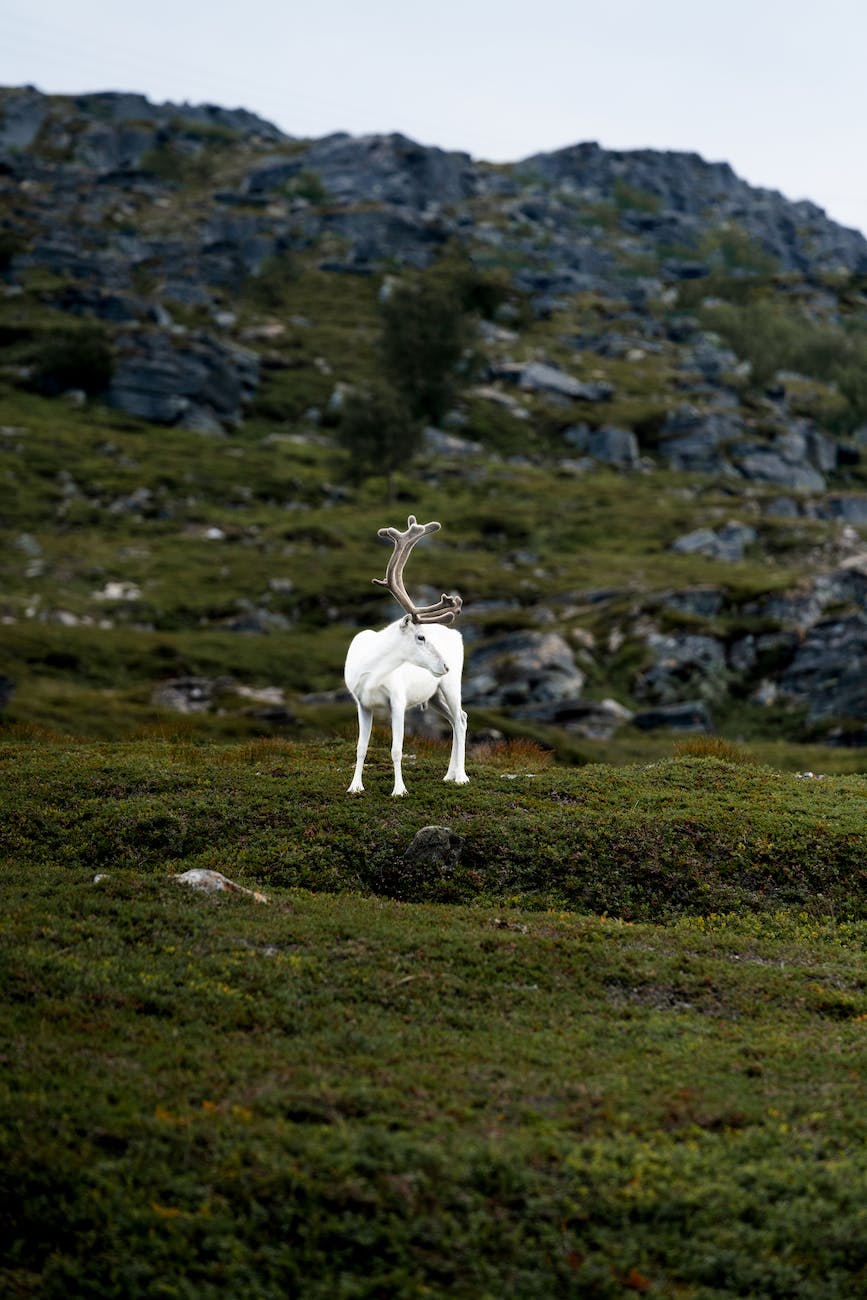
All photographs by Mari apart from the header one with the white deer, which is courtesy of Narvik Tourism.



 MARI'S TRAVELS WITH HER CAMERA