Last Thursday I watched The Third Man, possibly for the 4th time, the film that in 1999 was voted by the British Film Institute to be the film of the century: I have no argument with that decision. This British film noir starring Orson Welles, Joseph Cotton, Alida Valli and Trevor Howard has attained cult classic status in many countries, with its hypnotic theme tune played on the zither by Anton Karas, its atmospheric photography and its gritty screenplay.
Directed by Carol Reed from a Graham Greene script, the real star of this 1949 film is post-war Vienna. Kim Philby, the UK’s most famous espionage agent who worked for the Russians along with Guy Burgess and Donald Maclean, had been resident in Vienna in the early thirties and it was this that gave Graham Greene the idea for the screenplay – or so it is said. Greene’s Vienna reveals the murky post-war underbelly of the city, the squalor and black-marketeering and the ambiguities of living in that world – the world of Harry Lime played by Orson Welles in the film.

It portrays a burnt out Vienna in the immediate aftermath of the Second World War, a city divided into four zones governed by Britain, France, Russia and the USA, a city that created a world of criminals and black marketeers.
I found this other Vienna in a little museum hidden down a residential side-street in the Margareten neighbourhood – The Third Man Museum. The sole focus of this private exhibition which exists without sponsors and without subsidies is Carol Reed’s now-legendary film and Vienna’s pre and post-war history. It is the perfect antidote to the sugariness of Vienna’s palaces and pastries.

Gerhard Strassgschwandtner, 51, a ceramic artist and part-time city guide and his translator wife, Karin Hoefler, are responsible for this amazing collection. It is their consuming passion and they have designed the displays of 3000 original exhibits and documents and 420 cover versions of the Harry lime Theme in over fifteen rooms. Being unsubsidised they have to work at other jobs to support their passion so it is only open on Saturdays – and by appointments on other days.
Gerhard began collecting “Third Man” artifacts many years ago when he was trying to understand Vienna’s history. His idea at the beginning was to curate the history of Austria in the 1930s and 1940s, but as The Third Man encapsulates that history, the museum incorporates both Viennese history and the film. The museum is a trove of original film artifacts – from location stills and posters in foreign languages to clips of the stars and flea-market uniforms of Occupation soldiers. Dominating a corner of one room is a still functioning 1936 Ernemann 7b projection which was used when the film was first shown in Vienna and which is now used to play back a short film sequence. It was provided by Karin’s father who worked as a studio sound engineer. A whole wall is taken up with records that Anton Karas made of his moment of musical fame, including the zither with which he improvised the score as he watched the movie on the screen.

Original Camera used in Shooting of film 
There are over 2,000 original film posters, costumes, sheet music, sound and film recordings, autographed photos, zithers, CDs, books, and numerous cover versions of the music, including one from the Beatles. It even has Little Hansel’s cap!
The entrance to the museum is at street level and after you’ve spent time there, you are escorted outside and down the street to another building which houses, among other things, Trevor Howard’s original script and the actual zither on which the haunting theme music was recorded.

Interior of Museum 
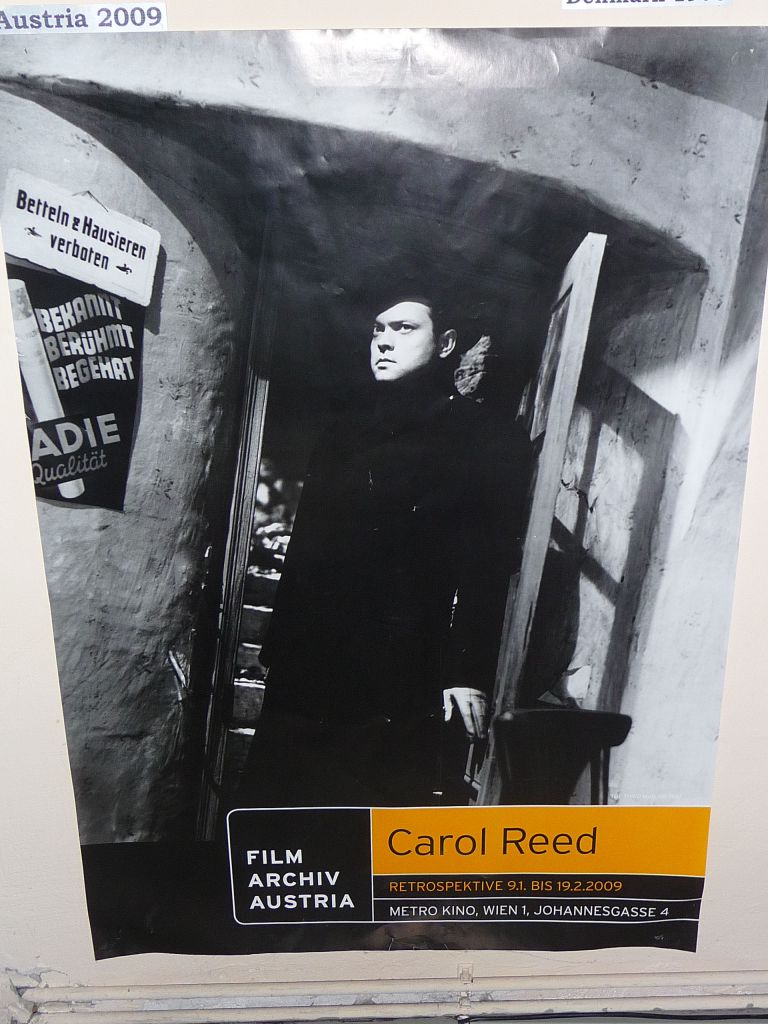
Iconic Poster 
Museum Entrance
But The Third Man Museum is more than a film archive. Fascinating though the exhibits are, the rooms in the basement housing pre and post-war artefacts which are less about the film and more about the period in which it is set, are just as interesting: more so to historians of the period. Here, in these rooms, the murky world of post-war Vienna with its four sectors a barrier to movement and free speech, the black marketeers and the hunger of citizens fearful of the future, are brought to life, setting the film firmly in time and place.
Revealed here are tales of the clerical dictatorship that preceded Hitler and of Vienna’s enthusiasm for Nazism. There are sections covering the early thirties when Austria was ripe for a takeover by Hitler, the days of the 1938 Anschluss and the Nazi annexation of Austria, and the reality of 1.7 million displaced persons in post-war Austria. One set of photographs shows a day in the life of a Vienna street: defended in the morning by Germans, open for shopping in the afternoon, then watching as Russians marched through at dusk.
The post-war is covered extensively by displays marking the occupation by American, British, Russian and French forces. Ration books, newspaper cuttings, photographs, and video recordings of survivors, bring this harsh period to life and as background to The Third Man it is an invaluable historical source.
Not many locals visit this museum: the dark days of the 1930’s are seldom spoken of in today’s Vienna which prefers to think of itself as the city of Strauss and strudl, waltzes and weiner schnitzel. The portrayal of the city in ruins after the war with a population mostly involved in smuggling, black marketeering, or just looking the other way, is not one that the good people of Vienna want to remember.
Gerhard was quoted in an article as saying ““Nobody teaches it in schools. The Americans invented a myth of Austrian innocence. It is not up to me to challenge that fiction. Graham Greene does it all in the film.”

You may not see the Museum listed in local guides: don’t think this is because it is not worth it. It is very much worth a good part of a Saturday spent in Vienna. On an average weekend you can still enjoy high-calorie kaffee und kuchen, spend time in palaces, churches and art galleries and nights at the opera – even take a drive through the Vienna Woods, but don’t miss The Third Man Museum.
It is closed at the moment but will open as soon as Covid subsides and things return to normal. When I visited in 2019 the entrance fee was €8.90 (€2 off with the Vienna Card) and it opened from 2.00-6.00pm on Saturdays (private visits can be arranged with the owner). Watch the website for news of opening. https://www.3mpc.net/
The Third Man Museum, Corner Pressgasse / Muehlgasse, Pressgasse 25, Vienna 1040
Tel: 0043 1568 4872 (Have the address with you. My taxi driver had to telephone for directions).
Precis of the film for anyone who hasn’t seen it.
Briefly, The Third Man is a story about writer Holly Martins (Joseph Cotton) who arrives in Allied-occupied Vienna looking for his friend Harry Lime (Orson Welles). Told that Lime has been killed in a car accident he attends his funeral where Major Calloway (Trevor Howard) informs him that Lime is a criminal engaged in the blackmarket sale of essential medicines and currently wanted by the occupying army and the police. Martins refuses to believe this, and is convinced that Lime was murdered, as does Harry’s girlfriend (Alida Valli), a refugee from the Russian sector who is fearful of being returned there. In the most iconic shot of the film he sees Lime’s face illuminated in a car’s headlights and there follows a cat and mouse game played out in the sewers of Vienna when Lime is hunted down by the army and his one-time friend, Holly Martins.
For those few who may not have seen it, the American version had to be altered for USA distribution as the powers-that-be felt they weren’t shown in a very good light!